Danni and Traci: portraits and colour in Second Life

Art Korner, March 2022: Dannika Dryke

Update, June 27th, 2022: Art Korner has Closed.

Wednesday, March 9th, 2022 saw the opening of an exhibition at Frank Atisso’s Art Korner Main Gallery that features images by two artists on a shared theme, but which are strikingly different in their style and visual impact.

The artists in question are Dannika Dryke and Traci (Traci Ultsch), who have split the gallery between themselves, with Danni’s images located on the lower floor, and Traci’s on the upper. The central theme is that of portraits, but the two styles offered by the artists are extraordinarily different.

Art Korner, March 2022: Dannika Dryke

On the lower level, Danni presents a series of large format images that might been seen as “traditional” modern portraits: the subject the centre of the image sans and background distractions, (largely) minimal visible posing, the colours clean and natural in tone. These are images that allow us to focus solely on the subject, drawing us into a study of their look and appearance and – oh, so gently – into a wider consideration of their nature as revealed (or imposed, depending on your viewpoint) by the pose they have struck.

These are picture that speak to the art of photography as form of modern portraiture that has largely taken over from the more formalised use of paint and canvas to immortalise an individual. With most images presented as head and shoulders / chest level, they reveal the avatar-as-a-person, someone who exists independently from any human operator behind the screen. Within the eyes, we can perceive life and mood, within the expression there lies emotion and and intelligence, within the choice of clothing a glimpse of character and nature. Such is the depth of life within each image, were the subject to lean out of the monitor and offer an introduction, it wouldn’t be in the least bit surprising!

Art Korner March 2022: Traci Ultsch

Life and vitality are also very much in evidence in the images presented by Traci on the gallery’s upper level – but in a very different way. Where Danni opts to go the more “traditional” route of portraiture, Traci leans into a more expressive presentation, the images swept with brush-like swirls of light or splattered with dark tones a-la Pollock or stamped with blocks of Warhol-esque colour to present bold statement of life in which the entire image speaks – subject, colour, contrast – to present not so much the individual, but the sense of mood / emotion, and presence / vitality of the subject.

These are images in which there is a lot going on, the very depth of elements drawing us into each picture, not so much to decrypt or understand it, but simply to flow with the narrative as it forms ideas and stories that are as unique and individual as the images and their colours.

Art Korner March 2022: Traci Ultsch
Taken individually, each of these displays of art has much to attract the eye; taken together, and they offer a marvellous juxtaposition and conjoining of style and content that is  wholly engaging.

SLurl Details

A Bamboo safari in Second Life

Bamboo, March 2022 – click any image for full size
Hi Inara! Sending my best regards to you – remember when I told you that we had a sim project on the go already? Well, finally we feel like it’s ready to be opened. – So I’m introducing “Bamboo”, and Yu and I would love if you came by. There’s a lot to explore and look at, scenic. Looking forwarding to having you as always as our guest 🙂 .

Jin Zhu (KidDreamz)

Thus was the invitation I received from Jin Zhu (KidDreamz) and Yu Zhu (JamaicasianBaby) to visit their latest region build which they have just opened to the public. I’ve always enjoyed touring their work, so as soon as time allowed, I jumped over to Bamboo to take a look – and it is an impressive build, richly oriental – as is Jin and Yu’s style – in content with much to see and photograph.

Surrounded by high mountains, the region is divided into three elements linked by bridges. The largest of these is home to the landing point, and sits as a formal gardens built around a large building with a temple-like feel to it that dominates the island’s plateau. Facing east, the building sits over water that has been carefully penned by the gardens around it, the water allowed to flow through pipes to a lower pool before which a meditating carved bodhisattva sits under a Torii-style gate, a miniature Zen garden adding to his journey towards Buddhahood.

Bamboo, March 2022

An aged peach tree faces the carved figure, occupying the heart of the landing point square, which is again surrounded on three sides by water. To the west sits more water drops away via a single fall to lower steps of the landscape – mortals will need to follow the paths and steps to descend to these lower reaches, sitting under giant willows and oaks, houses sitting under the shade thrown by board boughs and cooled by the passing waters.

Bamboo, March 2022

Northwards are two further islands that are richly diverse, mixing trees and paved walks, houses and temples, gardens and places to eat, torii gates and grassy walks, waterfalls and rocky climbs, stone bridges and rope bridges, snowy highlands and cliff-side shrines, and rickshaws and tuk-tuks – and a lot more!

Such is the beauty of the region, I really don’t want to waste time burbling on here, but rather encourage everyone who enjoys exploring Second Life to make sure Bamboo goes to the top of their list of places to see – and to allow themselves a decent amount of time to explore, as there is a lot to appreciate and a lot of little touches that can be missed if you’re not careful. Make sure as well, that you have local sounds enabled for the fullest experience.

Bamboo, March 2022

My thanks to Jin and Yu for the invitation, and also to Shawn Shakespeare for also poking me about Bamboo.

SLurl Details

2022 CCUG + TPVD meetings week #11 summary: mirrors! (maybe)

Aurora Falls, February 2022 – blog post

The following notes were taken from:

  • My audio recording and chat log of the Content Creation User Group (CCUG) meeting held on Thursday, March 17th 2022 at 13:00 SLT.
  • My audio recording and the video recording by Pantera (embedded at the end of this piece, my thanks to her as always for recording the meetings) from the Third-Party Viewer Developer (TPVD) meeting on Friday, March 4th, 2022 at 13:00  SLT.

These meetings are chaired by Vir Linden, and their respective dates and times can be obtained from the SL Public Calendar.

This is a summary of the key topics discussed in each meeting and is not intended to be a full transcript of either. However, the video does provide a complete recording of the TPVD meeting, and timestamps to the relevant points within it are included in the notes below.

Available Viewers

[Video: 0:35-3:15 + notes from CCUG]

  • The Performance Floater project viewer updated to version 6.5.4.569531, on March 18th. This viewer includes the Lab’s implementation of automatic adjustments to the viewer to try to maintain FPS. Monday, March 21st: Appears to have either been rolled back, or update to official viewers list was premature.

The list below reflects the rest of the currently available official Second Life viewers:

  • Release viewer: version 6.5.3.568554 – formerly the Maintenance J&K RC viewer, promoted Monday, February 28 – No Change
  • Release channel cohorts (please see my notes on manually installing RC viewer versions if you wish to install any release candidate(s) yourself).
    • MFA RC viewer, version 6.5.4.569309, issued on March 15.
    • Performance Improvements RC viewer version 6.6.0.569349, dated March 14.
    • Lao-Lao Maintenance RC viewer, version 6.5.4.569191, issued on March 11.
  • Project viewers:
    • Mesh Optimizer project viewer, version 6.5.2.566858, dated January 5, issued after January 10.
    • Legacy Profiles viewer, version 6.4.11.550519, dated October 26, 2020.
    • Copy / Paste viewer, version 6.3.5.533365, dated December 9, 2019.

General Viewer Notes

  • It is hoped that those using the official viewer and who are in the Performance Improvements RC cohort (or opt to manually install this viewer) will see noticeable performance improvements in terms of frame rates and fewer viewer stalls, when compared to previous SLV releases.
    • The RC has already seen some new bugs raised against it, and these are being worked on (e.g. BUG-231936).
    • It is still hoped this will be the next promotion to de facto release status, but this hinges on bug fixing and a decision on whether or not to release MFA as a dedicated viewer.
    • It is acknowledged that the work in this viewer and the Performance Floater project viewer needs to be reconciled with the work carried out by Beq Janus of the Firestorm team, whose code will be in the upcoming Firestorm 6.5.3 release.

MFA Viewer

  • Summary:
    • Multi-factor authentication (MFA) is coming to the viewer.
    • As MFA is implemented in the official viewer, there will be a “grace” period to allow TPV adopt the viewer code.
    • During this period, users will be able to access SL on TPVs as they currently do now, regardless of whether or not they have opted-in to MFA.
    • After this “grace” period, all users who have opted in to MFA will be required to authenticate themselves when using any viewer to log-in to Second Life (with the usual 30-day period of valid authentication, as per secondlife.com MFA), but those who have not opted-in to MFA will see no difference in their log-in steps, regardless of whether the viewer they are using supports MFA.
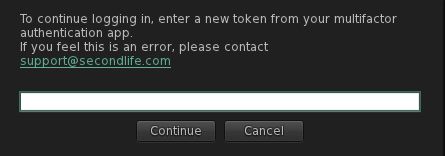
  • The RC version of the viewer, version 6.5.4.569309, was released on March 15th. This appears to have an authentication bug – BUG-231938 – related to how pass codes are parsed by the viewer.
The MFA RC viewer prompts those who have opted in to SL’s MFA capability to provide an authentication code / key (once every 30 days) in order to log-in to SL
  • [CCUG meeting] The decision has yet to be taken on whether to maintain MFA as a dedicated viewer update or possibly merge it with another RC viewer (e.g. the Maintenance RC) to streamline the number of active viewer versions and the QA process.

Mirrors! (Maybe)

[Video: 4:05-16:29]

  • In-world mirrors that reflect that reflect their surroundings – including avatars – have long been a requested capability in SL. Over the years, various attempts have been made to fake mirrors, such as using Linden Water and static photographic sets, though to “cheating” using projectors (albeit sans reflecting avatars) and the old means of duplicating sections of a build and inverting it so it appears to be reflections on a polished floor.
  • In 2014, Zi Ree of the Firestorm team developed a means of generating real time reflections, including avatars, within the viewer, and produced a video on the idea. At the time, due to various reasons (most notably the impact on performance), LL decided mirrors could not be supported, which has tended to remain their position since.

  • However, Mojo Linden (VP of Engineering) is now prepared to consider possibly enabling some implementation of mirrors in SL, although how this might be done is open to discussion, particularly as the potential for a massive performance impact is still very much a concern.
  • Suggestions made by Mojo on how this might be done included:
    • To have user-initiated “mirrors” (that is, there are “mirror” objects in a space, but the rendering of their “reflections” is only triggered for a viewer based on something like their proximity to the object).
    • To possibly limit mirrors in terms of what they reflect (such is things that are directly in front of them, rather than much further in the background or only render avatars with the background left white.
  • In terms of “triggering” mirrors, there was discussion on whether this should be automated or with user-controlled input:
    • Automated within the viewer:
      • The viewer detects the “mirror” object based on proximity, per above & renders the reflections. Discussion on this included the ideas that there could also be a Graphics preference option to completely enable or disable all mirror rendering by the viewer and a slider / drop-down to set the overall quality of the rendering of reflections (as is we already have for graphics quality (slider) and water reflections quality (drop-down)).
      • Automated via LSL (setting / unsetting flags on objects that trigger “reflection” rendering) or possibly using the interest list.
    • User controlled input: reflections are toggled in a manner similar to Media On A Prim: the user touches the “mirror” surface  and “reflections” are rendered only by their viewer – although this seems clunky / immersion breaking, even if it is an approach taken by games such as Cyberpunk 2077.
  • One suggestion from those at the meeting was to take the Linden Water planar reflections (which are rendered anyway, whether the Linden Water is visible or not) and render them at a lower resolution in screen space.
    • Using the Water planar could help with things like reflective floors, mirror walls, etc., although screen space rendering in SL can be subject to clipping.
    • Screenspace reflections (SSR) have appeared in some TPVs – like Firestorm and Niran’s Viewer, but how well these work is open to question – for Firestorm, there were issues with the release of materials that resulted in the code being removed.
    • One  suggestion make for limiting performance impact was to limit the viewer to rendering only the nearest mirror surface and either use SSR for the remaining mirrors or, don’t render them at all
  •  A lot depends on potential use-cases, and whether expectations can be managed – as there is a potential that any solution will not be able to meet all requirements, simply because of the risk of performance impact.
  • Everything on mirrors is purely at the discussion stage right now and there is currently no formal project – and indeed, there might never actually be any project to implement mirrors; however, that the topic is being discussed by LL marks a significant shift in thinking.

In Brief

From the Content Creation Meeting

A lot of general discussion on a number of topics, none of which is currently the focus of any Lab project, including:

  • Using physics to allow more “wiggling parts” – such as ears, etc., – on mesh avatars: a lot of this would come down to positioning the most suitable bones and rigging to them.
  • Controlling / ordering joint position overrides (BUG-231904 / BUG-231579): this is currently handled by mesh UUID – which can be random from the POV of the user. However, trying to order using the order things are added to an avatar could lead to race conditions, as the outfit system doesn’t have any concept of prioritising attachments, therefore a more structured schema – such as adding a specific field that could be set for objects – but even this could have conflicts and also likely to be a non-trivial piece of work.
  • Expansion of supported upload formats for mesh (e.g. glTF) and use of techniques such as PBR, with a stated preference (from creators) for SL handling of reflections / reflectivity to be overhauled before any attempt is made to add PBR support.
  • Expanding Bakes on Mesh to support materials – which as noted over the last several meetings would require a significant update to the Bake Service, which LL is not planning on doing in the foreseeable future.
    • A further complexity here is managing the proper ordering of the additional maps. Example: some users may want their shirt partially blended with their bra / vest normal; others might want their shirt to cover their bra /vest normal map whilst others may not want their bra / vest to have a normal at all; so how can these three states be collectively handled in terms of layering?
  • Further discussion on terrain – which is the subject of a project for 2022, although there is some split about increasing the texel density / increasing the resolution/repeats (and thus reducing the blurriness) + allowing normal maps, or allowing more in the way of mesh terrain (heightmaps, etc.).
    • Another request for terrain has been to allow greater compositing of textures (e.g. for more graduation in changes of textures by height or offering greater depth to terrain by layering-up textures.
    • A further request has been to allow terrain painting – e.g., being able to “paint in” dirt patches on grass, etc.
  • A request for a scripted means to apply EEP settings to oneself beyond the inventory Apply to Self such that (as an example), you buy a pair of sunglasses or tinted goggles, and they apply EEP setting that make your surrounding look darker. This would require a means to read and apply the contents of an object,

From the TPVD Meeting

  • [Video: 16:31-27:45 and 28:58-42:30] A broad-ranging discussion on the viewer build process and tool chain, moving to more recent graphics APIs (the likes of Vulkan and Metals are under consideration), resource utilisation within the Lab, future work on improving the viewer’s threading capabilities, etc.
    • Outside of the ongoing (/periodic) tool chain updates and graphics API investigations, none of discussion points are subject to any immediate / near-term project.
    • It was again pointed out that a issue in considering replacements for / alternatives to OpenGL is that a lot of users run older PC harder which is incapable of running more recent APIs like Vulkan.
    • As most of which will likely only be of interest to viewer devs, please refer to the video.
  • [Video 42:44-43:28] ARCTan project and Legacy Profiles:
    • Initiated in 2020, ARCTan is an attempt to re-evaluate both avatar rendering costs and the cost of in-world scene rendering, with the initial focus on avatar rendering cost / impact, itself running on two tracks:
      • Developing a new UI element in the viewer pull together information from various menus / debugs to display useable information on avatars / attachments that are heavy in rendering cost, and what can be done.
      • Gathering data with the intent to revise and improve the actual formulas used for calculating avatar complexity, making them more relevant.
    • ARCTan effectively went into hibernation as a singular project in the latter part of 2021, and is currently awaiting development bandwidth.
    • [Video 45:09-46:05] One of the issues with ARCTan was being able to pull together the data in a fine enough detail to make any UI used to make changes worthwhile. Beq Janus has tackled a lot of this work for the upcoming Firestorm release, and this is liable to be fed into projects like ARCTan and the Lab’s own work in improving viewer performance and making options visible to users.
    • Legacy Profiles is a project to move avatar profile information back into the viewer and away from using web pages. There is project viewer (see the list at the top of this article), but it has been awaiting some back-end server work to be completed, and it is hoped that the project will be moving forward “Soon™”.
  • [Video: 43:54-44:44] CEF: Chrome Embedded Framework (CEF) is the API used to manage media in SL. The SL version is now running several releases behind the current CEF version, and while a need to update has been noted, it is liable to require some significant work (e.g. updated UI elements as well as under-the-hood changes).
  • [Video 46:05-end] miscellany text conversations, mostly on the topics noted above.

Spring at Nelipot in Second Life

Nelipot, March 2022 – click any image for full size

I dropped back into Nelipot, the Homestead region held and designed by Shawn Shakespeare (SkinnyNilla) and Lien (Lien Lowe) to both catch it in its Spring 2022 dress and to give the Firestorm implementation of the 360º snapshot floater, which will soon be coming up for release. Not because the implementation really needed testing – Firestorm look to have adopted LL’s code pretty much “as is” – but just to satisfy myself; plus – and quite frankly, Nelipot deserves to be seen in its full glory.

For its spring 2022 look, Nelipot moves from what had been something of a North American lean to something perhaps a little more European in tone.

The landing point sits on one of two small islands that brace the main land mass for the region. Sitting to the south-west of the region, this landing point island sits in the jaws of the main land area, separated from it on either side by the waters of an inlet that cuts its way into the region. To reach the rest of the setting, people can either swim or – as might be easier – jump into the pedal boat moored at the island’s little dock and paddle across the bay (don’t double / single-click TP off of the boat when you get to shore or you’ll be returned to the landing point; instead, stand and wade ashore).

Nelipot, March 2022

The core of the main part of the island is given over to a small farm that appears to be split between growing grapes and raising livestock. Given its Tuscan look, the farmhouse and the vines suggest this might be somewhere in Italy – but that’s for visitors to decide.

Across the bay, and bracketing the farmhouse, are two windmills sitting at the end of the finger of land. The wharf and barn here suggest the farm might supplement its income by offering tourists the chance to go fishing out on the surrounding waters, or simply take a kayak or rowing boat out onto those same waters.

To the north-west lies the second little island, another low hump of land rising from the waters, this one the home of an old shack, now used as another fishing retreat. Across the water from it and back on the main island, what might be a holiday cottage lies nestled on the far side of a low rise which separates it from the farm.

With a hilltop café providing a picturesque view across the water to the farmhouse and several places to sit, the pedal boats available for paddling around on the waters in the bay and around the island, and plenty to photograph and explore in-doors and out, Nelipot once again offers a lot to appreciate and enjoy.

Nelipot, March 2022

SLurl Details

  • Nelipot (Safe Haven, rated Moderate)

SL19B: theme, music festival & performer applications


June 2022 will mark the 19th anniversary of Second Life opening to public access – and as we’ve all come to expect, a portion of the month will be given over to celebrations at the Second Life Birthday (SLB).

On Thursday, March 17th, Linden Lab officially announced the 2022 Birthday event and it’s theme, and also opened applications for the (now traditional) Music Fest that kicks-off the official celebrations, and also applications for those wishing to perform during the celebrations as a whole.

Dates and Theme

This year the SLB festivities will open on Thursday, June 16th, with the Birthday regions open through until Tuesday, July 5th, and the main celebration events taking place from June 16th through to Sunday, June 26th, 2022. The theme this year is Steampunk.

via Linden Lab

Music Fest

Now in its 8th year, the Music Fest has become the traditional opener for the official celebrations, and this year it will provide three days of live music entertainment between Thursday, June 16th and Saturday, June 18th inclusive.

The Lab is seeking at least a dozen performers, both veteran Second Life musicians and those new to the scene, to provide the music for the festival. Full details on requirements / policies can be found in the Music Fest application form; however, and in brief:

  • Previous sets at the festival run to an hour in length including any required set-up time.
  • There is a 350LI allowance for props and rezzable items for your show, which must be set-up as a part of the performance time.
  • Accepted acts are requested to be at the venue one hour ahead of their appearance, in order to complete final check-out with SLB personnel to ensure everything is ready for their set.
  • There is no payment for participation – however performers will be permitted the use of tip jars, subject to the festival policy notes.
  • All performances and song lyrics must be G-rated.
  • Applications will close on Sunday, April 10th, 2022.

Performer Applications

Linden Lab are looking for all types of performers to join the week-long festivities taking place between June 19th and June 26th, inclusive. DJs, live performers, dance troupes, particle performers and more are welcome to apply.

Performers for the week are asked to complete the official performer application form. Note that applications must be made by the end of Sunday, May 8th, 2022.

Related Links

Questions on the real and the Unreal in Second Life

Vibes Gallery: Axiomatic Clarity – RealUnreal
What is it to take a picture?
I ask that to myself and I let that question absorb me subconsciously, continuously as I render what I see into a frame so that elements of composition, light and background fuse in a balance in dependent from the subject.
The subject means nothing. 

– from the introduction of RealUnreal

What is the real nature of a photograph? Once upon a time, cameras and photographs were a means to freeze a moment in time; a memory, something that might become an instant marked in history or a simple sharing of a family activity, a moment of friendship or love or something else.

Vibes Gallery: Axiomatic Clarity – RealUnreal

Today, however, almost everyone has a camera at their fingertips. From the advent of the basic point-and-click “instant” camera through the rise of digital camera to the merging of camera and cellphone / smartphone, we have all become photographers. And with the increase in digital editing software readily accessed through ‘phone and computer, we have all become self-styled digital artists. Further, such is the skill we have developed in using such post-processing editing tools that it perhaps prompts the question: how much of an image remains true – remains real – to its subject, and how much is “unreal”, the result of the photographer imposing their subjective interpretation of their subject through cropping, light and colour adjustments, changes in focus, and other editorial techniques?

These are some of the questions posed in  a new exhibition of images  by Axiomatic Clarity, gathered from both the physical world and Second Life, which is currently on display at Eviana Robbiani’s Vibes Gallery. The title of the exhibition is RealUnreal – which itself references the fact the images offered are from both the physical and virtual realms.

Vibes Gallery: Axiomatic Clarity – RealUnreal
Although the methodology is a good compromise it still does not grasp what I am looking at. Do I know what that is, do I like how it manifests, do I let it change myself?

– from the introduction of RealUnreal

Across the three gallery halls and the spaces between, Axiom presents a marvellous collection of predominantly black-and-white or monochrome images, with two of the halls focused on images from the physical world, and one on images from Second Life. They are all evocative; all have a story to tell. They challenge us to see them as images offered for display and how the artist arrived at their finished appearance; that is, what is the reality of their focus and content, and how much is “unreal” – the result of that subjective imposition placed on each by the artist through the editorial process? Indeed, what does each say about the artist’s approach to photography and developing a balance between the subject of each image, and the story the photographer feels drawn to tell?

Is it possess[ion], is it obsession, is it a form of growth?
The deeper to discriminate at a deeper and abstract level, a level where the photographic language borders the inexpressible and even replaces the subject entirely … and I tentatively find that balance.

– from the introduction of RealUnreal

Vibes Gallery: Axiomatic Clarity – RealUnreal

These are complex questions, worthy of being pondered given they are central to the photographer’s approach and execution of their art, with RealUnreal mixing fabulously expressive we have a complex, visually compelling selection of art that draws us into the questions of “reality” vs. “unreality” and the drives that govern a photographer in the creation of their art.

SLurl Details