Logos representative only and should not be seen as an endorsement / preference / recommendation
Updates from the week ending Sunday, April 24th, 2022
This summary is generally published every Monday, and is a list of SL viewer / client releases (official and TPV) made during the previous week. When reading it, please note:
It is based on my Current Viewer Releases Page, a list of all Second Life viewers and clients that are in popular use (and of which I am aware), and which are recognised as adhering to the TPV Policy. This page includes comprehensive links to download pages, blog notes, release notes, etc., as well as links to any / all reviews of specific viewers / clients made within this blog.
By its nature, this summary presented here will always be in arrears, please refer to the Current Viewer Release Page for more up-to-date information.
Note that for purposes of length, TPV test viewers, preview / beta viewers / nightly builds are generally not recorded in these summaries.
Official LL Viewers
Release viewer version 6.5.4.570575 – formerly the Lao-Lao Maintenance RC viewer, promoted Monday, April 18 – No change.
Perpetuity, April 2022 – click any image for full size
The last time I visited Camis and Tamara Sierota’s Full region of Perpetuity, it was dressed as elven retreat caught in the snows of winter. Now, with the northern hemisphere welcoming spring, time and the region’s design have moved on, and visitors dropping in will find themselves in a summery touch of Smalltown USA.
A visit commences on the waterfront of a little harbour in the north-east of the region, a place with a couple of wooden piers, a fish market and oyster shop and places to enjoy a glass of beer or a very British custom of fish’n’chips. It’s a location that brought a smile of recognition to my face as moored at the piers lay the Shield Class 2 sailing boat by Burt Artis that helped get me started with sailing in SL and the outboard-powered Shippe and Saille Harbour Master, a dory hulled cruiser I reviewed a couple of years ago.
Perpetuity, April 2022
The harbour fronts a broad surfaced road that encompasses the setting, passing all the way around the coastline and linking the bulk of the land with a small island sitting down to the south-west. This road offers an obvious means of exploring, and those who wish can grab a bike from the rack outside the harbour master’s office and use their pedal extremities to follow it (or if preferred, pull a wearable bike from inventory and do the same).
Taking the road south offers a route past the open beach with its single pier to one side of the road, and a small industrial area with motor garage and warehousing on the other, to where a short incline runs up to the local church and school. Here the road turns to the right to cross the waters on a single-span bridge to reach the aforementioned island and the house that occupies it. However, just before the bridge there’s a junction with a second road which cuts diagonally across the land, again following the sands of a beach that faces the island across the channel.
Perpetuity, April 2022
Go north from the harbour master’s office, and the road quickly turns left to parallel the north beach westwards, passing out of the town before swinging to a more southerly route and past a farm with lands dissected by the road which cuts across the region, before reaching the second bridge crossing to the south-west island.
The farm comprises two large barns, one of which has been converted into a simple home whilst the other interestingly combines its expected role in keeping animals and farm equipment with that of a home-made bar serving pie and cider! A hitching post outside of this barn offers the means to make your way around / through the region on horseback, passing more horses penned in the corral behind the barn.
Perpetuity, April 2022
As with all of the perpetuity builds, this one is packed with a lot of detail; all of the buildings are open to the public and houses, workshops, cabins, and so on have décor and fittings that bring them to life. The school house comes complete with desks and playground, the local church has been neatly converted into a an artist’s studio, the beaches offer numerous places to sit and pass the time, and more can be found in the fields and gardens.
I admit to particularly liking Roady’s, sitting just off the road cutting through the farmlands. It’s a building by DRD I’ve frequently seen in my travels through SL, often taking the form of a generic bar (or equally as often, a record shop). Here it fulfils its stated purpose: a biker’s bar. With machines propped up on their kickstands before it, the Harley Davidson logo emblazoned on an outside wall and its run-down look, there is something oddly appealing about the bar that just further underlines the Smalltown authenticity that exists throughout the build.
Perpetuity, April 2022
There are also touches within this build that hark back to my first visit to Perpetuity in July 2021. There’s the beach pier, one of the barns and a couple of the outdoor seating spots, together with one or two of the vehicles that give a sense of connection between this iteration of the region and the July 2021 version.
As always, Perpetuity offers a lot to see and appreciate during a visit. Those wishing to use props for photography can obtain rezzing right by joining the local group; as auto-return appears to be off, do be sure to clean-up when done. Photos are welcomed in the Perpetuity Flickr group.
A study outlining priorities in US planetary science for the next decade was published by the United States National Research Council (NRC) on April 19th. Entitled Origins, Worlds, and Life: A Decadal Strategy for Planetary Science and Astrobiology 2023-2032, the report is part of a 20-year history of the NRC offering periodic roadmaps for America’s space exploration strategies, during which time many of the recommendations made have gone on to shape NASA’s activities and goals.
The next decade of planetary science and astrobiology holds tremendous promise. New research will expand our understanding of our solar system’s origins, how planets form and evolve, under what conditions life can survive, and where to find potentially habitable environments in our solar system and beyond.
– from the introduction of the 2023-2032 Decadal Survey
The report – running to 522 pages – includes input from science organisations, universities and research institutions from around the world. Within it, the committee has identified twelve priority science questions that should be the focus of NASA and America’s work in space. These are divided into three categories: Origins, Worlds and Processes, and Life & Habitability, with each category including a total of 12 major areas of investigation, with the committee outlining the robotic and crewed mission proposals that NASA should consider undertaking in support of these investigations.
This report sets out an ambitious but practicable vision for advancing the frontiers of planetary science, astrobiology, and planetary defence in the next decade. This recommended portfolio of missions, high-priority research activities, and technology development will produce transformative advances in human knowledge and understanding about the origin and evolution of the solar system, and of life and the habitability of other bodies beyond Earth
– from the 2023-2032 the Decadal Survey
Highlights of the survey’s recommendations include:
Flagship Missions
Flagship missions are the “big ticket” missions for NASA. At the time of the last Decadal Survey (2011), the flagship missions were identified at the Mars 2020 mission, Europa Clipper, and the Uranus Orbiter and Probe (UOP) – the latter ultimately losing out to the other two.
This being the case, UOP has been awarded the highest priority within the 2023-32 survey. It would deliver an in-situ atmospheric probe into Uranus’ atmosphere and conduct a multi-year orbital tour to study the ice giant and its system of moons, with the objectives including the study of Uranus’ interior, atmosphere, magnetosphere, satellites, and rings.
A drawing of the proposed Uranus Orbiter and Probe.
Due to the need to utilise planetary fly-bys (gravity assists) to reach its destination, UOP would not launch until the early 2030s, when planetary alignments would facilitate the needed assists, with the primary science mission around Uranus commencing in the mid-2040s.
A second Flagship mission identified by the survey as worthy of consideration by NASA is the Enceladus Orbilander. If funded, this mission would launch in the late 2030’s sending a compact robot vehicle to orbit Saturn’s icy moon of Enceladus, passing through the plumes of water we know to be escaping the moon’s subsurface ocean as a result of gravitational interactions with Saturn. The aim of the mission is to to sample and study the plumes before making a landing on Enceladus in the early 2050s to search for biosignatures either in the surface ice.
New Frontier Missions
Regarded as “medium priority” missions, the New Frontier missions identified in the survey for further / continued development are designed to increase our understanding of the major and minor bodies in the solar system. The cost of such missions is capped at US $1.65 billion, with NASA likely to select two new missions from the crop of recommendations. They comprise:
Europa Clipper: a former Flagship mission, now downgraded to reflect its advanced status, this is due for launch in October 2024. It will arrive in orbit around Jupiter where it will fly by Europa multiple times, investigating the moon’s habitability and help identify a potential landing site for a future Europa Lander mission.
A Ceres sample / return mission to follow-up on the Dawn mission’s orbital survey of the asteroid Ceres.
A comet sample return mission.
A network of lunar landers to collect geophysical data.
A Saturn orbiter mission to follow-up on the Cassini mission.
The Oceanus Titan orbiter, proposed but not selected as a 2017 Frontiers Mission.
A Venus “in situ atmospheric” mission – possibly a vehicle to deliver a balloon that would drift through the upper reaches of Venus’ atmosphere.
A Triton (Saturn’s largest moon) orbital mission.
Mars Exploration
For the first time, a Decadal Survey identifies Mars as a dedicated target for exploration, specifically underling two missions:
The long-planned Mars Sample Return mission, which has had its share of ups and downs, and has yet to be properly settled upon by NASA.
The yet-to-be-defined Mars Life Explorer (MLE) mission designed to look specifically for signs of current microbial life on Mars and to pave the way for future human missions to Mars.
[A] sample return will provide geologic materials that are not represented among Martian meteorites and whose volatile, organic, and secondary mineral composition have not been altered by impact… In addition, sample return will allow for future analyses by instruments and techniques not yet developed. As has been the case with the Apollo samples from the Moon, future analyses are expected to yield profound results for many decades after sample return.
– from the 2023-2032 the Decadal Survey
The survey calls for cohesion between robotic and human missions is a priority for future missions to the Moon and Mars. Credit: NASEM
Lunar and Human Exploration
Unsurprisingly, the survey supports NASA’s lunar ambitions, identifying the need for robotic missions in support of a human presence on the Moon, the establishment of an “Artemis Basecamp” in the south polar region of the Moon. This also recommends much more coordination for human activities on the Moon to be linked with human missions to Mars.
Planetary Defence
A call for the development and improvement of our abilities to detect and track near-Earth Objects (NEOs) that may come to pose an impact threat for Earth, and the means to mitigate such genuine threats when identified and confirmed.
The highest priority planetary defence demonstration mission to follow DART and NEO Surveyor should be a rapid-response, flyby reconnaissance mission targeted to a challenging NEO, representative of the population of objects posing the highest probability of a destructive Earth impact (~50-to-100 m in diameter). Such a mission should assess the capabilities and limitations of flyby characterization methods to better prepare for a short-warning-time NEO threat.
– from the 2023-2032 the Decadal Survey
Which of the missions outlined by the survey are actually adopted will be down to a combination of NASA planning and congressional funding / willingness to support the goals and aspirations set out throughout the report.
Picture of the Week
Paris, April 17th 2022: the full Moon rises in line with the Arc de Triomphe and the Avenue des Champs-Elysées – a single exposure image captured by astro-photographer Thierry Legault. No compositing or other post-process used. Credit: Thierry Legault
SpaceX Starship Update
SpaceX has been moving ahead rapidly with the development of both prototypes of their Starship / Super Heavy vehicles and the facilities required to manufacture and launch them. Here’s a quick summary of key activities since my last update:
Booster 7 (sans any Raptor 2 engines) has undergone initial cryogenic and pressure testing whilst on both the orbital launch platform and the “Can Crusher”.
The test on the launch stand marked the first time any Super Heavy booster has had both tanks filled with cryogenic liquid (in this case, liquid nitrogen).
The tests on the “Can Crusher” have comprised both an ambient nitrogen pressure test of the tanks under high gaseous pressures and liquid nitrogen load tests.
The load tests have apparently included the use of the thrust rams of the “Can Crusher”, designed to simulate the pressure exerted against the rocket as a result of the thrust from its Raptor 2 motors.
Booster 7 undergoing cryogenic testing using liquid nitrogen to fill both tanks to capacity, forming frost on the outside of the stainless steel hull. Credit: NASA Spaceflight.com
At the same time as this work has been carried out, work on the next Super Heavy rocket – Booster 8 – appears to have been accelerated.
This has led to a degree of speculation that Booster 8 will actually make the first orbital launch attempt, not booster 7, which may be consigned to the role of a structural test article (much like Booster 1 and Booster 4).
The reason for this thinking is that Elon Musk has stated that with Raptor 2 production still ramping up, there will only be sufficient engines for a single booster by May, when SpaceX hope to complete the first orbital launch test. So if these engines are to be used on Booster 7, there seems little need to accelerate the assembly of Booster 8.
It also now seems likely that Starship 24 will be the vehicle to participate in the orbital launch attempt with either Booster 7 or 8. Originally, the inclusion of a payload bay door to facilitate the deployment of Starlink satellites, had been thought of as indicative that Ship 24 would be held over until SpaceX is ready to commence testing Starlink deployments with Starship.
Animated showing how the payload slot on Ship 24 and Ship 25 could release multiple Starlink satellites. Credit: OweBL
However, Ship 25 has also now been fitted with a similar mechanism, suggesting that it will be a feature of Starship vehicle during at least the next phase of development. If so, it would fit with the idea that SpaceX would like to demonstrate Starship’s ability to deliver payloads to orbit as soon as possible, even if other aspects of the system are still in development.
Nor is this the end of progress over recent weeks:
The SpaceX launch faculties at Kennedy Space Centre’s Pad 39A have seen the foundations for the new Starship / Super Heavy launch facilities start to come together.
At Roberts Road just a few kilometres away, the sections of the massive orbital launch tower are being assembled in parallel, with each section additionally being outfitted with all the required plumbing, ducting, etc., it requires.
This means that when ready, it should be possible for SpaceX to rollout, secure, stack and connect the sections into a finished tower in relatively short order compared to the construction of the tower at Boca Chica, which was erected in stages and the plumbing added after initial construction was completed.
From early April: four sections of the Starship / Super Heavy launch support tower under construction at Robert Road, Kennedy Space Centre (KSC). When complete, this section will be moved to the launch facilitates under construction within Pad 39A at KSC. Credit: Julia Bergeron / NASA Spaceflight.com
Also at Robert’s Road, work on the new fabrication and assembly facilities for Super Heavy boosters and Starship vehicles is moving forward.
All of this progress has perhaps been why SpaceX appear to have abandoned – or at least delayed – the development of a second orbital launch facility at Boca Chica (although this might also be in order to head-off any negative findings by the FAA on those plans when the latter’s environmental study and recommendation is finally published).
one of the two oil rigs SpaceX purchased for offshore launches has also completed the first stage of refurbishment – the removal of all equipment and elements not required for its use as a floating launch platform – and has been relocated in preparation for more extensive fitting-out to commence.
There is a long way to go before the Starship / Super Heavy system proves itself – from being able to launch successfully through to the routine and safe recovery of both boosters and starship vehicles to demonstrating the system is safe for human flight, let alone routinely flying with crews / passengers or being ready to meet the company’s long-term goal of reach Mars (a very different proposition to launch / landing here on Earth). However, there can be no denying the determination of SpaceX to develop, iterate and expand along their development path.
IMAGOLand Suburbs Gallery, April 2022: Arnno Planer
Arnno Planer is a self-described Second Life “snapoholic”, whose work I first encountered at the 2020 Movember art exhibition organised by JMB Balogh at the Men in Motion gallery. At the time I was struck by the natural arc and look of his avatar studies, so I was pleased to be able to see more of his work thanks to the April 19th, 2022 opening of an exhibition entitled La Ville, La Vie (The City, The Life).
Hosted by Mareea Farrasco as a part of her ever-evolving IMAGOLand cultural facilities (albeit on a separate region), the exhibition is being held with the Suburbs gallery space.
IMAGOLand Suburbs Gallery, April 2022: Arnno Planer
Be that as it may, La Ville, La Vie is located within a pair of hanger-like buildings that sit side-by-side, and presents a genuinely engaging and rich selection of both colour and monochrome male avatar studies. Some sit as what might be regarded as the more “traditional” form of avatar study, either portraiture or as a single framed story; others are more subtle in their message; several skilfully depict what might be regards (at least in places like the UK, America and Canada) “typically” French elements or touches.
Take Burning Man, LacheTon Number, Beyound and Un Seul Coq. all are beautifully composed and framed as might be found in the pages of a high fashion magazine or through a Flickr photo stream covering SL fashion, with Un Seul Coq, offering a little nod-and-wink to us on the role of the model in such photos.
IMAGOLand Suburbs Gallery, April 2022: Arnno Planer
Or take Metagorique and Degaine; two quite marvellous monochrome studies, each richly layered in potential interpretation. Taken in context of city and life, Metagorique might be seen as reminding us that not everything about city life is bustle, business, happiness and fashion; Degaine meanwhile, whilst suggesting the invincibility of youth, is captured in such a way as to evoke classic French cinematography of a bygone era.
And then there is the quite marvellous Rat Race, symbolising the whole clean / dirty nature of city life (the out-of-focus gleaming lights of soaring towers contrasting with litter and detritus of daily city life on which rats and other perceived pests survive sharply defined in the foreground), whilst also personifying the whole mad rush of modern life and consumerism: the tossed-way waste of an empty coffee cup, the bright new trainers and the manner in which one foot is raised as if to crush the rat’s head (a trick of perspective, clearly, but nevertheless a visceral portrayal of many go through life, stepping on those around them in a pointless race to the top).
IMAGOLand Suburbs Gallery, April 2022: Arnno Planer
Wherever you look within this selection of 22 pieces, you will find something that captures the eye and fires the imagination, making La Ville, La Vie an exhibition that should be seen.
Every year Fantasy Faire brings something extra special to Second Life, places for which “region” is too shallow a term: that are realms of the imagination; places rich with backstory and depth. True, there are years when not all may appeal to everyone’s sensibilities or style – but equally there are years when it is hard not to become lost within these worlds, one becomes so captivated by the creativity presented within them.
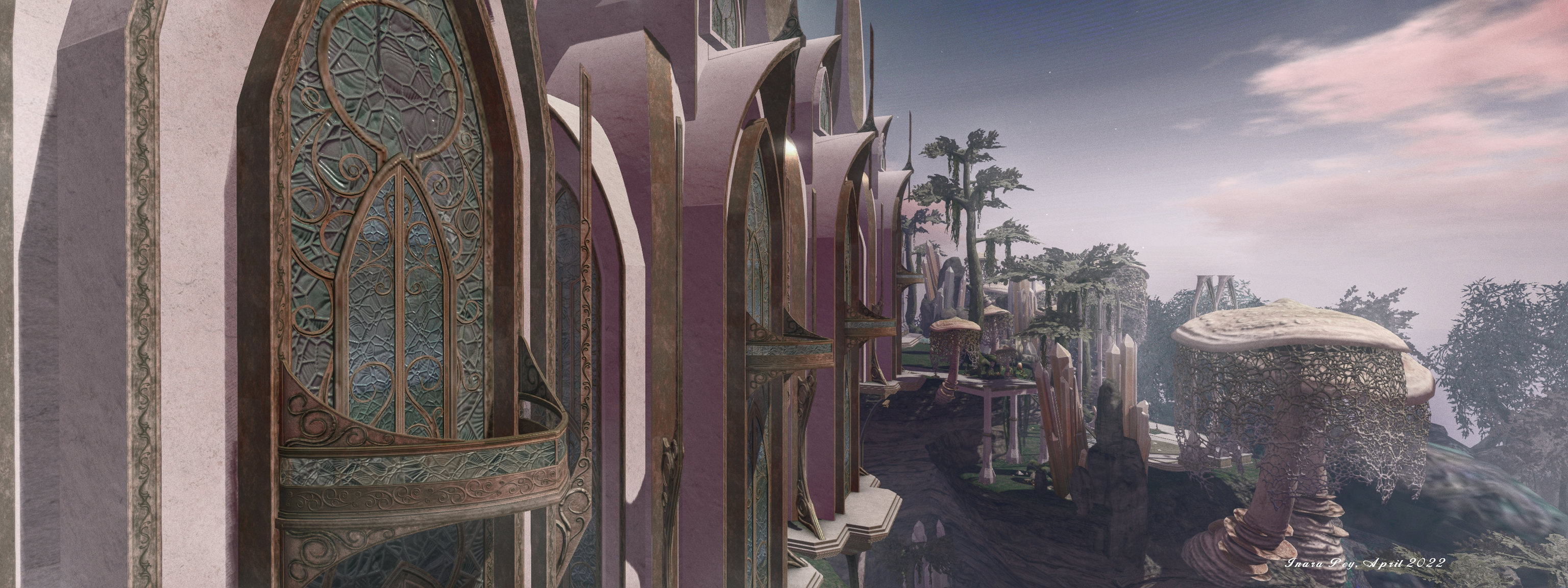
2022 is no exception to the richness of variety present within the twenty regions that are this year home to the Fairelands. All have something to say and to offer; but throughout my travelling over the last few days, I must confess that it is Mythspire Ridge that has captured both my eye and my imagination the most, and of which I write here.
Mythspire Ridge, April 2022
Born of the mind of Elicio Ember – who, truth be told, were he to reveal himself to be genuinely of elven descent I would not be in the least surprised such is the beauty and serenity found within so many of his creations – Mythspire Ridge is a place of such depth and vision, it is perhaps too easy to overlook the intricacies it offers to those who pause to spend time simply exploring along its broad paved paths, up and down its crystal steps and along the less obvious trails awaiting discovery.
From the mists of legend, majestic white spires group out of craggy mossy cliffs in a mix of elven architecture and organic flow, surrounded by gentle cascades of otherworldly vegetation and serene contemplation terraces.
– Elicio Ember, Mythspire Ridge
Mythspire Ridge, April 2022
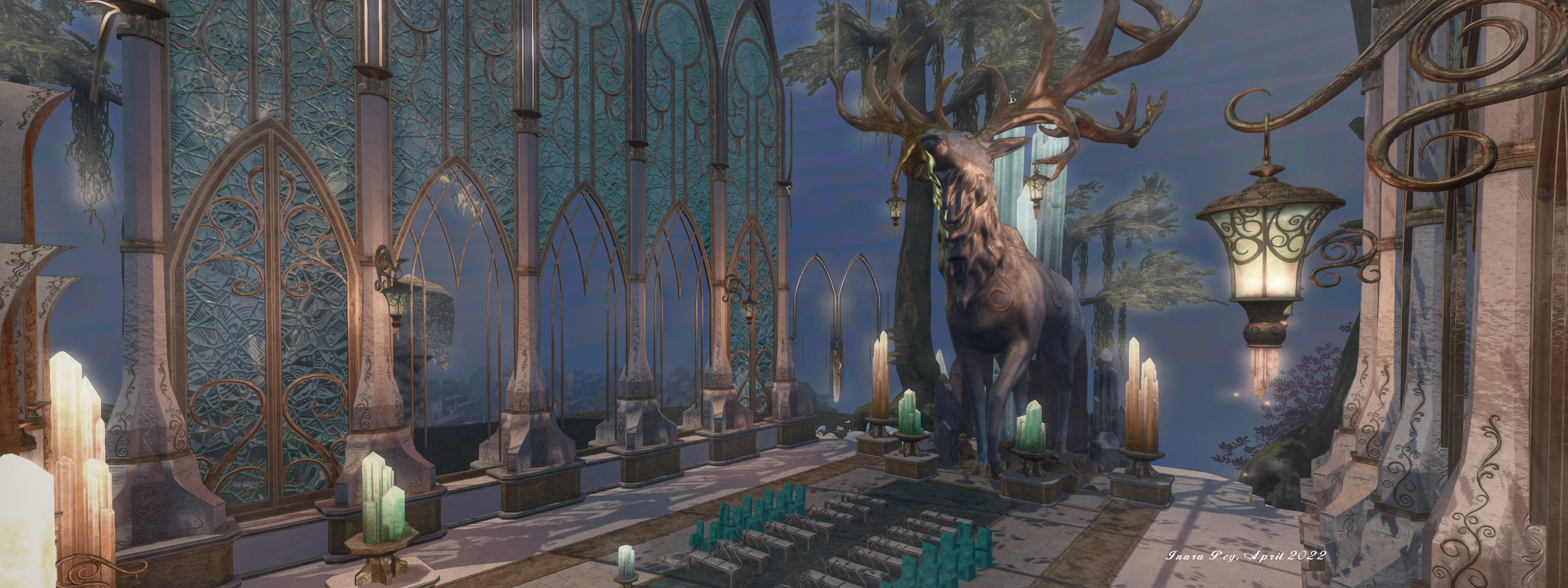
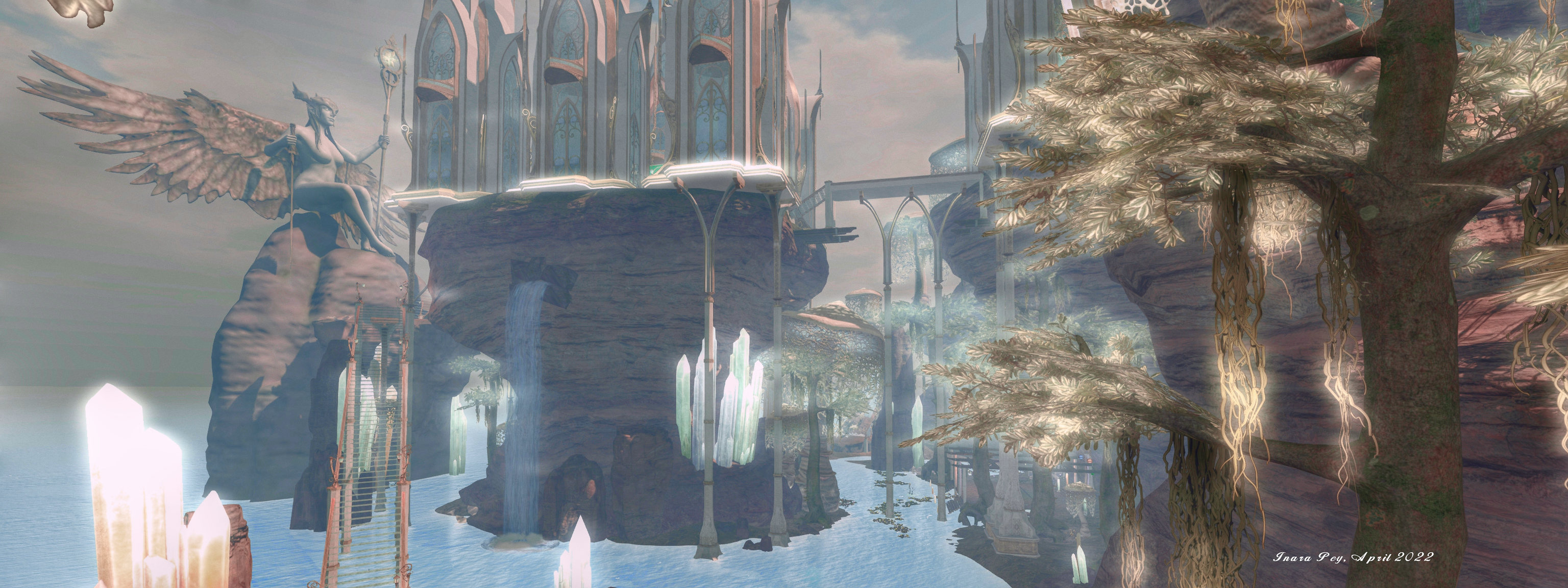
The region is home to both shopping opportunities and the Fantasy Faire LitFest. Those arriving via teleport will find themselves on the top of the high plateau of those mossy cliffs and amidst the gleaming towers of the elven architecture. The landing point takes the form of a square terrace sitting between the Hall of the Golden Stag to the north-east, a centre for LitFest events dominated by the stunning stage that gives the hall its name, and the halls of the region’s selection of stores, watched over at its south-western end by a giant carved and winged elven warrior, a staff held upright in one hand, a mighty runic sword in the other.
Such is the height of the store towers it is easy to miss much of their slender grace and beauty walking between them – so be sure to take time to cam up / out and appreciate them fully. Filaments of light follow the line of filigree set within buttresses, under the supports of high balconies and along the edge of steps; lanterns hang from high points on each, offering a soft illumination that changes as the region’s Day Cycles progresses (again, do be sure to have your viewer set to Use Shared Environment (World → Environment).
Mythspire Ridge, April 2022
Also extending outwards from the landing point are two broad paths. One sweeps around and between the other-worldly trees that add their beauty throughout the setting, and over the mossy ground to where crystal stairs descend under tall crystal columns to reach a storytelling (or perhaps Council) circle within an ornate terrace seated on a shoulder of the plateau. This also offers view down to the trees, greenery, waters and crystals of the lands below, giving a hint that there is a lot more to be explored – once the way down has been found!
And finding one’s way down is worthwhile: the waters are rich in luminous lilies, above which float firefly-like pinpoints of light. Lanterns mark trails that lead around the pools of water to where a hidden pavilion awaits those who love dance and the romantic at heart.
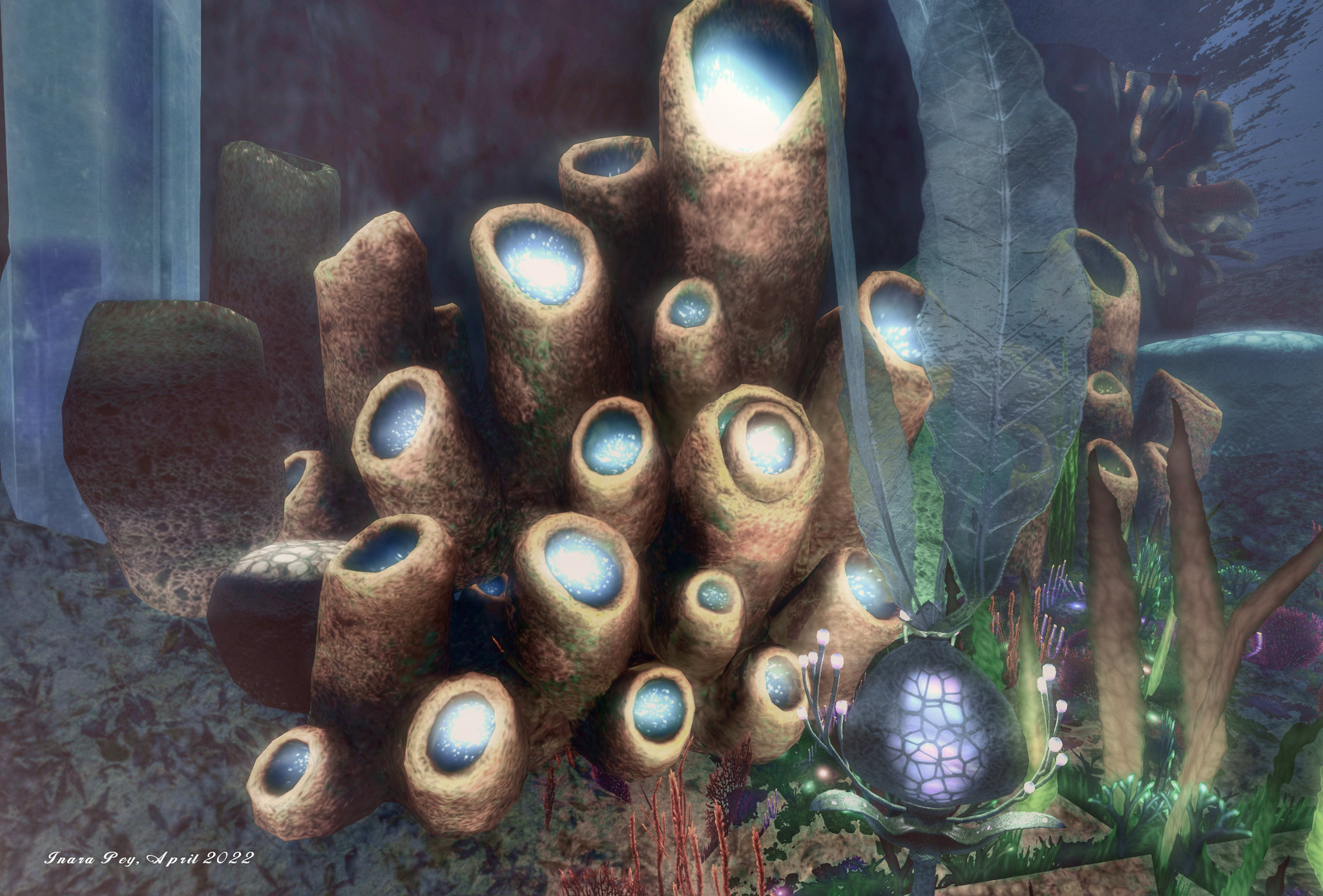
Nor is this all. Beneath the waters the magic continues in the form of a submerged garden of exotic corals and plant life. There are two ways down to the realm’s lowlands: a pair of great crystal stairways that start from the natural tower of rock upon which the elven warrior. However, only one of these presents the route to the pavilion; the other descends to a rocky island and a further broad paved path that connects Mythspire Ridge with Fairelands Junction.
The second path leading away from the landing point terrace (and pointing south-east) also ends in steps descending to another story / Council circle sitting within their own terrace (again, be sure to cam out / up to appreciate the architecture of both of these terraces). On the far side of this terrace a path continues along a broad ledge below the plateau top to where a bridge spans the gap between Mythspire Ridge and Atheneum.
Mythspire Ridge, April 2022
So many elements combine in Mythspire Ridge to make it genuinely magical: the scale of the build, the sweeping beauty and geometry of the towers and terrace arches, the exotic plant life above and below the waves, the garden spaces, the hidden pavilion, the richness of the Day Cycle (it is genuinely worth staying within the region to experience the full 4-hour cycle) – but most of all the vision and imagination of Elicio Ember.
Whether you are a lover of fantasy or not, if you enjoy exploring Second Life, Mythspire Ridge is a place you must make time to visit between now and May 8th.
My audio recording and chat log of the Content Creation User Group (CCUG) meeting held on Thursday, April 21st 2022 at 13:00 SLT.
The video recording by Pantera (embedded at the end of this piece, my thanks to her as always for recording the meetings) from the Third-Party Viewer Developer (TPVD) meeting on Friday, April 22nd, 2022 at 13:00 SLT.
These meetings are chaired by Vir Linden, and their respective dates and times can be obtained from the SL Public Calendar.
This is a summary of the key topics discussed in each meeting and is not intended to be a full transcript of either. However, the video does provide a complete recording of the TPVD meeting, and timestamps to the relevant points within it are included in the notes below.
The list below reflects the rest of the currently available official Second Life viewers:
Release viewer: version version 6.5.4.570575 – formerly the Lao-Lao Maintenance RC viewer, promoted Monday, April 18.
Release channel cohorts:
Performance Improvements RC viewer version 6.6.0.570163, dated April 4, issued April 14(?).
MFA RC viewer, update to version 6.5.4.569725, on March 24.
Project viewers:
Performance Floater project viewer, version 6.5.4.569531, March 18.
Mesh Optimizer project viewer, version 6.5.2.566858, dated January 5, issued after January 10.
Legacy Profiles viewer, version 6.4.11.550519, dated October 26, 2020.
Copy / Paste viewer, version 6.3.5.533365, dated December 9, 2019.
General Viewer Notes
The focus remains on fixing the bugs reported on the Performance Improvements RC viewer so that it can be the next viewer promoted to de facto release status. The RC version has been updated but has yet to be issued.
The promotion of the Lao-Lao viewer to release status means the current RC viewers are going through the merge with that codebase, and a new Maintenance RC should be appearing soon.
The Copy / Paste project viewer has been languishing in project viewer hell for some time whilst the focus on viewer work has been elsewhere. It is hoped that this well move forward once more Soon™.
[Video 6:26-7:35] Additional work is being carried out on the Legacy Profiles viewer (such as allowing the avatar UUID to be accessed via scripts by the likes of greeters that display the avatar image, etc.).
CCUG: Additional Materials Support / PBR: Hitting the RESET Button – CCUG Meeting
This formed the core of the CCUG meeting. The notes below should also be referenced with my notes from the previous CCUG meeting.
As previously noted LL had proposed a two-step approach towards moved to “full” Physically Based Rendering (PBR) materials support to give a high fidelity to SL rendering where PBR materials are used.
Significant concerns were raised about this approach at the last two meetings (e.g. a lot of creators do not use PBR-based workflows – a requirement for glTF – and so moving in this direction could create extensive issues for those creators).
As a result of the feedback, discussions at the Lab have been focused on an alternate approach:
Creation of a materials inventory type with an associated asset which could potentially have different forms (e.g. in one state it could be associated with PBR, another simply specify the legacy texture / materials parameters)
Where the PBR materials are specified, render using a new “PBR render path”; if the legacy parameters are used, render via the existing render path.
Move directly to a PBR implementation.
This would initially be limited to the materials aspect of glTF and not support any geometry for objects that can also be held by a glTF file (so no uploading for uploading complete mesh objects as glTF) – which is not to stay upload support for other formats wouldn’t be added at some point in the undefined future).
However – the above bullet points are all still under discussion at the Lab, so no final decision on the overall approach has been made.
It has also been noted that whatever happens, a significant requirement will be to provide specifications on which materials types are going to be supported, and what people can expect.
It is hoped that at least some of the Lab’s approach can built off of existing specifications rather than reinventing the wheel, then extended into those “optional” materials should be supported.
Cube Maps / Reflection Model
A concern was raised that current cube mapping used by SL is limited, and would need to be updated to a higher resolution for PBR support to be effective.
LL are aware of the limitations of the current cube map and would be “looking to address that” – although indicated this may not be done for the initial release of any related work.
This led to concerns that any release of PBR materials support without any corresponding update to SL’s cube mapping will result in creators attempting to implement their own workarounds to perceived limitations, resulting in content at odds with any cube mapping updates the Lab does make.
This latter point wasn’t seen as a problem, as LL’s view is that any updates to SL’s cube map will only be relevant to content created after the update, and it was further suggested that any “initial” updates to support PBR (and sans cube maps updates, environment maps, etc., might not even be user-facing, but purely for internal use / testing.
A similar concern was raised over the current reflection model + environment maps – that if not considered / managed as a part of the PBR project, it will lead to very poor results or limit the use of PDR materials.
Again, LL’s view is that reflection map / probes / environment maps re something that will be tackled “later”; some creators are of the opinion that it needs to be tackled as a core element of the work.
LL suggested that they might offer support of static environment maps initially, and then move towards the ability to cast reflection probes to allow reflections to be dynamically generated. However, all of this is still being discussed internally at the Lab.
It was also pointed out that lighting / reflections in PBR are calculated on physical properties (e.g. lumen equivalency) – which currently isn’t possible in SL without significant update to the rendering system. This was again seen as something that could be handled “later”.
Concerns were also voiced over the idea of things being set aside for “later” on the basis that LL has a long track record of breaking projects down into “iterative phases” – only to deliver the first one or two, and then push further work off into the future for assorted reasons (Examples:. the original materials project, Animesh, Experience Keys, EEP, the in-world aspect of ARCTan (allowing for the fact ARCTan as a whole seems to have become stuck)), with the results they become “someday / never”.
General Questions
Will the addition of broader materials support with PBR lead to alterations to the land impact formula?
Potentially for content using PBR, but this has yet to be fully determined. The feeling among creators is that a re-balancing of the LI formula would be required.
However, LI calculations themselves are in need of overhaul to more accurately reflect the cost of rendering objects (something the Lab has planned to do as “phase 2” of adjusting rendering calculations as a whole under project ARCTan, so while not intrinsic to PBR, LI / rendering costs might be reviewed as an adjunct to this work.
Will this lead to an increase in region land capacities? No.
Will it apply to all new content, post implementation? Yes, with the exception of system avatars and content requiring the the Bake Service.
Will this approach allow scripted update / changes to materials on faces? That is something that will likely have to be “tackled latter”.
Will this mean further updates to the uploader? most likely, yes.
TPVD: Off-line Friendship / Group Offers + Simulator Capabilities
Monty Linden has been working to fix issues of off-line friendship and Group invitation offers failing.
This has required a complete overhaul of the related capabilities for handling such offers, with the focus being primarily on getting them working again. Although “at some future time” the functionality might be revisited to do “something bolder and more interesting with it.”
This work is going to QA, and will be moving to Aditi (DRTSIM-537) for further testing.
The focus had been on making sure the list of capabilities in up-to-date.
Work will now be going forward to update / provide the underpinning documentation for all the capabilities. This will be done on an as time permits basis.
TPV In Brief
[Video 7:38-26:00] Extensive discussion on updating / refactoring the viewer code, updating the viewer build process, LL’s thinking on moving to more recent graphics APIs (e.g. Vulkan) and the problems involved,
Some of this has been covered previously in these summaries (e.g. options for future graphics APIs, the number of users running systems unable to run Vulcan, etc).
Much of the discussion is well into the long grass of viewer code, etc., and thus you are referred to the video.
[Video: 26:25-37:10] Accessibility options (close captions for when Voice is being used; text to speech, etc).
Accessibility is something that is looked at during general UI design work, but there is no project looking at specific questions of accessibility. However, it is recognised that perhaps a more formalised approach to handling accessibility should be adopted.
The issue of allowing Voice to be set so that all speakers can be heard equally irrespective of distance from the listener (as once supported by several TPVS, see: BUG-23172) is apparently difficult to implement in the current Vivox implementation and so has been subject to discussions between LL and Vivox.
The question was asked if TPVs felt effort should be pushed into a significant Vivox update.
A suggested response was given that any attempt to update to Vivox 5 would require a “wholesale change” to the Voice service, LL might be better looking at alternative offerings that offer better means of support.
Based on feedback from the meeting, Mojo suggested the keenness for LL to focus on large Voice related project isn’t there.
It was suggested that Pathfinding could be improved if the options in the viewer were all moved to a single tab on the Build / Edit floater. LL agreed this would be beneficial and requested a Jira on the idea.
LL more broadly noted that Pathfinding could benefit from a re-visit / update, although there are no current plans for any work. Some ideas for potential work have been submitted via BUG-229442. This in turn leads to a broader discussion on some of the additional issues with Pathfinding (lack of cohesive documentation, complexity of use, lack of automatic region rebakes, etc.).
[Video: 43:05-46:49] The above flows into a discussion on custom pivot points, some that was being worked on by LL but has been on the shelf of late, and the complexities involved.
[Video: 48:15-60:00] A general discussion on land impact calculations and making them more reflective of the cost of rendering (particularly textures, etc.).
This touches upon the ARCTan project, which was originally initiated to overall the formulas used to calculate both avatar complexity and the complexity of in-world objects – the latter of which may have led to adjustment in LI calculations, although ARCTan went on to initially focus on avatar complexity prior to being suspended altogether.
Folded into this is further discussion of alternate methods of calculating LI (e.g. through object geometry – although this doesn’t necessarily account for draw calls, which tend to be a big hit for the viewer), and ideas for encouraging best practices / finding a balance between control and offering the ability to create and upload.
There is further informal discussion after the meeting has ended. Please refer to the video if interested.





 Inara Pey: Living in a Modemworld