Moruya Sanctum, December 2022 – click any image for full size
I first came across the work of Kaja Ashland and Marcus Bremser when, in 2014 I visited the AERO Golf Club and, whilst not a fan of golf in the physical world, found myself enjoying the game. This led to several returns over the next few years and prompted me to write about the club again in 2017, after it had undergone an extensive redesign.
Since then, both Kaja and Marcus have launched individual projects, and in 2020 and again in 2021, I visited and wrote about Kaja’s Noweeta Homestead region. As such, a write-up of Marcus’ latest project, Moruya, is long overdue.
Moruya Sanctum, December 2022
At the time of my visit, this roughly 12,000 sq m parcel of land sitting on the east coast of Sansara’s Islandia North, lay presented as Moruya Sanctum, which Marcus describes as a tropical beach fronting high cliffs, the landscape transitioning to something more temperate in nature as visitors climb up to its high table top.
I’ve no idea if Marcus has drawn on the name Moruya from Australia’s New South Wales and the Moruya River (the name drawn from an Aboriginal word, mherroyah, said to mean “home of the black swan”). Given his Profile states he spends “extended periods abroad”, it’s tempting to think so even if his Profile also states his current time zone is only 12 hours ahead of SLT, rather than the 19 one might expect for far New South Wales. Not that there is any similarity between Moruya Sanctum and the Aussie river of which I’m aware (other than having its own stream flowing eastwards to reach the sea, doing so via a high waterfall rather than a broad estuary); it’s just an idle direction my little imagination wandered off towards during my visits.
Moruya Sanctum, December 2022
The landing point for Moruya Sanctum is presented as a little dinghy tied up to a small, T-shaped wooden dock reaching out a short distance from the beach. Bracketed to the north and south by shoulders of rock extending from the main cliffs, the beach is split by the aforementioned falls and the water which flows out from them in a short, shallow channel. The south part of the beach, on the far side of the water from the dock, offers a little place to enjoy the Sun, complete with palm tress for a degree of shade.
The path up to the highlands switchbacks up the cliff above the north side of the beach as a mix of sloping rock, steps and ladders. Getting up this path takes a little care (I noted several people have some issues, mainly because they were trying to take shortcuts up very tall rocks – just follow the obvious steps and take care at the narrow pass at the top of the ladders, and you’ll be fine.
Moruya Sanctum, December 2022
A stone arch greets visitors at the top of the climb, a final climb of steps running up to the main path between the head of the waterfalls and a stone-built gazebo. The arch and a stone wall bridging the waters of the stream offer the first suggestion that these highlands may have once been home to a structure constructed of cut stone blocks, some of the stone from which may have been used to create the tile-roofed gazebo.
The gravel path immediately offers a choice of routes. To one side, it curves neatly around the gazebo to reach a grassy little faerie round for sitting in the shade of trees, nicely secluded from the rest of the plateau. The second route takes you across a wooden bridge over the stream to a further fork in the path, both of which again hint to a structure of great age having once stood here, thanks to the presence of moss-covered stone steps along both arms of the path.
Moruya Sanctum, December 2022
To the left, curved steps rise to a small grassy meadow cut through by the continuing arc of the footpath as it passes between mature pine trees to reach further steps leading up to more extensive ruins overlooking the upper reaches of the stream and the waterfalls feeding it from the cliffs at the western end of the setting. Meanwhile, the second arm of the path reaches back over the water via a great slab of rock to where steps lead up to another secluded seating area set out in the grass and facing the ruins from across the channel of the steam.
But these aren’t the only routes across this upper reach of land; at the base of the curved steps pointing the way to the ruins is a ribbon of grass in seed. Take this and you’ll find yourself with a choice of natural trails reaching to pools of water isolated from the stream and offering their own outlooks and places to sit. Travel onwards along the upper of these trails as it runs through the grass and under the shade of more mature trees, and you’ll find a nicely hidden camp site, complete with its own back route up to the ruins above the stream.
Moruya Sanctum, December 2022
Secluded seating and sitting spots aren’t the only secrets awaiting discovery here, however. Tucked away within Moruya Sanctum is a gently winding throat of a cave, its sandy tongue reaching deep under the high cliffs to lap at an emerald pool of water.
You’ll have to find the entrance for yourself – part of the fun of exploring Second Life is finding such hidden spaces, so I’m not going to give everything away here (not that the cave entrance is that hard to find). Suffice it to say, find your way into the cave and you’ll find bats, places to sit, cats, and the opportunity to bathe in the waters of the pool. All of this is overlooked by two figures, one carved in stone, the other cast in bronze, and one of which, together with the banners hanging from the rock walls, offers a hint of Arthurian legend.
Moruya Sanctum, December 2022
Cosy yet with a rich sense of space, easy on the eye (and the viewer), with plenty of opportunities to relax and / or take photographs, Moruya Sanctum makes for a highly engaging and picturesque visit.
Each December, it has become my habit to offer a general look back on Second Life’s progress through the year – as I recently published for 2022, using the Lab’s own look back as a foundation (much as I did in 2021). In some of these looks back, I’ve included some personal notes on my own times in-world, although of late I’ve let that drop away, as is seemed rather self-indulgent. However, to break things up a little as 2022 draws to a close, I thought I’d toot my trumpet again and look back on the year and what it has meant to me.
Most notably on a personal level it’s been a year of evolving friendships, with two of particular note. The early part of the year was marked by times spent with Tasha, someone I’d met in 2021 and shared a good deal of time with having all sorts of fun, thanks to the two of us being in the same time zone and having fairly matching on-line times. Sadly, matters of the physical world meant that for the better part of 2022 we’ve had next to no time in-world, but the memories are precious.
More happily, 2022 brought me into contact with Tulsa, whose sense of fun and humour has prompted me to call her Imp, and whose companionship I’ve come to greatly appreciate, our sharing of a mutual time zone again making getting together easy, and allowing us to share a mutual interest in building. More recently, times in-world have been also shared with Wilhelmina, who has also been a welcome companion in exploring SL and visiting art exhibitions.
One of the things blog-wise I did at the start of 2022 was to write about how I came to name my avatar; I did so as a result of having received multiple questions on my name and whether it was connected to the short-lived TV series Firefly (quick answer: yes). Again, I thought the piece to be self-indulgent, but it proved popular among readers and on social media – so thank you on that! Further self-indulgence came in April 2022, when after earlier mis-communications, Strawberry Linden interviewed me for the Lab’s Spotlight series; something I found to be an honour as well, given the luminaries who have featured in the series.
Of course, exploring SL continues to be a passion for me, and 2022 saw me complete over 180 visits and write-ups on in-world public spaces (a handful admittedly return visits later in the year to places I’d dropped into early-on in 2022). It’s an activity I genuinely enjoy because it allows me to see the creativity of others in second life who, whilst not “content creators” in the traditional sense, nevertheless have the creative eye and ability to bring together the works of others in a manner to offer us all places of beauty, mystery, fantasy, and more, where we can explore, relax, play, and have fun.
Sadly, 2022 brought the news that one of the Second Life region designers I particularly admired for his ability – often working with Jade Koltai – to bring us magnificent interpretations of some of the most evocative locations to be found within the physical world. As I noted in a personal reflection on his passing, Serene Footman will be greatly missed by Second Life explorers and photographers.
Black Bayou remains one of my favourite physical world locations Serene Footman and Jade Koltai brought to Second Life. First offered in 2018, it was a location they brought back for a time in April 2022.
In looking at some of the stats on the blog, I was also surprised to realise that 2022 has seen me visit and write about over 170 art exhibitions and installations.
The ability for Second Life to promote art is genuinely second to none. Capable of showcasing 2D and 3D art, whether produced in-world and / or with the assistance of external editing tools, and presenting the ability for artists to upload and display their physical world art, SL is an outstanding platform for artistic expression and audience reach. It has been, and remains, my delight and pleasure to cover art in-world as fully and broadly as I possibly can, although I cannot hope to cover everything, so to those who did through the year extend invites to their opening and exhibitions which I was unable to accept, I offer a genuine apology.
In April Owl, Ceakay and Uli graciously hosted an exhibition of my SL photography at NovaOwl Gallery
A habit I got into a while back, mainly as a means of offering an alternate kind of product review, was writing about the prefab houses I’d buy then promptly kitbash for use on the home island. It is something I continued at the start of the year, utilising a couple of Novocaine Islay’s builds (see: The InVerse Orlando house in Second Life, and The InVerse Nizza house in Second Life). However, I’ve not done anything like it for most of the latter part of the year, not because I’ve not (again) changed house, but because the current house is a scratch-build; albeit it strongly influenced by a commercial build.
In August 2022, I made a number of visits to see Cory Edo’s Jura Waterfront Cabin, trying to work out if it could fulfil an idea I had for a new personal home. Unfortunately, my examinations of the design revealed that I’d have to pretty much tear it apart in order to achieve my goal, so instead I went the scratch-build route, albeit using photos I’d taken of Cory’s design. As such, it’s not a build to be written about in its own right – and I hope Cory will forgive me my cheek! For those of you who are looking for a thoroughly engaging waterfront home, it’s a build I can still recommend it as design unlikely to disappoint.
And talking of homes, a genuine highlight for me in 2022 was the invite I received from Miltone Marquette to visit his exquisite in-world reproduction of Fallingwater, aka the Kaufmann House, the iconic house in the Laurel Highlands of southwest Pennsylvania designed by Frank Lloyd Wright.
The original Fallingwater is a house within which I’ve had a long (and indirect) relationship with for many, many years. I’ve been an admirer of many of FLW’s architectural designs, with Fallingwater being the one I have myself built and re-built in-world over the years, and to which I’ve often returned in order to build far more personal takes on the essential looks and layout of the main house in order to give myself a personal home in-world.
However, none of my builds have been as faithful to the original as Miltone’s; his is a genuine work of art in which no detail from the original has been missed. As such it was an absolute delight to be able to visit it and tour the rooms – and drop into two of his other reproductions of FLW houses -, and I wrote about in Miltone’s Fallingwater in Second Life. If you have a similar passion for Frank Lloyd Wright’s designs, I thoroughly recommend contact Miltone directly in-world and arrange a time when you might visit his reproductions of Fallingwater, the Robie House and the Jacobs’ First House.
Fallingwater by Miltone Marquette, October 2022
Of course, 2022 has also allowed me to continue to inflict another pair of my interests on readers – those of space exploration and astronomy, subject which, like my love of sci-fi, came to me by way of late father. I have no idea how broadly popular Space Sunday might be (I try not to look too deeply ay blog analytics for fear I stop writing about what I enjoy and start focus on those subjects that gain the most clicks); however, I will say it is one of the hardest regular pieces I write for the blog; not because the subjects are hard for me to get to grips with, but rather because there is so much I want to cover, I have difficultly in reining myself in, so my apologies to those of you who might find the pieces a case of TL;DR!
Overall, however, 2022 has for me been nicely balanced between blogging and enjoying personal times. I’ll confess that on occasion in recent years I’ve wondered what the hell I am doing with SL outside of writing about it, so 2022 has been an opportunity – thanks in no small part to Imp and those close to me – to strike a new balance and get back to many of the things outside of blogging I enjoy. In this I also want to thank R, whose sage advice – given in 2021 – took root through this past year: do what you enjoy.
And keeping all that in mind, I’m keen to see what 2023 brings!
NASA’s Mars 2020 Perseverance rover has started preparations to have some of the samples it has gathered to be returned to Earth for extensive analysis.
Since its arrival on Mars in February 2021, the rover has been exploring Jezero Crater and collecting samples of sub-surface rocks in much the same manner as its older sister, Curiosity, which arrived within Gale Crater half a world away on Mars 12 years ago.
Some of these samples have been subject to on-board analysis by the rover’s internal lab, but for the most part they have been sealed in special tubes stored in an on-board cache, part of a total volume of 43 such tubes it carried to Mars tucked within its underside.
The idea behind the tubes – one of which has been used to collect a sample of the Martian atmosphere, and five more contain various materials intended to capture particulates in the ambient environment – is that they would form one or more sample caches Perseverance could deposit at locations where they could later be collected for return to Earth by a European-American sample-return mission.
Thus, on December 21st, 2022, the rover started building the first of these caches with the “drop” of the first tube to be selected for surface caching. The operation involved the rover parking at a recognisable feature within Jezero crater – dubbed “Three Forks” – and then rotating the rotunda of sample tubes so that the selected tube – containing samples of igneous rock collected at the start of 2022 – could be released and dropped to the Martian surface. Then, to confirm the operate had succeeds, and the tube wasn’t snagged somewhere in the mechanism, NASA commanded the rover to use its robot arm to peer down between its wheels and use the camera mounted on the end of the arm to confirm the position of the tube and check its overall condition.
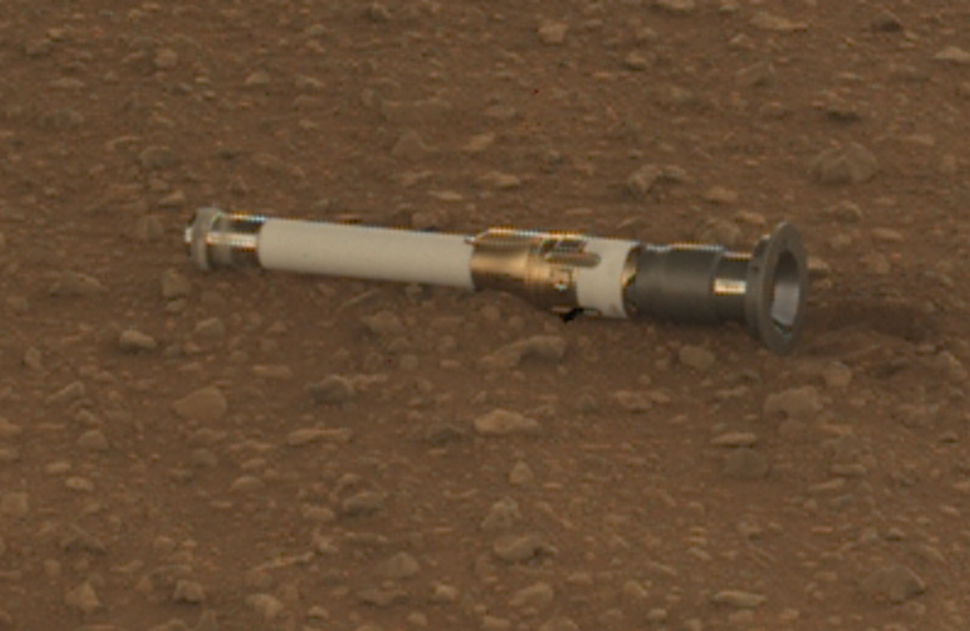
Somewhat resembling a light sabre from the Star Wars franchise, the sample tubes are made up of a mix of materials designed to protect their contents from the rigours of being placed out in the harsh Martian environment and and rick of contamination by solar radiation or by the future process of transferring them to the vehicles that will be used to return them to Earth.
Resembling a Star Wars light sabre, a sample tube dropped by the Mars 2020 rover Perseverance on December 21st marks the start of an operation to place 10 sample tubes in a cache for collection by a future mission which will return them to Earth. Credit: NASA
This resemblance to a light sabre is something that has not been lost on the mission team at NASA’s Jet Propulsion Laboratory.
I’ve been holding out my hand to my computer screen to see if the tube will be transported from Mars, since as director, I’m pretty sure the Force is with me, right? OK, so no joy so far, but I’ll keep trying!
– Laurie Leshlin, NASA’s Jet Propulsion Laboratory director
A photo of the “Three Forks” cache site in Jezero Crater, Mars, depicting the points at which the ten sample tubes will be dropped by the Perseverance rover. Credit: NASA
In all, ten of the 22 tubes so far used by the rover will be dropped around the “Three Forks” location – each one in its own drop point to facilitate easier pick-up. The second of the ten – containing the longest core sample thus far collected by the rover, comprising sedimentary rock taken from the edge of an ancient outflow delta in the crater – was dropped on December 22nd. A second cache of tubes will be established elsewhere in the crater at a later period in the rover’s mission to offer an alternate collection point for samples.
The current plan for the sample-return mission (July 2022) requires an orbiter / return vehicle to be supplied by the European Space Agency and delivered to Mars orbit in May 2028. At around the same time, a Sample Retrieval Lander built for NASA, will also arrive on Mars relatively close the the selected sample cache and carrying an sample ascent vehicle and two small helicopters similar to Ingenuity, already operating on Mars in concert with Perseverance.
The Mars Sample-Return Mission elements. top: the ESA- built orbiter / return vehicle; right: the sample lander with the ascent vehicle above it, carrying the sample back to the orbiter; left: the Perseverance rover and an Ingenuity-class Mars helicopter, one or other of which will be used to transfer sample tube to the lander vehicle, which will load them into the ascent vehicle. Credit: NASA / ESA.
Perseverance, which will have returned to the cache site in the interim, will then collect the sample tubes and pass them to the lander vehicle, which will then use a special robot arm to stow them in the ascent vehicle. Should Perseverance be unable to carry out the collection and transfer, the two helicopters will do so instead. Once all the samples have been collected, the ascent vehicle will launch to a rendezvous with the orbiter, and the containment unit with the sample transferred to it for the return to Earth, arriving in 2033.
Goodnight, InSight
As one team at NASA’s Jet Propulsion Laboratory were celebrating the success of the latest phase of their mission, another team was saying a final “farewell” to their mission vehicle.
Having operated for a total of four years on Mars – two years longer than its primary mission period – the NASSA InSight lander’s mission was officially brought to an end on December 21st, 2022, its mission team no longer able to communicate with it.
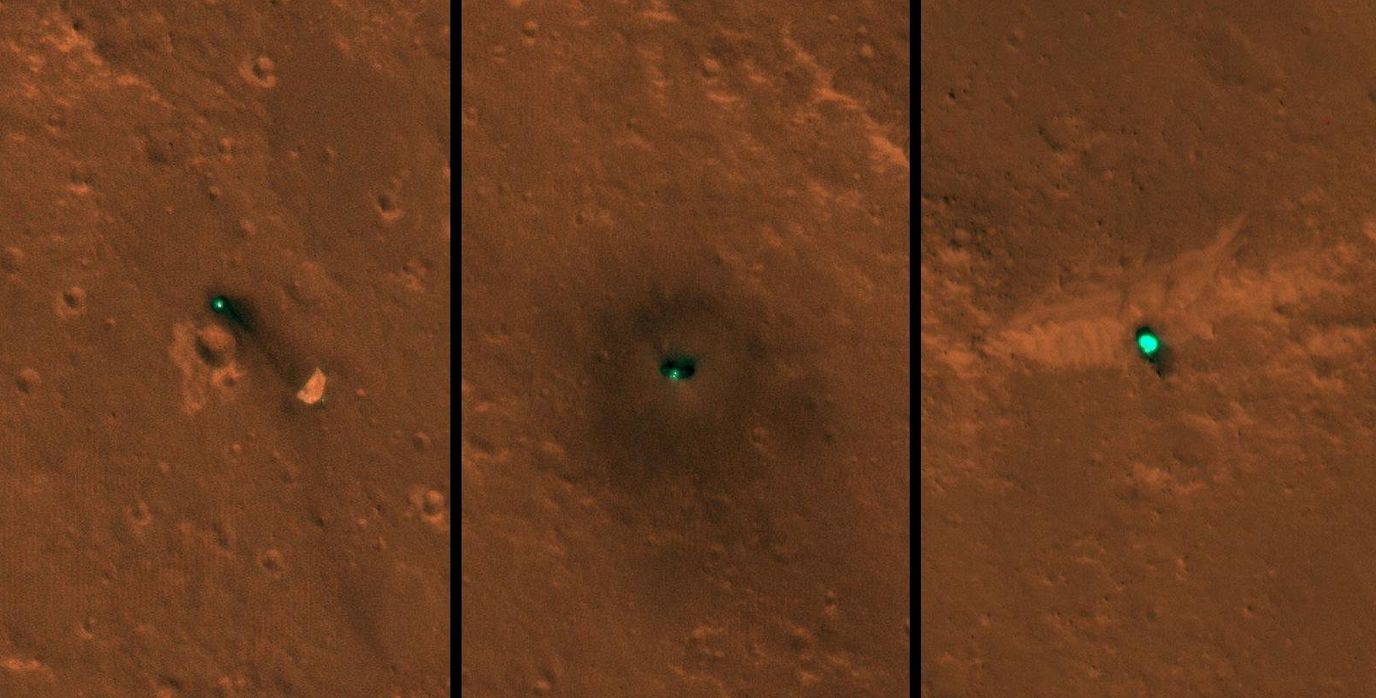
Three images captured by the HiRISE camera on NASA’s Mars Reconnaissance Orbiter, released on December 13th, 2018. Left: the lander’s aeroshell and parachute. Right: the heat shield, discarded after EDL and ahead of parachute deployment on November 26th, 2018. Centre: InSight itself with a surrounding ring of regolith blasted by the lander’s landing motors. The teal colour is not genuine, but the result of sunlight being reflected off of the lander and its parts saturating the HiRSE imaging system. Credit: NASA/JPL
Whilst not as exciting as an ambulating rover mission, InSight – short for INterior exploration using Seismic Investigations, Geodesy and Heat Transport – was a massively ambitious mission, full details of which can be found in Space Sunday: insight on InSight. As the name suggests, the overall aim of the mission was to gain information on the processes going on deep within Mars.
To achieve this, the lander notably included two experiments it had to transfer from its deck to the surface of Mars, post-landing. One of these experiments, the Heatflow and Physical Properties Package (HP3) and involving a self-propelled “Mole” designed to investigate how much heat is emanating from Mars’ core, did not fare too well, the Mole becoming stuck very early in its attempt to burrow into the ground.
However, the second surface package, SEIS (Seismic Experiment for Interior Structure) – the primary mission element for the lander – proved to be highly successful in its goal of recording details of “marsquakes” and other sound-generating events within and on the planet (such as recording meteor impact later traced to a new 150m diameter crater on the planet), allowing scientists build up a clearer understanding of the planet’s internal structure and activity.
In all, SEIS measured over 1300 seismic events in 4 years, marking Mars as still being geologically active deep below its surface. Fifty of these events were “loud” enough to reveal information about their location on Mars, with a large cluster of them coming from Cerberus Fossae, a region of the planet having been thought to be geologically active relatively recently in its 4.5 billion year history, with many “young” surface features.
SEIS also showed that the Martian core is molten but is larger than thought and less dense than the lower crust. Lighter elements mixed with molten iron in the core lower its density, which explains how the core can still be molten even after cooling considerably.
As a static lander, InSight always had a limited lifespan; as a solar-powered vehicle, its panels would inevitably become so coated in dust and subject to deterioration in the harsh Martian environment that they would no longer be able to generated sufficient power to charge the lander’s batteries. However, it had been hoped that dust devils, tiny Martian tornadoes created during the changing of the Martian seasons, might help “clean” the panels in much they same way they have with the solar-powered MER rovers. Unfortunately, this was not the case – possibly because the 2m diameter solar arrays used by the lander were simply too big for passing dust devils to effectively blow accumulated dust off of them.
TONAL estate, December 2022 – click any image for full size
On this grid I actualize the worlds I imagine, conjure my wildest daydreams, and walk a path unknown. I am here to create a fantasy for others to enjoy. Landscaping is my medium, my love language, and my story.
– TONAL (Avalyn Aviator)
At the start of 2022 I visited the TONAL brand regions, held and designed by TONAL (Avalyn Aviator) who, despite hailing from California, has a clear love of France. At the time, the two regions offered an engaging mix of Parisian cityscape and open French countryside (see: A trip to France in Second Life); since then, the estate has grown somewhat. So, given this, and the fact that I had a timely reminder from Shawn Shakespeare concerning the estate, I thought bookending the year somewhat with a return visit as 2022 draws to a close might be a good idea.
TONAL estate, December 2022 Gone now is the cityscape I encountered in January 2022; instead, the three core regions of the estate offer a more rural setting, caught in the depths of winter. At the western end of these three regions sits the open countryside of Lake Siren, offering a memory of Village des Chasseurs de la Valle de Londyn which stood within it at the time of my January 2022 visit. However, this is just an echo; the landscape has changed considerably, now being built around a smaller village, within which can be found properties available for rent.
This is curious place, inasmuch is sitting in the middle are a couple of light aircraft parked on a small apron – although how they got here is a mystery; however, each has its own little secret. Touch the red-and-white DSN Debonair and you’ll be transported to your home location; the C90 King Air, meanwhile offers an experience-based teleport to the TONAL airport, sitting further to the west of the regions I’m exploring here, and so beyond the scope of this article.
TONAL estate, December 2022
Close to this village sits a rather interesting camp site (or I assume it is), although whether units here, both on the ground and up on tree boughs, can be rented was not immediately clear to me. To the north of the village, the land drops away around the edge of a narrow-necked inlet cutting into the rugged landscape. Fed by a series of waterfalls dropping into it from two ends, the inlet forms a T-shape, the east side of its stem forming a long tongue of land ending in a bridge passing over the water’s neck.
To the north of the region, the land is largely given over to a private house and grounds, whilst westwards the land opens out in rolling, snowy countryside. Here can be found rezzing points, allowing visitors to drop a car or – as I would suggest – a horse or other rideable, and take to exploring. The major road runs more-or-less due west, and sadly doesn’t offer a route up to the façade of the hilltop hotel.
TONAL estate, December 2022
Travel far enough westwards along the road and you’ll come to a stone bridge providing access to the third of the regions I explored. The home of the city setting at the time of my start-of-year visit, this region – TONAL Family – is now given over to the huge and impressive Château de Chantilly. Open to the public, this contains echoes of the city build; its rooftop bar brings to mind the (more ostentatious) Jardin et Salon de Thé found within the January build, whilst the considered use of statues in the ground also helps give a sense of continuity between the two very different settings – something I always enjoy finding.
Within the chateau there is much to be found: an art gallery, museum, library, lounges, a spa, the Chateau also offers luxury rooms for those looking for a place in which to spend time. Details of the rooms and rates can be found on the TONAL website, which also provides information on the estate’s rentals and the TONAL airport, mentioned above. Those staying at the chateau gain access to all of its facilities, which also include horse riding, hunting, swimming and horse racing.
TONAL estate, December 2022
Taken together, these three regions within the TONAL estate offer an interesting and generally photogenic visit with plenty of opportunities for exploration. However, I do have to be honest; in places, there is a lot going on, and as a result frame rates can take a hit, so be prepared to drop your draw distance or disable Shadows (if used), other than when taking photos.
Theme for art exhibitions is not a new idea – many, many art exhibitions are built around a theme, whilst individual works are frequently used by artists to express an idea or ideal or theme, often with a defined commentary. Such themes can be complex and layered; hinted at, rather than openly expressed, offering their audience suggestions to prod their own cognitive faculties. Others are more direct in tone and theme, presented as a direct commentary – or simply as a celebration.
Ode to Snowmen falls cleanly into that last category. Presented by CK (Ceakay Ballyhoo) at the NovaOwl Sky Gallery, curated by curated and operated by ULi Jansma, Owl Dragonash and CK herself, this is an unbashed celebration of winter snowscapes and the joy and humour found within the creation of snowmen.
NovaOwl Sky Gallery: CK Ballyhoo – Ode to Snowmen
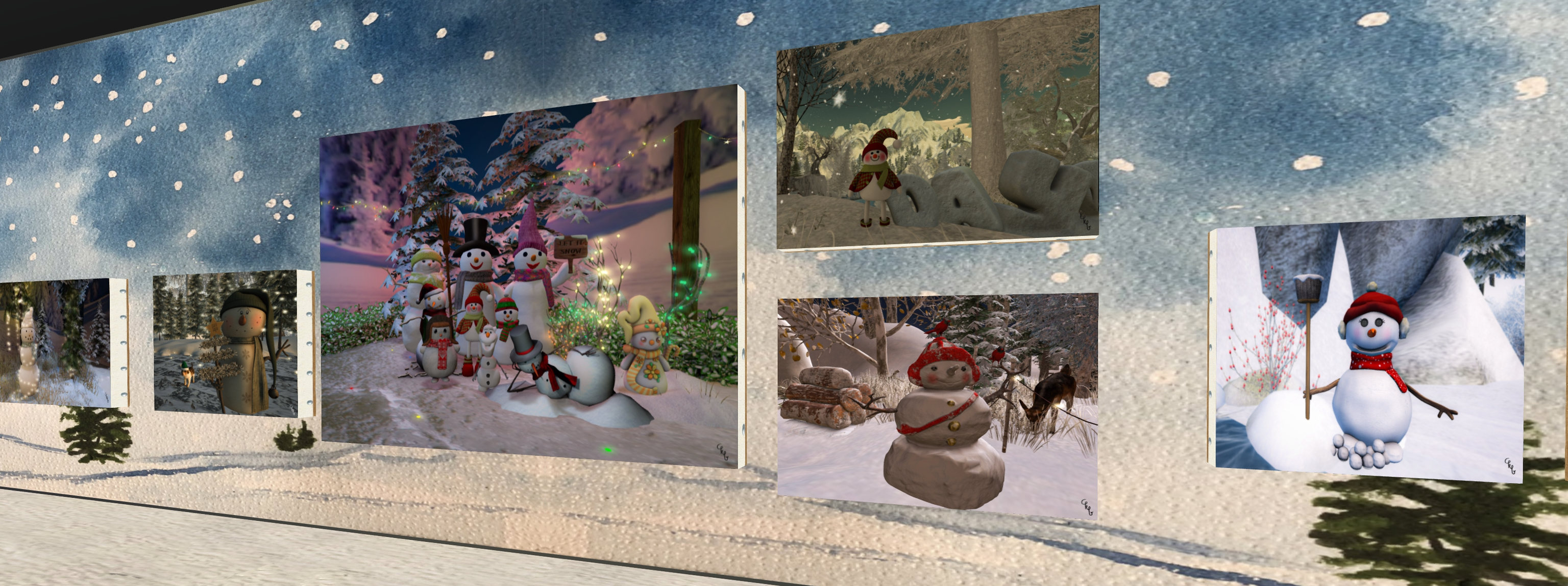
Naturally split between the two levels of the gallery, the exhibition features images of snowmen CK has found in her travels across Second Life, from the massive sculpture at the heart of Linden Lab’s Winter Wonderland through to snowmen (and snowwomen and their children!) getting up to all sorts of activities and mischief from simple family portraits to skiing (yes, some snowmen have legs!) to peeping in through windows to see what is going on in those warm places which we love but are anathema to snow folk.
With the floorspace covered in snow and dotted with paintings and drawings of snow-laden fir trees and snowmen, this level of the exhibition also stand as a reminder of the immersive storytelling installations CK used to build in-world, often working with artists such as Silas Merlin and CybeleMoon (Hana Hoobinoo).
NovaOwl Sky Gallery: CK Ballyhoo – Ode to Snowmen
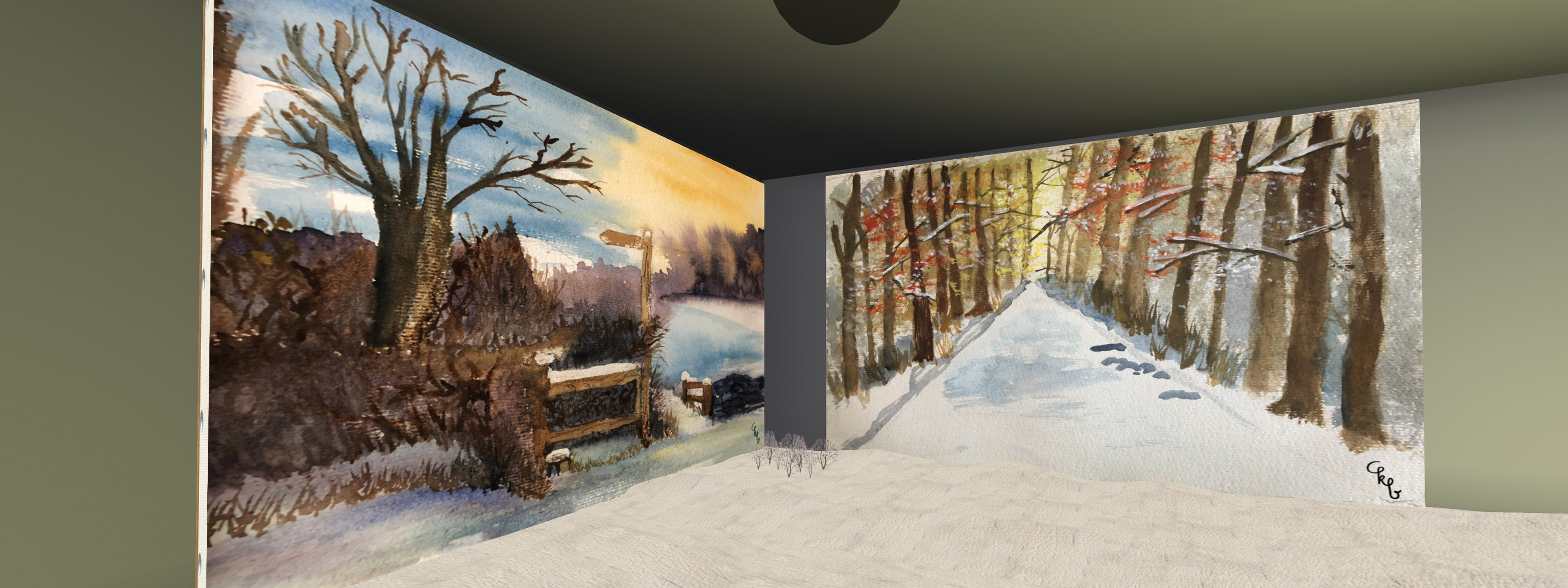
The upper floor of the exhibition features a set of seven watercolour paintings by CK celebrating winter landscapes. Collectively, they offer views which bring to mind lyrics from songs like Walking in a Winter Wonderland and (for me, as I love its haunting tones – particularly in Isao Tomita’s evocative version) Debussy’s Des pas sur la Neige (Footprints in the Snow), itself said to have been inspired by a painting of a winter snowscape.
From snow-covered paths guarded by denuded trees standing to attention on either side, to frozen ponds suggesting an invitation to go skating, and signs pointing the way to trails lying just out-of-sight relative to the painting, these are all warm, inviting pieces which call to the fore childhood memories of the wonder of snow and (perhaps for some) romantic walks through pristine fields of snow with a loved one. All of this is overseen by several snowmen painted on one wall, and several on the floor which blend nicely with one of the paintings.
NovaOwl Sky Gallery: CK Ballyhoo – Ode to Snowmen
A fun, easy-on-the-eyes exhibition presented in a timely manner for the holiday season, Ode to Snowmen will be open through until the end of December 31st, 2022 – so get your visit in soon!
On Friday, December 23rd, Linden Lab published their review of 2022, which also included a quick look ahead to 2023. As this time of year when, in the past, I’ve offered a (sometimes multi-part) personal look both back and forward, I this that this year, as with 2022, I’d take a look at the Lab’s look back / look forward and add some of my own thoughts as well.
Linden Lab: People and the Media
2022 got off to something of a bang when on Thursday, January 13th, 2022 Linden Lab officially announced that High Fidelity Incorporated was now an official investor in the company.
This news was significant on a number of levels; most particularly the fact that the arrangement meant that Philip Rosedale, one of the original co-founders of Linden Research (aka Linden Lab), would be supporting the company’s development and direction as a special Strategic Advisor role whilst maintaining his role as CEO and co-founder of High Fidelity Inc.
Philip Rosedale: inwards investment to LL and a role as Strategic Advisor
At the time the new was made public, I speculated whether – given the deal involved the transfer of patents from High Fidelity, a company specialising in spatial audio in virtual spaces – this might see a re-vamp of Second Life’s voice / audio capabilities to encompass the full spatial audio offered by Hi Fi. Well, as it turned out that was a case of barking up the wrong (Linden) tree!
One of the immediate outcomes of this announcement was a renewal of interest in Second Life on the part of tech media, was assorted interviews with Philip Rosedale and also Executive Chair Brad Oberwager; in this, Philip Rosedale’s influence cannot be underestimated.
As the co-founder of Second Life, one of the longest-running immersive virtual worlds, and one of the first to try to recapture the genie with the founding of High Fidelity of 2013, he has remained true to the ideals of establishing “the metaverse”, and very vocal in his views on privacy, user security and rights, opposition to the idea of ad-driven platforms and approaches wherein the user is the product, whilst also offering clear-sighted views on virtual currencies and the UGC market – as a look through his Twitter profile will reveal. This makes him well-placed to discuss “the metaverse” as a would with reporters and columnist – and in doing to, to place Second Life front-and-centre in their minds.
Second Life users got to hear from Philip directly after the announcement, when he was a guest with Brad Oberwager (with whom he is good friends) on Lab Gab (video and summary here), and also via a Twitter Space event he hosted (summary and audio extracts here – sadly the original event is no longer available via Twitter). More widely, he was a key voice in a four-part podcast series by the Wall Street Journal: How to Build a Metaverse,
User Benefits
2022 saw some interesting user benefits popping out across the months. The arrival of both the Premium Plus and Plus subscription plans, bracketing the original Premium, are both well-known, and both have proven popular. While there are no active plans to do so at present, it has been indicated that other subscription package options might be considered, with some within the Lab somewhat keen on an a-la carte approach: you pay for the options you select from a list. IF this were to come to be at some point in the future, it could prove interesting (just please do not expect anything like it in 2023!).
Other subscription-based “benefits” made available in 2022 were the removal of VAT surcharges on Monthly and Quarterly (where applicable) payment options, levelling the cost of subscriptions for those in VAT-paying countries (VAT was removed from annual payment some time ago); and the reduction in tier fees payable on Mainland parcels of 8192 sq m and above, up to a full region. In terms of payments, the cost of Name Changes for Premium members was reduced to US $34.99 (+VAT), whilst the capability was made available to Plus and Basic account holders at the original US $49.99 (+ VAT).
Technical Front
Unlike 2021, 2022 saw the Lab working a lot more on user-facing updates and capabilities (2021 being devoted to optimising SL server and simulator performance on AWS). Much of this is is recorded in the Lab’s review, but I’d venture to suggest the most impactful aspect of this work has been the release of the Performance Improvements, and the adoption of these updates by the majority of TPVs, bringing significant boost to viewer frame rates as a result of a lot of code and thread refactoring. This work in turn has paved the way for more improvements, supported by work by Beq Janus of the Firestorm team, in the upcoming Performance Floater / Auto-FPS RC viewer, which should be promoted to release status early in 2023.
This work also cleared the way for a significant project which did not quite make it to release status in 2022: the PBR Materials / Reflection Probes project, which will see Second Life move to utilising the glTF 2.0 specification for runtime asset delivery format, intended to bridge the gap between 3D content creation tools and modern graphics applications. This is important because the specification provides a more fluid and predictable workflow from tools like Substance Painter, Blender, et al, into Second Life than can be achieved through the current mixed-format approach to content creation and import.
The initial element of the project focuses materials use (together with the implementation of Reflection Probes) provides a recognised approach to supporting physically-based rendering (PBR) in SL, whilst the glTF specification as a whole from content creation in external tools right the way through to importing that content (including replacing the Collada .DAE model format with glTF as some point down the road.
Sample of PBR materials and detail (r), compared to SL’s “legacy” materials (l). Image courtesy of Runitai Linden’s PBR work
This work could revolutionise how Second Life looks indoors and out going forward; in addition, it pushes the platform to a position where it is potentially, much easier for content creators familiar with other platforms to dip their toes into a possible (for them) new market in which to sell their creations.
A key thing with the glTF / PBR work is the manner in which the Lab has engaged with the community: the viewer development work has been relatively open for creators to join-in with, see and test; feedback and suggestions have been actively sought, and the work has very much had a element of users and the Lab working together to bring about a capability that is not only needed, but which will be welcomed and used.
Reflection probes are invisible objects which produce a cubemap of a defined area to generate “reflections” of that environment on suitable, local surfaces (in this case, the two spheres). Image courtesy of Runitai Linden’s PBR work
This collaborative approach has also been evident in the other major technical project for 2022: Puppetry. Originally called “avatar expressiveness”, this started as a means of capturing head and arm movement via webcam and having the avatar mimic them. However, thanks to user involvement and testing, the project has been revised and improved, allowing the support of multiple hardware devices for capture, and extending the range of capture close to full-body.
Puppetry is a project championed by Philip Rosedale, and could well leverage knowledge and experience gained by High Fidelity, several of who transferred into Linden Lab as a part of Hi-Fi’s start-of-year investment, including Leviathan Linden (who was also once Andrew Linden, one of the original LL employees) who was working on the concept as far back as 2014, as the video below demonstrates – with Andrew providing backing vocals. Within it, it’s not the quality of the avatars that is important, it is the way the guitar strumming matches the music, and the facial expression match Emily’s as she sings (although capturing facial isn’t currently part of the SL puppetry project).
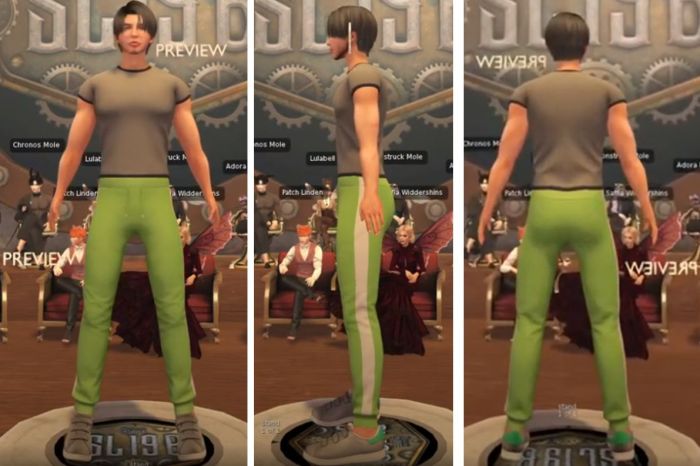
Another project imitated in 2022 – or at least previewed – is all-mesh Starter Avatars. First revealed at SL19B the intent is for this avatars is to ease the pain-points new users face in trying to get their heads around selecting, and customising existing avatar bodies and heads. Given the Lab hopes this project will both encourage a new ecosystem on clothing and accessories created by the community for use with the new avatars but also see these avatars as being a stepping-stone to help new users get settled and then move on to more commercial offerings, it is going to have to step a fine line.
Also, taking their all-in-one nature as seen at SL19B, I’m admittedly curious how these new avatars will make converting from them to use “commercial” mesh bodies / heads any less confusing than it is at present for people shifting from system / starter avatars to commercial offerings.
A preview version of the new, single mesh (head-to-toe) avatar, revealed at SL19B and a part of the new user experience work underway at Linden Lab
Looking Ahead
In looking ahead to 2023, LL pointed to a number of project / initiatives, some of which were anticipated (new user experience et al); further performance improvements (including those noted above) and further scripting improvements.
A couple of surprises with the list, however, were mention of:
New centralised “hubs” to better connect residents to the communities that match their passions and interests.
First peek at a world and avatar centred mobile-first Second Life experience.
The second of these is intriguing, given the start-stop-push-to-the-side nature of the iOS “SL Mobile” app project. Whether this hint means LL a have been back working on this and expanding its capabilities on the QT, or whether it might mean they’ve opted to buy-in a solution or turn to a streaming solution (which in turn potentially offers the highest fidelity with the viewer in terms of rendering), isn’t clear. All three have been hinted at as possible directions at various points in 2022, and – assuming an equitable price plan could be developed – it’s not as if LL doesn’t have exposure to viewer streaming options, thanks to the Pelican project of around 12 years ago, or (more particularly) the short-lived SL Go solution provided by OnLive.
The centralised hubs is an interesting in terms of its implementation; LL is already revamping the entire “land journey” for users – how to obtain mainland, lease a region from LL directly through to how to find and rent late from private estates – so there is a question here as to whether this new hubs will be hooked into this work, providing a means for users to more easily obtain land and become a part of a community. Or, might it be a means to offer added value to Community Gateways – or even a revamp of Place Pages (which never really took off) to make them more responsive to communities and groups – thus offering both the means to access these new hubs from without SL as well as from within.
Not mentioned in the official blog post are the plans for the Marketplace. With MP Search updated, the road is apparently clear for the 2023 deployment of Marketplace Styles: allowing multiple versions of an object (e.g. different colours of the same jacket or dress) to appear in a single listing. There is also the mention that 2023 might also see the start of work to build a completely new Marketplace and (eventually) migrate users to it. Just don’t expect the work to be completed in 2023 (if it does get started).








 Inara Pey: Living in a Modemworld