Frogmore’s touch of Halloween Gothic in Second Life

Witherwood Thicket, October 2023 – click any image for full size

Halloween is rolling around for 2023, and once more we’re starting to see region designs marking the time of year pop-up, whether along “traditional” Halloween settings with pumpkins and a light touch of ghostliness and spookiness, or with a deep footing in horror and / or bloodthirsty goings-on. As such, it is often hard to choose particular regions and locations to cover; after all, when you’ve seen one pumpkin patch, you’ve seen them all, regardless of whether or not they feature a small boy with a blanket steadfastly awaiting the gift-giving arrival of a mythical creature. However, there are exceptions.

For example, the annual Halloween regions delivered to the grid by Ty and Truck and the team at Calas Galadhon (of which I’ll have more in the near future) or – for this article, the realm of Witherwood Thicket, the latest Frogmore instalment from the imaginations of Frogmore owner Tolla Crisp and her companion-in-building, Dandy Warhlol (terry Fotherington).

Witherwood Thicket, October 2023
A Gothic Tale told in shades and shadows upon an English Moor, inspired by works of Edgar Allen Poe.

– Witherwood Thicket About Land description

The above description does much to sum this setting up, providing sufficient information to inform visitors they are about to enter a world edged in mystery-horror; one with a slant towards the English moorlands (take your pick, we have a fair number which are all known for their outstanding beauty and wilderness feel, starting far down in the West Country and then scattered all across England (as well as Scotland and Wales also having their shares of equally enchanting moorlands). However, it also leaves more than enough unsaid to practically demand a visit.

Witherwood Thicket, October 2023

Whilst it is an American master of the of the macabre mentioned within the region’s About Land description, the broad strokes of some parts of Witherwood Thicket might bring to mind images of mist-filled nights deep within the mires of Dartmoor, and the tall, slender form of Basil Rathbone’s Sherlock Holmes leading Nigel Bruce’s Dr. John Watson as they attempt to track a certain demonic hound. At the same time a certain part of the setting might have some imaginations edging towards thoughts of Tolkien, whilst throughout are elements of horror, the occult and monsters which might well give H.P. Lovecraft a reason to smile.

Which is not to say the region is in any way mishmash; far from it. Everything here has been well placed, with multiple buildings dressed to encourage visitors to step inside, with the passage around the region nicely set to present something of a visual narrative – although precisely what the story within it might be is left up to our imaginations.

Witherwood Thicket, October 2023
Journeys through Witherwood Thicket commence at the landing point, well to the south and west of the region, where sits a fortified gatehouse, now roofless and all but deserted. It sits on a narrow spit of land with water on three sides, but it is not hard to picture the route through its twin arches having once provided access to wooden wharves where vessels might have at one time sailed for and to, laden with goods both coming and going. Or if not docks, then perhaps the mind might picture the tongue of land straddled by the gateway marching onwards a distance before the opening out once more beyond the region’s edge, the waters to either side allowing the stone walls of the gatehouse and the great gates which doubtless once stood under its arches form a natural defensive point.

Beyond this ancient structure, the land rolls inwards to a second arched gateway flanked by defensive towers, the path between the two bordered by the skeletal ranks of trees either side and they stand-in for any curtain walls which may have – if the imagination runs that way – between gatehouse and gateway. Once through the third arch, the path become further hemmed in on either side by a tall crop of something or other watched over by a scarecrow as spooky as the watcher standing guard over the path running from the gatehouse.

Witherwood Thicket, October 2023

Once past the crop and its guardian, the setting becomes more moor-like (so to speak), the path turning into an unpaved road curving through a small village. Here, lights spill out from shaded windows and / or doors stand open, inviting people in. Yes there are hounds here that may not appear entirely friendly (but are hardly demonic, to return to my earlier reference!), but the houses deserve time to look inside, as each presents its own sense of mystery and / or the occult. As the road passes between them, so it reveals the looming form of a castle perched up on a hill and watching over affairs. Perhaps the old gatehouse once formed a part of its defences – or perhaps not.

The village, riven in two by the passage of a deep gully with choked waters at its bottom and best crossed by the sturdy bridges, is actually more extensive than might first appear to be the case. There is, for example, the moulding manor house to be found at the end of another rocky promontory pointing a crooked finger out to sea and, across a small bay from it and directly below the village, the crouching form of an old cabin which might look quite at home deep with America’s bayou country, giving a further little twist to the setting. There’s also the village church and graveyard and, acting like a magnetic, the castle sitting high on its rocky perch.

Witherwood Thicket, October 2023

The castle is best reached by passing through the village and following the road as it becomes more of a trail heading back eastwards and then south to where a lighthouse rises out of the mist in impressive fashion to vie with the castle in terms of providing the highest view out over the landscape. It is here as well that the touch of Tolkien enters the imagination. Climbing the rocky incline leading up to the castle, it is hard not to look back at the lighthouse and expect to see a fiery eye staring unblinking out over the landscape as Sauron’s was said to have done from the highest point of Barad-dûr.

As for the castle, this offers its own sense of mystery. While the halls and rooms within its walls and towers are empty, its courtyard is set for some form of event – although what this might be is again left to the imagination. Then there is the second great house, no more than a stone’s throw from the lighthouse and sitting ablaze at the water’s edge, a burning ship close by. They both beg for visitors create a tale for why they are burning, be it the result of the demon on the terrace leading to the house or something else.

Witherwood Thicket, October 2023

Rich in detail – much of it intentionally not covered here – and presented with a fitting environment setting and a soundscape heavy with the cry of crows (possibly standing-in for ravens, given the Poe reference 🙂 ), Witherwood Thicket is a place you’ve want to spend a decent amount of time exploring and which (it really goes without saying) is highly photogenic.

SLurl Details

2023 SL viewer release summaries week #39

Logos representative only and should not be seen as an endorsement / preference / recommendation

Updates from the week through to Sunday, October 1st, 2023

This summary is generally published every Monday, and is a list of SL viewer / client releases (official and TPV) made during the previous week. When reading it, please note:

  • It is based on my Current Viewer Releases Page, a list of all Second Life viewers and clients that are in popular use (and of which I am aware), and which are recognised as adhering to the TPV Policy. This page includes comprehensive links to download pages, blog notes, release notes, etc., as well as links to any / all reviews of specific viewers / clients made within this blog.
  • By its nature, this summary presented here will always be in arrears, please refer to the Current Viewer Release Page for more up-to-date information.
  • Note that for purposes of length, TPV test viewers, preview / beta viewers / nightly builds are generally not recorded in these summaries.

Official LL Viewers

  • Release viewer,  version 6.6.13.580918, formerly the Maintenance U(pdate) RC viewer, version 6.6.14.581101, promoted August 23.
  • Release channel cohorts:
    • Inventory Extensions RC viewer, version 6.6.15.581961, September 28.
  • Project viewers:
    • No updates.

LL Viewer Resources

Third-party Viewers

V6-style

  • Kokua: 6.6.14.51029 (no RLV) and 6.6.14.54485 (RLV variants) October 1  – release notes.

V1-style

  • Cool VL Viewer Stable branch updated to version 1.30.2.30 and Experimental branch updated to version 1.31.0.8 on September 30 – release notes.

Mobile / Other Clients

  • No updates.

Additional TPV Resources

Related Links

Cica’s Workshop in Second Life

Cica Ghost: Cica’s Workshop, October 2023

October 2023 sees artist and builder Cica Ghost presents something a little different for Second Life users to enjoy. In Cica’s Workshop we find not a new fantastical landscape or garden or alien world or other setting where our imaginations might go wandering through thoughts of faerie and folk tales or memories of childhood or other such avenues. Instead, it sits as a kind of living gallery, a celebration of many of Cica’s creations down the years, and a place where if we’re so-minded we can pick up copies of her work either directly or via convenient links to her Marketplace listings.

For those with a long familiar with Cica’s work, this is a chance to take a walk down memory lane – which I found myself doing. For example, throughout the region-wide exhibition there are her 2D drawings, large and small, which carry with them memories of installations such as The Visitors (2014), wherein she brought a flavour of occupancy to the former art centre The Lost Town – La Città Perduta. These figures also offer a reflection of her monochrome characters from her 2012 installation Cica, which rightly brought her widespread attention in Second Life, and also 2013’s Ghostville, which I believe is the first of Cica’s installations I ever blogged.

Cica Ghost: Cica’s Workshop, October 2023

Meanwhile, up on the flat crown of a hill sits a pastel cream garden and little house. The latter brings to mind many of Cica’s builds stretching all the way back to around 2014 as well, when her Little Village made its first appearance. These little houses, varying in size whilst often retaining their general looks and proportions, have gone on to appear in many of Cica’s designs, such as Moonlight (2016, and still one of my favourites among Cica’s installations) and very uniquely within Drawn Town (2019).

This is a place inhabited by many of Cica’s animal and creature creations, from her ever-popular sheep and cows, through to her dinosaurs, which I think first appeared within 20022’s Dinosaurs and Coconuts, her residents of Burlap, and cast from Monsters and ever-friendly Elephants (all from 2020) – and more besides.

In addition, several new characters are waiting to befriend visitors, whilst the installation also includes many items from Cica’s furniture range for those looking for something a little different for home and / or garden. And if you fancy having a near-avatar scale sandcastle for your beach or spending a little time in an anti-gravity cage – Cica has you covered.

Cica Ghost: Cica’s Workshop, October 2023

Even for those who may be relatively new to Cica’s work and her marvellous imagination, Cica’s Workshop offers and lot to see and enjoy – and possibly purchase along the way. As such, and while it may not be a “traditional” Cica presentation, it nevertheless shouldn’t be missed.

SLurl Details

Rock Your Rack 2023 in Second Life

via Rock Your Rack

Presented by Models Giving Back, Rock Your Rack opened its doors on Friday, September 29th, and will run through until Sunday, October 8th, 2023. The annual fund-raiser for the National Breast Cancer Foundation (NBCF), the event offers shopping, music, fashion shows, entertainment and art.

Some 1.7 million women – and men – were diagnosed with breast cancer in 2012; today that figure still stands at around 1.6 million world-wide. NBCF’s mission is to help women in the United States by providing help and inspiring hope to those affected by breast cancer through early detection, education and support services. NBCF is also joining hands with organisations around the globe to provide breast cancer education, and Rock Your Rack aims to raise funds to support all of these activities.

Rock Your Rack 2023, September 29th-October 8th – shopping

Located on a single region, the event this year doesn’t carry a single theme per se, but draws on ideas of the American West, the seaside, city life and mystical forest glades in what might be seen as reflective of some of the environments and settings to be found in Second Life.

In all, the event features around 70 sponsors and designers through the shopping and entertainment activities, and as with previous years, supporting designers have been asked to provide a limited edition item, of which 100% of all proceeds of sales go towards Rock Your Rack. A full list of these items can be viewed on the Rock Your Rack website. Those wishing to catch up with the full list of sponsors and designers can do so here.

Entertainment will be on offer each weekend of the event and features DJs, live singers and performances by Terpsicorps Artwerks. The complete event schedule can be found in the calendar below and the Rock Your Rack website weekend entertainment schedule.

There is also much to do throughout the event besides shopping and dancing. Once again there is the Rock Your Rack hunt, with many designer and other booths at the event presenting a Hunt item available for L$10 – look for the heart-in-a-clothes hanger objects. There’s also the event’s Art Show featuring many SL artists, and a further Fashion Show to be held on Saturday, October 7th, 2023. In addition, visitors can try their hands at bumper boats, table-top games and funfair rides whilst exploring.

Rock Your Rack 2023, September 29th-October 8th – Art Show

About Rock Your Rack

Rock Your Rack is the annual fund-raiser for, and officially endorsed by, the National Breast Cancer Foundation in the United States. Launched in 2012, the event has been held every year since then, operating on the basis of complete transparency. All documentation relating to the funds raised at each event from screenshots of totals raised, through the Lindex credit processing of US dollar amounts out of Second Life to donation receipts from the MBCF, are posted each year directly to the Rock Your Rack website.

SLurl and URL Details

Space Sunday: happy 65th, NASA!

The NACA and NASA “meatball” logos. Credit: NASA

On October 1st, 1958 the National Aeronautics and Space Administration officially commenced operations, just two months after then-President Dwight D. Eisenhower signed the US National Aeronautics and Space Act into law.

NASA’s birth essentially arose out of what would become known as the “Sputnik crisis”. In October 1957 Russia launched Sputnik 1, the world’s first artificial satellite. Worse, just a month later, they launched Sputnik 2, which not only carried a living animal into orbit (the dog Laika, doomed to expire in orbit as the technology did not exist for the craft to re-enter the atmosphere and land safely), it demonstrated Russia had a launch system vehicle could be used relatively rapidly. This put US space launch efforts – activities largely split between the three branches of the military – into something of a tailspin, with the realisation that any civilian / science space programme could not be reliant on competing military programmes.

To this end, it was decided to place military space development under the auspices of a new agency within the US Department of Defense: the Advanced Research Projects Agency (ARPA – now the Defence Advanced Research Projects Agency, or DARPA), which was also charged with managing all aspects of emerging technologies research as they related to military use. Meanwhile, civilian space research would be placed in the hands of a new agency, with the National Advisory Committee for Aeronautics (NACA) charged with coming up with a structure for that organisation.

A replica of Sputnik-3 on display at the U. S. S. R. Industrial Exhibition, 1958, held in Moscow. The 4-metre long, 1.3 tonne spacecraft was 100 times the mass of its American counterpart, Explorer-1, and its launch and that of the earlier Sputnik-1 and Sputnik0–2 missions did much to speed the creation of NASA. Credit: Pathé News

Further haste was given to the need to determine the best direction of the US civilian space programme in May 1958, when Russia launched Sputnik-3 to mark the International Geophysical Year. Massing 1.3 tonnes, or 100 times that of the US satellite launched 3 months earlier with the same goal, Sputnik-3 demonstrated Russia had a payload to orbit capability well beyond anything within the United States, and a technical capability to fly large suites of science instruments on a single vehicle (12 instruments in the case of Sptnik-3).

In being instructed to study options for a new civilian space agency, the NACA was uniquely placed. Founded in 1915, it had (at that time) been at the forefront of aviation development in the United States for more than forty years, and following the end of the Second World War, it had become increasingly involved in aerospace research. For example, NACA was responsible for the initial design concept of what would become the X-15 hypersonic aircraft after developing and flying a number of supersonic craft during the early 1950s, and worked with the US Air Force to develop the vehicle from 1954 through until the establishment of NASA in October 1958.

A 1952 photograph of the NACA High Speed Test Force at Edwards Air Force Base during flights of the Douglas D-558-2 Skyrocket, the first aircraft to exceed Mach 2.0 (November 1953). Credit: Armstrong Photo Gallery.

After due consideration, NACA submitted a report and after reading it, James Killian, the then-chair of the Science Advisory Committee realised that NACA was not only well-placed to recommend what form the new space agency should take, it was ideally placed to become the foundation of the new organisation, informing Eisenhower via a memorandum the to Eisenhower stating the new agency should be formed out of a “strengthened and re-designated NACA, a going Federal research agency with 7,500 employees and $300 million worth of facilities” and which could expand its role “with a minimum of delay”. His suggestion was accepted and incorporated into the National Aeronautics and Space Act.

As a result of the decision to transition NACA into NASA, the new agency was able to hit the ground running, gaining three major research centres – Langley Aeronautical LaboratoryAmes Aeronautical Laboratory, and Lewis Flight Propulsion Laboratory, and the NACA budget and staff. In the months immediately following NASA’s establishment, those elements of the US Army and US Navy trying to build and operate orbital rocket systems were transitioned over to the new agency (including the US Army team utilising Wernher von Braun and other former German rocket engineers), together with the California Institute of Technology’s Jet Propulsion Laboratory, which has become world-famous as the developmental and mission operations centre for the majority of NASA’s robotic deep space missions.

As a part of its very first research activities, NASA took over the hypersonic X-15 programme mentioned above, overseeing all 199 flights of that craft along with the US Air Force. At that time NASA came into existence, the NACA and the USAF had been collaborating on the idea of extending the X-15 into an orbit-capable vehicle to be launched vehicle a family of modified missiles, thus allowing the US to gain valuable insight into the design requirements and operating nature of space-capable aircraft, which were even at that time being seen as the future of manned spaceflight.

Conceptual illustrations of the X-15B orbital vehicle with various launch options, and (r) the X-20 Dyna-Soar. Credit: Mark Wade

In particular, the USAF was keen to gather data to help with a  concept for a multi-role “space glider” which would evolved into the X-20 Dyna-Soar project of the early 1960s (although this was ultimately cancelled in 1963). However, NASA’s new leadership preferred a more cautious approach to putting men in space, determining primates should be flown first and recovered for post-flight study. Therefore, the X-15B concept, with its need for a skilled pilot at the controls, was rules out in favour of the less capable but easier to fly Mercury capsule. Thus was NASA’s manned spaceflight programme born.

Today, whilst still a relatively small organisation in terms of manpower when it comes of federal agencies (the Federal Aviation Administration, for example, numbers 48,000 employees to NASA’s 18,000), and with a modest budget (less than US $26 billion from the US mandatory federal budget of US $4.1 trillion – which admittedly and conversely is still around 4.5 times more than the FAA’s), NASA is an incredibly diverse and far-reaching organisation.

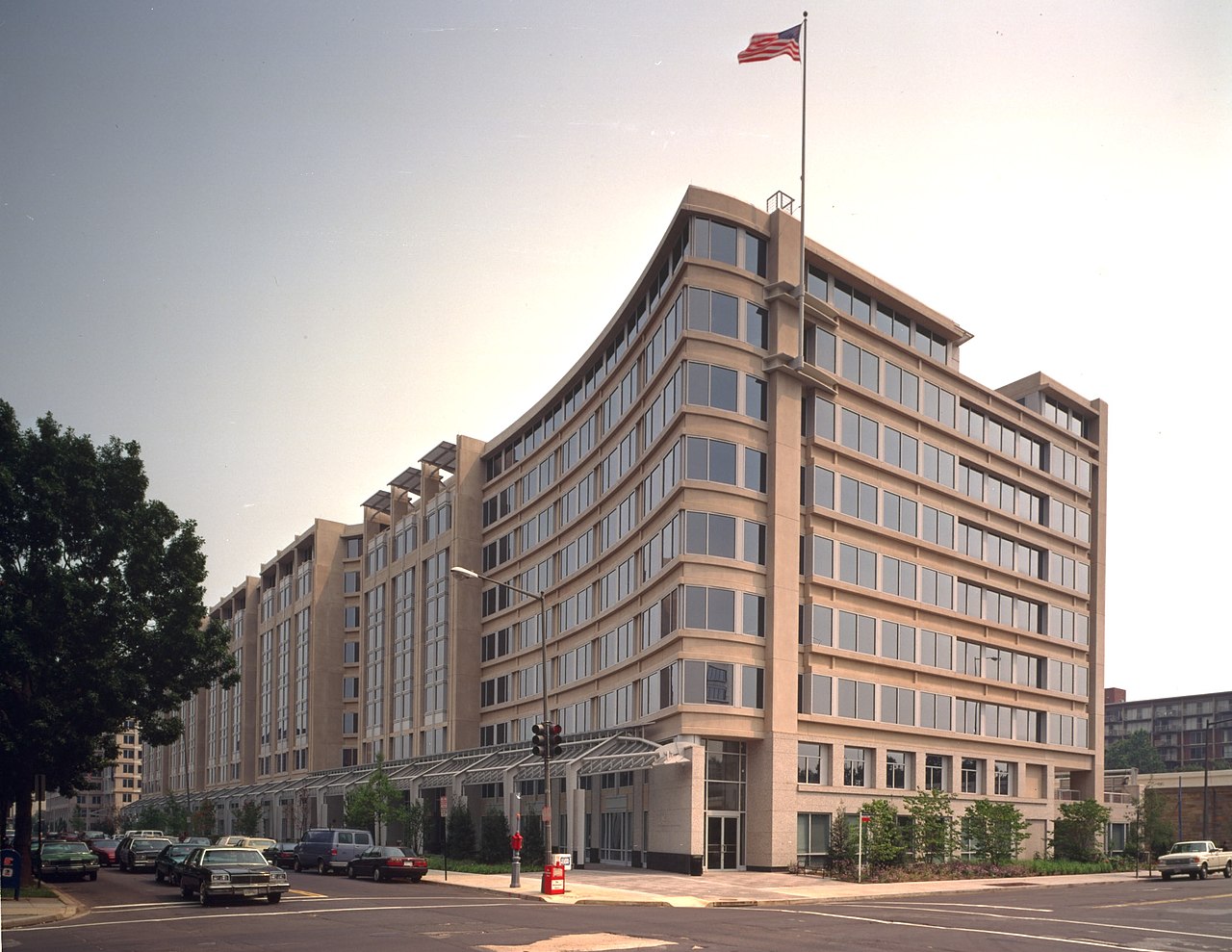
NASA’s rarely-noted administration headquarters at 300 E Street SW, Washington DC. Credit: NASA (1997)

Not only does it manage all of America’s civilian space activities through ten major research and operations centres across the United States (as well as numerous smaller facilities and centres), it continues to carry out wide-ranging aeronautical research and development in what is a continuance of the cutting-edge work started by the NACA more than 100 years ago.

In addition, NASA is involved in R&D and operations across many disciplines and areas of research, including communications; vehicle and transportation safety; environmental monitoring (climate and weather in partnership with the National Oceanic and Atmospheric Administration (NOAA); pollution control, environmental management, global land use, deforestation monitoring, agricultural monitoring, etc (much in partnership with the US Geological Survey, or USGS); research into alterative and sustainable energy systems; nuclear research; multiple avenues of general science research as they pertain to the planet and to healthcare; and in promoting education, science, mathematics and the harnessing of technology through a range of STEM initiatives in the US and around the world.

So, happy anniversary NASA. You may be at retirement age in human terms – but here’s to many more!

Updates

OSIRIS-REx Samples

Previously on Space Sunday (as they say on TV shows) NASA’s ORISIS-REx mission returned to Earth samples captured from 101955 Bennu, a carbonaceous near-Earth asteroid. As we left that story, the sealed capsule containing the estimated 250 grams of material was pending a transfer to NASA’s Johnson Space Centre (JSC), Texas.

The first glove box unit at the ARES facility, JSC, purpose-built to handle the disassembly of the ORISIS-REx sample return capsule so that the samples of asteroid Bennu it contains can be removed for examination and analysis. Credit: NASA / Robert Markowitz

That transfer occurred on Tuesday, September 26th, 2023, with the sample capsule being airlifted from the US Army’s Dugway Proving Ground in Utah, some 31 kilometres from where it landed, to Ellington Field Joint Reserve Base near Houston, Texas. From here the special transpiration container with the capsule inside was move by road to the Astromaterials Research and Exploration Science (ARES) centre at JSC.

ARES is home to the world’s largest collection of “astromaterials” (samples returned from space), and is usually the first US centre to examine such samples brought to Earth by US space missions. As such, it is the ideal permanent home for the OSIRIS-REx samples, and will be the centre that carries out an initial sample analysis and then divvy it up for distribution to research centres around the world and to museums.

How it should have gone – the OSIRIS-REx TAGSAM “touch-and-go” mechanism recovering samples from the surface of asteroid 101955 Bennu in 2020. As it turned out, the asteroid’s surface was so brittle, the sample head and arm smashed through it to a depth of around 50cm.

Continue reading “Space Sunday: happy 65th, NASA!”

2023 week #39: SL TPVD meeting summary

Cloud Island, July 2023 – blog post

The following notes were taken from my chat log transcript of the Third Party Viewer Developer (TPVD) meeting held on Friday, September 29th, 2023, together with the video recording of the meeting made by Pantera Północy, which is embedded towards the end of this summary. My thanks as always to Pantera for making these recordings.

Meeting Overview

  • The TPV Developer meeting provides an opportunity for discussion about the development of, and features for, the Second Life viewer, and for Linden Lab viewer developers and third-party viewer (TPV) / open-source code contributors to discuss general viewer development.
  • As a rule, these meetings are:
    • Generally held once a month  the third or fourth Friday, at 13:00 SLT at the Hippotropolis Theatre. See the SL Public Calendar for specific meeting dates.
    • Open to all with an interest in viewer development.
    • Conducted in a mix of text and voice.
  • The notes herein are drawn from a mix of my own chat log and audio recording of the meeting, and are not intended to be a full transcript.

Viewer Updates

[Video: 0:00-3:17]

The Inventory Extensions RC viewer updated to  version 6.6.15.581961, on September 28th.

The remaining official viewer currently in progress stay unchanged as:

  • Release viewer, version 6.6.14.581101, promoted August 23.
  • Release channel cohorts:
  • Project viewers:

General Viewer Notes:

  • Given the speed at which the Inventory Extensions RC viewer has been iterated of late and bugs addressed whilst also reducing the crash rate, it now looks as if this will be the next viewer to get promoted to de facto release status.

PBR Materials Update

The following was offered in lieu of a CCUG meeting during the week.

Protocol Update

[Video: 1:05-3:16]

  • The communications protocol changes referenced in my recent CCUG meeting summaries (and of particular relevance to the viewer) are with LL’s QA, and also live on a series of regions on Aditi (Rumpus Room 31 through 34. An RC viewer update with the code supporting these changes is pending release until the simulator code has passed QA testing, hopefully in week #40.
  • This change should overcome the bandwidth overload between the viewer and the simulator with respect to scripted PBR updates. It is described as being terser than the current version, using much the same throttling and interest list culling as used in terse updates, and de-couples PBR updates from full object updates.
  • As it is a protocol change:
    • The deployment of the simulator code is liable to be cautious – initially to the Preflight PBR regions on Agni, with testing restricted to those before the update is deployed to the more public Rumpus Room regions on Agni, and then wider (full simulator RC channel?) deployment after that.
    • Some regressions are anticipated as this change gets to be used by a wider audience in Agni testing.

PBR Terrain

[Video: 4:48-5:05]

  • This is an offshoot project from PBR Materials covered in previous TPVD meeting summaries and particularly CCUG meeting summaries). The focus is on applying PBR materials as terrain textures to give an improved look to SL default terrain. It is not terrain painting (this is described as “something that’s on the radar” for possible future implementation).
  • The work includes all supported materials other than displacement maps, and is currently primarily viewer-side, but may be extended into the simulator code.
  •  The focus for Cosmic Linden at the moment is on improving terrain normal maps.

In Brief

Refer to the video for the following:

  • [Video: 5:15-7:20] Github Actions: LL is continuing the work to move their viewer build processes over to Github Actions, and this work is now seen is being “extremely close” to going live for all viewer builds from the Lab. In particular, this will potentially allow TPVs using the same build infrastructure to more readily leverage elements of the LL build process.
    • For example, scripts used to manage the build process under Team City have had to remain private to the Lab, due to the requirement for them to include credentials. With Github Actions, the credentials can be removed, allowing the scripts to become public actions and thus be used by TPVs.
  • [Video: 13:14-22:34]  Code-signing. This follows from the last TPVD meeting, and offered as clarification. Both Windows and MacOS require code signing through different mechanisms. This helps avoid things like anti-virus software and firewalls throwing up potentially off-putting warnings to users trying to install viewers.
    • As a purely speculative point in the last meeting, Vir Linden noted that within Github Actions, the infrastructure the Lab will be using for code signing can be opened-out to allow TPVs to leverage it using their own credentials, potentially helping to smooth the process of code-signing for those wishing to adopt it.
    •  However, it was noted that the problem for TPVs wasn’t so much the code-signing process as trying to keep personal information required by the credentials from being revealed. There has been one known case of this happening, exposing the individual concerned to potential doxing.
  • [Video: 25:44-end] Discussion commencing with building a TPV progressing through message protocols to region identification protocols between viewer and simulator (see this forum thread). It further encompassed:
    • A more general discussion on LSL coding (including the potential for impact on region / simulator / simhost performance), procedural changes to things like object movement to prevent message spamming, etc.
    • Commentary on the viewer stats and that due to the level of inaccuracy involved with the bandwidth /ping and packets in/out statistics, whether this should be removed, or if not removed, should at least be viewed with “a degree of scepticism” in terms of their reliability / accuracy, with the note that tools such as Wireshark / Tracy should be used which accurate stats gathering is required.

TPV Notes

  • [Video 9:24-13:10] Black Dragon is developing an improved first person IK system which constrains the camera to the avatar’s chest position, and which smooths camera turning with the avatar.
    • This has a range of uses, including with weapons / combat, where it allows them to be properly aimed, including up and down.
    • It is also something LL might review and consider for implementation in the official viewer, were the code to be formally contributed.
  • Firestorm has been shadowing PBR development with and “alpha” Firestorm PBR viewer available to a limited cohort of testers, and plan to have an update to that viewer based on the Lab’s protocol updates once the code has been made available on simulators on Agni and the Lab’s PBR RC viewer has been updated with the viewer-side code.

Next Meeting

† The header images included in these summaries are not intended to represent anything discussed at the meetings; they are simply here to avoid a repeated image of a gathering of people every week. They are taken from my list of region visits, with a link to the post for those interested.