Firestorm 6.0.2: Animesh release

On Sunday, February 17th, 2019, Firestorm release version 6.0.2.56680 of their viewer, marking the official release of Animesh support within Firestorm.

This release is essentially a follow-on to the Animesh Early Access release made in December 2018.

Table of Contents

As I covered this in Firestorm 6.0.1: Animesh Early Access, aside from highlighting some of the more user-visible updates in that release, this article provides information on those updates specific to Firestorm 6.0.2.

Please use the table of contents above right to jump to any specific topic of interest. Full details of all changes, and contributor credits can be found in the official release notes.

The Usual Before We Begin

As per my usual preamble:

  • There is no need to perform a clean install with this release if you do not wish to.
  • Do, however, make sure you back-up all your settings safely so you can restore them after installing 6.0.2.
  • Please refer to the official release notes for a full breakdown and changes, updates and credits associated with this release.

Notable Firestorm 6.0.1 Updates

The following is a short update of some of the more user-visible updates present in the Firestorm 6.0.1 Early Access release, presented for the benefit of users who may not have downloaded that version.It includes both Lab-drived and Firestorm-specific updates. For a more detailed overview on that release, please refer to Firestorm 6.0.1: Animesh Early Access.

Animesh

For a detailed overview, see my Firestorm Animesh notes.

Animesh allows the avatar skeleton to be applied to any suitable rigged mesh object, which can then in turn be animated using suitable scripts and animations contained within the object’s Contents. This opens up a whole range of opportunities for content creators and animators to provide things like independently moveable pets / creatures, and animated scenery features.

While Animesh is likely to primarily be used by content creators, it has been designed so that any suitable rigged mesh can be converted to Animesh directly from the Build / Edit floater . Do be aware, however that simply converting an object will not cause it to start animating – you’ll need suitable animations and a script to run them. Like any other object utilising animation, this is done by adding the animations and scripts via the Edit > Contents tab for your converted object.

The best way to get started with Animesh is to use the available resources. These include:

Firestorm Animesh Additions
  • Derender Animesh: depending on your system, Animesh may impose some performance impacts, particularly where a lot of Animesh is active within a scene. To help mitigate this, Firestorm 6.0.2 includes an option to derender all Animesh in a scene (Developer menu > Rendering > Derender All Animesh). Note that this is only temporary, and derendered Animesh will reappear after a teleport or re-logging.
  • Auto-scaling amortisation of the new Animesh dynamic bounding box calculations. This fix limits the overhead of the new dynamic bounding box calculations to AvatarExtentRefreshMaxPerBatch per AvatarExtentRefreshPeriodBatch frames. The default is 5 avatars per 4 frames, so in a busy region, 25 avatars would take 20 frames to refresh the bounding boxes.
  • Performance tweaks by reducing Matrix operations per render pass.
  • More JointMatrix Palette caching tweaks:
    • The cache has been moved to drawable for more benefit (reduces CPU overhead when rendering shadows and materials by caching the jointmatrixpallette).
    • Sacrifices some potential cache locality but savings seem to outweigh this.

Other Notable 6.0.1 Updates

Additional updates in the Firestorm 6.0.1 pre-release worth noting are:

  • Mesh Uploader (for full details on the mesh uploader changes, please refer my Firestorm Mesh Uploader notes): Beq Janus has overhauled the mesh uploader to improve its use and the information it provides. She has also provided comprehensive documentation on these updates, which are summarised below:
    • Upload cost and physics cost calculation breakdowns – see image below for more.
    • Physics details, the costs of the different types of physics (convex hull, prim).
    • Resizable preview window with higher resolution image and improved shading/lighting.
    • Correct highlighting of degenerate mesh.
    • Improved error handling for physics models (avoid some MAV errors).
    • UV Guide overlay.
    • Note Firestorm 6.0.2 includes further updates to the uploader
  • Experimental Teleport Attachments Fix (Debug Settings > FSExperimentalLostAttachmentsFixKillDelay): a timer delay designed to prevent attachments from being detached temporarily after a teleport has completed.  Works with FSExperimentalLostAttachmentsFix when set to TRUE; set to 3 seconds by default.
  • Left-click None option (Build Menu):  allows transparent prims / mesh to be clicked-through that might otherwise be in the way when trying to touch other objects (via LL).
  • Auto Replace for Note Cards: dynamic replacement of text within note cards when the Auto Replace function for spelling is enabled via Preferences > Chat > Typing > Auto Replace (see the Firestorm wiki on Auto Replace).

Linden Lab Derived Updates in Firestorm 6.0.2

This version brings Firestorm up to parity with Linden Lab release viewers through to release version 6.0.1.522263 (formerly the Spotykach RC viewer, promoted on December 13th, 2019. Major updates in that release include:

  • Voice Server:
    • Second Life: Vivox version 4.9.0002.30313 (Mac and Windows) (Opensim: Vivox version 4.6.0017.22050 (Mac and Windows); Linux: Vivox native voice version 3.2.0002.10426, Firestorm only).
  • Chromium Embedded Framework (CEF) Dullahan:
    • Dullahan: 1.1.1080
    • CEF: 3.3325.1750.gaabe4c4.513446
    • Chrome: 65.0.3325.146
    • Page of test URLs for Dullahan. With the Developer Menu enabled (Ctrl Alt Q) press Ctrl-Shift-Z then the Home page button.

Firestorm 6.0.2 Updates

Appearance and Inventory

  • The Avatar menu includes new short cut for the Avatar > Avatar Health > Refresh Attachments option (Alt-Shift-R).
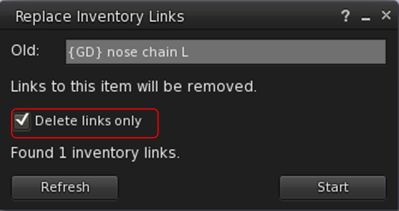
  • Replace Links – Delete links check box

    Inventory: Delete Links: the Replace Links inventory option now includes the ability to delete all links to an object:

    • Open your inventory.
    • Locate the object which has links you wish to delete (or one of the links themselves). Right click on the item / link and select Replace Links.
    • The Replace Links dialogue box opens, recording the object link name, the option to replace it with a new name and a new Delete Links Only check box.
    • Click the Delete Links check box to activate it. The Replace field in the dialogue box is replaced by the warning Links To This Item Will Be Removed.
    • Click Start to delete all links.
  • Experimental Lost Attachments Report (Debug Settings > FSExperimentalLostAttachmentsFixReport): when enabled, this reports attachments that were attempted to get detached during a teleport or region crossing to nearby chat.
  • Inventory should no longer automatically opening to show new items regardless of settings (FIRE-23476).
  • Enabling Disable Random Eye Movements (Preferences > Firestorm > Avatar > Disable Random Eye Movements) will no longer cause the avatar’s hands to splay (FIRE-23457).

Build Updates

  • Revisions and updates to the mesh uploader introduced in Firestorm 6.0.1
    • Allow intentional degenerate placeholders – this fixes the problem of “Physics mesh too dense” false positives (FIRE-23367 and FIRE-23387).
    • Allow override of client side mesh validation as a workaround for edge cases and different grid validation.
      This effectively restores previous server-side MAV error dialogues alongside client-side warnings.
    • Fixed up 3-point lighting (so it has 3 points) that was messed up in a rogue merge.
    • Fixed up black bar in mesh preview when the mesh uploader is used with low resolution screen (FIRE-23340).
    • Increased panel height to avoid warning message overlapping.
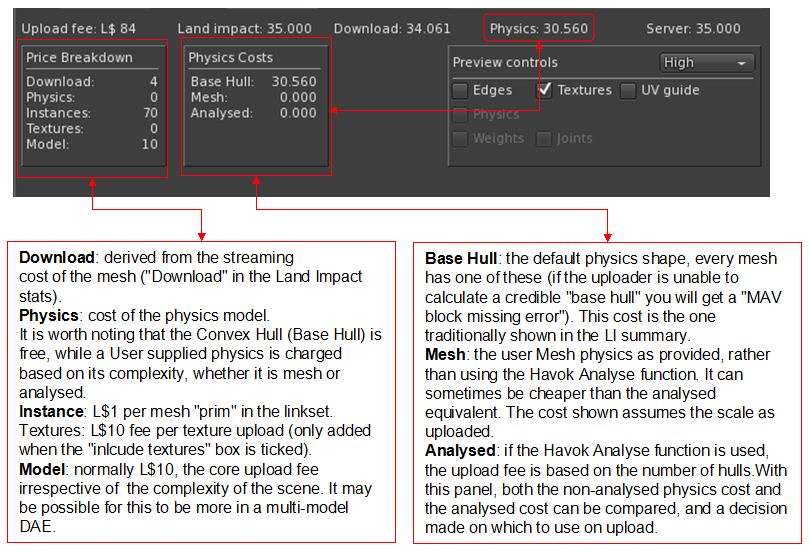
Mesh Uploader: new cost calculations breakdown elements by Beq Janus – see Firestorm 6.0.1: Animesh Early Access

UI Updates

  • Texture picker should no longer open the wrong floater when pressing space in preview mode (FIRE-23582).

RLVa Updates

Firestorm is still using RestrainedLove API: RLV v3.2.1 / RLVa v2.2.0.56680.

@setgroup Throttle

With Firestorm 6.0.2 @setgroup is throttled to one (unowned) call every 60 seconds across all objects. An object a @setgroup lock may bypass this throttle once, to allow @setgroup=n,setgroup:[;]=force to succeed regardless of any/other objects’ command history.

This will break all animated group tag cyclers introduced after the @setgtoup feature was added to Firestorm 5.1.7. However, it has been introduced at Linden Lab’s request due to the performance issues multiple frequent @setgroup calls were causing (each call generates a database write). Further, Linden Lab will shortly be introducing a server-side throttle to active group changes and group role changes, and so @setgroup will be broken in any viewer using it.

Please do not blame Firestorm or any other TPV using @setgroup for this change. There is nothing that can be done about it, given the forthcoming server-side throttle. We did attempt to contact all the sellers of these group title animators on the Marketplace many weeks ago to warn them that the feature had to be removed & sadly only one creator removed their listing.

Other RLVa Changes
  • New ‘RLVaSplitRedirectChat’ setting: splits long chat lines when @redirchat restricted.
    • Debug: RLVaSplitRedirectChat) – set to TRUE.
    • Menu bar > RLVa > Split Londe Redirected Chat
  • Fixes for:
    • @setoverlay_alpha causing a diagonal line to appear on the rendered texture.
    • @shownames exceptions should not have their name anonymised in nearby chat.
    • @shownames exceptions not having the correct colour on the minimap (FIRE-23473).

Other Updates of Note

  • FMOD Studio updated to version 1.10.10.
  • KDU updated to version 7.A.6.
  • Firestorm application icon should no longer randomly flash on the Windows 10 taskbar (FIRE-23498)
  • Fix for the camera floater zoom glitch (FIRE-23470).
  • Firestorm should no longer crash when adding a large number of users to a contact set.
  • Firestorm should correctly request microphone permissions on OS X Mojave (FIRE-23405).
  • The context menu in scroll lists (LLScrollListCtrls) can now be opened with the Windows keyboard (FIRE-19933).
  • Skinning and translation updates – see the release notes.

Feedback

Not a major update, unless you skipped the 6.0.1 early access. As with that release, the core element for 6.0.2 is Animesh, together with the revised mesh uploader for content creators.

Performance-wise, I’ve found Firestorm 6.0.2 to be equitable to Firestorm 6.0.1. Other than this, not a lot to report.

Links

Kokua 6.0.1.44611/619

On Saturday, January 26th, 2019, the Kokua viewer updated with the release of version 6.0.1.44611 (no RLV) and version 6.0.1.44619 (originally .44610).

The RLV version of the viewer initially brought the RLV version of Kokua to parity with RLV 2.9.25, released on January 25th. However, that release had a bug in it, forcing Marine Kelley to issue a hot fix release, version RLV 2.9.25.1 on January 26th, which was quickly adopted by the Kokua team into Kokua 6.0.1.44619. Outside of this fix, .44619 is functionally identical to .44610.

RLV Updates

The RLV updates can be summarised as:

  • Force a rebake whenever attachments and wearables are changed.
  • Prevent the avatar from going into T-Pose while editing an attachment that has been worn only for a few seconds.
  • When in Mouselook, don’t show rigged attachments that are worn on any head attach points.
  • Optimise the rendering of the vision restriction spheres.
  • Remove the artificial far touch restriction when vision is restricted, to allow objects to beyond an avatar’s visual range to be touched.

Kokua Updates

Both the .44611 and .44619 releases include the following updates from the Kokua team:

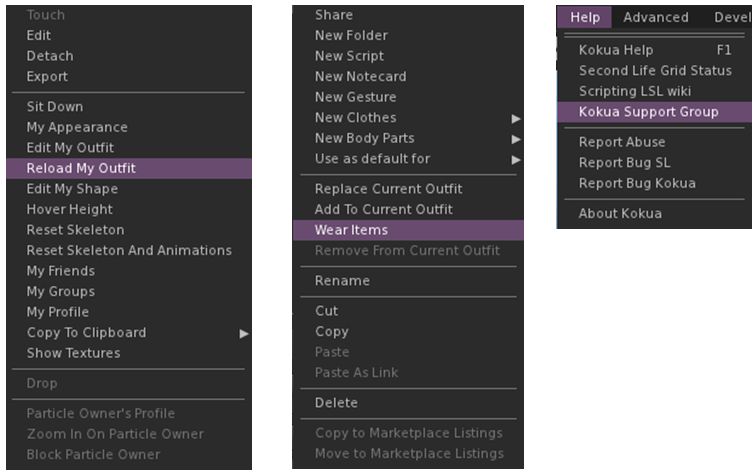
  • New Avatar right-click context menu option Reload My Outfit: this can be used to resolve clouded logins by manually forcing another attempt to wear the default outfit, effectively adding the current outfit onto itself.
  • Addition of Firestorm’s Wear Items option added to the inventory folder right-click menu. This causes the wearable items in the folder to be worn, replacing any items on the corresponding attachment points.
  • Reinstatement of the Help > Kokua Support Group option to obtain in-world help from other users (issues / bugs should still be filed via the Kokua Sourceforge support option).
The new right-click avatar content menu option Reload my Outfit (l); the right-click Inventory context menu option Wear Items (via Firestorm); and the reinstated Help menu > Kokua Support Group option (r)
  • Removal of the following menu options:
    • Disable Build Constraints (no longer supported by Second Life servers)
    • Texture Memory Stats (there was no code behind this menu entry, so it would always do nothing)
    • Toggle PG (again, there was no code behind this option)
  • Addition of various Firestorm improvements to login, inventory handling and outfit wearing.
  • Internal changes to make the performance statistics code more efficient.
  • A switch to using Linux GCC V7 from V5 for compilation.
  • Fixes for a number of errors in the XML configuration files for menus and floaters. These reduce the number of entries written to the log files and provides a small performance benefit.

I’ve not had time to drive this viewer following the release, so cannot comment on general performance, etc. However, as chance would have it I did get the chance to try the Reload My Outfit option, which seemed to work pretty well.

Kokua 6.0.1 updates

The last version of Kokua I looked at in these pages was version 6.0.0, which primarily added Animesh functionality to Kokua.

Since that time, there have been a number of further updates, up to and including 6.0.1.44454 (RLV), and this article is intended to catch up to the current releases. In short, the intervening updates have been:

  • 6.0.0.44291 (RLV), November 29th, 2018: focused on parity with Marine Kelley’s RLV 2.9.24.
  • 6.0.0.44301 (RLV for Windows), December 8th, containing RLV bug fixes and four new RLV information panels.
  • 6.0.1.44374 (RLV) and 6.0.1.44375 (No RLV) for Windows, Mac and Linux, released on December 13th.
  • 6.0.1.44454 (RLV), December 17th, 2018 for Windows, Mac and Linux – essentially a bug fix release for a issue with the 6.0.1.44374 (RLV) release.

In addition, the 6.0.1.44374/44375 updates saw Kokua merged to parity with the (at the time of writing) current SL viewer release, version 6.0.1.522263, formerly the Spotykach Maintenance RC viewer, promoted by the Lab of December 13th, 2018 (release notes here).

It is the the 6.0.1.44375 and 6.0.1.44454 (RLV) updates that I am focusing on in this update, together with an overview of the new RLV panels introduced with 6.0.0.44301.

Menu Restructuring

The major visible change to both 6.0.1.44375 and 44454 is a revised menu structure. Up until now, Kokua has used the legacy (going back as far as v1 viewers) initial menu structure of  File, Edit and View, as opposed to the Me, Communicate and World options found in the official viewer and followed by (for the most part) most other v5/v6 viewers.

To help Kokua users gain familiarity with the new menu structure, the Kokua team have produced a document outlining how and where options have been moved between menus in converting them from the old format of File, Edit and View to the more standard Me, Communicate and World.

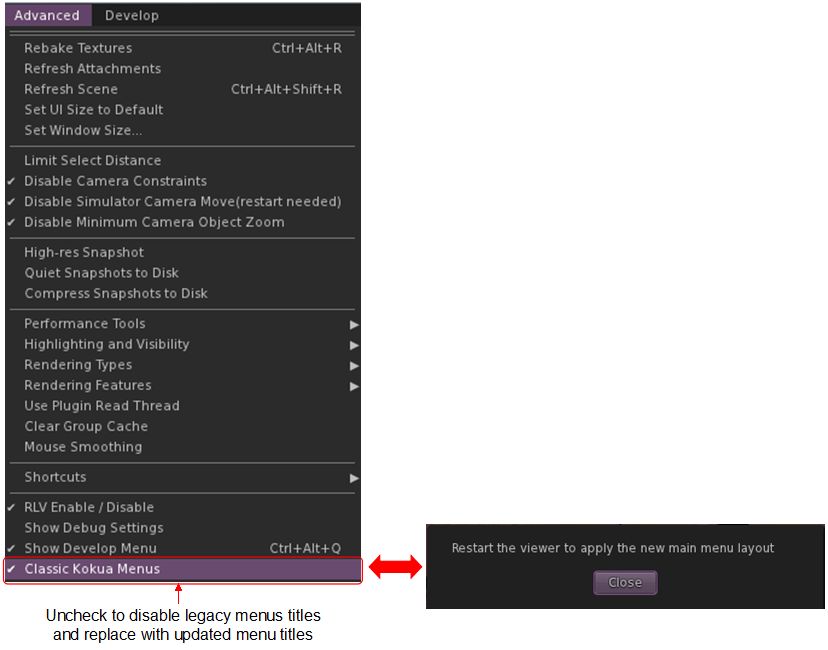
Advanced menu > Classic Kokua Menus allows users to toggle between the “legacy” (File, Edit, View) and “current” (Me, Communicate, World) menu titles. A restart is required for each change to take effect

By default, the new menu structure is OFF, to avoid the risk of confusion for users not expecting the change. For those wishing to to use the new menu system, it can be enabled via Advanced menu > unchecking Classic Kokua Menus. The viewer must be restarted to apply the change. This option can also be used to switch back to using File, Edit, View, if desired (again with a viewer restart required).

RLV Updates

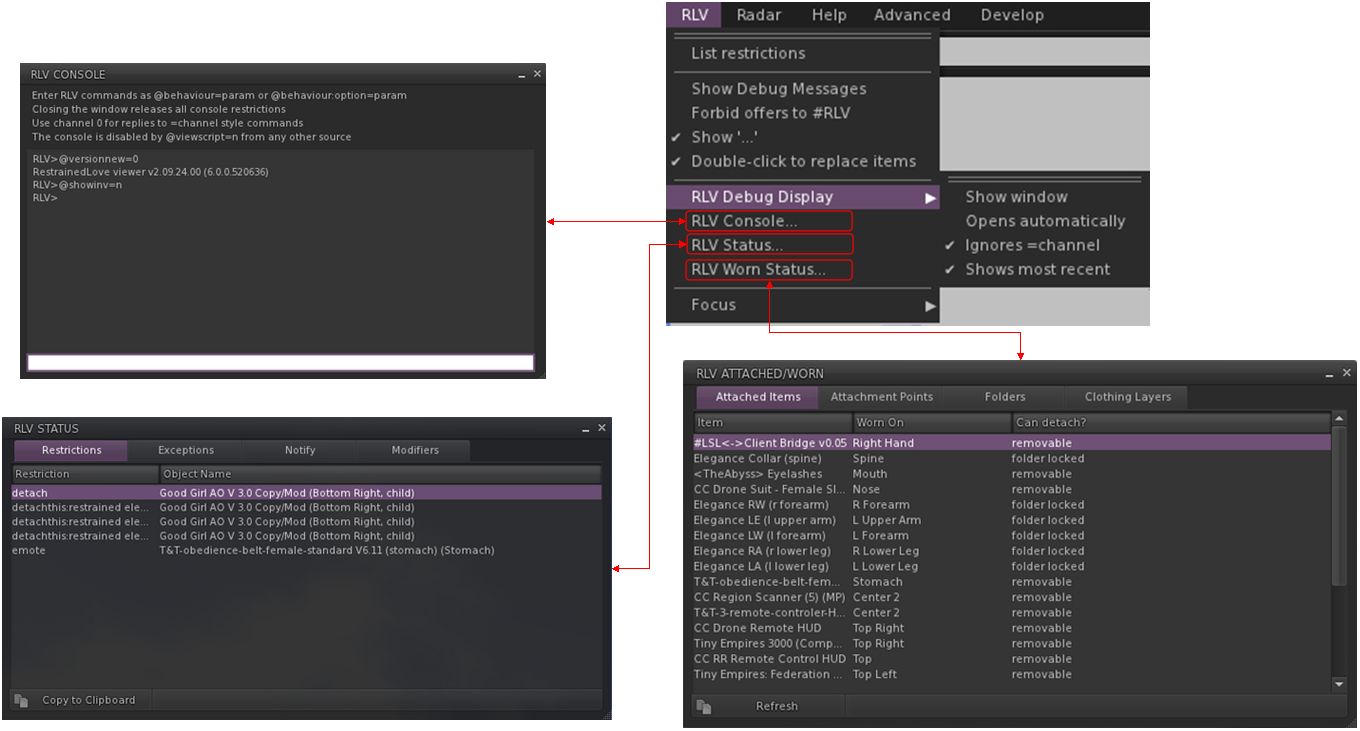
Kokua 6.0.1.44301 implemented a new set of RLV diagnostic panels designed to assist RLV users, as these were initially only available in the Windows version of the viewer, I’m covering them here, as they are now available on all OS flavours of Kokua.

The new panels are a combination of code from the Script Error window found in the standard viewer, and some code from the RLVa implementation within Firestorm. They’ve been designed by Chorazin Allen of the Kokua team, who gives full credit for the base code used, although as he notes, the operation of the panels based on Firestorm’s RLVa implementation have been substantially modified to work with RLV and his own design preferences.

The new panels are all accessed via the RLV menu, which includes a new section for the panels, shown on the top right in the image below.  Chorazin also provides a comprehensive guide to their use, and I refer RLV users to that document for further information.

The new RLV windows – click for full size, and also refer to New RLV Information Windows on the Kokua viewer blog. Console, Status and Attached / Worn panel images via the Kokua website

From 6.0.1.44374 (RLV) to 6.0.1.44454 (RLV)

Version 6.0.1.44374 (RLV) and 6.0.1.44454 (RLV) are functionally identical to one another with the exception of the Out Of Character (OOC) functionality – that is, the use of “((” and “))” in text during role-play to indicate comments / messages that should not be considered part of the on-going role-play exchanges.

In short, a change was implemented in RLV 2.9.24.1 that affected how OOC chat is handled when a user is under certain RLV restrictions. However, the change broke the OOC chat processing logic. While not a problem for the dedicated  RLV third-party viewer, it has caused problems for Kokua users (see OOC chat with (( )) not working with Kokua RLV 6.0.1.44374).

6.0.1.44454 fixes the issue through the provision of two new options in Preferences > Kokua > General:

  • Allow OOC chat using (()) (requires restart): enabled by default, this must be checked in order for OOC chat to work at all. If it is disabled, all OOC will appear as “…” in local chat. So, only disable this option if you do not want to see OOC in local chat at all (as the option notes, you will have to restart Kokua when enabling / disabling this option).
  • Send OOC chat to redirected chat rather than local chat – enabled by default. This has two functions:
    • When enabled and applicable RLV restrictions are in operation, all OOC chat goes to redirected chat handlers and it will not appear in local chat.
    • When disabled, the expected OOC behaviour applies, and OOC chat will appear in local chat in the usual (( and )) parentheses.
    • This option can be set independently to the first, and does not require a viewer restart.

You can find out more about this update in Kokua 6.0.1.44454 – RLV OOC chat handling fixed.

Additional Links

Firestorm 6.0.1: Animesh Early Access

On Sunday December 16th, 2018, the Firestorm team issued Firestorm 6.0.1, which includes Animesh support.

Note that this update is being classified as a “public beta”, because further Firestorm-specific Animesh optimisations are being planned. This means there will be a further “full release” is being planned for  January 2019.

However, while Firestorm 6.0.1.56538 may be classed as a”beta”, it should be considered as stable and as bug-free as any previous release.

In keeping with my usual approach to Firestorm releases, what follows is an overview of the release, highlighting some of the more significant changes I feel will be of most interest to users.

Please use the table of contents on the right to jump to any specific topic of interest. Full details of all changes, and contributor credits can be found in the official release notes.

Table of Contents


The Usual Before We Begin

As per my usual preamble:

  • There is no need to perform a clean install with this release if you do not wish to.
  • Do, however, make sure you back-up all your settings safely so you can restore them after installing 6.0.1.

Note that as a beta release, Firestorm 6.0.1.56538 will not overwrite any existing release version of Firestorm you may have installed, but will be installed into a separate folder / location. However, note that swapping back and forth between this beta and another version of Firestorm will wipe your cache each time.

Lab Derived Updates

Core Updates

This version brings Firestorm up to parity with Linden Lab release viewers through to version 6.0.0.520636 (Animesh), including the recent Rakomelo, Quinquina and Hear No Evil, Speak No Evil Maintenance viewers, and incorporates Vivox Version 4.9.0002.30313 (Mac and Windows).

Animesh

For those who may be unaware of it (!), Animesh allows the avatar skeleton to be applied to any suitable rigged mesh object. This, together with suitable animations and scripts placed within the contents of the object, allow it to be animated in much the same way as the Second Life avatar. This opens up a whole range of opportunities for content creators and animators to provide things like independently moveable pets / creatures, and animated scenery features.

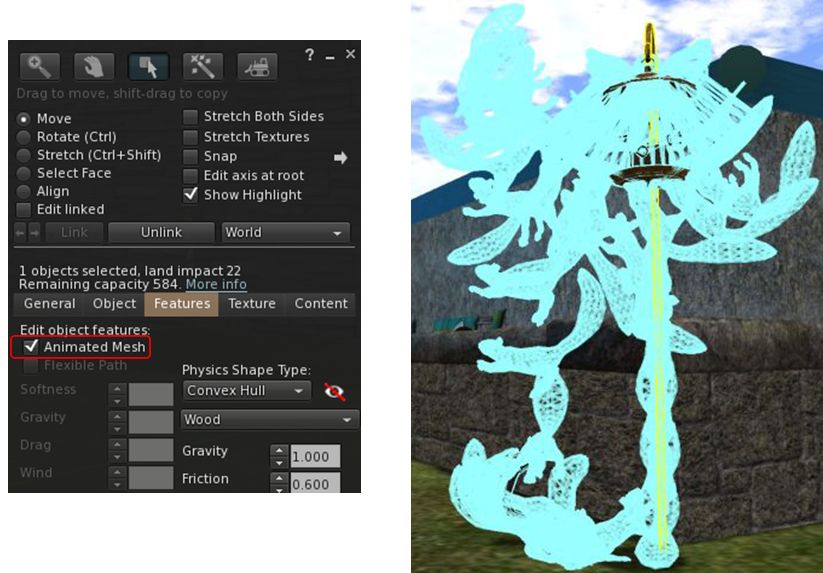
While Animesh is likely to primarily be used by content creators, it has been designed so that any suitable rigged mesh can be converted to Animesh directly from the Build / Edit floater (see below, left). Do be aware, however that simply converting an object will not cause it to start animating – you’ll need suitable animations and a script to run them.

Like any other object utilising animation, this is done by adding the animations and scripts via the Edit > Contents tab for your converted object.

Left: any suitable rigged mesh object can be converted into Animesh by adding animation scripts and toggling the Animesh check-box in the viewer. Right: one possible outcome of Animesh is that over time, it might discourage the use of alpha-flipping to simulate animation. This involves creating multiple versions of something like an animal (or parts of an animal) and then using a script to reveal them in turn, while keeping the other hidden with alpha masks. While it results in simulated animation (such as a squirrel climbing a bird feeder), alpha flipping is very performance / rendering intensive (r)
How To Get Started With Animesh

The best way to get started with Animesh is to use the available resources. These include:

Firestorm Animesh Additions

Derender Animesh: Despite the hoped-for performance improvements Animesh might allow when compared to alpha flipping, these will be the potential for performance impacts in regions / parcels with a large number of Animesh objects moving around.

To help mitigate this, Firestorm 6.0.1 includes an option to derender all Animesh in a scene (Developer menu > Rendering > Derender All Animesh).

Note: Derendered Animesh will reappear after a teleport or re-logging.

Also, Firestorm includes a number of other Animesh tweaks:

  • Auto-scaling amortisation of the new Animesh dynamic bounding box calculations. This fix limits the overhead of the new dynamic bounding box calculations to AvatarExtentRefreshMaxPerBatch per AvatarExtentRefreshPeriodBatch frames. The default is 5 avatars per 4 frames, so in a busy region, 25 avatars would take 20 frames to refresh the bounding boxes.
  • Performance tweaks by reducing Matrix operations per render pass.
  • More JointMatrix Palette caching tweaks:
    • The cache has been moved to drawable for more benefit (reduces CPU overhead when rendering shadows and materials by caching the jointmatrixpallette).
    • Sacrifices some potential cache locality but savings seem to outweigh this.

Other Lab-Derived Updates

Additional Lab updates worth noting are:

  • BUG-216339Add a  Click to: action to the Build / Edit floater to disable clicking objects that can be set per-object in a linkset – see Left-Click None Option, below, for more.
  • BUG-216416 – Add a transparency indicator for invisiprims. When “Highlight Transparent” (CTRL+ALT+T) is used, invisiprims will now be highlighted in green.
  • BUG-225670 – Include the full Windows 10 build number in Help > About Second Life and logs
  • TextureLoadFullRes setting no longer persistent, to avoid issues with accidentally setting it on systems which cannot handle the memory load.
  • The CTRL key must be held when dragging inventory folders into in-world objects. This change was primarily made to address accidental inventory “loss” by dragging a folder of no copy items into an in-world object.
  • Fix for your avatar not standing up after pressing Shift+Alt+S keyboard short-cut.

Continue reading “Firestorm 6.0.1: Animesh Early Access”

Firestorm’s Pets for New Residents 2018

Do you have a wearable / follow pet that you no longer use, and that is Transferable? Why not donate it to the Firestorm team for gifting to a new SL user this Christmas?

You may remember that in August, the Firestorm team ran a fun-raiser, asking people to donate their unwanted gacha items?

Well for the end of 2018, they are again asked for the donation of items – but this time with a very different aim in mind, as they explain in the following  Firestorm wiki article:

With Christmas around the corner we think of ways to spread the cheer and give gifts to those who are dear to us. This Christmas, how about extending that love to the ones brand new to Second Life, to let them see what a wondrous place they have entered with loving and generous people.

Every year we are presented with amazing new pets from talented creators and they seem to get better and better with each new creation. And although they are just virtual companions, these pets have the ability to make the times we are here without human contact seem less lonely. They transcend the realm of mere fashion accessories to a loving addition to this our Second Lives.

When the new loves come along, our past companions are packed away in a folder, maybe to come out another day. So why not make that day today and why not pass them on to be loved by another.

Many entering Second Life are shy and overwhelmed with learning the basics. Having a virtual friend and companion to share those first tentative steps with could make a world of difference. Just think your well-loved pet going on to give the warmth of friendship to another, touching their second lives and bringing joy to their hearts.

So for December 2018 make it a true month of giving and pass on your Ex-Loved pets so that they too get a chance at a Second Life.

Kindly contact Kio Feila and entrust her with your Ex-Loved Pets and know that they will be warming the hearts of someone new this Christmas.

Christmas is, as they say, the time for giving. So, if you do have a pet or pets now forever kennelled, caged or locked in a folder in your inventory, and which do have suitable permissions for passing them on to others,  why not follow the article’s suggestion and donate them so that they might get to have a second life with a new owner? Just drop a line to Kio via the link above!

Kokua goes Animesh with version 6.0.0

On Sunday, November 18th, 2018, Kokua issued version 6.0.0, which includes full Animesh support. As always with Kokua, the viewer is offered in two options:

  • With RLV support: 6.0.0.44120.
  • Without RLV support: 6.0.0.44121.

Both of these options are, again as always, available for Windows, Mac OSX and Linux.

As well as Animesh support, the update includes a series of third-party updates and additional bug fixes.

Animesh

As per my release overview, Animesh has been in development for about a year, and like Bento, has been a collaborative effort between Linden Lab and Second Life content creators. Essentially, it allows the avatar skeleton to be applied to any suitable rigged mesh object, and then used to animate the object, much as we see today with mesh avatars. This opens up a whole range of opportunities for content creators and animators to provide things like independently moveable pets / creatures, and animated scenery features.

Rigged mesh can be set to be used as Animesh through the Build / Editor floater

To help people get started with Animesh, there is already a range of available resources, including:

In particular, the user guide and test content offer the best way of getting started with Animesh for those who haven’t tried it thus far.

And, Animesh isn’t just for content creators: it has been designed such that just about any rigged mesh can be converted to Animesh directly from the Build / Edit floater. Do be aware, however that simply converting an object will not cause it to start animating – you’ll obviously need suitable animations and a script to run them.

Like any other object utilising animation, this is done by adding the animations and scripts via the Edit > Contents tab for your converted object. If you’re not a scripter / animator, you can still use the Animesh test content and have a play around with things.

Additional Updates

The 6.0.0 release of Kokua re-introduces the NACL viewer sound explorer (found under World > Sound Explorer). In addition, a number of options have been ported from Firestorm:

  • The animation explorer (under World > Animation Explorer).
  • The Money Tracker/Tip Tracker (View > Money Tracker).
  • Phoenix-style extended hovertips (View > Highlighting & Visibility > Hover Tips > Show More Information).
  • Avatar Complexity score in name tags (Edit > Preferences > General) along with the Only If Too Complex and Show Own Complexity options.
Kokua adds Firestorm’s approach to display avatar complexity information

Other updates comprise:

  • A bug fix so that Turning on Full Res Textures works.
  • If RLV is active, the Message Of The Day will appear in chat at login as a substitute to it being suppressed on the login progress screen.
  • Further ports of:
    • Reporting the latest grid status bulletin in chat at login (Edit > Preferences > Notifications).
    • The ‘do not hide worldmap after teleport’ option ( Edit > Preferences > Kokua > General).

I’ve not had time to take the viewer for a thorough test of the viewer, and the Kokua team note they’ve not had the opportunity to test Animesh. Therefore, If you see any strange behaviour please check it against the LL viewer and then either raise a Jira ticket on the LL viewer or against Kokua at: https://sourceforge.net/p/team-purple/kokua/tickets/.

Additional Links