The following is summary of changes to SL viewers / clients (official and TPV) which have taken place in the past week. It is based on my Viewer Round-up Page, which provides a list of all Second Life viewers and clients that are in popular use (and of which I am aware) and which are recognised as being in adherence with the TPV Policy.
This summary is published every Monday, and by its nature will always be in arrears. Therefore, for the most up-to-date information on viewers and clients, please see my Viewer Round-up Page, which is updated as soon as I’m aware of any changes, and which includes comprehensive links to download pages, blog notes, release notes, etc., for Viewers and clients as well as links to any / all reviews of specific viewers / clients made within this blog.
Updates for the week ending: 22 July, 2012
SL Viewer updates:
Beta version:3.3.4.262068, July 18
Development: rolled to 3.3.5.262070, July 18
Niran’s Viewer rolled to 1.44 on July 16th – core changes: use of LL’s Viewer rendering code; performance improvements; faster rendering of shadows, local lights, occlusion, etc.; integration of tone mapping from the Exodus Viewer
Singularity rolled to 1.7.0 on July 16 – core updates:- Multi-Wear release; general graphics engine update; region windlight support; RLVa partial update to 1.4; LSL editor update; sound system bug fixes & new sound system FMOD Ex; mouselook gun aiming incorporated; new build preferences; radar now indicates gesture/sound/particle/animation spam; holding Shift while crouching works as crouch toggle (release notes)
LittleSight was added to my list of Android clients on July 22 – review here
Cinder Roxley pointed me towards LittleSight, a simple SL client for Android.
The application has been around for at least a year or so, going on the download page comments, and is now at version 1.0.4 (reviewed here). There does not appear to be any dedicated website for the application, and it is not listed in the TPV Directory.
Compared to the likes of Mobile Grid Client and Lumiya, the functionality is extremely limited, however, if you want a quick means of accessing SL on-the-go for the purposes of IMing others, it may offer something to you.
The application is free – although it limits you to being logged into a random location and will display ads at the top of the screen. You can unlock additional log-in options and remove the ads on payment of around $1.28 / 1.05 Euros / 0.82 GBP via Google play.
Once installed, LittleSight is simple to use. The log-in screen comprises fields for your user name and password, with an option to save the password for future use.
log-in: unpaid (l); paid (r)
As mentioned above, using the application in unpaid mode will log you into a random location (this used to be “Yamato of Japan”, but the region no longer appears to be active). If you opt to pay for the application (via the Start At button), tapping the Start At button will present three further options in addition to “Yamato of Japan”:
The last location you visited
Your home location
Any named region (default arrival point: 128,128 – SLurls do not appear to be supported).
Once logged-in, you are presented with a simple and clean (other than the ads in the “unpaid” mode) interface. At the top are four buttons:
Chat – will display all local chat going on around you (if any), with avatar name / profile pictures displayed against their text. Tap the text input box to open your on-screen keyboard and start chatting
IM – allows you to display IM conversations and converse one-to-one
People – displays a list of people nearby / friends on-line
Map – displays a map of the region you’re currently in.
In addition, two further on-screen buttons – Logout and Settings can be displayed by tapping the menu button on your device..
People
Logging-in opens the People display by default. This may display a list of people within chat range (if any) and / or your friends who are also on-line (if any).
People nearby (l) and people nearby & friends on-line (r) (note ads displayed in “unpaid” version)
If none of your friends are on-line and no-one is within chat range, all that is displayed are the list headings at the top of the screen.
Long-touching a name in either list will initiate an IM conversation (see below).
IM Conversations
Starting an IM conversation requires a little bit of screen-swapping. First you need to long-touch the name of the person with whom you wish to converse via either the Chat screen or the People screen. In either case, you’ll see a pop-up prompting you to Send IM. Tapping on this will swap you to the IM display, with the name of the person you are about to IM displayed at the top and text entry field immediately below it. Enter your message and tap SAY.
Any new incoming IMs are automatically sent to your IM display, and you can respond to them directly from there.
IM only displays one conversation at a time – to swap conversations, tap on the name of the person with whom you are currently conversing. This pops-up a list of all active IM conversations. Tap the name of the person you wish to switch to in order to display the conversation.
IM conversations display and swapping between conversations (tap the name of the person you are currently IMing to display a pop-up list)
Logs
LittleSight automatically logs and saves all chat and IM conversations, some / all of which is automatically displayed on opening Chat or when initiating an IM conversation with someone you’ve previously IM’d. logs can be deleted through the Settings options (see below).
Map
Map display
The Map option offers a reasonable image of the region you are in, with avatars displayed as familiar green dots. Tapping on any dot will display the name of the avatar at the bottom of the map. You own avatar is displayed by a dot which is slightly larger than those of other avatars, having a yellow circle around it. The only real annoyance with the map is that the region name isn’t displayed; given log-ins can be random, it would be nice to work out where you are rather than having to ask a passer-by.
Settings Options
The application includes a number of settings options, which are accessed via the menu button on your device and then tapping the on-screen Settings button. From here you can:
Set the application to display an icon in the status bar of your device when it is running
Prevent the screen of you device from sleeping when the application is running
Set audible (ringtone) or vibration notifications when friends log-in to SL, someone logs-in nearby, when you receive chat or IMs
Delete the Chat and / or IM logs. Note that when you do this, the Chat and IM displays will be cleared of all current conversations as well.
Issues
Several reviews on the LittleSight Google Play page indicate problems when using the application, particularly on Motorola Droid devices. While the application has, for the most part, run OK on my Samsung Galaxy S2, I did encounter a problem which I could only resolve by re-installing the client. This manifested in the application crashing while entering my log-in credentials, then repeatedly force-closing on me, which not even a shut-down and restart of my ‘phone would clear. The re-install did finally resolve the issue as a last resort, which has since not recurred.
Feedback
LittleSight is a simple, lightweight and largely intuitive SL client. The displays are all clear, and conversations in chat / IM are easy to follow are displayed well, with names (and profile images) appearing against text entries, complete with time & date stamps. If chat / IM is all you feel you need when accessing SL when away from your computer and you’ve not tried a mobile client before, then it might be worth a go.
However, if you already have the likes of Mobile Grid Client and Lumiya, LittleSight really has little to offer. Similarly, if you need mobile access to SL to do more than chat / IM, you’ll probably be better-off looking elsewhere.
Following-on from the TPV/Developer meeting on the 13th July, during which pathfinding was discussed, and the recent roll-outs of pathfinding functionality to the Magnum Release Channel, the Firestorm team have announced that they will be adding pathfinding support to upcoming releases. The announcement reads in part:
What’s next…Pathfinding! We’ve decided to release LL’s Pathfinding work in Firestorm in two stages.
Unless LL changes the current plan, when Pathfinding goes live, all regions will have pathfinding enabled by default, and all objects that contain scripts will be treated as “Movable Obstacles.” Movable Obstacles will have an impact on region performance, so region owners will need tooptimize their regionsby setting scripted objects that don’t move to “Static Obstacles.” To do this, you will need Pathfinding Tools!
So our plan with our next release is to get Pathfinding tools out as soon as we can. This will be based on our 28744 release + post 28744 crash fixes + LL Pathfinding code. There have not been many new additions beyond that since the release, and this is for the best: we expect this code will destabilize the viewer to a degree, since it will be a large merge, and we’d rather base this version on a solid release than on a wild card.
Stage 2 (follow-up release). Release with the Havok Library for NavMesh. Havok will be used to enable viewing of NavMesh, display of object types and AI Preview of object paths.So the second Firestorm release from now will have Havok + stability fixes to the previous release + more of our own goodies.
The two-stage release is unsurprising, given Lorca Linden’s recommendations at the meeting on the 13th July. At this time, no time-scales are available for the releases, because, as Jessica points out in the post:
How soon? Great question, and a very tough one to answer since there are many factors involved that we have little control over. Like…
LL’s timeline to release Pathfinding;
How much Linden code we have to merge into Firestorm;
How many regressions and new bugs we pick up from that merge;
How long it’ll take us to fix them, etc.
But we want to get these out as soon as we possibly can once it’s live on the grid.
Phoenix
Phoenix will not immediately be getting pathfinding due to the amount of work involved in getting the capabilities integrated into Firestorm. Region holders using Phoenix will still be able to disable/enable pathfinding using a viewer-independent console, but for all else they will need to switch to a viewer that supports the full pathfinding tool set.
Update: The tiling fixing reached the SL viewer in December 2012, and has subsequently been incorporated into the majority of TPVs. Please refer to your preferred TPv developer for information on the fix (MAINT-628), if unsure.
The ongoing issue with taking high-resolution snapshots resulting in “seams” appearing in captured images may have a final fix on the way.
The issue was initially reported in JIRA MAINT-628 at the end of 2010, and has impacted viewer releases since then, becoming the subject to intense investigation by users and LL alike. The problem has tended to make itself known when taking images at a higher resolution than that of your monitor, resulting in lines breaking-up the captured image, as shown below.
The problem (image courtesy of Dil Spitz)
In reporting the fix, which has a couple of limitations, Runitai gave the following update on the JIRA:
Runitai Linden added a comment – 18/Jul/12 1:57 PM
Fixed in viewer-cat
Fix was to use a large render target for snapshots that are larger than the window, but only when lighting and shadows is enabled. Screen space effects will still show seams when lighting and shadows is disabled.
If the graphics card is unable to allocate a single render target large enough for the high res snapshot, the old method of tiling is still used. On my GTX 580, I could take artifact-free snapshots up to 3500 pixels wide, but could not allocate a full set of render targets at 4000 pixels wide, so the old method is used.
Changes involve an invasive set of changes to LLRenderTarget, so QA should be careful to check various shadow modes, ambient occlusion, depth of field, and anti-aliasing with lighting and shadows enabled. Running with Debug GL enabled will likely cause a crash now when taking high-res snapshots (expected and acceptable behaviour), since the driver reports “out of memory” when trying to allocate a large render target. When Debug GL is not enabled, the viewer handles this error condition gracefully and continues to function.
The code is in a changeset, and will be going through LL’s QA testing. If all goes well, it will hopefully progress through viewer release cycle soon.
July 16th marked a new Singularity release with a number of updates and new features, namely:
Support for multiple clothing layers
Region Windlight support
New build preferences
A new audio display floater
Mouselook aiming
RLVa 1.4 update
Shift-C crouch toggle
LSL editor update, including external editor support
Radar now indicates gesture/sound/particle/animation spam
Sound bugs fixed.
The following is an overview of the key changes to the viewer, and is not intended as an in-depth review.
Download and Install
The Windows installer is some 23.8Mb in size; it is recommended that any prior versions of Singularity are removed prior to installing 1.7.0. The viewer installed smoothly, and did not throw any false-flag anti-virus warnings for me (I use AVG anti-virus)..
Once logged in, inventory download was fast in comparison to V3-based viewers.Granted, I keep my inventory fairly tight and tidy (anything not in regular use gets packed away – particularly COPY items), but by the time I’d rezzed (itself only a handful of seconds), my inventory had loaded; this seemed a lot faster than with other viewers of late.
Multi-wear
The ability to wear multiple items on the same layer of system clothing is now pretty much a staple part of most viewers. However, Singularity stands apart from the rest in it’s offering by not only being compatible with the LL multi-wear code, but in also providing a very useful enhancement.
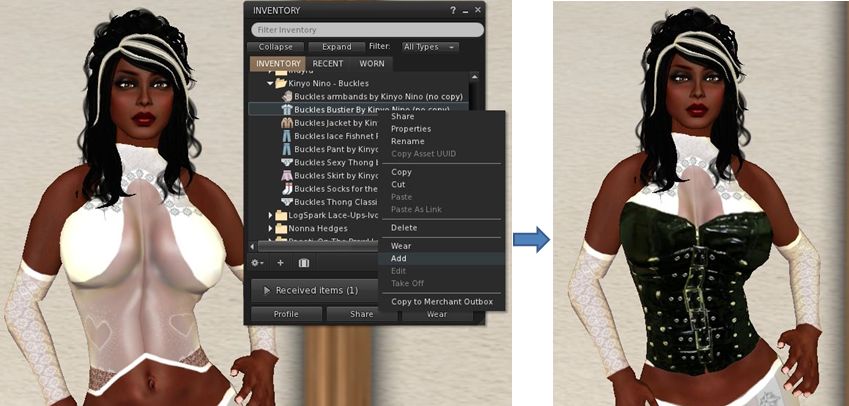
In most viewers providing multi-wear capabilities, adding an item of clothing to the same layer as an item already being worn will currently see the additional item appear to be worn “over” the existing item (i.e. if you are wearing a shirt layer item, any shirt layer item added to your outfit will appear to be worn “over” the item already being worn).
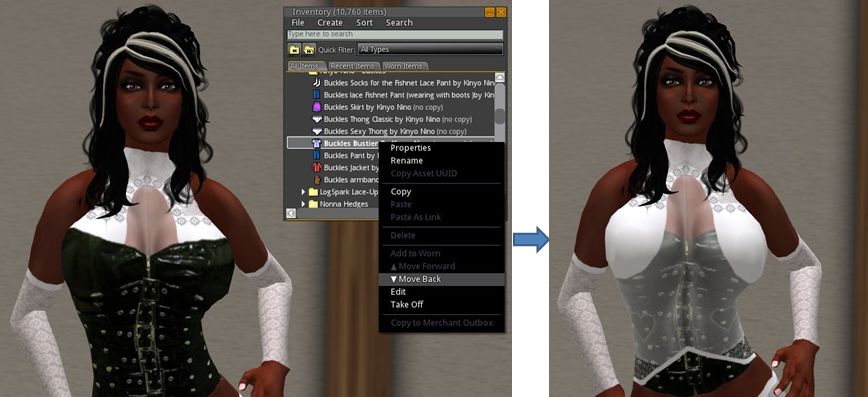
Singularity, however, provides two additional inventory menu options: Move Forward and Move Back, which allow you to change the order in which clothing items worn in the same layer are “stacked”, allowing them to appear to be worn under / over one another, as shown in the images below.
Multi-wear in most viewers: adding an item (in this case a shirt layer bustier) to a layer with clothing already worn will see the new item worn “over” any clothing on the same layerSingularity’s Move Back and Move Forward inventory options allow the order of clothing items worn on the same layer to be changed relative to one another
Notes:
The menu options are context sensitive and will only be available for clothing items worn on the same layer
Which of the options is available for use depends on a clothing item’s position in the “stack” (e.g. if the item is the last item added to a layer, the Move Back option only will initially be enabled, but not the Move Forward option)
The options can be used with any number of items worn on a single layer (up to the standard maximum of 5 items per layer)
Any changes you make to the order of clothing items in the same layer will be correctly rendered in other viewers.
This should provide a very flexible way of additionally creating “mix’n’match” outfits. Kudos!
Along side of multi wear, Singularity 1.7.0 also provide full support of the Current Outfit folder as well.
Audio Display Floater
Accessed via the Singularity menu (Singularity->Streaming Audio Display), this displays a floater listing the artist and track name for any active media.
Audio display floater
Mouselook Aim / Zoom and Shift-C Crouch
Those into combat are likely to appreciate these additions – although they are not exclusively for such environments.
Mouselook aim / zoom: when in Mouselook, depressing the right mouse button and using the scroll wheel on a mouse, can zoom in / out of the direction you are looking
Pressing SHIFT-C will now toggle your avatar into a crouch until such time as you press SHIFT-C again, allowing you to move and do other things without having to hold down the C key yourself.
Build Preferences
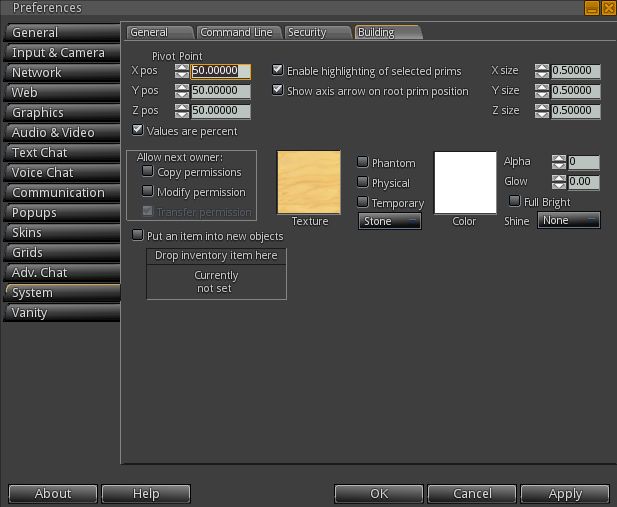
The Build tab in PREFERENCES->SYSTEM has been extensively updated, as per the images below, offering users the ability to set global defaults on prims as they are rezzed and used (i.e. default texture type, permissions set against them, etc).
New Build Preferences
Performance
Running Singularity on my home platform (370m) with lighting and shadows off, Singularity rolled along at an average of 39-40 fps. With lighting & shadows active and sun/moon + projectors enabled, this dropped to 12-13 fps. On the ground on my home sim, these rates dropped to 7-8 fps with lighting and shadows, etc., on and around 17-18 fps with them off. Again, and while totally arbitrary, the tests were carried out on my usual system and with all other settings as defined in the panel on the right of this blog’s home page. Overall, the performance wasn’t far behind what I’ve seen on the new home sim with recent V3.2 viewers.
Opinion
As with the last release of Singularity (1.6.0), this is a long-awaited and tidy update. Feature changes may appear small – but they are by not means trivial. Much has been done to “future-proof” the viewer, although the Merchant Outbox functionality is still currently lacking.
What I particularly like in this release is the way in which multi-layer system clothing support has been implemented. The ability to alter the order of the clothing on a specific layer is very neat and a step ahead of other viewers – and is something that could prove very popular among users. It will be interesting to see if it appears in other TPVs moving forward.
For credits on the various elements and additions to this release of Singularity, please refer to the release notes (link below).
The following is summary of changes to SL viewers / clients (official and TPV) which have taken place in the past week. It is based on my Viewer Round-up Page, which provides a list of all Second Life viewers and clients that are in popular use (and of which I am aware) and which are recognised as being in adherence with the TPV Policy.
This summary is published every Monday, and by its nature will always be in arrears. Therefore, for the most up-to-date information on viewers and clients, please see my Viewer Round-up Page, which is updated as soon as I’m aware of any changes, and which includes comprehensive links to download pages, blog notes, release notes, etc., for Viewers and clients as well as links to any / all reviews of specific viewers / clients made within this blog.
Updates for the week ending: 15 July, 2012
SL Viewer updates:
Beta version: rolled 3.3.4.261355, July 10
Development: rolled to 3.3.5.261706, July 13th
Pathfinding rolled to 3.3.3.261768, July 14
Dolphin rolled to 3.3.12.24714 on July 14th, which had an issue with broken shadows and so was followed by 3.3.12.24707 on July 7th – core changes: code in SLPlugin has been changed in order to limit the number of virus warnings from anti-virus s/w; FIRE-6171/VWR-28846; ‘Save as’ dialog deadlocks on Ubuntu 12.04; FIRE-4730 – Client AO breaks attachments with animations, for example shoes with “Ankle locker”; additional Windlight settings from Firestorm; Fixed: Don’t block texture fetch threads for 2 minutes if the CURL callback fails (release notes)
Niran’s Viewer rolled to 1.44 on July 9th – core changes: use of LL’s Viewer rendering code; performance improvements; faster rendering of shadows, local lights, occlusion, etc.; integration of tone mapping from the Exodus Viewer
Zen Viewer rolled to release 3.3.5.2 on July 9th – core update: fixed a Merchant Outbox Network Connect Error (release notes)
Cool VL Viewer made two releases:
The release version rolled to 1.26.4.22 on July 13th, reported as a bux fix release fixing breaks to the texture vertical offset spinner and the land brush force slider in the build tools floater
An experimental build 1.26.5.0 was also released on July 13th, which is the first phase of a backport of the viewer v3.3 renderer to the Cool VL Viewer
Singularity rolled to 1.7.0 on July 16 just prior to my viewer round-up being updated, and so makes this report; core updates – Multi-Wear release; general graphics engine update; region windlight support; RLVa partial update to 1.4; LSL editor update; sound system bug fixes & new sound system FMOD Ex; mouselook gun aiming incorporated; new build preferences; radar now indicates gesture/sound/particle/animation spam; holding Shift while crouching works as crouch toggle (release notes)



 Inara Pey: Living in a Modemworld