This summary is published every Monday and is a list of SL viewer / client releases (official and TPV) made during the previous week. When reading it, please note:
It is based on my Viewer Round-up Page, a list of all Second Life viewers and clients that are in popular use (and of which I am aware) and which are recognised as adhering to the TPV Policy
By its nature, this summary will always be in arrears
The Viewer Round-up Page is updated as soon as I’m aware of any releases / changes to viewers & clients, and should be referred to for more up-to-date information as the week progresses
The Viewer Round-up Page also includes comprehensive links to download pages, blog notes, release notes, etc., as well as links to any / all reviews of specific viewers / clients made within this blog.
Updates for the week ending: 4 November, 2012
SL Viewer updates:
Beta version rolled to 3.4.1.266511 on Nov 2 – core updates: core updates: tcmalloc re-enabled; realloc disabled (release notes)
Development version rolled to 3.4.2.266405 on October 30
CHUI project viewer updated to 3.4.1.266356 on October 30
Dolphin released version 3.3.24.24816 on November 1 – core updates: Incorporates World Map background in Mini-map, incl. parcel boundaries, etc. (from Catznip R7); Button to reset Grpahics settings to default in the menu bar (GReset); Refresh Texture refreshes scupts and tortured pirms (from Firestorm); Restore Inworld also sets to land group, if the latter enabled through prefs; this is the final Dolphin version which will support OpenSim access (release notes)
Niran’s viewer rolled to 2.0.2212 on October 29 – core updates: fading toats, experimental tweaks to webkit plugin; removal of “Hide Lookat feature (release notes)
Cool VL updates:
Stable branch rolled to 1.26.4.37 on November 3 – core updates: bug fixes imported from Firestorm; additional bug fixies and optimisations; further media on a prim (MOAP) backports and fixes, option remains disabled as work continues; system clothing layers now stack correctly under RLV; fixes for using Temp directories for plug-ins; OpenSim support: pirms now resizeable to 0.001.
Experimental branch rolled to 1.26.5.17 also on November 3 – core updates as per main release, plus:Reverted the “blurry/rainbow texture” fix implemented in the last release for the new HTTP texture fetch, as it caused memory leaks. Recommendation is to disable the new HTTP capability to avoid blurry/rainbow textures, or use the “reload selected texture”
Libretto – removed from round-up page due to website being unavailable for a month and no response from creator on status (also removed from the SL Third-party Viewer Directory)
This summary is published every Monday and is a list of SL viewer / client releases (official and TPV) made during the previous week. When reading it, please note:
It is based on my Viewer Round-up Page, a list of all Second Life viewers and clients that are in popular use (and of which I am aware) and which are recognised as adhering to the TPV Policy
By its nature, this summary will always be in arrears
The Viewer Round-up Page is updated as soon as I’m aware of any releases / changes to viewers & clients, and should be referred to for more up-to-date information as the week progresses
The Viewer Round-up Page also includes comprehensive links to download pages, blog notes, release notes, etc., as well as links to any / all reviews of specific viewers / clients made within this blog.
Updates for the week ending: 28 October, 2012
SL Viewer updates:
Beta version rolled to 3.4.1.266073, October 21, and then to 3.4.1.266251 on October 24 (release notes)
Development version rolled to 3.4.2.266255 on October 25
Catznip rolled to R7 on October 23 – core updates: Mini-map improvements, Appearance floater updates and improvements; improved inventory floater and tools; right-click rigged mesh detach; Remove Folder option in context menu; Legacy Search Places re-introduced; temporary and permanent object blocking; Build tool updates; Chat and Group enhancements; Preferences updates
Dolphin released version 3.3.23.24802 on October 27 – core updates: “Restore to last in-world position” re-implemented for objects; “Previous Owner” display in the edit floater ported from Firestorm; The shape editor floater now reports the correct avatar height; log-in panel on splash screen visually cleaned-up
Kokua Beta released 3.4.1.0 October 24 – although reports at 3.4.0.7765 in HELP->ABOUT
Niran’s viewer rolled to 2.0.2185 on October 24 – core updates: updates to top windlight toolbar buttons and to new Preferences overlay; additional button options; minor rendering updates
Zen rolled through 3.4.2.0 on October 22 to 3.4.2.1 on October 23 – core updates (both): Implemented OpenAL and GStreamer Plugins; removal of FMOD libraries & code; fixed and exposed “Email Me IMs” and “Enable Plain Text” Chat Preference Panel booleans; RenderAnimateTrees reintroduced via Debug Menu; missing DLL files added (release notes)
Cool VL updates:
Stable branch rolled to 1.26.4.36 on October 26 – core updates: The new target omega code enabled by default; added script editor support for new LSL functions and constants updated per the latest LeTigre RC channel deploy; assorted fixes and clean-ups
Experimental branch rolled to 1.26.5.16 also on October 26 – core updates as per main release, plus: implemented latest mesh deformer code; lowered the max number of simultaneous connections to 12 for new HTTP code; fixed a “blurry texture bug” resulting from implementing the HTTP core based texture fetcher
Libretto – removed from round-up page due to website being unavailable for a month and no response from creator on status (also removed from the SL Third-party Viewer Directory)
NiranV Dean has been back working on Niran’s Viewer, and in doing so has lifted the viewer to version 2.0 with a number of initial Betas. On Wednesday October 24th, he made a final release, 2.0.2185, which he calls Niran’s Viewer Rebooted, given the amount of additional work put into it, which finally saw him bypass his planned 1.5 release.
As the last release of Niran’s Viewer in these pages was version 1.46, the following will touch on elements previously released in 1.47 – 1.49 as well.
Download and Installation
The download file remains an archive EXE, rather than an actual installer, and is just on 50MB in size. It will extract the files into a default directory Nirans Viewer in C:\Program Files. If you’ve had a previous version of Niran’s Viewer installed, it is strongly recommended that you remove it first, together with all cache and settings files. The viewer itself has no uninstaller, some removal is a matter of deleting the program folder. The locations for all three are:
Viewer: C:\Program Files\NiransViewer (delete this entire folder)
Cache: C:\Users\[user name] \AppData\Local\NiransViewer (delete this folder)
Settings: C:\Users\[user name] \AppData\Roaming\NiransViewer (delete this folder and all sub-folders inside).
First Time Running
Once you’ve made your initial keyboard camera preferences selection, the log-in screen features a new video from NiranV. I have to admit, I’m curious as to the music track and whether it is taken from something or original, as I rather like the keyboard arrangement in it.
Watch a video while entering your login credentials
You may get an anti-virus alert relating to the SLVOICE.EXE plugin – if you do, make sure that it is the plugin being referenced and clear it. The log-in splash screen is again liable to be something of a surprise to first-time users. There is no familiar splash screen feed from Linden Lab here. Instead, and providing you’re running flash, there’s a YouTube video NiranV has put together and which will play while you enter your log-in credentials in the panel to the right.
Note that Niran’s Viewer isn’t intended for use on OpenSim, so the other grids selection is limited to the SL Agni (main) and Aditi (Beta) grids. Once you’ve entered your you log-in credentials, you’re treated to a series of hints and tips as the viewer logs-in to Second Life.
Preferences Overlay
Niran’s alternative to the usual Preferences floater started appearing in version 1.46 of the viewer, where he referred to it as his “Skyrim influence”. It’s slowly been maturing through a number of releases since then, and with version 2.0, it completely replaces the old Preferences floater, which is no longer available within the viewer.
Accessed via the Preferences toolbar button, CTRL-P or NV->EDIT->PREFERENCES, the overlay does exactly what it says – overlays the in-world view.
Preferences Overlay with a submenu displayed
To the left of the overlay are the main options: Display, Audio Controls, Camera, Chat, User, Interface and Viewer. Depending on the complexity of the screens / options associated with this, clicking on one of them may display a panel directly, or may open-up a sub-menu of further options which in turn will open up individual panels on the right of the overlay.
Preferences overlay with an open panel
Please use the page numbers below left to continue reading this article
It’s been a while since the last release of Catznip – mainly because the team has had a number of other projects and RL things to deal with, but R7 is now here, and it sees the viewer get an extensive update and overhaul, with new features, updates large and small and bug fixes galore.
Not only has the viewer itself been overhauled, but the Catznip team have been putting considerable effort into matters of support as well – which is where this review starts.
Catznip JIRA, Wlki and More
With the R7 release of Catznip, the team have moved away from Bug Genie and adopted JIRA as their issue reporting and tracking tool. As a part of this, anonymous postings to the tracker will not longer be allowed, and users will have to register an account. However, this does mean that the team will be better able to deal with specific issues and contact those logging problems with greater ease.
Release R7 also sees the formal arrival of the Catznip wiki, providing additional support, information, documentation and information on RLVa. The wiki is still under development, and (as with all wikis) is constantly evolving, so should be a bookmarked resource of anyone who uses Catznip as their primary viewer.
The Catznip wiki
The Catznip wiki, together with the Catznip blog can be accessed from within the R7 release, via the HELP menu. Similarly, HELP->REPORT BUG will open the Catznip JIRA in your web browser (or the built-in browser, depending on your preferences setting), rather than attempting to open the default LL Bug Tracker.
So, to the Release itself.
Download and Install
The Windows installer for Catznip R7, at 29Mb in size, is just a tad bigger than the official Second Life viewer installer. Installation for me was smooth and incident-free, as all Catznip installs have been in the past.
On start-up, the familiar viewer 3.x-based FUI is displayed, with button ranged to the left and along the bottom. As with most TPVs and the official viewers, Catznip forgoes the ability to place toolbar buttons at the top of the screen, which is no great loss. Sadly, R7 hasn’t implemented the ability to align buttons to the left or right at the bottom of the screen (which I’d personally love to see gain more widespread adoption among TPVs) or at the top or bottom on the left / right of the screen. However, this also doesn’t detract from usability in any way.
The following sections provide an overview of some of the more significant updates, starting with floater updates. For a complete breakdown of updates and features in this release, please also refer to the Catznip R7 release notes. Please click any images of floaters, etc., for an enlarged view.
Appearance Floater
The Appearance floater has received significant work, with updates to both the Outfits and Wearing tabs.
The Wearing tab has been significantly updated to make viewing, ordering, finding, and sorting worn items a lot easier. The main revisions to the tab are shown below.
Updated Wearing tab in the Appearance floater in Catznip R7
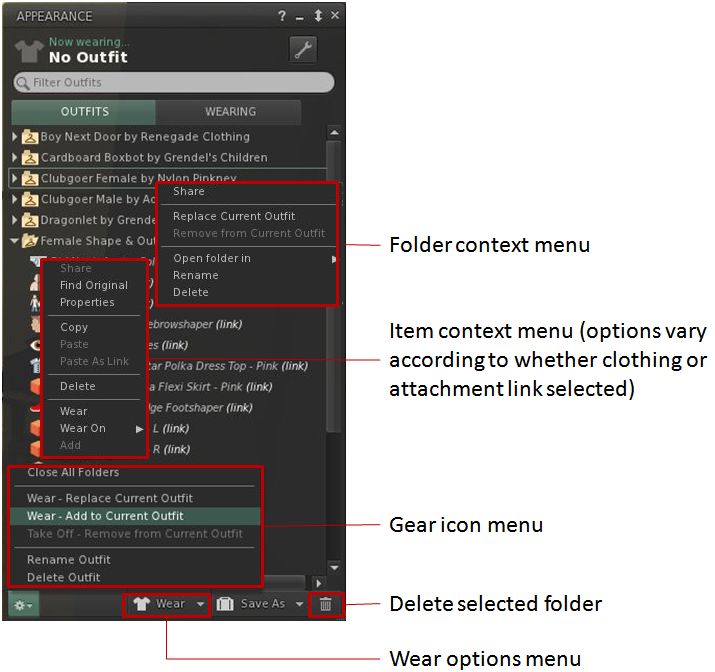
The Outfits tab has also been revised, with key elements shown below.
Updated Outfits tab in the Appearance floater in Catznip R7
In both tabs, FIND ORIGINAL will out the inventory floater with the original item for any link selected. Additionally, attachment point details are now included for all attachments shown in the Wearing tab.
Detaching Folders, Touching Worn Mesh
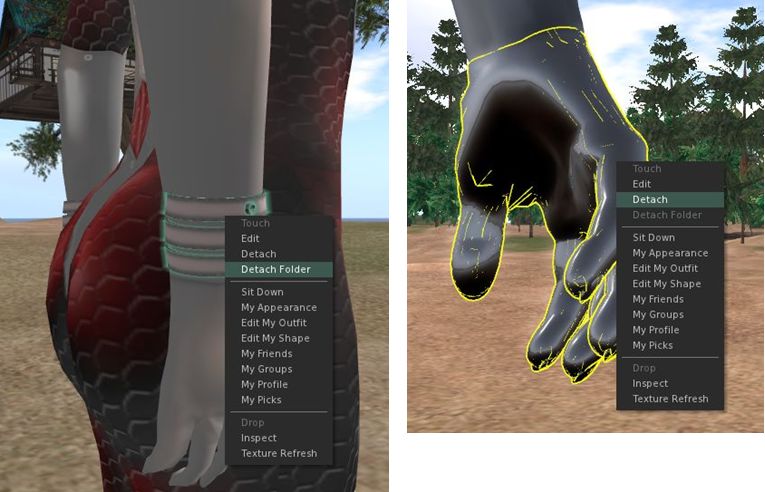
Catznip introduces two useful features – Detach Folder and the ability to right-click on worn rigged mesh items.
Detach Folder is a context menu option which allows you to remove an entire folder with a single click.Simply right-click on an attachment you’re wearing, and select Detach Folder from the menu, and the attachment and everything else in the same folder will be removed: other attachments, clothing, alpha layers.
Detach Folder (left) available by clicking on a suitable attachment; Context menu available for rigged mesh (right) when right-clicking on it
Inventory
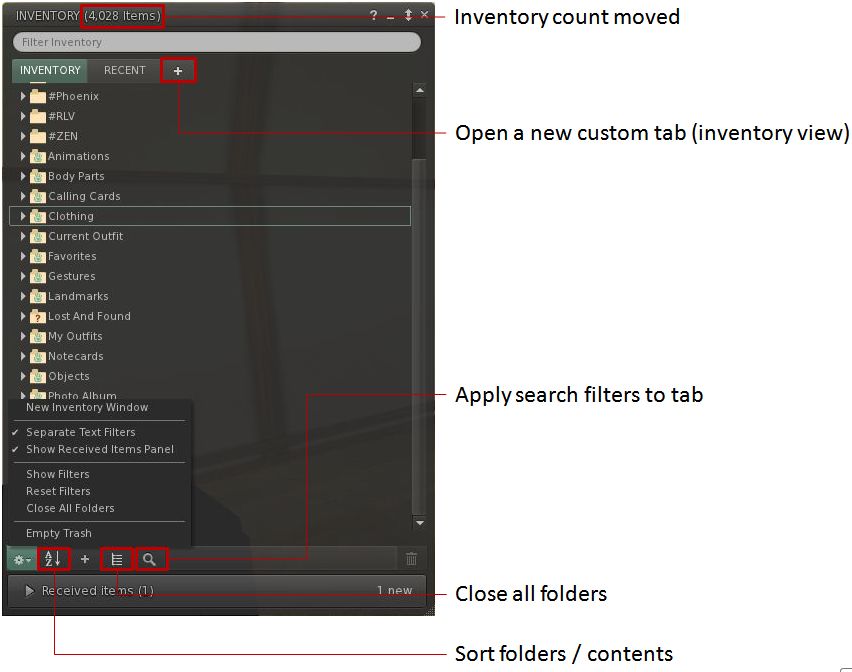
The Inventory floater has received a number of updates with the R7 release, with new buttons, the ability to use separate search filters on different tabs, a new “custom tab” option, a revised cut-and-paste option, and more.
Catznip R7 inventory floater
Significant points of note with the inventory floater with R7:
The overall layout of the floater has been tightened
As shown above, the sort options have been moved from the gear icon button to their own button, simplifying the re-ordering of an inventory display
Custom tabs allow you to open additional inventory views in their own tabs and apply specific search filters against them
The right-click context menu for FOLDERS includes an option allowing you to open the folder in a new tab within the current inventory floater, or in an additional inventory floater instance
The right-click context menu for ITEMS includes an option to FIND ALL LINKS within your inventory for a given item (moved from the gear icon menu)
Cut & Paste operations work in a more file manager-like way. works the way you would expect from file manager with cut are marked and moved on Paste
COLLAPSE ALL will not collapse top-level folders that are currently open
A SHOW RECEIVED ITEMS option has been added to the gear icon button. When checked, the Received Items panel will be displayed in the Inventory floater; when unchecked, Received Items appears as a folder within the Inventory floater.
This summary is published every Monday and is a list of SL viewer / client releases (official and TPV) made during the previous week. When reading it, please note:
It is based on my Viewer Round-up Page, a list of all Second Life viewers and clients that are in popular use (and of which I am aware) and which are recognised as adhering to the TPV Policy
By its nature, this summary will always be in arrears
The Viewer Round-up Page is updated as soon as I’m aware of any releases / changes to viewers & clients, and should be referred to for more up-to-date information as the week progresses
The Viewer Round-up Page also includes comprehensive links to download pages, blog notes, release notes, etc., as well as links to any / all reviews of specific viewers / clients made within this blog.
Updates for the week ending: 21 October, 2012
SL Viewer updates:
Beta version rolled to 3.4.1.265898, October 16 (release notes)
Development version rolled to 3.4.2.266075 on October 19
The Mesh deformer project viewer rolled to 3.4.1.266081 on October 20
Kokua Beta released 3.4.0.0 (Pathfinding) October 15 – core updates: pathfinding tools
Niran’s viewer rolled to 2.0.2136 on October 18th – core updates: updates to top windlight toolbar buttons and to new Preferences overlay
Cool VL updates:
Stable branch jumped to 1.26.4.35 on October 21 – core updates: media plugin code to match the latest v3.4 viewer-development; backport of latest bug fixes from v3.4 viewer-development; further work on MOAP backport (which remains disabled as work progresses); implemented the new LL HTTP engine (currently disabled); added script editor support for new LSL functions and constants implemented in the latest LeTigre RC channel deploy; assorted fixes and clean-ups
Experimental branch jumped to 1.26.5.15 also on October 21 – core updates: Backported a v3.4-renderer-specific fix from viewer-development v3.4; implemented & enabled the new LL HTTP engine
Lumiya release version 2.3.2 on October 20 – core updates:avatar name tags in 3D view; configurable avatar rendering limit; ability to touch attached objects; object menus displays as pop-up dialogue boxes in 3D world view; ability to view textures from inventory; support for subfolders in My Outfits. (release notes) – latest review in this blog
Libretto – removed from round-up page due to website being unavailable for a month and no response from creator on status (also removed from the SL Third-party Viewer Directory)
Alina Lyvette has again been beavering away with Lumiya, adding features, fixing bugs and sorting a couple of things out. In this, I feel a little guilty, as one of the things she’s been sorting out is the Outfits folder. I mentioned last time around that there was a slight hitch with it, and Alina immediately started work correcting it, when really she should have been taking a break.
The result is yet another release for Lumiya, this one 2.3.2, which features the following key updates:
Avatar tags in 3D view
Object dialogs are now displayed as pop-ups
Ability to touch attached objects
Ability to view textures from inventory
Support for subfolders in My Outfits
Configurable avatar rendering limit
Avatar Tags in 3D View
Tagged!
This does exactly what it says on the label: displays the name tag over an avatar’s head, using either the avatar’s display name or legacy name.
Group names are currently not displayed and frankly, when using Lumiya on a small screen, they’re something I can personally get by without; although I suspect Alina is working on adding them!
Note that there is an option on the Settings menu to display either legacy avatar names user names) or Display Names. This will determine whether Display Names or user names are displayed in the 3D world view as well as in chat, etc. Toggling between the two options will immediately switch between displaying other avatars’ user name or Display Names in chat and IM, but may require a re-log in order for the 3D world view to update correctly.
Object Dialogue Pop-ups
Until now, touching a scripted object in the in-world view and handling the menu was a bit of a convoluted affair: touch the object, switch to chat to see the menu, use the menu, swap back to the 3D view.
Well, no more. Touch an object and you’ll get an initial menu, complete with a TOUCH button. Tap that, and the menu for the object will overlay the in-world view, which you can used exactly as you would in a full viewer.
Touching Attachments
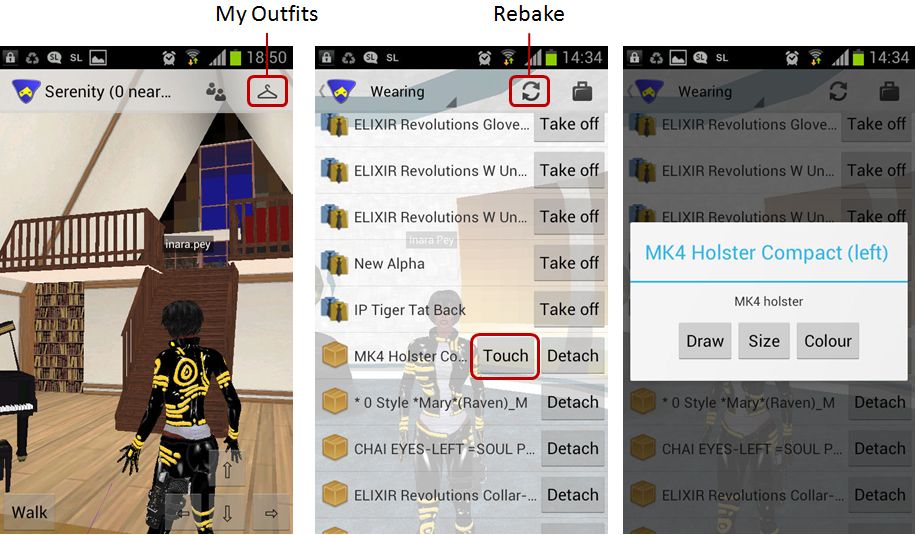
Lumiya 2.3.2 brings a new means of touching worn scripted attachments.
To touch one of your own scripted attachments:
In the 3D view open the Outfits window (hanger icon) – note that the text mode shortcut for attachments is no longer available from 2.3.2.
Switch to the WEARING tab in the Outfits window (if using Lumiya on a small screen, you may have to tap “My Outfits” to display a menu which will allow you to switch to a list of worn items)
Scroll through the list of worn items to the one you wish to touch – it will have a TOUCH button associated with it. Tap this to display the menu
When you have finished with the menu, tap the Back button on your device to clear the menu dialogue box.
Touching a scripted attachment on your own avatar
If you wish to touch an attachment worn by another avatar, you can do so in one of two ways: via the 3D world view or via text mode.
In the 3D world view:
Long touch the avatar wearing the attachment – aim for the middle of the avatar, not the attachment itself
A menu is displayed at the top of the screen, which includes a TOUCH button if the avatar is wearing anything touchable. Tap this to display a list of touchable items the avatar is wearing
Tap an item on the list; if it is publicly accessible (or if you’ve been granted access to the attachment by the user), any menu associated with the object should be displayed
When you have finished with the menu, tap the Back button on your device to clear the menu dialogue box.