SL project updates 16/2: Content Creation User Group

The Content Creation User Group meeting, at the Hippotropolis Camp Fire Circle (stock)

The following notes are taken from the Content Creation User Group meeting, held on  Thursday April 20th, 2017 at 1:00pm SLT at the the Hippotropolis Camp Fire Circle. The meeting is chaired by Vir Linden, and agenda notes, etc, are available on the Content Creation User Group wiki page.

The meeting was live streamed / recorded by Medhue Simoni, and that video is embedded at the end of this update, my thanks to him for providing it. Timestamps in the text below will take readers directly to the relevant point in the video (in a separate tab) where topics are discussed.

Supplemental Animations

This is an idea to overcome issues of animations states keyed by the server-side  llSetAnimationOverride() conflicting with one another. This problem has been particularly noticeable since the arrival of Bento, and a typical example is that an animation to flap Bento wings, if played to have natural wing movement while walking, results in a conflict with the walk animation, causing the avatar to slide along the ground.

Again, this is only an issue with the server-side animation triggers; older scripted animation overriders, such as ZHAO, which use the scripted llplayanimation function are unaffected.

[03:41] This is still under discussion at the Lab, and if anyone has specific views / ideas, they are invited to attend the CCUG meetings and discuss them.

Scripted Avatar Skeleton Reset

[05:45] A question was raised (via chat) on whether it would be possible to reset the avatar skeleton via script (rather than replying on the local Reset Avatar options in the viewer), as bone offsets defined within some meshes are not resetting when the mesh is removed (see BUG-11310).

Vir indicated that having a means to do this via script may well be useful, but is unsure of where it might slot into the work priorities were it to be adopted, particularly as it would require a new server-side message for passing the update notification to all surrounding viewers.

Skeleton Reset on Region Entry

[13:52] The above spawned a question on having the viewer automatically perform a Reset Skeleton function on entering a region. to try to also combat problems of avatars appearing deformed.

There are some cases where this might be useful. If you run an animation just once to trigger a deliberate avatar deformation, (e.g. from human to quadruped), that animation is not persistent, so if you enter another region, there is a chance other people will see you as deformed. However, trying to fix such situation through an automated skeleton reset is seen as problematic.  For example, an automatic skeleton reset by the viewer on entering a region could conflict with the receipt of animation updates intended to deform an avatar in your view so it looks correct, resulting in the avatar being unintentionally deformed (again, as in the case of an avatar which is supposed to be a quadruped appearing as a deformed biped, as the Viewer has ignored the necessary appearance information as a result of the automated reset.

Projects Under Consideration

The last several Content Creation User Group meetings have included discussions on two potential projects for the Lab. Neither has been as yet adopted, but are under possible consideration by the Lab, and Vir offered a recap of both.

Applying Baked Textures to Mesh Avatars

[20:57] This is essentially taking the ability of the default avatar baking service to manage compositing and baking system layers (skins, shirts, pants, jackets, tattoos, etc), onto a default avatar, and extending it to be used on mesh avatars, potentially reducing the complexity of the latter (which have to be built up in “onion skin” layers in order to be able to handle things like tattoos, skins, make-up options, etc.), and thus making them more render-efficient.

As mentioned in previous Content Creation updates in this blog, there are some issues with doing this: the baking service would likely need to be tweaked to handle 1024×1024 textures (it currently only support up to 512×512); it does not handle materials (although this is not seen as a major issue, as it is felt among those at the CCUG meetings that the primary use of the baking service would be for compositing skins + make-up /  tattoos into a single texture for mesh application), etc.

Animated Objects / NPCs

[25:17] Animated support of object in-world could be used from a wide variety of things, from non-player characters (NPCs), which do not require a link to an active viewer / client, through to animating things like tree branches swaying in a breeze, etc.

This work has various levels of complexity associated with it, and were it to be adopted, might actually result in a series of the related projects. NPCs in particular would be an extensive project, as it would need to encapsulate a means to define what the NPCs are wearing / have attached, how to make NPCs customisable through something like the avatar shape sliders, etc.

As such, were the Lab to decide to pursue animated objects, decisions would need to be made on overall scope for the project, what might be initially tackled, what might be seen as a follow-on project, etc.

How To Encourage the Lab to Adopt Projects

[28:03] Supplemental animations, bakes on meshes and animated objects have been the three major topics of discussion within the Lab in terms of possible major projects. Until they actually get on to the Lab’s roadmap (*if* they get that far), it is not easy for specific time frames, etc., to be discussed at meetings.

However, the best way to actively encourage the Lab to continue looking into such potential projects is to attend meetings like the CCUG and discuss them. Despite using them in the past, polls aren’t seen as particularly useful, whereas direct discussion through meetings like the CCUG tend to bring a consistent set of interests / ideas / suggestion to the service.

Continue reading “SL project updates 16/2: Content Creation User Group”

SL project updates 16/1: server, teleports and other bits

The Incredible 4 blog post

Server Deployments

As always, please refer to the server deployment thread for the latest information.

  • On Tuesday, April 18th the Main (SLS) channel received the server maintenance package previously deployed to the RC channels in week #15. This includes:
    • Several internal fixes and two new internal logging modes
    • Another adjustment to fix issues with off-line IM and Group Notice delivery reliability
    • Fixes an issue where large numbers of objects could be returned after a rolling restart.
  • On Wednesday, April 19th, the RC channels should be updated as follows:
    • BlueSteel and LeTigre should receive the improved region capacity and access capabilities
    • Magnum looks set to receive a new “secret” update, which has been under testing on the Snack channel (and will likely have Snack reabsorbed into it).

SL Viewer

There have been no viewer updates thus far this week, leaving the viewer pipeline as:

  • Current Release version: 5.0.3.324435, dated March 13 – snapshots to e-mail hotfix
  • Release channel cohorts :
    • Project AssetHttp project viewer version 5.0.4.325368 dated April 12th – This viewer moves fetching of several types of assets to HTTP / CDN – overview
    • Maintenance RC viewer version 5.0.4.325124 dated April 3rd – avatar rendering and other updates
  • Project viewers:
    • Project Alex Ivy (LXIV), 64-bit project viewer version 5.1.0.503537 dated March 17th
    • 360-degree snapshot viewer version 4.1.3.321712 dated November 23, 2016 – ability to take 360-degree panoramic images – hands-on review
  • Obsolete platform viewer version 3.7.28.300847 dated May 8, 2015 – provided for users on Windows XP and OS X versions below 10.7.

Other Items

Differences Between Teleporting and Physical Region Crossings

As we know, whether you teleport between one region and another or physically cross the boundary between two regions, you are performing a region crossing. However, there is a slight different in how they are handled. Rider and Simon Linden described the processes involved during the Simulator User Group meeting, which makes for interesting reading if you weren’t previously aware of the processes involved.

In referencing teleporting between regions, Rider said, “Teleport packs your avatar into a big ball of data and throws you at the destination.” It’s then left up to the destination region to determine whether or not you actually get in. Hence the teleport progress bar.

Simon then said of a physical region crossings, “They do a bit more pre-crossing checks to see if you go into the neighbour[ing] region than TPs do.” Rider Linden then added, “If the regions are adjacent, the sim you are on checks to see if it should smush you into that ball before it does.”

These pre-crossing checks are handled through your child agent on the neighbouring region, allowing the simulator running the region you’re currently in to “see” if you’re able to access the neighbouring region. If it believes you can’t, it won’t bother creating the ball of data about your avatar (and everything attached to it), reducing its workload.

When is a Region Not a Region?

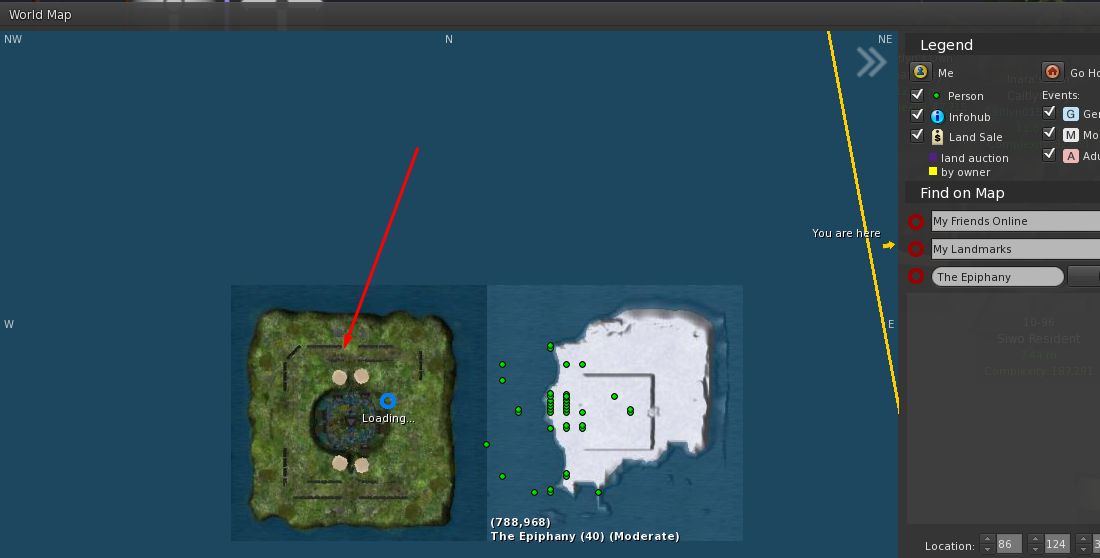
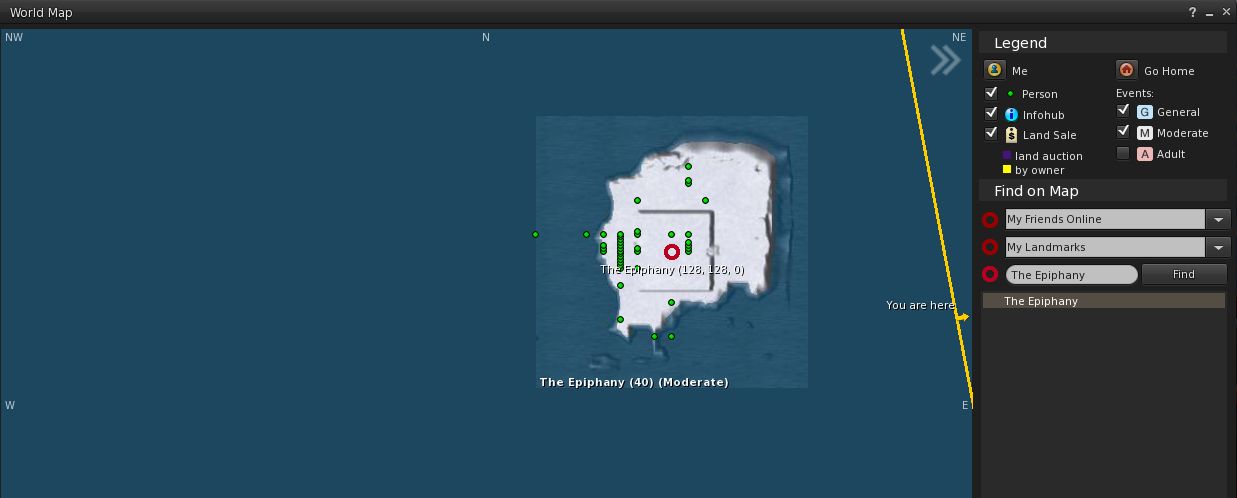
A curious topic came up at the meeting: when is a region not a region? The simple answer is probably “when you can’t see it”. But what about if you can – apparently – see it, at least on the map, and it doesn’t appear to have a name.

The mystery island as it appeared for some people using both the LL viewer and Firestorm

Whirly Fizzle spotted this phenomenon on the World Map with a region apparently adjoining The Epiphany, although her curiosity was piqued as it was apparently without a name. The mystery deepened when most of those at the meeting reported they couldn’t see any such region on their maps – although two or three besides Whirly could, on both TPVs and the official viewer (ruling on an issue in how a specific viewer is handling the map data).

What was equally mysterious, was that those who were able to see the unnamed island on the World map could also see it on the web SL map – while those who couldn’t see it on the world map also couldn’t see it on the web SL map.

As other saw the same area on the map – regardless of viewer

Several theories were put forward for the phenomenon, including it being a  non-updated map texture; a potential error in map tiling and loading;  an  old texture loaded and stuck at the  wrong LOD; and so on.  Running a quick check, Simon Linden couldn’t find any evidence for a region ever having been placed in any of the eight grid areas surrounding The Epiphany. He did, however, offer a possible explanation of what might have happened:

I do know the support team will do some interesting tricks sometimes … they will move one of their regions next to another to do some sort of work, then move it away. Perhaps that got captured there.

Either way, a curious little anomaly.

Mesh UUID Flipping via Script / UUID

Back in the mists of time as mesh support was being added to Second Life, there was the ability to change mesh assets via UUID / LSL. However, the ability was used most frequently as a means of animating meshes  – putting considerable stress of the rendering system in the process. Because of this, a wiki page on the subject was raised, and the ability to change mesh UUIDs via script was eventually removed altogether.

The Lab is currently considering implementing a means to animation meshes (something routinely discussed at the Content Creator’s User Group meeting). This would be a far more efficient and less stressful means of animating meshes where it to be taken up as project, and completely negate the need for animation via UUID flipping.

However, while allowing meshes to be changed through scripts / UUIDs has other potential uses, it is unlikely to be re-introduced even if animated meshes are introduced to SL, because anyone obtaining the UUID for a mesh could potentially download the “mesh” as a vnd.ll.mesh  file from the CDN, and could then theoretically reconstruct the original mesh item from that data (thus effectively stealing it).

SL project updates 2017 15/2: server updates / content creation (w/audio)

The Incredible 4blog post

Server Deployments – Recap

As always, please refer to the server deployment thread for the latest information.

  • The was no Main (SLS) channel deployment or re-start on Tuesday, April 11th.
  • On Wednesday, April 12th, the three RC channels all received a new server maintenance package which includes:
    • Several internal fixes and two new internal logging modes
    • Another adjustment to fix issues with off-line IM and Group Notice delivery reliability
    • Fixes an issue where large numbers of objects could be returned after a rolling restart.

Upcoming Server Updates

Note: DRMSIM is the Aditi (beta grid) channel reference.

DRTSIM-323: New Simulator Build

This update was delayed in its deployment to a release candidate channel on Agni (the Main grid), with Mazidox Linden indicating it will now be moving in week #16 (commencing Monday, April 17th). Region holders wishing to test their applications / services etc., on the new simulator build should contact Concierge about having their region moved to the appropriate RC channel(s) when known.

DRTSIM-332: Updated Avatar Capacity / Access for Regions

See either Improved Region Capacity and Access from the Lab or Lab announces improved region capacity and access in Second Life in this blog for details. This update is currently on a micro-channel (McRib) on Agni, with Mazidox noting the following:

After careful consideration, we’re making the new limits a default, rather than requiring intervention from Estate Managers (of course it is still possible to set limits lower using the region console or the current Maintenance viewer at http://wiki.secondlife.com/wiki/Linden_Lab_Official:Alternate_Viewers ). As a result there’s a new version on Aditi and we’ll have an updated version for McRib soon.

DRTSIM-343: Allow Public Access Region / Parcel Settings Changes

This is the updates to region / parcel access that will mean that if a region is explicitly set to Allow Public Access, parcel holders on the region will no longer be able to override the setting at the parcel level (see my update here). The update had been deployed to the three RC channels, where it was awaiting a viewer-side update featuring revised / improved land controls. However, Mazidox notes the code:

Was removed from RC after residents raised concerns about losing their previous state of “Allow Public Access”. To alleviate concerns of accidental change by landlord wiping out existing access settings on all parcels, we’re saving parcel setting until the region restarts. This means that while it won’t be saved permanently, it will be restored if the landlord removes their Ban Lines override. DRTSIM-343 will likely be back this week in testing, but may not have a corresponding viewer change yet.

DRTSIM-347: Fix for Incorrect Object Returns

This fix is designed to prevent a bug wherein objects might be returned from a region when it is restarted. It is about to undergo testing on Aditi prior to onwards deployment to Agni.

Content Creation User Group

The following notes are taken from the Content Creation User Group meeting, held on  Thursday April 13th, 2017 at 1:00pm SLT at the the Hippotropolis Campfire Circle. The meeting is chaired by Vir Linden, and agenda notes, etc, are available on the Content Creation User Group wiki page. The audio extracts are from my own recording, and a video of the entire meeting, livestreamed by Medhue Simoni, is embedded at the end of this update.

HTTP Asset Fetching

Vir re-iterated that the HTTP asset viewer, which utilises HTTP and the Content Delivery Network(s) leveraged by the Lab to deliver all Second Life asset types to users (rather than just mesh and texture assets and avatar baking data) as is currently the case with release versions of viewers), is now at Release Candidate status. The viewer has gone through two rapid-fire updates, with the latest version (at the time of writing) being 5.0.4.325368. I have an overview of the viewer, which includes an explanation of CDN use, for those who may not be familiar with the way things work.

Applying Baked Textures to Mesh Avatar

[Video: 2:04-18:35] The Lab is digging further into this idea, which if implemented would in theory allow at least some texture layers to be baked onto avatar meshes in a manner akin to that used with system layers and the default avatar. This could greatly reduce the complexity of mesh avatar bodies by removing the need for them to be “onion skinned” with multiple layers, although there are some issues which would need to be addressed.

One is that the baking service cannot currently handle materials (normal and specular maps; only texture – diffuse – maps), and the Lab has no idea as to how widespread either might be among clothing makers specifically producing applier systems for mesh bodies (which can support the use of materials). As such, they do not have a clear idea as to whether support for materials through the baking service would be required; something that could make any project related to this idea far more complicated to develop.

This led to an extensive discussion on what would be required from a system which could bake directly onto mesh layers, how widely materials might be used, and exactly how such a system would be used. The broad consensus of the discussion was that in terms of baking down layers, most creators like likely prefer to see things like skins and skin variations, tattoos, lingerie, freckles and eyebrows  baked down to a single layer, none of which tend to require significant materials support.

The discussion also touched upon the opportunity to present better alpha masking / alpha blending than chopping up mesh bodies into sections for masking / having alpha blending on different layers get into a fight, etc. Overall, it was felt that presenting some means to bake down some layers and reduce the complexity inherent in mesh avatars would be preferable to waiting on the Lab to be able to undertake a more widespread overhaul of the baking service to provide “full” materials support through it. Vir is going to take these points raised back to the Lab for further consideration.

Animating Objects

Animating mesh objects is another project under consideration. This would be especially useful for things like non-player characters (NPCs) and the like. There are several ways this might be approached, but as Vir explained in reply to a question, none of them would involve animating the Collada file. He also pointed out that animated objects is still only at the discussion stage, so whether any project – were it to be taken on – would include the ability for animated objects / NPCs to attach static objects (e.g. a hat or similar), hasn’t been addressed.

Rapid Round-Up

Animating Objects (/ NPCs): This is also still under consideration, but yet to be adopted as a project. However, were it to go ahead, it would likely not involve animated the Collada files, as suggested during the meeting, but leverage SL’s existing animation capabilities. It’s also too early in the process to say whether or not animated objects would support static objects being attached to them (e.g. an NPC being able to wear different hats).

Supplemental animations: The idea is to allow “supplemental” animations to run alongside the animation states keyed by llSetAnimationOverride(), effectively allowing them to play together, rather than conflicting with one another as is the case at the moment. Suggested some time again, it is still be considered, but no work has been carried out as yet.

Rendering Cost Calculations: he Lab is running a background project to look at the cost of rendering a wide range of Second Life features across a range of different client systems running the viewer. The tests for this work have now been defined and are about to be put into use. Once sufficient data has been gathered, the Lab will use it to determine what might need to be done to improve the accuracy of the avatar rendering calculations. Vir further defined the project’s status:

Re-using Linden Water Maps: The question was asked about re-using Linden Water data (Linden water being a combination of animated diffuse and normal maps) so that it might be re-used on other surfaces. The obvious use here would be to enable mirrors. Quite aside for the feared performance hit this could cause, it seems likely that the water system probably stands as its own unique implementation which would not easily lend itself to other uses.

Bouncing Bewb Improvements: In creating a set of animation for a client, Medhue Simoni noticed an issue with breast attachments and rigged mesh breasts. Essentially, as breast attachments go to the chest, they don’t necessarily follow the movement of the breasts when physics are used (which utilise the volume bone). His suggested solution would be to allow breast (/ nipple) attachments to be attached to the volume bone instead, allowing them to naturally follow breast movement,

Other Items

Aditi Inventory Server Update

The Lab has upgraded the hardware for one of the Aditi inventory servers. Almost all users logging-in to Aditi should be using it. There is a request that if those who do file a bug report f they notices anything strange related to inventory: lag, failure to load, textures looking incorrect etc.

SL project updates 2017 15/1: server, viewer

Sky Gardens, Holly Kai Park

Server Deployments

As always, please refer to the server deployment thread for the latest information.

  • The was no Main (SLS) channel deployment or re-start on Tuesday, April 11th.
  • On Wednesday, April 12th, the three RC channels should all receive a new server maintenance package which includes:
    • Several internal fixes and two new internal logging modes
    • Another adjustment to fix issues with off-line IM and Group Notice delivery reliability
    • Fixes an issue where large numbers of objects could be returned after a rolling restart.

It had been indicated that the new server OS build could be deployed to an RC this week. Whether this would be a “full” RC (BlueSteel, Magnum or LeTigre) or perhaps to a limited channel (as is the case with the increase avatar capacity updates, which are on McRib),  was made clear. More on this later in the week, maybe.

SL Viewer

The recent Voice RC, version 5.0.4.324770 was withdrawn some time on Monday, April 10th / Tuesday April 11th as a result of suffering a high crash rate.

The AssetHTTP project viewer was promoted to RC status with the release of version 5.0.4.325144 on Monday, April 10th.

This leaves the remainder of the current viewer list as:

  • Current Release version: 5.0.3.324435, dated March 13th – snapshots to e-mail hotfix download page, release notes
  • Release channel cohorts:
  • Project viewers:
  • Obsolete platform viewer version 3.7.28.300847 dated May 8th, 2015 – provided for users on Windows XP and OS X versions below 10.7.

SL project updates 2017 14/2: TPVD meeting, server updates

Maison de L’amitieblog post

The notes in this update are taken from the following sources:

  • Server Beta User Group meeting, held on  Thursday April 6th, 2017 at 3:00pm SLT – transcript here
  • The TPV Developer meeting held on Friday, April 7th, 2017 at 12:00 noon SLT.

A video of the TPV Developer meeting is embedded at the end of this update. My thanks as always to north for providing it. Timestamps in this report, where relevant, will link you to the point in the video where items are discussed (via a new browser tab).

SL Viewer

No changes to the current pipeline since part one of the week’s update:

  • Current Release version 5.0.3.324435, dated March 13th – snapshots to e-mail hotfix
  • Release channel cohorts:

    • Maintenance RC viewer version 5.0.4.325124, dated Monday, April 3rd  – review
    • Voice RC viewer version 5.0.4.324770 released on March 20th – several improvements to voice
  • Project viewers:
    • Project AssetHttp project viewer, version 5.0.4.324828 dated  March 30th – This viewer moves fetching of several types of assets to HTTP / CDN – overview
    • Project Alex Ivy (“LXIV”), 64-bit project viewer, version 5.1.0.503537 dated March 17th
    • 360-degree snapshot viewer, version 4.1.3.321712 dated November 23rd, 2016 – ability to take 360-degree panoramic images – hands-on review
  • Obsolete platform viewer version 3.7.28.300847 dated May 8th, 2015 – provided for users on Windows XP and OS X versions below 10.7.

64-bit Build Instructions & Windows Crash Rates

[11:15] The Lab plan to update the viewer build instructions on the wiki to match the 64-bit build process once the 64-bit viewer reaches release status, and the build process is seen as stable.

[29:14] The 64-bit build is being tested across all versions of Windows back to Windows 7. While the current project viewer cohort of users is small, there is evidence that Windows 7 64-bit systems have a “significantly higher” crasher rate with the viewer than Windows 8 or Windows 10, with Windows 10 systems having the lowest overall crash rate.

SL Voice: Linux Updates and Blocking Older Versions of SL Voice

[0:49] Vivox, the company that provides the Voice back-end service and delivers the Voice plug-in for the viewer are no longer providing updates for Linux. This means there will no longer be any Voice updates for the Linux flavour of the viewer unless Vivox reverses that decision.

[1:42] The plans to block older versions of SL Voice to ensure  users are only using the most recent versions of the plug-in, first announced in the latter part of 2016 and placed on hold in December 2016, remain on the back-burner with Oz  Linden noting, “We don’t have any time line for disabling older Voice versions … We may or may not get to it.”

Region Access Changes

There are two changes to region access which are currently in progress.

Region Capacity and Access

[2:36] The first is the Improved Region Capacity and Access updates as reported by the Lab on Tuesday, April 2nd, and which are being rolled-out in stages. There has been some negative reaction to these change (some basic account users have been particularly vocal about the upper capacity to a very busy region being “reserved” for Premium members); however, the deployment which was placed on its own limited server channel (McRib),  appears to be going well and so will be rolled to a larger selection of regions in week #15 (commencing Monday, April 10th).

[3:28] The Lab will continue to look at avatar capacity within region types  as they continue to make other changes to the system, and if the opportunity arises to increase the numbers, they “probably will” (quote). Of course, increases to region capacity on the back-end can have a negative impact at the viewer end of the equation, where the viewer and client system potentially have to work than much harder.

Revised Region and Parcel Access Controls

[4:40] The Lab is revising how Public Access controls are set at both region and parcel access. This involved changes to both the back-end (already on RC) and a set of changes to the viewer UI. You can read more about this in my separate report here.

Simulator Operating System Update

[4:07] As noted in recent SL project updates in these pages, the Lab has been working on a new region simulator build using an updated version of Linux. These work has been on test on Aditi (the beta grid) for the last several weeks (on channel DRTSIM-323), and is due to move to an RC release in week #15, pending no last-minute show stoppers arise in final QA  / test.

This is an extensive back-end change to the simulator, which should be largely invisible to users. However, the Lab will be watching the initial deployment carefully, because as Mazidox  Linden commented at the server beta meeting, “It won’t change anything you should notice, and could change anything, at the same time.” This being the case, there is a standing request that as the update is deployed, those using regions running on the RC channel(s) on which it is running (see the week #15 server deployment notes in the Second Life Server forum, once published) to be extra vigilant and report anything untoward they may see / encounter.

Once this operating system update has been completed, the Lab will start work on a further update.

Other Items

Rendering Cost Calculations

[19:25] The Lab is running a background project to look at the cost of rendering a wide range of Second Life features across a range of different client systems running the viewer. The tests for this work have now been defined and are about to be put into use. Once sufficient data has been gathered, the Lab will use it to determine what might need to be done to improve the accuracy of the avatar rendering calculations with a view to making them more accurately reflect the real cost of rendering high poly count items. Changes will be communicated through forums such as the TPV Developer meeting ahead of any implementation.

[33:55] One potential project which might help with mesh avatar complexity is to allow system layer texture baking to be applied to mesh avatars. This has been the subject  of numerous discussions at the Content Creation User Group meetings (see here and here for more), and while it is still not officially adopted as a project by the Lab, they are continuing to take a detailed look at the idea,

Ban List Improvements

[28:00] This was first raised at the TPV Developer meeting held of Friday February 17th. Essentially, the region ban lists are seen as difficult to use, particularly where the ban list is extensive. There have also been requests that the upper limits for both region and parcel ban lists are raised.

Both subjects are still subject to discussion within the Lab, and while no project is currently on the cards to deal with either, it seems likely that were they to be addressed, they would be addressed together. It has been noted that one possible driver for change might be the upcoming changes being made to how Public Access is managed for regions where it is set (see above).

Windows 10 / Nvidia Shadowplay Bug

Whirly Fizzle has reported a bug which appears to have started with a recent Nividia driver update or a Windows 10 update. In short, launching the Nvidia GeForce Experience and enabling ShadowPlay on a Windows 10 system with Nvidia graphics, which tend to result in a viewer crash. See BUG-11530 for more, including a response from Nvidia on the issue.

SL project updates 2017 14/1: server, viewer

Orcadi Islandblog post

Server Deployments

As always, please refer to the server deployment thread for the latest information.

  • On Tuesday, April 4th, the Main (SLS) channel received the server maintenance package previously deployed to the three RC channels in week #13, comprising a small update to asset metrics stats logging.
  • On Wednesday, April 5th, the three RC channels should all receive a new server maintenance package which includes a new option in the estate settings which allows parcel owners to override the public access settings for all parcels in the estate. However, this change is pending a viewer update in order to make it visible to users.

SL Viewer

The Maintenance RC viewer updated to version 5.0.4.325124 on Monday, April 3rd. This viewer as a number of updates and improvements, which I reviewed in a recent post (albeit for the earlier version of the viewer).

Outside of this, the release of the LL viewer pipeline remains unchanged:

  • Current Release version 5.0.3.324435, dated March 13th – snapshots to e-mail hotfix
  • Release channel cohorts:

    • Voice RC viewer version 5.0.4.324770 released on March 20th – several improvements to voice
  • Project viewers:
    • Project AssetHttp project viewer, version 5.0.4.324828 dated  March 30th – This viewer moves fetching of several types of assets to HTTP / CDN – overview
    • Project Alex Ivy (LXIV), 64-bit project viewer, version 5.1.0.503537 dated March 17th
    • 360-degree snapshot viewer, version 4.1.3.321712 dated November 23rd, 2016 – ability to take 360-degree panoramic images – hands-on review
  • Obsolete platform viewer version 3.7.28.300847 dated May 8th, 2015 – provided for users on Windows XP and OS X versions below 10.7.

Region Capacity and Access

On Tuesday, April 4th the Lab announced increases of between 10% and 25% on the number of avatars can enter a region, the exact percentage depending on the region type. These percentages apply to the default maximum number of avatars each type of region (Full, Homestead and Open Space), and to the limit imposed by the region owner. They also include other changes – refer to the official blog post (or my own) for further information.

Commenting on the change at the Simulator User Group meeting, Oz linden pointed out the change was made as an attempt to respond to multiple requests made at the SUG meetings for accessing full regions to be “improved”. Hints were given that the approach might be further refined  / updated in the future.