Many of us reported last week that development on Kirsten’s Viewer had been suspended due to Dawny being ill. As a consequence of her illness, Kirstenlee has had to seek full-time employment as well as needing more time to care for her.
Today, Hamlet Au published an interesting piece on the fact that if the (approx. 8,500) users of Kirsten’s Viewer were to each donate $6.00, then work could continue on the Viewer for an entire year. That’s not $6 a month – it’s $6.00 per person in total, or 50c a month.
Let me be clear here – as Hamlet is – this is neither Dawny nor Kirstenlee asking for money – this is a suggestion coming from Hamlet following-on from a conversation he had with Dawny. It’s not entirely clear what Kirstenlee’s views are – although I’d be surprised if they were any different to Dawny’s; the Viewer has been a major part of their lives for a long time now, and they have both put heart and soul into it, together with the rest of the team.
Hamlet isn’t suggesting people start donating right away – but rather they use the Kirsten’s Viewer site to register moral support – with dollars possibly coming later, once details have been worked out, and potential options looked at.
The Firestorm team have released an optional update to the Firestorm 3 Mesh Beta release. The update is to deal with a couple of issues, as explained in the official blog post:
“A new bug was brought to our attention recently that effects region restarts while using our Metaharper skin in our Firestorm Mesh Beta. Basically, the region will fail to restart and be left in a state that only LL Support can fix. We traced the origin of the bug, fixed it and have updated our download files.
“If you are an Estate Manager who performs region restarts AND you use the Metaharper skin it is strongly advised that you download our updated version 3.0.1.22566 from our download links on this page. No other skin is effected by this bug. Alternatively, you can fix the issue yourself without installing this optional update by following the instructions listed on this page. http://wiki.phoenixviewer.com/doku.php?id=fs_region_restart_bug
“We have also patched a performance issue some people may be effected by which essentially drops performance when you have many IM windows open at once. If you have performance drops while having multiple IM windows open you may find an improvement with this optional update.
“If you do not fall into the above criteria there is no need for you to update or worry, aside from what’s listed above, nothing else has changed since our 3.0.1.22525 Mesh Beta.”
If you are affected by either of the above, download the update from here.
Dolphin 3 (official 3.3.0.3 (20418) is the latest V2/V3-based Viewer for Second Life to gain support for mesh object rendering. With it comes a raft of other features. So how does it look and behave?
As with all V2/V3-based TPVs, Dolphin installs directly, without the need to install any “official” Viewer. The installation is fast and smooth, and leaves you with the customary option of launching the Viewer directly upon the installation completing.
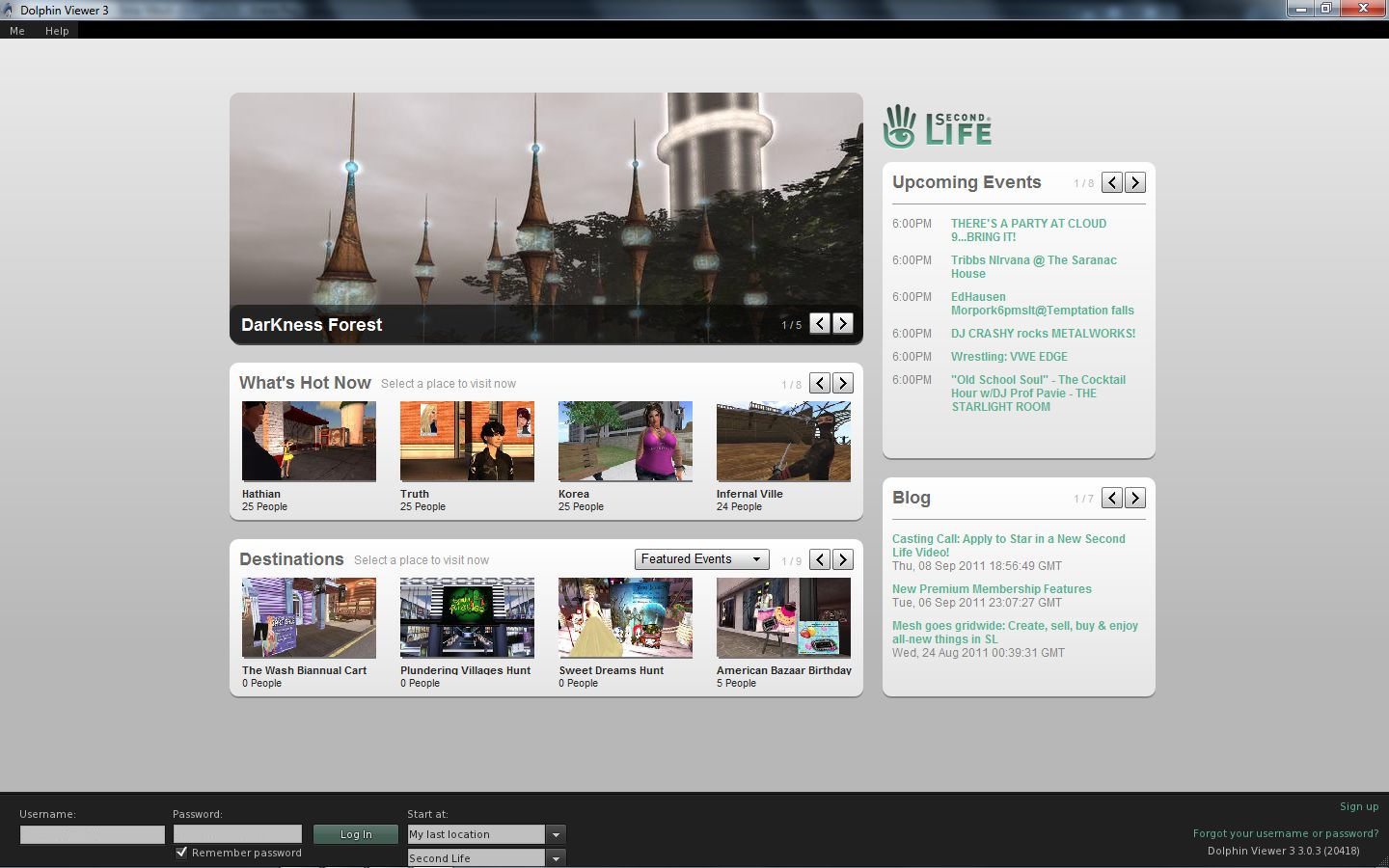
Given it is based on one of the latest code releases from Linden Lab, Dolphin 3 is the first to incorporate the new Second Life log-in screen – and kudos to Lance and the team for including it.
For those who have been using TPVs exclusively, the new SL Viewer log-in screen allows users to search SL for activities, events, destinations, etc., and log-in to them directly, without having to log-in to home / their last location, then run a search and then teleport. It’s a nice, tidy feature, and one I’ve reviewed previously. Not everyone will find it useful – but it would be nice to see it more widely available for those who do.
Dolphin 3: Features the SL Viewer log-in screen
Logging-in
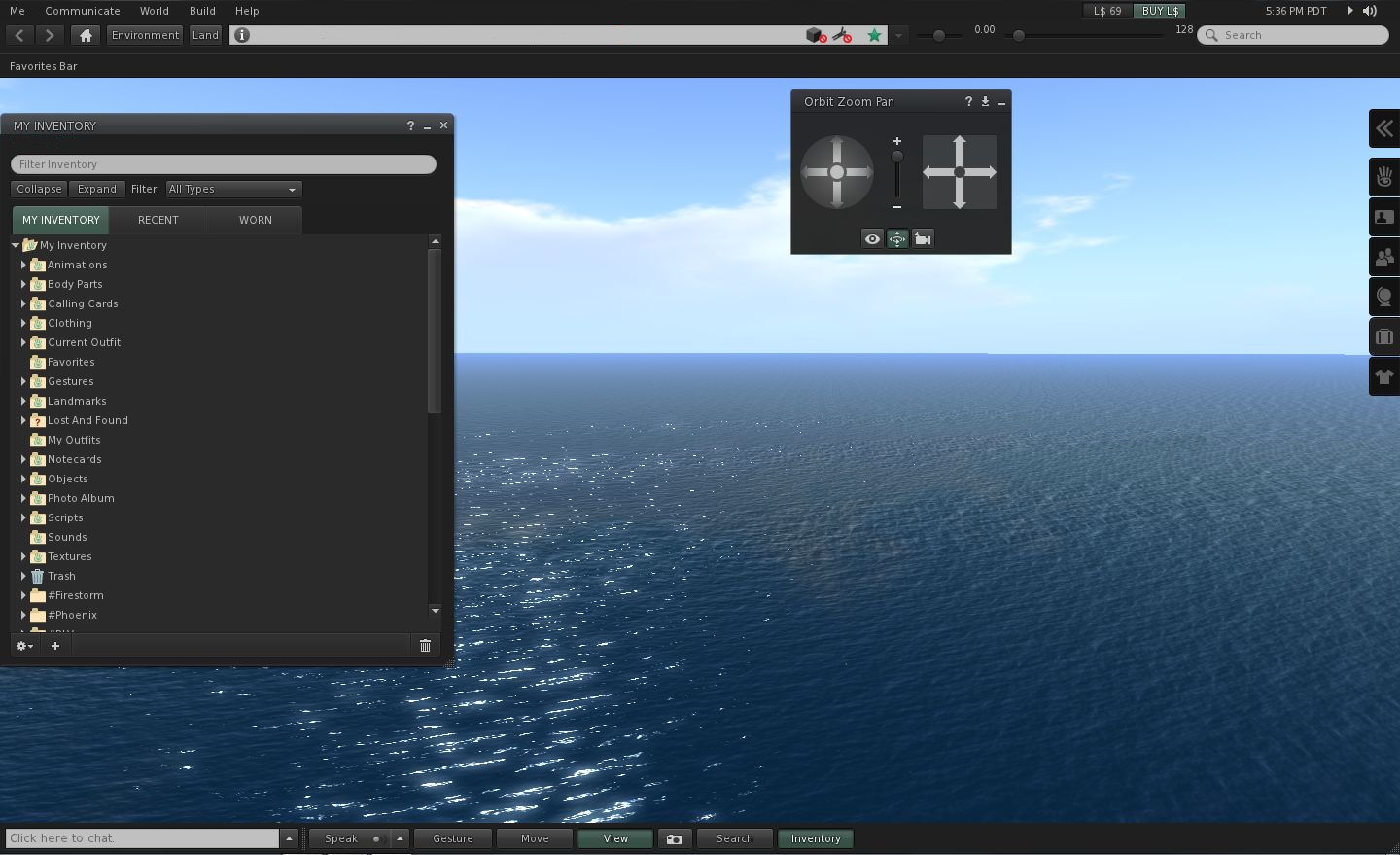
Once logged-in, Dolphin 3 presents a very V3-like UI, with some subtle differences. The Navigation Bar gains a new button – ENVIRONMENT – while retaining LAND, while the toolbar and the bottom of the window retains the INVENTORY button from Dolphin 2.
Dolphin 3 UI: familiar with a little difference
The inventory button is something that has been seen elsewhere in V2/V3 TPVs, providing a means of quickly accessing the Inventory slider of the Sidebar. Dolphin 2 has always approached things a little differently, and in a way that could appeal to those who have no great fondness for the Sidebar – it opens a dedicated Inventory window floater.
Inventory floater: directly from the Inventory button
What’s more, clicking on the Inventory Sidebar tab doesn’t close the floater – it still opens and closes the Inventory slider, as per “normal” Viewer 2 behaviour. Working together, both the button and the tab thus allow for two Inventory windows to be opened with the minimum of effort, thus overcoming one of the major complaints concerning V2/V3. I’ve always felt this to be a smart move, and it is good to see it being retained in Dolphin 3.
The Environment button provides quick access to an updated set of Windlight settings, etc.,for the sky.
New Features Overview
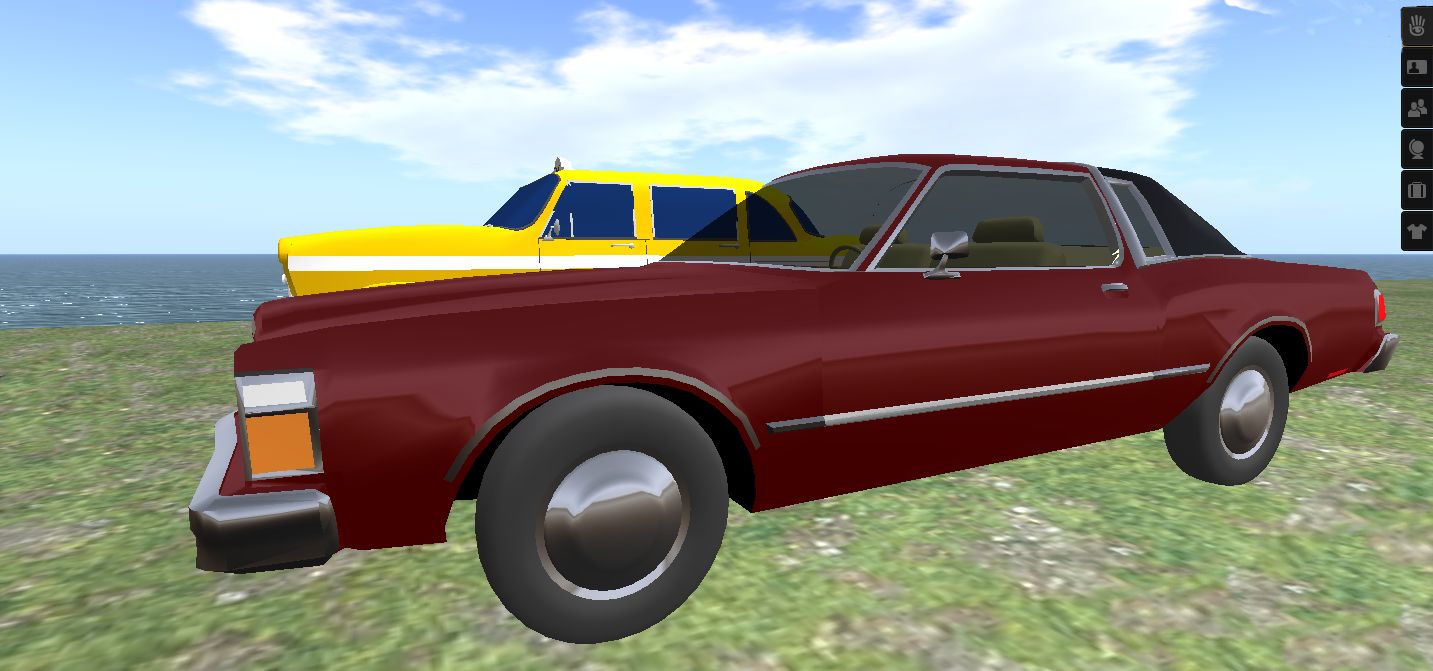
Mesh object rendering is perhaps the major reason for Viewer 3, and by extension, the changes we’re seeing to Viewers in general at the moment. Dolphin 3 renders mesh objects as well as V3 or any other Viewer; I used my familiar examples from the Beta grid, and they rendered without issue.
Mesh rendering
Like all Viewers that can render mesh objects, Dolphin 3 includes the new prim count / PE counts in the edit menu.
Prim Counts and PE
Also as with the majority of TPVs at present, Dolphin 3 does not have any upload feature for mesh objects.Hopefully, this will change in the future for all TPVs that currently do not have the capability; but as I’ve mentioned ein the past, for most people the capability to see mesh objects is what matters, rather thean the ability to upload it.
Alongside mesh object rendering, Dolphin 3 supports the new native 64m maximum size – which it again, unsurprisingly, handles without fault.
Lance Corrimal has launched Dolphin 3, the latest in the Dolphin range of Third-Party Viewers, and another alternative to Viewer 2.x/3.x.
The new release follows hard on the heels of the Firestorm “Mesh Beta” brings with it a wealth of new features – including mesh object rendering. The full list of new features reads:
All new goodies from Linden Labs up to their internal version 3.0.3:
Mesh object rendering
Camera depth-of-field
Avatar physics
Native 64m prim support
Build tool improvements (see below)
Increased maximum cache size (up to 9984 Mb)
Increased maximum setting for LOD (up to 8 )
Mini-map back in the People sidebars with options to turn off & re-size
Enhanced parcel privacy, a check box in About Land/Options
Marine Kelley’s Restrained Love v2.07.03.03
All of Lance’s own additions to Dolphin 2, with the exception of Qarl Fizz’ “select Linden plants” patch, which does not work with the mesh engine
The improved build tools include:
Ability to perform simple mathematics in the spinner controls in the Build tool’s Object tab (numeric fields in Position, Size, Rotation). For example, to double the length of a prim along the y axis you enter sy*2 in the y-size field. The other “variables” are px/py/pz for position, sx,sy,sz for size, rx,ry,rz for rotation.
A new button in the Build tool is present, so that creators can create a sculpted prim directly instead of first creating a box and then changing it to a sculpt.
The maximum number of repeats for textures has been set to 256
The maximum size for hollow has been increased to 99.99% from 95%
More precision (4 decimals) in the spinner controls in the Build tool, together with a way to increase and decrease the single digits with your keyboard
This release does not include mesh object uploads, for the same reason a Firestorm 3, and may also have inherited the Linden-generated nVidia 400-series+ crash bug – so caution may be required in using Basic Shaders.
I’ll hopefully have a features review of Dolphin 3 out within the next 24 hours.
In a sad notice posted today, Kirstenlee Cinquetti has announced the end of line for the foreseeable future – if not permanently – of the outstanding Kirsten’s Viewer. The entry in full reads:
“You may have noticed that the client has not been updated in some time. Sadly Real Life events have taken an unfortunate turn which basically puts an end to any more development.The Plans for S22 have been shelved and the project has been marked as discontinued.
“Installers have been removed as they are now very outdated, the sourcecode will of course remain. The website and forums will stay up for as long is required. Also inworld groups will stay active. It is of course entirely your choice as to how long you continue to use the client, however I do stress that it will fall behind with features and it may be wise to seek alternatives in the near future.
“Dawny has been very Ill, and had to stop working. As you can imagine my priority is to support her in any way possible and that means I have to become the main bread winner, as much as I enjoy working on the client it’s obviously the first thing to go.
“Not much more to say…
“BUT finally I would like to wish everyone who has supported the project over the years, a huge hug and many thanks, Jabba, Altair and all the people who have put up with my ranting and raving and unusual colour choices in UI. 🙂
“Who knows what the future holds! But for now Kirstens Viewer goes into a deep sleep.
“Presses the Shut Down button, Drives spin down, silence……….
“Love to you all, KL”
This is a very sad day for Second Life and Viewer development. Over the years, Kirsten’s Viewer has set the benchmark for SL-related photography and machinima as well as being ground-breaking in many other areas, not the least of which was the development of the first Viewer 2 hybrid client that offered a usable interface well ahead of V2’s own at the time, and which has remained innovative and highly preferable to LL’s own offering. More recently, it became the first and, up until its suspension, only Viewer to support the upload of mesh objects outside of Viewer 3.x.
I’ve always enjoyed using Kirsten’s Viewer – it requires a fairly high-end machine, and at times my PC had struggled with it, but it has always given me faultless performance and the ability to enjoy elements of Second Life that just weren’t available to me through other Viewers – such as the initial iteration of dynamic shadows.
Happier times: Jabba Abbye’s screen capture celebrating the release of S21 Build 9 with mesh object rendering / upload support
I’d like to take this opportunity to thank Kirstenlee and the team for everything they have done and achieved with the Viewer, together with a personal message of best wishes and a return to health for Dawny. For now it is Adieu to Kirsten’s Viewer; perhaps we’ll meet again in the future.
Yesterday, the Phoenix / Firestorm team released a Beta version of Firestorm (officially called 3.0.1.22525), specifically aimed at mesh object rendering. The team is keen to emphasise that this is bordering on an “experimental” release, and urge anyone trying it out to read the accompanying release notes – of which more anon.
The release itself was almost destined not to take place; on Tuesday morning the team discovered a series of regression issues that needed to be resolved, then their service provider announced significant issues with their fibre, leaving the Phoenix servers only able to accept around 10 connections at a time!
Nevertheless, the team worked through issues and, following the fortnightly Phoenix Hour on MetaMix TV, the Beta was duly released. So – what is it like?
Starting Firestorm
The differences between this version and earlier releases are apparent from the moment you install and run Firestorm. On the log-in screen alone are three new features:
Log-in screen – new features
Log-in drop-down list: Firestorm gains the Phoenix username drop-down list with this release. If you use several alts, names and passwords can be retained by the Viewer and chosen from a drop-down list, making for easy selection. In a further nice touch, if you use the same name to log on to multiple grids, the Viewer will remember the specifics. For example, I have three entries under username: “Inara Pey”, which logs me into the SL Main grid; “Inara Pey @ Second Life Beta” which logs me in to aditi, and “Inara Pey @ InWorldz” which logs me in to InWorldz – the required Grid is automatically selected when I select the user name
Beneath the Username field is a new button – DELETE THIS ENTRY (arrowed). This removes the details of the selected avatar from your log-in records held by the Viewer – again, useful if you have multiple avatars and discard one, or if you no longer log-in to a specific grid
There is also now an option called DEFAULT SETTINGS. This allows you to select a default “UI” style with which to run the Viewer. By default, it is set to “Phoenix”. Clicking on the arrow to the right of the option displays the additional options of “V3” and “Hybrid” (boxed above).
Now, these have been described as setting different User Interface styles – and to a point, they do (setting V3, for example, will give you the familiar Sidebar tabs from Viewer 2.x/3.x); but if anyone is expecting “Phoenix” will deliver a full-blown Phoenix-esque V1.x UI will be in for a disappointment – the differences in presentation are far more subtle: “Phoenix” delivers a UI that is pretty much identical to the current Firestorm release UI, for example.
Firestorm 3.0.1 “V3” UI option
“Hybrid” refers to a new – and, I’d say cleaner – variant of the Firestorm UI developed for this release, which I’ve now set as my default (as far as possible – there is at least one issue with this release).
Firestorm 3.0.1 “Hybrid” UI option
As with the Viewer Modes in Viewer 2.x / 3.x, changing the default settings will require you quit and restart Firestorm. While this requirement is the same as the official Viewer when switching between Basic and Advanced modes, it would be nice if this could be automated if at all possible: clicking the OK button shutting down and restarting the Viewer in one convenient go.
Firestorm 3.0.1 “Phoenix” UI option
Navigation and other “Top” Bars
By default, both the Phoenix and Hybrid settings have the Navigation Bar at the top of the screen turned off, while the V3 option has it on, together with the Search bar. Speaking of the Search Bar, as there is an option to turn it off/on, it would be nice if this worked independently of the Navigation bar (currently turning Search on / off only makes a difference if the Navigation Bar is displayed). It’s a small thing, but would add to convenience of use.
The Favourites Bar is on by default in all three, and while I like the fact that in the Phoenix and Firestorm options it is on a transparent background, this may cause issues for some and it is frequently difficult to see against, say, the sky. I also like the Hybrid option’s transparency around the tool bar at the bottom of the screen; this is a nice touch and adds to the feeling that one has a greater in-world viewing area.
Of Sidebars and Pie Menus
The “V3” option of the UI obviously uses the V2.x/V3.x Sidebar and tabs, although options can be accessed from the toolbar at the bottom of the screen as well.
The “Hybrid” UI option uses the “tabless” Sidebar seen in earlier Firestorm releases, with options accessible from the toolbar buttons. In both cases, options can be “torn off” from the Sidebar and floated as independent windows, and will persist as such between log-ins.
The “Phoenix” UI option disposes with the Sidebar completely, and simply floats options in their own windows.
Both the Phoenix and Hybrid options utilise the Pie Menu by default – I would personally prefer the Context Menu were the default in the case of the latter, but I suspect I’d be in the minority for saying so! The V3 option uses the Context by default.
Major New Features
Volume Control Access
Volume Setting Controls
With this release, Firestorm inherits Phoenix’s quick-access panel for all volume control settings. Simply hover the mouse over the volume icon at the top right of the Firestorm window and the control panel will drop down.
All the expected options are there, with sliders, together with options to mute those that are frequently not used: streaming music, media and Voice.
Alongside the Quick Preferences button located down on the toolbar, this is perhaps one of the most eagerly awaited V1 TPV UI options to reach Firestorm.
Built-in Flight Assist
Adding to the client-side AO, Firestorm now sports a flight assist option. This is accessed through PREFERENCES -> FIRESTORM and then checking the ENABLE BRIDGE FLIGHT ASSIST option. As the option itself suggests, the Firestorm Bridge must be worn in order for the flight assist to work; furthermore, you should remove / turn off any other flight assist options before using the built-in flight assist, or you might experience all sorts of issues!
Camera Floater Updates
The camera floater receives an update in the new release, with the Phoenix and Hybrid versions receiving new buttons, while the V3 floater sits somewhere between the previous Firestorm version and the Viewer 3.x controls.
Camera floaters Viewer 3.x (left), Firestorm Beta, Firestorm “V3” and Firestorm “Phoenix” / “Hybrid” (right)
The layout of the new “Phoenix” / “Hybrid” floater makes it appear slightly larger on-screen, and also a little tricker to resize.
Contacts List Changes
The Contacts List has been updated to show whether friends have allowed you permission to map them / edit their items – all to the good. On the downside, a column to show Display Names has been added alongside user names, which tends to push out the size of the window unnecessarily.
Contacts List – a lot of screen space
It would be nice if there were an option to turn off either the user name column or the Display Name column in order to make the List less screen-consuming. If this could be coded, and reduce the amount of screen real estate lost to the window.
 Many of us reported last week that development on Kirsten’s Viewer had been suspended due to Dawny being ill. As a consequence of her illness, Kirstenlee has had to seek full-time employment as well as needing more time to care for her.