Linden Lab issued one of their (increasingly rare) blog updates on ongoing work with Second Life. The updates comes on the heels of the release of CHUI, the Communications Hub User Interface, which reached LL’s development and beta viewers on the 26th and 27th February respectively, and which I’ve briefly overviewed. Until now, the only official notice of CHUI’s arrival had been via a forum post which hasn’t been entirely visible, so the blog update include Torley Linden’s informative YouTube video on the release.
The update also references the e-mail preference changes made to the Marketplace at the start of February, as well as passing comment on region crossings, noting:
We have made several improvements to region crossing that allow a smoother transition between regions, instead of the jerky transition some users experienced in the past. This change also reduces the rate of teleport failure rate. This went out the full grid on January 25, 2013. Since that date, the number of reported teleport failures has dropped by 91%.
While teleport failures may have been reduced, many are still seeing continued issues with vehicle crossings …
The Cocoa project for the Mac builds of the viewer, which I made mention of in week 8, and offers a link to the Cocoa Project viewer for Mac users.
Finally, the post looks ahead to upcoming features and updates – but sadly, only makes passing mention of the materials processing project. One can hope that as CHUI is now in the beta viewer and there was, s of week 8, apparently only one remaining issue with materials to be dealt with, a project viewer will finally be appearing sooner rather than later …
CHUI, the Communications Hub User Interface has taken two major steps towards official release, having been integrated into both the SL development and beta viewers.
The release of the SL development viewer containing CHUI came on February 26th (3.5.1.270826). This was followed 24 hours later with a beta viewer release on the 27th February, again containing the CHUI code (3.5.0.270825). Both of these releases see the SL beta and development viewers move to the 3.5 code base.
As well as CHUI’s new conversational and chat log floaters, which I previewed a while back – although it has had a number of changes since then – the viewer brings a number of changes to the overall way in which user communications are handled by the viewer, including a new set of chat preference options for handling incoming messages and notifications.
The most immediate change with CHUI is the conversations floater, which may open automatically as the viewer is started if you have received offline IM or are receiving incoming messages from HUDs, etc., while logging in.
Conversations Floater
For those who have been using TPVs as their primary viewers, the updated CHUI Conversations floater will appear very familiar, as it gathers IM windows and Local Chat into the same panel. On the left is a vertical tab display which will list all open conversations, whether individual IMs or group chats, and which includes four buttons. On the right is the actual conversation window, which has six buttons associated with it, not all of which many be active at all times (the first three are automatically disabled in local chat, for example).
CHUI Conversations floater
These buttons put all of the most common controls required for text / voice conversations within the floater itself, providing it with considerable power and ease-of-use. The chat window display options, of example, allow you to switch quickly between displaying chat headers (the little icon bars within the conversation) or removing them (so that just names and text are displayed) and whether or not to show the time, or even the name of the other person in one-to-one IM conversations.
As noted in my original preview of CHUI, the minimise buttons on the floater are particularly useful, as they offer a number of ways in which the amount of screen space is taken up by the floater. The buttons can be used individually or together, to radically reduce the amount of space the floater takes up.
CHUI: The new conversations floater in three display modes – open, collapsed, & minimised (image uses the CHUI project viewer)
It’s a “lightweight” week for deployments, with all channels receiving one of two maintenance packages.
Server Life Server (Main) Channel
Region restart notifications: the “old” style (top), and the “new” style (bottom)
On Tuesday February 26th, the Second Life Server (SLS / Main channel) received the server maintenance project which was on all three RC channels last week. This project has miscellaneous bug fixes, along with an impoved restart notification (which will only be apparent when this new version restarts for the next update) – see the image on the right.
While this is much better than the previous notification, it does suffer from the fact it will still fade from the viewer’s window and become a chiclet whether or not the OK button is clicked – and thus can still be missed if attention is not on the screen when it appears. To help avoid this, it is possible to set a sound for the alert using the Debug Setting UISndAlert, which requires the UUID of the sound, which coule be one you’ve uploaded to inventory yourself (Firestorm additionally has UISndRegionRestart, which can be set through Debug Settings or Preferences > Sound & Media > UI Sounds 2).
This release means the until the RC channel deployments take place (see below), almost the entire grid is running the same server code – the only exceptions being a few “special” regions (such as the Linden Realms regions) – release notes.
Release Candidate Channels
On Wednesday February 27th, all three Release Candidate channels should receive a new server maintenance package which includes a fix for a crash mode – release notes (BlueSteel).
As always, there is a forum thread for discussing the deployments.
Server-side Baking
Following-on from his initial feedback given at the TPV Developer meeting on Friday 22nd February, Nyx Linden gave a further update on the recent Sever-side Baking (SSB) pile-on / load test when chairing the Content Creation User Group meeting on Monday 25th February
Thanks all for everyone who helped out with the pile-on test of server appearance last Thursday. The results tended to be that when the system worked, it was nice and speedy, however there were a number of issues that prevented it from working for everyone all the time. We got a good bit of data on the bugs we knew were there as well as a couple new ones. we’ve been crunching on the results and are starting to attack the issues, so it was definitely successful in achieving what we wanted: more data :). There will be future rounds, so thanks in advance for anyone who comes back to help us test again.
Z-offset Issue and SUN-38
As noted in the comments following my quick SSB test using currently available TPVs with SSB enabled, there is an issue with the “Z-offset” capability common to many third-party viewers, which allows the vertical height of an avatar above the ground to be adjusted, such that sits and kneels don’t leave the avatar apparently floating in the air, and which allow those with very tall / giant avatars or very small / petite avatars and those wearing full body mesh to similarly adjust their vertical placement relative to the ground / floor.
The problem was reported to Nyx in week 8, and SUN-38 was subsequently raised by Henri Beauchamp on February 24th to officially log the matter. Commenting on the problem during Content Creation meeting, Nyx Linden stated. “It hasn’t escaped our notice. We’re considering a couple different approaches … we’re considering a few different options. Suggestions appreciated, but we haven’t officially settled on an approach we’re going to commit to publicly just yet.” He also suggested that any questions on the subject be asked again next week, presumably by which time LL will have had time to consider the problem in detail, and hopefully consult with TPV developers.
Interest List Updates
Andrew Linden is continuing to work on the interest list code, with more refinements to come, as well as looking at a number of bug fixes. The updates about to go to LL’s QA include changes which should make scenery load faster / more correctly when first logging-in to SL or teleporting to a region.
Future updates to the interest list code should see scenery in your world view rezzing a lot faster
This summary is published every Monday and is a list of SL viewer / client releases (official and TPV) made during the previous week. When reading it, please note:
It is based on my Viewer Round-up Page, a list of all Second Life viewers and clients that are in popular use (and of which I am aware) and which are recognised as adhering to the TPV Policy
By its nature, this summary will always be in arrears
The Viewer Round-up Page is updated as soon as I’m aware of any releases / changes to viewers & clients, and should be referred to for more up-to-date information as the week progresses
The Viewer Round-up Page also includes comprehensive links to download pages, blog notes, release notes, etc., as well as links to any / all reviews of specific viewers / clients made within this blog.
Updates for the week ending: 24 February, 2013
SL Viewer updates:
CHUI development viewer continued to be updated, reaching release 3.4.6.270766 on February 23rd; no changes to the project viewer
Dolphin updated to 3.4.13.27316 on February 19th – core updates: improvements to feed profile page to better facilitate the Japanese language; all “Autopilot cancelled” messages optional; sourc code up-to-date with the LL dev viewer; internal fixes for the upcoming openSUSE 12.3 release
Kokua updated to release 3-4-5-25935 on February 18th – core updates: updated to LL 3.4.5 code base; port of client-side AO (Teapot / Firestorm); further OS Grids added to grid selection drop-down
Niran’s Viewer updated to 2.0.9 on February 19th – core updates: UI changes to the inventory and build floaters; slight changes to the rendering system; implementation of OPEN-162/ARVD-49
Metabolt updated to 0.9.64.0 (Beta) – February 23rd – core updates: interest list fix for nearby objects – release notes
Radegast updated to 2.8 on February 22nd – core updates: interest list fix for nearby objects; server-side baking support (see my quick test); a range of new features and improvements; bux fixes – release notes
Discontinued Viewers
Phoenix officially reached end-of-line for SL on December 31st – read more here
Zen viewer was withdrawn from the SL TPV directory and all repositories shutdown on January 27th, 2013.
Update February 24th: Henri Beauchamp has filed a SUN JIRA on the Z-offset issue mentioned in comments following this article. Z-offset is an opton found in many TPVs which allows the vertical height at which an avatar stands / kneels / sits / lays to be adjusted through the viewer, allowing users to compensate for their avatars appearing to float in mid-air. The SSB code effectively “breaks” this capability. The JIRA description carries a comprehensive description of the issue for those unfamiliar with the problem.
Update, February 23rd: The Catznip team (which includes Kitty Barnett, have added a post to their blog on the subject of RLVa and SSB. Be sure to read it!
Following the recent Server-side Baking (SSB) pile-on / load test, I took a little time out to try-out the various viewer versions which are starting to appear which provide SSB support. This was not intended to be an extensive break test or anything – just something to sate my own curiosity on a number of points.
As such, the tests I conducted were simple, and as they were performed on Aditi, they may have been influenced by some of the inventory issues being experienced there. For the tests, I used my main account, and my CTA – Crash Test Alt, which routinely gets used when testing experimental viewers, etc.
Testing covered the Cool VL experimental branch, Singularity Alpha release with SSB support and Radegast 2.8. Throughout the tests, my CTA was running the official Sunshine (SSB) project viewer 3.4.5.270409. Testing did not include Lumiya, which has SSB support implemented. The reason for this is that I remain unable to log-in to Aditi with Lumiya.
I started with a couple of baseline tests to remind people of what is going to happen once SSB is deployed to the main grid.
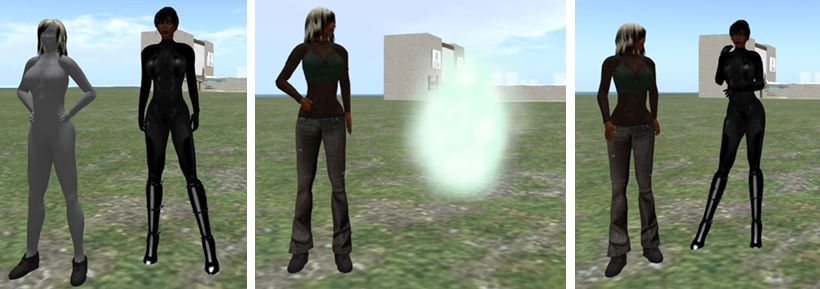
The three faces of SSB:On the left, what is seen when running a viewer which does not support SSB: the viewer user looks fine, but everyone else is a grey ghost. In the centre, what is seen when looking at someone who is using a viewer which does not support SSB: they are a cloud. Right: what is seen when both parties are using a viewer with SSB support: properly rendered and dressed avatars (remember: SSB does not affect prims / sculpts / mesh, hence why these render OK in the non-SSB viewer)
Following this, I switched to using Singularity first and then Cool VL.Results wer as expected – both accurately rendered outfits and outfit updates without any significant issues.
SSB on Singularity: Top: as I render in Singularity with SSB, as seen by myself (l) and with the official SSB viewer (r). Bottom: as I appear after an outfit change to both myself in Singularity (l) and the official SSB viewer (r).
Testing Radegast 2.8 also generated the expected results: outfits rendered correctly in both the Radegast 3D viewer, and in the SSB viewer, as did any outfit changes made via Radegast. Furthermore, and as expected, outfit changes made using one viewer were accurately reflected when logging into another viewer (so outfit changes made in Singularity were accurately rendered by Radegast, for example).The only issue I actually encountered was that footwear would not render correctly – which is not an SSB issue.
Baking on Radegast: (top) outfit changes on an SSB-enabled region render correctly in Radegast and (bottom) are also correctly rendered in other SSB-enabled viewers
SSB and RLVa
While carrying out these tests, I also took a look at RLVa on SSB, and confess to not finding any obvious issues when using Singularity or Cool VL (which uses RLV). All RLV/RLVa options functioned as expected:
Items “locked” as non-detachable remained undetachable until “unlocked”
Restrictions applied through RLV/a all functioned as expected (e.g. map restrictions prevented access to the World or Mini-Map; inventory denial prevented inventory access, etc.)
Remote access to #RLV Shared Folders worked as expected (i.e. remote changes of outfit worked and were accurately rendered)
Remote (HUD-based) access between avatars worked as expected
Control zone restrictions applied / released as anticipated.
This does not necessarily mean that RLVa is not “broken”. I actually have no idea if the Cool VL experimental or Singularity Alpha contain specific updates for RLV/RLVa outside of any work Kitty Barnett may be undertaking for RLVa and SSB.Aslo, just because the basic functionality of RLVa appears unaffected by SSB does not means that there are deeper, more subtle issues which need to be addressed in order to ensure all of RLVa continues to function correctly under SSB.
Summary
SSB is beginning to find its way into TPVs and appears to be working well – which is not to say that there are not bugs and issues still to be resolved with the service as a whole. Doubtless, we’ll find out more on this as LL continue to analyse the results of the initial pile-on test, and further tests are undertaken in the future. As a result of this quick-and-dirty play with the service over a number of viewers, I’m certainly curious to know if some of the issues encountered during the pile-on / load test (such as a noticeable slow-down in the time needed for outfits to render after a change) might be indicative that the system still needs tweaking in order to handle larger numbers of outfit changes, rather than all the problems being related to other issues on Aditi itself.
In terms of potential RLVa issues, I draw no conclusions; as mentioned above, the fact that the most obvious RLVa functions worked OK for me is not to say RLVa and SSB are without issues; there is much which goes on “under the hood” with RLVa which could very well be affected by the arrival of SSB which requires code refactoring but which does not result in outright / obvious breakages.
If you’d like to have a play with SSB for yourself, use the links below.
The release and beta version of the viewer are effectively on a par with one another at this point in time, following the roll-out of SL viewer 3.4.5.270263 on February 14th. There is currently nothing “in” beta at the moment in terms of specific SL projects.
Development Viewer and CHUI
The development viewer and the development version of the CHUI (Communications Hub User Interface) project viewer are also pretty much on a par, and it is anticipated that the CHUI code will be merged-up to viewer development “any minute now”, to use LL’s parlance, although a date has not been indicated. The viewer development code branch is pretty much waiting for this to happen, and CHUI remains in pole position as far as LL’s code merge plans are concerned, so potentially there could be more news on this in week 9.
Project Cocoa
Work is progressing on Project Cocoa within LL. This is a rarely talked-about project to update LL’s Mac support to the Mac OSX Cocoa API specifically for OSX 10.8 support, and remove dependencies on old Mac APIs which are not well-supported any more. The overall goal of this project, as commented on by Widely Linden is to, “Get people building cleanly with 10.8,” although OSX 10.6 will continue to be supported, although it will no longer be possible to build a Mac viewer using 10.6 once this project has been deployed. Widely also commented that there is a project viewer and source code for this work, which interested parties “should snag.”.
Vivox Update
Work is underway to update the SLvoice plugin to use the latest release of Vivox. This should bring with it a number of benefits including: security updates, stability improvements (although perhaps not improved connection reliability), better echo cancellation and – anecdotally, at least – better voice quality. There is no ETA on when this project will be deployed.
FMODex
Linden Lab continue to work on utilising FMODex as a replacement for FMOD.
Materials Project
There has been significant progress in fixing the known outstanding issues on the project which are standing in the way of a public project viewer and viewer code appearing. Speaking at the TPV Developer meeting on Friday 22nd February, Oz Linden said, “Our list of things which must be fixed before we can hand it out to people is now down to one.” However, there is still no estimated date as to when a project viewer and source code will actually appear Real Soon NowTM, which appears to put them both closer than Pretty SoonTM and Real SoonTM on the LL scale of things :).
Materials processing: with one remaining issue to fix, a project viewer now really should not be that far away. In the meantime the server code is fully deployed to the main grid
As has been reported in my server-side news for the week, the server code for materials is deployed to the whole of the main grid, and so the system will be usable as soon as project viewer surfaces.
Server-side Baking
What is likely to be the first in a number of Server-side Baking load / pile-on tests took place on Thursday February 21st. Results were, at best, mixed, for a variety of reasons.
The test was held in the Sunshine project test regions on Aditi, immediately following the Server Beta User Group meeting. Those participating were asked to use the latest iteration of the official project viewer, which had been set-up for LL to do a certain amount of data logging. Anyone encountering issues was asked to raise a JIRA under the SUN project, listing issues encountered, with the viewer session log attached.
the test was in two parts:
Part one: performed on a region still running on a region using the current baking system, this saw people change between three of four outfits so that some baseline data could be obtained at the LL end of things. As this was using the current baking system, the usual baking issues were apparent
Part two: performed on a region running the new baking service, this again saw people changing between a number of outfits, this time monitoring and reporting on their own experiences.
Results were, it is fair to say, mixed. They were also not helped by the fact that Aditi itself has significant issues with inventory, etc., which made the test considerably more complicated than perhaps needed to be the case (for example, people were getting “object failed to rez”-style messages and other errors as items could not be fetched from inventory, etc.).
SSB load test: mixed results (image courtesy of Latif Khalifa
As an overall load test on the service itself, this should have generated some interesting numbers for LL with at least 40 people participating in the test at its peak. Commenting on the test on Friday 22nd February, Nyx Linden said, “A big thank you to everyone who participated in the pile-on yesterday. We got a lot of data out of it, [and] it looks like the majority of the issues were inventory-related, and we’re going to be digging into those. Anecdotal evidence suggests that when the system worked, it worked pretty darn well; but there were some people who had more trouble than others … We are looking into the remaining issues; we’re going to be fixing them as quickly as possible.”
While Nyx indicated that the majority of problems were inventory-related, he also stated that he and his team were still digging into the data to see if the problems were purely related to the known issues with Aditi’s inventory handling, or whether some of the issues are apparent in the inventory system itself, either on the server-side of things or within the viewer itself.