Logos representative only and should not be seen as an endorsement / preference / recommendation
Updates for the week ending Sunday, May 28th
This summary is published every Monday, and is a list of SL viewer / client releases (official and TPV) made during the previous week. When reading it, please note:
It is based on my Current Viewer Releases Page, a list of all Second Life viewers and clients that are in popular use (and of which I am aware), and which are recognised as adhering to the TPV Policy. This page includes comprehensive links to download pages, blog notes, release notes, etc., as well as links to any / all reviews of specific viewers / clients made within this blog
By its nature, this summary presented here will always be in arrears, please refer to the Current Viewer Release Page for more up-to-date information.
Official LL Viewers
Current Release version 5.0.5.326444, released on May 18, promoted May 23 – formerly the Maintenance RC viewer overview – download page, release notes – NEW
Project AssetHttp project viewer updated to version 5.0.6.326593 on May 26 – This viewer moves fetching of several types of assets to HTTP / CDN – overview (download and release notes
The Content Creation User Group meeting, at the hippotropolis Camp Fire (stock)
The following notes are taken from the Content Creation User Group meeting, held on Thursday, May 25th, 2017 at 1:00pm SLT at the the Hippotropolis Camp Fire Circle. The meeting is chaired by Vir Linden, and agenda notes, etc, are available on the Content Creation User Group wiki page.
Audio extracts are provided within the text, covering the core points of the meeting. Please note, however, that comments are not necessarily presented in the chronological order in which they were discussed in the meeting, but are ordered by subject matter.
A video recorded at the meeting by Medhue Simoni is embedded at the end of this update, my thanks to him making it available. However, do not that this cuts out mid-way through the meeting. Timestamps in the text below refer to this recording.
Applying Baked Textures to Mesh Avatars
[1:54] This was announced as a new project – see my separate update for details.
The meeting saw additional questions asked about the baking service, which are summarised below.
Will the Baking Service Support Animated Objects?
Not initially. Baked textures are only relevant to your Current Outfit Folder (COF), affecting your appearance only. Animated objects will not have any notion of a COF (as they do not have an associated inventory structure as avatars do), so whose textures would an animated object show?
Also, even if you could assign your own COF-defined appearance to an animated object, it would only be valid until you change your own appearance, which would discard the bake used by the object, probably leaving it blank.
One solution might be allowing arbitrary textures to be sent to the baking service (see below). Another would be to allow animated objects to have their own notion of a COF contained within the object itself which the baking service could somehow reference
WERE this kind of work to be adopted, this would be Vir’s preferred approach. However, it is not currently a part of either the animated objects project or baking textures on meshes.
Baking Arbitrary Textures
Would it be possible to have a LSL function to request baking arbitrary textures?
Not as a part of applying baked textures to mesh, although it might be considered in the future.
However, the baking service could offer considerable flexibility of use were it to be extended, simply because of the way it defines the body area (head, upper body, lower body).
A problem is that, as noted above, baked textures are held only so long as your current avatar appearance defined via your COF is relevant, after which they are discarded. For the system to be useful with arbitrary textures, the resultant composite textures would need more rigorous storage, perhaps as a new asset class or retained in some form of “temporary” texture store – either of which would have to be defined and allowed for.
Thus, the problem is the amount of work involved in extending the baking service and (potentially) the asset handling required to support it.
HTTP Asset Viewer
[4:22] The HTTP Asset viewer was updated to version 5.0.6.326593 on Friday, May 26th. This update primarily bring the viewer to parity with the recently promoted release viewer, and so primarily comprise the revised region / parcel access controls, and the updates to Trash emptying behaviour.
Supplemental Animations
[6:53] As well as working on animated meshes, Vir is now also working on the LSL side of supplemental animations alongside of LSL changes need for animated objects. The work is designed to overcome issues of animations states keyed by the server-side llSetAnimationOverride() conflicting with one another.
Animated Objects
Current Project Status
Vir has got basic prototyping working in a “hacked up” single version of the viewer. He’s now working on the shared experience – how is an animated object seen by multiple viewers.
There is still no details on what limits beyond land impact which may be applied to animated objects (e.g. number of animated objects – not avatars – permitted per region type, etc), as there is not at this point any solid data on potential performance impact to help indicate the kind of limits which might be required..
Number of Allowed Animation Motions
[8:52] Currently, SL supports a total of 64 animation motions playing at one time per agent (hence walks, arm swings, wing flaps, tail swishes, etc., all of which can happen at the same time). It’s not been tested to see how much of an actual load running multiple animations places on a system. The limit might have to be changed as a result of animated objects – or it might not; it’ll come down to testing.
Other Items of Discussion
Avatar Scaling
[12:24-video end] There is a lengthy discussion on avatar scaling.
Essentially, the size slider works within a certain range; go beyond this, and distortions of body parts (e.g. facial features) can start to occur, as some sliders stop working properly.
Obviously, it is possible to scale avatars using animations, but again, doing so also doesn’t play nicely with the sliders.
This problem is particularly impactful with Tiny and Petite avatars (although it also affects really large avatars). One workaround is to upload a mesh without joint positions of the affected bones, but this causes breakages in the mesh.Thus, having a slider which could handle the avatar’s scale over a broader range might be beneficial. However:
Changing the definition of the current scale slider to work over a broader range isn’t an option, due to the risk of existing content breakage.
Adding a new “global scale” slider to the system might be possible. However, while its is relatively simple at the viewer end of things, SL is already close to its limit of 255 sliders, and any additional global slider will require significant changes to the back-end.
A further problem is motion is not affected by scale, but is keyed to the current avatar size range. So, additional work would be required to the locomotion system to ensure the distance covered by an avatar’s stride is consistent with its size, adding further complexity to any changes.
Also, the ability to scale avatars would also require using rotations only, as any use of translations could result in locomotion issues noted above (e.g. so a really small avatar would appear to zip along at 100s of miles an hour), and rotation-only animations are somewhat limiting.
BUG-20027: Allow joint-offset-relative translations in animations
Created during the Bento project, this feature request was originally closed as something the Lab could not implement. It has now been re-opened as people wanted to add further feedback to it. So, if you have an interest – please go and comment on the JIRA.
Cost of Animating via Bones vs. Using Flexis
The Lab views animating via flexis as being very inefficient, but have no numbers for a direct comparison to the cost of animating bones.
Improving IK Support
General requests have been made for SL to better support Inverse Kinematics (IK) to add greater flexibility of joint / extremity positioning. Vir has requested that if someone could start a feature request JIRA, open for comments, on what might be sought, it would be helpful.
Next Meeting
The next CCUG meeting will be Thursday, June 8th, 2017.
During the Content Creation User Group meeting held on Thursday, May 25th, Vir Linden announced that Linden Lab is now formally investigating applying baked textures to mesh avatars in Second Life, a project that has been on the request list since at least the Bento project.
In short, if it can be implemented, it would mean that textures such as skins and make-up layers could be applied to a mesh avatar in much the same way as system layer clothing can currently be applied to system avatars, thus in theory reducing the complexity of mesh avatars by reducing the number of “onion layers” they currently require in order to simulate the capabilities of the baking system. This in turn should ease the rendering load mesh avatars place on CPUs and GPUs, thus hopefully improving people’s broader Second Life experience.
HOWEVER, the project is only at its earliest stages, and it will be a while before there is anything visible to see with regards to it. The following is a summary of the project’s current status:
The first aspect of the work will be to update the existing baking service.
This currently operates at a maximum texture resolution of 512×512.
For mesh purposes, this needs to be increased to 1024×1024 (which can already be used directly on avatar meshes via textures and / or applier systems).
As the baking service hasn’t been touched in some time, updating it may take a while, and any progress on the rest of the project is dependent upon it being completed.
Once the baking service has been updated, then the actual work of extending it to support mesh avatars should be fairly straightforward.
The exact specifications for how the bakes will work have yet to be defined, so there are no feature / capability details at present.
The capability will not support the use of materials, as the baking service as a whole has no notion of materials at present; it only produces a composite of diffuse textures, and there would be a considerable amount of additional work required to make it “materials aware”, marking it as (perhaps) a separate project.
It is important to note that this capability is not necessarily intended to replace applier systems; rather it is to add flexibility to using texture bakes with mesh, and potentially reduce the complexity of mesh avatars.
Further updates on this work will come via the Content Creation User Group (CCUG) meetings, and I’ll report on them through my usual CCUG meeting updates.
The following is an audio extract from the May 25th CCUG, at which Vir announced the project.
Note: there was a broader discussion on the avatar baking service, and this will be covered in my upcoming report on the CCUG itself.
On Tuesday, May 23rd, the Main (SLS) channel was updated with the server maintenance package previously deployed to LeTigre in week #20, containing the updated server-side parcel access override settings (more below)
On Wednesday, May 24th, the RC channels should be updated with a new server maintenance package containing the parcel access override controls, together with a fix for BUG-100704, “[Server] If Anyone Can visit is selected after Allow Group was set only group members can enter”.
SL Viewer
The Maintenance viewer, version 5.0.5.326444, dated May 18th, 2017 was promoted to release status on Tuesday, May 23rd.
This viewer is notable for its inclusion of some improvements to Trash purging behaviour, and support for the parcel access overrides which as of this week are fully deployed across the grid.
I have an overview of this viewer, which examines both the Trash purging changes and the parcel access overrides in detail, as well as touching on the other updates included in the release.
Voice RC viewer, version 5.0.5.325998, dated May 5th
Project AssetHttp project viewer, version 5.0.5.325940, dated May 4th – This viewer moves fetching of several types of assets to HTTP / CDN – overview
Project viewers:
Project Alex Ivy 64-bit viewer, version 5.1.0.505089, dated May 11th
360-degree snapshot viewer, version 4.1.3.321712, dated November 23, 2016 – ability to take 360-degree panoramic images.
Obsolete platform viewer version 3.7.28.300847 dated May 8th, 2015 – provided for users on Windows XP and OS X versions below 10.7.
Expect the two RC viewers to be updated to bring them to parity with the new release viewer viewer.
Infrastructure Updates
As noted in my week #20 updates (notably the TPV Developer meeting notes), the Lab is working on a range of infrastructure updates, together with updates to things like the teleport re-try throttle (which can place a considerable load on the “receiving” region’s simulator). It is hoped that these updates will a) help SL progress into the future, b) potentially offer further increases in the numbers of avatar regions can support.
Other Items
Changes to Mesh Upload Access
Linden Lab recently changed the requirements for being able to upload mesh content to Second Life. For more information, see my separate update.
Instancing Regions?
Note: this is not an actual project with the Lab, nor is it necessarily on the roadmap for SL development. What follows is purely in the realm of speculative discussion.
During the Simulator User Group Meeting on Tuesday, May 23rd, it was asked if instancing regions (notably private standalone regions) might some day be possible. That is, if there is a stand-alone region hosting a very popular event, a copy of the entire region might be spawned, which would then allow people into it to deal with the demand.
While there are a wide range of infrastructure, permission system and other issues associated with it (how is the instance to be paid for? what about No Copy items, can they be reproduced in an instance of a region, where technically they aren’t a duplicate? How is the required hardware managed & what happens when demand for additional server space isn’t high?, etc.), the idea wasn’t ruled as being completely out-of-bounds. Right now it remains purely on the “someday maybe” wish list.
Logos representative only and should not be seen as an endorsement / preference / recommendation
Updates for the week ending Sunday, May 21st
This summary is published every Monday, and is a list of SL viewer / client releases (official and TPV) made during the previous week. When reading it, please note:
It is based on my Current Viewer Releases Page, a list of all Second Life viewers and clients that are in popular use (and of which I am aware), and which are recognised as adhering to the TPV Policy. This page includes comprehensive links to download pages, blog notes, release notes, etc., as well as links to any / all reviews of specific viewers / clients made within this blog
By its nature, this summary presented here will always be in arrears, please refer to the Current Viewer Release Page for more up-to-date information.
Official LL Viewers
Current Release version: 5.0.4.325124, dated April 3, promoted April 19th – formerly the Maintenance RC viewer overview – download page, release notes – No Change.
Maintenance RC Viewer, version 5.0.5.326444, released on May 18th – new trash purging behaviour, support for estate access overrides (download and release notes)
The majority of the notes in this update are taken from the TPV Developer meeting held on Friday, May 19th, 2017. The video of that meeting is embedded at the end of this update, my thanks as always to North for recording and providing it. Timestamps in the text below will open the video in a separate window at the relevant point for those wishing to listen to the discussions.
Server Deployments Re-cap
There was no Main (SLS) channel deployment or restart on Tuesday, May 16th.
On Wednesday, May 17th, the three RC channels were updated as follows:
[1:00] The Voice RC viewer has an elevated crash rate, and the Lab currently haven’t determined why.
The Maintenance RC viewer updated to version 5.0.5.326444 on Thursday, May 18th. This viewer currently has a lower crash rate that the other RC viewers (although it has not been out that long), so might be a candidate for promotion. I have an overview of this viewer for those interested.
64-bit Viewer
[2:23] The last major functional addition for the 64-bit Alex Ivy viewer is currently with the Lab’s QA. If all goes well, a further project viewer update should arrive in week #21 (commencing Monday, 22nd May).
This introduces a new executable to the viewer – SL Launcher – which runs an update check at start-up. If there is a new version of the viewer available, the Launcher manages the download and installation – including ensuring Windows users get the right version for their operating system (32-, or 64-bit). If there is no new version to install, or once the viewer installation has completed, the Launcher will launch the viewer as a child process, and will shut down when the viewer exits at the end of a session.
The plan is to move the crash data capture package to the Launcher in the future, which will give full end-to-end monitoring of the viewer in the event of a crash.
360 Snapshot Viewer
[6:07] The work on the 360 snapshot viewer is once again progressing. A new library has been added, which provides the appropriate meta data so that websites supporting 360-degree viewing can correctly such images taken by the viewer on upload, eliminating the need to process them separately via the web service currently supplied by the Lab.
This work is currently being tested, and should find its way into a project viewer update some time in the next two weeks or so, with a release candidate hopefully not too far behind that.
Region Crossing Hand-off / Caps Router Issues
[7:43] Fantasy Faire experienced very high levels of region crossing hand off problems with avatars trying to move between the various regions. A similar issue has surfaced at the just-opened Home and Garden Expo.
While it issue isn’t new, the Lab found a cause is the Caps Router running out of connections due to the number of avatars it is attempting to serve. New monitoring has been put in place which will determine how many connections the Caps Router is using, and when it is approaching its limits. The data gathered will be used to help better determine how many connections are needed, allowing the Lab to adjust the number supported.
This work is going to be carried out incrementally, starting with an initial RC deployment in week #21 containing conservative adjustments in the hope of avoiding creating additional bottlenecks in changing things too radically at one time. However, the hope is that the changes will in time result in two improvements:
It could result in an increase in the number of avatars a region can comfortably support
As this is an issue at the SERVER level (not the simulator), the changes should help reduce people on regions with few avatars on them experiencing issues as a result of the region being hosted on the same server as one (or more) regions with a lot of avatars on them.
As a result of understanding the problem, the Lab was aware the issue was impacting the Home and Garden Expo even before it had been reported.
Unsuccessful Teleports Impacting Region Performance
[14:20] During investigations into the region issues at Fantasy Faire, the Lab noted that a simulator running a busy region has to carry out a lot of work to determine whether or not someone can teleport into it, which can degrade overall simulator performance.
To combat this, the Lab is going to change the teleport re-try throttle following a failed TP. As viewer-initiated teleports are already somewhat throttled, the change should not affect them. However, it will likely mean that the very rapid retry TP HUDs (aka “TP hammers”) will break or degrade in their performance unless adjusted.
The hope is that by reducing the load placed on a simulator as it tries to deal with too rapid a succession of TP requests which cannot be granted as the region is full, overall performance will be improved and those already in the region will enjoy a better experience.
This change should be appearing in a server RC update soon.
Additional comments on teleport failures:
A queuing system will not be added, as this is deemed to be too difficult to implement and manage.
There is no relationship between the size of an avatar’s inventory and the frequency with which that avatar may experience teleport failures. However, the amount of items attached to an avatar, the scripts they are running, etc.
The Lab can monitor teleport failures in real-time.
Automatic Additional Logging after Region Crashes
[29:27] It was asked if additional logging could be automatically enabled on a region crash. This is something that cannot be done, and Oz’s belief is that doing so would result in an additional load on the simulator during recovery, and so not be a good idea.
Avatar and Object Rendering Cost Investigations
[31:00] The Lab is continuing work in reviewing the rendering cost calculations for in-world objects and avatars, work I first reported on in September 2016. However, the numbers aren’t at a point where any adjustments can be made to the calculations.
Fun Fact
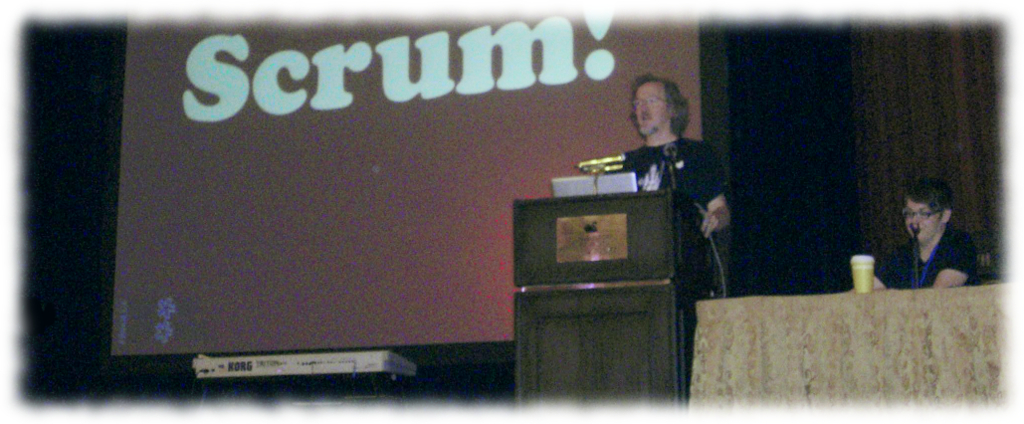
Oz Linden marked his seventh anniversary at the Lab this week – so a belated happy rezday to him! Some of us can likely remember his 2010 appearance at the SLCC, when Esbee Linden introduced him to the audience in Boston 🙂 .
Oz at one of the viewer / open-source panels at SLCC 2010, with Esbee Linden just visible to the right



 Inara Pey: Living in a Modemworld