Logos representative only and should not be seen as an endorsement / preference / recommendation
Updates from the week ending Sunday, March 21st
This summary is generally published every Monday, and is a list of SL viewer / client releases (official and TPV) made during the previous week. When reading it, please note:
It is based on my Current Viewer Releases Page, a list of all Second Life viewers and clients that are in popular use (and of which I am aware), and which are recognised as adhering to the TPV Policy. This page includes comprehensive links to download pages, blog notes, release notes, etc., as well as links to any / all reviews of specific viewers / clients made within this blog.
By its nature, this summary presented here will always be in arrears, please refer to the Current Viewer Release Page for more up-to-date information.
Note that for purposes of length, TPV test viewers, preview / beta viewers / nightly builds are generally not recorded in these summaries.
Official LL Viewers
Current release viewer: Project Jelly viewer (Jellydoll updates), version 6.4.13.555567 and dated February 5th, 2021, promoted February 17th – No change.
Release channel cohorts:
Custom Key Mappings project viewer updated to version 6.4.17.556726, dated March 15th.
The following notes were taken from my audio recording and chat log of the Content Creation User Group (CCUG) meeting held on Thursday, March 18th 2021 at 13:00 SLT, and Pantera’s video recording of the TPV Developer’s meeting of Friday, March 19th, a copy of which is embedded at the end of this article.
There have been no changes to the current pipeline of SL viewers since the update to the Key Mappings viewer at the start of the week. This leaves the pipelines as follows:
Release viewer: version 6.4.13.555567 (Jelly Doll improvements) originally promoted February 17th.
Release channel cohorts:
Custom Key Mappings project viewer, version 6.4.17.556726, dated March 15.
Maintenance RC viewer – Eau de Vie, version 6.4.14.556149, dated March 4.
Love Me Render (LMR) 5 project viewer, version 6.4.14.556118, dated 23, 2021.
Project viewers:
Legacy Profiles viewer, version 6.4.11.550519, dated October 26.
Copy / Paste viewer, version 6.3.5.533365, dated December 9, 2019.
Project Muscadine (Animesh follow-on) project viewer, version 6.4.0.532999, dated November 22, 2019.
360 Snapshot project viewer, version 6.2.4.529111, dated July 16, 2019.
Viewer Status
The Simple Cache viewer is being updated and will re-enter circulation as a new RC viewer. Depending on the outcome of further testing this man or may not be the next viewer promoted to release status.
The other RC viewer with the potential to be promoted is the Key Mappings Viewer.
LMR 5 has encountered some additional crash issues centred on Intel GPU drivers, and so is unlikely to be in line for promotion at present.
Graphics Work
The graphic team is addressing bugs relating to lighting underwater and to the Moon haze. This work, together with the LMR 5 issues mean Euclid Linden’s work to separate out UI rendering from scene rendering is currently on hold.
ARCTan
Summary: An attempt to re-evaluate object and avatar rendering costs to make them more reflective of the actual impact of rendering either in the viewer. The overall aim is to try to correct some inherent negative incentives for creating optimised content (e.g. with regards to generating LOD models with mesh), and to update the calculations to reflect current resource constraints, rather than basing them on outdated constraints (e.g. graphics systems, network capabilities, etc).
As of January 2020 ARCTan has effectively been split between viewer renderings focused on revising the Avatar Rendering Cost (ARC) calculations and providing additional viewer UI so that people can better visibility and control to seeing complexity. This will be followed in the future by work on providing in-world object rendering costs (LOD models, etc.) which might affect Land Impact will be handled as a later tranche of project work, after the avatar work.
This project has reached a point where consideration needs to be given to how performance controls that can leverage the avatar-related ARCTan data can be implemented. However, this work is waiting on Steeltoe Linden.
In Brief
There was more general discussion on improved avatar scaling – uniform / proportional scaling, etc. However, as has been pointed out in the past, the general design of the avatar skeleton, coupled with the morphing capabilities (sliders) do not make uniform scaling easy to implement.
One of the calls for making such scaling possible is to allow users scale down their avatars so that regions feel much “bigger” and thus can present larger settings. However, this view ignores the fact that there are other practical constraints on the region and the underpinning simulator that mean just because avatars are smaller, “more” can be packed into a given space.
The majority of the meeting was general spitballing on options for revising the avatar per above, requests to implement Marvelous Designer, providing morph targets, and so on. However, none of the chat related to projects the Lab are currently working on or plan to implement in the foreseeable future.
The TPV Developer meeting amounted to some 6 minutes of discussion, ergo no timestamps to the video.
Kokua released version 6.4.16 of their viewer on Tuesday, March 16th. The release takes advantage of a pause in releases of the official viewer to allow the Kokua team to incorporate a number of TPV derived updates and capabilities.
Kokua 6.4.16 also sees a jump in version number as a result of the pause in official viewer promotions, which came as a result of the knotty problem of the Simple Cache viewer being promoted and then rolled back. The release notes for Kokua 6.4.16 provide a slightly complicated explanation about the version number jump, but this can really be summarised as to allow Kokua remain in lock-step with official viewer numbering when the next official viewer promotion (6.4.17) is made, and Kokua merge the changes.
The following is a summary of the core changes seen within Kokua 6.4.16. Again, please refer to the formal release notes as well.
From Firestorm
People Floater – Contact Sets
Possibly the largest update seen with this release ins the inclusion of Contact Sets, ported from Firestorm.
For those unfamiliar with the capability, Contact Set provides the means to organise the people on their Friends list into virtual groups for ease of reference.
You can, for example, assign all those you have friended because you’re all involved in the same role-play group into one Contact Set, your closest friends friends to another, customers you have friended into a third, and so on.
Once created, Contact Sets can be individually displayed and actions taken against selected names (IM, offer teleport, pay, etc), just as you can when viewing them in your full Friends list, and a single name can appear in more than one Contact Set, depending on your needs.
With Kokua, Contact Sets ha been integrated into the People floater rather than (as with Firestorm) utilising a separate UI element, and thus can be accessed in four main ways:
Via Communicate Contact Sets.
By pressing ALT-CTRL-SHIFT-X.
By opening the People floater via its toolbar button and selecting the Contact Sets tab.
By enabling the new Contact Sets toolbar button and using that.
For a complete guide to Kokua’s Contact Sets, including differences between it and Firestorm’s implementation (for those familiar with the latter), please refer to the Kokua Contact Sets guide.
People Floater: Contact Sets tab and context menu updates
People Floater Nearby – Context Menu Updates
The right-click context menu on the Nearby people list has been updated to include adding a person to a Contact Set; giving an avatar a coloured marker on the map; and options to Freeze / Eject avatars on your own land.
In addition, and while related to the Mini Map, the ability to see a place or avatar profile from the Mini Map has also been from Firestorm.
Crouch Mode
This allows your avatar to move in a “crouched” pose, which can be useful in things like combat games.
Enable the mode via Preferences → Move & View → Keyboard → check Enable Crouch Toggle Mode.
To use, with your avatar on the ground, press PAGE DOWN and your avatar will adopt a “crouching” pose and will remain in it and move around in it until PAGE DOWN is pressed again.
Note that as a part of this, Kokua has split Preferences Move & View into three sub-tabs:
Camera: the camera control options (View Angle, Distance, etc.).
Keyboard: the keyboard check options (using the arrow keys to move; using the AZERY keyboard layout, crouch mode, etc.).
Mouse: the mouse options (Show me in Mouselook, Enable Context Menus in Mouselook, etc).
From Catznip
Kokua now includes the ability to mark any folder as a System Folder (so promoting it to the first group of folders and protecting it from deletion), as provided in Catznip.
Kokua Team Updates
Status Bar Graphs
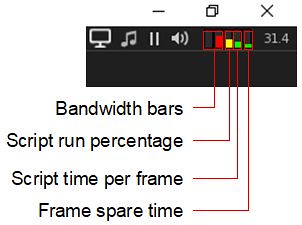
The new script bar graphs
Kokua 6.4.16 introduces three new bar graphs, located in the top right corner of the viewer, alongside the familiar bandwidth graphs. These are:
Script run percentage: how much of what scripts want to do per frame is actually achieved. A score of 100% means everything that should have happened did happen, and the bar graph will actually be clear. The more coloured bar is, the lower the script run percentage.
Script time per frame: how much of each frame (around 22ms) is used for scripts.
Frame spare time: is how much of the frame time was not used. Again, the less you can see of this bar the better things are. A full bar means there is no spare time.
Hovering the mouse over any of the bars will display a pop-up with the current value. Please refer to the Kokua web page on these bar graphs for a complete explanation of each of them.
Personal Lighting Floater Tool Bar Button
Following a Feature Request from Yours Truly, Kokua now includes a tool bar button to directly access the Personal Lighting floater. When enabled, this will hopefully make it easier for photographers to access the floater and make lighting adjustments.
The Personal Lighting tool bar button
Find the button on Toolbar Buttons floater, along with the new Contacts Sets button.
RLV Updates
The RLV and FTRLV versions of Kokua 6.4.16 incorporate RLV 2.9.30.0 and the RLVa @setsphere functionality. Note that white the following are a part of the RLV 2.9.30.0 release, they are not described in the release notes:
In the status floater it would try to resolve the UUID for camtextures to a name and fail, showing ‘waiting’. Instead it will simply show the UUID.
A new debug option RestrainedLoveSelectionOutlines allows switching between the earlier behaviour of no selection outlines/no change to vision spheres when an object is selected and the later behaviour of showing a selection outline whilst forcing the nearest vision sphere to opaque. The earlier behaviour is the default.
The RLV Status floater’s last tab has been updated to show @setsphere information whilst it is in effect
Feedback
An interesting selection of updates for Kokua – and I’m obviously pleased to see the Personal Lighting floater tool bar button.
I’ve admittedly never really used Contact Sets – the capability has always struck me as a exercise in playing people administrator rather than being of practical use, but then I don’t have any particular need for it: the Search option in the People list gives me all that I need. Others might find the addition a lot more useful – and if looking for a move from Firestorm, it could well be an added attraction to give Kokua a try.
Certainly, this release sees Kokua make good use of the pause in official viewer updates whilst allowing them to remain set to quickly adopt LL’s next promotion.
The following notes were taken from the Tuesday, March 16th, 2021 Simulator User Group (SUG) meeting.
Server Deployments
Please refer to the server deployment thread for the latest news and updates.
Tuesday, March 16th: no deployment to the the servers on the SLS Main channel.
Wednesday March 17th: all RC channel will receive simulator update 556847, comprising the following fixes / improvements:
Optimisations for crossing and teleporting into a region.This should result in less of a performance hit being felt with lots of people entering a region.
We were unwrapping the entire package of avatar data on arrival as soon as we got it. That processing is now being deferred, so the actual arrival may be a bit slower in high volume situations but you won’t get the hit on the main simulation frame that you did.
– Rider Linden on the changes to how avatars enter a region.
Maintenance RC viewer – Eau de Vie, version 6.4.14.556149, dated March 4th.
Love Me Render (LMR) 5 project viewer, version 6.4.14.556118, dated February, 23rd.
Project viewers:
Legacy Profiles viewer, version 6.4.11.550519, dated October 26th.
Copy / Paste viewer, version 6.3.5.533365, dated December 9th, 2019.
Project Muscadine (Animesh follow-on) project viewer, version 6.4.0.532999, dated November 22nd, 2019.
360 Snapshot project viewer, version 6.2.4.529111, dated July 16th, 2019.
In Brief
Map tiles continue to be worked on, but still not fully fixed. However an unspecified “technical hurdle” has been passed in getting the issue corrected.
Inventory syncing between Agni (the main grid) and Aditi (the Beta grid) is currently not working following the migration to AWS. The issue is being addressed, but there is currently, but no ETA at present.
BUG-226851 “Only 30 – 50% of scripts run on regions since SLS Main server roll of April 18th [2019]” – a long-standing issue for which LL now has some ideas on how to address, but no promise on a possible deployment date.
BUG-230415 “Region Lordshore (Jeogeot) cannot be entered via vehicle and will not rez objects (either on ground or on avatar)” – this is an issue that appears similar to a former griefing vector. It appears confined to the one region, and data is being gathered.
BUG-229227 “Offline group invites not working” – no update on this long-standing issue, however it has been noted by the Lab that the entire methodology with off-line message handling could benefit from a “revisit”.
On Monday March 15th, 2021, the Firestorm team released version 6.4.13 of their viewer.
Regarded somewhat as a maintenance update more than a major release, the primary am of 6.4.13 is to hopefully move Firestorm into its quarterly cadence of releases.
That said, as well as fixes and updates, this release includes a number of additional and new capabilities added by the Firestorm team, and these form the focus of this overview.
Installation
There is no need to perform a clean install with this release if you do not wish to.
Do, however, make sure you back-up all your settings safely so you can restore them after installing 6.4.13.
Again, please refer to the Firestorm 6.4.13 release notes for additional details of all changes and updates in this release.
Linden Lab Derived Updates
This release brings Firestorm up to parity with the Lab’s 6.4.12.555248 Dawa Maintenance RC, which focused on bug fixes. This viewer became the Lab’s default viewer on February 1st, 2021.
Menu Updates
Avatar Menu: Recreate LSL Bridge
If you encounter issues with the Firestorm Bridge, you can now recreate it via Avatar → Avatar Health → Recreate LSL Bridge.
Note: you must be on a script-enabled region / parcel for this to work.
World Menu: Bulk Windlight Import to EEP
With Firestorm 6.4.13, it is now possible to bulk import Windlight .XML files directly to inventory as EEP settings / assets.
Go to World → Environment → Bulk Import
Select the EEP type you’d like to use for the import process (days, skies, water).
A file selection window will open. Use this to navigate to the folder on your computer containing the corresponding Windlight .XML files.
Use SHIFT-left-click / CTRL-left-click to highlight the .XML files you wish to import and click Open at the bottom of the window.
The window will close and the import process will import the .XML files and convert them to corresponding EEP settings and assets using the original Windlight file name, placing them in the Settings folder in your inventory.
Bulk import of Windlight .XML file to EEP settings / assets
Side notes:
You must ensure you select the correct import type / .XML fly type for this to work. For example: if you click on Skies, you must import .XML static sky files. Selecting the wrong import option or the wrong file type will result in a file validation error.
Remember that the viewer already includes around 200 of the more popular Windlight .XML files already converted to EEP settings .
These can be found in the Library Environments folder, and can be copied to your Settings folder (or a folder of your choice) in inventory and used from there.
It may be easier to check this folder for the more popular Windlights, as you may find those you have on your computer.
World Menu: Asset Blacklist Sound Button
The Asset Blacklist floater now includes a Play Sound button. When a sound item you’re added to the list is highlighted, the button will be enabled and can be used to hear the sound in question.
Build Menu: Mesh Uploader
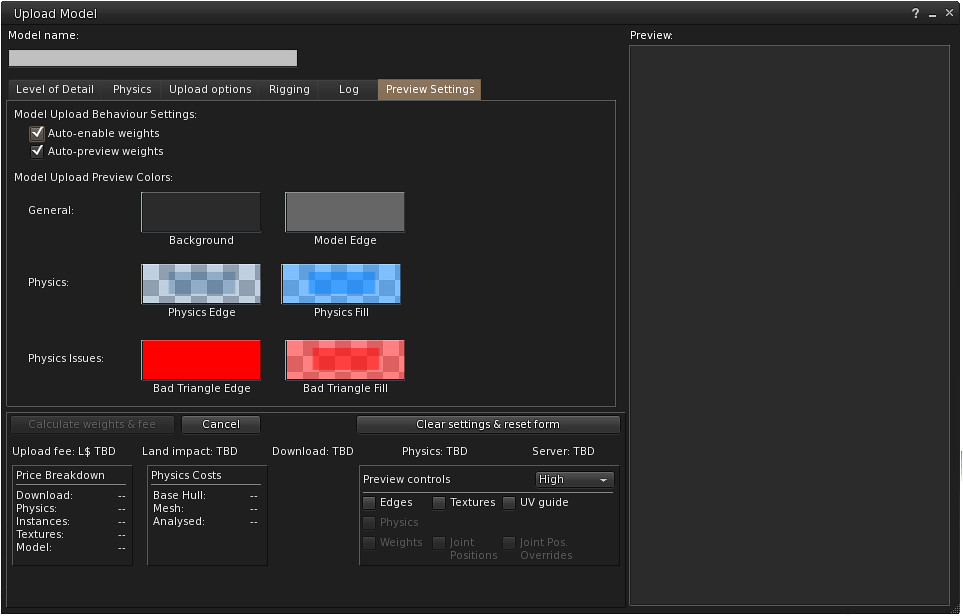
The Mesh Uploader now includes a new tab: Preview Settings.
Mesh Uploader Preview Settings
Preferences Updates
Move & View: Avatar Rotation Speed
Movement → Avatar Rotation Turn Speed slider: alters the rate at which your avatar responds to turning. 0-100 as estimated percentage of the maximum turn rate. Note that high values will be snappy/jerky.
User Interface: Use Small Camera Window
With the introduction of Camera Presets, the standard camera floater was revised to include buttons for setting and using the Presets capability. However, some have found this revised floater intrusive.
When checked, Preferences → User Interface → Interface Windows → Use Small Camera Window will replace the revised camera floater with the “old” pre-Camera Preset camera floater. Unchecking the option will display the revised window floater once more.
Using the “old” camera floater
Notes:
The revised camera floater can be resized to something approaching that of the “old” floater, for those who would like to retain the new floater but wish to reduce the amount of screen space it takes up.
If, for any reason, you revert to an earlier version of Firestorm (while available) with this option enabled, the next time you use Firestorm 6.4.13, you will have both versions of the camera floater displayed. Toggle the setting to correct.
User Interface: Time Format
Preferences → User Interface → Top Bars → Time Format: a drop-down allowing you to set the preferred time format (12 hour or 24 hour notation, etc.), as displayed in the top right corner for the viewer.
Logos representative only and should not be seen as an endorsement / preference / recommendation
This summary is generally published every Monday, and is a list of SL viewer / client releases (official and TPV) made during the previous week. When reading it, please note:
It is based on my Current Viewer Releases Page, a list of all Second Life viewers and clients that are in popular use (and of which I am aware), and which are recognised as adhering to the TPV Policy. This page includes comprehensive links to download pages, blog notes, release notes, etc., as well as links to any / all reviews of specific viewers / clients made within this blog.
By its nature, this summary presented here will always be in arrears, please refer to the Current Viewer Release Page for more up-to-date information.
Note that for purposes of length, TPV test viewers, preview / beta viewers / nightly builds are generally not recorded in these summaries.
Official LL Viewers
Current release viewer: Project Jelly viewer (Jellydoll updates), version 6.4.13.555567 and dated February 5th, 2021, promoted February 17th – No change.








 Inara Pey: Living in a Modemworld