The Drax Files 9: Fashioning your world

Elie Spot is a name well-known in the fashion world of SL. The co-owner of Mon Tissu and Celoe, now both on their dedicated and stylish region of Mayfair, she’s also the subject of episode 9 of The Drax Files.

Involved in Second Life since 2006, Elie is very much an example of the way in which the physical and the virtual can blur together and complement one another. Given her father designed games and her mother is a graphics artist, it is perhaps not surprising that Elie herself is a designer in the digital domain. But to leave things here would be to miss out on the most interesting part of her story.

May-9_001
Mon Tissu and Celoe in Mayfair

Having joined SL at nineteen as a means to escape a very hectic daily routine, she has not only established two successful brands in-world, she’s found the additional skills and understandings she’s gained through running those businesses have helped to enable her to take-up business opportunities in real life, such as with Cake & Whiskey, which she co-founded in Spring 2013, following-on from the creation of Offbeat and Inspired in 2012.

Elie-spot

As one might expect from both a content creator and long-term resident of Second Life, Elie has an understanding of the nuances of the platform, and the reasons people find it so attractive and appealing. The ability to create almost anything you want, for example, or to be able to create and build a business or brand, to share with others in a myriad of ways, and the opportunities for escape and to be whomever or whatever you want.

In discussing this and Second Life, Elie touches on one of the stigmas attached to Second Life from the world at large.

“It’s just a very common misconception that if a person sits down at a computer and starts talking to other people online that they’re hiding, or that they don’t have social skills.” she says. “I mean to take a personality type and look down on it like that and to project that on an entire culture of people? It’s just a little bit strange.”

It’s what I’ve been known to refer to as the “Star Trek syndrome”: the views that people involved in Second Life and platforms like it need to somehow “get a life”. Sad to say, the attitude isn’t necessarily restricted to people on the outside looking into Second Life; there are a lot of examples of people engaged in the platform taking a stance of perceived moral  / social / intellectual superiority over others, simply based on how those others like to portray themselves within SL, even though in doing so they do not impinge upon the lifestyles or in-world activities of those looking down on them.

DF_WM_E9_dollparty
Freedom of expression

That people do is really a shame, because Second Life can be liberating, and allows us all to reach past barriers and inhibitions defined by circumstance and / or society, and enjoy a freedom of personal expression and freedom of interaction with others from around the globe whose interests overlap with our own. The fact that some people are unable to accept others purely on the basis of how they seek to express themselves through their in-world appearance, perhaps speaks more to the prejudices of those unable to give acceptance, and to their own limitations of imagination and creativity.

Elie’s insights aren’t restricted to the unfortunate habit of stereotyping SL users, however. She is, first and foremost a very successful businesswoman in Second Life, and as such has some very clear and practical advice to give to those wishing to start-up a business of their own, as well as touching (again) on the wealth of opportunities presented in SL for doing to and the freedoms one can experience which are in may respects unique to the platform.

This is another excellent insight into Second Life and the broad potential of the virtual medium. Elie’s narrative is both clear and direct, but also carries a warm passion for the platform which is a joy to listen to, marking this as yet another outstanding piece in what is already an outstanding series.

Continue reading “The Drax Files 9: Fashioning your world” →

Escaping the prison of one’s mind

Quan Lavender invited me to the opening of two new exhibitions at the Art India Gallery on Wednesday August 14th. Together, they make interesting companions – and a strong juxtaposition of images and emotions.

Inner Prisons

“The sculptures of Chuckmatrix Clip always had a strong dark side for me,” Quan opens her introduction to the first of the pieces, Inner Prisons by Chuckmatrix Clip. “About 6 months ago I asked him if he would like to exhibit at Art India Gallery and to concentrate on this dark side. Luckily he agreed.”

The result is something of an autobiographical exhibit which, I understand, has it roots in a piece Chuckmatrix submitted to the UWA, one that touched upon his own struggle with mental illness.

Inner Prisons
Inner Prisons

Inner Prisons takes this a stage further, presenting a series of sculptures which vividly  – and with the help of the accompanying soundtrack – very emotively capture the struggles he, and others with the same affliction, face in dealing with the demons inside their minds.

Staged within the confines of a set representing an asylum, the sculptures are mixed with a series of pictures which provide insight into the many factors which can contribute to the unsettling of the mind from childhood through to adulthood, and which can so easily leave a person isolated, feeling unloved, alone, and with little more than self-loathing and fear for company.

It is a series of dark vignettes which one does not often see identified as art, much less put together in an open exhibition like this. It’s also a very moving experience as well – as Quan says in her notes, this is an emotional bearing of a man’s soul, and intensely powerful one at that.

Inner Prisons
Inner Prisons

And the fact that it is, is also why Inner Prisons carries an underlying message of hope in the final piece. Fears can be controlled; inner demons can be exorcised. It takes time, it takes help, it takes a willingness for people to understand – but it can be done. One can be brought back from the edge of despair and a contemplation of suicide to face one’s darkest thoughts and, if not be rid of them entirely, be able to sublimate and dispel them; all it takes is a simple trigger to start the entire process. For Chuckmatrix, that trigger came in the form of a small white  teddy bear, the focus of the final sculpture.

While it may have been a long, painful road from where he was when that bear re-entered his life towhere he is today, Chuckmatrix nevertheless stands a proof –  to use his own words – that “no matter how far you fall, there is always a way back up”.

Pictures alone do not do this work justice. It needs to be experienced.

Inner Prisons
Inner Prisons

Escapes

Of his own piece, Escapes, Dan Freehand says:

My work shown in SL manipulates and abstracts pornographic imagery.  Porn is generally not treated as art, yet it is part of our visual language. Porn as an escape for some, an anathema for others, but to simply dismiss it or hide it under the bed denies us the ability to understand something about who we are. I look for the art in it.

His pieces are a vivid contrast to Chuckmatrix’s work. Here we have vivid colours and shapes, all drawn from the naked human form, female and male, but not exactly in a manner which is NSFW. The images have been abstracted (some, admittedly a lot more than others), some have been given motion, scrolling slowly across the canvas in a series of hypnotic and ever-changing patterns. All are exhibited in a more “usual” gallery-style environment.

Escapes
Escapes

The contrast between the two exhibits couldn’t be stronger. Where Inner Prisons is stark, dark and disturbing, Escapes is initially loud, proud, and bold. Escapes is also much smaller in scale and setting than Inner Prisons, which also makes it perhaps more intimate.

There an initial subtext here as well which tends to get the mind boggling a bit, and I’ll be curious to know what conversations may well come out of it. Here were have images deliberately focused on pornography on display in a virtual environment which is, in the eyes of the world, some kind of hub for pornography and sexual encounters. Yet the images are themselves, through the very nature of being abstract, demure and devoid of the in-you-face attitude people associate with pornography.

Escapes
Escapes

There is also something else in Escapes, however; something Quan picked-up on herself in her notes as curator of both exhibits. Whereas Inner Prisons is stark and unsettling, it nevertheless carries a message of hope. By contrast Escapes, because it is based on the pornography business which can be dark and ugly, may well be bright and alluring to look at, but it perhaps carries a darker and more uncomfortable subtext.

Which is not to say it should be avoided – both exhibits make compelling sets and are equally deserving of an audience. You can catch both of them now through until  September 29th.

Related Links

A short stay in Collins Land

I dropped in to Collins Land after coming across shots of it in Cerys Collins’ (aka Cerys Celestalis) Flickr photostream. It is Cerys’ Homestead region, to which she extends a warm invitation for people to visit.

This is a rugged region, with high hills cut in two by water, a large sheltered inlet laying below them which protected from open water on one side by a sweep of low-lying land. There are a couple of houses here, one up on a hill-top and another with an ultra-modern geodesic dome down on the coast. There are also farm outbuildings, cobbled paths, high wooden platforms and more to see.

Collins Land
Collins Land

The arrival point is in an old greenhouse up on the hill to the north-west of the island. From here you can wander up to a high glade where stands a barn and sheep graze. There are places to sit here, as there are on the platform on which the greenhouse sits. For those wanting to explore onwards, there’s a wood-and-rope bridge spanning the deep split in the hills. Crossing this brings you to a small house with outdoor hot tub and a modest vegetable garden.

The region is a curious mix of features – the old-style house and wood-framed buildings on the tops of the hills, the modern stone-and-concrete circular house with its huge glass dome down below; a broken and rusting old van, a sleek yacht… But all of it comes together in a way that is both natural and very pleasing to the eye.

Collins Land
Collins Land

There are also lots of little details which bring the region to life – the picnic laid-out at the side of a track, seagulls wheeling over the water, wildlife ferreting in the underbrush or sitting calmly watching you watching them, and so on. There are one or two touches of humour as well – such as one of the stars of a certain series of animated feature films and his long sought-after object of affection (or is that greed?). In fact, such is the level of detail it’s worthwhile taking time in your explorations or you will miss something along the way.

Getting from the highlands to the lowlands can be done in one of four ways. You can jump (but that’ll probably hurt) or you can fly (but that’s cheating), or you can take the elevator down the wooden tower near the arrival point, or, if you’re feeling daring and want some fun, you can use the rope slide.

This last one can be enjoyed in first or third-person view, and takes you across the inlet on the east side of the island from a platform up near the little house to one on the banks of the inlet, not far from the circular house.

Collins Land
Collins Land

About Land for the region has a kindly invitation: “A quiet and peaceful for those who seek serenity and quiet place. You are welcome :)”, and the island certainly is peaceful, with plenty of places to sit or lie down. This is a place which can be enjoyed on your own or in the company of others, and places like the path-side picnic and a little lodge near the waterfalls certainly invite you to stay.

But … there is also something of a dark secret as well; you’ll need to keep an eye out for it, but in this little piece of paradise there is something that might have its own mysterious story to tell, for those who find it…

Collins Land
Collins Land

But if it does have a story too whisper, then it is something I’m going to leave to your imagination to discover!

Collins Land is a perfect place to visit and relax, and a fun place to explore. Recommended.

Related Links

A Black Basalt Beach and a little brandy wine

Since coming across Jac Mornington’s work, first with Baja Norte and then with Sol Existence, I’ve been trying to keep an eye out for news on other regions he’s had / having a hand in. At the end of July, Ziki Questi blogged that he’s been working on Black Basalt Beach, Rosy Highwater’s Homestead region of Brandy Wine Island.

Since then, the region has gained the attention of a number of bloggers, and I’ve been trying to resist the temptation to immediately hop over myself and blogging. Trouble is, Jac’s work is to much of a temptation…

Black Basalt Beach
Black Basalt Beach

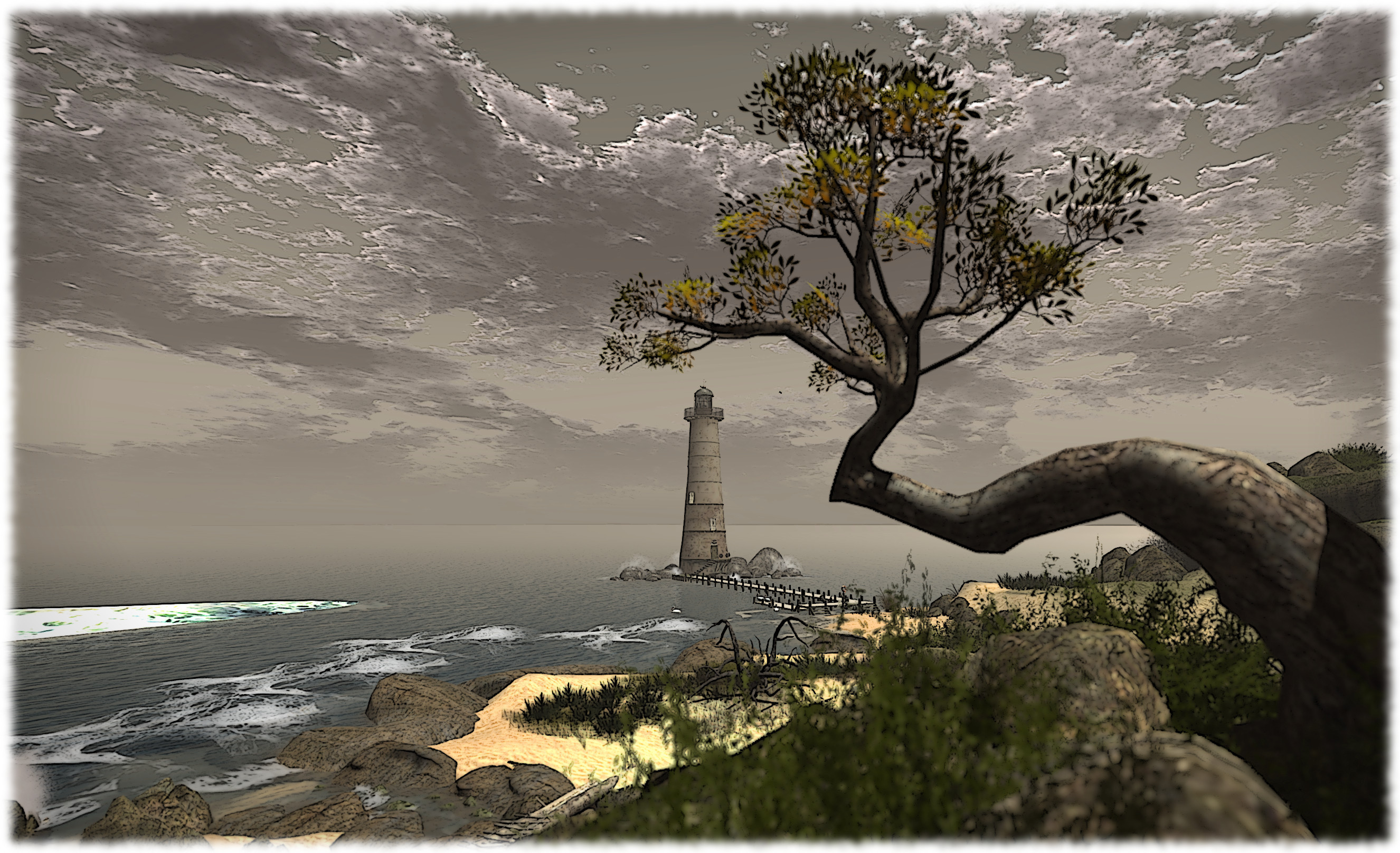
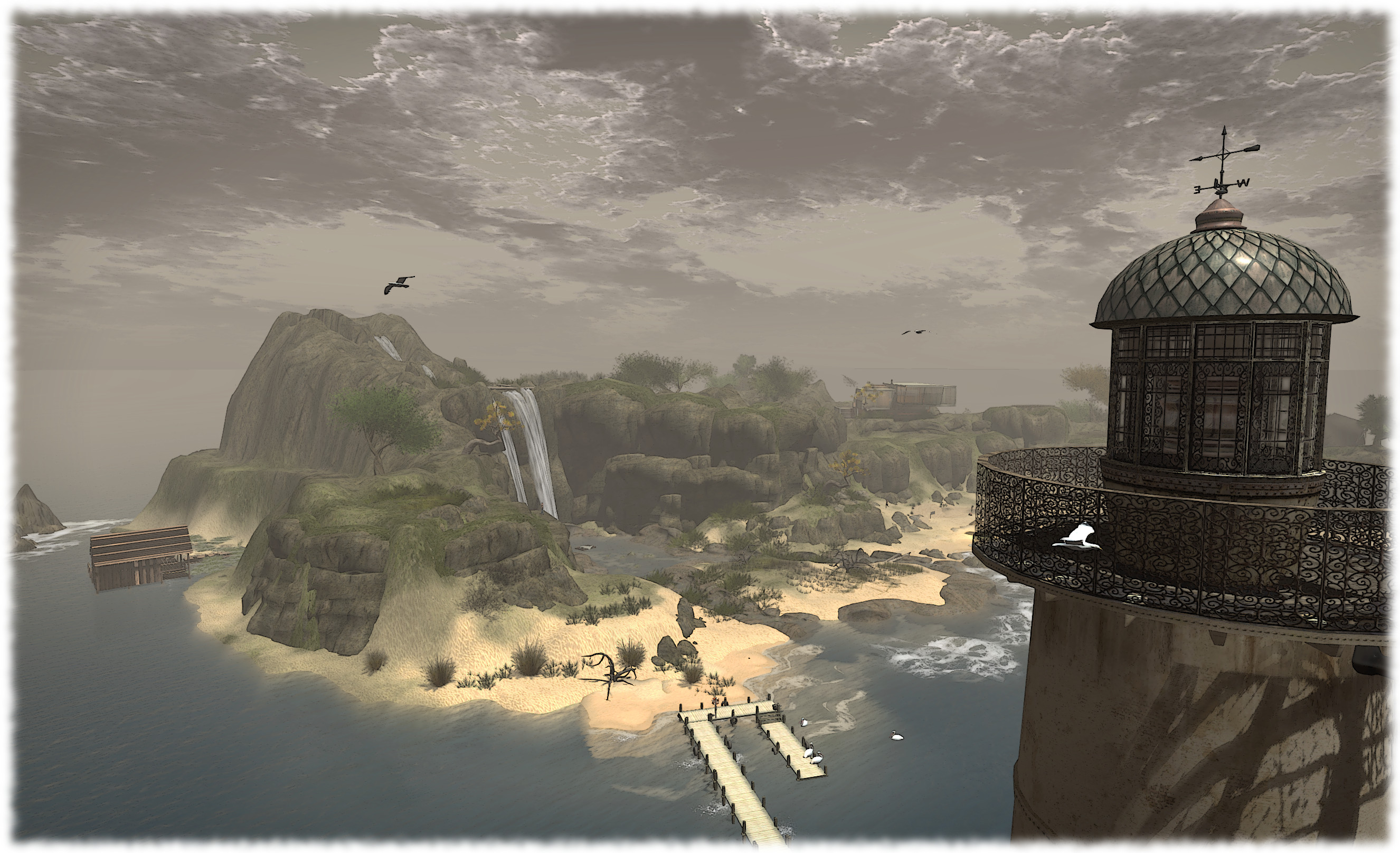
As one would expect from a project which includes Jac’s hand, Black Basalt Beach is a stunning landscape; a rocky island with a long, sweeping beach on its west side, a tall lighthouse standing guard over rocky outcrops, and tall waterfalls tumbling from the cliff tops above. Everywhere the attention to detail is amazing – and equal credit should go to Rosy as well for this, as the region is very much a collaborative piece developed by her and Jac.

Walk along the beach and you’ll come across all kinds of detail – a bicycle rezzer for those wishing to ease their walking while they explore, pelicans patrolling the water near the lighthouse and basking on pier and sand, cormorants watching proceedings from the rocks, and plenty of places to sit alone or with a companion or companions and watch the world go by.

The lighthouse, reached via wooden pier, offers an wonderful view of the island, and there are walks to be followed, both on the beach and via wooden walkways, leading to more delights and treasures to be found.

Black Basalt Beach
Black Basalt Beach

Follow the wooden walkways around to the south side of the island and you are led through a deep, narrow gorge which cuts-off the south-east corner of the island from the rest. Here stone stairs lead you upwards to precarious-looking wooden bridges which allow you access to the isolated corner of the island and to also reach the top of the island, where there is even more to see.

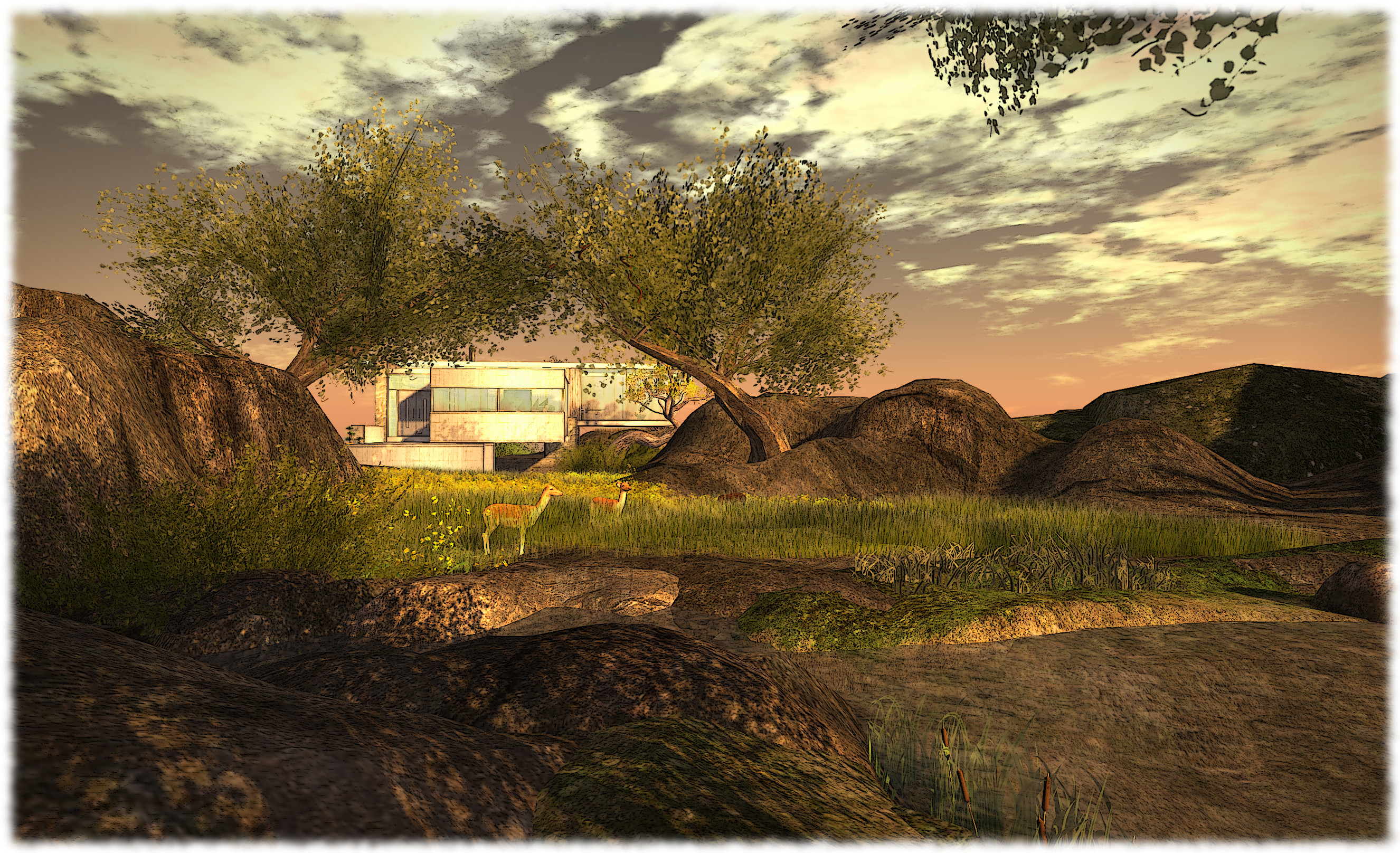
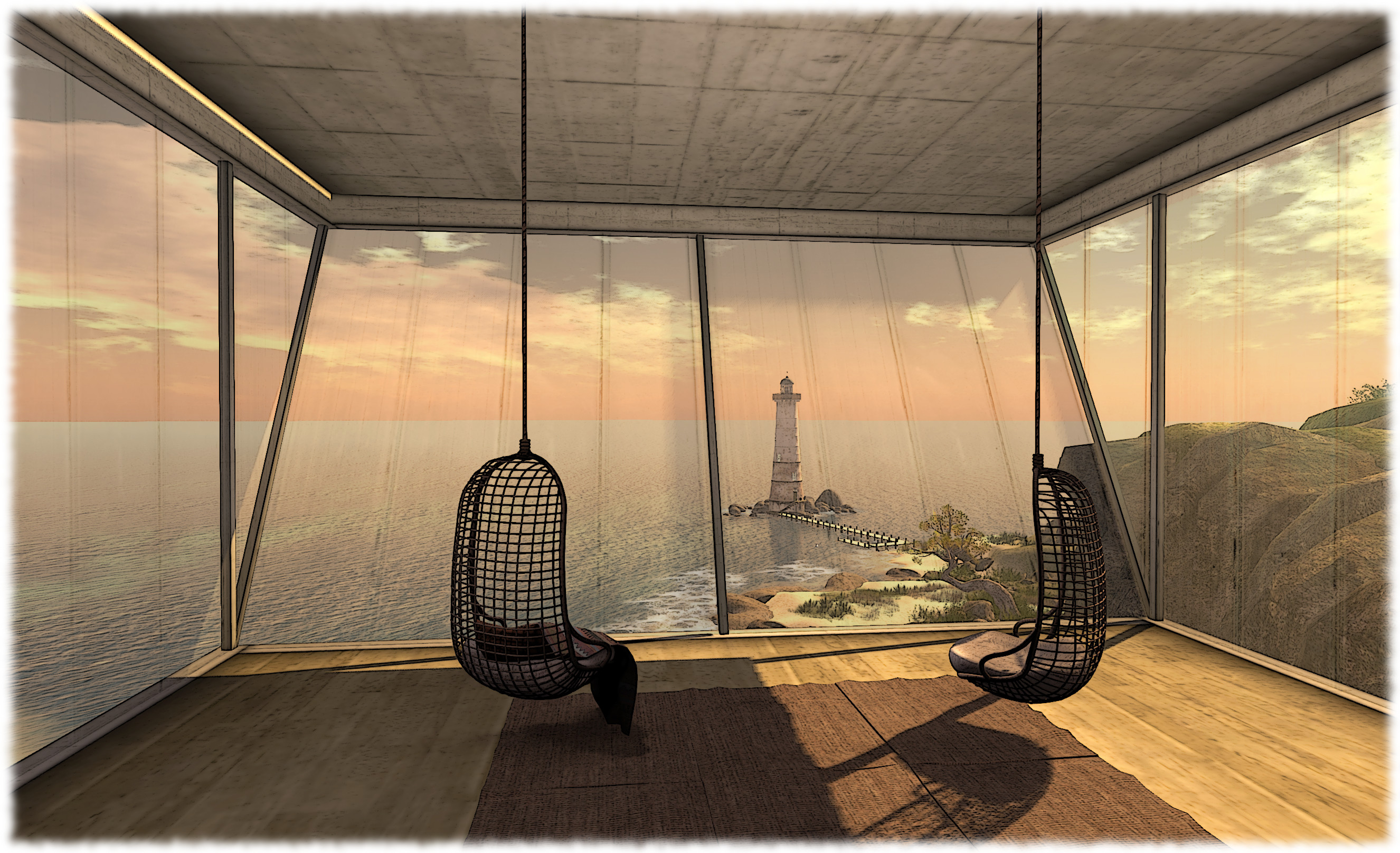
Up on the top of the island, overlooking the beach, is a Skyline Drive house by Van Auster, perfectly positioned to offer dramatic views to the west, south and north. It is of a cantilevered design which I think it fair to say would have the blessings of Frank Lloyd Wright. The house appears to be open to the public – there are no “keep out” signs of privacy signs outside, and there is a tip jar inside – and it’s worth taking time to go visit; the views from inside are both eye-catching and breathtaking, and the furnishings, etc., complement it perfectly – I particularly like the drafting table with floor plans, which (for me at least) offered a nice little nod to Mr. Lloyd Wright.

Make sure you do take time to explore the rest of the upper reaches of the island; the attention to detail here again makes it well-worth the effort. There are paths to follow, more bridges to cross and touches which will raise a smile (and a camera) wherever they are found.

Black Basalt Beach
Black Basalt Beach

It’s been a long time since I’ve been envious – I mean really envious of people’s designs and builds in SL (giving up my land holdings was, after all, my own choice), but I have to say that visiting Black Basalt Beach is one of those occasions where I found myself thinking I could really live in a place like this in SL. Liara Okiddo’s Garden of Eden was the last place to get my creative juices flowing as I explored, and Black Basalt Beach did much the same. Not that I’m ever likely to once again take-up a large-scale land holding in SL; but both the design here and Liara’s work have me thinking that it might be fun to once again have a suitable parcel where I can have a little play around.

At the risk of a further deviation away from Black Basalt Beach, one thing I have been doing of late is trying to work through my list of SL destinations (found until the Reviews > Virtual Destinations menu at the top of this blog’s pages) and determine what is still open, what has been revised since my last visit and what has, sadly, vanished for one reason or another. I think it is more-or-less up-to-date, although I know that without regular curation it’s liable to fall behind the times again. I’ll endeavour to keep an eye on it around once a quarter in order to keep things up-to-date.

Black Basalt Island
Black Basalt Beach

But that’s the thing with a world as dynamic as Second Life. Things are always changing, and there are always new places to visit as well as old places to return to. All of them can so easily become favourites and entice you back again and again, while other you promise yourself you’ll return to, only to find that when you eventually do, they’ve gone. It can make exploring Second Life hard work, even with a good part of stout boots, and when you’re confronted with a place as beautiful and inviting as Black Basalt Beach, there is a huge temptation just to sit and rest and watch and enjoy.

Which is probably why, should you drop by Rosy’s island, you’ll likely find me idling the hours sitting in one of the hanging chairs in the glass house, or perched with the puffins, watching the tide ebb and flow.

Very thoroughly recommended.

Related Links

[gigya src=”http://www.flickr.com/apps/slideshow/show.swf?v=71649″ width=”625″ flashvars=”offsite=true&lang=en-us&page_show_url=/photos/inara-pey/sets/72157634982361773/show/&page_show_back_url=/photos/inara-pey/sets/72157634982361773/show/show/&set_id=72157634982361773&jump_to=” allowFullScreen=”true” ]

(view slideshow full-screen)

A little bit of Bitacora

A new entry popped-up in the Photogenic Spots of the Destination Guide recently. Bitacora Land is the brainchild of Serenity Goizane, one of the founders of the Spanish SL travelogue, Bitacora Viajera, and the winner of the official SL10B photo contest.

Bitacora
Bitacora

A Homestead region, Bitacora certainly has a lot for the SL traveller to see, all very cleverly presented and offering a range of photo opportunities, as well as featuring a number of very familiar motifs and objects for those who do spend a fair amount of time exploring Second Life.

The arrival point delivers you to a clifftop picnic area with a nearby barn / stables. This overlooks a small village square which in turn overlooks a quayside and some sail boats nestled in a sheltered harbour. An opening in the ground, while somewhat grave-like in appearance, leads to a network of tunnels which can be used to reach various parts of the region, including the village square by means of actually walking under it and then flying / jumping up a set of quayside steps. Or, if you’re feeling energetic, you can scramble down the cliff-side and slide down the roof of one of the buildings :).

Bitacora
Bitacora

The village square offers itself as a place to meet friends and sit and chat. Unusually, none of the buildings are shops or stores (they are all shells backing into the surrounding cliffs). and the square offers an eclectic set of photo opportunities. Gates at one end lead to a little children’s play area.

Follow the tunnels to their various destinations and you’ll find a number of beaches, each with its own little theme – such as one featuring a disco and live music stage, another with a beach house standing out over the water, surf boards propped up against it, and so on.

Above ground, things are equally interesting, with high cliffs and mesa connected by wooden bridges (in places), with a church and balloon ride atop one, the aforementioned barn on another and a hot air balloon on another together with some chairs suspended under what I assume to be helium-filled balloons for the daring!

Bitacora
Bitacora

The high lie of the land has echoes of a number of places I’ve visited recently, all of which seem to be taking the land upwards to create gorges and valleys into which the designer then builds, Wendy Xeno’s Hazardous perhaps being the most popular example. Here, the approach is enhanced through the use of Grand Canyon sim surround which works very well with the overall design of the region, and gives a good deal of additional natural depth to the build.

There are echoes of other regions as well; perhaps the most obvious being the name of the region appearing in large stone letters overlooking the village square, which is very mindful of the big SMILE standing on It All Starts with a Smile. Railway tracks leading out into the water also remind one of other popular places the seasoned SL traveller may well have come across.

Which is not to say that Bitacora is merely an ad-hoc series of ideas copied from other regions. Everything here comes together, albeit a little haphazardly, into a complete whole which is unique unto itself. As such, the echoes of other regions and places in SL are, I think it fair to say, intended as little homages rather than attempts to copy. Hence the use of balloons in the stone-carved name, or the positioning of the little trawler at the end of the railway line leading out into one of the region’s bays.

Bitacora
Bitacora

I would perhaps have liked to see more means by which one could get to see all the various parts of the region without the need to resort to flying – there are some cliff-top aspects which appear to be inaccessible unless you do fly – but this is just a quibble on my part, and if you have a look beforehand, any flying can be kept to a minimum and leave you with plenty still to explore using your pedal extremities.

All-in-all an interesting place to visit, with plenty of opportunities for the photographer, and more than a few places for the romantics to sit and enjoy one another’s company, and for the gregarious to meet others.

Related Links

[gigya src=”http://www.flickr.com/apps/slideshow/show.swf?v=71649″ width=”625″ flashvars=”offsite=true&lang=en-us&page_show_url=/photos/inara-pey/sets/72157634962262240/show/&page_show_back_url=/photos/inara-pey/sets/72157634962262240/show/show/&set_id=72157634962262240&jump_to=” allowFullScreen=”true” ]

(view slideshow full-screen)

UWA Centenary Art Challenge and 6th Machinima Challenge winners announced

On Monday August 5th, the University of Western Australia (UWA) announced the winners of both its Centenary 3D Art Challenge and the 6th UWA Machinima Challenge. All told, both competitions saw a total of L$1.7 million on offer for the winners, of which some L$65,000 was on offer to members of the public participating in the judging.

As always, the entries came from all around the globe, with 64 pieces submitted to the 3D Art Challenge, in which artists were tasked with creating a piece of 3D art which fits the theme of the challenge, and to do so using no more than 150 prims (LI 150). The theme was that of “Reflections”, in recognition of the fact that the UWA is itself celebrating 100 years of existence and pondering on what the next 100 years might bring.

The first prize of L$100,000 went to Australian artist Glyph Graves, and his piece, I Thought I Hated Him. described by the artist as “a romance of the old style pulp paper book variety”, and also a “dance piece, one conducted between the New York Stock Exchange composite index and The Shanghai Stock Exchange composite index.”

I Thought I Hated Him by Glpyh Graves, winner of the UWA's Centenary 3D Art Challenge
I Thought I Hated Him by Glyph Graves, winner of the UWA’s Centenary 3D Art Challenge (image courtesy of UWA)

In it, two figures dance a dance of cautious passion, with both the moves and the music generated by the interaction of the New York Stock Exchange (the male character) and the Shanghai Stock Exchange (the female character). The characters, move towards or away from each other depending upon the “price” of their index, a reflection of the desires, thoughts and wants of the millions who trade on these markets.

The 6th Machinima Challenge similarly saw 64 entries from around the world, which was held on the same theme of Reflections, which the original challenge announcement described as:

Reflections in a pool of water… Reflections of light… Reflecting on the grandeur of the universe… Reflections of art…. An Inner Reflection…..Reflecting on opportunities lost, or seized… How ‘Reflections’ is interpreted is exactly like how beauty is interpreted…. in the eyes of the beholder… or in this case, the eyes and lens of the machinimatographer.

The video awarded the L$200,000 first prize came from Vilvi Rae of Finland, ending Tutsy Navarathna’s 3-year run as “defending champion”. Vilvi’s piece, Past I Beyond is described by Jon Stubbs, Director of UWA’s Student Services as “a hauntingly beautiful future fantasy autobiography that explores past choices and what lies beyond. Beautifully filmed: 5 stars from the judging panel!”

Tutsy’s own piece, Narcissus,  was awarded the second prize of L$150,000.

The full list of all prizes winners in both challenges can be found in the UWA blog post. In addition, FreeWee Ling has put together a superb on-line exhibition catalogue for the 3D Art Challenge, and the pieces themselves can be enjoyed for a while longer by visiting the exhibition space at UWA. Links to the winning machinima can also be found in the UWA blog post, while all of the entries to this year’s Machinima Challenge can be found on Aview TV.

Fruit of Time by Rebeca Bashly, one of my personal choices in the 3D Art Challenge
Fruit of Time by Rebeca Bashly, joint 8th prize winner, and one of my personal choices in the 3D Art Challenge

Audience Participation 1st Prize Winners

The first prizes in the audience participation competitions for each of the challenges went to Gisle89G (L$7,000) for the 3D Centenary Arts competition and Karima Hoisan (L$15,000) for the Machinima Challenge competition. In addition to the cash prizes, both will receive real-life prizes and offered the chance to be on the judging panel for the next art and machinima challenges.  The full lists of audience participation winners are again available in the UWA blog post.

Related Links