The really terrific news is that Ty and Truck have managed to re-organise things so that only two regions – Bay of Belfalas and Sea of Nurnen – have gone. While both will be missed, particularly the latter with its underwater “garden” with sea turtles and mer-friendly dance area, it means that the rest of the park remains intact and ready for a new season.
Ty and Truck: keeping their vision alive
During the month-long closure, Ty and Truck have been busy right across the parklands, which are displaying signs that autumn is upon us, and we’re entering the shadow months of the year. Dimrill Dale and the Grey Havens have seen the most extensive changes, although there are touches and changes right across the entire estate.
“We added more romantic areas and new dances in the intans, too,” Truck informed me, when I dropped in on him and Ty shortly before they opened the gates once more. “We have three new gallery shows on main street,” he continued. “I’ve discovered Hamish Blakely, a RL artists we love… and of the period. And we have new rideable whales and dolphins.”
When looking at the issue of continuing to finance such a large public environment such as Calas Galadhon, Ty and Truck had considered allowing a small number of rental properties into the estate to help offset the costs of running so large an estate. Another idea they were toying with would be to limit park access. However, after giving both options cosiderable thought, they’ve decided to reject both, and continue to run the park as a place open to all.
“Considering our original vision of ‘Calas’ as an unique Estate destination (and haven) in Second Life, both in its size and natural beauty … we felt we’d be cutting off opportunities for those good folk who have not yet found us,” Ty comments in the blog post announcing the re-opening.
So when visiting, please do remember the donation points scattered throughout the regions and pass on a few Lindens so that many more can continue to enjoy the estate.
Live music will also continue to feature at Calas as well, with a new programme of events kicking-off in September at both the Dolphin Cafe and OZ Nightclub. Details of events and performers can be found at the information hubs across the park.
Sadly, my semi-preview visit was cut short by the needs of real life. However, I managed to see a good deal of the park and can say that while two regions have gone, what remains is even more stunning than ever. The Calas Galadhon parklands aren’t simply to be explored and enjoyed, they are to be savoured, each of them a feast for the eyes. If you’ve never visited before, I really do implore you to do so; there is so much to see and to do, whether you opt to hike the tracks and trails, take to a horse, pilot a boat or ride the winds in a balloon. And don’t forget to keep your eyes peeled above and below ground (and ready to peek under water as well!), or you still might miss something!
Musiclandia, a full sim art piece by Livio Oak Korobase, opened on LEA-11 on Wednesday August 28th as a part of the 5th round of the Artist-in-Residence (AIR) programme. The piece is billed as an exploration of music as an art form, and offers-up the following teaser:
What is the definition of music? What is the relationship between music and mind? What is the connection between music and emotions? Search for your answer in Musiclandia.
It’s a fascinating piece, offering a watery landscape in which musical instruments form a series of set pieces inviting exploration. This is an interactive piece, requiring a reasonable amount of time in order to discover all of its secrets, so it’s worth taking your time to look around each of the pieces and discovering what there is to see and learn – note cards are offered at various points around the installation, providing further information and food for thought.
The arrival point provides some basic instructions – you’ll need sounds active to enjoy the exhibit (although not necessarily media streaming enabled) and you should drop draw distance to 128 or so metres to stop most distractions from the neighbouring regions creeping into your view. There’s no set order to exploring things, just go where your eyes take you, out from the little village square under the massive brick piano and across the water.
Some of the many roles music plays in our lives are explored here; how it can channel a freedom of personal expression, how it can play an emotional, spiritual or therapeutic role. In these explorations, issues of identity and self are also touched upon. Symbolism is also strong here; some of it obvious, some of it less so; when it comes to matters of self, a towering stag, harp held within its antlers, reminds us umuntu ngumuntu ngabantu – “you are who you are because of how you relate to others around you”.
The food for thought comes in a number of forms; the Musiclandia Beach, for example delves into the role of music and sound in creation myths, including the origin of that simple Biblical phrase “In the beginning was the word”. Elsewhere, the Lab and Jam area examines the role of music in therapy, while Feathers and Kites probes matters of self and identity.
In these explorations, Livio draws on the writings of a number of people; some may be recognisable – even notorious / controversial – to visitors, others perhaps not so; but the selected passages do invite further explorations; if you find this is the case, the sources are cited, and the Interwebz are your friend.
Which is not to say that it’s all a dry, intellectual piece; there are plenty of opportunities to find your own self-expression through music, be it via dance, interacting with objects or enjoying the sensation of simply playing an instrument.
The piece isn’t limited to the ground, either, there are a couple of sections up in the sky; Moby and Paradiso. The latter looks like it is intended to be used as live music / entertainment venue, although this is by no means clear (at least, I didn’t get a note card explaining its purpose on my arrival).
Getting around the exhibit can be done on foot, via the teleport map in the village square, or for those who are feeling serene, via a number of Harleywan Haggwood’s flyable kites. As mentioned above, this is a piece that requires a little time – and an open mid – to explore, and the kites are actually a fun way of getting around and letting thoughts and reactions to the piece flow freely.
[With] every single thing that has ever happened in Second Life people have yelled, “It’s the end of Second Life as we know it!” And in fact it is – because it keeps getting better.
So states Robin Sojourner. And if anyone is in a position to make that point, it is Robin. She has been involved in Second Life for just shy of ten years (her anniversary falls on September 16th). This being the case, and given this is SL’s tenth anniversary, it is perhaps fitting that she be a subject for an episode of The Drax Files.
I’m going to take a little time out here and confess that when Drax confirmed to me that Robin was to be appearing in the series, I was overjoyed. I’ve long been an admirer of her work both inside and outside of Second Life, and it was one of her products which formed my first “really useful” purchase in SL way back in time – and which I still use today. So I make no apologies for dwelling as much on her work outside of SL as in; Robin is someone very much worthwhile getting to know – even if I do only know her distantly – and she and her work very much deserve discussion.
As well has bringing the perspective of being involved in SL almost since the beginning, Robin also brings another unique perspective to the table when discussing Second Life. She is a member of what the UK media refer to as “the silver surfer generation” that is, a member of an older demographic of computer users. I say “unique” not in respect of her seniority per se, but rather because that on the one hand, she represents the very broad appeal Second Life can have with people, while on the other, she represents a demographic that – perhaps – the Lab is gradually shying away from in its push to build an audience among younger generations.
Robin came to Second Life as a result of suffering from Fibromyalgia, which impacted heavily on her ability to create and draw and, being a creative person, she sought alternative avenues by which she could continue to create, and SL offered her one of the most comfortable mediums.
As I mentioned above, I’ve long been an admirer of Robin’s artwork ever since I discovered it back in 2007, which I admit is rather late-on in the day.
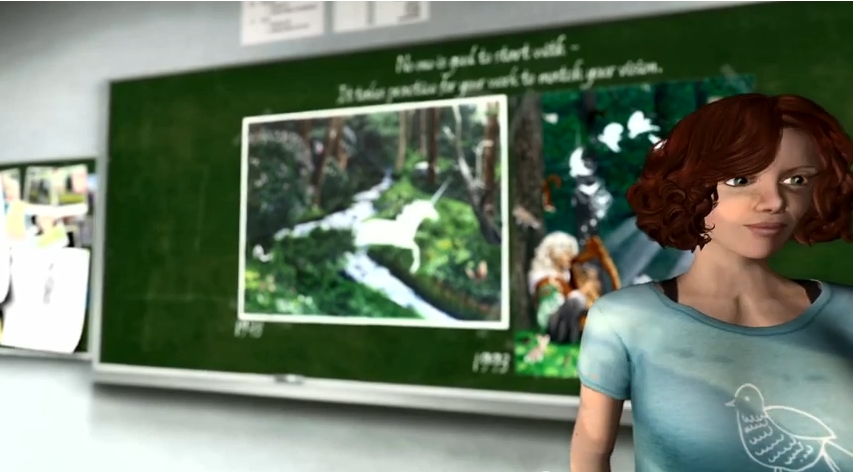
If you’ve never visited her website, I cannot recommend it highly enough as a place to visit; it is a veritable Aladdin’s Cave. Within it you’ll find samples of Robin’s art, such as her magnificent Robinton, Masterharper of Pern, a piece which has gained worldwide recognition for its depiction of one of Anne McCaffrey’s most-loved characters from her Dragonriders series.
The image is stunning in its detail, and very evocative, perfectly capturing its subject in his later years, his glass of Benden wine raised in salute, his quizzical smile and eyes hinting at the depth and breadth of his intellect and his wry humour. Little wonder Anne McCaffrey bought the original!
Within the website you’ll also find information on Robin’s books which include a must-read for all cat lovers and owners, The Theory of Cat Gravity, as well as her titles on Tarot and Wicca. Robin’s essays are also to be found here as well, and they make thought-provoking reading for anyone prepared to approach them with an open mind, and reveal much of Robin’s heart, intellect and the warmth of her humanity.
As a content creator within SL, Robin started with the very humble prim – basic shapes, no flexies, no sculpties. Since then she’s been able to observe each and every change wrought in SeCond Life in terms of tools and capabilities for content creation, and to do so objectively enough to be able to recognise their benefits without all of the ballyhoo which all too often marks change within the platform. Instead, she’s simply accepted them, learned about them and been at the forefront of putting them to good use – as the shots of her use of materials in the video demonstrate.
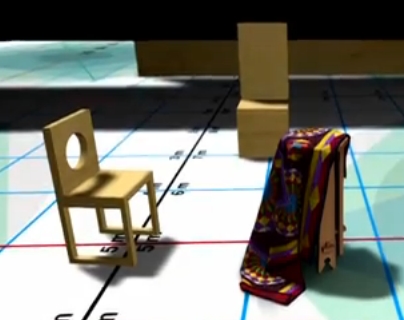
Then and now: Robin’s original 1-prim chair and her recent mesh “1-prim” (1 LI) creation: a stool draped with a quilt
She’s also very aware of the empowerment latent within the platform for people to reach beyond themselves through it – if they are prepared to make the effort. As she says of her own observations of the platform, and her real life experiences as a teacher, Second life offers people who have no idea that they are creative or who have convinced themselves, due to the pressure of society or through some inner self-editing process that they are not the “creative type”, discover that actually, they are.
In this, it makes no difference if people make the discovery using prims and then move on to other tools outside of Second Life. As she says later on in the programme, when talking about the so-called “Second Life / real life divide”, there is no dichotomy in starting out with in-world creation, then moving on to tools outside of SL. It is simply people learning skills, developing techniques and using tools, all of which combine to enhance their creativity, increase their pleasure and self-expression and – ultimately – help to continue to make Second Life better.
In terms of the idea that those engaged in Second Life somehow need to go out and get a life, Robin has a very simple response, one which also offers up a huge an essential fact about the so-called “SL / RL divide” – it doesn’t have to exist.
“I can go out and smell the flowers,” she says of the idea that people need to go “get a life”, “But if I spend all day outside smelling the flowers, I’m going to get a horrible sunburn. ”
She goes on to point out that life is about balance in things, and Second Life very much plays a part in achieving that balance. In her case, it allows her to create a quilt pattern through one programme, import it into Second Life and create a finished quilt there and use the pattern in the real world to create a quilt of her own. Thus, Second Life is a natural part of a blending of the creative process which mixes the real world and the digital world bringing a completeness to both. But as Robin points out, the ability for the platform to bring together the real and the digital goes further than that.
“I don’t think that there is as much difference between virtual stuff and real stuff as people seem to think that there is,” Robin continues. “Emotionally, there is not any difference between doing stuff in real life and doing stuff in Second Life. It hits you emotionally in exactly the same place.”
Which is why there is no need for those engaged in SL to consider going out and getting a life. The vast majority do have a life, and see Second Life as it is meant to be, as another vehicle by which they can express and enjoy themselves. In this, it is actually no different to the freedom and enjoyment some find in painting their faces and going to a large stadium with several thousand others to watch two teams kick / carry a ball around a large rectangle of grass.
Providing one is prepared to approach it openly and honestly, Second Life can provide positive emotional fulfilment; that it can is no reason to shun it or depict the fact that it does as a weakness in those who use it.
Rather the reverse. It’s another aspect of the magic of Second Life.
A Conversation with Drax
Sadly, real life at the moment, coupled with extremely poor planning on my part meant that I didn’t have the time over the last couple of weeks to clear my schedule, sort out thoughts and questions as this episode of The Drax Files was coming together, and get to sit down with Drax and Robin as I’d hoped. So unfortunately, no conversational piece this time around :(. All things being equal, we’ll be back next time around.
“Yeah. I was one of those who volunteered for the Calico rescue mission. If you can call it a rescue, ’cause that implies there are people needing rescuing…”
I was drawn to take a look at Calico after seeing shots of the place on the LivingSL feed which had been taken by Goizane Serenity. This isn’t my usual haunt in terms of SL explorations, but something in Goizane’s images caught my eye, and I had to go take a look.
This is a dark urban region – with the emphasis very much on the “dark” – I couldn’t see a blessed thing with the local windlight! :). Having read the introductory notes, I opted to switch over to something which would keep up the dark/dramatic feel of the place, but which would also let me take a few snaps.
“Spooky? That doesn’t come close. The place was deserted. Not a soul … more than that, not a living thing outdoors; just wrecks of cars and trucks; all of them recent models, but all of them just rusting away, like they’d always been that way…”
That you’re in a place overtaken by some local calamity is clear to see when you arrive (when you can see, that is :)); car wrecks litter the road, as do trash, various belongings and, strangely, comic books… Buildings have broken windows; overhead the street lamps glow weakly, and everywhere is a sense of panic. But … where is everybody?
The clues are few and far between. It’s clear that something had caused the people on this strange, forgotten corner of the world to try to leave – and leave in a hurry. It also seems that the authorities tried to stop them. The one road out of town is blocked with heavy concrete blocks and police and military vehicles are much in evidence – including the hulk of a tank, its long barrel pointing ominously back into town.
“In fact everything looked old, y’know? Like it had been deserted for decades – yet there was still electrical power. The lights worked. Or some of them did…”
But of the people who once lived here, the police, the servicemen, the civilians – not a sign. And what happened to the bridge beyond the road block? Ripped asunder, it offers no route to safety; but how did it come to be like this? No storm would cause such damage.
Elsewhere things are equally as strange; there is an odd air of decay about the place, some of it out-of-keeping with things like the modern makes of vehicle found scattered and broken through the town. The buildings are more decrepit than one might expect, and wooden piers seem to be rotting where they stand; even some of the trees look stark and diseased…
“The first place we searched was the hospital. We figured if anyone was alive, they’d be there. But there was nothing. No survivors, no medical staff…no bodies… just nothin'”
Clearly, there are questions to be answered here – and not just with what has happened. Visiting the region, I wasn’t actually sure whether it is intended for future role-play or whether it is meant for photography / machinima. In the end, and having read the About Land notes, I opted for the former, but the place perhaps isn’t ready to go just yet. The notes read:
A long forgotten town on an island, recently discovered after having been abandoned many years ago. No one knows how the inhabitants vanished or why, only clues that an evacuation gone horribly wrong remain.
“And you know the really weird part? Wherever we encountered the worst of the wrecks and accidents in that town, we only had to look a little to the left or right, and we’d see that church tower, like it was leering over us, daring us inside…”
The one thing the place is, is very atmospheric; and if you explore it carefully, you’ll realise that everything that is presented here seems to all focus on the church sitting in what amounts to the dead centre of the town… Could this also be a clue….?
For those looking for an alternative venue to explore – and allowing for the fact that it may well become a role-play centre at some point – The Town of Calico is an interesting and dark diversion, which lends itself to the imagination and the creation of backstories.
Footnote: Pey’s Law is a wonderful thing. I IM’d the owner of A town called Calico about the purpose of the region. RL being what it is, our messages passed each other by, and his arrived just after I published this piece. Here’s what he said:
“At the current time it’s more geared towards photography and machinima. We’re currently in the process of making it into a fully interactive game with roleplay and combat and survival elements. But as of now, it’s roleplay, photography and whatever else your heart desires. The sim itself is still under heavy construction. It most likely won’t be actually open to the public for another month or two.”
I was delighted to learn from Ziki that Scribbled Hearts has made a return to Second Life. Formerly on the region of Water Reserve, Scribbled Hearts is back on another Homestead, this one bearing its own name.
It’s fair to say I fell in love with the original when I visited it in October 2012, and I was disappointed to learn it was going away at the end of that year. So on reading that is it now back with us, I had to hurry over and explore.
The new region has much in keeping with the old. It is a quiet rural / coastal setting where water plays a key part, styled by Randi Lenroy. It is the home of *. emm [shop], which was present in the original, owned by Snowy Melody-Deluxe, and which is this time joined by Little Closet, operated by Noel Ryhann Kennedy-Deluxe. Finally, as also was the case with the original, neither store overwhelms the region, but fit their surroundings perfectly.
Little Closet occupies a small island in the south-east corner of the region, which is linked to the rest of the land by a partially flooded grass causeway which in turn forms the main teleport point. *. emm [shop] is across the region, towards the north-west corner, sitting in open grassland. There is also a cafe on the west side of the main island, surrounded on three sides by water. The rest of the region is a mixture of woodland, water and a small, intimate beach, all beautifully and naturally presented.
Winding across the main island are a couple of trails, one of which runs from the cafe the other from * emm [shop] before they both meet under the shade of the trees and point the way towards Little Closet. “Trails” is actually probably too strong a term. Looking at the way they wind across the land and under the trees, and considering their raised, cut sides, they look just like dried-up stream beds rather than paths. If that was the intention is laying them, then it’s another clever nod towards Scribbled Hearts’ water-related nature.
The region has a custom windlight setting which is absolutely perfect for the landscape, presenting you with a late afternoon, the sun partially hidden by clouds, a slight haze evident through the trees. If you have Firestorm or have installed Vincent Nacon’s clouds, the windlight works really well with the altocumulus clouds. Not that you need be limited to using it; as with the previous designs, this is a place which lends itself to a whole range of lighting options and opportunities, allowing the SL photographer to play to their heart’s content.
There’s a lot worth snapping as well; not only is the landscaping superb, there a lots of lovely touches to be found throughout the region and around the buildings themselves. The cafe is practically a work of art of itself with all the detail put into it, and very photogenic as a result, while Little Closet has a number of nice touches around it, some of which form little vignettes of their own, such as the scene with the taxi and shed. * emm [shop] offers itself as a part of the rural setting, its barn-like appearance blending will with the open meadow and surrounding trees. And it doesn’t end there – wander around and you’ll come across opportunities to capture a lot of pictures and scenes.
If walking isn’t particularly your thing, you can pick-up a bicycle from the cafe and use it to get around the islands, although I confess I found the bike a little hard to steer (hardly surprising giving there are no paved surfaces :)).
There is a 3-minute auto return time on the region, so if you are in need of a prop or two for a particular photo, you have a few minutes in which to make use of it.
It is wonderful to see Scribbled Hearts make a return to Second Life, more so given the strong sense of continuity between “new” and “old” for those of us fortunate enough to remember how it looked when hosted on Water Reserve.
If you’ve never paid a visit to Scribbled Hearts old or new, I cannot recommended it highly enough, whether you’re seeking a new place in which to relax or to explore, or whether you have an itchy camera shutter finger.
For me, the return of Scribbled Hearts came at just the right time. It’s the latter end of the school holidays here, and as per a usual routine, I have a my God-daughter (one of three) for the week. She’s an energetic almost-eight, and it may well be only Monday, but I’m already worn out, so it’s a welcome piece (peace?) of sanity in my world right now :).
I came across Quiet Wilderness, located on the homestead region of Almourol, entirely by chance. Group owned, the About Land tab describes it as “a quiet and peaceful place to relax, sit by the campfire, walk around or take a canoe ride”, and it is quite simply lovely.
You arrive up on a hill – not at the top, but about half-way up – overlooking lowlands on either side, with a river looping lazily through. There are no houses here – not on the ground, at least – and everything other than a fenced crop of wheat is an open wilderness with tall trees, woodlands, open meadows and a number of trails to be followed.
The hill on which you arrive rises to split the region pretty much in two, and – in keeping with a number of places I’ve visited of late – is itself split by a deep river gorge, this one spanned by a natural stone bridge.
The hill also acts as a natural source for the river, with waterfalls on either side of the rocky hillside tumbling down to feed two small lakes which are in turn connected by the river’s meandering.
To the west is a lush, low-lying woodland, bordering the sea, and which has hints of a wetland area. One branch of the river exits to the sea here, and the shadows between the tall tree trunks provide hiding places for some of the region’s resident wildlife. A cobbled paths wanders into the woods from the north-west shoulder of the hill and branches just under their broad canopy, with one arm leading back out over a wooden bridge to the coastal grasslands, the other winding deeper under the trees and it’s worth following it to find a couple more little landmarks.
Wildlife is very much in evidence across the region, with birds, waterfowl, deer and more – although you might have to again keep your eyes open to see all of it. As well as the wildlife, sheep also graze peacefully, watched over by the resident dogs, Dandy and Chi.
The park-like, natural ambience of the region is enhanced by the placement of a couple of canoe rezzers. These allow you to explore the island from the river, including travelling through the gorge, which has its own waterfalls splashing down from either wall.
If you have music streaming enabled, one thing to watch out for is that the region is split two, parcel-wise, each with it’s own media streaming. Both streams are actually very listenable and suit the environment; they do, however clash a little as you move between the parcels, and it can be a little disconcerting having Johnny Cash telling you his woes where a split second before you were lost in the gentle sounds of a harp.
Don’t let the misty look of some of my shots fool you, either; the region is far from dim or misty. It’s just that the wide open, natural spaces encourage Windlight fiddling rather a lot, and I played around trying to get shots which might evoke and early morning feel (as well as going for late afternoon shots, which I confess in summer / autumn is my favourite time of day).
Once you’re done wandering, there are several places to relax and simply watch the world go by, or the tide ebb and flow. You can float on a raft on one of the lakes, climb up to a tree platform, sit at a campsite or rest at one of several platforms around the hill sides. If the mood takes you, you can sit by the side of the water and play a grand piano. That you’ll be a virtuoso is guaranteed; the piano is from Musical Alchemy, and Persephone Milk includes a superb selection of pieces in her pianos. There are even chairs set out for an appreciative audience…
Whether you travel to Quiet Wilderness on your own or with a friend or two makes no difference, it is a place which can be enjoyed as much shared with others as it can be when on wandering with just your own thoughts for company. And should you want to put the rest of Second Life out of mind for a while and just lose yourself in music and scenery, it could be precisely what the doctor ordered.
Given the nature of the region, rather than simply closing with another photo before the slide show, I’d leave you with a piece by John Schmitt of The Piano Guys, which I think is equally appropriate.