The purpose of the Hub is to develop “a resource directory of ethnic, cultural and historical communities for use by educators and students for research and learning.” Although, as Honour noted, it’s also a useful resource for the intrepid Second Life explorer.
Inside the Hub are information boards on communities within SL, arranged into a number of categories (Arts, Spiritual, Educational, Historical, Countries, Social Services, and Other). Clicking on an info board delivers a note card on the named community, while upstairs, there is a bookcase where more in-depth information on many of the communities can be obtained in the form of an interview / Q&A with one or more of the community’s leaders.
There is also an open invitation to communities which fit the overall goal of the Hub:
If you belong to a community which prides itself on cohesiveness culture, tradition, ritual, [and] values, which are embodied in the collective identity, we would like to hear from you. At the very least, we would like information on your community. At best, we would like to interview one or several community members.
Earlier in the week, I dropped in to LEA13 and Xineohp Guisse’s The {Lost} Garden of Sundarya Lahari, his mythology-in-the-making, and the first part of which I visited on February 9th.
At the time I dropped in, the second chapter of the tale was being installed – most notably, a huge creature rising from the sea, but the book had not been updated, so I tiptoed away to wait to see what transpired.
I didn’t have long to wait, as a couple of days later, Honour McMillan and I bumped into one another exploring Cica Ghost’s Little Village, and Honour dropped me a note card containing chapter 2 of story. Even so, it wasn’t until this weekend that I managed to hop back over to see what else had been added.
In the first part of the story, we learned how the Ancients discovered a kind of reed capable of resonating a sound frequency when touched. Harvesting the reeds, the Ancients used them in a meditative and spiritual garden. When the Ancients discovered a symbiote, which they called the Pentapuss, and which fed off the sound waves made by the reeds, they created biospheres in which to nurture juvenile Pentapuss, helping them to reach maturity.
And so the story was told; that many moons had passed, and the Ancients had built their garden of tranquility – a place of musical beauty providing solace and much enjoyment.
So opens the second chapter of The {Lost} Garden, which continues:
A wondrous creature rose from the waters one day. With fear in their hearts and in haste, the Ancients captured and killed the “beast”.
The Ancients realised, that in their foolish haste, they had killed the mother to the creatures they had so lovingly nurtured, and that Mother had only arisen from the depth of the blue waters to the call of her younglings.
So the Ancients built the Mechanicum – to keep mother alive so that her species live on …
It is the Mechanicum that forms the great sea-beast rising from the waters near the Garden’s arrival point. Beneath it lies a wondrous underwater garden, which can be reached either by stepping off the side of the walkways leading from the arrival point, or by falling up to the headless maw of the creature and then walking down through it.
This latter route will see you fall through an organ which appears to be laying eggs. More of these eggs are cradled in shell-like cups. Rolling around the seabed beneath these are young Pentapuss, while swimming around them are one-eyes larvae which occasionally penetrate the eggs, causing them to glow. Around all, nutritional spores fall from the mother-beast and rise from the eggs.
The symbolism evident in the eggs and the swimming creatures is clear – and quite visual, given the nature of the texturing on the eggs themselves. It’s also entirely intentional, given that this represents the birthplace of the symbiotic Pentapuss. Photos alone actually don’t do the Mechanicum or the undersea scenes justice; there is far too much movement and changes of colour for a still image to capture; rather, it is best witnessed and experienced.
More chapters of the story are due to be added in the coming months. In the meantime, if you have not already done so, I do urge that you visit The {Lost} Garden; it really is visually stunning.
Little Village, March 2014 – click any image for full size
Cica Ghost officially opened her latest installation at 12:00 noon SLT on Thursday March 6th. This blog post was supposed to be a preview; then that thing call real life occurred…
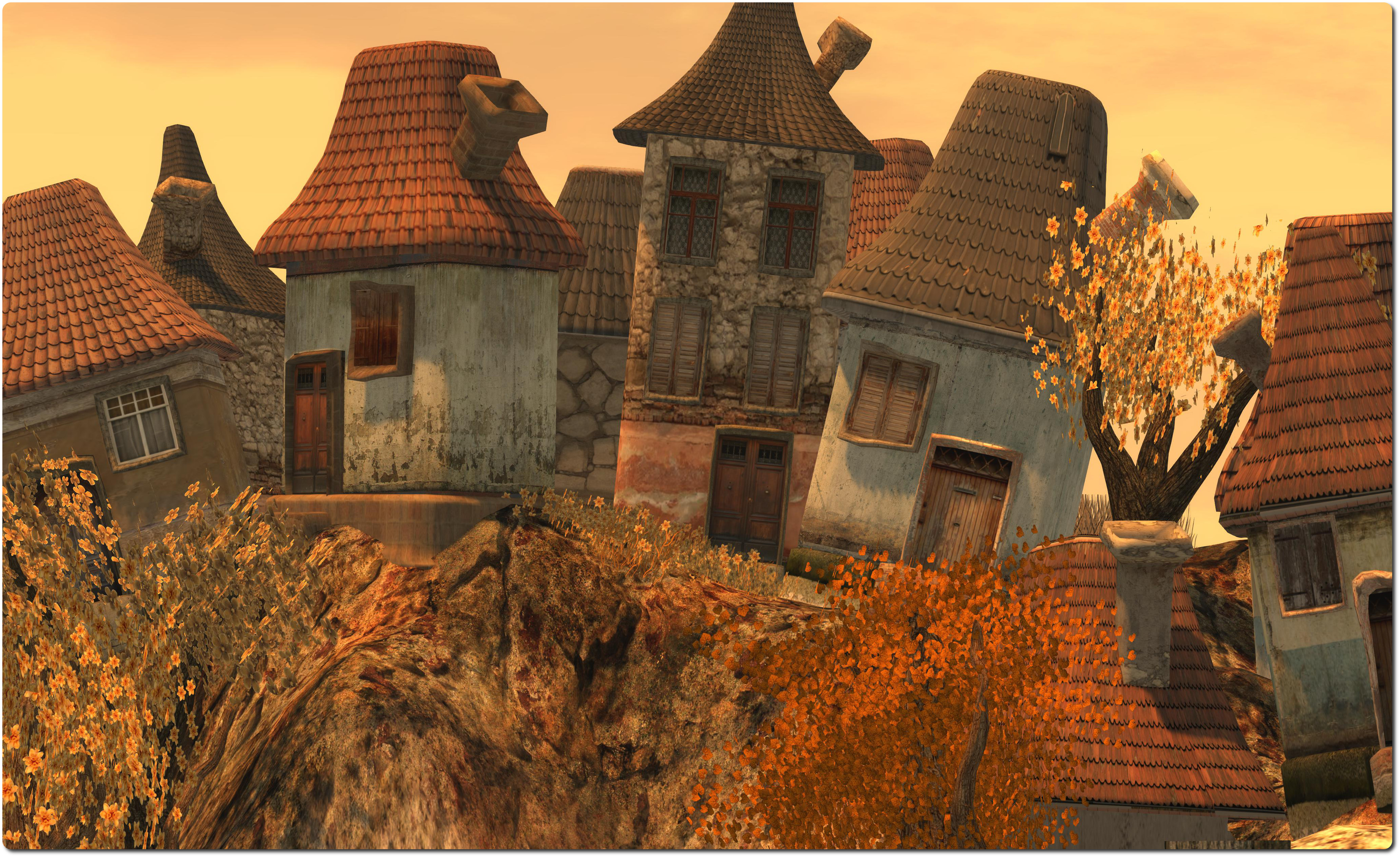
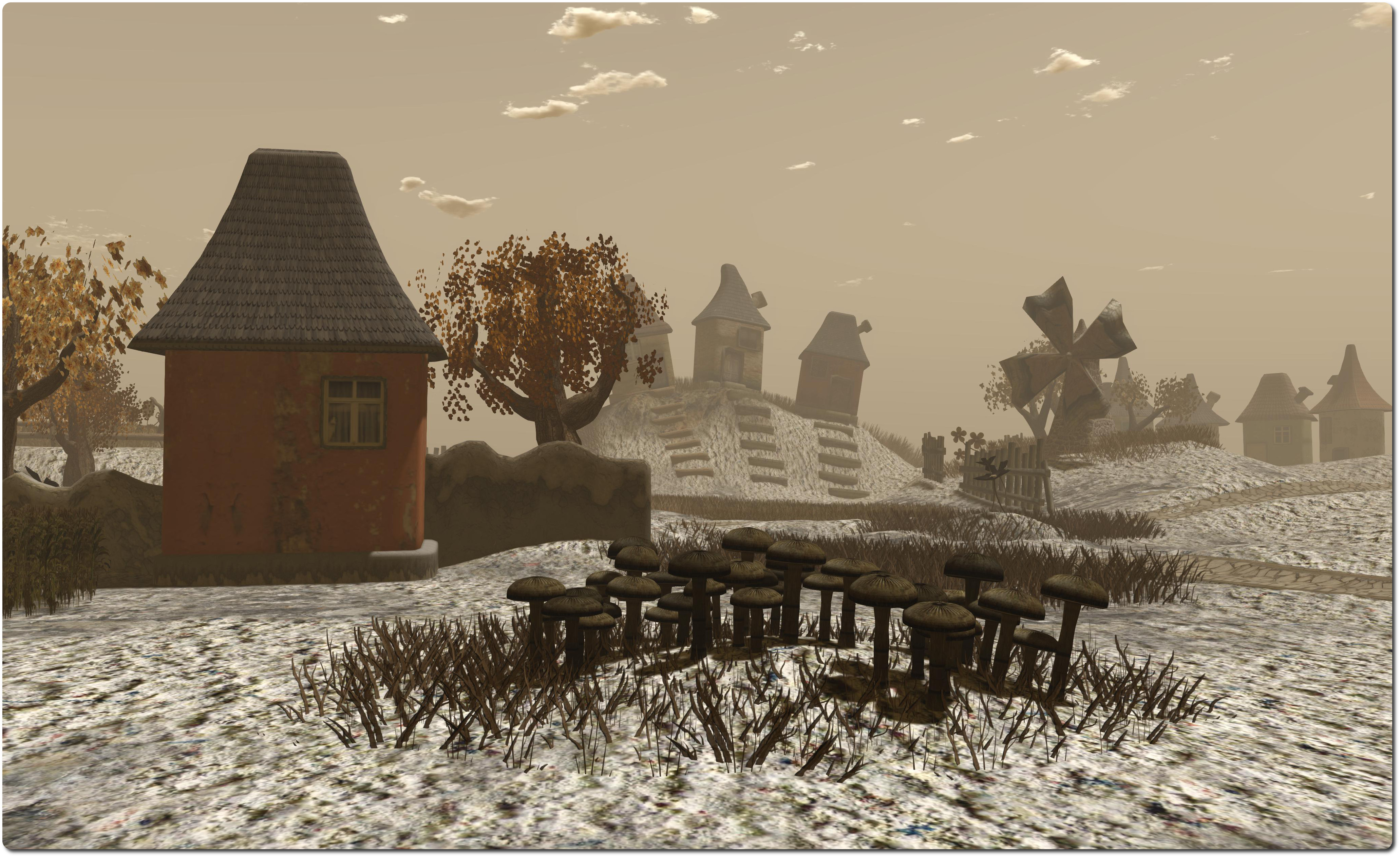
Anyway, anyone who enjoys Cica’s creations is going to love Little Village. “Delight” barely covers one’s reaction on seeing this marvellous collection of whimsical houses with wobbly chimneys, huddled together in little groups or standing alone, some on level ground, others precariously straddling little hills.
These are houses with character, their shapes seemingly lifted from a children’s cartoon and made real, each with its own unique character and colour (some could perhaps do with a lick of paint!), all of them vying for your attention; indeed, when camming over some of the little groups, it isn’t too hard to imagine them jostling one another for position, trying to catch your eye.
Between and around them are trees and plants, little footpaths running here and there – and nowhere in particular – while rickety fences dot the landscape. There’s a simple, glorious charm to the entire setting, one which belies the care and detail put into the work. Can you spot the cats in the windows, or find places to sit and watch the world go by?
I understand from talking to Ziki Questi that Erythro Asimov provided the region so that Cica could build her Little Village, so we him a vote of thanks for doing so, just as Cica deserves a word or two of thanks as well for once more sharing her whimsy with us.
But don’t just take my word for it, go see for yourself; you’re sure to find yourself smiling.
I’ve been a huge fan of Kaya Angel’s work, and his Angel Manor has long been a favourite of mine; so when I read Quan Lavender’s post about a new build he has completed on behalf of his friend, Marcusgay Lefevre and the Lefevre family, it zapped to the top of my list of must see places.
The Lefevre Mansion and grounds occupy two regions, the mansion and the majority of its outbuildings sitting in a full region, and the adjoining homestead largely given over to gardens and open spaces.
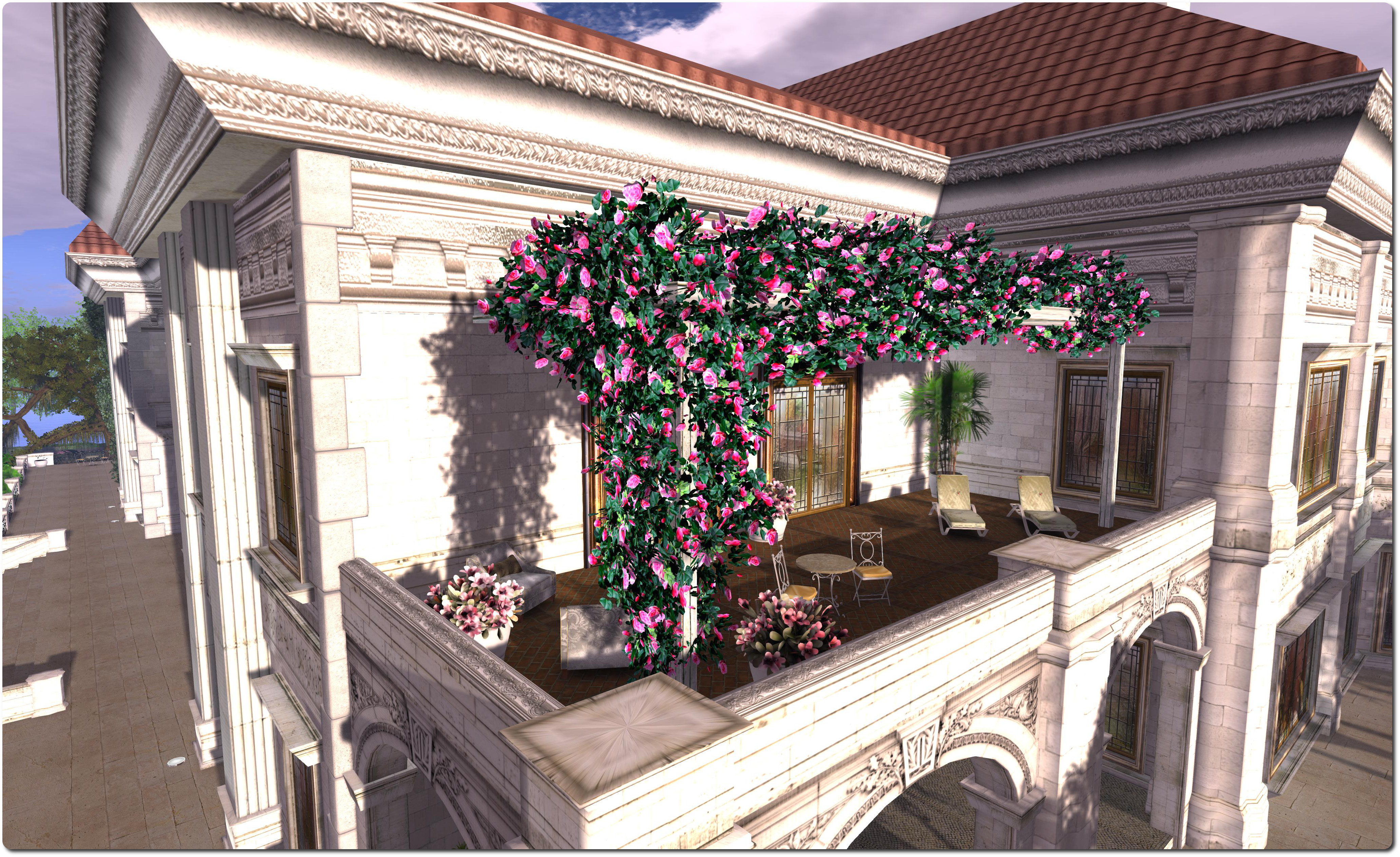
The house itself is (obviously) much smaller than Angel Manor, but this doesn’t mean it is in any way lacking. If anything – and this is not a slight towards Angel Manor – the smaller size makes it somewhat more intimate and personal in feel; two essential elements for anywhere which is intended to function both as a public space and as a private residence.
There is definitely a feeling of visiting a landed estate when touring The Lefevre Mansion. Both regions are beautifully landscaped, and from the arrival point, the visitor travels past the estate’s art gallery (possibly a coach house complex converted for this purpose?), through the wrought iron gates bearing the estate’s name, and can then follow the drive into the estate, passing the bath house before turning up and round to the front of the house. Or, if you prefer, you can turn off the main drive before reaching the bath house, and cross a well-tended lawn to arrive at a reflecting pool overlooked by the grand facade of the back of the house.
Inside the house, the rooms are lavishly and beautifully appointed, and all focused on the grand ballroom. I confess to being quite in love with the library, and could happily spend hours in there, if only the books could be taken and read! When exploring, do keep in mind that many of the rooms on the upper floor are a part of the family’s private residence.
This is another build which is not so much seen as experienced; it’s not enough to simply wander around, each room deserves the time take o linger and absorb the ambience; camming needs to be done with care or some detail might be easily missed. Great use is made of baked and scripted light effects, and ALM should be enabled, as there are touches of materials to be found around the house and in the grounds which add further depth to the overall look and feel.
When you’ve finished admiring the magnificent stately home, why not hop on the teleporter near the main entrance and see what might be going on up at the Partycular Theatre, which also has a home in the region.
Zachh Barkley is the Master of Magic in SL, as revealed in the 17th instalment of The Drax Files. While it’s not clear from the video, he appears to have joined SL as a teen, and has since built up a successful brand within the virtual world specialising in the thing that most fascinates him: magic.
Spells, incantations and more are Zachh’s stock in trade, and LSL, particles, prims and more are his hallmark. It’s the extension of a childhood love which (I’m guessing from his chat with Drax) grew out of a love of Harry Potter and early experiments with build-you-own game environments and tools.
Zachh Barkley
Which should not be taken to mean Zachh is the archetypal Second Life user beloved of certain elements of the media (i.e. someone lacking a life). It’s clear from the video that not only does he have a life outside of Second Life, he has shown friends and family that the virtual can give rise to real world benefits, such as an income.
Those who do tend to dismiss Second Life as a crutch for the less socially capable would do well to listen to Zachh’s disarming explanation of his time with the platform – building revenue-generating business, learning skills (such as coding) which are transferrable elsewhere, mastering digital content creation (another transferrable skill) … it all adds up to something rather unique and which offers potential for development and employment (as well as fun) well beyond the platform.
There are a lot of great moments in this segment, and Zachh’s disarming openness and honesty again demonstrate that those engaged in the platform really are the best ambassadors for it. This is something I really do wish the Lab would more fully appreciate: the opportunities for strong narrative marketing which are available to them for promoting the platform to a broad cross-section of different audiences. The stories don’t have to be constructed – they’re already here, waiting to be told.
All they lack is the reach of a constructive, progressive marketing campaign. And with all the improvement and updates made to the platform over the last two years, perhaps we’re approaching the time when such a campaign can enter the planning stages – so how about it, Ebbe? Are your marketing team ready to construct a narrative around the stories we have to tell?
And with that said, there can only be one … way to sign-off this article, and that’s with another video, not a million miles removed from this segment of The Drax Files or the essence of Second Life itself.
Miro Collas is a good friend who is always on the look-out for places to point me towards, and a little while back he tweeted me about Fairyland, a region which appears to have been developed as a small Polish community, and which offers a rural setting for visitors to enjoy. Miro’s recommendations are never duff, so I headed over to take a look, and must say what I found was quite delightful.
A homestead region, Fairyland is described in the About Land floater as, “the only such place in Second Life where the animals are talking with each other more often than men”, and that as a result, there has been conversation there since 2007! There’s no set arrival point, so I pitched-up on a dirt track, one of several running through the region.
This is a very pastoral setting. Crops are growing in the fields, almost ready for harvest, cattle gaze peacefully, chickens strut, cockerels call and birds ride a late summer breeze. The land, surrounded by tall, grass flanked hills, appears to sit between a lake and the open sea, a river winding through it, connecting the two and with a series of wooden quays towards what I assume is the seaward end of its meandering, where a fishing boat with nets furled lays tied-up alongside, awaiting its next trip down river to open waters.
Where you go on arriving is entirely up to you; the main track runs beside sloping fields, and several house sit atop the slopes, paths leading up to them. Do keep in mind these may in fact be private residences, and take care around them. One the other side of the track, across the river, lay steeper slopes, a small vineyard occupying one of them, the others overlooking more crops. A country church and a small cemetery occupy the hilltops here, reached via a wooden bridge and a rough path which loops past a beautiful stone water-mill to set of stone steps winding up the side of the hill.
Follow the track at the foot of the hill, passing below the church, and you’ll find your way to the wooden quays and a large warehouse. If you get a tad thirsty in your wanderings, there is also a tavern where you can quench your thirst and catch a game of Greedy Greedy with friends, if you’re so minded.
Despite the claim that the animals talk more than men, there a is a small meeting place towards the middle of the region, where people gather and chat, including the region owner, Gocha Merlin. I also understand that the region hosts various events as well, which I assume take place at the covered dance floor near the tavern; so it may get a little busy at times.
For my part, I found the region charming and inviting me to play with windlights while snapping, although (assuming I could paint), getting out an easel and oils also felt appropriate. Why not go see for yourself?