A Place Between the Rocks, June 2024 – click any image for full size
Sitting on the north side of Brittany, the westernmost region of metropolitan France and facing the English Channel, is the department of Côtes-d’Armor. It’s an area with an interesting geography and an equally interesting history, encompassing as it does a curious mix of being both strongly Catholic and also having a long tradition of anti-clericalism.
Brittany as a whole has a lot to commend to visitors, including within the Côtes-d’Armor, containing as it does the seaside resort of Perros-Guirec, the Castle of the Roche Goyon (aka Fort la Latte), a monument historique, and – close by to the castle – the peninsula of Cap Fréhel with its spectacular cliffs, moorland terrain, lighthouses (one dating back to the 17th century) and (now controversial, due to the wind farm location roughly 15 km off the coast) views out over the channel waters.
A Place Between the Rocks, June 2024
Côtes-d’Armor is also the location of the commune (here meaning an “administrative division” of a similar nature to something like a civic parish in the UK or a civil township in the USA, rather than a place where hippies might bliss out) of Plougrescant. Extending its thumb out into the English Channel and with the town of Plougrescant sitting at the inland end of the thumb, this area features a marvellous circular walk out and back from the town taking visitors up the eastern coastline to its northernmost tip, La Pointe du Château, and the the beginning of a fabulous rocky landscape with glowing hues, which breaks up the lowlands, with the path followed this more rugged setting back south along the western coastline. As it does so, the path by Castel Meur, a lowland peninsula with two small headlands, a lake-like body of water trapped on their landward sides.
Sitting on the more northerly of these two little headlands and overlooking the inland waters is the remarkable la Maison du Gouffre, “the house between the rocks” (and which is perhaps more widely also known by the name of the land). Remarkable, because la Maison du Gouffre is exactly what it’s name suggests: a house (cottage might be a better term nowadays) built slap bang between two outcrops of rock rising from the flatland like teeth.
A Place Between the Rocks, June 2024
Built in 1861, the house has always been in precarious position – the weather can be frequently violent – and utilises the rocky outcrops on either side as a means of protection whilst also being built so that its back faces the open expanse of the English Channel. As such, it has survived down the years, and – remarkably – has remained largely in the hands of the descendants of the original occupiers. Such is its iconic look, that over the years, the cottage was featured in a series of tourist campaigns intended to bring visitors from around the world to Brittany.
One of these campaigns used a postcard with an image of the cottage, and was so successful, it not only brought visitors to Brittany – it brought them practically to the front door of the cottage. As a result, in 2004 the owner (and granddaughter of the original owner) successfully sued for, and won, all commercial image rights over the property, preventing its use in any commercial venture without her expression permission.
A Place Between the Rocks, June 2024
As a private residence, la Maison du Gouffre is not open to visitors, but non-commercial photographs can still be taken whilst passing by, and thanks to people posting personal images on-line, etc., its fame has potentially grown even more.
However, you don’t necessarily have to visit France to witness the marvel of la Maison du Gouffre; you can currently do so right here in Second Life, courtesy of Bella (BellaSwan Blackheart), who brings us her homestead region design A Place Between The Rocks, inspired by the house at Castel Meur.
A Place Between the Rocks, June 2024
Just like its namesake in the physical world, the setting provides a scene of a largely flat landscape broken by three large outcrops of rock, the large two of which offer some shelter to the little cottage nestled between them. The cottage is, again like its namesake, a stone-built structure with shuttered windows bracketing the front door, and squat chimneys to either end of a roof from which gabled dormer windows stare out over the land and water. This is not a furnished property within, but outside has all the indications of being occupied: potted plants are much in evidence, chickens are being kept, a bicycle with a bag of groceries is propped outside of the front door, whilst a cobbled terrace to the rear of the place shows signs of use as it sits under a wooden pergola.
No lake faces the front of the house, the general design of the setting suggesting it is an island unto itself (with a smaller one sitting just offshore as a study point for an artist), but the low wall surrounding the original has its digital sibling here. Rich in heather and wild grass, the land has the feeling of being both windswept and at times pounded by angry storms, the island-like nature of the entire setting merely adding to its sense of beauty and retreat.
A Place Between the Rocks, June 2024
A Place Between The Rocks is a part of Bella’s default group, Bella’s Lullaby, so members of that group will have rezzing rights on the land for photography, while those requiring such rights can obtain them for L$40 – just please pick up your bits after you. Caught under a very suitable EEP setting, and rich in the sounds of cats (they’re all around, keeping an eye on things!), bird and chickens and with places to sit scattered around awaiting discovery, this is another excellent region design by Bella.
Nong Han Kumphawapi, June 2024 – click any image for full size
Far to the north of Thailand and located within the Udon Thani province lies the lake of Nong Han Kumphawapi. According to the folklore of the region (lore which encompasses both northern Thailand and neighbouring Laos), the lake plays a pivotal role in the tragic love tale of Phadaeng and Nang Ai, as do the flows which bloom within it (in their memory) and the wetlands within which it sits – wetlands that were designated as being of international importance in 2001, due to their biodiversity.
Nong Han Kumphawapi, June 2024
The lake is also, as of June 2024, the latest setting Jade Koltai has used as inspiration for an in-world region design. In doing so, Nong Han Kumphawapi joins Jade’s Painjin (2023) in depicting another of the physical world’s wetland areas within Second Life (see: A Red Beach in Second Life).
Covering an area of just under two square kilometres, with the surrounding wetlands covering a total of just over 4 square kilometres, the lake is also known as Talay Bua Daeng – Red Lotus Sea or Red Lotus Lake – due to the fact that while the water is more open that the surrounding wetlands, it is home a huge array of flowers which, which in bloom, turn the lake into a carpet of pink and red.
That the plants are tropical water lilies rather than lotus plants makes no difference – the sight of the flowers blooming across the water from around late November through until around late February give it both a mystical air and mark it as a tourist attraction. The lilies serve to hide a secret of the lake: whilst it may well cover an area of almost two square kilometres, it is for the most part little more than a metre in depth.
Nong Han Kumphawapi, June 2024
As noted, both the lake and the wetland are noted for their biodiversity, sustaining as it does a variety of fish, birds and plants. Water from the area also serves part of the Udon region to the south, providing them with water for agriculture, etc. However, it is within the tale (or rather, tales, as the story takes multiple forms) of Nang Ai and Phadaeng that the lake is best known to the peoples of northern Thailand and neighbouring Laos.
In essence the story goes that Nang Ai (and also known as Aikham), daughter of King Ek-Thita, became famed for her beauty, bringing forth suitors from far and wide; one of whom was Prince Phadaeng. Another was Prince Pangkhee (or Pangkhii to some), the son of the Grand Nâga, ruler of the deep. He was said to have been married to Nang Ai in at least one past incarnation and was determined to be so again. As neither Despite Nang Ai clearly being in love with Phadaeng, her father insists a contest is held for her hand – and neither Phadaeng nor Pangkhee succeed in winning it. Nang Ai’s uncle does, but he’s disbarred from wedding her, leaving everyone a tad miffed. However, both Pangkhee and Phadaeng determine they will each see the princess again.
Nong Han Kumphawapi, June 2024
Being the son of a shape-shifting deity, Pangkhee turns himself into an albino squirrel for his visit. In doing so, he successfully finds himself on the menu when Nang Ai sees him and decides stewed squirrel would go down rather well for lunch. Killed by Nang Ai’s hunter, with his dying breath, Pangkhee requests that his father avenge him and kill all who eat squirrel – and just to help sort out who this should be, turns himself into 8000 cart loads of ready-to-cook squirrel meat. This goes down very well (literally) for the townsfolk – and Nang Ai even serves the visiting Phadaeng squirrel soup.Enter the Grand Nâga and his angry horde to carry out the requested vengeance. As the killing rages, Phadaeng and Nang Ai attempt to flee on horseback, but the Grand Nâga floods the land, creating the lake and Nang Ai carelessly falls into it and drowns. Stricken with grief Phadaeng dies as well – only to bounce back as a ghost leading an army of ghosts, no also out for vengeance, this time on the Nâga’s horde, who are indeed defeated, but not before the land around the lake is flooded, forming the wetlands.
Nong Han Kumphawapi, June 2024
With her design, Jade particularly captures the flowering nature of the lake, although the setting perhaps suggesting it has been transposed to a more coastal location. The waters are shallow, the lilies in bloom, and here and there the land rises above the water. On one sits the remnants of an ancient temple, while more ruins and the remains of wood houses rise from the waters like romantic apparitions, watched over by cranes. A modern raised deck sits out over part of the water, clearly awaiting the arrival of tourists, whilst sampan-like boats float out among the lilies, just like the ones used to carry visitors over the shallow waters of the real Nong Han Kumphawapi.
Rich in bird song and setting under s sky in which a westering Sun is slowly setting, the region includes multiple places to sit and be serenaded by bird song and the gentle sounds of lapping water. Recommended.
It was back to the Kondor Art Centre, operated and curated by Hermes Kondor, for my second visit to the Kondor Art Museum, which saw the opening of its second four-month exhibition of 2D and 3D art; one which features 2D artist-photographers who are, in my opinion, some of the most expressive in the of field presenting work in Second Life.
The exhibition opened on June 23rd, 2024, the exhibition answers a question I cogitated during my first visit in February (see: The Kondor Art Museum in Second Life): would the Museum feature just the one set of exhibitions, or offer a rotating series of exhibits? For this four-month run, the Museum features pieces by Mihailsk, Monique Beebe, Hermes Kondor, Selen Minotaur and Scylla Rhiadra, with a selection of Ilyra Chardin’s charming 3D figures awaiting discovery at the entrance and in the main foyer.
To the left of the museum (as you enter the foyer), Scylla presents La Danse Des Petits Rats. However, this is not a celebration of small rodents jiving (or performing other dances), as the name might suggest; rather it is a celebration of the work of French artist Edgar Degas (July 1834 – September 1717). Often referred to as an impressionist painter, despite the fact he often despised the impressionist movement with its focus on “bright” colours and use of artificial light, Degas is probably best known for a series of paintings he produced from the late 1860 through the 1880s focused on the young dancers studying at the School of Dance at the Paris Opera who were referenced as the Little Rats.
Kondor Art Museum, June 2024: Scylla Rhiadra
No-one knows exactly where the name originated, although the likes of Balzac claim that the romantics saw the rat as a creature to be held dear – small and inquisitive, but able to mature into a “tiger” or “panther”, powerful and lithe – just as the young students at the School of Dance started out urchin-like, maturing into a lithe dancers, their moves fluid and graceful.
Whatever the origins of the term, Degas’ paintings of the Little Rats stand as a history of the students at the School of Dance – from painting the dancers during a performance, he moved to producing “behind the scenes” paintings showing the dancers backstage, in rehearsal or being taught. In doing so, he provided insight into the secrets of ballet training, the paintings becoming extremely popular. At the same time, the series also helps to mark the artist’s own evolving style as a painter. Within her exhibit, Scylla offers A celebration of Degas’ style – his use of colour and light (both of which do stand him aside from his impressionist peers) and, like his original studies of the Little Rats, pay homage to them and their growing mastery of the art of ballet.
Kondor Art Museum, June 2024: Mihailsk
Connecting to Scylla’s exhibition and running around the back of the museum is that of Mihailsk, who is one of the most expressive single-frame storytellers in Second Life. Emotive, often rich in metaphor as well as shooting straight from the hip, Mihailsk’s work spans both colour and monochrome, the stories wrapped within them.
On the upper floor, Monique presents something of a retrospective of her avatar-focused photography, which – as with Mihailsk – is generally centred on her own avatar and marvellously expressive and rich on both narrative and, frequently, a degree of subtext. Her exhibitions tend to be thematically driven and often highly sensual in nature, and the latter is clearly observable in several of the pieces in this collection – and should potentially be regarded as NSFW.
Kondor Art Museum, June 2024: Monique Beebe
At the risk of repeating myself, Selen is also a richly expressive artist, often working to a theme or idea, the pieces she produces richly layered both in terms of their use of colour and elements and in terms of their meaning / interpretation. As with Moni, the items presented in this collect form a retrospective of her work from 2020 through 2024.
Rounding out the exhibition, and located at the front of the museum and to the right of the entrance is Beach Time, a quite marvellous collection of monochrome photographs by Hermes, celebrating summer at the beach.
Kondor Art Museum, June 2024: Selen Minotaur
Engaging, beautifully presented and ideal for appreciating / purchasing, these 2D exhibitions make for a worthy visit, with Ilrya’s characters bringing the charm of their own visit to the museum. Those visiting can also wander the Kondor Art Garden outside of the museum, which is again hosting an exhibition of AI art by Milena Carbone.
Endless: Antipodes, June 2024 – click any image for full size
I received an invitation to visit a further iteration of Endless: the Full private region featuring designs by Sombre Nyx and Jackson Cruyff – my thanks to Jackson for said invitation.
The last time I visited, Sombre had used a physical world location in New Zealand as an inspiration for her design (see: An Endless: Birdlings Flat in Second Life). This time around, she sticks with the idea of an antipodean location, but where it might be relative to you in the world is a matter of choice; the setting sits equally well in most northern / southern latitudes as thus could also be west or east as well, depending on your place in the world.
Endless: Antipodes, June 2024
An island at the end of the world, where seething seas break against the rocks of the coast. Where craggy and low, rugged hills offer views to forever. Where rural life is quiet, but full, and nothing really matters but the moment.
– Endless: Antipodes About Land
As the About Land description indicates, this is a craggy, rugged location, one island among a small group. The flora on the island – mostly scrub and grasses, interrupted here and there by lonely trees – the one close-knit grouping of trees being mangroves sprouting up from the wetlands on the island’s eastern side. Such is the lie of the land and its blanket of flora, it gives no clue as to its possible latitude or longitude, although it is not unfair to say it is probably outside of tropical and most sub-tropical climes.
Endless: Antipodes, June 2024
The arrival point lies toward the western side of the island, sitting on a shoulder of land separating two shallow bays with sandy beaches, one of which appears suitable for bathing, sheltered as it is from northern winds by a further high-shouldered promontory extending out into the sea. A footpath runs out along this headland, and also forms a track running eastward along the bluffs above the north coastline. As it does so, it crosses what appears to be the former course of a stream that once tumbled to the sea from higher ground, then descends towards the eastern coastal lowlands.
A wall has been build over the rocks of the coastline here, helping to ensure the sea and land remain separated and allowing the former to become a level setting for a homestead farm, complete with an orchard alongside it. The farmhouse has the look of having been long since been converted into more of a cosy retreat than a place of work (although the apples from the orchard are very clearly being cultivated / harvested); the integral barn is now a bedroom and outdoor decks provide additional living space – their presence suggesting the island perhaps does not suffer from too much in the way of really inclement weather.
Endless: Antipodes, June 2024
This house is one of three on the island, the spines of hills separating it from its neighbours one of which lies on island’s far side, the other more directly to the south. A small, rough beach sits to one side of the farm, and the path continues from close bay, this time following the east coast as curves around a bay cutting deeply into the island, home to the wetland and mangroves mentioned above, and its mouth guarded by a small isle. Whether the studio is used by whoever occupies the little farmhouse or not is open to question, as the path continues on to the house on the south side of the bay, putting it within easy reach of the studio isle, whilst its design and décor perhaps suggest the aesthetic of an artist has been at work inside.
The remaining house is very much a place of work – a barn with tractor and feed for livestock, etc., lying just up the hill from it and a chicken coop betwixt the two. Whoever lives here likely owns the sheep found scattered across the island. As well as the sheep, the island is something of a home for birds, including herons and kingfishers as they carefully keep an eye on all the comings and goings across the land.
Endless: Jack’s Canyon, June 2024
Such is the design of the setting, it is easy to arrive and just wander; however, there is also a ground-level teleport system (starting at the arrival point) to help guide people around the major points of interest for those who prefer. Rezzing is open for photography props, with auto-return set to 30 minutes – but do please clean up yourself if you use the option.
Jackson’s location – as with his past joint designs with Sombre – occupies a sky platform overhead. It takes the form of another rugged setting – perhaps part of one of the island seen off the coast of Sombre’s setting. A short walk from the landing point the land is cut through by a deep gorge, clearly formed by the erosion of the water pouring into it from one end, before making its way seaward but not quite entering open waters. Instead, a natural rocky breakwater block overland progress – but given the water simply hasn’t risen to overcome the barrier, one might assume there are submerged routes passing under the rock that allow it to escape.
Endless: Jack’s Canyon, June 2024
This gorge gives the setting its name: Jack’s Canyon, and forms the focal-point for explorations. Invisible from ground level, it is a little like Rivendell, only opening to view when practically on top of it. Unlike Rivendell, the gorge has a man-made path in the form of a wooden board walk and ladder descending into it, the top of this walk forming a deck close to the one building in the setting: a small wooden cabin.
This route down into the gorge is overlooked by a further deck extending out from the west cliffs, whilst the seaward end is watched over by two tall rock formations, one of which also looks down on a small camp site sitting on a broad lip of rock and grass forming a step in the cliffs on the west side of the canyon (another little camp area occupies a further lip close to the bottom of the canyon as well). Wildlife in the form of bears, boars, wolves, foxes, cranes and eagles are to be found throughout the setting, all of which perhaps suggest this is a location more in the northern hemisphere – but wherever you choose to place it (if at all), there is no doubting its natural beauty. So much so, that even a time-traveller appears to have dropped in for a bit of a look around!
Endless: Jack’s Canyon, June 2024
Like Antipodes, Jack’s Canyon includes a local teleport for hoping between the local arrival point and the canyon floor. However, this is not directly connected to Sombre’s Endless: Antipodes; both the ground level setting and the canyon are only linked via the common landing point in the region – hence why no SLurl earlier in this article – which must be pass through when moving between the two.
With both locations offering local sound scape and various opportunities to sit and relax and / or take photographs, they can be enjoyed individually or jointly – and my thanks again to Jackson for the invite!
Sharing your Second Life experience via social media can be something of a scattergun effort, utilising different platforms for different activities: Flickr or Deviant Art for photos, for example, Twitter or Bluesky or Discord, etc., for messaging and so on. But what if there was a single platform where these various needs could be met, one which – although independent from Second Life and Linden Lab – had been developed specifically for, and with input from, Second Life users and offered a degree of integration integration with Second Life, with the potential for more in the future?
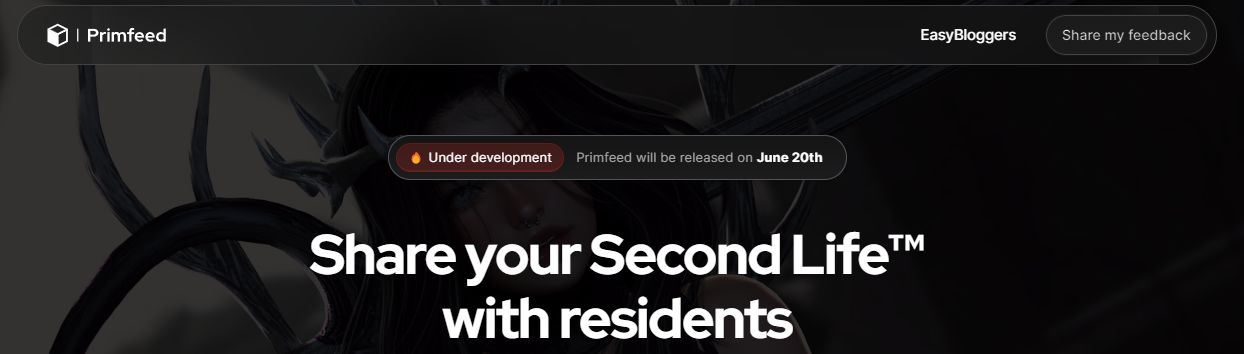
Well, as of June 20th, 2024, there is: Primfeed. And this is its story so far.
First formally announced on May 26th, 2024, Primfeed is the brainchild of Luke Rowley, a Second Life resident and developer with over 17 years history on the platform. He is also the developer behind EasyBloggers, a blogger management system specifically designed to simplify the management of blogger teams by Second Life store owners and which has proven exceptionally popular and highly regarded among Second Life creators and bloggers alike since its launch in 2023.
About Luke
Primfeed developer Luke Rowley
Initially introduced to Second Life by his brother, Luke at first treated the platform as most of us do: as a means of fun and relaxation. However, he became fascinated by Linden Scripting language (LSL) and starting with objects scripted purely for fun, he quickly graduated to developing practical tools (including a complete combat meter system – something that also has relevance in 2024, as Rider Linden works to overhaul the Second Life Combat System (SLCS) and make it a more robust set of tools for combat system developers).
From here, Luke started developing web interfaces that could be used with Second Life, work which led him being engaged by one of the biggest hospitals in France developing a Second Life-based simulation to help train medical interns in providing support during disaster situations. Two years later, and still working in the healthcare sector, he started on a career as a web developer.
The main aspect of code I love is: Your code visually creates something. And with SL being this 3D world where the objects you script in-world directly interact with your avatar, I was sold.
While we can think SL looks outdated, I do feel that they are making huge progress, and trust me, it’s not easy when you have 21 years of legacy behind you, while maintaining what’s working now on the grid. What they are doing with PBR is awesome. It looks awesome, and it will save hours of work for every designer.
– Luke Rowley on the appeal of Second Life
Throughout all of this, Luke maintained his love of Second Life, looking for a means to combine his professional skills with the platform and develop something that would not only produce a useful service to Second Life users, but would actually raise the bar in how external websites can both support Second Life and offer a professional level of integration with the platform.
After much discussion with fellow SL users and creators, he came up with the idea for EasyBloggers, a platform which, at the time of writing and just 10 months after its launch, is used by over 400 designers and 2000 users. Part of this success is down to the fact that not only does EasyBloggers fill a much-needed gap in the Second Life creator / blogger ecosphere, it is exceptionally easy to use, feeling like a natural extension to SL. Another aspect with EasyBloggers is that Luke has not rested on his laurels: he has continued to develop and enhance the platform in response to user feedback. At the same time, he started looking at what else might be done to help support Second Life users, and his thinking quickly turned towards social media platforms.
Enter Primfeed
As anyone who has used any social media platform is aware, they can be difficult places for Second Life users, both directly, and Luke notes from his own experience. “You try to see what other SL users are doing and what’s going on but within second of scrolling on a traditional platform, about 90% of your timeline is flooded with ads and suggested content that have nothing to do with SL.”
This led him to thinking about a platform that might be specifically geared towards Second Life users and avoid the pitfalls of more generic options like Twitter/X et al. At the same time, he was aware of increasing frustrations within other spheres such as Flickr. Combining these two factors gave birth to the idea of a dedicated social media / photo sharing platform.
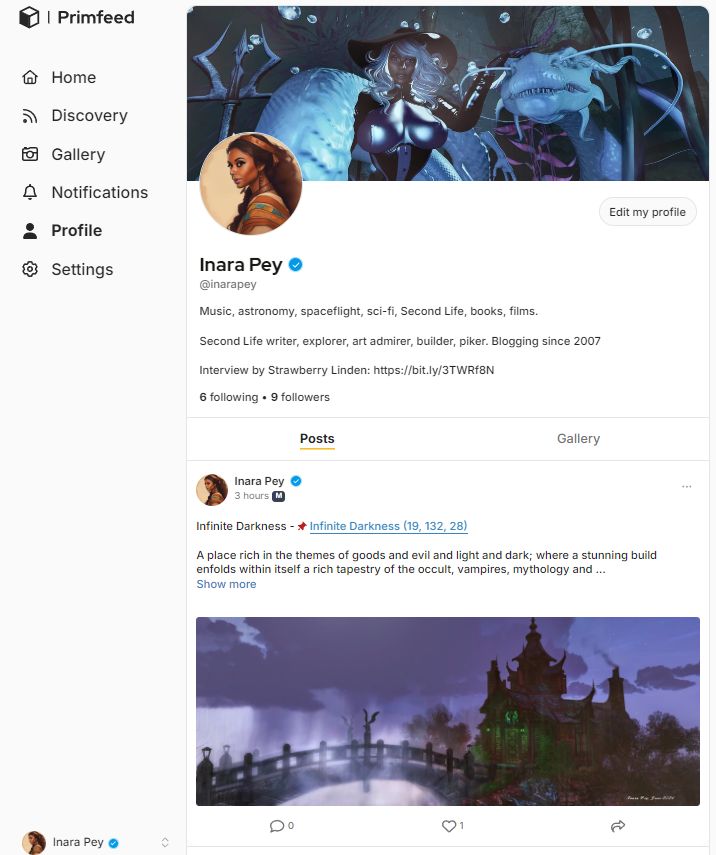
My personal timeline / feed on Primfeed
However, coming up with the idea for such a platform is not the same as developing one; as Luke noted, it’s another level of product management – one that would require some indication it would be welcomed if effort were to be put into it. As such, Luke initially thought it might be something to approach over time, starting with him testing the water first. “My original idea was to perhaps start work on it in 2025; but I was not sure residents were sharing my observations and frustrations,” he notes. “So I thought, ‘Well, let’s make a simple Google Form and see if people are interested’. I included some simple questions with the idea that if 30 to 50 people responded, I’d consider the idea as a future project.”
That questionnaire went live on May 16th, 2024 and the response was overwhelmingly positive, with people not only confirming they’ve love to see such a platform – but that they wanted it now. A message Luke received very clearly.
“I knew I’d have to start working on it as soon as possible,” he told me wryly, “So the next day I worked through the number of responses, looked at the realistic costs of building and running such a service, and quickly became convinced that yes, such a platform could be viable and supported by users. On the back of that, I made an informal announcement that I’d soon start work on the new platform – and the reaction was again overwhelmingly positive.
Over the next several days, Luke continued to refine the idea, looking at what he could initially achieve and how the service might be expanded. From the start, and like EasyBloggers, he wanted the platform to fulfil an identified need. He also wanted to make using it feel, as much as possible, as an extension to Second Life. By May 26th, he was ready to formally announce his new service, with his initial focus for its capabilities being to support the abilities to both upload photos in up to 4K resolution and share thoughts and ideas through simple Twitter/X-like posts.
Integration / Extension
Of course, Primfeed is not the first attempt as a dedicated Second Life centric social media platform – I’ve covered some past attempts in these pages. However, those services have tended towards the use of pre-existing software platforms and services. Primfeed, like EasyBloggers is being built as a dedicated service by Luke under his Kynno brand. This means he has the unique ability to directly engage with SL users and develop / tailor the platform in response to requests and feedback, thus helping to make the platform a genuine extension of people’s SL.
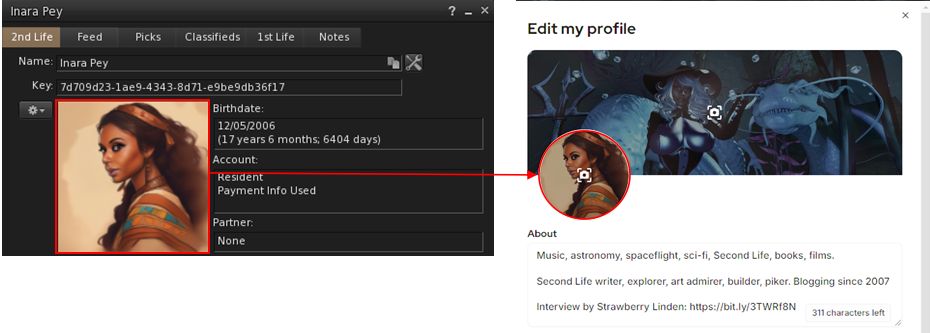
Already this is manifest in a number of ways. Take sign-up for example: Primfeed will automatically pull your Second Life profile photo across and use it as the default profile image there (although you can also change it if you wish).
An example of integration: when signing-up, Primfeed will automatically use your SL profile image for use with your Primfeed profile (which you can later change if you wish)
More particularly, Primfeed offers a set of maturity ratings that are remarkably similar to those found in Second Life and with similar icons and definitions, allowing Primfeed users to filter the content they see on the platform in a manner similar to that found on Second life, providing an instant sense of familiarity.
That said, Luke has taken things a step further than Second Life in this regard: as well as an Adult rating, he has provided an A+. The former indicates things like nudity are likely present, with the A+ indicating active sexual content, and others legal extreme content. Given the (incorrect) claim oft made by some that Adult always equates to “extreme content”, this is a useful distinction – art, for example, can include nudity, but is hardly “always” extreme content.
When you build your websites totally from scratch and you are not using a paid template, you can deeply and carefully add features that really matters and match what residents really want.
– Luke Rowley on designing Primfeed
Primfeed leveraging popular approaches from social media platforms such as Twitter/X, with a left-side menu providing users with easy access to options, and a Flickr-like gallery display of images
Nor does it end there; for those familiar with using the likes of Twitter/X, Bluesky and so on, the Primfeed interface will be immediately feel comfortable, sharing a lot of similarities of approach and layout:
The left-side quick-access menu.
The ability to click on a user’s name in the timeline and open their timeline and / or hover the mouse over their name to see their profile summary.
When viewing a user’s profile, the option to view a gallery of their uploaded images.
The ability to access a timeline directly (subject to being logged-in to the platform) using the format “primfeed.com/user_name” (so you could add your own timeline to your SL profile, for example.
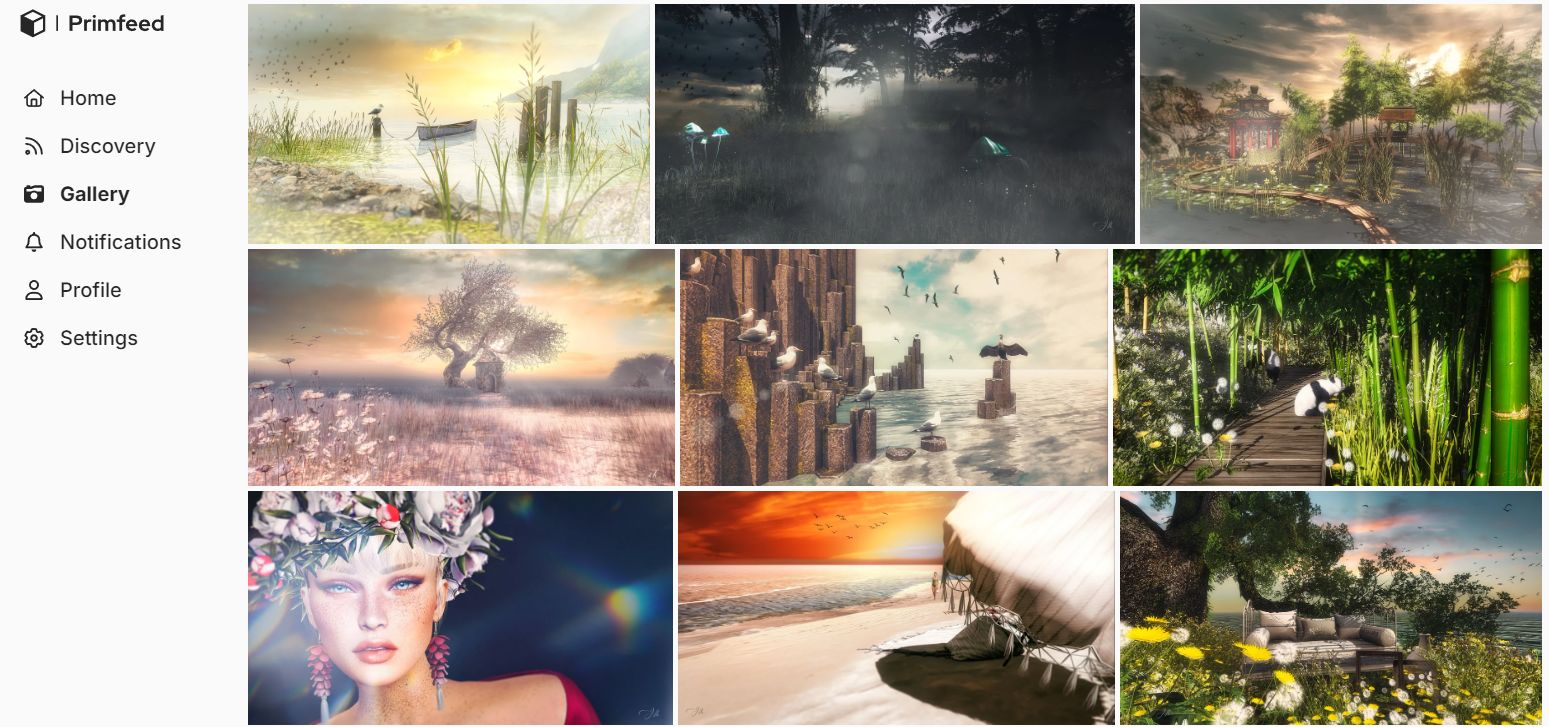
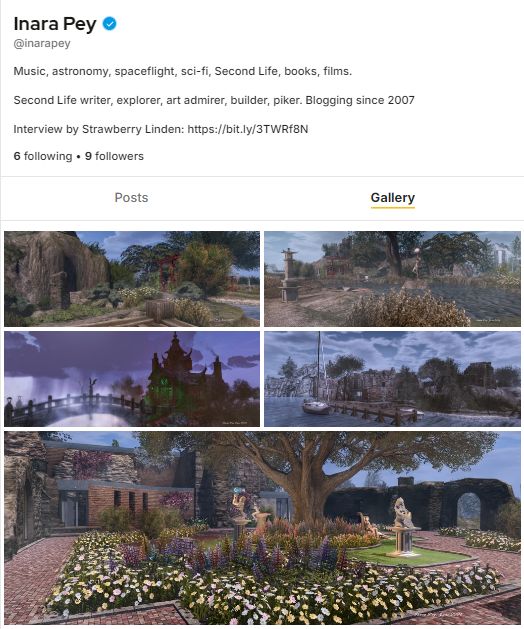
Similarly, and in response to requests from Beta users, Primfeed presents a Flickr-like Gallery option for display uploaded photographs from all users, as shown in the image above.
An example user Gallery display, in this case the gallery accessed from my timeline / feed
Another aspect of integration – so to speak – is the fact that Primfeed is mobile / tablet friendly, offering the same capabilities and design layout, making it exceptionally easy for used to be able to use it and keep in contact with one another wherever they are (Internet connectivity allowing, of course!).
Photos and Posts – But More to Come
The initial release of Primfeed focuses on the ability to upload photographs and post then directly or with accompanying text, and the option to send Twitter-style text posts, which also includes these capabilities:
Posts (text and / or image) can be deleted or be opened to have their text edited.
URLs are automatically converted to clickable links.
Clicking images will open a viewing overlay, allowing the image to be zoomed in on to be viewed in detail, with any text accompanying it (and any posted comments) displayed on the right, a-la Twitter/X, etc.
But there is more to come, including:
Two public feeds / timelines: the first featuring both text posts and images (as is currently the case) and one specifically for uploaded images.
Support for direct messaging between users.
The integration of EasySubscribers: residents will be able to follow subscribe to a given store’s newsletter from the store’s profile.
The ability for creators to create personal accounts and have “Store” pages for their products, and the ability to switch between the two.
While the initial focus appears to be photography, Primfeed is not just about photographers; it will be for every Second Life resident who wants to use it. There will be a lot of features coming as the platform grows and I receive feedback and people vote on ideas through the upcoming Feedback Portal.
– Luke Rowley on expanding Primfeed’s capabilities
As Luke mentions, the Primfeed Feedback Portal will be an important element for helping to enhance Primfeed going forward. During the most recent period of development, Luke has relied on Discord and a group of Second Life users in a closed Beta phase of testing / feedback/ enhancement. However, he’s also recognised that when the platform is launched, he would need the mean for any and all users to have an easy, direct means of providing feedback, requesting features and – equally importantly – reporting issues.
This portal might also be said to be another aspect of trying to make using Primfeed as comfortable and familiar to users as possible: Luke has built it using the same software as Linden Lab now uses for its feedback portal, thus making filing and viewing requests, etc., as familiar as doing so for SL.
Costs and Payments
Obviously, running a service like Primfeed involves costs, both in terms of hosting and management and in development. As such, the platform will be based on a tiered / free / subscription model. At launch this will mean:
Those using free accounts will be limited to a maximum image resolution of 1500×1500.
Those opting to subscribe to the platform’s Pro option will be able to upload images up to 8196×8196 resolution.
As further features are added, so the Pro subscription will gain further benefits over free accounts, although these will be carefully weighed. “I do want to provide more value to the Pro subscription, but I don’t want to paywall every feature on Primfeed,” Luke notes. “So my guiding principle is, “What can I give to people wanting to pay without making those on free accounts feel they are being penalised?”
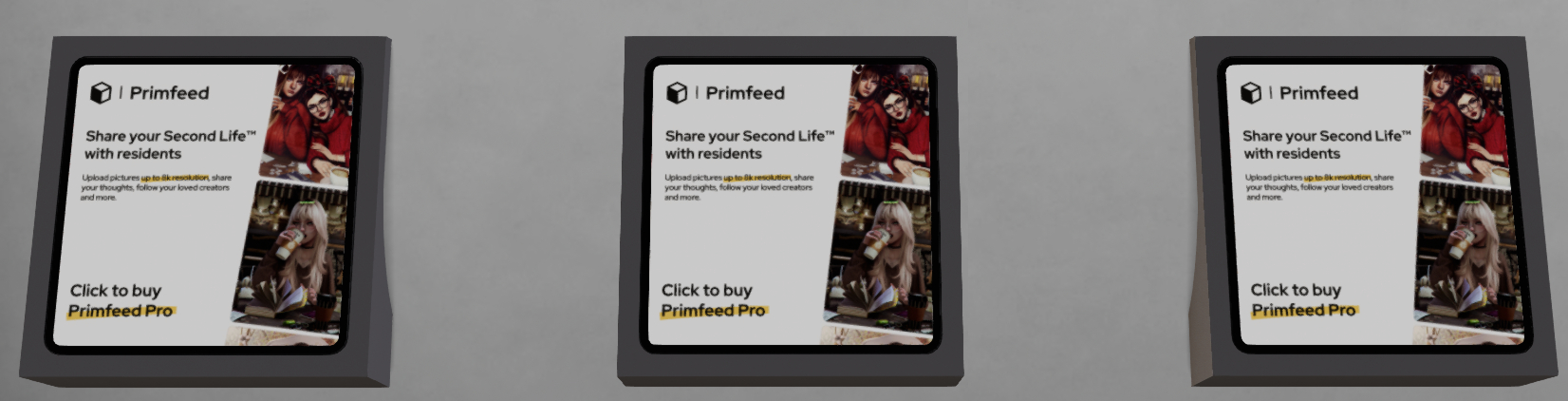
One of the biggest aspects of Primfeed in this regarded is that right from launch it supports subscription payments in Linden Dollars. These can be made in-world at the Primfeed Payment Centre. At launch, a Pro subscription will be offered on a 4-week payment basis at L$1860 for 4 weeks or L$8870 for 24 weeks (representing a 12% saving of the 4-week rate).
Primfeed Pro subscriptions can be paid for in L$ through in-world terminals
“It’s important to me to offer a Linden Dollar payment service,” Luke told me. “Not only does it make Primfeed unique among social media platforms, but it does so at great convenience for SL users who might otherwise be put off by, or unable to make, payments in US dollar values. It also means that there is no requirement for users to have to provide personal payment data in order to use the service.”
How to Get Started
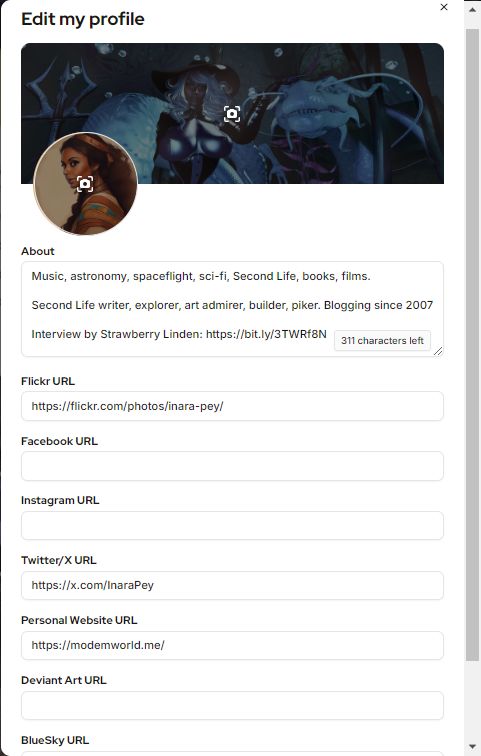
The Primfeed Profile edit pop-up
If all this sounds of interest to you, getting started with Primfeed couldn’t be easier:
Enter your Second Life avatar account name (not your Display name).
A special code will be sent to you in-world via local chat.
Enter this code into the sign-up page, accept the Primfeed Terms of Service, and you’re in!
Once your Primfeed account is established, you should go to the Settings option and add a password to your account. While this is not required, if you do not, you’ll have to repeat the steps above each time you want to log-in to Primfeed.
You can also use the Settings option to:
Set the maturity ratings you wish to be able to see when using Primfeed.
(If you are a Pro subscriber), see the time remaining on your subscription and use a button there to enabling teleporting to the in-world payment centre (by way of the SL World Map and launching your viewer, if required / enabled).
After this, you can update your Profile via the dedicated Profile link. In doing so, you can:
Update the profile photo and / or set the banner image displayed when viewing your Primfeed timeline / feed.
Provide a brief About bio.
Include links to any other popular social media and photo / art sharing platforms.
Closing Comments
Despite the rapidity of its initial development, Primfeed already has a lot to offer Second Life users, and it is clear Luke has a lot more planned in carrying the platform further. Even so, it is a service developed and operated by a Second Life user – which means that while it is developed by someone with an innate understanding of Second Life, its user base and what they would like to have, it also means it is a personal project, rather than a commercial offering – and thus lacks the weight and “assured” longevity of a platform like Twitter or Flickr. Thus, there are bound to be some concerns as to what might happen to Primfeed should Luke’s interests move elsewhere.
This is something Luke is all too aware of, as he noted to me. “It is always a gamble with any Second Life product or service; however, I have no intention to go somewhere else. Yes, I am a single developer and entrepreneur; but as long as residents continue to support Primfeed, EasyBloggers and EasySubscribers, I don’t see any reason to stop anything; all my products are very much a part of my work – so I’ll be staying in Second Life for as long as I possibly can!”
In proof of this, he’s not resting on his laurels but is already considering additional services for future development. “I will be working on a vendor system, again as a result of multiple requests from users of my current services. Can you imagine for a second what kind of integration could be done between Primfeed and EasyVendors? That’s exciting!”
And in case anyone is wondering why Primfeed doesn’t share the “Easy” naming convention with other products, the reply is simple, as Luke again explains.
I feel like my EasyApps are dedicated to creators/designers (EasyBloggers, EasySubscribers, EasyTextures, and so on), while Primfeed is for everyone, so it deserves distinction. It is also a reminder of where everything started in Second Life. Creating a prim is probably one of the first action you would do back in the days when you were playing Second Life, and I liked that element of nostalgia in the name.
– Luke Rowley
In closing, and with the launch of Primfeed, I would like to thank and congratulate Luke for his time and on the launch of the service, and I look forward to continuing to use it. I’ve enjoyed the past week’s opportunity to try Primfeed and discuss the platform with him. As we were drawing things to a close, I offered Luke the opportunity for a final word.
“I’d like to thank everyone who has supported my work, and who have directly contributed to Primfeed’s development by responding to my questionnaire, who helped with initial alpha tests and engaged in beta testing, who provided feedback, identified issues and helped spread the word about Primfeed through their own social media activity. Most of all, I’d like to thank my RL partner, who has been an insane support for me.
“I hope everyone enjoys Primfeed and helps to make it a success!”
Addendum
To mark the launch of Primfeed there will be a party in-world:
Nitroglobus Roof Gallery: Maghda – Demons of Reason
Monday, June 17th see the return of evocative photographer Maghda to Nitroglobus Roof Gallery operated and curated by Dido Haas with a monochrome collection entitled Demons of Reason.
Maghda’s avatar studies are never less than richly composed and layered, frequently presenting explorations of self and life, and this is clearly evident in Demons, offering a visual essay on the struggles we have all doubtless suffered: dealing with the demons of irrationality as we try to face the daily challenges of life.
The Demons of Reason lurk in the shadows of our thoughts, challenging the clarity of our understanding. These elusive forces twist logic and distort perceptions, leading us into the labyrinth of irrationality. They whisper doubts and fears, causing us to question even the most evident truths. In this eternal struggle, the Demons of Reason remind us of the fragile balance between knowledge and ignorance.
– Maghda
Nitroglobus Roof Gallery: Maghda – Demons of Reason
These are beautifully minimalist pieces, the majority set against a plain white background, with several using the motif of a bottle or bottles – a motif also seen within the sculptures by Adwehe which support the exhibition. It’s an interesting motif, potentially symbolising a number of elements within the overall theme, such as referencing the way we so often try to bottle up the doubts and irrational thoughts we have all they way through to how we might try to silence them though more liquid means.
As well as the use of the bottle, the images in the collection offers views on how we might respond to our inner demons – and how thy might equally and irrationally take us over, becoming more that tiny voices inside us but near-physical entities whom we cannot ignore, leaving us feeling their darkness or somehow separated from those around us, leaving us ghosted to them – or them to us. Meanwhile, the tinges of green suggest the jealousy / envy that so often accompanies such irrationalities.
Nitroglobus Roof Gallery: Maghda – Demons of Reason
Maghda has intentionally avoided giving her images individual titles, and this allows us to appreciate them more fully, allowing each one to speak directly and individually to our own thinking / mood / imagination. As such, Demons of Reason is an exhibition which should be seen rather than experienced second-hand.





 Inara Pey: Living in a Modemworld