The mystery of the Egg in Second Life

The Egg
The Egg, LEA 19

Now open at LEA 19 as a part of the 9th Artist in Residence series is Livio Korobase’s The Egg. And a curious installation it is (slight pun intended).

The introductory notes provide a Theosophy Trust treatise on the role of the egg throughout human history. It’s a comprehensive piece, guiding the reader from the creation myth of the Cahuilla Indians by way of Scandinavia, Russia and China, through the Laws of Manu and asks us to consider the role of the egg in reproduction, the power of life, of creation, that it contains.  It’s also quite heady, and something that may well leave the reader just how it and the installation might relate to one another.

The Egg
The Egg, LEA 19

This presents a giant egg, supported atop a scaffold, and itself topped by a meditative frog. Below and around this lies a gently undulating landscape, semi-flooded and overlaid in places by mandalas. On this sits what I can only describe as a series of scenes, each one individual in style and presentation (and each uniquely identifiable as Livio’s work). Some of these offer elements those familiar with Livio’s past installations may recognise. Some of them are wonderfully interactive (touching and clicking is strongly encouraged, as is having local sounds enabled).

But what is their relationship with the introductory notes? Obviously, if one seeks meaning hard enough, it will be found; and in truth there are some subtle echoes between text and installation. The egg sits at the centre of everything, much as it is represented as being at the heart of all creation; and certainly, there is a lot of creation evident in the installation: scaffolds, ladders, wheelbarrows, and cement mixers. The egg is the source of life, and there are  references to life and love to be found. The egg is a cultural symbol, and there are cultural symbols in evidence here as well; some perhaps more obvious than others.

The Egg
The Egg, LEA 19

But all that said, I cannot help but feel that when all is said and done, Livio has approached this installation with a very large twinkle in his eye. While the Theosophy treatise on the egg may well stir the grey matter, he’s actually telling us not to look too deeply for a connection, but simply accept – and enjoy.

However you opt to interpret the installation, do be sure to visit – and make sure you spend time poking and touching and listening and enjoying. Above all, do make sure you pay a visit to the area under the egg, and follow the arrow (that is, click on it). It will lead you to the heart of the egg itself.

 SLurl Details

Art is Protest

Art is Protest: Staten Island, July 17th 2014, Nino Vichan

In Art is Protest, open now at Rubin Mayo’s Trésor de l’Art, we are invited to view exhibits by SL artist Nino Vichan and RL artist Basu Kshitiz.

Nino’s installation, reached via a large entryway to one side of the landing area, entitled Staten Island, July 17th 2014, is an examination of the events of July 17th, 2014, in which African American Eric Garner met his death at the hands of officers from the New York City Police Department, and the events which followed in the wake of his death.

Art is Protest: Staten Island, July 17th 2014, Nino Vichan

The installation is presented in a 3-part narrative. I Can’t Breathe (a reference to a phrase repeatedly uttered by Eric Garner), presents  the events of July 17th, 2014, and the death of Mr. Garner. Black Lives Matter recalls the widespread civil unrest which occurred across the United States in late 2014 after a grand jury decided not to indict Daniel Pantaleo, the officer perhaps most directly involved in Mr. Garner’s death. Finally, Violence Begets Violence causes us to reflect upon the events of December 20th, 2014,  when Ismaaiyl Abdullah Brinsley shot and killed Brooklyn police officers Rafael Ramos and Wenjian Lui as a direct response to Mr, Garner’s death and the Ferguson, Missouri, police shooting of Michael Brown on August 9th, 2014. Brinsley himself then committed suicide.

This is perhaps not the most comfortable of installations to visit – but that’s precisely the point; in marking the anniversary of an event which still has repercussions today, Nino is challenging us not only to revisit and consider the matters of Mr. Garner’s death and the events which then followed, but also to question the issue of violence as a whole.

Art is Protest:  Basu Kshitiz
Art is Protest: Basu Kshitiz

The route through the three scenes of Staten Island, July 17th 2014 will return you to the landing area, which features a display of work by artist and political commentator Basu Kshitiz.

Nepal is a country riven not only by earthquakes, as we so recently witnessed, but also by extreme poverty (it is 145th of 187 countries on the Human Development Index) and much more besides. Since the end of the decade-long civil war in 2008, the country has also been in a state of political turmoil, with rampant corruption in both government and business.

Art is Protest: Basu Kshitiz

Basu’s work, which appears in annapurapost.com, the on-line portal for the Annapura Post, a daily newspaper in Nepali language, seeks to drawn attention to political corruption and social injustices which continue to deny many in his country with the basic essentials of water, healthcare, education and energy.

Art is Protest will remain open through to September.

SLurl Details

A farewell to Matoluta Sanctuary in Second Life

Matoluta Sanctuary, Sartre; Inara Pey, March 2015, on Flickr Matoluta Sanctuary (Flickr), March 2015 – click any image for full size

Manatou (Ursus Broono), who along with Mz Marville, has been a driving force behind the Matoluta Sanctuary has announced the two regions on which it is located  (Hudhufushi and Sartre) are to close on or around Monday, July 20th and Tuesday July 21st, 2015.

Having opened in July 2014, Matoluta Sanctuary was established with a unique aim in mind: to offer people the opportunity to engage in equine role-play (i.e. actually taking on a horse avatar), and to learn about the plight of the Colonial Spanish Horse on the North American continent –  and in doing so, donate to the ongoing conservation of these horses.

Matoluta Sanctuary, Sartre; Inara Pey, July 2014, on FlickrMatoluta Sanctuary (Flickr), July 2014

The Colonial Spanish Horse, perhaps more familiarly known as the Spanish Mustang,  is descended from the original Iberian horse stock brought to America from Spain, and are one of only a very few genetically unique horse breeds worldwide. Following their arrival in North America, some of the breed escaped into the wild. In time, due to their nature and abilities, they became the preferred mount of the Great Plains tribes of native Americans. Unfortunately, in more recent times their numbers have greatly reduced,  and the breed’s extinction status is regarded as critical.

To assist in the preservation of the breed, donations made when visiting Matoluta Sanctuary go to Return to Freedom, an organisation dedicated to “preserving the freedom, diversity, and habitat of America’s wild horses through sanctuary, education, and conservation, while enriching the human spirit through direct experience with the natural world”.  Return to Freedom is fully aware of the activities at Matoluta, and representatives from the organisation have been into Second Life to  witness activities in the regions first-hand.

Manatou (Ursus Broono) at Matoluta Sanctuary
Manatou (Ursus Broono) at Matoluta Sanctuary, July 2015

Since opening, Matoluta has evolved, both in terms of its expansion to a second region in September 2014, and in terms of activities offered: equine care, conservation awareness, special events aimed at raising donations for Return to Freedom, and so on. However, while both Manatou  and Mz Marville have met the cost of the regions directly in order to ensure donations go to Return to Freedom, the situation has been gradually changing, prompting the decision to close the regions.

“We’ve had good traffic since we opened,” Manatou informed me as we discussed the decision, “but to be honest, it has slackened off to the point where we’re better off donating the money we spend on tier directly to the charity, rather than relying just on donations.”

Matoluta Sanctuary, July 2015

Not that he is in any way blaming the situation on a lack of traffic. “It has been helpful in encouraging people become aware of the need to preserve wild horses,” he said. “It has led to others to join in with giving aid, so it has surely been of worth.”

Nor does it mean the end of in-world activities related to equine preservation, as Manatou informed me. “We will still do activities to raise money to help wild horses; we’ll open up a special region a few times a year for this, most likely once a quarter. That way we can continue involving people in raising money to benefit these efforts of preservation, and keep awareness of the need to preserve wild horses in people’s minds. Return to Freedom is very conscientious about how they allocate funds, most of every cent they receive go towards rescue efforts, very little goes towards administration.”

Matoluta Sanctuary and Bay; Inara Pey, September 2014, on FlickrMatoluta Sanctuary (Flickr), September 2014

In the meantime, Matoluta Sanctuary is still open to visitors, with the regions due to close, as noted, on Monday, July 20th (Hudhufushi) and Tuesday July 21st (Sartre)  and might be around a little bit beyond that. So if you want to visit them before they go and enjoy their natural beauty, do make the time over the weekend. And, if you’re so minded, feel free to make a donation towards Return to Freedom’s work.

SLurl Details

Rooftop art in Second Life

Art on Roofs
Art on Roofs

Running through until July 23rd at Solodonna Land, operated by Sniper Siemens and Elettra Beardmore, is an exhibition featuring the work of a personal favourite of mine in Second Life: Mistero Hifeng.

Art on Roofs is precisely that: a display of Mistero’s work imaginatively placed across a series of tiled rooftops, complete with courtyards and narrow streets below. These are overlooked from a terraced landing point, giving visitors the impression they standing on a hillside terrace looking out across the packed rooftops of an old Mediterranean town or village.

Art of Roofs
Art of Roofs

The overall effect, beautifully framed by Annan Adored’s Dusty windlight setting, is visually impressive. The feeling of looking out over a small town is complete, and Mistero’s art, reached via wooden board walks which guide the visitor around the roofs, has been integrated into the scene with both flair and care.

Anyone familiar with Mistero’s work will instantly recognise many of the 3D pieces displayed here: E rubero’ per te la Luna, floating over the town, the bubbles of Una vita quasi Umana rising slowly from a courtyard, the figures of Volare once again playing out their quite deadly game of chess..

Art on Roofs
Art on Roofs

I was particularly drawn to the placement of Siamo ciechi…io…e…te and Il tempo Perfetto. (seen below). The two figures in the  former make a magnificent statement about love, the blindness it can bring. The couple are beautifully framed by the four pocket watches of Il tempo Perfetto ticking quietly behind them, perhaps counting away the time the lovers have – and to which they may also be blind.

While Mistero’s 3D work can be widely seen across Second Life in a variety of settings, his 2D artwork may not be so familiar to some; so its good to see a number of his paintings included here.

Art on Roofs
Art on Roofs

I’ve always found Mistero’s art to be a powerful draw (indeed, his beautifully evocative Per te is displayed in my garden). The imagery and emotion evident in some of his pieces may be discomfiting to some – but this doesn’t deny either the beauty or power of his work, all of which can be seen at his own gallery space at Cammino e Vivo Capovolto.

As noted, Art on Roofs will be open through to July 23rd, and my apologies to Sniper, Elettra and curator Terrygold for not covering the exhibition sooner.  When visiting, do please consider donating to the venue via the tip jar. Also, keep an eye out for some sculptures by CioTToLiNa Xue, which are also present on the rooftop board walks. She is someone else who most certainly deserves exhibition space of her own.

SLurl Details

More Timeless Memories in Second Life

Timeless Memories; Inara Pey, July 2015, on FlickrTimeless Memories, July 2015 (Flickr) – click any image for full size

Timeless Memories, the homestead region held by Elvira Kytori, captivated me the first time I visited it back at the start of 2015. Since then, the region has undergone a redesign to match the season here in the northern hemisphere and prompting me to make a re-visit.

In its current iteration, the region draws its inspiration and name from coastline at Tropea, southern Italy, and the monastery of Santa Maria dell’isola. In doing so, it presents another quite stunning landscape which is highly photogenic as well as offering some charming locations in which to relax.

Timeless Memories; Inara Pey, July 2015, on FlickrTimeless Memories, July 2015 (Flickr)

The 7th century monastery may be absent from the scene, but the coral cliffs upon which it sits have been recreated, offering a high perch on which sits one of the delightful Italian-style villas designed by iBi (8f8). This is reached from the beach, itself reached from the landing point via a short walk along a charming, palm-shaded terrazzo hugging the foot of the south-east side of the cliffs.

This offers plenty of opportunity for relaxation: sun loungers, seats shaded by parasols with a kiosk offering refreshing gelato close to hand. Meanwhile, the golden sands of the beach stretch their way around the south side of the island, offering superb views out over the open sea. Look westward, and you’ll spy a float-plane heading towards a gentle splashdown just off the coast, perhaps bringing new visitors to the island (and the temptation to stand up on the cliffs of the villa and call out, “The plane, boss! The plane!” while waving towards its arrival 🙂 ). That said, the pilot had better keep an eye on the water below, as it is the playground of orcas and dolphins.

Timeless Memories; Inara Pey, July 2015, on FlickrTimeless Memories, July 2015 (Flickr)

The villa is reached by a flight of stone steps snaking up the side of the cliffs, guarded in places by stone walls which appear to be quite aged. Together with the columns also to be found on the climb, the walls suggest that perhaps the stairs and one time gave access to something much older than the villa which now occupies the grassy plateau just below the island’s peak.

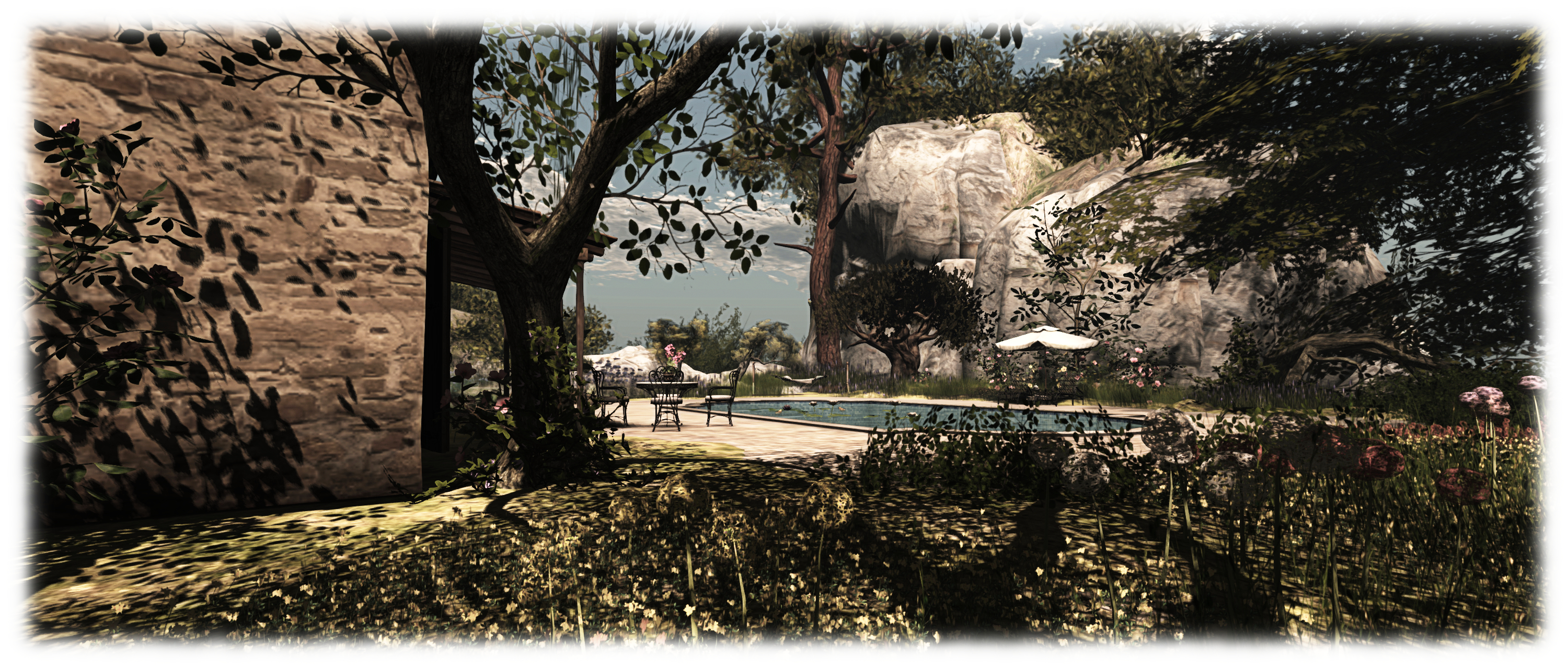
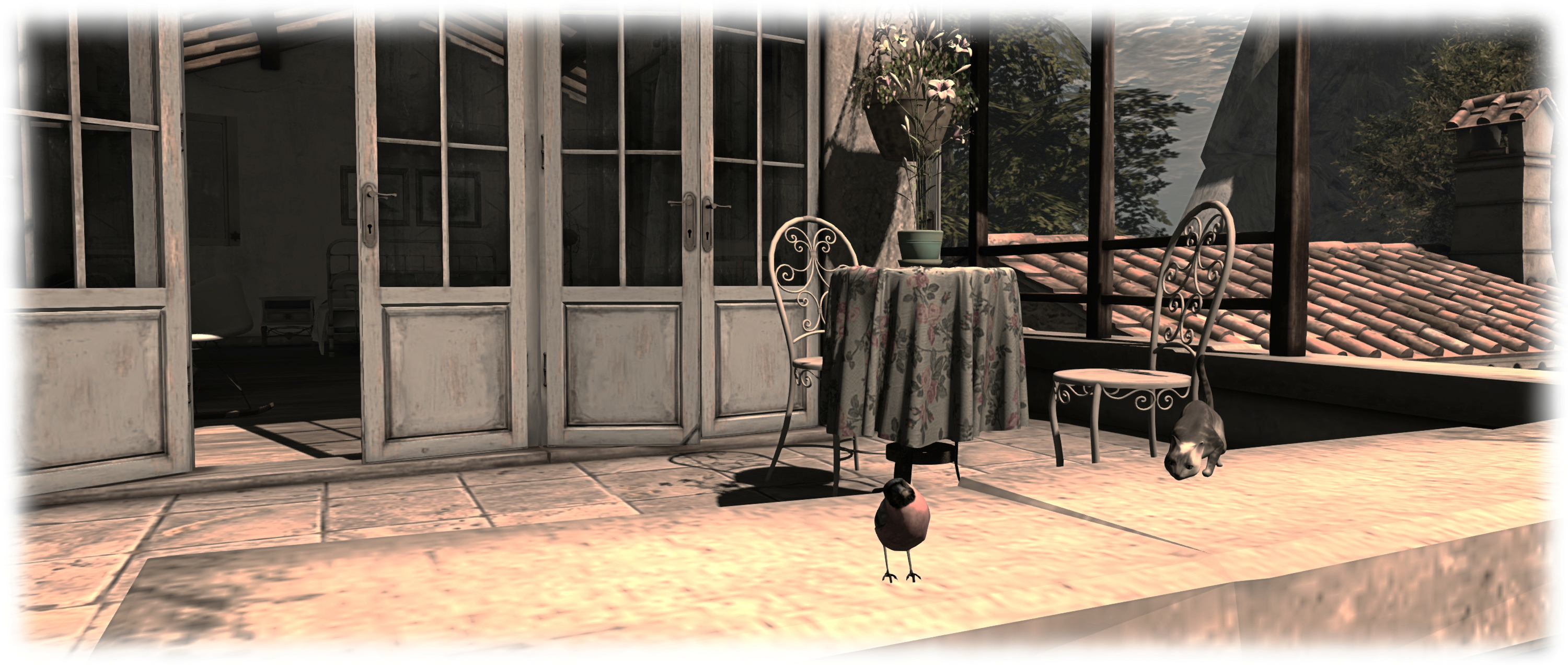
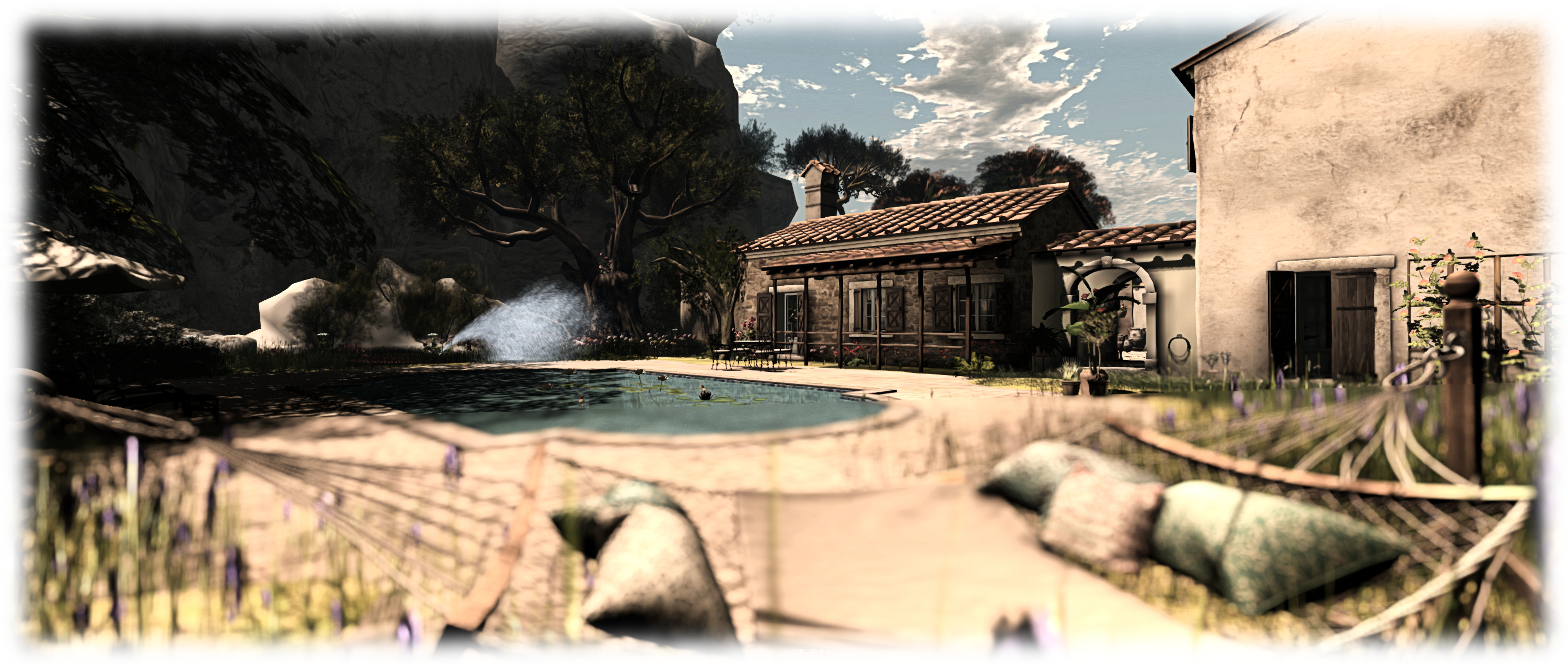
Here there is more on offer to please the eye; the villa itself is a work of art, and beautifully decorated with rustic charm both inside and in the stone-flagged courtyard around which it is built. Behind the house is a garden area with a stone swimming pool surrounded by cobbles, the flower borders to one side being watered by a gently rotating sprinkler. However, if you opt for a swim, do take note that the pool is already occupied by a couple of little chaps!

Timeless Memories; Inara Pey, July 2015, on FlickrTimeless Memories, July 2015 (Flickr)

Such is the design of the island that is it hard to pull oneself away from it; the terazzo and beach offer plenty of places to relax in the sun (Jodi and I spent a couple of hours lounging  and chatting, lost in the surroundings), while the villa offers a cool retreat for those who might want to escape to the shade.

When I first wrote about Timeless Memories, the About Land notes indicated that it might not survive. I’m glad this has turned out not to be the case; with this second build, Elvira has provided yet another utterly captivating design, and I have no hesitation in recommending you visit and see for yourself. And please, when doing so, do consider tipping the laptop at the landing point and help Elvira to keep Timeless Memories alive so that we can all continue to enjoy it.

Timeless Memories; Inara Pey, July 2015, on FlickrTimeless Memories, July 2015 (Flickr) – click any image for full size

And as it is a romantic location with an Italian theme, I’m going to bow out with Matt Monro’s One Days Like These, a song I love quite apart from its links to a certain 1969 film; and who wouldn’t, given Mr. Monro’s silken voice?

SLurl Details

Tristan und Isolde in Second Life

Tristan und Isolde
Tristan und Isolde

Opening at 13:30 SLT on Wednesday, July 15th at ItalianVerse, is Giovanna Cerise’s latest installation, Tristan und Isolde. Based on Richard Wagner’s 3-act opera of the same name, the installation is, like the opera itself, a remarkable piece.

Premièred in 1865, after a difficult gestation, Tristan und Isolde is acknowledged as one of the peaks of the operatic repertoire, and one of the most influential works in the development of western romantic music, providing direct inspiration to the likes of Gustav Mahler, Richard Strauss and Benjamin Britten, as well as spurring composers such a Claude Debussy, Maurice Ravel and Igor Stravinsky to develop their styles of romantic music as a sharp and lasting contrast to Wagner’s more tonal approach.

The core of the story is based on a medieval tale of love between the titular Tristan, a knight of Cornwall, loyal to King Mark(e), and Isolde, an Irish Princess. Within it are the classic themes of murder, love, betrayal and forgiveness played out on three sets, all of which are reproduced in Giovanna’s remarkable installation.

Tristan und Isolde
Tristan und Isolde

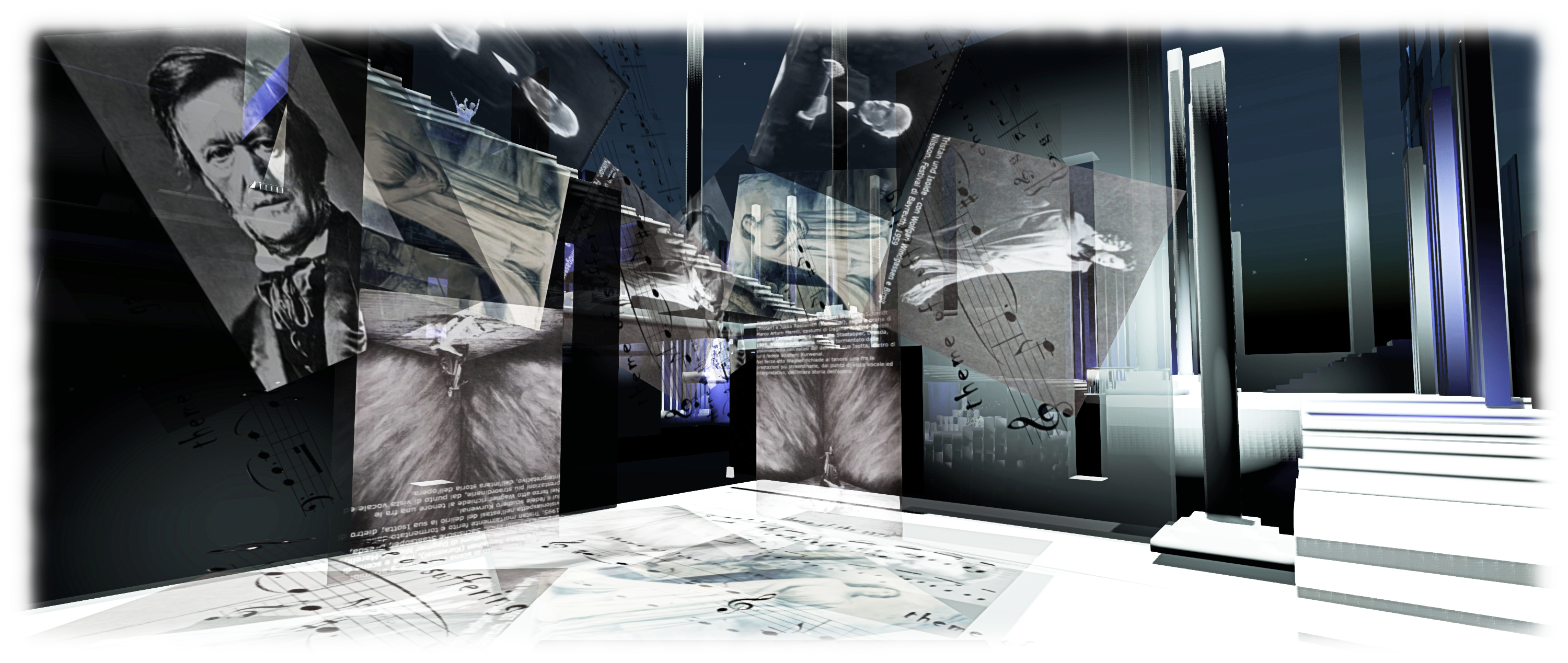
The arrival point, which might be said to be fashioned after the foyer of an opera house, is filled with images of Wagner, Mathilde Wesendonck (with whom Wagner was infatuated at the time Tristan und Isolde was written), promotional images from and 1859 production, and elements of the musical score, gives a hint of what is in store for the visitor.

From here, stairs ascend upwards, leading one to a balcony overlooking the opera’s first act: the ship commanded by Tristan that is bringing Isolde, somewhat by force, from Ireland to Cornwall, where she is to be married to Tristan’s uncle, King Mark(e). On and over the deck of the ship we see symbols representing the unfolding drama.

Tristan und Isolde
Tristan und Isolde

Above it sits a net about to enclose two pairs of hands coming together in a clasp, indicating both the love between Tristan and Isolde (itself not entirely the product of the potion they both unwittingly drink) and the events that are enfolding them. Then there is the little box of potions – poison and love – which play pivotal roles in the unfolding story.

Finally, lying on the deck and almost transparent, is a sword – a symbol of so much within the tale: Tristan’s role as a knight loyal to his king; his murder of Isolde’s fiancé, and the fact that Isolde once held Tristan’s own life at the point of his own sword, only to spare his life out of her own growing love for him, the result of having saved him from his own mortal wound prior to realising he was the one responsible for her fiancé’s death.

Tristan und Isolde
Tristan und Isolde

More stairs lead the way upwards to the scene of the second act. Here we find a tree, representing the night-time hunt led by King Mark(e), now wedded to Isolde, which departs the kings hall and leaves the two lovers free to meet. The figures with the net are clearly Tristan and Isolde, their pose reminiscent of the one used in the 1859 promotional material seen in the foyer.

Then there is the net itself; symbolic of so much: the love that binds Tristan and Isolde together; the way in which that love will betray them before the king; the truth behind Tristan’s declaration that only in the long night of death will they ever be truly united; and even Melot’s growing suspicions about the two of them, which also plays a role in their fate.

And so it is that the stairs bring use to a final set of balconies, these again lined by silhouettes of knights, as with the last, once again suggesting a courtly environment. But this is not representative of King Mark(e)’s halls; rather it represents Tristan’s own castle in Brittany. Here the final act is played out; one involving death, forgiveness and ascension, all of which is again beautifully encapsulated in the set of figures rising into he air over a dark shroud.

Tristan und Isolde
Tristan und Isolde

Opera is often said to be drama on a grand scale, and Giovanna’s installation is very much a reflection of this. It captures an influential piece of opera in the most beautiful and dramatic of ways, a magnificent reflection of Wagner’s work, exquisite in its detail and tone, right down to the selected windlight and the incorporation of musical spheres containing extracts from the opera itself (don’t have the local audio stream running when visiting!).

Truly an installation not to be missed.

SLurl Details