Mac Kanashimi’s Snarl in Second Life

Snarl - Mac Kanashimi
Snarl – Mac Kanashimi

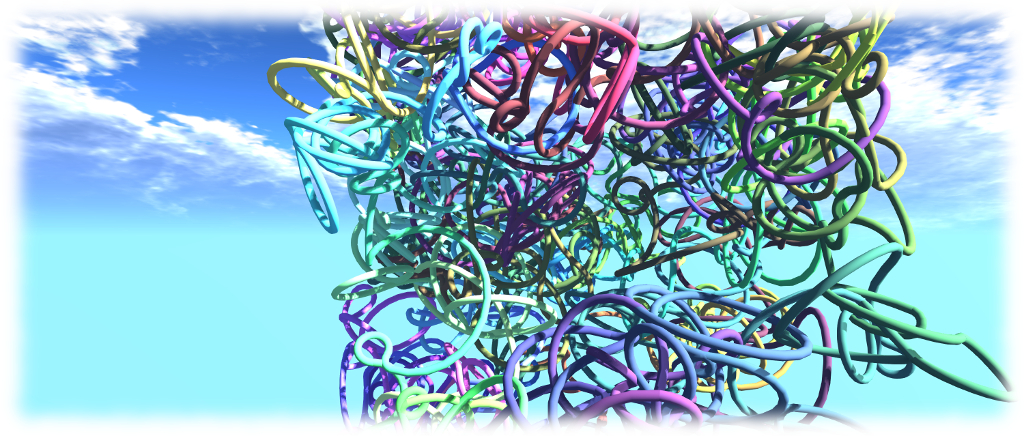
Snarl is the name of Mac Kanashimi’s latest art installation, and it really is one of those things that has to be seen in order to be appreciated; frankly, no photograph really does the build justice.

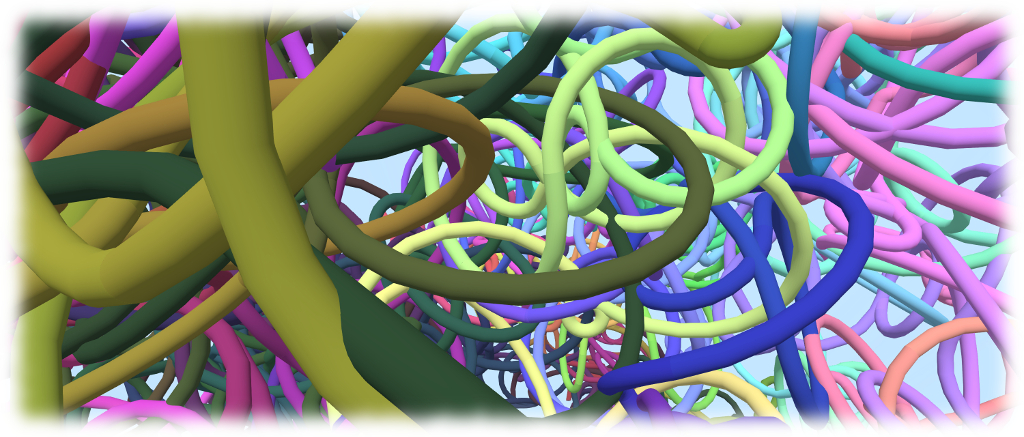
Known for his huge, fractal-based builds, several of which I’ve covered in this blog (see Climbing the Pinwheel (August 2014), The Geometry of Art (April 2014) Enter the Dragon Curves (February 2014)). However, for Snarl, he has opted for something far more organic in form: a huge vine-like tower of rings, curls, loops of fibre-like elements which rises more than 4,000 metres in to the sky above the region in which it sits.
Snarl - Mac Kanashimi
Snarl – Mac Kanashimi

The result is quite extraordinary, some 5,000 items, each with an LI of three, all of which utilise HSL (Hue, Saturation, Lightness) to RGB conversion.This has been set such that lightness has the slowest cycle of conversion, causing the tower  to go from light colours in the lower extremes through to darker colours at the top. Saturation then has a slightly faster cycle than lightness, leaving hue with the fastest cycle.

To appreciate it requires ramping-up draw distances as high as your system can comfortably handle – and this is really worthwhile doing. If you are fortunate enough to have a Space Navigator / joystick which allows you to flycam, I can thoroughly recommend ramping-up draw distance and then flying up the side of Snarl at a relatively slow pace. Watching the curls and twists slowing unfold / pop into view as distinct clumps and then slowly connect to one another, colour washing over them after then have appeared, really does bring home the organic nature of this build.
Snarl - Mac Kanashimi
Snarl – Mac Kanashimi

Do note that when you arrive at Snarl, which rebuilds itself tail-to-top once a day, you will do so at the top, and sans any platform on which to stand. This affords you with the novel (if initially disorienting) experience of falling through the installation, all of the segments of which are phantom, presenting you with a unique “inside” perspective on the build which is worth repeating by flying through it as you examine it.

Snarl is an extraordinary installation, which will remain open through until the end of 2016.

SLurl Details


A walk through Legacy Ridge in Second Life

Legacy Ridge; Inara Pey, July 2016, on Flickr Legacy Ridge – click any image for full size

Legacy Ridge is described as a private residential community within Second Life, although it is open to public visits. A full region, the design is largely the work of Isa (Isa Messioptra) and Cipher (Ciphertazi Wandin), the talents behind Crestwick Island, a destination I last wrote about a little over a year ago, at the start of June 2015.

Given Isa and Ciph are involved in Legacy Ridge, you might expect it to be somewhat special in look and feel – and if you were to do so, you’d be absolutely right. This is a beautifully imagined and designed coastal hamlet, tucked into a fjord-like lnlet cutting deep between tall mountain peaks which hunch protectively around it as if sheltering it from the rest of the world.

Legacy Ridge; Inara Pey, July 2016, on Flickr Legacy Ridge

A visitor’s journey begins at the welcome centre, down near the north-facing waterfront. The latter is without the expected beach; instead the grassy land sit protected from the waters of the bay be a strong of boulders which sharply define the waterfront and give every impression of having been hauled down from the mountains and placed as they are for precisely this purpose. Behind them sits a tarmac parking lot and the 50’s style Lucy’s Diner.

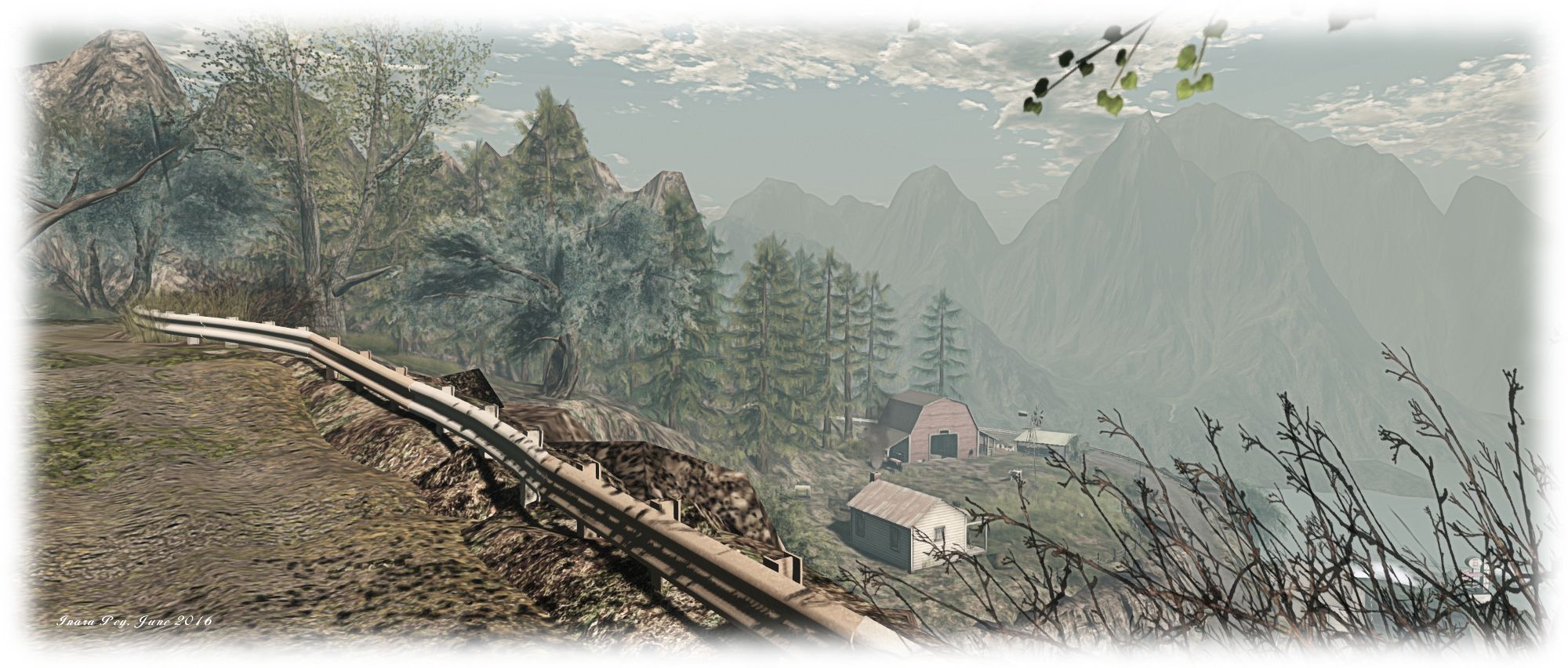
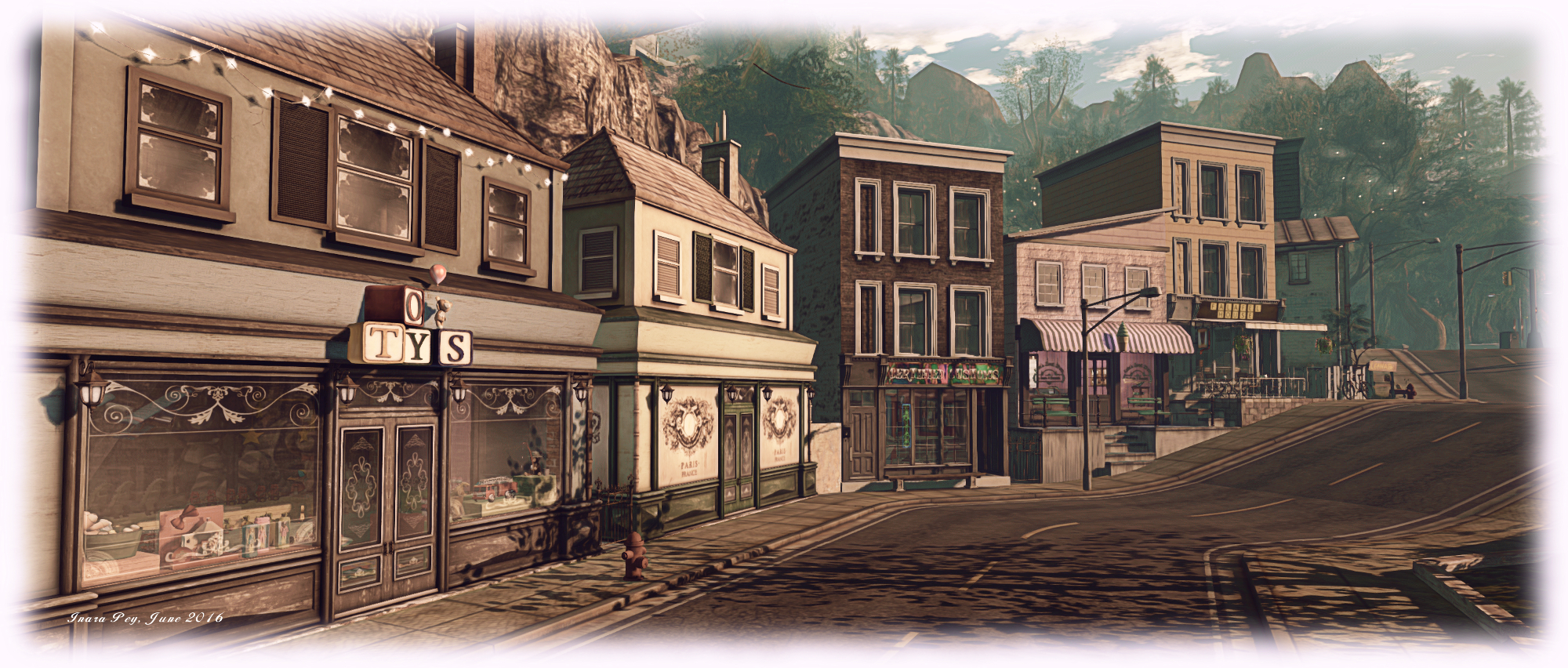
The road from the diner offers short run to the east, passing and ancient fishing boat which has been left well and truly high and dry, before petering out, a rough track completing the route to a small dock built out over the water. Southwards from the diner, the road climbs a short incline to reach a little row of shops sitting with their backs against a sheer cliff and looking out over a children’s playground to the bay beyond.

Legacy Ridge; Inara Pey, July 2016, on Flickr Legacy Ridge

A junction marks the end of the shops, offering a choice of routes: continue eastward, and you’ll arrive at another parking lot, this one sitting before the local motel. Turn left, however, and the road will lead you onwards and upwards to a further junction. This is denoted by the abrupt end of the tarmac surface as it is crossed by an unpaved road pointing west and east. It’s entirely up to you which route you take from here, as both will lead you around the rest of the region, climbing ever higher in the process as you pass houses cosily nestled under hill and tree.

It is this aspect which gives Legacy Ridge a very unique look and feel. Walking (or cycling) up and around the tracks, there is a real impression of moving along an old coastal road, winding slowly away from the little hamlet below and to some new destination “inland”. To the west and north, the land falls away, offering views out over the water. To the east and south the land rises to a series of rounded peaks, and while these don’t blend seamlessly with the mountains of the sim surround, they do nevertheless give an immersive feeling of being the foothills to them, as they naturally hide the tall peaks from view as one winds passes directly below them.

Legacy Ridge; Inara Pey, July 2016, on Flickr Legacy Ridge

The majority of the houses up in the hills were empty at the time of my visit, but they are defined as being for private occupancy, therefore investigation is not recommended, as requested within the region rules. Other than this, Legacy Ridge is open to exploration and offers some excellent opportunities for photography, and is perfectly completed with a natural sound scape, so be sure to have local sounds enabled. Should you enjoy your visit, do please consider a donation towards the region’s upkeep.

SLurl Details

MetaLES at seven in Second Life

MetaLES 7th anniversary retrospect
MetaLES 7th anniversary retrospective

MetaLES, the arts region operated and curated by Ux Hax and Romy Nayar celebrates its seventh anniversary this year, and is marking this achievement with a special retrospective exhibition.

Since its creation, MetaLES has been a mainstay of the arts in Second Life, hosting remarkable installations, a fair number of which I’ve written about in these pages.  These have been designed by some Second Life’s most remarkable and enduring artists, including Alpha Auer, Igor Ballyhoo, Rebeca Bashly, Giovanna Cerise, Cica Ghost, Cherry Manga, Patrick Moya, Bryn Oh, Maya Paris, Betty Tureaud, and Ux and Romy themselves, to name but a few.

MetaLES 7th anniversary retrospect
MetaLES 7th anniversary retrospective

The retrospective presents many of the region’s exhibitions and installations as seen through the eyes of photographer Anita Witt. In typical MetaLES style, the exhibition sits upon a desert-like plain, itself perhaps offering a faint echo of the desert which once surrounded Anita’s own Dryland gallery (itself now gone, but not forgotten).

Above this plain, Anita’s framed photos float, anchored to the ground by rocks, and in places preventing some rocks  drifting off into the sky themselves. Lanterns also rise from some of the rocks, while scattered between them are various objects: here an oversized tea-cup and saucer; there a great stone throne, elsewhere the boxlike form of a piano, and so on, all of which further encourage the visitor to wander and admire the art.

MetaLES 7th anniversary retrospect
MetaLES 7th anniversary retrospective

The images, offered individually or in pairs or small groups, are presented with the name of the installation and the artist responsible for it. For those familiar with the installations staged at MetaLES, it presents a fair trip down memory lane, as well as offering an accessible exhibition for anyone with an interest in in-world art, whether or not they are familiar with MetaLES’ distinguished history.

Congratulations to Ux and Romy on reaching their seventh anniversary, and my best wishes to them both for many more.

SLurl Details

Enjoying a tropical Smile in Second Life

It All Starts With A Smile; Inara Pey, June 2016, on Flickr It All Starts With A Smile – click any image for full size

I’ve long enjoyed visiting It All Starts With A Smile, the photogenic Homestead region by Kaelyn Alecto and Maxx (Maxxster). I first dropped in far back in May 2013, and have since blogged about it several times in these pages. However, over the course of the last year, I’d actually lost track of the region, and so was delighted to receive news the latest iteration would be opening in mid-June, and made a point to put time aside to visit as soon as I could.

In this new design, It All Starts With A Smile has become a tropical paradise of five islands. Four of these are little more than idyllic stretches of sand rising out of the water, offering banyan shaded escape from the worries of the world; places where visitors can simply relax under an early morning default windlight. Standing over them like a mother guarding her brood, sits the largest island, offering tiered opportunities for exploration which reach from beach to  grassy plateau, where gazebo and ancient castle await discovery.

It All Starts With A Smile; Inara Pey, June 2016, on Flickr It All Starts With A Smile

Nor does it end there. Tiki huts vie with cabins, pergolas, and shacks in tempting visitors to tarry within their comforts, the waters idling gently between the islands further inviting wanders to take a dip or rest on a raft or snuggle on a rowing boat; the latter also form one of the means by which visitors can move between the islands, while bridges also connect four out of the five for those who prefer exploring on foot, with smooth stepping stone crossing the water to the fifth.

The landing point is located on the largest island, offering visitors the opportunity to make their way through lush foliage, over sand and beach and up stone stair to the plateaus and tiers above, where sit the castle and gazebo. Continue northwards, and the first of the wooden bridges will carry you over the water to the first of the smaller islands, where sits a bar offering the chance to quench any budding thirst, the opportunity to dance, or the restful retreat of Tiki huts reach by wooden stair.

It All Starts With A Smile; Inara Pey, June 2016, on Flickr It All Starts With A Smile

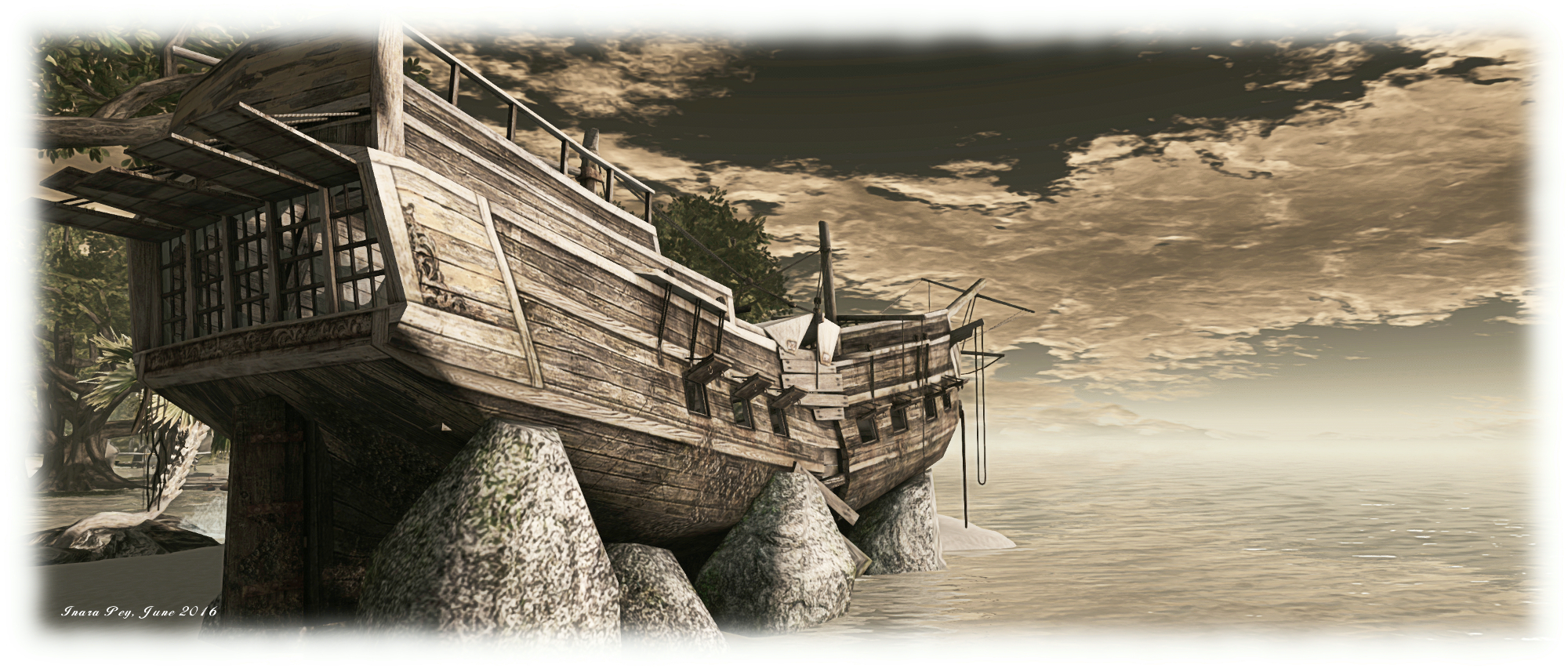
Continue onwards north and east across the region, and more beaches will offer themselves to you, one with a seaplane drawn up onto the sand, newly offloaded luggage alongside, perhaps destined for the cabins just across the water. Then there is the hulk of an old man-o-war, raised upon rocks, her broken hull offering more shelter from the sun and a place to rest and snuggle.

It All starts With A Smile has always offered consistently delightful designs, guaranteed to please every SL traveller and visitor. But I have to confess, there is something especially delightful about this tropical world Kaelyn and Maxx have created. There is a very natural beauty about it which is wonderfully enhanced by both the wildlife found scattered across the islands and waters, and in the marvellous ambient sound scape.

It All Starts With A Smile; Inara Pey, June 2016, on Flickr It All Starts With A Smile

Should you enjoy your visit – and I have absolutely no doubt you will – please consider a donation towards the upkeep of the region so other might enjoy it as well. You can also join the  IASWAS (it all starts with a smile) group for a modest L$250, which gives you rezzing rights for photography props, your payment also going towards the cost of the region. Visitors are also welcome to post their snaps and images to the It All Starts With A Smile Flickr group.

SLurl Details


Organic Geometry in Second Life

Organic Geometry - Morlita Quan
Organic Geometry – Morlita Quan

Now open at the Art Gallery the Eye is an exhibition of physical world art by Morlita Quan, entitled Organic Geometry. Presented under her physical world artistic name of MorlitaM, the exhibition presents some 22 images, and is presented with a number of  and several pieces of 3D digital art by Morlita within the exhibition and the gallery entry foyer.

“Inspired by nature,” Morlita says of the exhibit, “This collection tries to show an abstract concept about the beautiful nature’s shapes with a strong touch of the geometry, always guided by the feelings.” Abstract the images may be, but the influence and inspiration of nature is evident within each piece presented here, the majority of which lean towards monochrome, while those incorporating colour do so in a soft, subtle and – dare I say – organic manner.

Organic Geometry - Morlita Quan
Organic Geometry – Morlita Quan

The geometry within the images seems to exist on two levels. On the one, we have very clear geometric inferences: the use of grid lines, the balance of shapes within the images,  division of elements within each image; all of which are immediately apparent. Then there is a more subtle geometry of form and shape, gentle sweeps of line and form, repeated over an over, much like the gentle, organic geometry of the petals on a plant. All of this adds to the depth and captivating beauty of the images.

There are two additional dimensions to this exhibition as well, the first of which is sound.  Morlita is a musician as well as an artist, and is working on the final elements of a noise experiment album. Organic Geometry presents a sound scape through local sounds (not the music stream) which adds further texture to the exhibition. The other element is poetry, a piece, My Gaia, Gaia of My, written by Morlita to accompany the exhibit can be found in the note card introducing it,  which can be received along with Morlita’s biography via the board at the entrance to the gallery.

Organic Geometry - Morlita Quan
Organic Geometry – Morlita Quan

I admit to being a newcomer to Morlita’s work, despite her having exhibited widely in Second Life. I will, however, be keeping an eye out for future exhibitions she mounts.

SLurl Details

UWA: call for Immaterial entries in Second Life

Via UWA
Via UWA

While the Grand challenges came to an end in December 2015, with the awards for Pursue Impossible, the University of Western Australia is still involved in supporting the arts in Second Life, both through the UWA Gallery and through various exhibitions.

Launching the latter, and announced on Friday, June 24th, is IMMATERIAL, with an open invitation for 2D, 3D and machinima artists to enter.

The theme for the exhibition is “Immaterial”, and is described as being about light, shadows, textures, motion, and ideas. The announcement states the theme is intended to::

Highlight the technologies of SL as a medium for creative expression. We especially want work that uses advanced techniques, in addition to objects per se, including but not limited to:

  • Mesh
  • Materials
  • Projected light and shadows
  • Avatar and object motion/animation
  • Advanced scripting/interaction
  • Particles
  • Pathfinding

As this is an exhibition and not a challenge or competition, there is no judging panel and no cash prizes. Instead, all entries will be documented, and an exhibition catalogue will be published on-line as part of the UWA Studies in Virtual Arts (UWA SiVA) journal series.

The deadline for submissions is 23:59 on July 31st 2016 at 11:59 PM SLT, and entries will be displayed in the UWA Gallery as they are received. The exhibition will be on display for at least two months, but calls for entries for subsequent shows may overlap.

General guidelines for entries are:

  • Artists may submit up to one entry each in 3D, 2D, and/or machinima. Collaborations are encouraged, so if you participate as a named collaborator on any entry, you may also submit a separate entry as an individual.
  • Land Impact limit for 3D work is 200. Sound and light emitting objects should be carefully crafted in consideration of other nearby entries. Objects that might impact other nearby entries may have to be placed on a platform to isolate it. In such cases a poster and TP device will be placed in the gallery. Any entry with excessive script lag may be refused or returned for revision.
  • 2D entries should reflect the theme and must be images substantially created in SL. Post-processing (e.g., Photoshop effects) should be kept to a minimum.
  • Machinima entries can be of any length or subject matter as long a they are substantially produced using SL as the primary medium and conform to other criteria listed here. A poster and/or screen shot will be placed in the gallery and in the exhibition catalogue along with a link to the machinima.

For the full entry guidelines, including how to submit your entry, please refer to the UWA Immaterial call for entries.

Good luck to all who enter!

Additional links