Solitude at Dathúil

Solitude - Dathúil Gallery
Solitude – Dathúil Gallery

Opening on May 5th at Dathúil Gallery, is an exhibition of art by Cicada (aspencicada) entitled Solitude. It comprises 17 images, 16 split between to ground floor and mezzanine level of the gallery, with a large format piece suspended from the ceiling, facing the main entrance.

I confess to not having been previously familiar with Cicada’s work, and this exhibition presents an interesting contrast of subject and style focused on the central theme of solitude, with the majority of the pieces depicting either individual  flowers and plants, or groups of flowers seen from above, while five present avatar studies.

Solitude - Dathúil Gallery
Solitude – Dathúil Gallery

“Solitude,” the artists informs visitors, “is the remoteness from habitations. The sense of feeling to want to be away from everything. I’d like to be able to get away for a long time, just to think, to plan and to just be. A time to fix myself, fix all things broken, fix everything.”

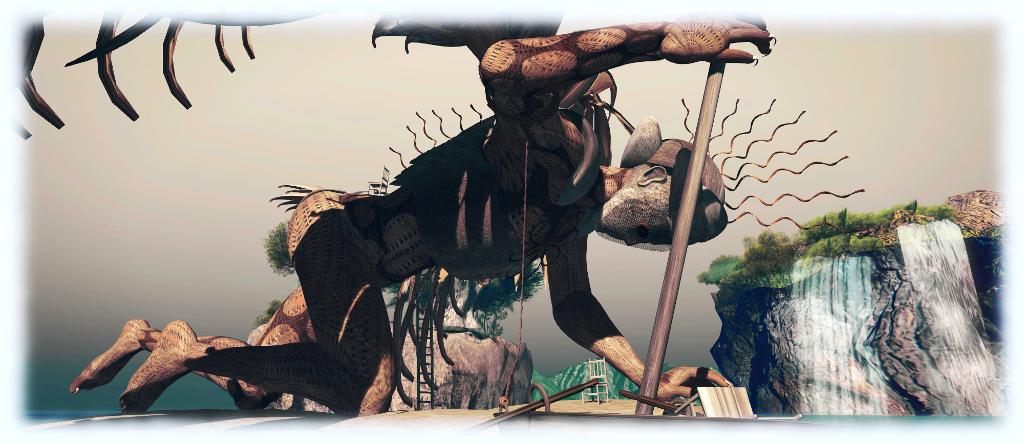
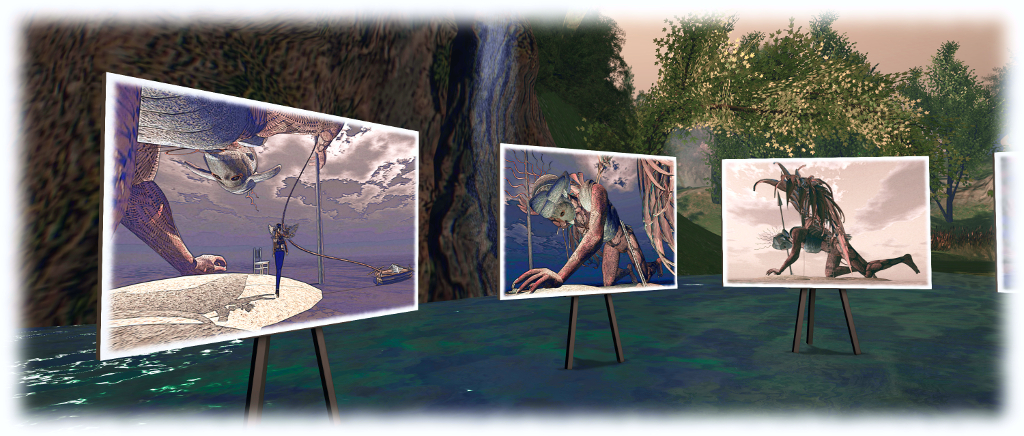
This is certainly evident in the five avatar studies on display, all of which convey a certain pensiveness or pathos. Three in particular – two on the left of the entrance and one to the right – appear to be part of the same narrative,conveying that need to be alone coupled with a pensive response to being discovered and observed.

Solitude - Dathúil Gallery
Solitude – Dathúil Gallery

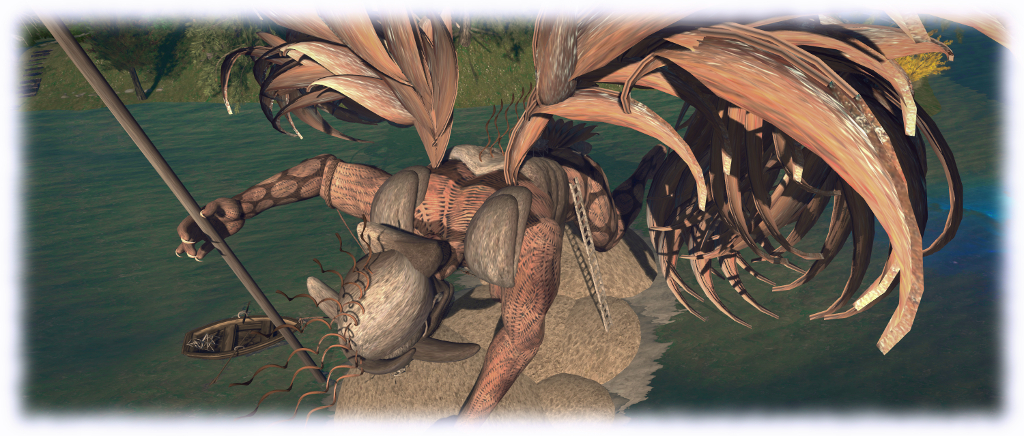
The remaining two, which comprise the large overhead image and a further picture to the right of the entrance, are more stand-alone. The latter suggests a time of solitary reflection, the overall lighting of the piece perhaps indicative that the reflections in question are centred on darker thoughts.

However, it is the overhead image which tends to dominate the space and hold the attention. This is in part thanks to the blanket of yellow flowers, matching those in the image, which carpet the floor of the gallery either side of a path of yellow tiles, all of which direct us to the image, which in turn seems to embody the idea of being alone in order to fix oneself.

Solitude - Dathúil Gallery
Solitude – Dathúil Gallery

The images of plants and flowers further convey the idea of solitude, albeit quite differently; so differently, in fact, that they may at first seem out-of-place compared to the theme of the exhibit and the avatar studies. But they stand as a reminder that there is beauty and peace in solitude – and also beauty in being among one’s friends and peers.

There is no formal opening planned for this exhibition, partially due to schedule conflicts and partly because Cicada prefers not to have a party. Instead, the exhibition will open in the morning of Thursday, May 5th (SLT) and will remain open through until May 30th.

SLurl Details

Mistero Hifeng at The Living Room

Mistero Hifeng at The Living Room

Now open at The Living Room, the art and music venue operated by Owl, Daallee and Nora, is the May exhibition, this time featuring a personal favourite of mine: Mistero Hifeng.

Anyone who has seen Mistero’s work will known that it stands and some of the most instantly recognisable 3D art in Second Life. His pieces, with individual figures, couples, or set-pieces has a unique look, style and evocative presentation which has us instantly responding to it as much on an emotional level as on a more objective critical level, engaging heart as well as eye.

Mistero Hifeng at The Living Room

Spread across all three floors of the gallery space are some of Mistero’s most iconic pieces, together with more recent works, offering those who may not be so familiar with his work with the broadest possible introduction to it. Many of the pieces have been imaginatively displayed.  E rubero’ per te la Luna, for example, presents our erstwhile lunar thief gamely tugging the Moon through the gallery’s window,  while the gaunt figures of Veglio su di te form canopies over the circular seats scattered around the exhibit space, thus literally watching over those seated!

Among some of the more recent pieces from Mistero is Oltre l’azzurro (Beyond the Blue), which is featured flanking a piano – one of the motifs he also uses at his gallery space; it’s a fitting pairing as well, given Gershwin’s Rhapsody in Blue Oltre l’azzurro is one of his pieces I find particularly interesting as its possible interpretation can vary with just the slightest change in mood on the part of the observer.

Mistero Hifeng at The Living Room

It is the suggestion of narrative which makes Mistero’s work so attractive. Take La vita…imparare vorra, for example. is the person leaning against the wall weary from thinking, weeping as a result of some loss or happening, or engaged in a game? The story is entirely ours to determine. And again, the story may well change with or own mood, or simply as a result of the local lighting.

Mistero will be on display at The Living Room through until the end of the month, and don’t forget the monthly music sessions there as well! Thursday, May 19th will see The Vinnie show providing the music from 17:00 SLT, followed by Mark Allen Jensen at 18:00 SLT. Then, on Thursday, May 25th, Tone Uriza will be taking to the stage at 17:00 SLT, followed at 18:00 SLT by Bat Masters.

Mistero Hifeng at The Living Room

SLurl Details

Savouring a Honeycomb in Second Life

Honeycomb; Inara Pey, May 2016, on Flickr Honeycomb – click any image for full size

Lundy De Luca (Londinia Leistone) is a maker of mesh home and garden furnishings under the Hive brand. She also offers her store’s homestead region of Honeycomb as a place others are welcome to visit and explore, as indicated in a recent Destination Guide Highlights blog post from the Lab.

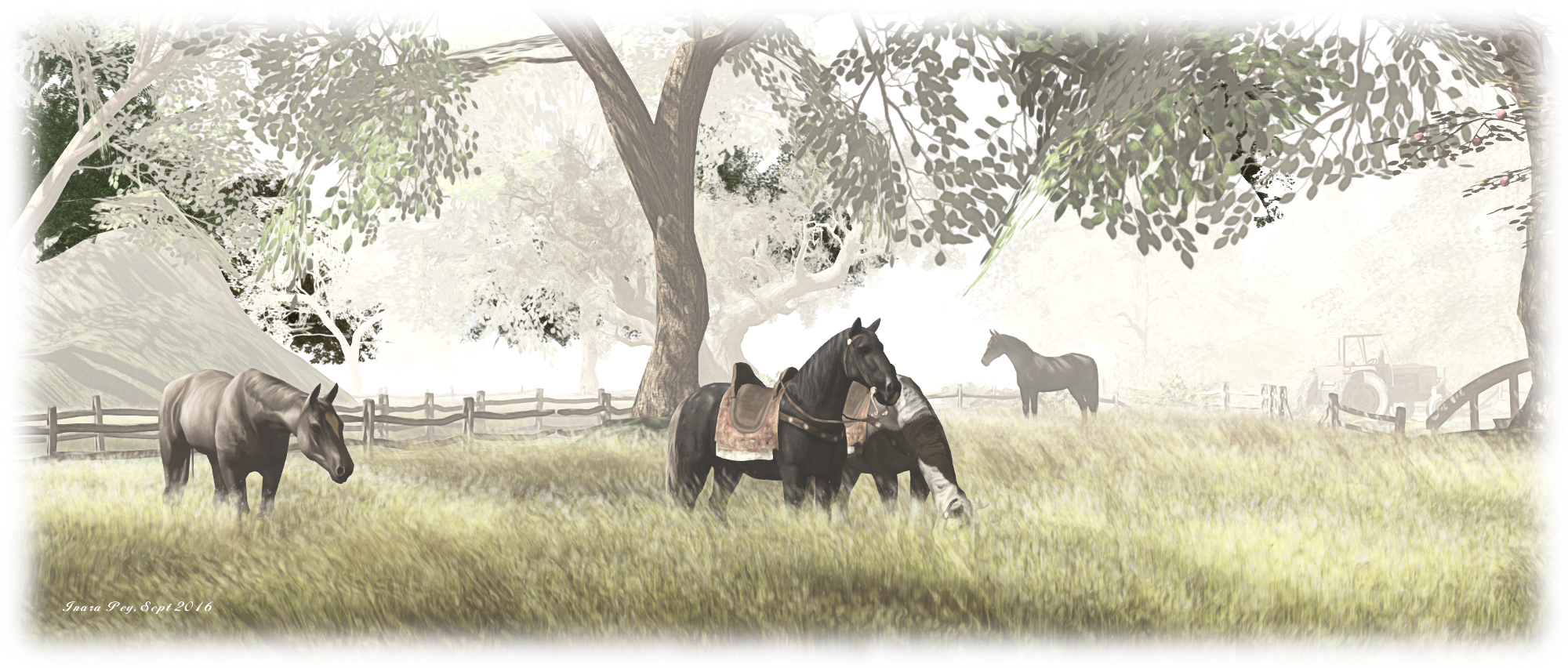
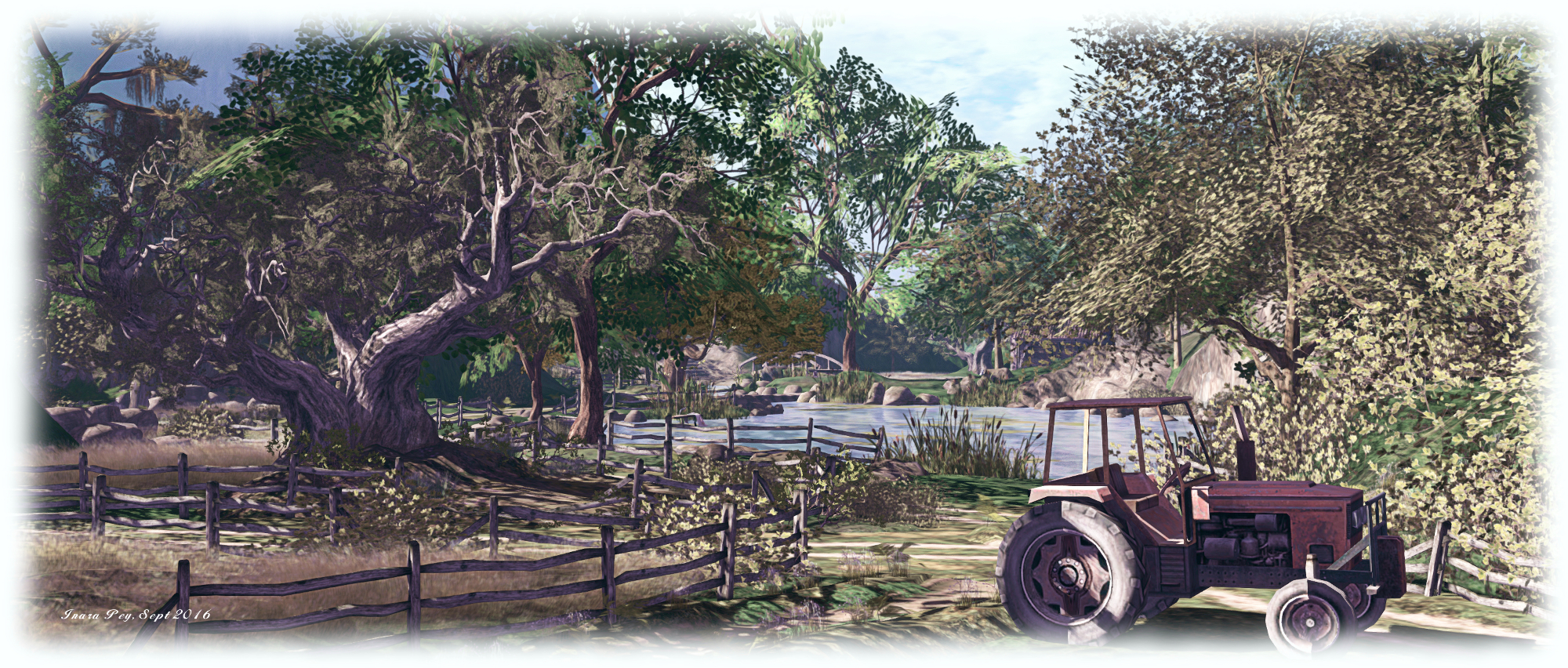
Honeycomb presents a rugged landscape, deeply cut by the sea into a series of headlands linked by a low, forked tongue of land, and two equally rugged islands. The store and landing point occupy the largest of the headlands, located in the north-west of the region, a dirt track dipping down from it, turning north-east at the fork of the tongue, to arrive at small farmstead where horses peacefully graze in a field of grass turned golden brown by the sun. Here sits an old garage with a makeshift wooden deck before it, looking out across one of the inlets towards the middle headland.

Honeycomb; Inara Pey, May 2016, on Flickr Honeycomb

Reached by crossing the local railway line, this middle headland offers a careworn beach on its west side, backed by a tired cabins built on or over its rocky eastern shore. A rickety looking bridge runs out from the beach to the smaller of the two islands, scarcely more than a table of rock rising from the sea, which is surrounded by a small skirt of sand and topped by a tall pier.

The railway line, which emerges from a tunnel beneath the Hive store, curls its way across two trestle bridges and the middle headland to arrive at the larger of the two islands, where it abruptly ends. Here sits another cabin on top of a rocky table, looking westwards towards the setting sun. A board walk and wooden steps offer a means to get down to the water’s edge on the east side of the island, passing under the railway. but to get to the gravelly, overgrown western shoreline of the island requires a bit of a scramble over rocks.

Honeycomb; Inara Pey, May 2016, on Flickr  Honeycomb

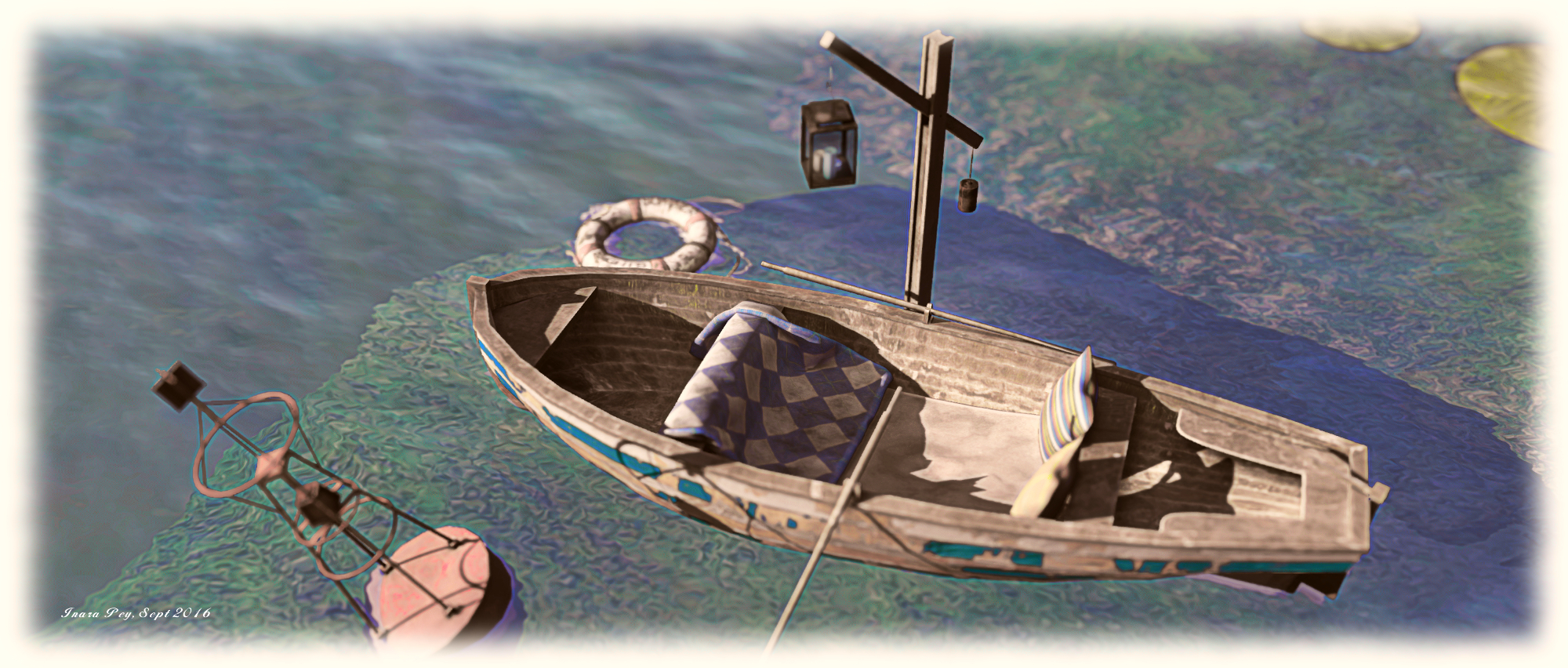
While it might sound tired and a little past its prime, the landscape of Honeycomb is nevertheless highly photogenic and evocative, and it is hard to avoid turning the camera slightly left or right and finding another view worthy of a photo. Gulls call from overhead, waves wash against the shores with soft hisses, while geese wander, horses and deer graze, and trawlers work just off the coast. From the tatty/chic beach through the connecting lowlands there are numerous places to sit and while away the time, with rowing boats out on the water offering a chance for a quiet cuddle with a loved one.

All in all, another great place to visit and, if you’re looking for something for your home or garden, or with which to further decorate you land, you might just find the answer in the Hive store!

Honeycomb; Inara Pey, May 2016, on Flickr Honeycomb

SLurl Details

Gem Preiz: a retrospective in Second Life

Gem Preiz Retrospective: Complexity (2013)

Open now through June at LEA 26 is a retrospective of Gem Preiz’s entire catalogue of fractal art installations in Second Life. For anyone who is familiar with his work, they offer a visual treat in spades; while for those who have yet to encounter Gem’s stunning canvases of intricate, fractal-generated images, all of which combine technology with wonderfully organic forms, even when depicting artificial structures, there has never been a better opportunity to be immersed in his work.

The installations are reached via individual teleports, arranged in chronological, left-to-right order as the visitor looks at them, each with its original info card giver located on the wall above the teleport disc. This allows visitors to not only visit each of Gem’s past installation in turn, but also to witness his growing confidence in using fractal generators to not only create scenes, but to weave narratives through his work, offering insight into his own growth within his medium.

Gem Preiz Retrospective: Heaven and Hell (2012)

I have covered Gem’s work extensively in this blog (all of my reviews can be found by following this tag, or view the menu: Second Life > Reviews > Art Reviews > Art in SL > Gem Preiz), and so was personally delighted to see his two earliest installations, Heaven and Hell and Complexity are included in the retrospective, as I’ve not previously had the opportunity to view them.

Heaven and Hell, Gem’s first ever exhibition in Second Life, dates from 2012 and takes as its lead a quote from French artist Georges Braque, “Art is made to disturb, science reassures.”

“It seemed to me funny and interesting to evoke the concepts of hell and paradise, which are by definition irrational, by means of one of the most accomplished domains of the science: mathematics and fractals.” Gem says of the installation.  inviting people to cross the Styx and enter the devil’s domain before being reborn in paradise.

Gem Preiz Retrospective: Polychronies (2014)

Complexity, first displayed in October 2013 at Timamoon Arts, is an intriguing voyage of creation and growth, physically and in terms of knowledge, reflected in a quote, “The detailed knowledge of the world helps us to better understand it, but we never understand it better than when we forget its details.”

It takes us through fifteen images, each an ever more complex outgrowth of the last, carrying us from a single fractal at the centre of a blue realm, to the most intricate and complex shapes which form their own universe, expanding ever outwards until at last we come to … what appears to be a single fractal floating in a blue realm. A perfect summation of the quote.

Gem Preiz Retrospective: Metropolis (2015)

From Complexity, one can travel onwards through Cathedral Dreamer – my first exposure to Gem’s art,  to Polychronies, which still stands as one of my favourite installations by Gem,  and onwards through to Metropolis, with his most recent joint work: Heritage: Vestiges and Wrecks, also on display above the same entrance hall, thus providing a complete tour de force of Gem’s work to date.

Gem’s work is a wonderful mix of art and science, organised structure and organic growth. Within it complex themes are interwoven, which also doesn’t prevent him from having a little fun as well. But when taken as a whole, his work simply isn’t something to be missed, as this retrospective amply demonstrates.

SLurl Details

Of pirates and airships in Second Life

Airship Pirates Town; Inara Pey, May 2016, on Flickr Airship Pirates Town – click any image for full size

Jamisson Burnstein recently drew my attention to a store called Airships Pirates Town, located high over the island of Hakone, and the work of へき (hekirekika Jinn). “Airship Pirates” is actually enough to get a quizzical eyebrow rising, but the build itself really has to be seen to be believed.

The “airships” in this case are not what you might think: they are neither dirigibles, nor are they (well, for the most part!) great galleons sung beneath gigantic gasbags or held aloft by whirling propellers. Rather, they are regular sailing vessels  – a man of war and an armed Chinese junk – berthed against a stone quay, all of which just happen to be 3,500 metres in the air, with the quay attached to the most fantastical and delightful to the eye steampunk town which also extends outwards blow the great stone piers of the quay.

Airship Pirates Town; Inara Pey, May 2016, on Flickr Airship Pirates Town

The landing point for this eye-catching build is a wooden dock, somewhat in need of repair, running out alongside the berthed Chinese junk. Wooden cranes sit idle alongside the dock while a zip line offers a rapid transfer down to the lower levels. However, it is likely to be the strange, piled-up charm of the town, reached by solid wooden stairs, will initially attract visitors on their arrival.

The town is an eclectic mix of buildings, some made of wood, others of brick, still others of wood-framed stone, all of random shapes and sometimes piled one on top of the other without regard – brick upon wood, for example. They are all clustered around one face of an enormous iron, steel and glass island from which huge chimneys and stacks rise and great pipes descend and around which little flying ships circle and even a great black locomotive chugs an endless circular journey from tunnel to wall.

Airship Pirates Town; Inara Pey, May 2016, on Flickr Airship Pirates Town

Clinging to the sides of this strange place on platforms of wood or steel or brick stand huge, slowly turning wheels or creaking wooden windmills. Stairways and steps and ladders provide routes upwards, while individual buildings invite visitors inside. Most are shops, but some offer living and working space. Getting around can be confusing, so look out for the teleport hub at the top of the stone steps or for the TP signs scattered around and within the buildings. Climb high enough, and you’ll find another zip line waiting to carry you back down to the quay.

Nor are explorations restricted to the shops and various levels of the floating island: find the right teleport or the right entrance, and you can enter the heart of the iron island, where sit both  the great generator which presumably keeps the place hovering in the sky, and also an Indiana Jones style course involving switching, swinging bridges, and dodging cogwheels – although the end of this journey is a little abrupt.

Airship Pirates Town; Inara Pey, May 2016, on Flickr Airship Pirates Town

With a dragon keeping an eye on things, and the odd genuine flying boat (emphasis on boat!) either moored higher up or circling the sky and a lot packed into what is a very small area, not to mention the phenomenal steampunk look, Airship Pirates Town is well worth a visit and explore, standing as a wonderful demonstration of the creative whimsy possible in this digital world.

SLurl Details

The hidden paths of Osprey Ridge in Second Life

Osprey Ridge; Inara Pey, April 2016, on Flickr Osprey Ridge – click any image for full size

Osprey Ridge has passed into the annals of SL history. SLurls have therefor been removed.

Osprey Ridge is a homestead region within the United Sailing Sims located eastward of Blake Sea and a place we’ve often passed when our sailing or boating. Open to the public, the region has been landscaped by Markarius Viper and is cared for by Flo (SweetFloXO) and presents a pleasing environment in which to spend time.

The best place to start a visit is at the moorings on the north side of the island, sheltered from the passage linking Blake Sea with Second Norway by a natural grassy breakwater. From here, visitors can walk eastwards along the moorings and the beach to come to a cosy summer gazebo sitting alongside a reedy pond, or head inland along a wooded track which winds its way to a sturdy and comfortable log cabin.

Osprey Ridge; Inara Pey, April 2016, on Flickr Osprey Ridge

The cabin sits nestled between tall columns and plateaus rising to the south and west of it, topped by tables of grass from which tress grow. Of these more anon; for now however, take the path onwards around the front of the cabin, and it will turn southwards and lead you between more trees and under the shadow of a another mesa on the east side of the region bore your arrive at the southern shore, a deck overlooking the open waters, with another ribbon of beach pointing westwards.

If you prefer, there is a track on the west side of the cabin, just within the tree line, which leads the way to the waters at the foot of the rocky cliffs, which are in turn spanned by a bridge made from the trunk of an old, fallen tree. From here it is possible to pass between the tall mesas on either side to reach the south-western corner of the island, or scramble over the rocks and into the cavern beneath the west side plateau.

Osprey Ridge; Inara Pey, April 2016, on Flickr Osprey Ridge

The cavern is a place of peace, watched over by a fae waystone which, for those running with ALM enabled, casts patterns of light across the surrounding rock faces and over the pool of water in which it sits. A narrow opening on the north side of the carven provides a short-cut back to the moorings, which eagle-eyed visitors may have spotted as they followed the rack down towards the cabin from the north side of the island.

The broad, grassy tops of the plateaus are home to a tree house, a camp site, Greedy, Greedy and a romantic cuddle swing. A wooden bridge connects the two plateaus, but how to get up to them without flying or double-click teleporting actually defeated Caitlyn and I (we eventually went the double-click TP route).

Osprey Ridge; Inara Pey, April 2016, on Flickr Osprey Ridge

The region could perhaps benefit from having the moorings on the north side parcelled-off so that auto-return could be set to say, 60 minutes, to allow those arriving by boat to come ashore and explore without fear of their vessel poofing to Lost and Found as soon as they do so, but this is a minor point. Osprey Ridge offers a pleasing visit to those passing or who are looking for photogenic spots within Second Life, with plenty of places up high and at ground level for simply sitting and enjoying the environment or having an intimate cuddle (including a bed suspended from the trees in the woods!).