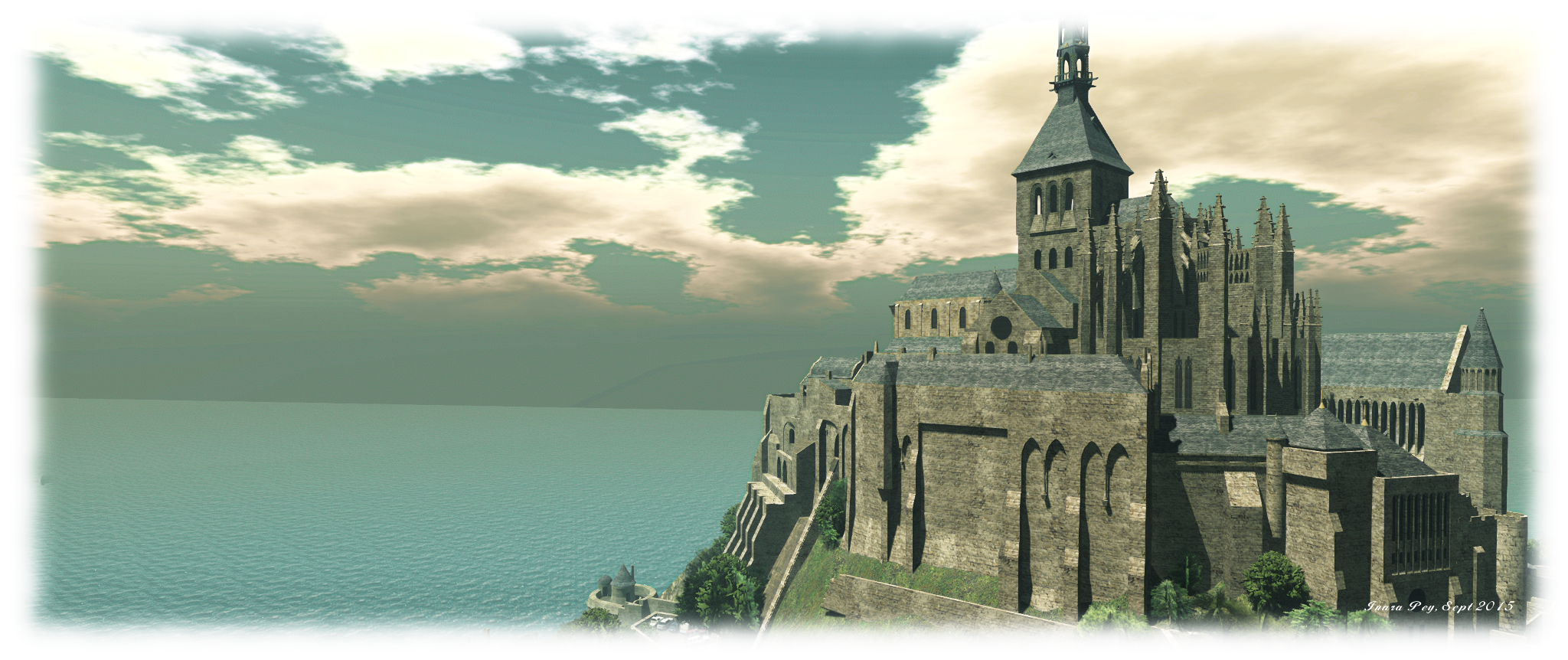
As is being widely reported, Mont Saint Michel has returned to Second Life.
Its return was first noted by Tyche Shepherd during her weekly grid surveys on Sunday, November 21st, and the news quickly spread – my thanks to all who contacted me on the matter.
An announcement about the region’s pending departure was originally made by the region holder, Moeka Kohime, in September 2015, saying the region would be closing at the end of that month. However it was still open to the public in November 2015, and didn’t vanish from the grid until October 2016.
Following this, there were numerous pleas from users on Twitter and other social media for the Lab to “step in” and “save” the landmark region. While such requests are understandable, they are perhaps not so easily fulfilled for a wide range of reasons.
However, as several people who contacted me about Mont Saint Michel noted, the region now appears to be held by Mogura Linden. It’s not clear whether this means the Lab is intending to preserve it – but I do know that they do take a genuine interest in these kind of matters. That said, I’d venture to suggest that as a personal business is connected with the region, any such act would require the original region holder’s OK; and as I’ve once again discovered for myself, getting a response from Moeka is far from easy. As such, it’ll be interesting to see how this develops.
In the meantime, if you’ve not visited Mont Saint Michel before, now is your chance to do so. It’s a stunning reproduction of the original, and well worth the effort.
Now open at Split Screen, curated by Dividni Shostakovich, is From Here On There Be Dragons by Alpha Auer. It stands as a celebration of these mythical, mystical beasts and much of what they represent both culturally and in terms of our own psyche.
Within an abstract environment of ornate towers lit from within and semi-transparent floors, sit the dragons of the title. From Alpha’s notes, they stand as guardians of self; that this strange structure is perhaps – if I might borrow from the current British television incarnation of a certain sleuth) – a “mind palace”, in which is hid the wonders and terrors contained within our deeper selves; countries of the mind through which we might only travel with care, and having accepted the challenge presented by the dragon standing before each one.
More than just a guardian, however, the dragon can be seen as a symbol of the challenges we might face in travelling those countries of the mind. As the protector of treasure, it stands as the guardian of Self; as a creature of power, harnessing a primal element – fire – it is a reflection of our own force of personality; it can also stands as a symbol of the fears we might want to overcome and of our own self-courage in doing so; and it may also reflect our baser emotions: anger, selfishness, temper.
But there is more here that introspection. As notes, this is a celebration of all that dragons can represent. Hence why the floor of this “mind palace” is inlaid with a leaf from Abraham Ortelius’s Theatrum Orbis Terrarum (“Theatre of the World”), considered to be the first true modern atlas. It is, as Alpha notes, a reminder that dragons once represented the unknown and the need to take care in the world at large: that there were limits to our knowledge and understanding of all that lay around us.
Then there are the dragons themselves, a mixture of common western and eastern archetypes, all vibrant and alive in this ethereal setting. Within their claws many hold an egg; a further symbol of the dragon’s role in many creation mythologies. Of course, in some religions the dragon symbolises the End of Times. In fact there is hardly a culture in the world, east or west, north or south, where the dragon doesn’t resonate in some way.
Hence why Alpha notes, “Dragons have always been with us, although we have come to deny their existence and their potency.” Hence why, perhaps, she also includes an extract from T.S. Eliot’s Little Gidding, allowing it to stand as an echo of the fact that dragons have always been with us, and always will be.
From Here On There Will Be Dragons will be open through until the end of January 2017, and you can also pick up one of alpha’s free avatars during a visit.
The authors and storytellers: Caledonia Skytower, Trolley Trollop and R. Crap Mariner at the October Stories at the Park
Sunday, November 20th will see the next in the Stories at the Park series, jointly presented by Holly Kai Park and Seanchai Library – and I hope that you’ll pop along to the event, which starts at 15:00 SLT.
Stories at the Park coincides with the monthly Art at the Park exhibitions at Holly Kai Park. Each month, story writers and poets from Seanchai Library and beyond are invited to visit Holly Kai Park and view the 2D and 3D art on display, and then to write a 100-word short story (“drabble”) or a poem of up to 100 words about any of the pieces of art which inspire them.
Submitted stories are then read in the live voice session for each Stories at the Park, which takes place at the Storyteller’s Garden, in the centre of the art display area. Authors can either read their own works, or if they prefer, have one of the Seanchai Library staff read them. Submitted stories are also published on the Holly Kai Park blog.
Stories at the Park, October 16th – the audience arrives
For November, Caledonia Skytower, Aoife Lorefield, R. Crap Mariner and – all things being euqal – Trolley Trollop – will be on hand to read pieces inspired by our current artists at the park: Sheba Blitz, Maxi Daviau and Skinnynilla, Terrygold and Sorcha Tyles.
While the readings are in Voice, there’s no need for you to have an active microphone; as long as you can listen via speakers or headset, that’s all you need. So, why not join us for some superb stories and poetry from 15:00 SLT on Sunday, November 20th at Holly Kai Park?
Just climb the steps by the lading point. And of course, you’re welcome to come early and explore the art and the park, or stay after and wander the paths and tracks of Holly Kai Park.
Now open at Nitroglobus Roof Gallery, curated by Dido Hass is Always Closer, a selection of personal images by Elo (elorac Paule).
Through the sixteen images on display, we are asked to join with Elo as she reviews her exploration of BDSM and discovery of submission (which might not be what you might believe it to be after reading those four letters) as a part of her in-world time. Alongside of this, they are presented as a reflection of Elo’s year, which she acknowledges has been an emotional one for her in both the physical and digital realms.
Displayed in the familiar large format used at Nitroglobus, these are sensual images presented – for the most part – in soft lighting and muted tones. Often, with photographs featuring nudity and / or adult theme like BDSM, the observer is cast into the role of the voyeur; we are given a sense of being given an illicit peek at a situation. With only a couple of possible exceptions, that’s not the case here; with these images we’re being asked to share in the emotions evoked by the images: moments of loving affinity, of vulnerability, of introspection, of surrender, and of human change.
Alongside the desire to evoke an emotional response in her audience, Elo notes that she also sees her pieces in terms of songs, and offers Affection by Cigarettes After Sex as a companion piece to this exhibit. in walking through the gallery. For reasons I can’t fully determine, Swing Out Sister’s cover of Windmills of Your Mind Iooped its way through my head; perhaps it was a subconscious linking of Elo (who is French) to Michel Legrand, composer of the song’s score; whatever the reason, it didn’t seem inappropriate.
Accompanying the exhibition is a personal note by Elo, alluded to above, which should be read alongside of the visit. Not only does it offer further insight into the very personal aspect of her photography, it also reveals her own understanding of the true nature of “submission”, devoid of the trappings of labels such as “BDSM”: that it is effectively the expression of love between two people; the willingness for each to give their best to the other without question or hesitation.
Always Closer is a fascinating exhibition. both through the art and Elo’s own words. Introspective, intimate, personal, it both reveals Elo’s life and journey and gives rise to contemplation of our own thoughts, feelings and – perhaps – direction, as we straddle the physical and the virtual.
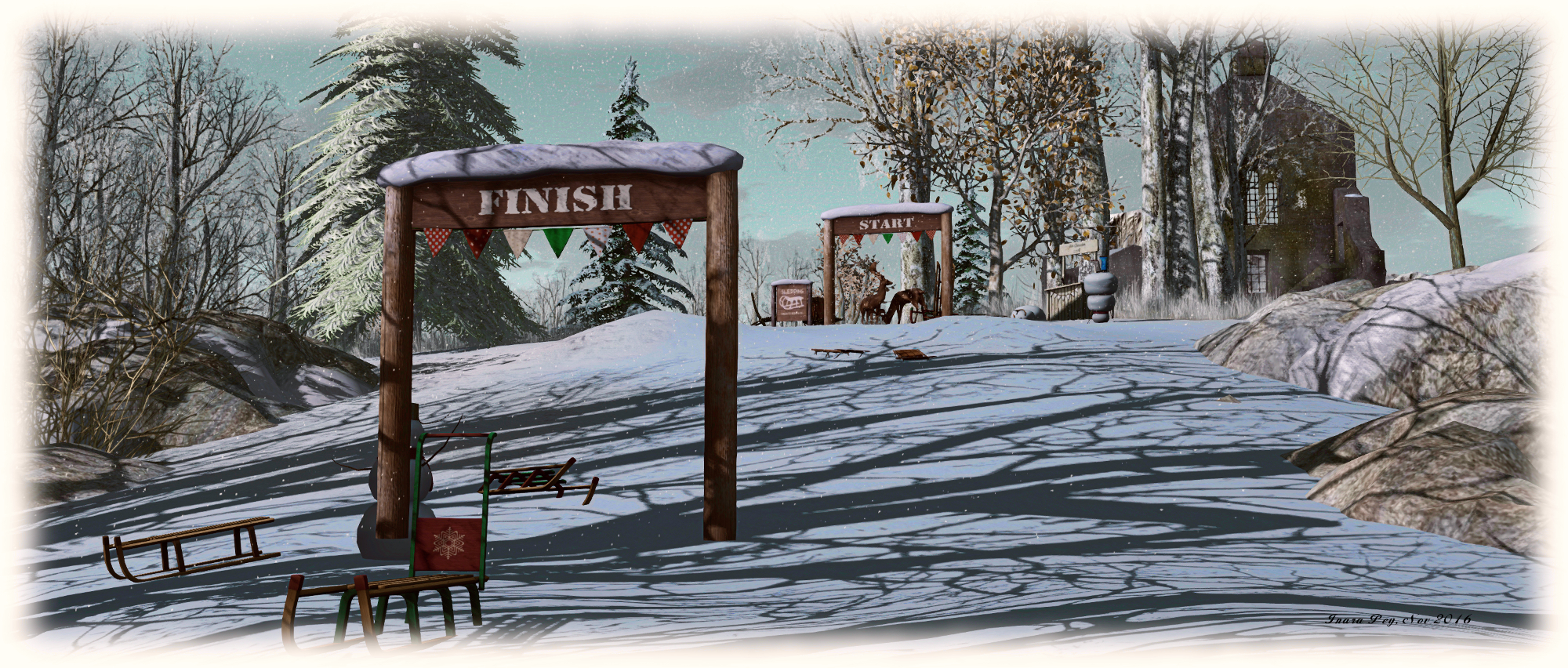
With winter now folding its arms around us in the northern hemisphere, regions with a winter’s theme are once again starting to appear across Second Life. This being so, it seemed appropriate – thanks (again) to a nudge from friend and fellow grid traveller Shakespeare (Skinnynilla) – to pay a visit to Winter Trace.
This is one of three regions jointly designed by Kylie Jaxxon and Elvira Kytori, the other two being Summer Trace (see here) and Fall Trace (which is on my list of regions to visit, but time hasn’t as yet allowed me to get to it). Each of them presents a vision of the season after which it is named, with Summer Trace also incorporating a touch of spring, and are presented as such all year round for people to visit and enjoy.
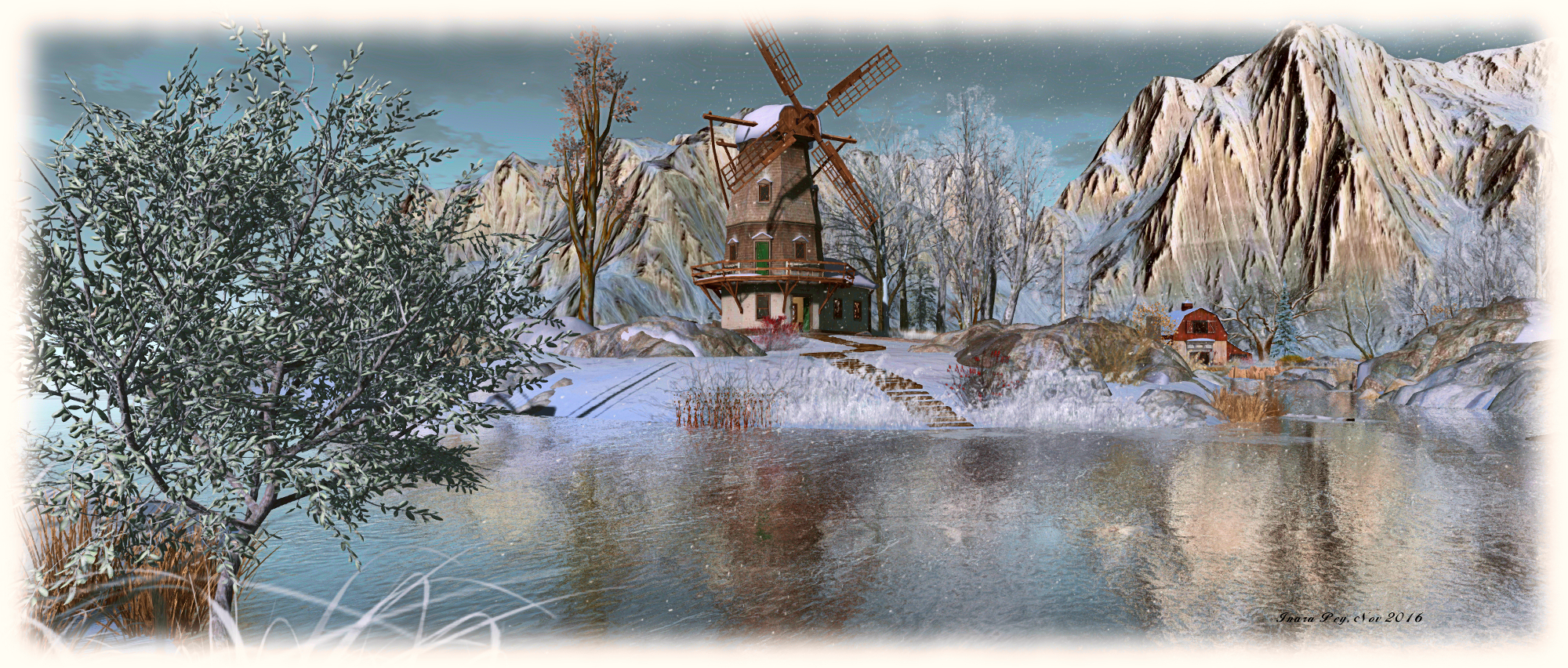
Almost completely surrounded by snow-covered, craggy hills, Winter Trace offers a rural landscape rising from frozen waters which wind their way into the land, slicing it into a series of islands. Most of these are relatively low-lying, although the largest and most central has a humpbacked hill near its centre, crowned by an old ruin.
Across the islands, snow has covered the ground, in places offering something of a salt-and-pepper mix where it has been pressed into the underlying sand by the passage of feet and wheels along tracks and paths. Wooden ties and sleepers are set out on the ground in places, forming footpaths of their own, further suggesting that in summer, this is a warm place, with sand underfoot.
Windmills occupy two of the islands, a narrow strait of water between them. One contains the region’s landing point, the other offers the potential to be a cosy little home for the budding conversion enthusiast. Across another channel from both sits the dark hulk of the ruins, a great stone bridge close by adding to the suggestion that perhaps long ago, this was a place of strategic importance to someone. Now, however, the ruin offer nothing more menacing than the chance of go sledding down the open slope of the hill pointing eastwards from it.
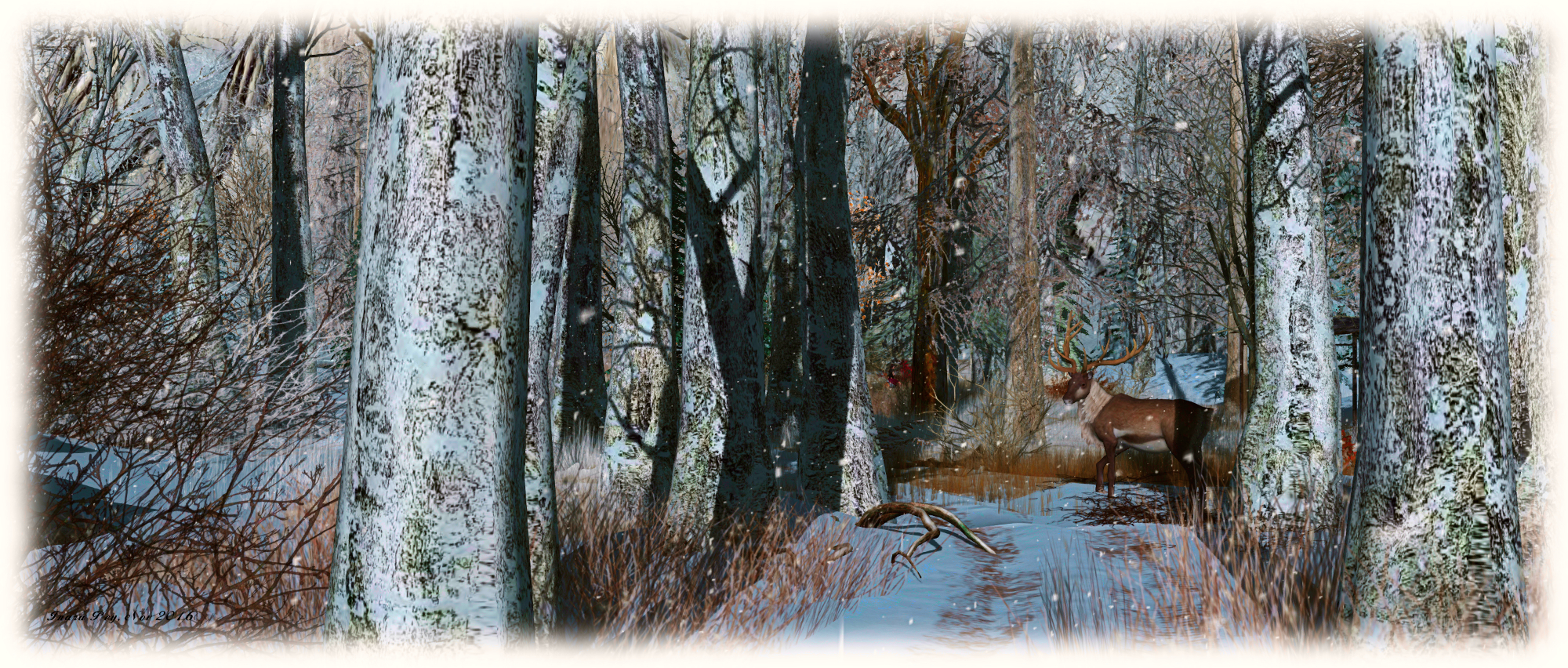
Further east and across a modest wooden bridge, stands a converted barn, its interior now a comfortable home, the horses it may once have housed now relegated to the field outside where the grass pokes up through the blanket of snow. To the south side of the barn there’s a narrow neck of frozen water, offering quick route back to the largest island, the trails that wind between larch and beech trees denuded of their leaves, branches raised to the grey sky, while between them fir trees carry a powering of snow on their shoulders.
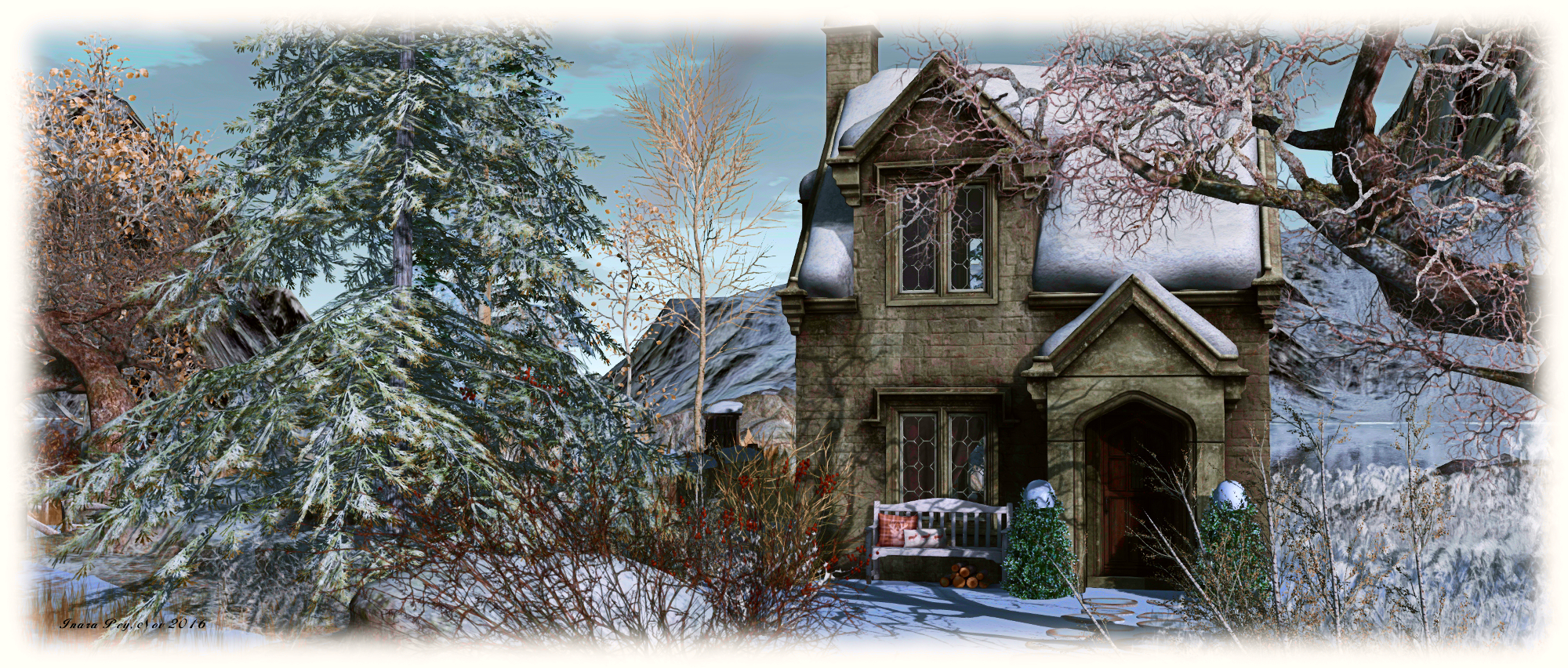
There are other signs of habitation to be found scattered across the land besides the windmills and barn, such as the little farmer’s market – currently the home of a woodcutter going by the piles of trimmed logs – and a little cottage sitting alone on an equally little island. Also to be found and places to sit and admire the view and / or have the odd cuddle with someone close. There are outdoor fires to help you stay warm, and fires in the hearths indoors should it prove too cold outside.
With snow gently falling from clouds moving lazily across the sky, a soft, subtle sound scape and opportunities for photographs in every direction and at every turn, all of which is set under a perfect windlight suggestive of a fresh, cold winter’s morning, Winter Trace is not a place to be missed – at any time of the year.
Update, November 19th: some users on TPVs may find the gun used gun in Quest 3 of Horizons Experience doesn’t work with their viewer. The Lab is aware of the issues, and is investigating options for a fix. For the moment, those affected will need to swap to the official viewer, but only for Quest 3. Full details can be found in llTakeControl issue and the Horizons Experience.
On Tuesday, November 15th, Linden Lab announced a new Mainland community initiative called Horizons. First hinted at during the Meet the Lindens talks at SL13B in June 2016, it became the subject of widespread speculation when two testing environments related to it appeared on the Second Life world map in October, with Patch Linden further stirring up interest by posting some teaser images to his Profile feed.
Picking up on the SL13B hints, I contacted the Lab with the idea of covering Horizons. Patch and his team were very receptive to the idea, and as result, I had the opportunity to tour the regions ahead of the opening, and learn more about Horizons from Patch Linden and Naughty Mole of the Linden Department of Public Works (LDPW).
In short, Horizons is a new themed Mainland residential community built around a central, 6-region gaming environment called Horizons Experience. As I’ve covered the community aspects at length in New Horizons in Second Life, this article focuses solely on the new six-region gaming experience.
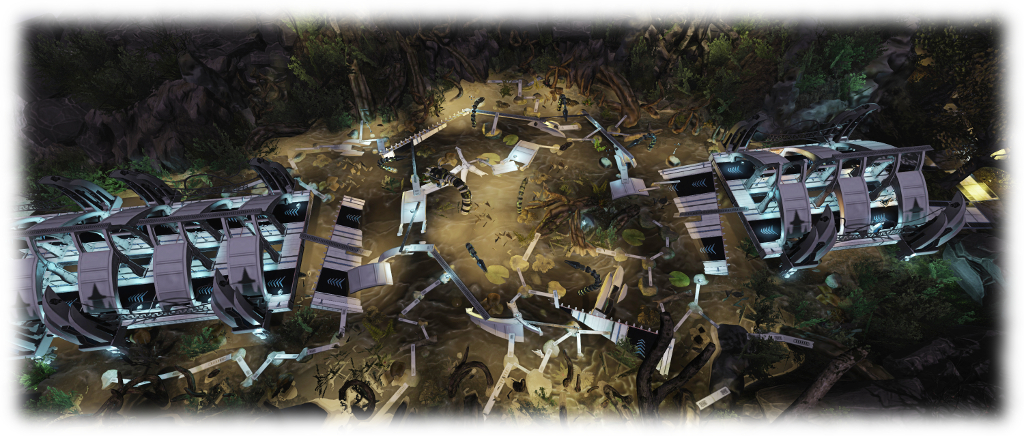
Looking down on one of the Horizons Experience quest regions
Horizons Experience essentially builds on the Lab’s work with PaleoQuest, the dinosaur themed adventure which opened in July 2015 (see Experiencing PaleoQuest, the Lab’s latest adventure in Second Life). As with PaleoQuest, players are tasked with completing a number of quests and multiple tasks in order to come to the rescue of Magellan Linden’s assistant, Tyrah, who is in deadly peril at the paws of the nefarious Doctor Talpa. Note that the game is on Adult rated regions, but this is not reflective of the games content.
“PaleoQuest was our most recent gaming project that we had put out at scale,” Patch said as we discussed the game ahead of our tour. “We took from that a lot of the game mechanics which people really enjoyed and liked, and we’re including them and a lot of new elements within the Horizons Experience.
“For example, one of the big new features is the ability to participate either as a player in the game or as an ‘explorer’ – someone who is not active in the game, but who can travel through the regions and observe as a bystander. With our other gaming experiences, you’re either in the regions with the intent to play, or you wouldn’t go. As Horizons is part of the Mainland, we felt it was important that people be able to drop in without disrupting the game-play.”
“We’re using different coloured indicator above people’s heads in the game regions to indicate whether they are a player or an explorer,” Naughty Mole added. “If they have a blue ball floating above them, they are an explorer. If they have an orange ball, they are a player. That way, the people in the game know who is who. Obviously, you can’t complete any of the quests as an explorer, nor can you receive any prizes; but you can walk or fly around and watch players (who can’t fly). Oh, and you can still be killed by any of the quest hazards!”
Part of the Horizons Experience start region, showing the Portal Room where returning players can jump to their last point of progress
Given that Horizons Experience is sitting in the middle of a residential area where flying vehicles are permitted, I wondered if there was a risk of aircraft interfering with the game. “Flying vehicles can pass over the gaming regions,” Naughty Mole answered, “but they must keep above a certain height. If they are too low, they will get a warning, and if they don’t increase their height, they will be auto-returned and those on board will be transferred to a resurrection hub inside the gaming areas as explorers.”
“The six regions of the experience are all uniquely themed,” Patch resumed, “The first region you go into is the starting region, where residents are introduced to the quest and receive their game HUD. While there they can watch an in-depth tutorial video and background story video, see the payout stations or follow links to the Horizons Experience wiki page for more information. Beyond all this are the five gaming regions, which are linear, like PaleoQuest. Each must be completed before you progress to the next one.”
Horizons Experience can be accessed in a number of ways. Anyone in the Horizons regions can fly to the central gaming regions, or they can use the teleport portals located at the Horizons info hubs and community centres, and which are scattered across the residential regions. Direct teleport via the map is possible, and there is also a Horizons Experience gateway at the Portal Parks.
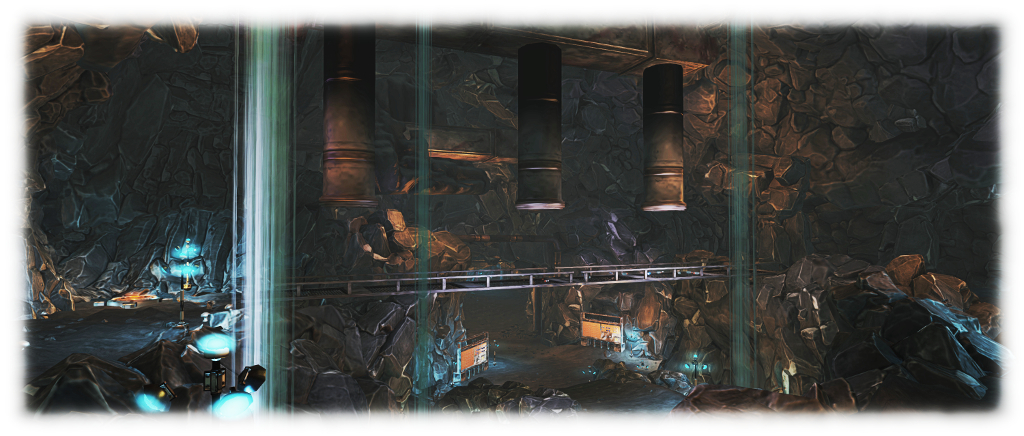
Down in the mines
Naughty added, “When people first arrive, they are given the choice of being a player or an explorer. If they selected ‘player’ they are registered for the game and receive a HUD. If they remove their HUD, they become an explorer. If players leave the game regions, their HUDs are automatically removed. However, all progress up to the point where they removed their HUD is saved.
“Returning players arriving at the start area can use the Portal Room to jump directly to any quest they have previously completed, or go to the Quest they were on when they left the game. So, if someone left while trying the third quest, they can use the Portal Room to get to quests one, two or three, but they will not be able to jump to quests 4 or 5.
“Also, there are HUD kiosks throughout the quest regions, so any player who removed their HUD can get a replacement, and they will be asked if they would like to teleport to their last point of progress. Explorers who have never played the game can also use these kiosks to obtain a HUD, and they will be asked if they would like to teleport to the start of the first quest.”