Byrd Island in Second Life

Byrd Island, Oyster Bay; Inara Pey, August 2016, on Flickr Byrd Island, Oyster Bay – click any image for full size

The homestead region of Oyster Bay is a regular stopping-off point on my rounds of Second Life. This is because Sera Bellic, the region holder, uses it to demonstrate her region design skills, changing the layout several times a year, thus periodically offering all of us something to new visit. This is currently the case with the regions latest iteration as  Byrd Island, which Caitlyn and hopped over to explore as the start of our weekend.

Visitors arrive at the island’s ferry pier, located on the island’s north-west side, where birds circle overhead, the first indications of how – spelling allowing – the island may have come by its name. Herons patrol the sandy tongue of land on which it sits, the only low-lying point of the entire island, which otherwise stands as a 30-metre high tower of rock rising from the surrounding mist-laden sea.

Byrd Island, Oyster Bay; Inara Pey, August 2016, on Flickr Byrd Island, Oyster Bay

Two routes to this high plateau are offered: a wooden elevator occupying a steel girder tower, or a rope ladder. The former gives visitors the option to stop off at a rocky observation shelf on their way to the top of the island, whilst for the adventurous, the rope ladder presents a climb directly to the platform at the top of the cliffs serving both it and the elevator.

From the platform, an arched hedge sitting between tall firs presents itself as a gateway to a gently undulating, and in place rugged, plateau with rolling grass, rocky outcrops and a mix of tress and bushes offering scattered places to sit and paths to wander. It all makes for a pleasing landscape well-suited to soft sunlight settings.

Byrd Island, Oyster Bay; Inara Pey, August 2016, on Flickr Byrd Island, Oyster Bay

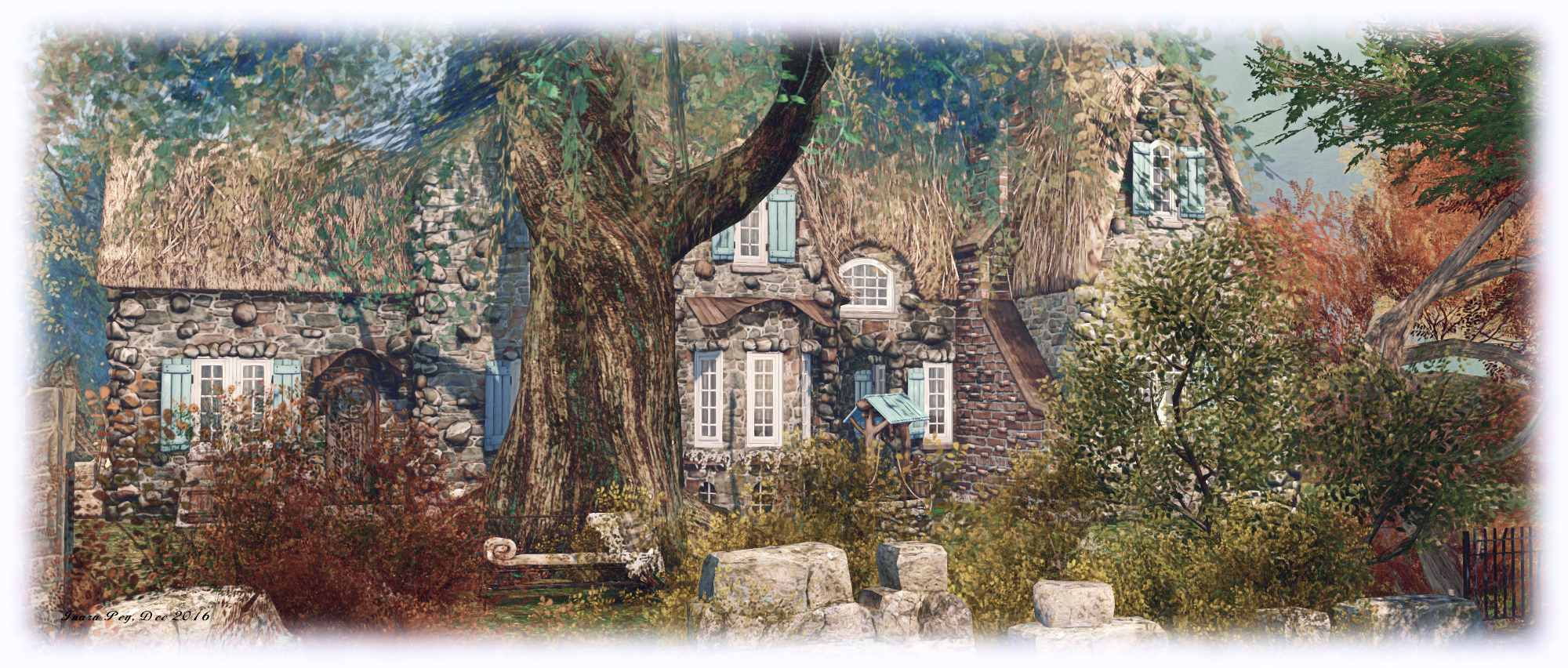
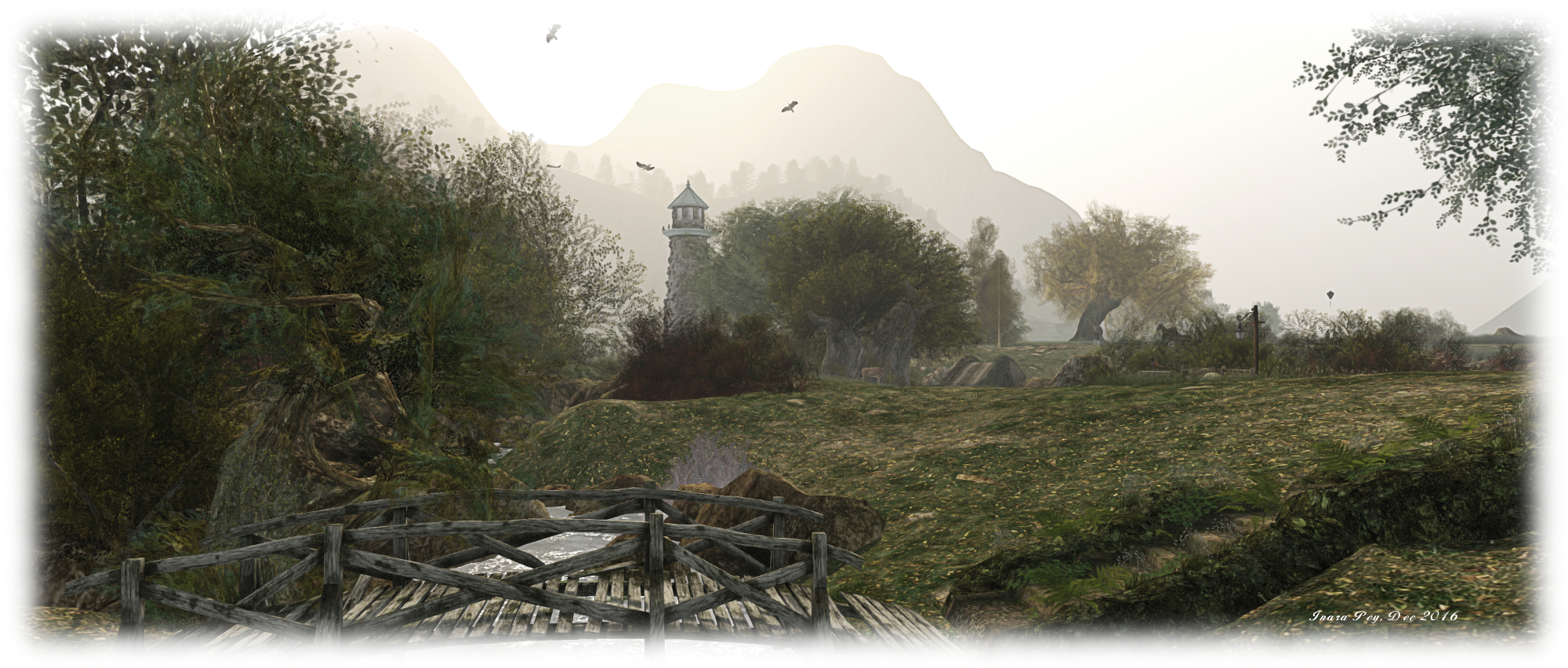
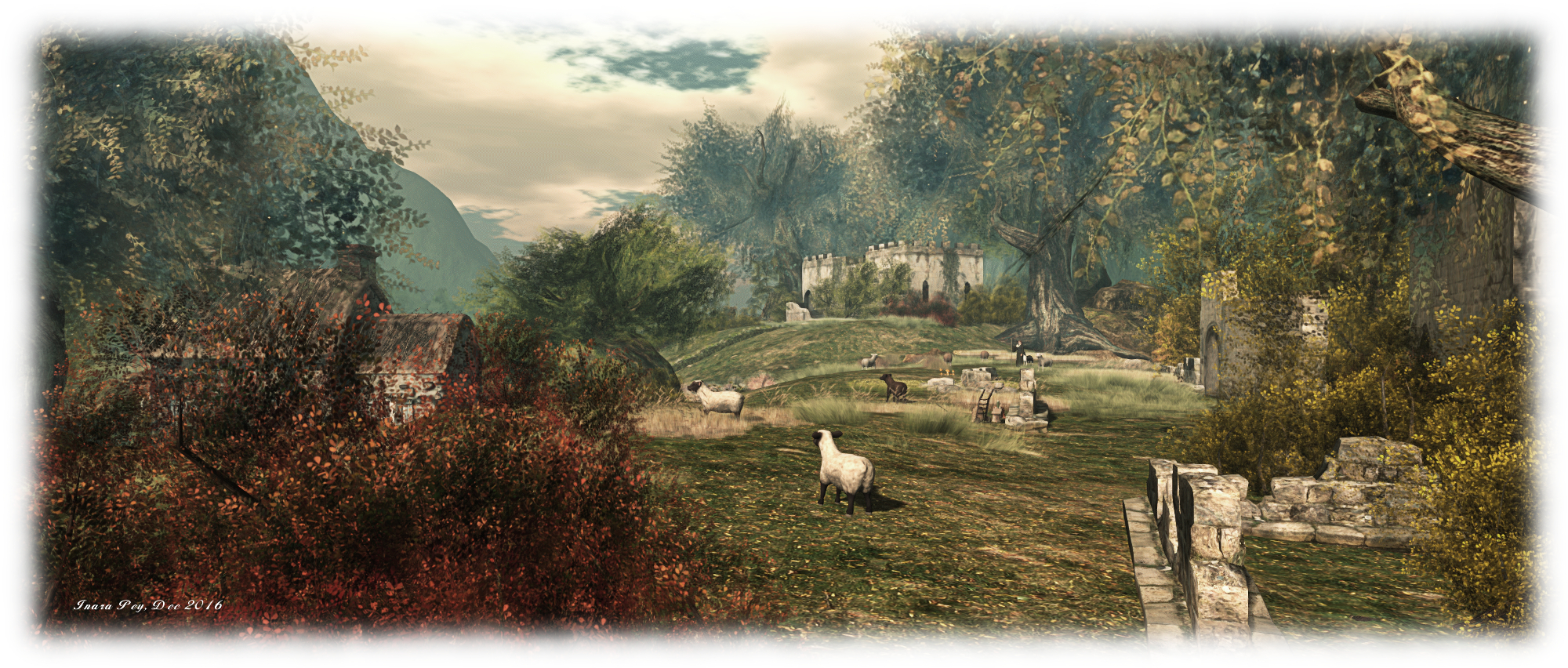
The paths, cut from the trunks of fallen trees, wind across the landscape, point the way towards the three buildings occupying the island: the tall lighthouse with attached lodgings; an expansive house to the south-east and a small stone-built lodge to the east. Across the landscape birds wheel and caw, sing and sit … and watch.

“The lighthouse keeper and his family abruptly left the island never to return.” Sera states in the land description. “Could it have been the birds, or something else?” Whatever might have caused the departure, the birds weren’t telling, but had one of the raven keeping an eye on things spoken up with, “Nevermore!” as Caitlyn and I passed, I really wouldn’t have been surprised; there is a faintly Hitchcockian edge to the island under its default windlight which naturally gives rise to thoughts of certain films, or of Poe on spotting the ravens.

Byrd Island, Oyster Bay; Inara Pey, August 2016, on Flickr Byrd Island, Oyster Bay

Which is not to say that just because the island has this slightly mysterious edge to it, it is deeply sinister. Take away the misty look with an alternative windlight – I found Annan Adored’s Morning Dream worked really well (among several others!) – and Byrd Island becomes the kind of place where get-away-from-it-all weekends should be spent. A place where late breakfasts in bed are the only way to start the day, followed by leisurely strolls across the island and afternoons lazing in the shade of trees, before seeing out the evening quietly, watching the sun set over the rippling ocean.

In all my visits to Oyster Bay, I’ve rarely been disappointed in the designs Sera has offered us; each one has been special, from the Adirondacks, back through the likes of Bellack House and The McFly Project and beyond. However, I admit to finding Byrd Island perhaps her best yet. It has an elegance and openness about it which makes exploration a pleasure, and is presented in a way not often seen in island design in-world, complete with a sprinkling of atmosphere and back story to add further flavour.

Byrd Island, Oyster Bay; Inara Pey, August 2016, on Flickr Byrd Island, Oyster Bay

SLurl Details

A New Fractal Insanity in Second Life

New Fractal Insanity

I’ve long been a fan of the work of artist Milly Sharple – particularly her fractal art (see my article on her Fractal Insanity exhibit at Timamoon Arts) – as well as her flair for region design, which I’ve blogged about twice in relation to her homestead region of Isles of Lyonesse when it given winter makeovers for public enjoyment in 2014/15 and 2015/16.

It is to Isles of Lyonesse that I recently returned, as it is now the home for an an extensive exibition of Milly arts in a gallery complex she has collectively called New Fractal Insanity, a reference to her small gallery space, Fractal Insanity, at Timamoon Arts.

New Fractal Insanity

Housed within three buildings arranged to form a peaceful central quadrangle between them, New Fractal Insanity offers plenty of space for Milly to showcase her work, which encompasses both fractal and abstract art, the latter of which also incorporates both expressionist and  surrealist leanings,  many of which utilise her photography as their point of origin.

Milly’s fractal art is almost instantly recognisable wherever it is displayed; there is a beautifully organic feel to it which demonstrates just why fractal pieces are so captivating. Generated by  algorithms they might be, but Milly work offers stunning images which between them ideas such as capture the vibrant pulse and flicker of a flame caught in a faint draught of air, the sweep and flow of coloured oils on water and the texture and look of flower heads, petals and leaves. Even within the more abstract pieces, which may more prominently feature “traditional” Mandelbrot and Julia Sets, this organic sweep and turn is retained.

New Fractal Insanity

Offered in the second of the two larger gallery buildings, Milly’s abstract art continues this theme of organic origins, whether the art is founded on fractal work or Milly’s photography.  Some of this is very obvious (but no less eye-catching), such as the series of (fractal-based?) studies of flowers, while others may be more subtle in their organic lines and flow.

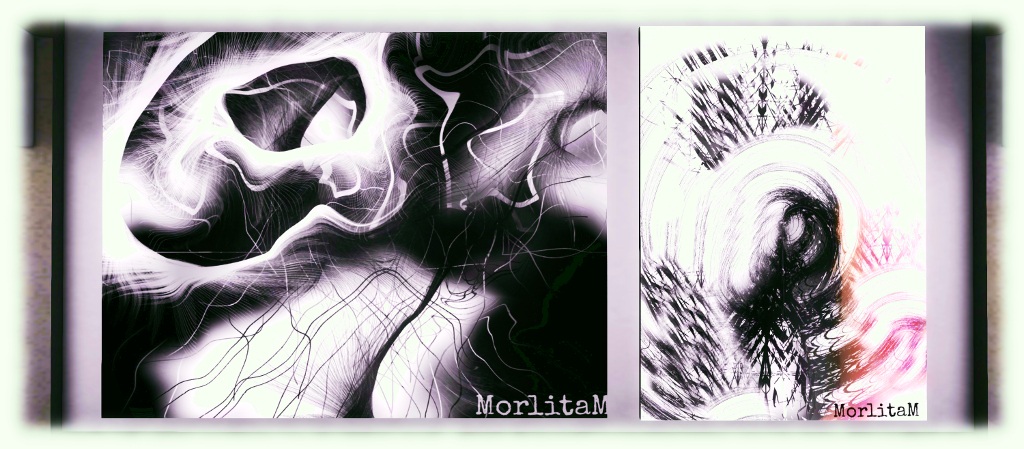
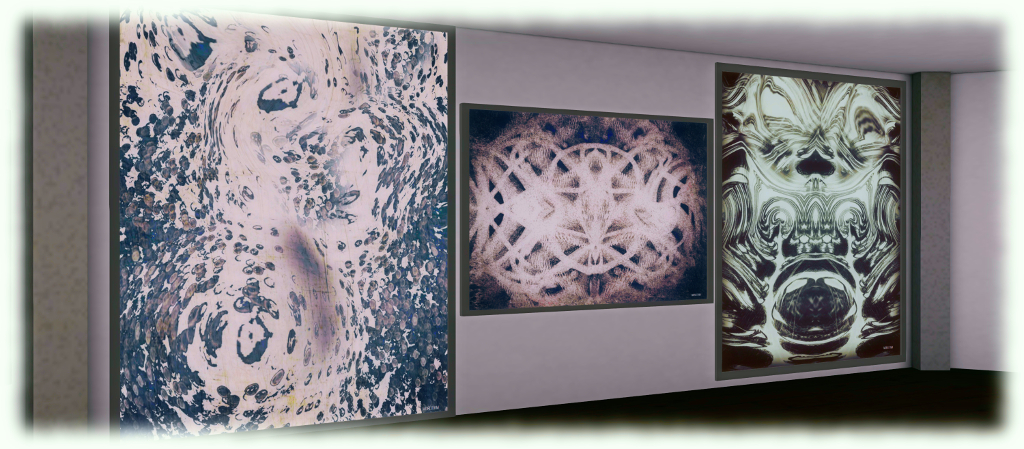
It is in this wing that the rich mix of abstract, impressionism and surrealism intertwine across two floors of art. Here visitors can find images strong in modern abstract expressionism with bold colours and sweeping or angular lines, whilst others a present a surrealist abstract view of the digital world. These latter are, for me, most beautifully offered through a series of paintings based on Mistero Hifeng’s sculptures (two of which are shown below). Elsewhere there are images strong suggestive of art generally produced through other mediums, such as oil on glass, all of which adds up to a thoroughly engrossing exhibition.

New Fractal Insanity

The third building bordering the quadrangle has a more industrial look to it. While open to exploration, the doors carry the warning Caution! Woman at Work!, suggesting this is perhaps intended to be more a workspace / studio more than “purely” a gallery space. Within it can be found more of Milly’s abstract pieces, some of which can be seen in the “main” gallery spaces, together  with a examples of her landscape art.

New Fractal Insanity is a place in which one can easily lose oneself; I wandered back and forth through the galleries for over two hours, examining and re-examining the art on display, finding myself lost in the rich depth of Milly’s fractal work or admiring her ability to encompass so much within her abstract pieces, or simply mesmerized by her animated works, several of which are soothingly hypnotic in their effect.

New Fractal Insanity

All of the pieces on exhibition are available for purchase, and with comfortable seating throughout, as well as a coffee shop, the galleries offer lots of space to sit and consider purchases or to just admire the art to a select of chill-out tunes over the audio stream. Even if you don’t make a purchase during a visit, do consider offering a donation towards the region’s upkeep via Milly’s tip kitties – one of whom seem to be particularly enjoying the audio stream!

SLurl Details

Binemust in Second Life

Binemust; Inara Pey, August 2016, on Flickr Binemust – click any image for full size

On Monday, August 15th, 2016, Biné Rodenberger officially opened her new full region, Binemust, the spiritual successor to her popular Binemist, which – with its ever-evolving look – had long been a favourite destination among SL photographers and bloggers over the years (I actually first blogged about it in September 2014, with my last visit occurring in March of 2016, visiting a number of times in between these two dates, and even producing a video in December 2014 to capture its look at the time).

Biné was kind enough to invite Caitlyn and I to see Binemust ahead of the opening, and those who always enjoyed her old region are liable to love the new one. Binemust is a region which has entirely its own identity, yet also shares much in common which Binmists of the past, offering somewhere entirely new yet delightfully familiar to explore and enjoy.

Binemust; Inara Pey, August 2016, on Flickr Binemust

A visit begins under water amidst a small set of ruins, a familiar chequered sea floor under foot. A sandy track winds its way over this, a pat of flamingos – another motif from past designs – grouped a short distance along it. In the waters overhead, a shark and marlin swim menacingly – but don’t mean anyone any harm – while in the distance a sign beckons with the announcement And So the Adventure Begins.

Just past this sign and under the boughs of trees is a camp site with tents, caravans, bric-a-bric and places to sit, examine and  / or poke around in, making for an immediate destination for the curious. But this is not the only location under the waves to be explored; close to the landing point, and in the opposite direction to the camp site, is a railway line, and just beyond this, a gently curving stair leading up the side of an island towards the surface.

Binemust; Inara Pey, August 2016, on Flickr Binemust

Follow the railway track, and it will reveal that more lies the water, as it leads you seemingly to the edge of the region. Off to one side sits Biné’s art garden, still presided over by Buddha and Mr. Batty Eyeball, her elephants standing near by. In the other direction to this is a curate’s egg of things to explore: part of a ship’s hull, a sunken fair, the broken tower of a lighthouse.

Climbing the wooden steps either before or after your submerge perambulations will bring you to the shore of a craggy up thrust of rock topped by a church. Lowlands stretch southwards from this, offering a mix of woodland, meadows, house boats and a cottage atop slits, whilst across the water, and reached via a balloon-suspended bridge, rests an even craggier island, surrounded by a sandy beach. Here visitors can circumnavigate the sands, enjoy time in the shade of a beach house, lazing in the lee of tall cliffs or climb the spiral stairway to the lighthouse up on the grassy plateau above.

Binemust; Inara Pey, August 2016, on Flickr Binemust

Throughout the region Biné’s familiar touches can be found: here celebration of 3D artists such as Bryn Oh, Cica Ghost and Rose Borchovski, together with familiar Nordic elements, such as the wrecked Viking longship. Several of the set pieces in the region – the beach house, the spiral stairway, will have those familiar with Binemists past smiling on seeing them. When visiting, don’t forget that even when you’ve explored under water and across the islands, there are still the teleport portals at the landing point, one of which will carry you to a little place on a sky rock, the other to what Biné calls, an “interior decor experiment” – but I’ll let you find out which is which!

Binemust took Biné some three months to the day to design and bring together, and the result is once again an environment rich in motifs and Scandinavian leanings, whilst also offering surprises for all around every corner, making it a destination not to be missed.

SLurl Details

West of the Rain in Second Life

West of the Rain; Inara Pey, August 2016, on Flickr West Of The Rain – click any image for full size

West Of The Rain,” Oobleck Allagash says of the region, “was originally conceived to be a tribute to the San Juan islands, as a token of love to my partner, Nodnol Jameson, given her respect and admiration for the nature and beauty of the Pacific North-west.”

While I’ve never been to the San Juan Islands, I have spent time looking at photographs from the web, and I have to say that Oobleck and Nodnol have done a superb job in recreating much of the look and feel of the islands, including some notable landmarks.

West of the Rain; Inara Pey, August 2016, on Flickr West Of The Rain

Visitors begin their journey on the south side of the region, where a quay juts out into the sea, a ferry alongside. Shoreward of this, rising up a gentle slope, are two rows of little shops and boutiques facing one another across a road. The first of these are, respectively, a charming little café and an old bed and breakfast – both perfect for anyone thinking of staying a while. Close by, on a little headland and in an homage to Friday Harbour on the main island,  sits a lighthouse.

Follow the road up through the town, passing the parking lot, and it will lead you north and east around the region. Or, if you prefer, you can follow the footpath running past the lighthouse and along the west side of the island. Whichever route you choose, the is a lot to see, be it the beach to the north, or past the steps leading up to the local church to the boat yard, and then onwards from either.

West of the Rain; Inara Pey, August 2016, on Flickr West Of The Rain

In addition. a footpath winds its way across the middle of the region, taking hikers through woodland, over a bridge and around a small lake to reach the main road once more. It is in the design of the road and footpaths where at least some of the magic of the region lies: they have been laid out in such a way as to give a feeling you’re travelling through a place much bigger and more irregular in form than a 256 metre on a side square of land.

The rest of the magic lies in the natural flow of the land, from little town to rural roads and footpath, from woodland to rocky cliffs and sandy beaches, from boat yard to lake, there is a natural, organic flow to everything here. There’s also a lot of nice little touches, from the rooftop terrace of the café, though the roadside picnic areas to the little cuddle spots dotted around; the care and love put into building the region is clearly evident.

West of the Rain; Inara Pey, August 2016, on Flickr West Of The Rain

“The entire region is public,” Oobleck says, “and will over time evolve and include installations by friends who we also want to feel a part of the creative process. There will be no commercial activities on the sim, nor do we solicit or ask for contributions. Our goal has always been to make this as pure as possible in every way.”

That’s a noble goal, and having spent a fair amount of time exploring the region on foot – you can grab a bicycle near the arrival point, if that’s your preference – I’d say Nodnol and Oobleck have already succeed in their goal to a good degree, and I’m certainly looking forward to seeing how things develop.

West of the Rain; Inara Pey, August 2016, on Flickr West Of The Rain

Rounded off by a subtle sound scape and offering many opportunities for photography, exploration and relaxing, West Of The Rain makes for a most enjoyable visit.

SLurl Details


Quill and Pen: Second Life authors and poets now in ebooks

Click image to open Quill and Pen volume 1

In June, Kultivate Magazine published the first volume of Quill and Pen, a new twice-yearly publication focusing on the work of writers and poets from across Second Life.

Quill and Pen features short stories (including flash stories), non-fiction and poetry, and is published each June and December.

The journal was initially made available through the Kultivate Magazine website in Issuu format, and via Smashwords in epub, PDF and Mobi / Kindle formats. However, as of August 15th, 2016, it is also available in  Kobo, Scribd and Nook formats.

The in augural volume features contributions by R. Crap Mariner, Eleseren Brianna, Glitterprincess Destiny, Kamille Kamala, Dawnbeam Dreamscape, Sabreman Carter, BayJoy, Judith Cullen aka Caledonia Skytower, Huckleberry Hax, Hobby Writer, Journey McLaglen aka Cindy Landers, Bryn Oh, Inara Pey, Ahn Avion, Pieni Resident, and John Herring aka Johannes1977 Resident.

I’m especially please and privileged to be a part of this newest publication in the Kultivate  portfolio, and doubly delighted to have witnessed the strong show of support for the first volume from the writing community in Second Life.

Where to Get It

If you’ve not already done so, you can read Quill and Pen, for free by either clicking on the cover image above right to open the Issuu version in your web browser, or by following one of the links below, according to your preference:

Submissions to Quill and Pen

The Quill and Pen is published twice yearly, in June and December. If you would like to see your work published, free of charge, submission in the following categories are accepted:

  • Poems: one poem per page, single spaced and left justified, maximum of six pages
  • Non-fiction: one essay up to 1500 words, double spaced, no extra space between paragraphs, white space for section breaks only
  • Flash stories: up to 500 words, double spaced, no extra space between paragraphs. White space for section breaks only
  • Fiction: one story up to 1500 words, double spaced, no extra space between paragraphs. White space for section breaks only.

Submissions must be made via the Kultivate Quill and Pen submissions form, which will be opened for a period of time prior to each publication. So, keep an eye on Kultivate Magazine (and this blog!) for announcements, and in the meantime start thinking about what you’d like to write, or dig out those stories or poems and get them ready to submit for publication!

A pocket planetarium in Second Life

Space - A Planetarium
Space – A Planetarium

I’m a space nut, both science-fiction and science fact; regulars to this blog will recognise this is the case simply via my Space Sunday column, and via the occasional sci-fi reference. So, when Kinn (Kinnaird) covers a planetarium in SL I’ve missed, it is somewhere I have to hop over to and see.

Space – a Planetarium, designed by Hazelee Haller, is located on Heterocera, not that far from the Unknown Theme Park in fact, which Caitlyn and I explored back at the start of July. It’s an interesting little place, offering what might be described as a more stylised approach to visualising the solar system. This is due in no small part to the planetarium occupying just 512 square metres of land – which is itself a remarkable achievement.

Space - A Planetarium
Space – A Planetarium

This stylised approach can be seen on the ground level, where mighty Jupiter sits within what can only be described as Saturn’s ring system (Jupiter’s own rings being far thinner and less well-defined). A teleport sphere located in one corner of the building will take you up to the planetarium proper.

Presided over by a huge Venus and Mars, the planetarium ins divided into two levels. On the lower are static displays of the major planets of the solar system together with their principal moons – although Phobos and Deimos are absent from Mars, possibly due to their tiny size. The planets and moons aren’t offered to scale relative to one another, but click on any one of them (other than the Earth), and you’ll be offered a link to their Wikipedia page.

Space - A Planetarium: the orrery offered aginst a black backdrop rather than the planetarium's sun-like interior, which Jupiter (upper right) and Uranus (left, centre) looking on
Space – A Planetarium: the orrery offered against a black backdrop rather than the planetarium’s Sun-like interior. The Earth and Moon, Mercury, Venus and Mars can be seen orbiting the (not to scale!) yellow sphere of the Sun. These are offered roughly to scale with one another and in scale orbits reflecting their respective motions around the Sun relative to one another. Stationary Jupiter (upper right) and blue Uranus look on

The upper level, reached via a ramp between the two lines of gas giants and their moons, offers a little orrery-like model of the inner planets  – Mercury, Venus, Earth (and the Moon) and Mars all orbiting around the Sun. These all appear to be to scale relative to one another (although obviously, not to the Sun!). Beyond them hang further static models of Jupiter, Uranus and Saturn, which also appear to be to scale to the inner planets. In addition, the walkway on the lower level passes through the wall of the planetarium’s sphere to a platform offering a view of the sphere itself, which is textured on the outside with an image of the Earth.

Space – a Planetarium is a neat little pocket-size guide to much of the solar system, and certainly presents a way for those not well-versed in the planets around us and their major moons to become more familiar with them, without also getting overloaded with facts and information. Yes, it does lack some of the options which might be available on a larger parcel of land, but this doesn’t in any way lessen what is offered here; rather the reverse, in fact. It shows what can be achieved on even smaller parcels with limited land capacity.

Space - A Planetarium
Space – A Planetarium

SLurl Details