The Drax Files 40: the eyes of experience in Second Life

Bernhard-2
Bernhard Dörries

Update, January 16th, 2017: Bernhard Dörries passed away in a hospital in Augsburg, Germany, on Sunday, January 15th. Our condolences to his family and friends. Those wishing to personally pass on condolences can do so through Concetta Curtiz in-world. Please see the comment from Draxtor which follows this article. 

“My name is Bernhard Dörries, basically for as long as I have been alive. In Second Life my name is Bernhard McIntyre; I am 88 years old. In Second Life I am, and I feel like, 37.” And thus the focus of the September 2016 segment of The Drax Files World Makers introduces himself in what is one of the most remarkable pieces so far filmed in the series.

His name may not be familiar to most of us, but Bernhard Dörries was instrumental in the establishing the German New Cinema movement following the end of World War 2. Perhaps not as recognised even within cinematic circles due to his focus on television, he nevertheless made 129 films during his career, ranging in scope from experimental meditations on the moral decline and subsequent clash of upper class society in Germany, through documenting the existence of two German states during the Cold War, to pieces examining art history and the influence of colonial powers on middle east painting and sculpture in the 20th century.

What’s more, he is still filming, having turned his attention to machinima and the potential of Second Life – a platform which has become as much his home as the assisted living centre in which he resides in the physical world.

Bernhard McIntyre " “My avatar is [my] co-creator, equal partner in sharing feelings, co-owner of feelings and emotions.”
Bernhard McIntyre ” “My avatar is [my] co-creator, equal partner in sharing feelings, co-owner of feelings and emotions.”
“I discovered Second Life in 2008,” he says. “It not only showed me new worlds, it opened new worlds inside myself! I became a new person!” Bernhard says of his experience of the platform. It is within Second Life that Bernhard lives with his Second Life partner, Alsya, where they share a tropical island home modelled after Stromboli – up to and including the volcano! – and which removes the physical world distance between them.

Throughout his career, Bernhard has looked into the nature of society; starting in Munich at the end of the war, and the near-destruction of his homeland. He has constantly sought to scratch away at the surface veneer of our modern society and look at what lay beneath, and how progress so often involves the burying (and ignoring?) of the past, perhaps leaving issues and situations – and lessons – ignored.

Bernhard’s own situation is perhaps a reflection of this. Elderly, in need of care assistance, confined to a wheel chair, he is of a generation our commercial, consumer-driven society can often see as having little intrinsic value (in the UK, for example, the most frequent television adverts we have for those of 60 or over present their commercial worth in terms of life insurance policies aimed at meeting funeral costs).

The fathers of German New Cinema, post WW2 (l-to-r): Christian Doermer. Dieter Lemmel, Bernhard Dörries, Edgar Reitz, Rob Houwer, Hans Jürgen Pohland, Wolfganf Urchs, Roland Martini, Alexander Kluge and Hilmar Hoffmann, director of the International Short Film Festival Oberhausen (1954-1970)
The fathers of German New Cinema, post WW2 (l-to-r): Christian Doermer. Dieter Lemmel, Bernhard Dörries, Edgar Reitz, Rob Houwer, Hans Jürgen Pohland, Wolfganf Urchs, Roland Martini, Alexander Kluge and Hilmar Hoffmann, director of the International Short Film Festival, Oberhausen, Germany (1954-1970)

Yet, as Bernhard demonstrates, while his body may be frail, his mind – and heart – are as agile as ever, and through Second Life he can fully enjoy creative expression in building an island home and in putting together an 80-minute machinima film. It is a place where he can also enjoy emotional release and partake of the company of loved ones and friends on equal terms, free from and shadows or outlooks which might otherwise colour interactions with him.

Bernhard himself recognises this, saying, “My avatar is [my] co-creator. Equal partner in sharing feelings, co-owner of feelings and emotions.” While the comment may have come in response to a question about his film, there is little doubt he’s referring to the broader dynamic between himself and his avatar. It’s a sentiment anyone who has invested time and self in their avatar will doubtless find resonating. However, with Bernhard, we should see within it a special value.

As with Fran Swenson, whose story Drax covered exactly three years ago in September 2013, he demonstrates that Second Life is as much about expressing who we are, regardless of age or situation or location as it is about creativity. It offers a genuine mix of potential and opportunity unmatched in any other medium.

So much so, that I find my thoughts sliding off at a tangent. Just how well will the upcoming new platforms – High Fidelity, Sansar, et al, with their onus more on the “real” self, through elements of identity, voice, and so on, manage to replicate the broad freedoms all of us enjoy in Second Life when expressing who we are – or who we prefer to be? It’s potentially an interesting subject on which to cogitate, although one perhaps better served in a separate article.

As it is, this a beautiful piece, fully deserving of the slightly longer running time, providing us with insight into a remarkable man who is still as much a pioneer today with his embracing of Second Life as he was when he and his colleagues set out to redefine German cinema.

Visiting Crystal Gardens in Second Life

Crystal Gardens; Inara Pey, August 2016, on Flickr Crystal Gardens – click any image for full size

Crystal Gardens, designed by Sandi Beaumont (Sandi Benelli) is presented to Second Life travellers as a place for photography and exploration, offering visitors a ruggedly beautiful pastoral seam which is stunning in its simplicity and looks. This is my third visit to Sandi’s designs, having previously written about her work with her partner, Mikal, in February and July 2015.

A homestead region, Crystal Gardens currently comprises three north-south oriented islands separated by a channel of water. The more westerly pair form a finger of land, the tip of which has been sliced off by a further, narrow channel spanned by a log bridge. Both are low-lying and somewhat rugged – the smaller island to the north decidedly more so than its southern cousin. On it sits a conservatory with a distinctly French feel to it, offering visitors comfortable armchairs in which to relax, a small selection of drinks at a small bar, and the promise of possible entertainment, given the microphone and amplifier. It’s a place which hints at being a refined little club, tucked away where only those in the know might find it.

Crystal Gardens; Inara Pey, August 2016, on Flickr Crystal Gardens

A bar area also comprises part of the southern island, located on the terrace of a Mediterranean villa which appears to be someone’s studio. Bee hives close by offer the promise of fresh honey, while a rowing boat tied up at the wooden jetty offers couples the chance for a little dalliance on the water.

The twin of this rowing bow sits alongside the jetty across the narrow channel separating the largest of the islands from the others. It is here, outside a row of little beach huts that visitors first land. A cooked breakfast awaits anyone feeling peckish on their arrival, and a raft hints at possible adventure at one end of the jetty.

Crystal Gardens; Inara Pey, August 2016, on Flickr Crystal Gardens

Beyond the beach huts, the island opens out into a gently undulating scene ripe for exploration. To the south sits a small farm of distinctly Tuscan design, whilst northwards, over the low hill marking the centre of the island, a narrow rugged bay cuts deeply into the land, a distinctly modern, open-sided summer-house overlooking it, with horses grazing close by. The summer-house might belong to the occupants of a converted workshop sitting on the east coast of the island. This has been converted into a comfortable home, while the ramshackle pier on which it sits suggests both have seen a hard-working life in the past.

Watched over by two lighthouses, one to the north-east, and the other to the west and off-sim, Crystal Gardens suggests itself as a small, private island lying just off the coast of somewhere like Scotland or perhaps the Canadian coasts (although I couldn’t help but picture it lying Lundy-like in the Bristol Channel). It is ruggedly beautiful, with an air of serenity about it which naturally encourages visitors to tarry.

Crystal Gardens; Inara Pey, August 2016, on Flickr Crystal Gardens

For photographers there is much to be found here. While entirely natural in look and feel, and flowing as a considered whole, Crystal Gardens also offers the locations and scenes scattered across its rocky isles and around its coastline as individual vignettes, ripe for the camera – and I hope some of my efforts here show. So attractive is it for photography, it is very easy to lose track of time when taking pictures!

Whether looking for somewhere to take pictures, a place to explore or somewhere to simply pass the time of day, Crystal Gardens has everything you could need. Beautifully conceived and executed by Sandi, and topped with a matching ambient sound scape, it’s a place which should be on every SL traveller’s itinerary.

Crystal Gardens; Inara Pey, August 2016, on Flickr Crystal Gardens

SLurl Details

Peace is a Choice: expressions of art in Second Life

Peace is a Choice Gallery

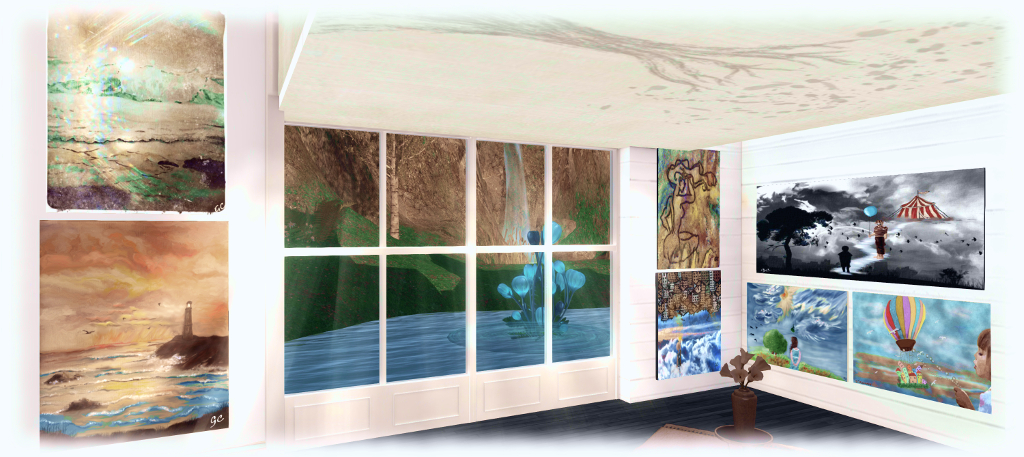
Located on the north coast of Nautilus and occupying almost the entirety of a region, sits the Peace is a Choice Gallery, founded and curated by Dove (TheDove Rhode). It is the home to an art display collected / provided over some nine years, from installations and artists past and present. As well as the gallery spaces, Peace is a Choice provides an event venue and an associated dance studio / meeting place.

Originally founded as the S&S Gallery of Fine Art, the current gallery is centred on a huge steel-and-glass building of sleek, modern design, and which is home to both 2D and 3D art. Outside of this, on the surrounding waters and the shoreline behind the gallery, larger pieces of 3D art can be found, together with the other facilities offered here.

Peace is a Choice Gallery

The cross-section of art on display is astonishing, with pieces from Francis Bagration, Mona Byte, Giovanna Cerise, Treacle Darlands, Asmita Duranjaya, Russel Eponym, Duna Gant, Cica Ghost, Instincta and Stem van Helsinski, Stem van Kicca Igaly, Pol Jarvinen, Gleman Jun, Livio Korobase, Daco Monday, Robin Moore, Moya, Nessuno Myoo, Fuschia Nightfire, Bryn Oh, Cheen Pitney, sChan Resident, Spiral Silverstar, Miso Susanowa, Ub Yifu, Noke Yuitza, and Jedda Zenovka. Such is the diversity of the of the art on display, it’s very easy to lose track of time wandering through the gallery and exploring outside.

Whether you start your explorations inside or outside the gallery is entirely a matter of choice; there is no set path to follow, and Dove has wisely placed the art so that there are no assigned areas for individual artists. This allows for some interesting juxtapositions of art, technique and expression, allowing visitors to gain a strong feel for contrasting styles among artists in Second Life. That said, the interior of the gallery building can be a little bewildering: during one of my trips to the gallery, a fellow visitor candidly admitted in IM that he had been admiring two pieces of art on one side of the gallery, only to realise they were part of a small stage area for musicians!

Peace is a Choice Gallery - Livio Korobase
Peace is a Choice Gallery – Livio Korobase

I’m fortunate enough to have a SpaceNav, so I initially cheated with the art outside, flycamming around (although doing so does give a unique perspective for viewing 3D pieces of art). For those restricted to shanks’ pony, there are invisiprims set over the water, allowing visitors to examine the works up close without fear of vanishing under the waves.

The outdoor display also encompasses events area outside of the galley structure, where music events are regularly held. Another way to see the outdoor art is to catch a teleport to the neighbouring dance studio – still part of the overall complex – via one of the boards displayed around the gallery. From there, it is possible to stroll out onto the beach and appreciate the art (or take a dance lesson, if you’re also so inclined!).

Peace is a Choice Gallery - Bryn Oh (foreground) and Francis Bagration
Peace is a Choice Gallery – Bryn Oh (foreground) and Francis Bagration

Peace is a Choice makes for a fascinating visit, offer a lot to see. For those into sailing or boating, it’s location makes it reachable by water as well, although I didn’t spot any mooring facilities – so if you do visit boat, the teleport limo may well be needed when leaving. However, you do opt to visit, please consider a donation towards the continued existence of the gallery.

SLurl Details

Immaculate perceptions and reflections in Second Life

Immaculate Perception - Immaculate Reflection
Immaculate Perception – Immaculate Reflection

“There is no truth, there is only perception … immaculate perception,” Krystali Rabeni enigmatically states in her introduction to Immaculate Perception – Immaculate Reflection. “What you see is what you thought before you looked … The immaculate perception of it is an immaculate reflection of the viewer. A very interesting abstraction proving that there is no truth, only perception.”

It’s a provocative statement leading the way into a surreal and thought-provoking setting, one complete with touches of abstract and the absurd – but one which is also compelling, given the artist’s statement. Across a watery landscape sits a host of vignettes drawn from multiple sources. Pieces in some of them will be familiar to visitors, others will be wholly new.

Immaculate Perception - Immaculate Reflection
Immaculate Perception – Immaculate Reflection

All present some curious scenes: animals hanging from balloons, a pair of women in 50’s style clothing walking a pair of hot-dogs, skeletons watching TV, chess pieces from one side pinning the king from the other side under a net, a pat of flamingoes examining images of other flamingoes; pocket watches with starfish, the list goes on.

However, what is important here is not from whence they came or even, necessarily, what the artist may have intended each to represent – but how we perceive them, and how that perception may be informed by the shadows of our own thinking even before we see what is in front of us.  Of course, how we perceive and interpret any art is a matter of personal reflection, but it is generally a subconscious process; here we’re being asked to consciously think about that process – which in turn further influences our perceptions.

Immaculate Perception - Immaculate Reflection
Immaculate Perception – Immaculate Reflection

In this, the track of thinking can become recursive: we question whether or not how much of what we’re perceiving in one vignette is shaped by our prior thinking, and then as we move on,  how much of that thinking is influencing our perception of the next vignette we see, which in turn calls into question our perceptions of the next vignette, and so on. Thus observation becomes as much introverted act, as it does a consideration of the art itself.
Within the installation, the potential recursiveness of our thinking  is perhaps enhanced by how the various vignettes are  placed. It is almost impossible to observe one without seeing two or perhaps three others, thus shifting our attention, directly or subliminally, influencing our thinking on the piece at hand, and thus influencing our perception of it.

Immaculate Perception - Immaculate Reflection
Immaculate Perception – Immaculate Reflection

However, and with all that said, we can leave the deeper considerations about Immaculate Perception – Immaculate Reflection to one side, and simply approach each vignette entirely on its own. Each offers a scene captivating to the eye which can be enjoyed in its own right, regardless of what is informing our perception, whilst also allowing us to tease ourselves with possible allusions which may appear to be in some of them which might otherwise be missed in any deeper appreciation / introspection.

However you approach this installation, it offers plenty of opportunity for visual appreciation and / or considered speculation.

SLurl Details

Astralia, Second Life

Astralia; Inara Pey, August 2016, on Flickr Astralia – click any image for full size

Astralia is the name of the homestead region held by artist and blogger Oema, and which is currently featured in the August 26th Destination Guide Editor’s Picks. It is offered as a surreal landscape in which visitors are free to relax, roam, take photographs and view the art on display.

Surrounded on three sides by off-sim mountains, Astralia is a water bound place, waves gently foaming in from the surrounding mountains towards a calmer centre while a gentle breeze caresses wind chimes, filling the air with their gentle reverberations. The rich azure of the waters here is a perfect reflection of a cobalt sky flecked with cloud, beneath which a ribbon of aurora ebbs, rolls and curls.

Astralia; Inara Pey, August 2016, on Flickr Astralia

Across the region lie nine vignettes, each offering its own unique look and opportunities for photography or relaxation. Some of these feature buildings or structures, some form a small island of grass, some sit directly on the water. They all face or flank a crystal palace which also rises from the water, home to a small art gallery, while a further island sits in the air nearby, offering a further floating sanctuary.

By default, the region windlight presents Astralia as something of a watercolour painting, the surrealist element coming not so much from the watery setting, but from the globe of mighty Jupiter,  who marches around the region behind the mountains, Great Red Spot staring down like an ever-present eye, watching all comings and goings.

Astralia; Inara Pey, August 2016, on Flickr Astralia

For photographers, Astralia’s default windlight works well, whilst the region is well suited to a good cross-section of others as well – I used Annan Adored’s Tricoloured II for the images here. For those wishing to simply sit and relax, the region offers plenty of spots to do just that, and presents a smoothing piano audio stream ideal for putting the stresses of life out of your head and simply losing yourself in your surroundings.

SLurl Details

A visit to Cica’s Library in Second Life

Cica Ghost: Library
Cica Ghost: Library

Now open to visitors is Cica Ghost’s installation, Library, which she introduces with a quote from Albert Einstein, “The only thing that you absolutely have to know, is the location of the library.” And to be honest, this one is pretty hard to miss, being another of Cica’s installations produced on a huge scale – something visitors immediately appreciate on their arrival, being reduced to the role of Lilliputians during a visit.

All good libraries are presided over by a librarian, who is there to provide assistance or – as the movies would generally have us believe – to ensure that Quiet remains the word of rule among the hallowed bookcases. Cica’s bibliothèque is no exception: across the wooden floor from the landing point, a matronly figure sits behind her desk, apparently engrossed in a tome of sheet music while a parrot alongside her keeps a weather eye on the comings and goings. They are the first indication of the scale of this particularly library – as you can see from the shot below, as Caitlyn takes a rest from exploring, perching herself alongside Polly.

Cica Ghost: Library
Cica Ghost: Library

Beyond the desk, the bookshelves rise into the sky, but so engrossed is the librarian in her own studies, the fact that there are more books than shelves seems to have escaped her notice.; Thus, ungainly towers of book rise into the sky across the vast floor, and giant volumes cascade down green slopes rising above the floorboards. A gap between the bookcases provides access to the rest of the library, or for those feeling energetic, wheeled stairways offer a way up to the lowermost shelves and back down the other side.

Also, for the intrepid and the curious, the library includes places to sit and / or lie down atop the piles of books, on the parrot’s perch and librarian’s desk, across the floor in the library’s “little” truck – even up in the branches of a tree. For those who aren’t fond of heights, a couple of the library’s cats offer ballet dances to be enjoyed individually or in the company of another, and which go well with the piano soundtrack gracing the region. Visitors should also keep an eye out for a hidden room where quiet conversations can be had out-of-sight of the librarian!

Cica Ghost: Library
Cica Ghost: Library

Library is another of Cica’s pieces which is bound to delight and have visitors smiling; there is whimsy aplenty, things to do and enjoy, and one can feel Cica’s humour at every turn. It’s a place which can so easily draw you back for further visits – as I noticed on my return, bumping into several people who had been wandering between the books and sitting atop piles and on branches when Caitlyn and I first set foot in the Library.

Should you enjoy your visit – and believe me you will – please do consider providing a donation for Cica’s continued work in Second Life.

Cica Ghost: Library
Cica Ghost: Library

SLurl Details

  • Library by Cica Ghost (Rated:  Moderate)