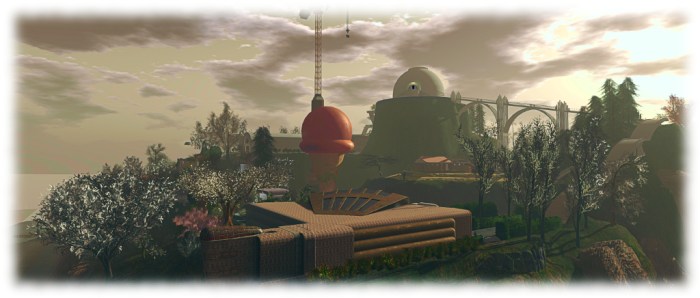
ragVR: imagination and expression in Second Life

ragVR
ragVR

RAG Randt is a content creator and designer who is perhaps best known for his work with MadPea, having worked on many of their games over the years. However, he recently departed the MadPea team to focus on his own work, and as we’ve been friends for several years, having worked closely on a project together, I was delighted to receive an invitation from him to see what he’s been up to within the region he’s been working on for the past few months.

“I’ve been putting together a portfolio site,” he explained as I arrived next to a DC3 sitting at the edge of a long runway, a fitting arrival point for visitors to his island. “Some of it is still under construction, but I’ve opened it to the public.” Called ragVR, the region is a veritable tour-de-force in RAG’s skills as a scripter, creator, builder and environment designer – and makes for a completely engaging visit.
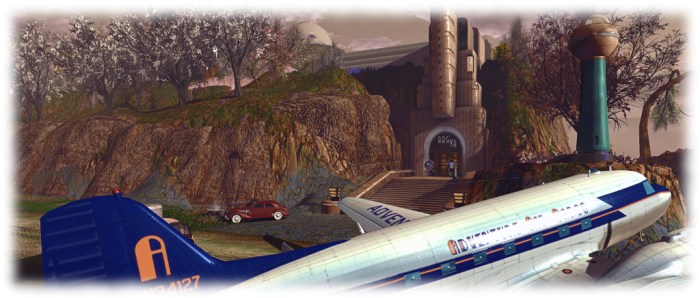
ragVR: arrival
ragVR: arrival

From the airfield landing point, a flight of steps leads visitors to the stunning Art Deco frontage of an elevator tower rising above the sheer cliff face against which it is built. Two kiosks stand before the doors to the tower, one of which invites visitors to click it, thus getting one into the habit of touching similar kiosks across the region to obtain information on the various locations one can visit. The second kiosk provides background information on RAG himself and the region, and should be read.

Summoning the elevator via the button next to the doors will bring the first of many smiles to your face, as the distant sound of the lift clunking and purring into its descent is gradually mixed by music in keeping with the Art Deco look of the tower, which gently grows in volume as the car approaches – as one might naturally expect. When the elevator doors open, so the music naturally increases in volume again, but not painfully so, inviting you to step inside. When you do, you’ll find this is no ordinary elevator. In keeping with the Art Deco look and feel, it retains a skilled (and charming) operator. Touch him to select your destination, and watch him operate the elevator’s control lever.
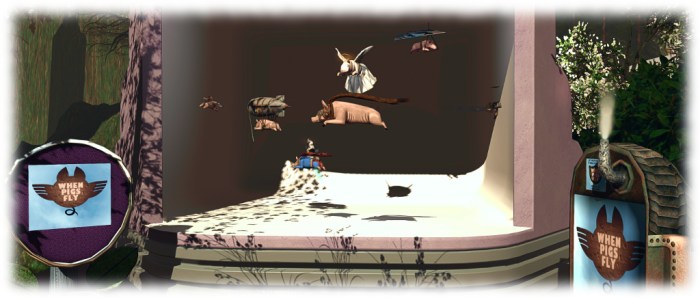
ragVR: pigs really can fly! RAG's gacha flying pig collection
ragVR: pigs really can fly! RAG’s gacha flying pig collection

On arrival at the upper floor, and with the elevator’s music fading behind you as the doors close, you’ll find yourself on the first part of a self-guided tour of the region and RAGs work. This starts with a retrospective of his early 2D work in SL, which built on his experience as an illustrator. Once again, a kiosk offers background notes on the display, together with a comment that while visitors are free to wander around the region whichever way they choose, the recommended route to take the exit to the left, relative to the elevator station, and follow the path.

Winding between trees and bushes, the path will take you by way of hill, dale and building, around and over the region, and the displays of RAG’s work. To list all of them would be to spoil a visit. However, as a few points of note, there are the gacha goods booths with delights such as RAG’s flying pigs (I have one at home 🙂 ), the MadPea centre where sets RAG build for a number of MadPea games are on display, and the model of the school Live And Learn Kenya  / Feed A Smile are building for Kenyan children, and which was the subject of a major MadPea fund-raising drive.
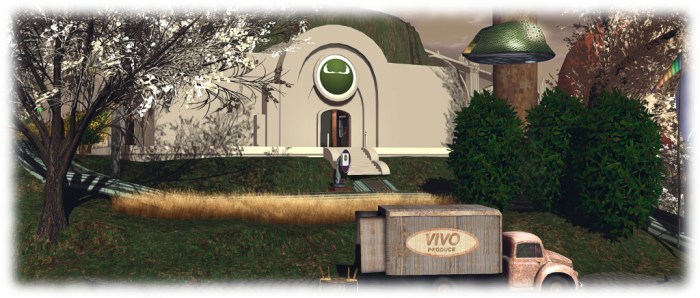
ragVR: celebrating MadPea

“There will be teleporters to skyboxes as well” RAG informed me, “And models of some of the items I will have on sale.” For those interested in the Horizons community, these items for sale will include two house styles designed to fit in with the theme  – and I’ll hopefully have more on these in a future piece on Horizons. “While the region is primarily aimed at people who need a builder, and who want to see what I can do,” RAG said as we wandered the footpaths of the region, “I hope it is also a fun place for people to visit and discover as well.”

Nor do RAG’s skills end with physical objects, be they furniture, creatures, buildings or machines. The entire region design demonstrates his ability to create and landscape an environment, and select windlight settings to add to the overall ambience. Outside of the flora, vehicles, a handful of rocks and tower crane found in the region, almost everything you encounter, including the footpaths, stairways and cliff rocks, have been built by RAG.
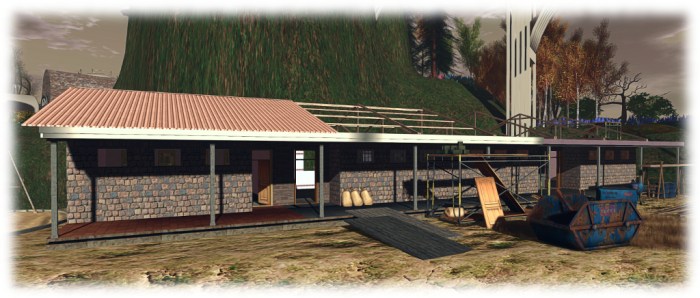
ragVR: the LLK / FAS Kenya school model

Whether or not you’re looking for someone to execute a custom design or build for you, a visit to ragVR is a demonstration of all that is possible in Second Life from prim (do not miss the Alien Ice Cream!), through landscaping to mesh and scripting. It reminds us that SL can be both an entertaining environment through games and gacha whimsies, and a place which can support physical world activities, such as building a school in Africa.

And if you are looking for a superb brewer of fine mesh, an expert shaper of prims and artisan sculptor of land, then taking a tour a is doubly recommended, as RAG could well be your man. You can contact him about projects and ideas and to discuss rates via IM, notecard or through e-mail (rag-at-ragmedia.com). A website in support of RAG’s work is also in development, and I’ll be adding the URL here once it is up and running.

SLurl Details

  • ragVR (Devil’s Moon, rated: Moderate)
No Frontiers in Second Life

No Frontiers - Gem Preiz
No Frontiers – Gem Preiz

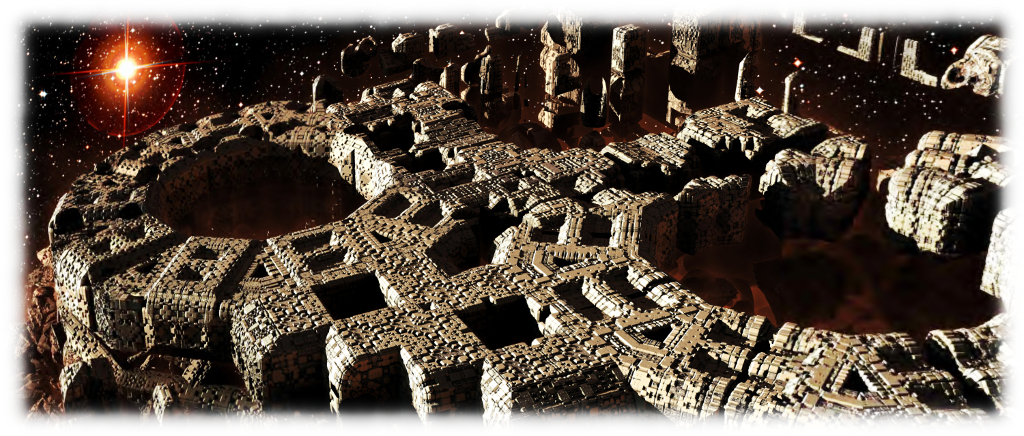
I’ve long been an admirer of Gem Preiz. His work in creating magnificent vistas using fractal art is simply astonishing. So it was a genuine pleasure to once again be offered an opportunity to previewing his latest installation, which opens on Thursday, January 12th, and runs through until the end of June.

No Frontiers is, in at least some ways, a sequel to his last two environments, Hertiage: Vestiges and Heritages: Wrecks (which you can respectively read about here and here). Within it, we are again asked to engage upon a journey through space and time. But where the Hertiage pieces were perhaps rooted in a dark vision of a future encompassing loss and departure, only brightening at the very end, No Frontiers presents something altogether more optimistic, a vision of a vast cosmos awaiting us, with opportunities unbounded, the potential for new encounters and a celebration of what we are, and what we may yet mature into.

No Frontiers - Gem Preiz
No Frontiers – Gem Preiz

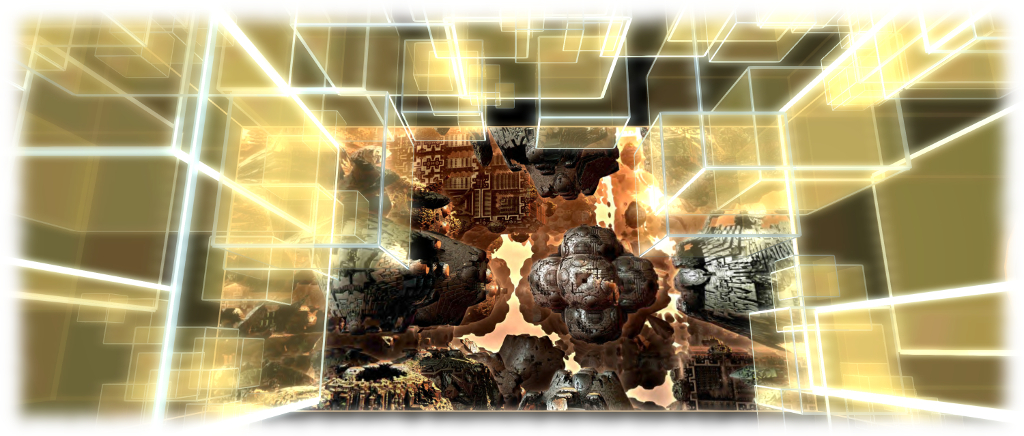
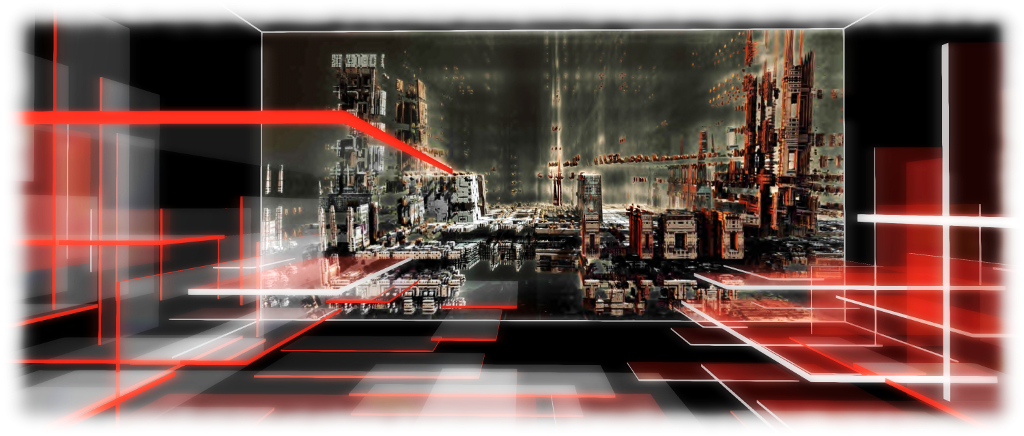
As with is previous works, No Frontiers invites the visitor to travel through a series of vast halls, in which each of is placed a single, gigantic fractal image, each comprising around 18 individual elements. The halls are all interconnected by tubes, and are so vast, flying is the most practical way to see them. To assist in this, Gem provides two flying vehicles, a single-seater and a tandem two-seater (although visitors are welcome to free fly is they prefer). These are found in the “departure hall”, where instructions on how best to appreciate the installation can be found. I recommend the latter are read, and that in particular, particles are turned up and the music stream is enabled.

In addition to the massive, intricate and breath-taking fractal images, the halls include 3D elements designed by Gem which further enhance both the environment and add to the narrative suggested by each image. Some of these may be easily translatable, others may actually be more subtle, and require observation to pick up on their nuance.

No Frontiers - Gem Preiz
No Frontiers – Gem Preiz

For example, within one hall, two spirals of spheres slowly rotate, horizontal arms extending from the spheres. Each resembles a strand of DNA vertically split, and as they rotate, every so often they align to become the familiar double helix. But on either side of this joining, when they almost align, there are perhaps hints at other forms of DNA, suggesting life alien to ours, waiting to be discovered in our voyage out into the cosmos.

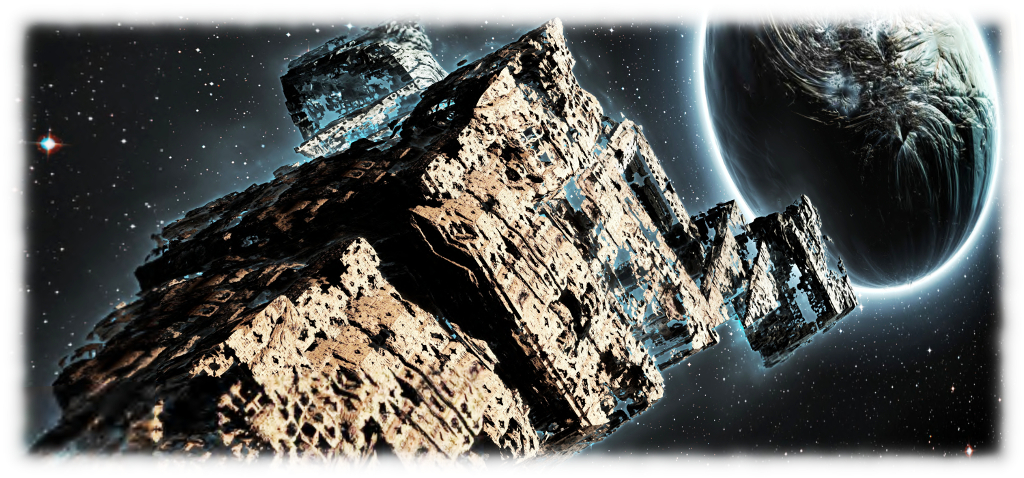
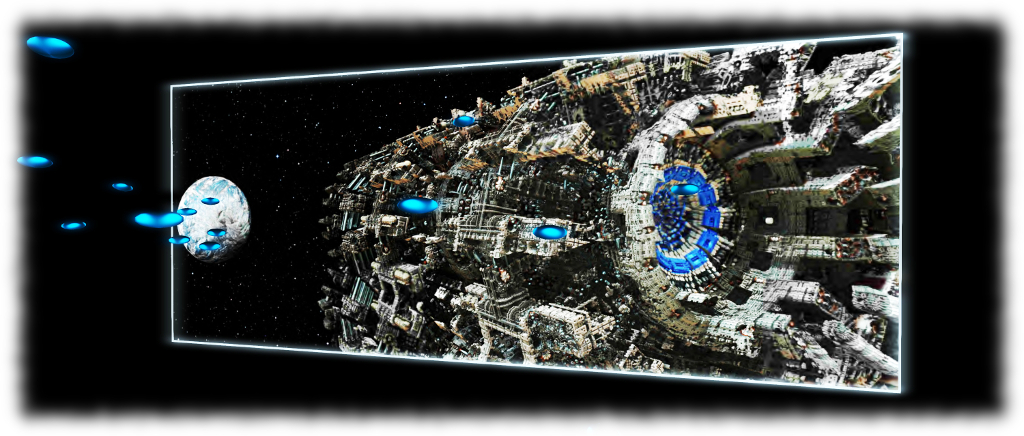
Suggestions of alien civilisations appear elsewhere as well. Take, as another example, the tiny spacecraft forming orderly lines of traffic heading towards a planet being orbited by a vast structure (the 2nd image in this article). Are these intergalactic commuters on their way to / from work? And what of the giant ringed sphere floating before a similar such object orbiting another world with one of Gem’s images? What tale of intelligences might they hold?

No Frontiers - Gem Preiz
No Frontiers – Gem Preiz

Meanwhile the connecting tubes themselves suggest two things. On the one hand, they are offered to us and connecting tunnels between environments, capped at either end by airlocks. On the other, they resemble wormholes we fly through, tunnels through the fabric of space and time, allowing us to travel the vast distances of the cosmos in mere seconds.

At the very end of the journey, visitors enter a vast space, surrounded by distant stars, and within which, as one rises through it, lay planets, spheres, the funnel of a black hole, the billion and billions of stars contained within an ever-spinning spiral galaxy. And, eventually, a landing platform / arrival point where they can safely lands and exit their craft.

No Frontiers - Gem Preiz
No Frontiers – Gem Preiz

Gem’s work is never less than awe-inspiring; and while he has used 3D elements in past installations no Frontiers offers something entirely new in how physical elements are images have been combined to add to our sense of voyage and immersion. Add to this the soundtrack he has provided, and No Frontiers makes for a stunning experience, visually, aurally and for the imagination. Not something to be missed. The official opening will be at 13:00 SLT on Thursday, January 12th and as noted, the installation will remain open until the end of June 2017.

SLurl Details

The Forest Beyond in Second Life

The Forest Beyond
The Forest Beyond

In the latter half of 2017, Ceakay Ballyhoo presented A Watercolour Wander, an exploration of a landscape rendered as a watercolour painting, complete with its own story (read more about it here). It was an imaginative approach to art and storytelling which at the time attracted Seanchai Library’s Caledonia Skytower to present readings of the story during walking tours of the installation.

Given that this melding of art and tale worked so well, little wonder that Ceakay has continued to explore the idea, and recently opened a follow-up environment and story, The Forest Beyond. Only in this case, rather than wandering a landscape rendered as a painting, visitors are invited to explore a painting rendered as a landscape.

The Forest Beyond
The Forest Beyond

Located on Ceakay’s own region, The Forest Beyond reunites us with Ceakay’s little girl from the first story – whose name, we learn, is Elle. As she drifts off to sleep, her eyes are drawn to a new painting on her bedroom wall, a Christmas present depicting mushrooms with faces under their broad, spotted tops, sitting under a starry sky, the warm glow of lights or a fire emanating from the entrance of a cave beyond them – and thus she falls asleep, and into the painting itself, wherein lies an adventure – which visitors are invited to share as they follow a path through the region and the painting.

A story is provided to help people along the way, and can be read in one of two ways: by visiting Ceakay’s blog, or by touching the little story stones located alongside each major scene of Elle’s dream to receive a note card. But be warned – there is more than just one story to be found here!

The Forest Beyond
The Forest Beyond

“The painting was made in autumn 2016. It was part of a small exposition at my gallery,” Ceakay (CK for short) explains. “[Then I]  started to try to make a hollow hill sculpt and once she accomplished that, [I] decided on making a world behind the painting.  The story developed as the build was progressing, fitting the separate textures and sculpts together as a whole.”

“Not all the creatures and trees or scenes have been included in the story of the Little Girl and the Forest Beyond,” she continues, referencing the additional scenes to be found in the forest. “The ones that have are certain to have unmentioned stories to their lives yet, the one that aren’t are waiting for people to add their own stories to them.”

The Forest Beyond
The Forest Beyond

And therein lies an invitation. If you enjoy creative writing, CK invites you to visit the forest and write your own short story or poem or song about what captures your imagination there – look for the reflections in the lake as an example of some of the things not featured in Elle’s story.Sorties submitted to CK via note card or e-mail ceakayballyhoo-at-gmail.com) by February 12th, 2017, could stand to win a L$500 prize!  To help get imaginations turning, there are several spots just off the main path offering places to sit and think, or to simply spend a little time relaxing.

This is another enchanting installation by CK. When visiting, do please consider a donation towards the upkeep of the region, and if you enjoy the story, memorabilia – models of the characters, paintings of the scenes, etc., can be purchased from the little shop area at the end of the trail.

SLurl Details

The Sagan Planetarium in Second Life

Sagan Planetarium
Sagan Planetarium – click any image for full size

It’s no secret that I love space exploration and astronomy – hence my Space Sunday series. Both are subjects which fit wonderfully into the niche of virtual worlds and virtual spaces, so I’m always on the look out from locations expressing either in-world. It therefore came as complete surprise to learn about the Sagan Planetarium  courtesy of a Tweet and blog post by Ricco Saenz; so much so that I had to clear all other plans for region visits and move it to the top of my list of places to visit.

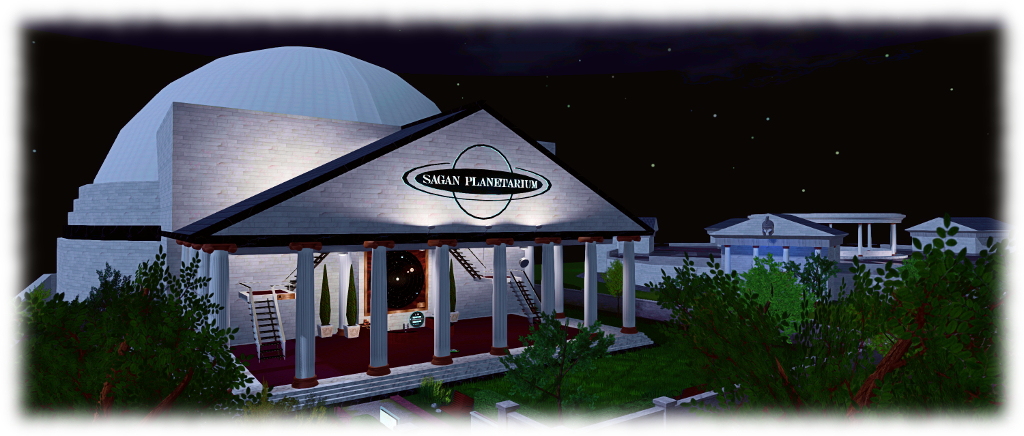
The planetarium – obviously named after one of the 20th century’s greatest intellects, the late astronomer and astrophysicist Carl Sagan – is the work of Josh Nitschke and is frankly a must-see visit, whatever your level of interest in astronomy and space exploration. The visitor spaces are split into four areas: the entrance lobby (I’ve used this as the landing point in the SLurls in this article), the Exhibition Hall, the main skydome and an outdoor orrery.

Sagan Planetarium
Sagan Planetarium – Exhibition Hall

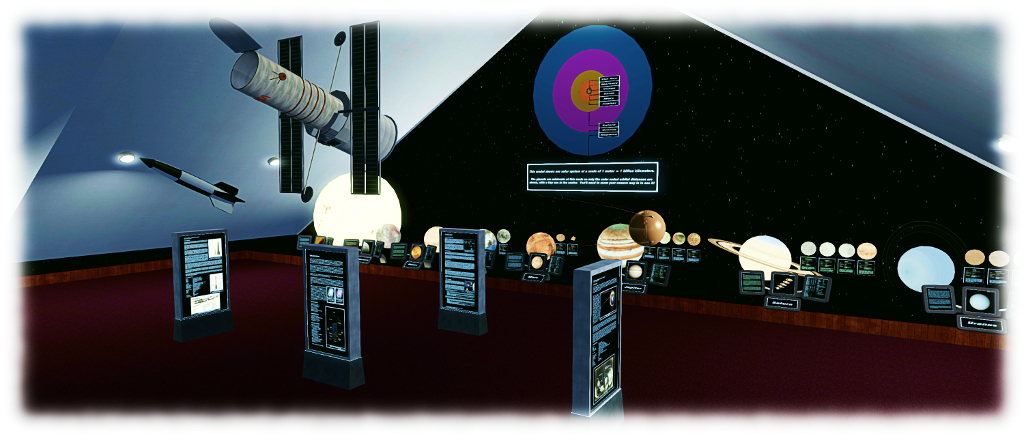
The exhibition area provides information boards on galaxies, nebulae, space missions such as Sputnik and the Hubble Space Telescope, and more. However, it is the interactive model of the Sun and the major planets of the solar system which is liable to hold attention. This provides a set of (not-to-scale, for obvious reasons!) models of the major planets from Mercury to Neptune, each with its significant moons (where applicable) and a sets of data panels. Given there is a wealth of information available about the planets, Josh has provided an excellent breakdown for each, although you’ll have to zoom right in to the panels to read it all. Touch the Sun and any of the planets, and you’ll get an annotated cutaway of the interior.

Above these is a model of the solar system going from the Sun to the orbit of Neptune – and this is to a scale of 1 metre to 1 billion kilometres. You can get an idea of the vastness of the space immediately around us, though, as none of the planets are visible in the model; only their orbits are shown, colour-coded – and you’ll have to zoom all the way in to even see the pinpoint of the Sun.

Sagan Planetarium
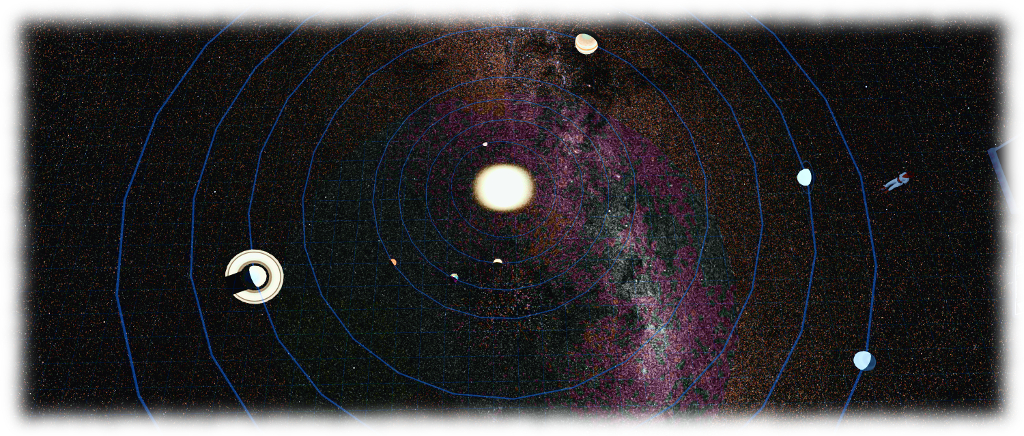
Sagan Planetarium – Skyhome show: that’s me in white over on the right to give an idea of scale. Note Saturn’s shadow falling across its rings in keeping with its position relative to the Sun

The skydome currently offer a single show – the Solar System. Lasting a little over 34 minutes, this is a multi-media presentation, requiring visitors accept the audio stream narration, written by Josh and given narrated by Phoenix Colter (this can also be obtained in a note card, but trying to read and watch the show is cumbersome; far better to listen if you can). Split into a number of elements, this show takes visitors on a journey through the solar system, from the Sun to the Kuiper belt, going by way of the cosmos at large. It incorporates the solar system’s creation, a look at the Sun and the major planets (and little Pluto – Charon, so far absent due to Pluto’s reclassification as a minor planet), and our emerging understanding of the solar system.

The wealth of information within the show is again extraordinary, and includes interactive elements: you can zoom at touch the planets when they are the focus of the show, for example, and see their interior structures. Two more shows are  – or have been – in preparation for the skydome, one on the Apollo missions and one on the moons of the solar system. Assuming they’re both still in preparation (I’ve IM’d Josh to ask), I look forward to seeing them.

Sagan Planetarium
Sagan Planetarium – Exhibition Hall planetary display

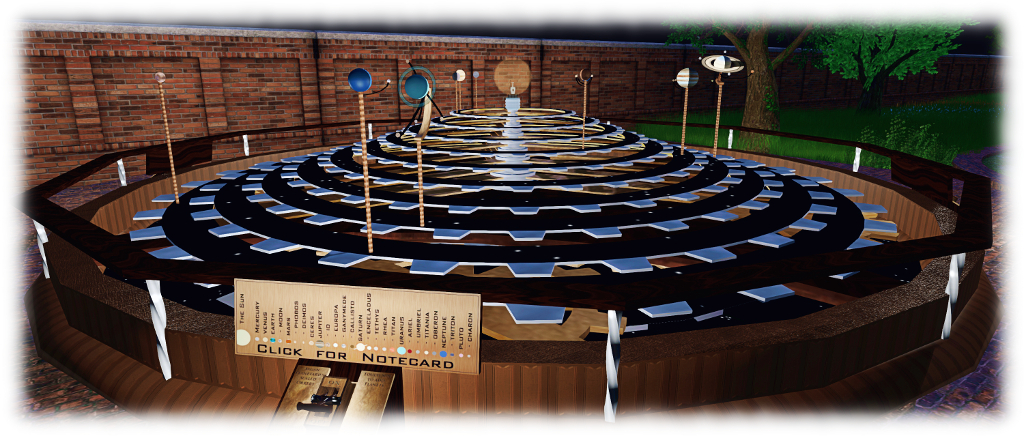
The orrery is located outside of the planetarium building and should not be missed. Beautifully ornate and in full working order – simply pull the control lever – it is the icing on the cake of a superb installation.

This is a fabulous build and presentation – the more so for all the core elements having been designed, written and scripted by Josh himself. As a planetarium, Sagan Planetarium stands head and shoulders above anything of this kind I’ve seen elsewhere. Yes, the presentation may be a little out-of-date courtesy of Dawn, Juno, New Horizons, and Rosetta, but this doesn’t in any way detract from what is presented. Sagan planetarium is a superb demonstration of what can be achieved within Second Life, visually and educationally.

Sagan Planetarium
Sagan Planetarium – the Orrery

I cannot recommend this enough – late though I might be in visiting myself! When visiting, please do consider a donation towards the upkeep of the facility, either directly or via the purchase of one of Josh’s brilliant models on sale in the gift shop.

SLurl Details

On display at Gallery 23 in Second Life

Gallery 23: January-February

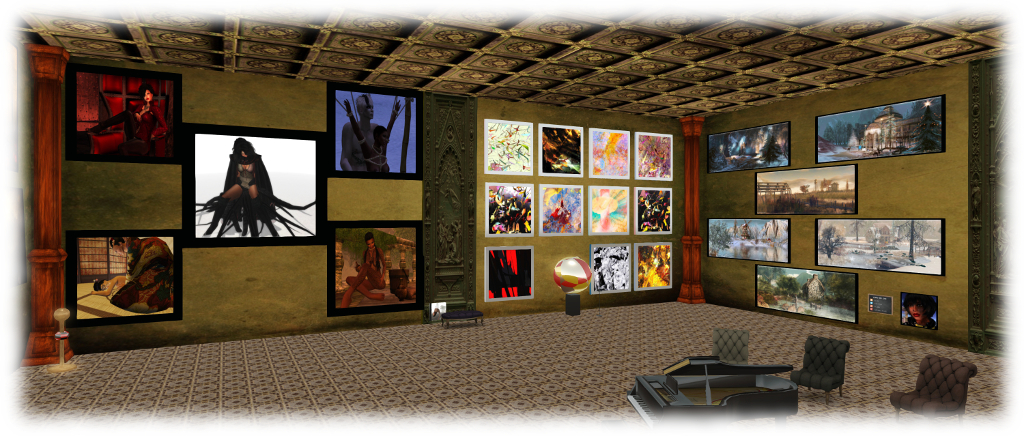
Now open through until the end of February 2017 at Virtual Chelsea Hotel’s Gallery 23, curated by enola em (enola Vaher), is an ensemble art exhibition featuring the images and art of Talitha Alice Minx, Vonnie Fox, Dulcis Taurog, Azu O, Miles Elventhauer, Hana Hoo (Hana Hoobinoo) and yours truly.

This is an eclectic and fascinating exhibition which brings together a number of artists of very contrasting styles, yet all of whom complement one another within the confines of the gallery’s walls. I will confess that not all of my fellow exhibitors were familiar names to me – but I will say that having spent time setting up at the gallery and having plenty of time to admire their work has made me something of a fan in some cases.

Gallery 23: Miles Elventhauer

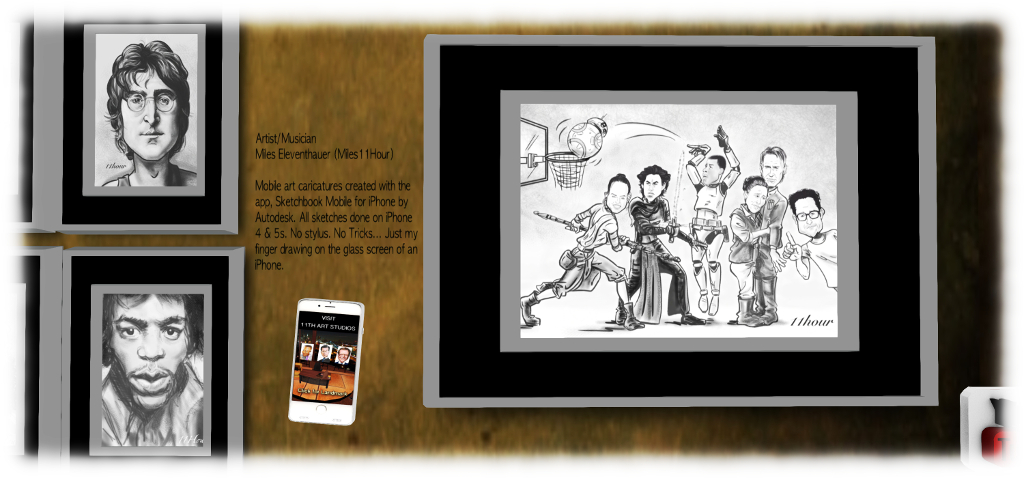
Take Miles Elventhauer for example. His work, located on the wall immediately to the right of the gallery’s entrance, is focused on caricatures of the famous and well-known, and he offers 8 individual drawings together with two ensemble pieces.  I challenge anyone not to identify all of those featured in the pieces.  However, as eye-catching and attractive as they all are, what makes this works stunning is that no pencil, pen, brush or stylus was used in their creation.

“All were created with the Mobile Sketchbook for iPhone app, ” Miles says of his work. “No stylus, no tricks. Just my finger on the glass of an iPhone 4 or 5.” Given he rarely exhibits outside of his own studio (“I live in New York, so I wanted to do the Chelsea,” he told me), this exhibition marks the perfect opportunity to gain an introduction to his art.

Gallery 23: Dulcis Taurog

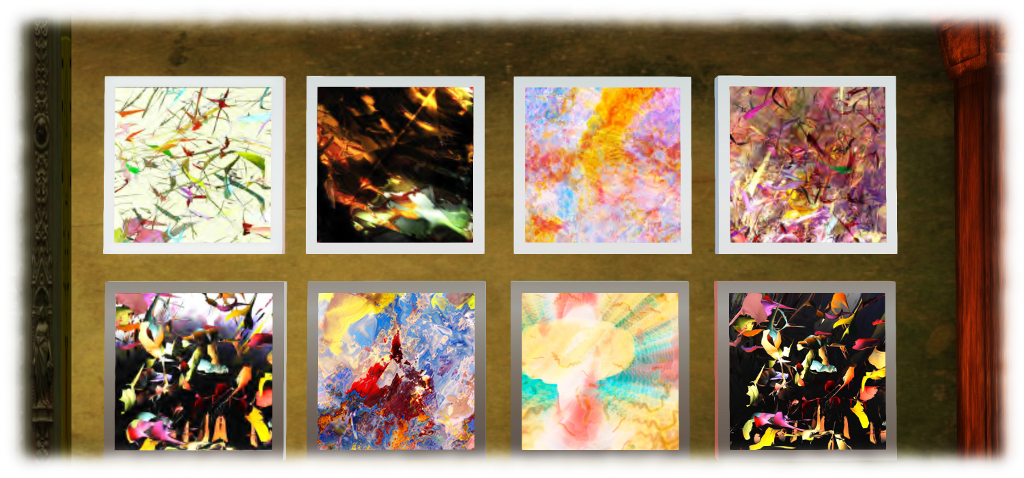
Dulcis Taurog, with whom I share a corner of the gallery space, is another artist whose work has to be seen to be appreciated. Entirely abstract in approach, it may at first appear to be art uploaded from the physical word, or digitally produced through PhotoShop or a similar application. However, this is not the case.

Rather, she utilises her own objects created in-world, or uses viewer elements such as the sculpty image window, the refraction sliders in the environmental editor, using texture from her inventory to replace the viewer’s default wave image,  all to create fabulous abstract images of extraordinary complexity and beauty.

Gallery 23: Hana Hoo

As noted above, this is a fascinating exhibition given the breadth of styles and images on display, with many of the pieces available for purchase. I’m delighted to have been given the opportunity to be part of things at Gallery 23 and the Virtual Chelsea Hotel, and my thanks to Enola for allowing me to do so.

SLurl Details

  • Gallery 23, virtual Chelsea Hotel (Lanestris, rated: Moderate)
Nagare no Shimajima, Restless Times, Second Life

Nagare no Shimajima, Restless Times; Inara Pey, January 2017, on FlickrNagare no Shimajima, Restless Times – click any image for full size

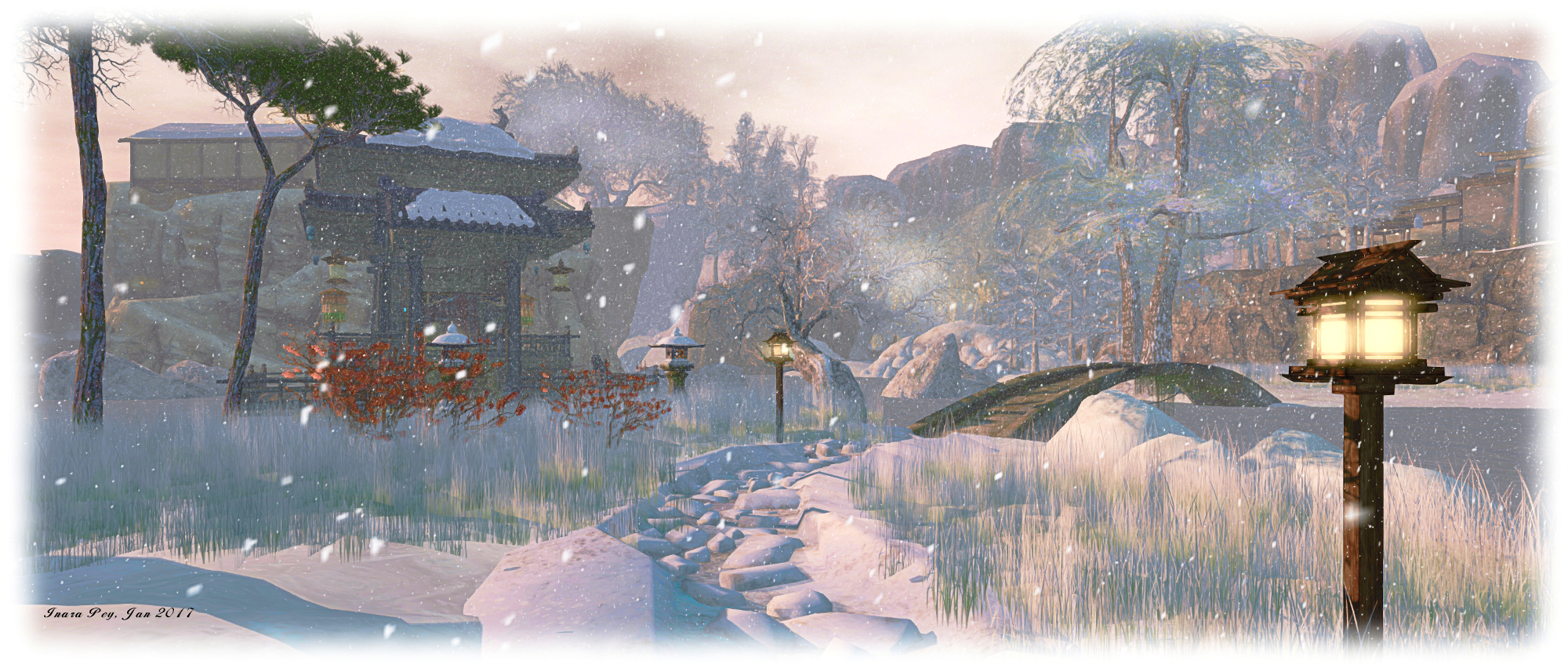
In October 2013, I visited Nagare, the home of the Blue Lotus Clan, offering both a place to visit and the opportunity for those who enjoy the art of traditional Japanese katana, nagi and short blades traditional fighting to join the clan’s C:SI (Combat Samurai Islands system) dojo. At that time, Nagare occupied a quarter region parcel on Southern Cross. A lot has changed since then, and thanks to a nudge by Loverdag, I realised it was high time I revisited.

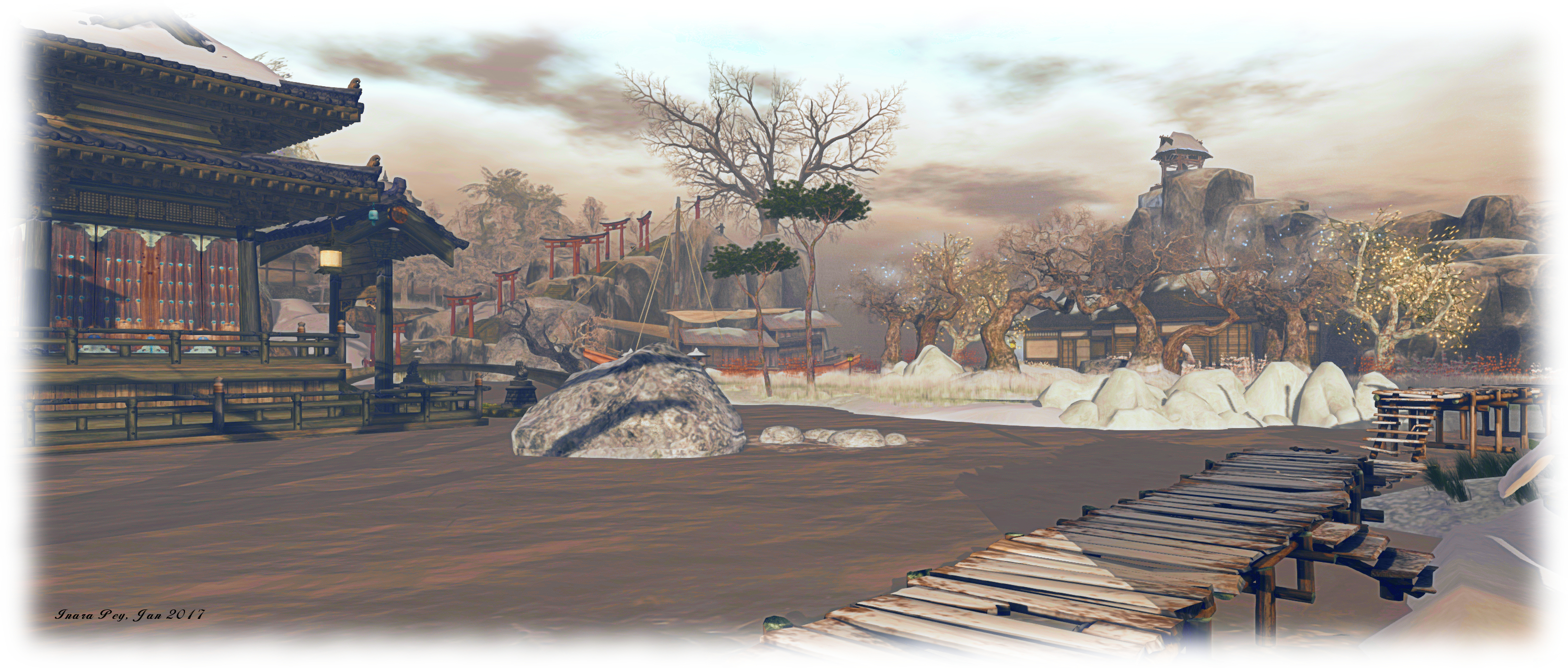
Today, Nagare – now called Nagare no Shimajima  (Nagare Islands, or Flow Islands) – occupies a homestead region of its own: Restless Times. One of the original designers of Nagare, Lila Aquacade is still responsible for much of the design the region, sharing the work with  Ratatosken Karu, and Roll (Pradalia) and Be Ino (Inorelin Ragowski), while the region is home to both the Blue Lotus clan and the Eternal Blades clan.

Nagare no Shimajima, Restless Times; Inara Pey, January 2017, on FlickrNagare no Shimajima, Restless Times

Given Lila’s involvement, there are many echoes of the original Nagare to be found here – the rugged landscape mixed with water channels, the large house boat occupying one of the latter and so on – but the increased space of an entire region means, obviously, that there is far more to explore.

As Nagare no Shimajima is a combination of public spaces and residential areas, the creators have defined a clever way of differentiating the two: public spaces are all connected via bridges; the more private residential island can only be reach via the little boats at the wooden quays. These can be rowed, sampan-style, by clicking on the boat to obtain a pole before boarding. Obviously, if you do take one, please respect the privacy of people’s domiciles, and do return any boat you use to its originating quay when done.

Nagare no Shimajima, Restless Times; Inara Pey, January 2017, on FlickrNagare no Shimajima, Restless Times

The landing point is located alongside the walled sparring area, occupying a broad sweep of rocky ledge between a wall of cliffs forming the west side of the region and a sharp drop down to the channels and bays which break up the eastward lay of the land. A path, marked by an aged torii gate, winds down to the lower levels of the region, where the bridges span the water. However, before leaving the landing point pagoda, I strongly recommend you collect the Nagare no Shimajima information card: it provides a wealth of information on where to go, the history of Nagare and the Blue Lotus and Eternal Blades clans, as well as information on Japanese religions and spirits in a highly conversational and engaging manner. In short, it is an excellent read.

Through this card, one can also about some of the little touches which have been added. Take heed of the warning about attempting to leave one of the cliff-top shrines before you have completed offering up prayers! That said, it does appear to be in need of a slight revision: while it refers to the teleporter being within the watchtower overlooking the sparring area, the only system I could find is located alongside the landing point pagoda (with another at ground level sitting on a snowy slope), while the sky dojo appears to be undergoing (re)construction.

Nagare no Shimajima, Restless Times; Inara Pey, January 2017, on FlickrNagare no Shimajima, Restless Times

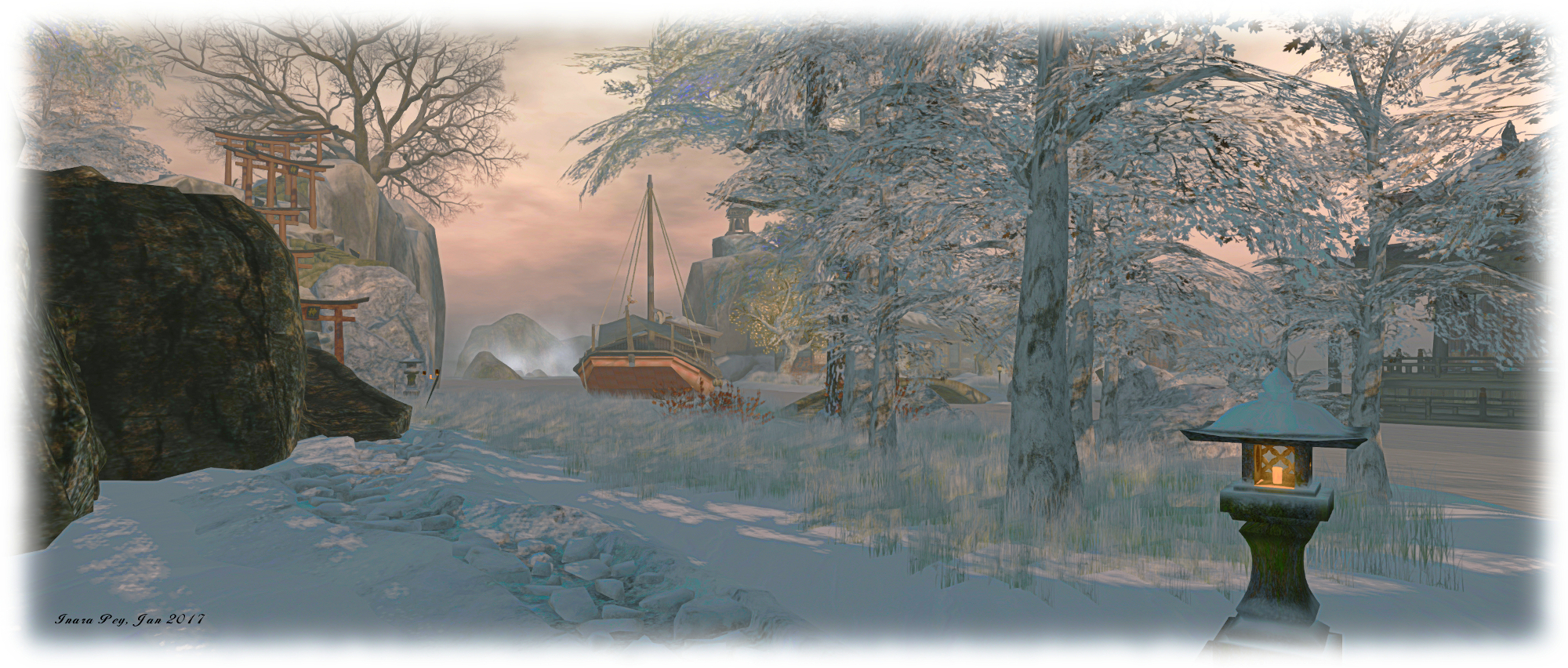
In 2013, I thoroughly enjoyed my visit to Nagare-as-was, my natural bias towards oriental regions notwithstanding. Visiting Nagare no Shimajima brought back several of those memories and was equally enjoyable.  Right now the region is caught in the depths of winter. I believe its appearance changes with the seasons, going on some photos I’ve seen. I’ll certainly be returning to find out!

SLurl Details