UWA to remain in Second Life for two more years

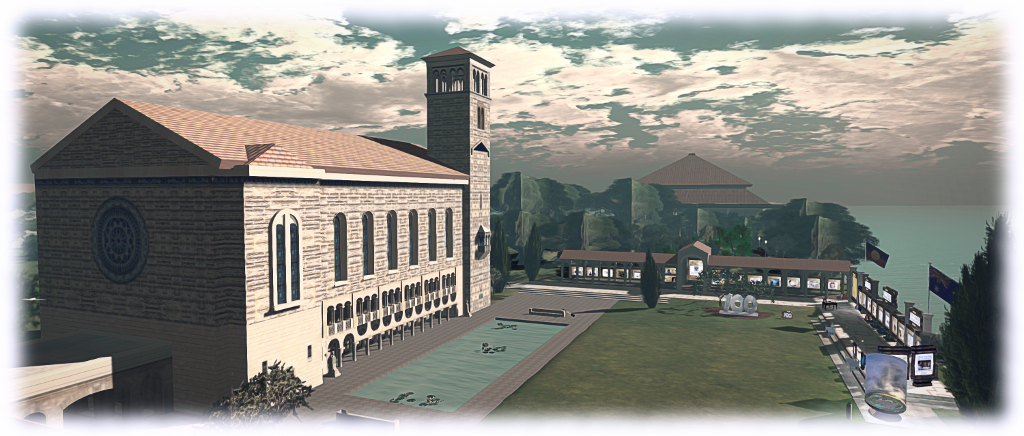
UWA: Winthrop Clocktower and the Reflection Pond, with the SLeducate area on the right (which you can read about here) all now set to remain in Second Life for the next two years

On Friday, June 30th, Jayjay Zifanwe contacted me with some excellent news: the University of Western Australia (UWA) is to retain a presence in Second Life for a further two years – albeit on a reduced scale.

UWA has enjoyed a long presence here in Second Life, operating multiple regions and becoming a stalwart supporter of virtual arts through its grand challenges and other competitions and opportunities offered to artists to present their work, as well a through support of machinima in physical world film challenges, such as those run by Screen My Shorts.

However, in September 2016, it was announced that due to changes within the UWA, its digital presence was to be largely shut down, with all but one of the five regions being removed from the grid at the start of October 2016, and the last given a stay of execution for at least a year.

Then, in October 2016 came word that one of the regions would transfer to the management of Sonicity Fitzroy (aka Dr Phylis Johnson) of the San Jose State University (and is now called SJSU Virlantis), while the four remaining regions – University of WA, UWA, UWA Winthrop and WASP Land would remain in place in-world until July 2017 before finally vanishing into the night.

Noke Yuitza: Transcendence Despite Falling Rain – an entry in the last UWA Grand Challenge style of art competitions, Transformations. You can see all the Transformations entries at the UWA Gallery

Now, two of the regions will be continuing for at least two years, as a jubilant Jayjay informed me via IM:

“I’m pleased to be able to tell you that thanks to the ‘UWA Community Partnerships Programme’, the University of WA and UWA regions will now be remaining in Second Life for the next two years,” he said. “This is absolutely wonderful news, and I’d like to thank everyone who have believed in and participated in all we have done and achieved over the years.”

Nor is that all. As noted above, one of the things UWA is famous for in it patronage of the arts, is its series of grand challenges involving 2D and 3D art and machinima – and there is good news here as well.

“A benefactor has donated L$300,000 for a machinima challenge,” Jayjay went on. “So we will be running one with art as the theme. Participants will be asked to select one or a number of artworks on display at UWA and weave a story around it or them.”

The Transformations exhibition space, UWA Gallery

Full details on the news about the extension to the two regions, and detailed information on the machinima challenge will be made available via the UWA of SL blog in due course. In the meantime a hint of the coming news can be found on the blog.

For now, congratulations to Jayjay, FreeWee Ling and everyone involved in making this happen.

Additional links

Melusina’s Absences in Second Life

Nitroglobus Roof Gallery: Absences

“Absence,” Melusina Parkin states in introducing her exhibition, Absences, at Nitroglobus Roof Gallery, “is a negative concept: it means that something should be there and it doesn’t. So, when we look at an empty place – a room, a seashore, a road or even a chair – we can’t avoid thinking of something or somebody who has been or will be there. That’s even more true when a world, including nature and landscape, is entirely made by humans, like Second Life.”

Absences is a set of twelve images on this theme, presented in Melusina’s familiar approach of offering a macro-like study, each scene a single point of focus – a beginning, not an entire story. Rather than the entire room, we are instead given an empty hanger on a hook, deserted chairs at a table, a glimpse of an empty couch facing windows without a landscape, the rumpled sheets on one side of the vacated bed, and so on. All suggest a story, of a presence lost but still felt; of  time when two were once one, but now only the one remains, the observer, the keeper of memories.

Nitroglobus Roof Gallery: Absences

But are the absences we see permanent – the result of the ending of a relationship or the passing of someone close to us? Or are they temporary –  the absence felt when a lover is away for an extended period, or who has just departed for a time and with the promise of reunion in the future? Or are they the absence created by changing circumstances – the empty room symbolic of possessions packed and gone, in transit to a new home while we remain, recalling all that has happened in the now deserted spaces – and the promise of new beginnings when next we see those possessions in their new home?

“I’m not completely aware of these thoughts when I take a photograph,” Melusina notes. “But when a detail, a colour shade, a light catches my eye and pushes me to freeze it in a photo, I think it happens ’cause they suggest me an atmosphere that any word, any human presence could better express.”

Nitroglobus Roof Gallery: Absences

And here is where the power of these pieces resides. Because they are each so focused, so macro in content, there is no sense  that we are being particularly directed to view any of them one way or another. Instead, each is but an opening word or line, awaiting its story to be told.

In this, we become not so much observers of each image, but playwrights, sharing each canvas with Melusina, writing stories of ending and beginnings unique to each of us, filling the page she offers us through each image. Because, and as she notes, the blank page holds so much more power than the sheet upon which words have already been written. And so these images, as evocative as they are, are made even more meaningful to each of us through our involvement in the narratives that flow from them.

Nitroglobus Roof Gallery: Absences

SLurl Details

Au Petit Jour in Second Life

Au Petit Jour, Hrodas Fen; Inara Pey, June 2017, on Flickr Au Petit Jour – click any image for full size

Au Petit Jour is the latest Homestead region design by Elyjia (Elyjia Baxton) and Brayan Friller (Brayan26 Friller) – who you may remember as being the couple behind The Heart of the Sea, which Caitlyn and I visited back in March 2017, and found to be a beautiful, tranquil location.

Those who remember The Heart of the Sea may notices that Au Petit Jour (“At Daybreak”) has much in common with that former build, whilst also being an entirely unique design.   There are two primary islands, for example, one of which includes the landing point, and a number of smaller offshore islets. As with Heart of the Sea, and as its name would suggest, Au Petit Jour is caught in the rays of an early morning sun, whilst the land presents a similar mix of lowlands and rocky, grass-covered bluffs and mesas.

Au Petit Jour, Hrodas Fen; Inara Pey, June 2017, on Flickr Au Petit Jour

But where Heart of the Sea rose from open waters, Au Petit Jour sits surrounded by other islands with tall green slopes and grassy shores which, to the east almost stretch out far enough to make part of this landscape a headland, rather than an island. To the north, between the rounded shoulders of these mighty hills, lies the open sea, a silver-grey Moon dipping slowly towards it, facing another open channel and the sea beyond, to the south.

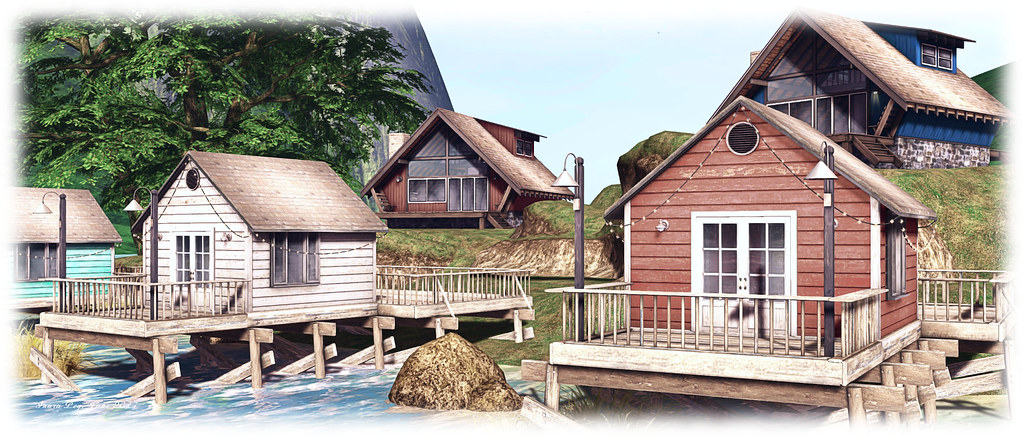
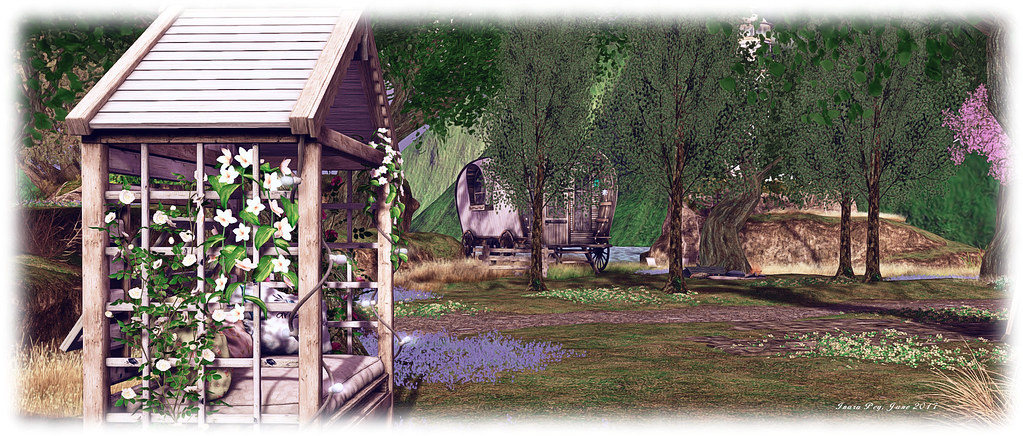
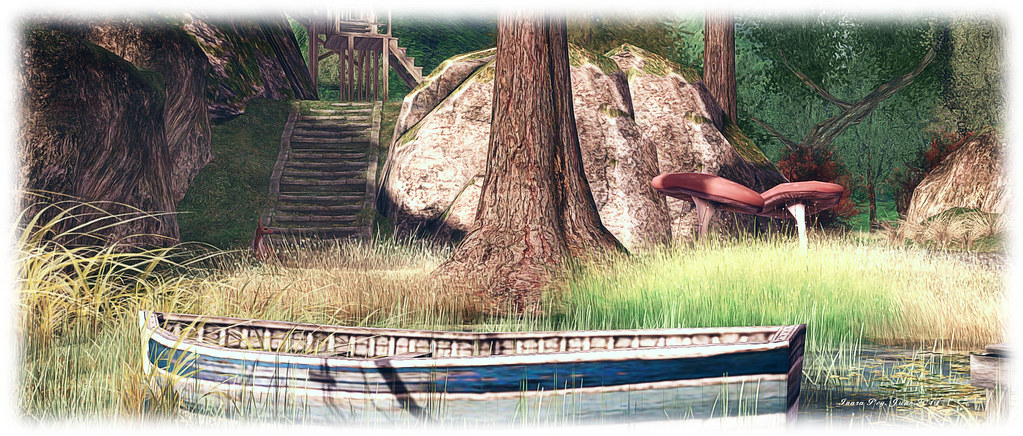
The landing point is located on the north side of the largest island, under the shade of two tall trees with trunks gently bowed from age, bluebells blossoming around the feet. Birds perch on fences greeting the morning in song, and a cinder track cuts across the grass east-to-west, separating a shaded arbor from a nearby Romany camp, beyond which a light house is perched upon a rocky outcrop rising from reeded waters.  Follow the track eastwards, over an old stone bridge, and you’ll reach the second of the two large islands.

Au Petit Jour, Hrodas Fen; Inara Pey, June 2017, on Flickr Au Petit Jour

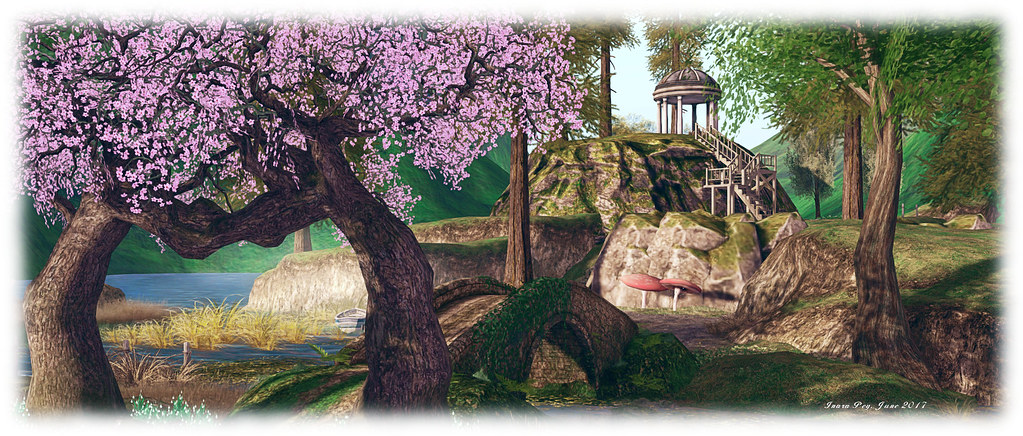
This throws a rugged face towards the tall hills to the east, crowned by an old folly (where dances can be enjoyed). The cinder path splits before reaching this flat-topped cast of rock, one arm leading to the steps that offer a way up to the folly, the other cutting between rocky faces to arrive at a low-lying area, shaded by trees and looking south over a cinder beach and across the inlet to the other islets in the group.

Go west along the track from the landing point, up a small flight of tone steps, and you have a choice of going south (left) or north (right). The southern path leads past more steps offering access up to a windmill seated on the island’s highest point, to a cove-like sandy beach presenting another vantage point looking towards the largest of the remaining islands. This is home to stilted beach houses built out over the water, with  cabins for rent on the low hill above them.

Au Petit Jour, Hrodas Fen; Inara Pey, June 2017, on Flickr Au Petit Jour

Northwards, the land remains flat and low, forming a hook to enclose a small bay into which waters tumble in falls down the side of the windmill’s table of rock. The hook offers a small place for music and dancing, while a raft anchored in the little bay presents another place for sitting and cuddling.

Beautifully laid out, with places to sit, places to cuddle and places to dance – as well as plenty to see, Au Petit Jour  offers much for the Second Life traveller to enjoy. When visiting, do keep in mind that the small island to the south-east, with the little cabins on the rocks and the little white boat dock, is a private area and not open to the public. Should you enjoy your visit, please do consider a donation towards the upkeep of the region.

SLurl Details

With thanks to Shakespeare (Skinnynilla) for the LM.

DixMix: Megan, Jes and Nekonuko

DiXmiX Gallery: Jes Mode

DiXmiX Gallery, curated by Dixmix Source and Megan Prumier, is currently hosting exhibitions by three artists with three very different, but complimentary styles: Nekonuko Nakamori, Jes Mode and Megan herself.

I last wrote about Nekonuko Nakamori when Sorcha Tiles was hosting an exhibition of her work alongside pieces by Blip Mumfizz, back in February 2017. A physical world artist with a grounded in Japanese art and who specialises in conceptual / abstract art in oil, Nekonuko uses her SL art to document her explorations of this digital world, each piece precisely square in ratio, and post-processed to give something of a painted look and feel.

DiXmiX Gallery: Nekonuko Nakamori

Twenty-two of her pieces are on offer in the gallery, twenty of them in a small enough format to allow them to be displayed in threes. Each offers a shot of Nekonuko in her wanderings, sometimes with enough surrounding detail for the seasoned traveller to be able to make an educated guess as to where she was at the time of the picture. Others, however, are a little more mysterious in nature. The majority are in colour, although three are monochrome, and offer interesting takes on avatar studies.

Occupying the White Gallery hall, Jes mode is making his debut exhibition at DixMix, and going on the quality of his work, I’m certain this will not be the last public display of his photography. All are presented as monochrome pieces, and are predominantly avatar focused. Some touch on the sensual, others on the serene or the satirical or the provocative. All are extremely well framed, and carry a unique narrative.

DixMix Gallery: Jes Mode

“I’m just an amateur,” Jes says of his work. I beg to differ; from the haunting beauty of Under a Heavy Rain through to the artful elegance of Situazione Surreale (Surreal Situation) these are masterful pieces. The sentiment and emotion in each is palpable; each captures the attention and draws one into their narrative, drawing forth felling of identification with the mood or tone of a piece, or making us a part of the scene.

Megan Prumier is possibly the more well-known of the three artists currently on display, her exhibition having opened a little ahead of those of Nekonuko and Jes. Nineteen pieces (including a 4-panel piece) are on display in the Black Gallery Hall, just off to the left of the gallery’s entrance foyer. These are again avatar studies, but are presented in soft focus and (predominantly) soft tones, given each piece an individual sense of life. Megan appears to be the model in most of the images, thus given some of them perhaps something of an autobiographical edge in the narrative they carry. All are, in two words, strikingly captivating.

DiXmiX Gallery: Megan Prumier

It’s a pity that – once again – no effort has been made to offer information on the artists. While this is fast becoming my usual nagging point about this gallery, it is something I feel strongly about. Discovering and appreciating the art on display is obviously a good portion of the draw to any gallery; but so to is the opportunity to discover something of the eyes, minds and personalities of the people responsible for the art, and to perhaps gain insight into their work and  / or their passions and interests as whole. Is providing an artist’s statement / bio therefore really that hard, given other galleries manage it?

SLurl Details

Kultivate Select Summer themed exhibition in Second Life

Kultivate Select Gallery

Sunday, June 25th marks the opening of the Kultivate Select Gallery’s June exhibition at Water Haven.

All artists invited to exhibit at the gallery must have previously exhibited with Kultivate, and are asked to display in accordance with any theme set for the exhibition – this month’s being “Summer”.

The June exhibition features the artists Bri Graycloud, CalystiaMoonShadow, captainofmysoul, Catalina Staheli, Inara Pey, John Brianna, Karma Weymann, talligurl, Tisephone and Veruca Tammas.The opening for the exhibition is at 13:00 SLT, and will feature live vocal artist Nina Bing, who will be performing through to 14:00 SLT.

Kultivate Select Gallery

SLurl Details

Orientalism in Second Life

Orientalism

Open now at the Gedenspire II Gallery, curated by Walter Gedenspire, is Orientalism. The title and focus of the exhibition – an examination of patronising representations of the Middle East in art – are taken from Edward W. Said’s 1978  book of the same name.

Displayed across the gallery’s two floors are over 60 images, together with signage bearing a wealth of information on the subject. The lower floor primarily focuses on paintings by 19th century French artists – Pierre Renoir,  Eugène Delacroix, Jean Ingres, Jean-Léon Gérôme and Henri Matisse (the later spilling over into the 20th century). These are supported by other western views of the Middle East: a poster from the 1966 film Khartoum, a post of Rudolph Valentino in Arab-style garb, cover art for an edition of A.E.W Mason’s The Four Feathers, and two paintings by Pablo Picasso.

Orientalism

The selected art very much points to the habit of painters in the 19th century – some of whom never travelled to the Middle East – romanticised the western view of Arabia – to inject a strong, almost patronising, western fantasy view of the East. Even among those who did make the journey eastwards, be it to Arabic states or places like Algeria, their work was heavily influenced by the Romantic movement, which reached its peak alongside the rise of French Orientalism, and western erotic leanings. Renoir went so far as to be outright dismissive of the “genuine article” he encountered during his travels.

The selected paintings are reflective of all of this, and the information boards expand on the art and the artists in an informative, easily digestible narrative.  Meanwhile, on the upper floor is a much broader display, covering cities / architecture, the influence of oriental clothing on western high fashion, and the more romantic views of the “oriental landscape”. Occupying one end of this floor is a small display of art by Osman Hamdi Bey, an Ottoman administrator who became enamoured of French Orientalism to the point of studying under two of the foremost exponents of the form, Jean-Leon Gerome and Gustave Boulanger.

Orientalism

For those who enjoy art and / or history, Orientalism is an interesting exhibition, nicely informative without being overbearing in the amount of information on offer. The gallery is nicely decorated in a style suggestive of Moorish interior styling, and for those who feel in the mood, a couple of “Arabic” costumes (female and male) are on sale in the gallery foyer at L$100 each.

SLurl Details