A new vacation at Pandora Resort, Second Life

Pandora Resort; Inara Pey, October 2017, on FlickrPandora Resort – click any image for full size

Note: this vision of Pandora Box of Dreams closes on August 1st, 2018.

A little over a year ago, I had the pleasure of previewing Pandora Resort, the full region venture by Lokhe Angel Verlack (Jackson Verlack) and his Second Life partner, Miza Cupcake-Verlack (Mizaki) – see here, and then writing about it post-opening.  Given the passage of time since those visits, and having seen a number of group notices about the region, I thought Caitlyn and I should hop over and have a look.

Back in September 2016, Pandora Resort was a winter location, high in the mountains. Now it is a tropical paradise – in Miza’s words, “An exotic island resort just off the coast to India is open to cater to the needs of fun, warmth and relaxing experience exposed to vivid lush wildlife and other hidden paradise”, a description which certainly piqued my interest given the time I’ve spent in Sri Lanka and the deep fondness I have for that country.

Pandora Resort; Inara Pey, October 2017, on FlickrPandora Resort – click any image for full size

A visit commences high over the region, on the upper deck of an airliner. Green arrows on the floor direct arrivals down to the lower deck and thence to the cabin door, where a teleport carries people to ground level, and a chance to debark the airliner.  Outside of the ‘plane is a tropical setting,  the “airport” sitting high on a plateau, sandy mountains visible on all horizons, a cobbled path leading the way past swimming pools shaded by pergolas on one side and an open-air dance area on the other, and on down to a reception lobby located part-way down the plateau’s east side.

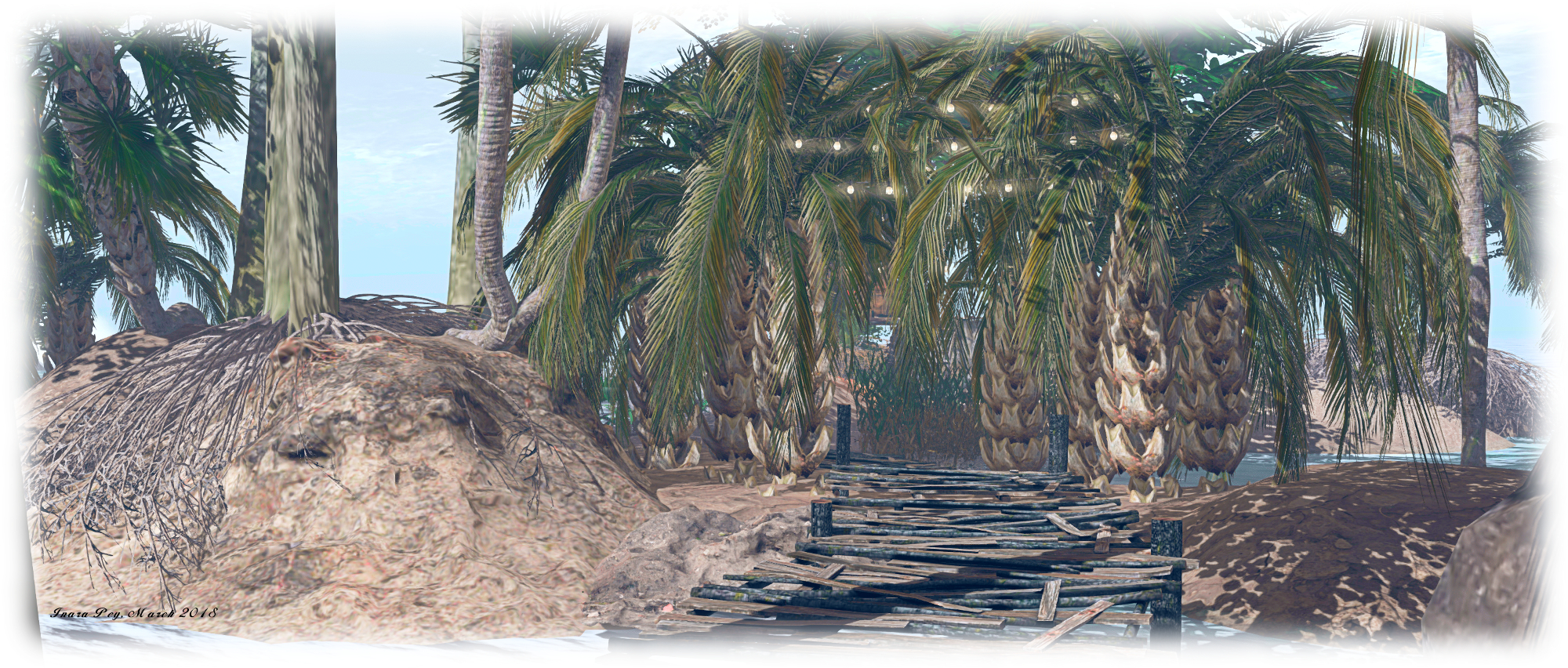
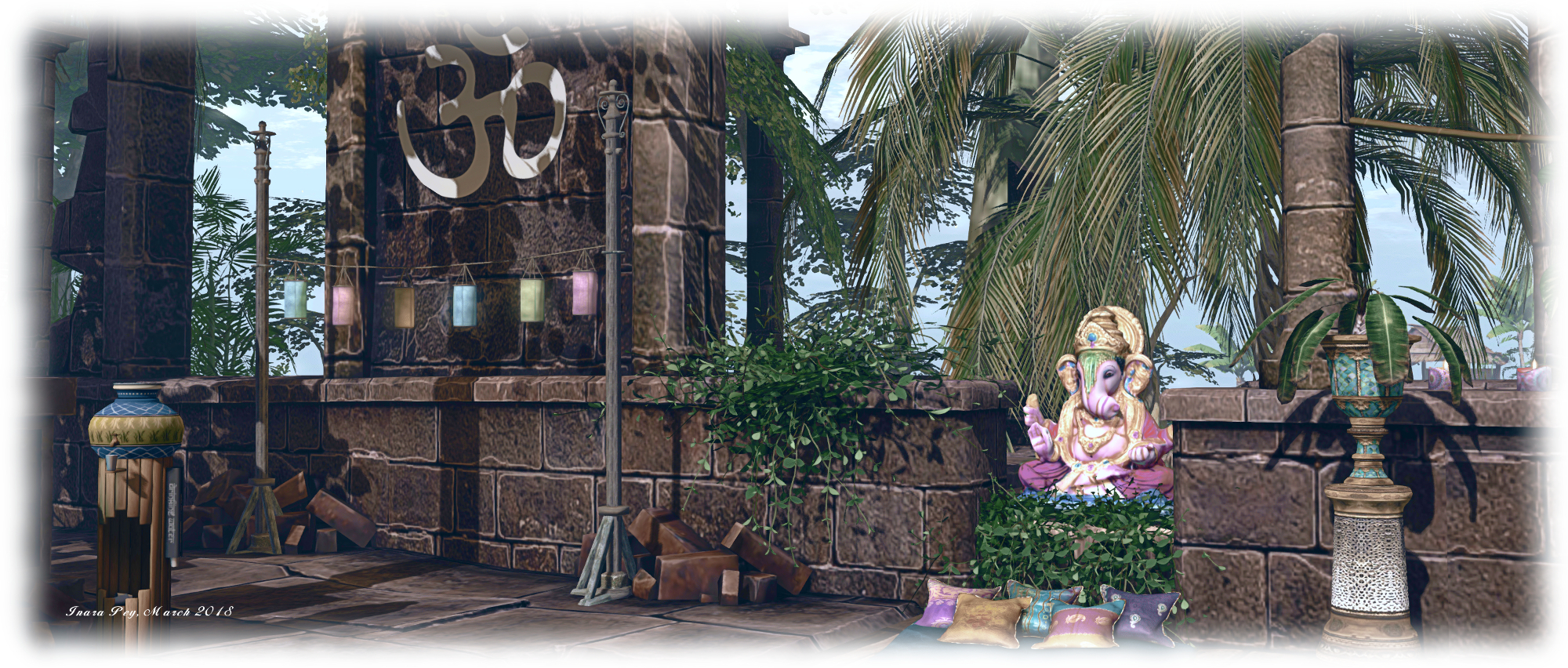
The reception area offers an opportunity to rest and to look down on the lowland to the north and south. Ancient steps lead the way down through palm trees and lush grasses and along the side of the plateau and so to the to the beach in the south-east corner of the region. A portion of this is given over to a water-side pavilion – a bath house with outdoor seating, shaded baths and massage tables. Hot pools sit on the sands outside of the pavilion, and a path points the way westward, through a further spa area sitting in a rocky cleft, and on to ancient ruins on the west side of the island.

Pandora Resort; Inara Pey, October 2017, on FlickrPandora Resort – click any image for full size

Here lies one of the places visitors need to take a little care. Tucked into the corner of these ruins is an Asian-styled house available for private rent, and off-limits to those not a member to the region’s group even when not occupied. The north side of the island, reached via a wooden board walk and east-side public beach, is similarly given over to private chalets available for rent and forming a discrete resort of their own.

It was here that I was put in mind of beach-side resorts in places like Sri Lanka; individual chalets with an open-plan layout; all it needs is for the landscape to be a little more lush and green, and it would be easy to imagine the essence of Sri Lanka had been captured here. The chalets sit out over water, and offer a  considerable amount of living space for those wishing to rent one. However, casual visitors should again be aware that when occupied, the chalets can be understandably off-limits – but the watery path between them does remain open to free passage.

Pandora Resort; Inara Pey, October 2017, on FlickrPandora Resort – click any image for full size

The west side of the island offers two bays of shallow water, one of which cuts quite deeply into the land, ending in a small, secluded beach under the lee of the central plateaus. A second beach on deep cut of this bay, and located under an ancient, broken aqueduct, provides another area for swimmers to enjoy.

There are one or two incongruities with the region – the little airport with its huge jet, for example, or the fact that the island – whilst quoted as being off the coast of India – is inhabited by African elephants. However, the latter is likely to be down to the availability of elephants on the Marketplace, which is biased towards the African variety. The former doesn’t actually detract from a visit, simply because once within the region, the airport

Pandora Resort; Inara Pey, October 2017, on FlickrPandora Resort – click any image for full size

For those of us facing the onset of winter, Pandora Resort – Namaste – offers a welcome retreat to reminder of sunshine, vacations and warm seas. It might even, for those fortunate enough to have travelled to tropical climes, open a doorway to past holidays and time spent at luxurious resorts.

SLurl and Website

Melusina’s Mysteries in Second Life

Nitroglobus Roof Gallery: Mysteries

Melusina Parkin returns to the Nitroglobus Roof Gallery for October, with an exhibition called Mysteries, and it is a thought-provoking display of photography.

“Missing faces, veiled ones, obscure looks,” Melusina states in introducing the exhibition. “Statues and mannequins populate Second Life with their mysterious mood. Sometimes they are creepy, sometimes they are gentle, always they are silent.”

Nitroglobus Roof Gallery: Mysteries

Thus, Mysteries presents thirteen images of mannequins, figures and statues captured from around Second Life. Such figures, to be found all over the grid, whether in stores or art events, parks or role-play regions, homes or photography studios, all have some kind of story to tell – be it part of a larger setting or contained within the frame of their own display as a work of art or object of everyday use.

So to, through Melusina’s collection, do they tell a story or stories within this exhibition. The images have clearly been selected with care to project this, Mystery 10 through Mystery 13, for example, are displayed together on two walls, presenting an unfolding narrative – although what that narrative might be is up to each of us as we view the images. Others, such as Mystery 7 perhaps tell a story quite independently of the other pieces in the collection. But however one looks at them, the stories are there, individual or collected, waiting to be heard.

Nitroglobus Roof Gallery: Mysteries

But there is more here as well, if we’re willing to look a little deeper. Our avatars are, in a sense, our own mannequins. Through them, we get to decide not only how we interact with one another, but how we actually appear to one another. We can project – or inhabit – our avatars at will, using them to reveal or hide, project or protect, many different facets of who we are. They are both a window into who we are and a shield by which we can hide the things we do not wish to have seen. Mystery 2 and Mystery 3 perhaps embody this most specifically.

So as Melusina states, Mysteries may present an apparently lifeless population – but in doing so, it makes us wonder about human feelings and thoughts – and particularly, perhaps about our own feeling and thoughts, about our identity, relationship with others,  and our openness.

Nitroglobus Roof Gallery: Mysteries

Mysteries is another nuanced, fascinating exhibition from Melusina; and yet another not to be missed.

SLurl Details

Milly Sharple’s Creations in Second Life

Cynefin – Creations: Milly Sharple

Update: Milly has relocated her work and gallery to Fractal Insanity – The Art of Milly Sharple – see my review here.

I’ve long admired Milly Sharple’s art, as I’ve tended to mention in the past. I’ve reported on her work – which includes region designs as well as art; and along with many others, disappointed to hear she was retiring from Second Life art and shutting down her facilities at Timamoon Arts and Isle of Lyonesse.

However, such was the outpouring of support from those wishing to see Milly continue to display her art in, she relented and established a new gallery called Cynefin, where she is now exhibiting a select of work called Creations.

Cynefin – Creations: Milly Sharple

One of the major attractions for me with Milly’s work is her fractal art; I’ve written about it on numerous occasions, and Creations includes examples among the 52 pieces on display. However it also includes pieces representing her more recent experiments with mixed media, combining her work with fractals with her photography. Also to be found are samples of Milly’s landscape photography from within Second Life – all of which makes Creations a fascinating and worthwhile visit.

The gallery space is set within a single-storey building of modern design which is ideal for exhibiting Milly’s work. A central entrance lobby featuring six pieces of Milly’s more recent work in mixed media, which opens out into two large gallery spaces with rooms for wall-mounted and free-standing displays of Milly’s art.

Cynefin Creations: Milly Sharple

The art itself is, as always, is magnificent; the richness of the pieces has to be seen in order to be fully appreciated. The diversity of styles on display – as is evidenced on entering the lobby space, where one is greeted by six attention-holding pieces – means this is a truly superb exhibition. As such, written words do not do any of the art offered the justice it deserves; nor does picking out any particular piece or group of pieces for specific mention above the others. However …

There is a series of seven female studies which I have to admit completely captivated me with their presence and depth (five are show in the image below). At first appearing as “simple” studies, there is a richness of style within each of them. With some this borders on the abstract, with others there is a hint of Milly fractal work within the mix of human study and floral painting. They are – even by the extraordinary standards of Milly’s art as a whole – stunning.

Cynefin Creations: Milly Sharple

Milly’s work stands as some of the most beautiful art in Second Life – and frankly, the grid could have been a duller place without it.  Seeing her return with a new gallery space, and one so rich in content is both a pleasure to see and a joy to welcome. I’m looking forward to many future visits.

Exodus: A Trip for Life in Second Life

Exodus: A Trip for Life

Art can be expressive in many ways. It can be an outflow of creativity, a reflection of moods and emotions, a cathartic release of hopes, fears, wants or needs; or an echo of joy or contemplation or endeavour or of life itself. And it can be a voice of conscience commenting on society, culture and politics.

Exodus: A Trip for Life is a full region installation which falls squarely it that last bracket: offering a voice of conscience in response to our societal and political outlook. In doing so, it touches – invokes – something we can so easily lose sight of – even when it might appear we are trying to empathize.

Exodus: A Trip for Life

Designed by Kicca Igaly and Nessuno Myoo, Exodus: A Trip For Life deals with the discomfiting issue of the world’s refugee crisis, which became a hot button topic on several fronts of the past couple of years; one in which some essential truths have perhaps been lost in the clamour of angry voices, political posturing, and perceived threats to security, jobs and income.

“It almost seems,” Nessuno says in introducing the installation, ” As if all the evils of our society, unable to find effective solutions to the problems which from time to time appear, have found, in the dark threat of the foreign ‘invader’ , the perfect scapegoat.”

Exodus: A Trip for Life

And yet the simple truth is, these feared ‘invaders’, these people risking life and limb and family, do so not because they’re seeking to exploit our vulnerabilities and our way of living. They do so because they already are vulnerable; their war of life has already been destroyed through war and / or political / religious upheaval and oppression. Everything they have known has been torn apart in ways we cannot understand; far from coming here as exploited, they arrive as the exploited, preyed upon in their journey by criminals and traffickers; people more interested in taking money and possessions than in saving lives.

All of this, and more is brought forth in Exodus: A Trip for Life. It starts out at sea, where a battered hulk rides a heavy swell, figures crammed into its rotting hold or crawling desperately up to the main deck and clinging in fear to anything looking remotely solid. The vessel is tossed by waves of money – a reference to the physical price those aboard have paid, while strings rise from the hull to a puppeteer’s controllers, a further reference to the exploitation inherent in trafficking the desperate, as they are time and again forced to travel in vessels unfit for purpose (and it is no coincidence that the bows of this ship bear two names, again underlining the dire circumstances faced by so many).

Exodus: A Trip for Life

Ashore, the imagery continues. New arrivals walk along a road, watched from a distance by locals, the gap between the two groups as telling at the walls that constrain the refugees to that single, lonely road. A camp sits close by, but again separated from  the locals as if in quarantine from the rest of the land, by walls and iron gates. Both the road and the camp stand as metaphors of how we see refugees; they may not be so alien, they may appear more human – but they are still “others” to be kept at bay. And we are far more comfortable when they can be moved from our sight and thoughts, as symbolised by the line of arrivals slowly vanishing into a white mist. They pass and are gone – to where does not matter, nor does the fact their plight still goes with them; we can resume our lives.

Poignant, pointed, provocative, richly nuanced and threaded with a wealth of observation and commentary, Exodus: A Trip For Life may not sit well with some; it may not even by easy to entirely decipher on a single pass. But it does have a voice; one that reaches into our conscience to whisper a stark reminder about the realities of the world around us even as sound bites, posturing and the fickle lens of the media would distract us and divert our thoughts and feelings.

Exodus: A Trip for Life

SLurl Details

Autumn comes to La Vie in Second Life

La Vie; Inara Pey, October 2017, on FlickrLa Vie – click any image for full size

La Vie has reopened! Please come pay a visit! And don’t forget to put your pics in the Flickr group. I can’t wait to see you and all of your art!

Thus read the invitation Krys Vita sent out to members her group a few days ago, inviting folk to drop into her homestead region of La Vie and enjoy its new look, and with an additional prod from Max and Shakespeare, Caitlyn and I hopped across to see how things had changed. The last time we were in the region, it was a tropical paradise designed by Krys and TreMeldazis; for this iteration, Krys has once again collaborated with Arol Lightfoot.

La Vie; Inara Pey, October 2017, on FlickrLa Vie

“It was time for a change I think,” Krys said as we arrived. “La Vie has been around a long time!” Seasonal changes are not uncommon within Second life regions, and with this rebuild, Krys and Arol have embraced the look and feel of autumn – with just a hint here and there of Halloween, some obvious (such as the pumpkins dotted around), others perhaps not so (such as the ghost-like blankets hanging in the windows of a barn!).

On arriving, visitors find themselves close to a farm-house and the aforementioned barn. A pick-up truck and tractor are parked close by, just off the track running by the farm. This offers explorers a choice of directions in which to most obviously head: east or west. Follow it east, and it quickly curls to the north, taking you by grassy banks, a little stall perched atop of them selling apples, to a box bridge crossing the narrow vee of a sluggish stream.

La Vie; Inara Pey, October 2017, on FlickrLa Vie

Another pick-up truck is sitting on the rack beyond the bridge, a trailer hitched to its tow bar, the track itself coming to an end a short distance beyond it. Across a short expanse of long grass and under the lee of gnarled trees, the old stone walls of a graveyard beckon – perhaps another nod towards Halloween, with the mist gathering about the aged tombstones and a raven keeping a cocked eye on those who visit.

The graveyard is overlooked by the back of a tree house with adjoining artist’s studio, both of which sit just above the ground on the splayed fingers of strong branches. Connected to one another by a quaint little wood and rope bridge, they look northwards across a quiet pond where swans and geese share the water with cormorant and heron. More rugged and wooded land lies westward of these tree houses, deer roaming beneath boughs still heavy with yellowing leaves, before the landscape opens a little, offering a quarter corner for a single trailer camp site, before the track resumes its meander back to the farm.

La Vie; Inara Pey, October 2017, on FlickrLa Vie

This is a place of muted colour, where gulls wheel, fishing boats and nets lie offshore, and farm animals wander and graze. Away from the main track, explorers may find little nooks and places to sit – a little camp fire here, and old picnic bench there, or cosy tree hut hidden among branches and leaves, a swing slung beneath…

Saddled horses also roam the land, or sit and lie in the shade of trees. Touching any of them will allow you to haul yourself up into the saddle and then take a ride around the land; when you dismount, the horse will be content to wander or lie down once more.

La Vie; Inara Pey, October 2017, on FlickrLa Vie

Finished with another fitting sound scape, Lie Vie in autumn is the latest in a series of wonderful designs by Krys and Arol, and a setting that shouldn’t be missed.

SLurl Details

  • La Vie (La Vie, rated; Moderate)

Highlighting my interview with Gem Preiz for Kultivate Magazine

Fractal 397 (Wreck, 2016) by Gem Preiz, on FlickrFractal 397 (Wrecks, 2016) by Gem Preiz, on Flickr

I’ve been an admirer of Gem Preiz’s fractal art ever since I first encountered it several years ago on my travels as a reviewer of art in Second Life.

This year, 2017, marks the fifth anniversary of Gem’s first exhibitions in Second Life, and he has been marking the with two retrospectives. The first, A Retrospective, was held at the start of the year, and you can read about it here. The second, appropriately called Five Years of Fractals, opened in September 2017, and you can read about it here.

To help celebrate this anniversary – and the fact that Gem himself is fast approaching his 10th anniversary in SL -, I had the opportunity to sit down with him in late September 2017 and discuss his work with him on behalf of Kultivate Magazine. It was a fascinating opportunity to learn about his arrival in Second Life, his art, his interests and inspirations. If I say so myself, the interview is well worth taking the time to read simply because Gem does have so much to say that is worth reading; this being the case, I thought I’d help whet appetites by offering a few excerpts from our chat.

No Frontiers 10 by Gem Preiz (2017), on FlickrNo Frontiers 10 by Gem Preiz (2017)

On Second Life and The Potential for Artistic Expression

I actually discovered Second Life in 2007 while on a trip to America. I was actually there to study new technologies for use in business, but discovered a world with wonderful personal opportunities in this social and playful virtual world.

My awareness of the potential for sharing creations coincided with a growing interest in digital imagery. In particular, I discovered two artists – Fiona Leitner and Milly Sharple … Seeing Milly’s work helped me see the possibilities for displaying my own art within Second Life, and in reaching an audience from around the world while also having the freedom to create exhibition spaces which would be impossible in the physical world.

On His Passion for Fractals

I have a science and maths-focused education and have always worked with technology. Because of this, the computer naturally became my paint brush.

Some of my passions include ecology, Earth sciences, and humanity’s relationship and place in Nature. Astronomy and cosmology particularly bring together my fascination with science with my own imagination and fascination for the human capacity to imagine, discover, explore and learn. All of these play a role in my creative expression and imaginings.

… Fractals allow me to create – to paint, if you will … with such a diversity of results … In addition, the underlying mathematical aspect make them welcome to my rational, scientific side.

Fractal 296 (Polychronies, 2014) by Gem Preiz, on FlickrFractal 296 (Polychronies, 2014) by Gem Preiz, on Flickr

On Science and Science Fiction

We are the ultimate product of life on this planet. We have been granted a brain which allows us to understand and influence our environment. At the same time, we question what is our purpose as a species …

Science, in its broadest sense, is the means by which we do so, through exploration, analysis, deduction, questioning and reason … We have it in us to resolve all of society’s issues – health, wealth, the environment – if only we are willing … I have a passion for science and a concern for the environment. We need both to secure our future – if we are to have a future.

Thus, Fractals and digital art are a means for Gem to express all of this to an audience, while at the same time giving flight to his creative narrative through both his visual art and the written word – as narrative forms a strong element in his pieces. Sometimes this may be obvious, such as a story running within one of his exhibitions, as with Heritage: Wrecks reviewed here) or it may be subtle: a story suggested by and introduction to his images, but which is left to the visitor’s imagination to flesh out.

Kultivate Magazine-October 17Through the interview, we were able to explore these ideas at some length, delving into just how some of his more recent exhibits came into being. We also explored his unique approach to reproducing his work in Second Life, as well as his ruminations on the platform as someone who has been a part of it now for almost a decade.

Gem is a genuinely warm, caring individual, and it was both a privilege and pleasure to chat to him for Kultivate. You can read the full interview in the October edition of the magazine, beautifully illustrated by images from Gem’s work selected directly from his library, which he kindly opened up to us to peruse in preparing the piece.

Click the magazine cover on the right to open it for reading in a new browser tab. You can also catch up on all of my reviews of his work in these pages through a dedicated blog tag.