Nativo in Second Life

DaphneArts: Nativo

Nativo, featuring the art, words and voice of Italian physical world artist Stefano Mingione, and which has been open for that last month at DaphneArts, is the latest in a series of installations presenting a broad canvas of artistic expression which can combine multiple approaches into a single installation / expression of ideas which are intended to be viewed as a whole, rather than just as individual elements, be they drawing, sculptures or poems.

An artist working in a range of media – drawings, paintings, sculptures, digital media, written word – Mingione tends to identify himself more thematically, through his focus on the dualities present in life. Birth and death, happiness and despair, hope and fear, youth and age; and this is very much in evident in Nativo.

DaphneArts: Nativo

The exhibition space is split into two parts – although together they form a whole. The main exhibition area, where  visitors first arrive, forms a cylindrical hall in which eleven draws are displayed. Some appear to have religious connotations, offered through titles such as Santissima Trinità (Holy Trinity) or La Caduta dell’Angelo (The Fall of An Angel), or through their subject matter – as with  Padre Perché Io Disegno (Father Because I Draw).

However, religious overtones – entirely in keeping with the idea of duality in life, expressing both the earthly and spiritual – are only part of what these images have to offer.  Collectively, they provide an expression of thinking about left, death and all that lies between in a manner – to my eye at least – not that far removed from the art of Hieronymus Bosch, another artist who pondered (agonised over?) dualities through his work (and even through his patronage).

DaphneArts: Nativo

A single walkway extends back from this cylindrical room. It offers a way to where a grand sculpture of an old man, curled foetal-like, hangs in the air. It is a further embodiment of the theme of duality: the aged man appearing foetus-like in the darkness. Positioned before the sculpture is a chair and “play” symbol. Visitors are encouraged to sit in former and click on the latter – which will allow them to hear three of Mingione’s poems – Amico, Nativo and Vecchio – narrated by the artist himself in Italian, and presented with both text subtitles and a series of sculptures representing each one. These are very much the heart of the exhibit, richly evocative, and deserve special consideration which may require each to be listened to and watch more than once.

Interpretation of Nativo is deeply subjective. I found it by turns fascinating and also a little pretentious – and ultimately captivating.

SLurl Detail

DaphneArts (Isle of Seduction, rated: Adult)

Bay of Dreams in Second Life

Bay of Dreams; Inara Pey, February 2018, on FlickrBay of Dreams – click any image for full size

Bay of Dreams is the Full region home of Valor Poses Mainstore and Photo Sim, operated by Keegan Kavenagh (AlexCassidy1), and designed on his behalf by inertia (Caridee Sparta) of Neverfar fame. This latter point alone should have anyone seasoned SL travellers adding Bay of Dreams to their list of places to visit, whether or not they are on the look-out for poses; as with Neverfar (about which you can read more here), the region is an eye-catching and involved design.

No landing point is set within the region, but a good place to start explorations is in the courtyard before the main store, tucked into the south-east corner. A large church style gate stands guard over the store area, separating it from the rest of the region, large gates ready to be opened or closed as required. A teleport board sits just beyond this, offering a choice of 10 destinations for those keen to start seeing the sights. These destinations include both the ground-level store and its skyborne Adult annex – a minor niggle here being there wasn’t (at the time of our visit at least) a TP point to easily get back to ground level from the latter. Also, as the board only delivers you to a location, we’d suggest it is actully better just to use shanks’ pony from the get-go, and explore on foot.

Bay of Dreams; Inara Pey, February 2018, on FlickrBay of Dreams

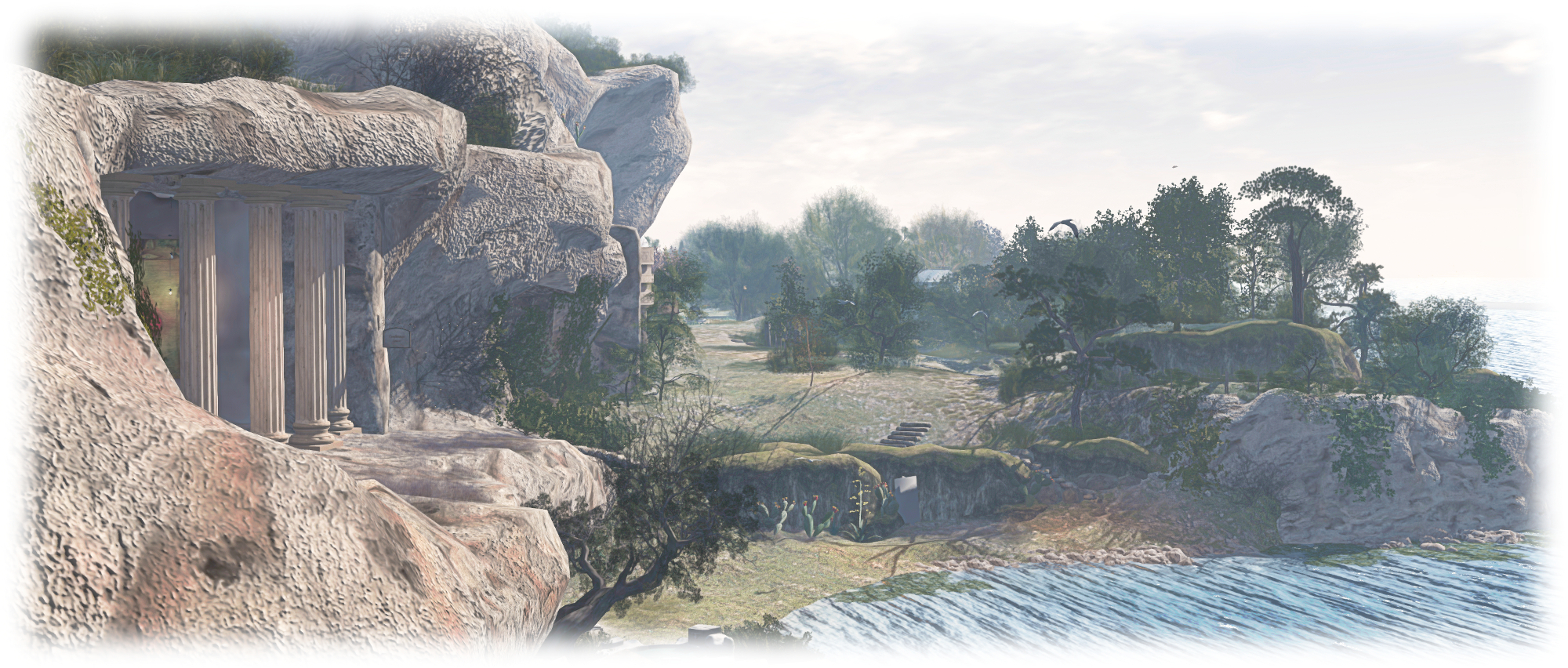
Veer left from the teleport board, and the route takes you through the ruins of a stone-built structure shouldered on either side by blocks of unhewn rock. Two arches stand at the end of the ruins, one offering a path down to a beach watched over by great trees with trunks bent with age to where a board walk cross shallow water to a smaller island. The other arch offers a path to where two old houses stand  above the beach, each reached by its own steps cut into the living rock. Both appear abandoned, and a rough, grassy path arcs between them, passing round a little copse of trees standing between them.

The larger of these two houses sits with its back to a deep gorge cutting south-to-north through the land, a sandbar at its southern extreme preventing the sea from completely splitting the region. A wreck of an old plane lies on the sandbar, and a path from the smaller of the two abandoned houses offers a route over the rocks above the edge of the gorge to where a set of steps drop down to the beach and ‘plane wreck. Alternatively, a wooden bridge spans the gorge from behind the larger of the two houses, linking it with the broad, stepped plateau on the far side. Here, past the windmill and tree house, up the wooden steps and with a little scrambling over rocks, you might find yourself at the front door of the largest house on the island, looking imperiously down at the rest of the scene.

Bay of Dreams; Inara Pey, February 2018, on FlickrBay of Dreams

A second bridge, wide and gated two-thirds of the way along its length, spans another watery charm splitting the land. It offers the way to a grassy shoulder of rock where visitors can either opt to go by way of log bridges down to a secluded beach and beach house, or use a switch back path cut into the rock to descend to where the wrecked aeroplane awaits.

The smaller island to the north-west and mentioned earlier, appears to have once been a centre of commerce. A lighthouse and a huge warehouse rise from the rocky base of the island, vying with one another to be the tallest. Old wharves extend out into the waters from their feet, and two old trawlers are moored in the shallows. But whatever went on here has long since ceased: the buildings are decaying slowly, the wharves falling apart, the waters beneath them fast becoming choked and overgrown with grass and weeds, while falling trunks of great fir trees now pin the old boats under their weight.

Bay of Dreams; Inara Pey, February 2018, on FlickrBay of Dreams

Whether the trees fell due to age, or were cut down might be a matter for debate. However, there is plenty of evidence for them having been brought low by storm and wind to be found elsewhere, while the heavily bent trunks of other trees suggests this is a place subject to extremes in wind, further suggesting it is the elements which are responsible for the damage.

With its rugged outlook, scattering of houses, store and old fishing centre, Bay of Dreams is a visual treat. For those who would like to tarry a while, there are numerous places to sit – indoors and out – to be found, and for photographers, rezzing rights can be enjoyed on joining the local group, although you might want to twiddle with Windlights.  Our thanks to Shakespeare and Max for pointing it out to us!

SLurl Details

The rugged beauty of Cuivieenen in Second Life

Cuivieenen; Inara Pey, February 2018, on FlickrCuivieenen – click any image for full size

Cuivieenen is the name given to a fabulously rural Homestead region designed and presented to Second Life users by Personal Jesus (Alexynophus). We were pointed towards it by Shakespeare and Max (TY, again!), and recently spent a pleasant evening wandering along its roads and paths, discovering its little nooks and crannies and spending time sitting and enjoying the scenery.

The landing point sits just off the region’s centre, just outside an old stone chapel. Where you go from here is – at first glance – a matter of following the unsurfaced roads running through the region, north-to-south, and winding westwards. By just keeping to these roads offers visitors a lot to see: the chapel surrounded by a small farm: cattle, chickens and sheep roam immediately outside of its walls, the wrought iron fence that might once have set it apart from their wanderings having long since have fallen or been removed over the years. And old barn sits behind it, while the role of pastor appears to been given over to a scarecrow, watching over his flock.

Cuivieenen; Inara Pey, February 2018, on FlickrCuivieenen

Turf-roofed cottages sit facing the chapel on two sides from across the roads, dry-stone walls guard the roads, while to the west what might be an old quarry awaits discovery. With each of the cottages being furnished, the exceptional care taken with the landscaping elements, this alone means Cuivieenen offers a lot to see – but keeping to the roads and just hopping into the cottages will reveal everything. For example, walk eastwards past two of the cottages to where the land drops rocky shoulders to the waters below, and you’ll find a path descending to a wooden board walk, which in turn offers a way to a small island  topped by a folly with a special welcome waiting inside.

Make your way around the coastline, and you’ll find other places to explore – the cinder beach to the north, the shallow and deep inlets to the south-east and the south, each of which offers a further eclectic feel to the region, be it through the Norse long-boat, or the Gothic alcove and ancient standing stones (with their retinue of cormorants).

Cuivieenen; Inara Pey, February 2018, on FlickrCuivieenen

Between these, up among the rocks are little places for couples to enjoy: a blanket and pillows spread under a tree, and old cart also with blankets spread in its bed; the ruin of an old boat converted into a shaded rest point on a cinder beach, the canoe floating on the waters of the quarry, or the motorboat moored at the foot of a set of iron stairs descending the northern cliffs. More cosy spots for sitting / cuddling can be found inside the region’s old barn, the ruins of a lighthouse and in the cottages – all of which adds a certain intimacy to any shared visit.

A nice touch with Cuivieenen is the way in which it has been blended with part of a sim surround. This very much gives the impression the region is something like a headland, that beyond the mountain behind it lies more land awaiting discovery. When you bring all of this together – the use of the sim surround, the overall care shown in the region’s design and the attention to detail evident in everything, large and small – Cuivieenen emerges as a place with a huge amount of depth. Although – and I say this cheekily and not as a critique – I had to agree with Caitlyn when she noted the landscape naturally leant itself to a cave or two for explorers to find.

Cuivieenen; Inara Pey, February 2018, on FlickrCuivieenen

One of the things I do when visiting a region is try to imagine where in the physical world it might be. In the case of Cuivieenen, I could not help but be put in mind of Iceland: the rugged landscape, cinder / lava like soil, sparse tree coverage – even the turf-roofed cottages – all put me in mind of various parts of Iceland I’ve been fortunate enough to visit, most notably the Myvatn region.

But howsoever you regard Cuivieenen in relation to physical world locations, its own beauty and design mean it not a place to be missed when region hopping across Second Life.

Cuivieenen; Inara Pey, February 2018, on FlickrCuivieenen

SLurl Details

Melusina’s minimalism in Second Life

DiXmiX Gallery: Melusina Parkin

Less is More is the title of an exhibition of Second Life photography by Melusina Parkin, featured at the basement Womb exhibition space at DiXmiX Gallery and which opened on February 20th, 2018.

As an aphorism, the phrase is most readily associated with the German-America architect, Ludwig Mies van der Rohe, regarded as one of the pioneers of 20th Century modernist architecture, although he appears to have lifted the expression from Robert Browning’s 1855 poem Andrea del Sarto  (also called The Faultless Painter). Van der Rohe used the term to define a form of architecture with a minimal structural framework that could suggest free-flowing open spaces, and which could explore the relationship between people, shelter, and nature.  Given Melu’s own unique approach to photography which very much encompasses the refined, minimalist use of structure balanced against the idea of natural,open space, the aphorism is an ideal title under which to exhibit some of her work. 

DiXmiX Gallery: Melusina Parkin

In all, 18 photographs are displayed in the Womb’s three halls – you can find it by entering the main DiXmiX gallery and making your way to the Black Gallery, where the entrance to the Womb resides. Primarily rendered in soft tones, all of the pieces perfectly exemplify the idea of minimal structure, both in terms of framing – most of the pictures carry an intentional off-centre focus – and in terms of content – the physical structures within the images are minimally presented against a broader backdrop suggestive of open space, whether offered by open water, cloudy sky or a blank wall. 

Also evident in these images, and in keeping with van der Rohe, is another of the architect’s adopted aphorisms: God is in the details. Yes, the over-arching aim of this type of photography is to present something that carries within in minimal structure and balances that structure against the use of space; however, this is something that just “happens”. It requires a measured eye and a flair for making what is actually a painstaking study of places and environments look so naturally easy.

DiXmiX Gallery: Melusina Parkin

Thus, while they might all look effortless in execution, considered study of each of them reveals the care and thought that went into bringing each of them to life. Even the way they have been paired within the three sets of images: views, interiors and bodies, should be considered; Melusina’s attention to detail is evident through this exhibition.So much so, in fact, that I couldn’t help but wonder if with some of the selected images, she’s not also offering a tip of the hat directly to van der Rohe. Looking at two of the images in Bodies (centre image of this article), I found myself thinking about his Farnsworth House design, and its original occupant, Dr. Edith Farnsworth.

Another excellent exhibition from one of my favourite artists in Second Life.

SLurl Details

A return to Chamonix City in Second Life

Chamonix City

With the 2018 Winter Olympics, officially known as the XXIII Olympic Winter Games running from February 8th through until February 25th, 2018 at Pyeongchang County, South Korea, a tweet from fellow SL traveller and writer, Erik Mondrian reminded me that Second Life also has its own winter sports venue in the form of six regions centred on Chamonix City on the Full region of Cross Check. It’s a place I last visited back in 2014, so the current games  and Erik’s tweet put me in the mind to hop back and have another look, and see what may have changed.

Chamonix City  – a reference to the location of the first Winter Olympics Games, held in 1924 – encompasses two of the six regions of this winter sports venue – Cross Check and Neutral Zone. They are bracketed by Breakaway to the west and Off Sides to the east, with Empty Net and Blueliner to the north and south respectively. Within these regions, the facilities on offer are extensive, and can be found both on the ground and up in the air. The city itself is dominated by two huge ice hockey arenas – the Brooks Arena on Blueliner, and the impressive Cleary arena, which straddles the northern part of Cross Check and most of Empty Net. Home to the Chamonix Pandas, Cleary arena also offers 10-pin bowling on the lobby area and one of a number of teleport stations which can be used to hop around the facilities scattered across the six regions.  This includes a direct TP to Brooks Area – although the walk across town is pleasant enough, or there is a subway option, with stations just outside of both arenas.

Chamonix City – Caitlyn tries her hand at curling

Directly behind Brooks Arena is the main curling hall, with four ends available for players. To be honest, some instructions would not go amiss – for example: is actually possible to sweep, and if so, how? However, game play is pretty much as per the physical world game – trying to slide your team’s stones as close as possible to the centre of the house, whilst also seeking to block / eliminate your opposition’s stones. When playing, make sure you wear at least one of the coloured brooms from the free pack available at the top house of each end – order of play is based on who is wearing the broom matching the colour (red or yellow) of the first stone to appear before the hacks (chocks). Clicking on the hacks will position the player and place them in Mouselook, then it is a case of taking aim (use the crosshairs HUD if required), then press and hold the left mouse button to deliver the stone – the longer you hold the button, the more momentum is delivered to the stone, and players should be wary of delivering too much momentum and carrying their stones out-of-bounds.

A faster pace of event can be found in the sky over Breakaway, where the speed skating arena resides.   Slip into a suitably aerodynamic suit, don your skates and then click on one of the speed skating rezzers located around the rink to get started. For those who prefer, there’s an indoor speed skating rink right next door to the outdoor arena. This is smaller and tighter, and requires a certain amount of skill to get around.

Chamonix City Park

Breakaway is also the home of the ski jump and alpine ski run for those who love sports skiing. Comprehensive instructions are given for the ski jump, and skis are available from the rezzer at the back of the jump’ s start. Sadly, the alpine ski rezzer appeared to be out of commission during our visit, so reacquainting myself with that run wasn’t possible.

Offsides, meanwhile, is the home of the snowboarding and bob-sleigh runs. However, at the time of our visit, while the rezzers (boots and board) worked OK for the former, the rezzer for the bob-sleigh also appeared to be out-of-action.

Chamonix City ski jump

At the time of my 2014 visit, there was a practice area in the sky over Neutral Zone, which included a figure skating rink. Since then, things have changed and this sky area is now the home of a go karting track, speedway circle and a Warbugs flying area, offering a set of alternatives to the winter fun across the rest of the regions. I’m not sure if this means the practice area and figure skating rink have been relocated – but I did have (an admittedly fast) hop around and attempt to find them, with no joy – and none of the teleport boards I found and tired led me to them.

A collaborative build, led I believe, by Kacey Rossini, Chamonix City provides a venue rich in winter scenery containing a lot of sports activities which can be enjoyed as a pert of a shared visit, with options as well for exploring the little town centre, having fun flying Warbugs or simply riding the cable cars.

SLurl Details

  • Chamonix City (Cross Check, rated: General, as are all six regions)

The Art Garden Gallery in Second Life

Art Garden Gallery

There are many galleries across Second Life. Some specialise in exhibiting photography and art created within Second Life; others focus on exhibiting the physical world work of artists who have come to Second Life for both social activities and as a means to reach a broader audience for their art. Indeed, such is the number of galleries, that reporting on all of them is a difficult task – but I enjoy hopping around SL looking for the smaller art spaces and discovering the work of artists between new to me and familiar.

One such gallery space, offering ensemble and mixed exhibits is the Art Garden Gallery operated by Fanny FooFoo Miklos (Sloane Cerise) and her partner Thorne Miklos. Located in the sky over the mainland, the gallery is – as its name suggests – presented as a garden environment; in this case a walled garden under a night-time sky.  The landing point is towards the centre of the garden space, with the art displayed on the outer stone walls.

Art Garden Gallery

At the time of my visit, most of the art on display represented physical world pieces by a broad range of artists, including Kaly Iali, Persia Silverblade, Toysoldier Thor, SaraMarie Paul, Shmoo Snook, JudiLynn India, Asmita Duranjaya, Dulcis Taurig, to name a handful. Given such a broad cross-section of artists, it should come as no surprise the art itself was broad in terms of content, style and approach. Some offered studies of flowers, others present landscapes or representations of landscapes, and others are far more abstract in nature. Thus, the gallery offers an eclectic and attractive mix of art for the visitor’s enjoyment.

If I have a complaint at all, is the lack of artist information outside of plaques bearing the name of each piece and the artist’s name. Given that there are so many artists in Second Life, and the ease with which information givers can be set-up, it would be nice to see settings like this do a little more to help inform visitors about the artists behind the works on display; doing so can add further depth to an exhibition.

Art Garden Gallery

At the western end of the gallery space is the Miklos Centre, a smaller space for what appears to be more themed art displays. Again, at the time of my visit, this smaller, enclosed area was home to a display of art and poetry entitled Telephone Walkers. On offer are seven pieces of art and seven poems on the subject of telephone poles. Four of the pictures were produced within Second Life, with the remaining three – by photographer Nils Urqhart and artist David E. Weiner – are of physical world locations. All feature telephone pole – or overhead power lines – either as something of a focal point – as with Ziki Questi’s Bonne Chance 3 and Furillen 1, in orders they are part of the overall image framing, as with In Every Life by Wintergeist and Old Stone Wall by Nordica Torok, while for the rest the poles are almost incidental.

The poems offer a broad range of perspectives on telephone poles,  and combined with the seven images – the numbers are more for balance than any attempt at pairing of specific images with poems – poems and pictures back for a very effective exhibition. I admit to finding Telephone Walkers more engaging than the main gallery space exhibition, partly because it is more contained and focused (and includes work by artists I greatly admire), but also because the poetry draws the visitor into each of the pieces, offering each multiple narratives to be enjoyed.

Art Garden Gallery – Telephone Walkers

I’m not certain how frequently exhibitions change at the rt Garden Gallery, but for those who enjoy visits to smaller, more boutique style galleries which can offer ensemble exhibitions, I recommend a visit.

SLurl Details