Italian artistry in Second Life

Astral Dreams Project

Astral Dreams Project is an exhibition celebrating Italian arts and creativity in Second Life, and to which I was recently invited to seen by the exhibition’s creator, Oema Resident.

“I was asked by Jack Davies and Mina Arcana, (the holders of the famous Astral Dreams region) to work with them to create an artistic project that helps to promote work of Italian artists in Second Life,” Oema informed me ahead of my visit, and framing the exhibition for me.

Astral Dreams Project: Ciottolina Xue

Given Italy’s role in the development of art and artistic expression in all its forms down through the centuries – architecture, painting, sculpture, design, and so on – an exhibition celebrating the work of some of the many Italian artists in Second Life really is appropriate; and Oema, Mina and Jack have clearly endeavoured to fold as many aspects of artistic expression into this installation.

Take, for example, the setting itself. This is a reproduction of the Piazza di Spagna, Rome, one of the most famous squares in that city, dominated by the Trinità dei Monti church located at the top of the Spanish Steps, which descend to the Fontana della Barcaccia. Within the exhibition setting, these elements come from the collections of Italian SL designers Acqua Aria and Dogma9, who are also responsible for the buildings used to represent the rest of the piazza – although a little licence has been taken in places. The Palazzo Barbieri, for example, site to one side of the square. In the physical world it more correctly belongs within  Piazza Bra in Central Verona; but its presence here is very much in keeping with the theme of the project.

Astral Dreams Project: Paola Mills

The square itself presents two rows of boutique gallery spaces for 2D art displays, facing one another across the cobblestones, while the buildings either side of the Spanish Steps (one of which occupies to location of the Keats-Shelley Memorial House) are presented as galleries spaces for the sculptures of Ciottolina Xue and Mistero Hifeng.

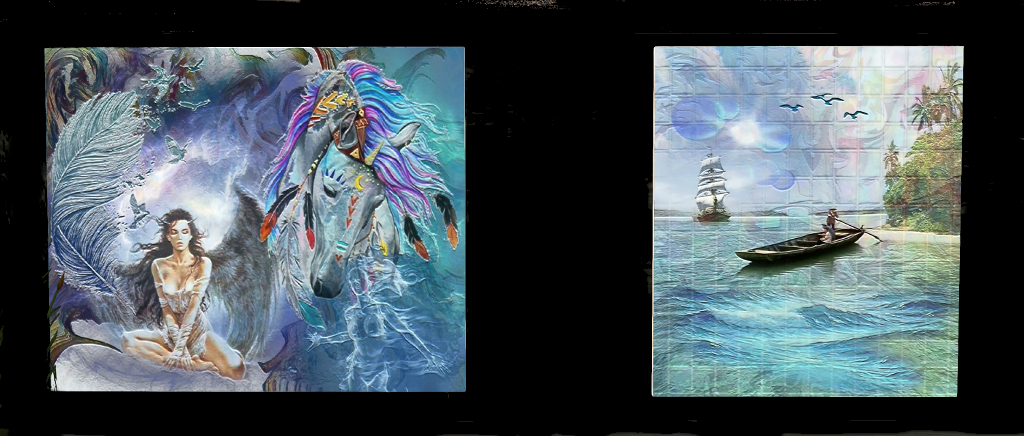
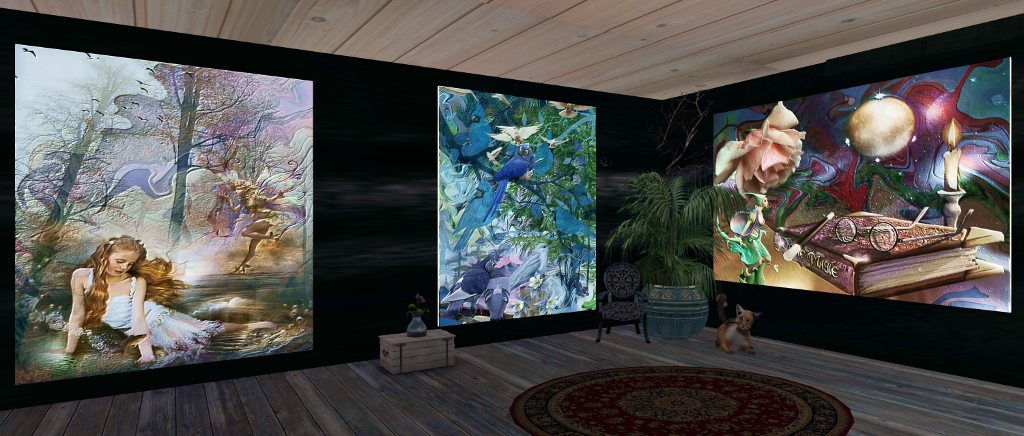
During my visit, the 2D display spaces featured the work of Paola Mills, Lorys Lane, Renior Adder, Desy Falcone, Magda Schmidtzau, Clarisa Congrejo, CandieSheel, Degoya Galthie, Jarla Capalini and Oema herself. I’m not 100% certain if these artists will be rotated with others, or if they will remain on display throughout the life of the project. Oema did indicate to me there are events in the planning to introduce further artists; but this doesn’t necessary mean those currently on display might vanish; there is still room for more.

Astral Dreams Project: Mistero Hifeng

I say this because both the Palazzo Barbieri and the Trinità dei Monti were, at the time of my visit, home to reproductions of classical Italian paintings, so they might yet develop into further gallery spaces for SL artists. If nothing else, the “Coming Soon” sign that was displayed outside the Palazzo Barbieri indicates that this at least would be a further gallery space in the near future.

There is perhaps a slight preponderance of avatar studies among the 2D art currently presented. This is not surprising, given the popularity of this genre of SL photography. However, it does run the risk of overwhelming the eye, and is perhaps why, that among the 2D artists, I found myself repeatedly gravitating towards Renior Adder and Degoya Galthie, both of whom offer quite different displays to the rest (which also should be taken to mean I did not appreciate the art of the other artists around the piazza!).

Astral Dreams Project: Degoya Galthie

I don’t have dates for further openings in the project, but I will be keeping my eye on it to see who else might have their work exhibited – and I certainly recommend it as a worthwhile visit for those who enjoy SL art.

SLurl Details

In the Wild in Second Life

In the Wild; Inara Pey, June 2018, on FlickrIn the Wild – click any image for full size

Update: In the Wild appears to have closed.

Given it is summer in the northern hemisphere and many are experiencing heat waves (even those of us in the UK!), the mind  turns inevitably to holidays and vacations. Often, however, we can’t always just take off to somewhere where the sun and warmth are more fun; but fortunately, there are plenty of places in Second Life that at least give the illusion of escape when we’d all rather be somewhere other than slowing baking in the heat at home.

Take In the Wild, for example. Sitting at the eastern end of the Orchard Heights Estates, it offer local residents and visitors alike the opportunity to escape the demands of physical and virtual life, and simply relax in a parkland setting offering much to see and do. For those seeking a little piece of privacy for a day, it also provides vacation cabins and tents for daily rent.

In the Wild; Inara Pey, June 2018, on FlickrIn the Wild

Designed by Liyora Resident, this is an exceptionally picturesque region, rich in detail with plenty of opportunities for photography and fun. Comprising three islands connected by bridges, the park offers a good mix of land and water, with trails and lookout points on the former, and sampans, bumper boats and kayaks on the latter – there’s even a swimming area with floating slide available, as this is a family friendly park.

The largest island includes the landing point, overlooking the waters and complete with an information board. A long covered bridge links it back to the rest of the estate, reached via a track snaking down the hillside. Above and behind the landing point is one of the park’s rental cabins, sitting atop a high cliff and presenting superb views to the south and north-west. Between landing point and cabin is a second track, pointing the way to the bridge leading to the next of the park’s islands.

In the Wild; Inara Pey, June 2018, on FlickrIn the Wild

This is where the water fun can be found – the swimming circle with its slide, and the bumper boats, together with a couple  of static water vehicles  which give the park a sense of being used, rather than offering actual rides. This is the largest of the island, backed by another high shoulder of rock on which a further cabin sits, guarded by the tower of a windmill and partially overlooking a circular inlet cutting into the lowlands.

Out on a north-eastern headland of the island is a public picnic area offering another fine lookout point, sitting as it does on a shoulder of rock just below another of the park’s cabins and the local lighthouse. Before this headland is  tongue a of land ending in a finger of rock where a further bridge connects to the smallest of the three islands, and home to another holiday cabin as well as the park’s music events area.

In the Wild; Inara Pey, June 2018, on FlickrIn the Wild

As well as the cabins, there are several tens scattered around the islands, also available for daily rent and provided pre-furnished and a modest LI allowance for rezzing props, etc. Paths through the park take a variety of  forms: dirt tracks, wooden board walks and sets of paving stones loosely place across the grass. Like spots offer solo places to sit in the shade of a parasols and. The kayaks mentioned earlier can be obtained via a waterfront rezzer a short walk from the landing point. and come in single and tandem seat versions.

In the Wild can be summarised as a well-designed region, one that is – as already noted – very picturesque. It is certainly well deserving of a visit.

In the Wild; Inara Pey, June 2018, on FlickrIn the Wild

SLurl Details

A Rusted Farm in Second Life

Rusted Farm

Rusted Farm, the latest installation by Terrygold, open on July 6th, 2018. With it, Terrygold leans towards an ecological theme.

Visitors arrive in a tunnel  – actually a drain which might otherwise act as a run off for rain water – where a series of information boards provide notes on preferred viewer settings and provide background notes framing the piece, all of which should be read: just touch the flags below the images to have the notes delivered in text in either English or Italian.

Oil pollution: it’s a contamination of the environment (soil, air and above all water) caused by all kinds of liquid hydrocarbons, i.e. from crude oil or its derivatives. Oil pollution can be systematic or accidental … Systematic or chronic pollution is often much more serious than accidental one. The lumps of tar deposited on the beaches in the seaside resorts derive mostly from the residues contained in the ballast water discharged into the sea.

– Extract from the Rusted Farm introductory notes

Rusted Farm

At the end of this tunnel is a ladder offering the way up out of the drain. To reach it, visitors gain the first hints of the direction in which Terrygold is taking the piece: strange-looking fish circle, watched over by equally curious bugs hovering overhead. At first appearing to be mechanical in nature, it takes a while to realise they might actually  be made up of waste material – rusting metal, discarded bulbs, with dorsal fins looking like deformed plastic six-pack rings, and so on. Beyond these, barrels leak oil into the drain.

The “ground” level, reached via a ladder placed beyond the fish and barrels, is a large field of sun-ripened wheat over which more bizarre creatures stand or fly. Birds look more like drones; ants and spiders again looking as if they are made up of waste and rubbish. Great spherical tanks with spigots are raised on spindly legs or set into the great wall of a building, apparently dripping water onto the field of wheat, giving it life.

The Great Pacific Garbage Patch, also described as the Pacific Trash Vortex, is a gyre of marine debris particles (mostly plastic) in the central North Pacific Ocean. It’s located roughly between 135°W to 155°W and 35°N to 42°N.

Extract from the Rusted Farm introductory notes (from wikipedia)

Rusted Farm

It is a bizarre scene, the field also crossed by pipes and other drains, raised above the crop as if ready to receive liquids. Nevertheless it is one, with the backdrop of a setting sun, seems innocuous outside of the initial framing of the information boards. Looking at the strange ants, birds and spider, it’s easy to put it all down to artistic licence.

However, dominating all of this is the flank of that huge building, in which a tiny door sits, reached by climbing one of the pipes and then walking along it. Opening this door and touching the blank wall beyond it to activate a teleport, reveals the truth of matters. Giant pipes sit within the walls of this building, rusted, ugly and dripping huge gobs of brown liquid – oil waste, contaminated water, take your pick as to what it might be; the key point is at least some of it is being delivered to collection drains which then carry it away and into the soil being used to grow the wheat.

Thus it is that we have the complete picture: fish, birds, insects a metaphor for the waste products we’re dumping into the world’s oceans, burying in landfills, and so on; the pipes and liquid waste a reminder of the waste products we let contaminate the land and which, ultimately, enter our food chain (as represented by the wheat). And it is apt that among the bizarre creatures we find in Rusted Farm Terrygold has included a deep ocean angler fish, highlighting the fact that while we tend to point to things like the Great Pacific Garbage Patch (estimated to possibly range between  700,000 sq km / 270,000 sq mi and 15,000,000 sq km / 5,800,000 sq mi in area – that’s between Texas and Russia in size), the impact of plastic pollution on the sea floor / deep ocean is still largely unknown.

Rusted Farm

A possibly dark installation in theme, but one intended to prick the conscience, Rusted Farm is also a curious mix. Despite the underpinning message, when taken on its own, the wheat field with its strangely crafted insects and birds is from some angles almost a garden of sculptures ready to be appreciated in their own right.

SLurl Details

A visit to Another Planet in Second Life

Cica Ghost: Another Planet

Cica Ghost opened her latest region-sized installation on Wednesday, July 4th, 2018, offering visitor the chance to visit Another Planet, a place where aliens roam free under the arches of strange landforms (are they mineral? Are they vegetable?), and where rocks – perhaps asteroids that were once falling from space – float serenely above various points in the scene, held aloft by invisible forces.

It is a strange landscape, in places pockmarked by tiny impact craters in the sand; in others the rock is covered in a an irregular pattern of indentations that from a distance almost look like they are indented scales on a skin. The strange “growths” rising from this gently rolling land also in places show signs of weathering by meteor strikes, suggesting they were once a part of the ground from which they rise. Here and there, odd circular protrusions rise and fall, as if breathing in a steady rhythm.

Cica Ghost: Another Planet

The aliens here come – if you discount human avatars (and who are perhaps more correctly the aliens within this environment) – two forms. There are strange, slug-like creatures with large, black eyes set either side of a small hooked proboscis, their bodies expanding an contracting along their length, even though they don’t move. Then there are the smaller creatures, who stand upright on ribbed conical bodies. They also have large eyes set into their round heads – perhaps indicative of the low lighting common to this world.

Despite seemingly without arms, these smaller aliens appear to have a degree of technological mastery; there are hover bikes and flying barges moving around the landscape, perfectly suited to transporting one or two them around (or indeed, one or two human avatars should you opt to sit on them – and if they don’t take your fancy, there is also a floating platform drifting around the sky). And as flying around may not appeal to all of them, some have apparently developed a form of television, and have gathered around it eagerly, some giving vent to very human frowns directed at others, possibly because their view was temporarily blocked.

Or… perhaps the television and the flying machines are the remnants of another time and civilisation? Who can say?

Cica Ghost: Another Planet

Visitors to the region are presented with a choice: to explore in their default form / look, or grab a free alien disguise from the vendor at the landing point. For those seriously interested in exobiology studies, the alien disguise is a must, helping you to blend in. And by “exobiology studies”, I mean having a little fun.

Another Planet is  a further marvellous, whimsical installation by Cica; one which comes – as do most of her designs – with a quote. It’s from English author, humorist and musician, Benny Bellamacina:

Find out if you’re still human, observe yourself from another planet

Cica Ghost: Another Planet

It’s an interesting quote, intended to give us pause and remember who we are. At a time when so much discomfort and hurt is being caused to so many around the world – the displaced, those seeking refuge, the lost – both in their own countries and those where they had hoped to find rest, help, and support, it’s perhaps a fitting little poke at our individual and collective consciousness; a reminder of what we should be to our fellow human beings.

Whether you opt to think on deeper things or to simply sit back and enjoy, Another Planet once again illustrates the magic of Cica’s imagination – which should be enough in itself to encourage a visit.

SLurl Details

Abandoned Abandale in Second Life

Abandale; Inara Pey, July 2018, on FlickrAbandale – click any image for full size

Update: Abandale has closed. The SLurls in this article have therefore been removed.

Somewhere, along some coastal road, perhaps hidden under the shade of trees or easily missed as it tries to compete with the stunning ocean vista on the other side of the road, an ageing, fading sign points the way down a turn off and is stencilled with a single word, fading with age: Abandale.

Take the turn, and the road gradually becomes more and more decrepit until, just as the idea of turning back and forgetting curiosity’s call, it arrives at a narrow stretch of coastline caught between sea and undulated shoulders of rock. Here sits a place where the black top finally gives up, and an old cargo container offers itself as a makeshift bridge spanning a narrow finger of water, the original crossing perhaps only a ford. It is the setting for the remnants of Abandale, a little town lost from civilisation and forgotten by time.

Abandale; Inara Pey, July 2018, on FlickrAbandale

There’s not much here to commend itself to visitors seeking comfort – all that’s left of the motel which may once have  stood at the town’s edge is the entranceway and the front office. Whether the rest was demolished or fell prey to a violent storm – the place stands almost on the edge of the land – is hard to say.

Beyond a curtain of trees from this, and reached by a wooden board walk, sits the ruins of a large building. But it doesn’t appear to be part of the motel; its general shape and the large gates sitting to one side suggest it was once a house, possibly part of a farm, going by the broken windmill and barn close by.

Abandale; Inara Pey, July 2018, on FlickrAbandale

The town’s bar, however, does survive intact. It faces the ruins of the house across what’s left of the main road, but the sign confirming it is open for business may not carry quite the assurance the proprietor likely hopes. Certainly, the detritus of other human habitation before it doesn’t offer a comforting invitation.

Across the narrow channel of water the intrepid explorer can find more signs of former habitation: a long abandoned and broken little fun fair shaded from the sun by a tower of rock, the ruin of an old chapel sitting on the other side of the road and reached via an old track. A second track offers passage up to the hills to where a run-down cabin sits.

Abandale; Inara Pey, July 2018, on FlickrAbandale

To the west of this, down on the coast, sits a beaches – perhaps the one place that offers an almost pleasant greeting for those who find it; certainly, someone has opted to set-up camp close by and avail themselves of the bar and volleyball. Perhaps whoever it is owners the rather pristine motorbike parked outside the old town’s garage, and they’ve found what’s left of Abandale a cosy enough place to rest from their own travels…

Designed by Dominique Redfield, Abandale occupies half a Homestead region and offers SL visitors something just that little bit different. Poetic licence on how to reach it aside, a visit begins up on the hills marking the parcel’s southern boundary, a switch back path offering a way down to the ruins of the house mentioned above, as a well as presenting a short walk along the cliff-tops to a high placed little wooden snug.

Abandale; Inara Pey, July 2018, on FlickrAbandale

There is a ramshackle, ageing charm to Abandale, with plenty of room to explore and for photography. True, some of the landscaping is a little rough (I’d personally have avoided laying the dirt tracks up the slope to the cabin, or at least worked the land a little more to help blend the edges of the track more with the rocks and shrubs), but there’s nothing here to really spoil the time spent in visiting it.

For those who enjoy atmospheric settings for their photography and who enjoy experimenting with their windlight settings to define a desired result, Abandale offers plenty of scope (and has its own Flickr group). Similarly, those looking for places to sit and relax in a “country grunge” type of setting, will find plenty of such places here as well, from the beaches to the aforementioned cliff-top shelter.

Abandale; Inara Pey, July 2018, on FlickrAbandale

Return to Chouchou and a musical crossing of the divide

ChouchouMemento Mori

One of the places I’d always enjoyed visiting in Second Life – although I admit it’s been getting on for 4 years since I was last there – is the paired regions of Chouchou, Chouchou V. These form the in-world base for the musical pairing of Japanese pianist arabesque Choche and vocalist Juliet Heberle, together also known and Chouchou. Over the years they gained a strong following in-world and have produced a number of CDs of their musical and original compositions, with samples and tracks showcased through their YouTube channel.

I first blogged about Chouchou – the region – far back in 2012, and it is both surprising and gratifying as to how little has changed over the years. The ground level setting, with its sand banks, shallow waters and teleport ladder rising into the sky remains always as it was, offering a haven of peace presided over by the duet’s music (do have the music stream enabled when visiting).

Chouchou

The teleport ladder provides access to two areas in the sky (both of which can also be reached via direct teleport as weell – SLurls at the end of this article): Islamey and Memento Mori (a third area, Babel, sadly seems to have sadly disappeared at some point in the past).

Islamey offers something of a traditional Japanese garden look, with teahouse built over water and walks under cherry blossoms, all sitting beneath a bright blue sky. This was once the venue for concerts – but to be honest, I’m not sure if this is still the case. But even if not, as I noted far back in 2012, it is a place of quiet contemplation where you can come when you want to give free passage to thoughts and ideas, or when you simply want to find peace and let Chouchou’s music soothe you gently.

ChouchouIslamey

Memento Mori is a place that used to draw me a lot because it is a magnificent build styled after the great medieval cathedrals, and that simply must be seen to be appreciated. It may appear to be a startlingly bright environment when first arriving,  but it is well worth leaving the default windlight set while climbing the stairs from the arrival point up into the cathedral’s great nave; the way the jet black piano is revealed through the surrounding light is almost transcendental in feeling and perfectly suited to the setting.

The intricacy of this build – a joint work dating from 2010 by Juliet collaborating with Miya Grut and with the support of Yuki Aabye for some to the sculpt work – is completely mind-blowing: From the sheer size of the cathedral, through the curling stairways leading to the upper passages, the great bell suspended over the piano as it sits within the space below the great tower to the ghostly pews between the nave and the two outer aisles, the beauty here tends to leave the visitor in awe. It is genuinely a place that has to be visited and seen, rather than written about and photographed.

ChouchouMemento Mori

I was actually drawn back to Chouchou for two reasons. Firstly, to witness Memento Mori once more, simply because it has been so long since my last visit. Secondly, and, more particularly, because reader Silvana Silk e-mailed me with a link to a recent video on Chouchou’s YouTube channel announcing a new set of concerts by arabesque Choche.

A noted and respected classical pianist going by the name of Michal Horák in the physical world, he will – for the first time – be giving a series of concerts in Japan under both his physical world name and his Second Life avatar name. As the notice with the video states:

Up until now, arabesque has been working not only as a composer and a pianist of Chouchou, but also as a classical pianist under his real name Michal Horák. And this fall, for the first time the two names will be combined together. He will have the first piano concert under two names with this title “Michal Horák/arabesque Choche Piano Concert.” The concerts will be held in Tokyo, Osaka and Kagoshima, and Chouchou’s new and second piano album “piano02 opus” expected to be released on December, 2018 will be on presale at the concert venues.

Tickets for the concerts are on sale, and there are links in the video description (in Japanese) to the concert venues – I only with I was in a position to attend one of them. As I’m not, and to mark the occasion in my own small way, I’ve put together a video of Memento Mori. I hope you’ll enjoy it and use it as a reason to visit / return to Chouchou.

SLurl Details and Links