La Galerie D’angle in Second Life

La Galerie D’angle: Donna Giordano

Officially opening on Tuesday, May 28th, 2019 with a special celebration starting at 18:00 SLT, is La Galerie D’angle, curated by Mary Zimmer. On display is a exhibition of art by Donna Giordano (Ohsoleomio), and it’s an intriguing exhibition for an inaugural event.

An abstract artist in the physical world, Donna presents almost 30 pieces of her art, the majority of which offer rich rich palettes of colour and wonderfully abstract images that offer suggestions of a sunset on water, fields in the breeze, coastal landscapes and what might be storm-struck rocks – or lightning-split clouds, sailing ships on the ocean, and more.

La Galerie D’angle: Donna Giordano

Mixed with these are pieces that have a wonderful geometric look and feel to them and mosaics with a depth of colour within them that makes their texture almost tactile in its richness.

As some who appreciates abstract art, these are pictures which hold a strong appeal; but while the colour images have a marvellous attraction, I admit to being deeply drawn to the monochrome images there is a depth and rawness that is stunning. In this I would particularly single out Perfect Storm, the aforementioned piece depicting what might be lightning and storm clouds or foam-topped waves crashing against rocks.

La Galerie D’angle: Donna Giordano

This is a superb exhibition with which to open a new gallery, pieces that invite the imagination to take flight. I wish Mary every success with her venture. Those wishing to celebrate the opening with her can do so from 18:00 SLT on May 28th, with music from Bill Tigerpaw, who will be followed a 19:00 by Djembe Dragonfire before DJ Skip takes over from 20:00.

SLurl Details

The Mill at Lemon Beach in Second Life

The Mill, Lemon Beach; Inara Pey, May 2019, on FlickrThe Mill, Lemon Beach – click any image for full size

Lemon Beach has seen many designs from various region holders over the years, some of which have been documented in this blog (see here, and here, and here and here, for example). The region is currently under the care of Sylvana Dench, who follows the tradition in offering it for the enjoyment of visitors as The Mill.

This is a wonderfully provincial setting that has hints of France about it, although to me it could perhaps easily be anywhere along the coasts of Belgium, The Netherlands, Denmark or Germany. Low-lying, the region, whilst a island, had an almost headland feel to it; a finger of land tickling the sea, a place where farmlands give way to sands and salt water.

The Mill, Lemon Beach; Inara Pey, May 2019, on FlickrThe Mill, Lemon Beach

The landing point sit off to the north-east, close to the edge of the region. A sign bids a warm welcome, framed by a small lighthouse sitting just off the coast. A further welcome is offered by a little café sitting close by, sitting under a thatched roof – although as we walked by, I couldn’t help but wonder if the smell from the fishmonger across the narrow track of a road might not be a little off-putting to patrons should the breeze be in the wrong direction!

A small cottage sits alongside the fishmonger’s barn, perhaps his home, while a larger house sits on a bend in the road, while the titular mill rises from a small rise in the land just behind the café and its little farm shop. Taken together, and with both sheep grazing on the coastal grass not too far away and the large meadow behind the house where horses frolic, this little grouping of mill, café and house all have the feel of being perhaps owned by the one family.

The Mill, Lemon Beach; Inara Pey, May 2019, on FlickrThe Mill, Lemon Beach

They, and the fishmonger’s house and barn, are not the only buildings here, however. Scattered across the landscape is a walled farmhouse, an old Tuscan-style villa converted to a place of business and another little cottage daintily fronted by walled flowerbeds, all awaiting discovery.

They are all easily reached by following the track that leads southwards away from the landing point. Meanwhile, and further westward, sit a couple of properties that might be holiday homes for those fortunate enough to be able to have a getaway sitting on the coast. One of these sits just off-shore to the south-west, and given it is within its own parcel, it might be intended for private ownership in the future – although at the time of our visit it was open to the public.

The Mill, Lemon Beach; Inara Pey, May 2019, on FlickrThe Mill, Lemon Beach

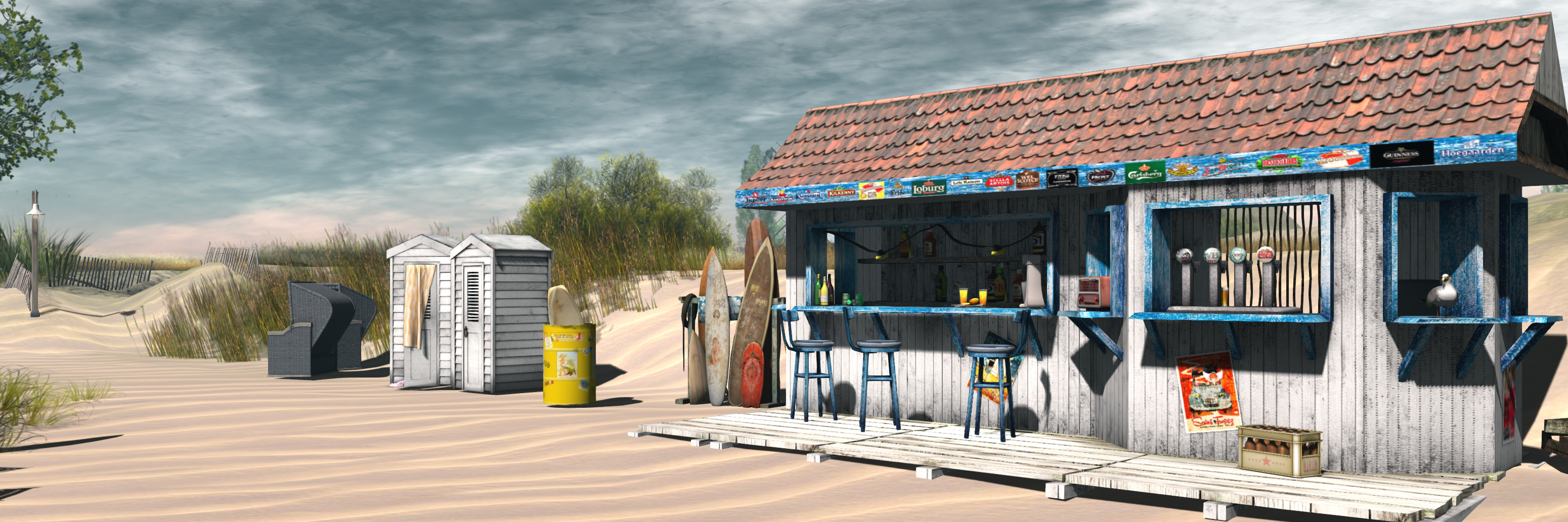
The second house sits above the western beach and is clearly set for private occupancy, as demonstrated by the ban lines that become visible should you stray too close. However, it shares a stretch of beach with plenty of room for wandering or sitting, and which also features a bar and what might be a cosy surfer’s shack. Surf boards (traditional and wind) sit on the shore, but aren’t open for public use.

With it sheep and cows grazing peacefully, horses enjoying the freedom of their meadow and with a delightful sound scape, The Mill offers an inviting visit with enough to see and appreciate without it feeling overcrowded or putting undue load on the viewer. Yes, there are a few details that could be tidied a little, notably some of the floating bric-a-brac around the antiques store (or perhaps that’s the influence of the slightly creepy doll sitting on one of the benches outside! 🙂 ), but these are small enough so as not to unduly spoil things.

The Mill, Lemon Beach; Inara Pey, May 2019, on FlickrThe Mill, Lemon Beach

And while the surf boards might not be available for use by visitors, this is an excellent place to for horse riding, if you have a wearable Animesh horse; while those who might be disappointed he surf boards can’t be used might want to keep an eye out for the little boat with an outboard motor, as it can be used for pootling around the coast; just keep an eye out for the odd Orca and bather!

Our thanks to Shawn Shakespeare for the LM!

SLurl Details

  • The Mill (Lemon Beach, rated: Moderate)

Finding Kusama with Cecilia Nansen in Second Life

DiXmiX Gallery: Cecilia Nansen

Finding Kusama is the title of Cecilia Nansen’s latest exhibition, which is currently being hosted by DiXmiX Gallery, curated by Dixmix Source.

I’ve long been an admirer of Cecilia’s photography. She has an evocative, emotive style that offers a rich vein of narrative – but Finding Kusama is something of a departure from Cecilia’s usual approach to her work, as she herself notes.

Kusama came to me with her dots, dots, dots and what I admire so much in art myself; femininity, minimalism, simplicity and clean lines. Meeting her, I knew I had to ‘play with her’ and find my inspiration in her universe. Pop art is not my usual style, but Kusama pulled me in. She made my brain bubble in ideas, like a child with a hundred pastels and a brush.

– Cecilia Nansen on Finding Kusama

DiXmiX Gallery: Cecilia Nansen

The Kusama in question is Yayoi Kusama, the Japanese contemporary artist most noted for her work in sculpture, but is also active in painting, performance, film, fashion, poetry, fiction and other arts. As a conceptual artist, she blends multiple approaches and styles – particularly abstract expressionism – and is regarded as one of the most important and influential artists to emerge from modern Japan.

A particular trademark with Kusama’s work is her use of polka dots, and this is very much reflected within Finding Kusama. Seven of the 12 pieces in this collection offer bright, vibrant pieces rich in the use of polka dots, each with a degree of minimalism Kusama herself would appreciate. There is a wonderful sense of fun about these pieces  – which again, is precisely what Cecilia intends.

The remaining five images in the collection are monochrome, and while continuing the minimalist approach, they are split between those echoing the polka dot theme with its lightness, and some that plumb a deeper, more personal depth for Cecilia, and which reflect a situation she recently passed through.

DiXmiX Gallery: Cecilia Nansen

As both a celebration of Kusama’s art and an exhibition of Cecilia’s own evocative and introspective art, Finding Kusama is not to be missed.

SLurl Details

Offering Atonement in Second Life

Atonement; Inara Pey, May 2019, on FlickrAtonement – click any image for full size

Update, August 20th: Atonement has closed and the region cleared. SLurls in this article have therefore been removed.

Occupying the full private island aptly named Canyon Creek, and making use of the additional full region land capacity bonus, Atonement is a relatively new – and utterly stunning – rental / public region.

We were pointed towards it by a number of friends, including MorganaCarter, Miro Collas and Shawn Shakespeare – and our thanks to everyone who did so.

Atonement; Inara Pey, May 2019, on FlickrAtonement

Designed by Aiden Caudron and Zomborg Vollmar, the region comes with an intriguing description:

An overgrown forest sim that has been abandoned overtime leaving homes buried between thick brush and twisted vines. You can find residential properties scattered around the sim with enhanced privacy provided by mother nature. Hidden caves leading to special destinations within the sim. Blogger friendly.

Atonement; Inara Pey, May 2019, on FlickrAtonement

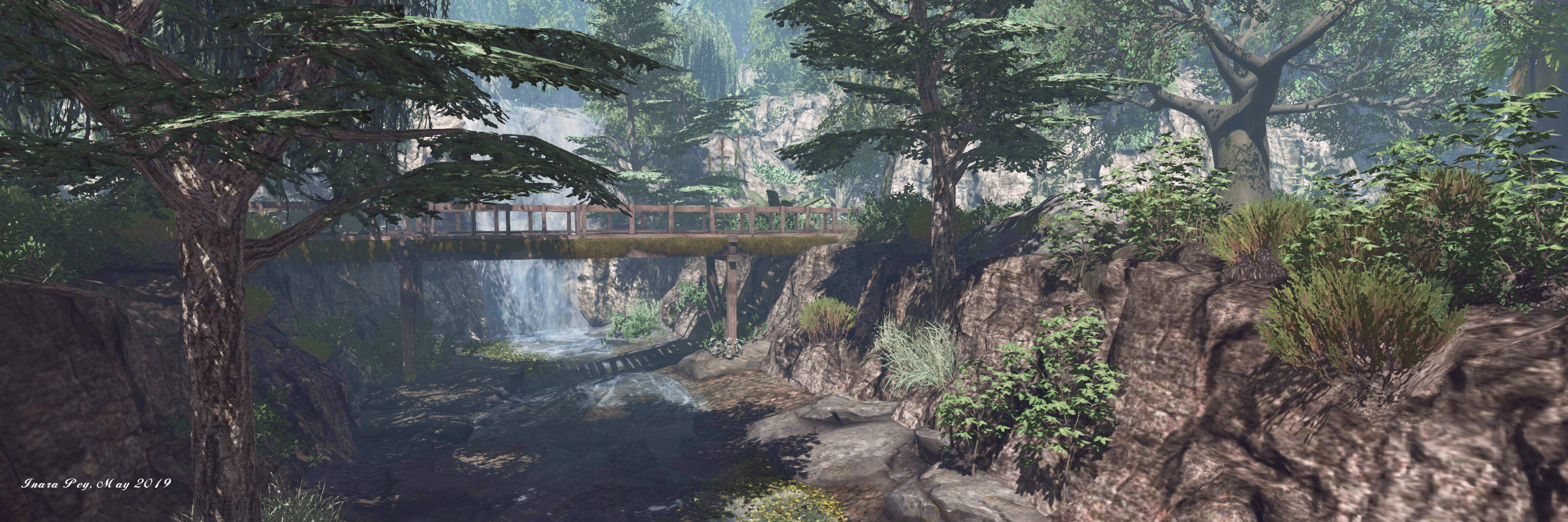
This is a region that is perhaps best not described as experienced. Represented a mountainous region, far off in the wilds, it’s easy to imagine coming across Atonement in the Rockies of North America, and its elevated setting is given an added sense of depth through the careful positioning of region landscaping and sim surround, such that from most viewing angles within the region, the two appear to blend seamlessly together in to whole as the mountains rise beyond the tree line.

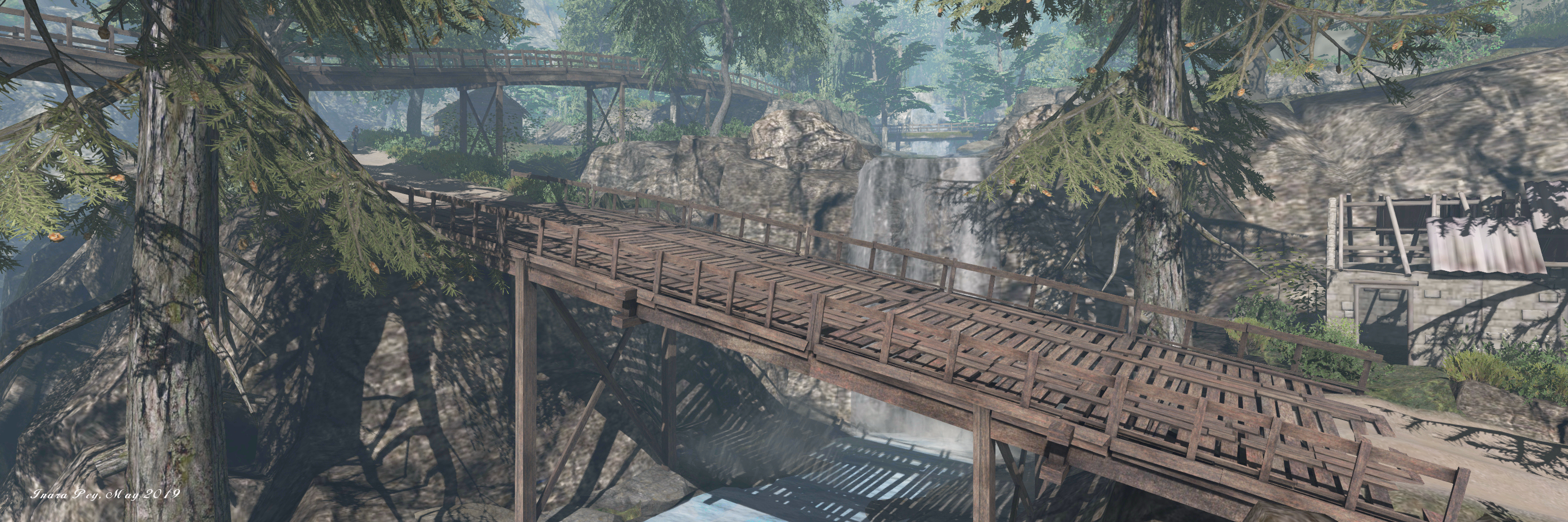
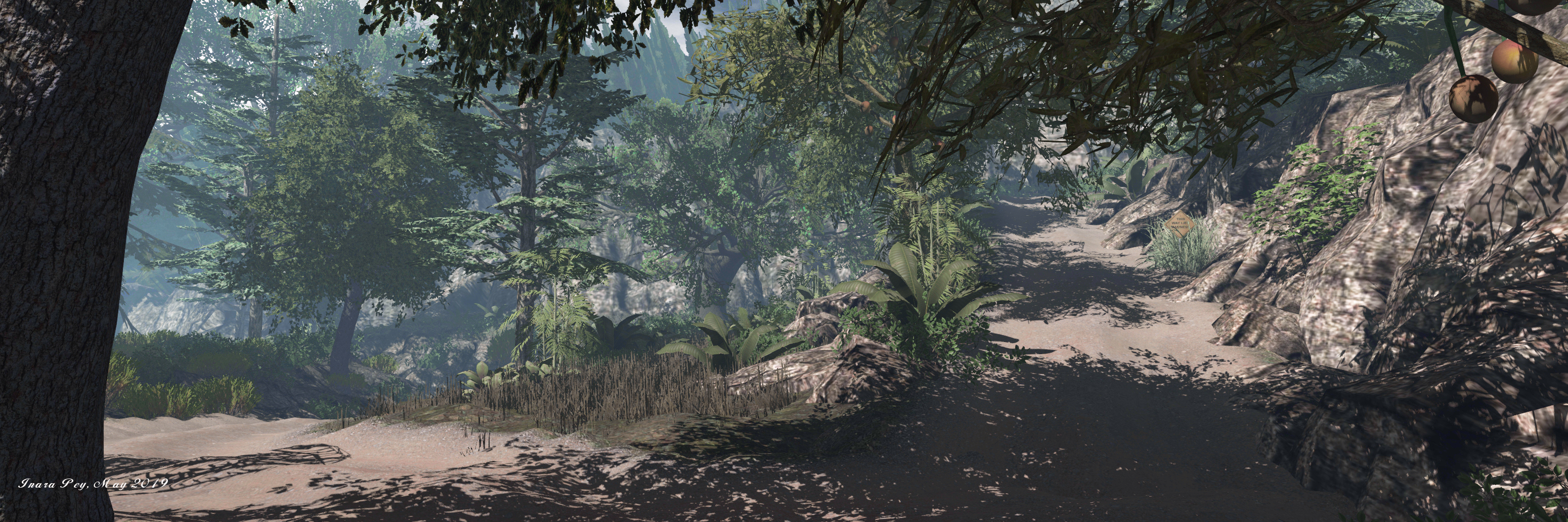
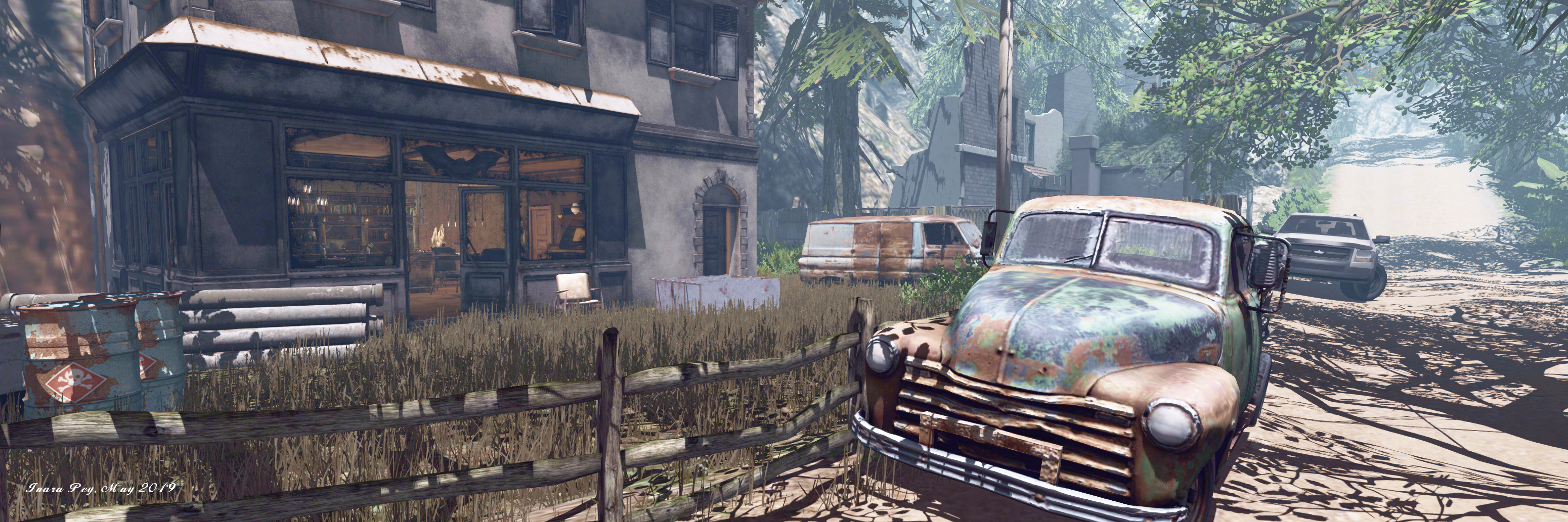
Falling from east to west in a series of tiers, a single narrow gorge, feed by tumbling falls and fast-flowing waters, the region is as the description states: richly forested and with a feeling of abandonment. The road winding through it is unpaved, footpaths are bare rock, the grass tall and wild where trees aren’t casting their shadows. Throughout all this are houses and buildings that have all seen better days, the bridges offering links between roads and paths looking as though they could perhaps benefit from a little TLC.

Atonement; Inara Pey, May 2019, on FlickrAtonement

Many of the houses are available for rent – so exploring with care is advised to avoid accidental trespass should any be occupied at the time of a visit. Elsewhere – such as the local pub – which most certainly has seen better days – there are twists of whimsy and humour that when discovered, are an unexpected delight.

Perfectly photogenic, the region’s mystique is given further depth by the question of why it should be here. Why locate a small town so deep in the rocky wilds? Perhaps the answer lies within the network of tunnels and caverns awaiting discovery  – be sure to accept your torch at the landing point. While appearing entirely natural, there is a hint that perhaps they might have once been worked, perhaps for mining gold or silver or something else equally enticing to the hands and pockets of humans.

Atonement; Inara Pey, May 2019, on FlickrAtonement

Although to be found throughout the region are places t be enjoyed when visiting, such as the rusting metal carcass of an old observatory far up at what is effectively the region’s peak: a table of rock that the old conservatory shares with a radio mast. Within the old frame can be found a cosy setting that is both at odd with, yet complimentary to, the overgrown interior of the old building. Elsewhere, those who explore far enough might find a games room / clubhouse, and there’s also the aforementioned pub.

Beautifully conceived and executed, Atonement can be a little taxing on systems if you’re running with a lot of the viewer’s bells and whistles active. however, it more than counters for this with its detail, unique approach and highly photogenic nature.

Atonement; Inara Pey, May 2019, on FlickrAtonement

Love at Artful Expressions in Second Life

Artful Expressions: Kazrakk

Love is the title of the latest exhibition of photography to go on display at Sorcha Sanvean’s (Sorcha Tyles’) boutique-style Artful Expressions Gallery. Featuring the work of Australian photographer Kazrakk,  the exhibition present six engaging pieces that offer insight into the many facets of the love between two people.

Featuring Kazrakk and his SL partner, Ninna, as the subjects in all six images, Love also might be seen as offering a window into their own relationship. There is something very personal about each of the photographs within this selection that embraces tenderness and lover – but which does not, by any measure leave the viewer feeling discomfited by thoughts of being a voyeur; even the images featuring near full-body nudity have a tenderness and grace within them that imbues of a feeling of sharing, rather than that of intrusion.

Artful Expressions: Kazrakk

Presented in both colour and monochrome, there are pieces that perfectly showcase Kazrakk’s ability to frame a moment in time, each picture captivating in both style and in narrative. There is a richness with each piece, whether it is focused solely on the avatars themselves, as three of the pieces are; or whether it offers a broader canvas, where the background plays a role in setting the tone of the narrative (the two here using Norderney and Chochou’s Memento Mori to marvellous effect); or whether it is an expression of pure artistic styling that offers a unique perspective on love and attraction, as seen in the first piece in the series, simply referred to as nr. 1.

Love is a small exhibition, true, but it is also one that leaves you wanting to see more of Kazrakk’s work, and this can be done by visiting his Flickr photostream. Now set within its new mainland home, Artful Expressions once again offers an alluring and engaging exhibit.

SLurl Details

Kun-Tei-Ner: a water world in Second Life

Kun-Tei-Ner; Inara Pey, May 2019, on FlickrKun-Tei-Ner – click any image for full size

Update: in keeping with Lotus and Fred offers different regions designs through the year and at different locations, Kun-Tei-Ner has closed. Slurls have therefore been removed from this article.

Kun-Tei-Ner is the name of the latest region design by the combined talents of Lotus Mastroianni and Fred Hamilton (frecoi). Between them, Lotus and Fred have been core parts of the design teams behind the likes of The Missing Whale (see The Missing Whale in Second Life), Little Havana (see A trip to Havana, with a little Voodoo In My Blood) and, most recently HoPe (HoPe: a world without humankind). In some ways, Kun-Tei-Ner, which opened on May 19th, 2019, is a continuation of HoPe.

With HoPe, we were presented with an environment that had suffered some kind of catastrophe, at least one part of which appeared to have been some form of natural disaster. In Kun-Tei-Ner, the theme of the natural disaster / event is continued, with the world apparently having suffered a massive ecological and environmental change, leaving it pretty much a water world, as the description of the region explains:

This is a place years ahead of us with no land. Humans have produced a lot of things…and many things are [now] useless. A city grows up on a huge mountain of containers filled with broken technological stuff, abandoned or fallen from ships.

Kun-Tei-Ner; Inara Pey, May 2019, on FlickrKun-Tei-Ner

And so it is that we are invited into one of the most unique and original environments currently to be found in Second Life: a marvellous mini archipelago of tall, close-packed islands rising from the sea, built from shipping containers gathered from who-knows-where, brought together to create the shoreline, hills, apartments and places of commerce this corner of humanity’s survivors treat as home.

Stacked together like Lego® bricks – and almost as colourful – the containers form everything one might expect from a close-packed group of islets: there are high peaks, valleys, ocean fronts, low-lying “flatlands” … Yes, all are obviously painted metals, but attempts have clearly been made to make things look more natural and return a hint of nature to the setting, with ivy and vines strung from the sides of some containers, well clear of where they might otherwise be splashed and contaminated by salt water.

Kun-Tei-Ner; Inara Pey, May 2019, on FlickrKun-Tei-Ner

The containers that have been converted into homes have had holes cut into their sides or have had their end or doors removed, the holes replaced by wooden frames, sliding doors, and windows cut from what looks to be sheets of acetate plastic. Others offer places of commerce: a pizza bar here, an little Japanese-style food market there ….

These, with their lit neon signs, at first look incongruous given the overall theme of the setting, but it is clear that power is not an issue here: the upper reaches of the container “hills” are lit by flashing neon billboards, and someone has taken the opportunity to place traditional wooden advertising hoardings up as well. Perhaps some of the power for the neons signs comes from the wind turbines sitting just of the “coast” of these iron islands, but there are signs of other industrial activity as well: great pipes rise from the waters to plug themselves into containers, while others run from one set of containers to another as a tall smoke stack belches orange smoke to drift in the wind.

Kun-Tei-Ner; Inara Pey, May 2019, on FlickrKun-Tei-Ner

It is clear from this that there is some form of heavy plant hidden within some of the stacked containers. Does it provide power? is it helping to grow foodstuffs hidden by corrugated steel walls? That’s up for you as a visitor to decide. There are other signs that technology has survived as well: a large satellite communication dish points its eye towards a spot in the sky, while a satellite receiver appears to be obtaining video signals from another orbital system.

Finding your way around the islands is a matter of following the LED arrows on the floors and walls of the containers, while bridges formed from wood and rope, open-ended container and metal gantries connect the different islands. The arrows point to multiple routes and passages around the islands, making exploration a walk of discovery, at least some of which is observed from above by a flying sculpture of a whale shark.

Kun-Tei-Ner; Inara Pey, May 2019, on FlickrKun-Tei-Ner

The paths offer a lot to see, from the interiors of the living containers, to the food market and pizza bar to multiple places to sit, indoors and out. They can also offer plenty of opportunities for photography.. Just be sure to give the region the time it deserves when visiting.

The region designs by Lotus and Fred are generally available for around a month before they kick-off their next project. So, in case that will be so for Kun-Tei-Ner, a visit sooner than later might be advisable to avoid missing what is – as noted – a fascinating setting worthy of exploration.