Open through until November 23rd 2019 at Ce Soir Arts, curated and operated by Mireille and Ǣon Jenvieve-Woodford, is the Mad Masquerade art exhibition, another opportunity to enjoy a wealth of art among the galleries and grounds of this Full region devoted to the arts in Second Life. I admit to getting to this review a little on the late side – the accompanying season of live and spoken word events has come to an end -, but this doesn’t lessen the value in visiting Ce Soir to enjoy the art on display.
This year’s event comprises some twenty-two 2D and 3D artists displaying their work, and if that sounds a lot to take in, then worry not; the fact that the entire region is given over to displaying art means the art is neatly split up over all of the ground-level space, offering plenty of opportunities to wander, relax and come across art quite unexpectedly within the grounds as well as the gallery buildings, so there’s never a feeling of being overwhelmed by the volume of art on offer.
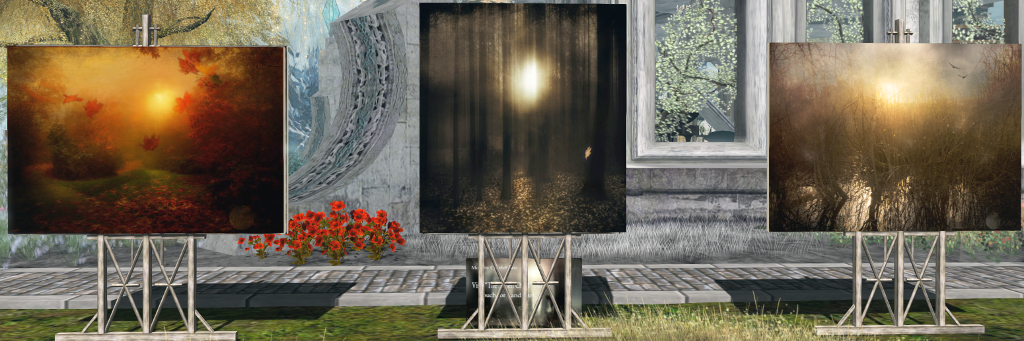
Ce Soir Gallery – CybeleMoon
The featured artists at the exhibition comprise:
Cote de la Mer Gallery: Isabel Hermano, JudiLynn India, Larke Longmeadow, Xirana Oximoxi and Mathilde Vhargon.
Ivy Tower Galerie: Dolph Beornssen, Carlotta Caewlin, Paula Cloudpainter, Xanthe Firehawk, Secret Rage and Michael Romani.
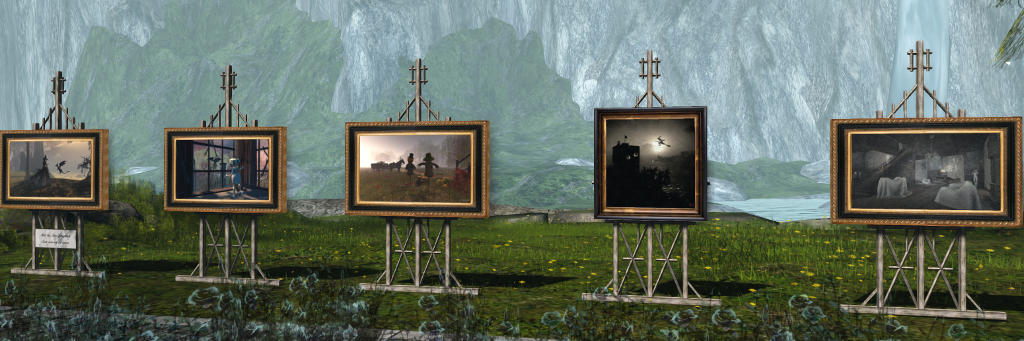
Misty Glen Gallery: Carlotta Caewlin, Sophie Dunn, Mireille Jenvieve, Larke Longmeadow and Liam Saxony, together with a machinina by Terra Merhyem. Click the board outside the gallery space to obtain note card with the URL to the video on Vimeo.
Ce Soir Gallery – H0n2a-Resident
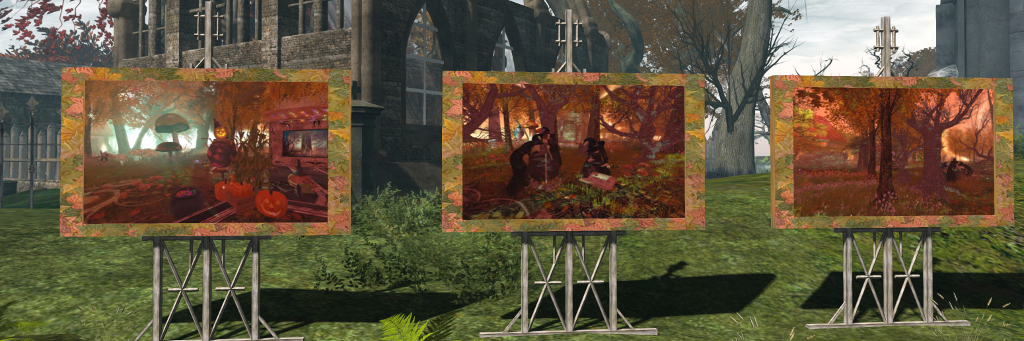
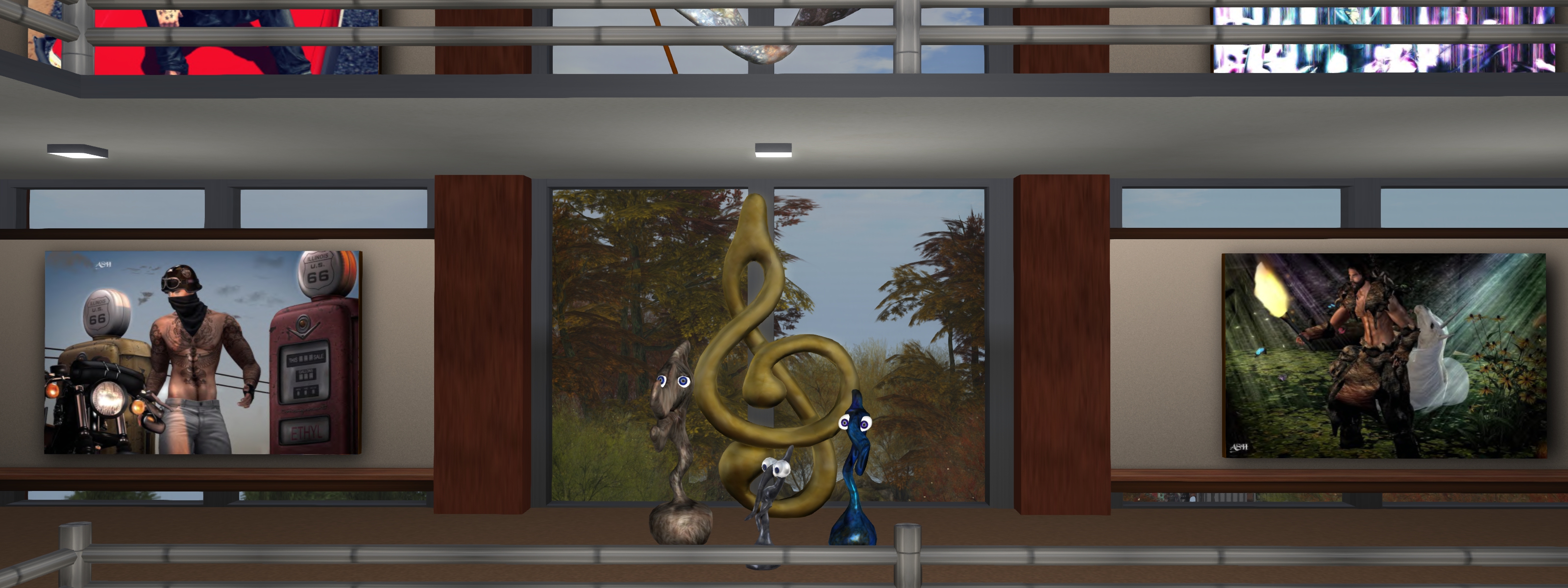
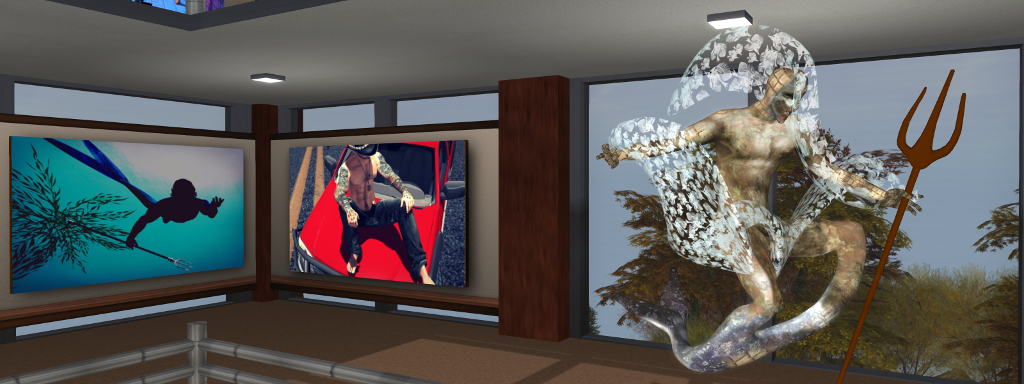
In addition, the following artists can be found throughout the grounds – just follow the paths and tracks, or go where your feet lead you: CybeleMoon, TaraAers, Terra Merhyem, H0n2a-Resident, Viktor Savior, Jojo Songlark, and Skyspinner Soulstar. As well as the featured artists, works by Bryn Oh, Russell Eponym, Garvie Garzo (and possibly others I may have missed) can be found in the region’s grounds.
Given this is an exhibition held around Halloween, some of the art offered focuses on the ghostly, with touches here and there of witches, but there is also a fabulous diversity of art from Second Life, from the physical world and from digital media that is a joy to view and experience.
Ce Soir Gallery – Skyspinner Soulstar
As well as the SLurls to the main exhibition spaces above, all of which are linked via path and track, allowing for easy exploration, a good place to start when visiting Ce Soir is the main landing point, particularly who may not have visited the region previously, and offered in the primary SLurl at the end of this piece. Details of all events at the region can be found through joining the region’s group or via the Ce Soir website.
Richly diverse, located throughout the fantasy inspired Ce Soir landscape, Mad Masquerade is a wonderful mix of art.
We first visited Elvion, designed by BoZanoNL in February 2019, back when it was a quarter Homestead region. As I noted in Elvion: an elven sanctuary in Second Life, back then it offered the look and feel of a elven sanctuary, steeped in mystic magic and with little places for visitors to sit and spend time. More recently, the setting has moved to occupy a complete Homestead region, and in doing so has obviously expanded.
The move and expansion has perhaps lost some of the more “elven” elements from the former. However, the move has allowed for the creation of a more extensive, open landscape, rich for exploration, still with numerous places in which people are welcome to spend time.
Elvion, November 2019
Set under a bright sky suggestive of a crisp spring or autumn day, the region is largely open, rolling grassland, cut on its south side by a mountain range running west to east, largely separated from the rest of the region by a narrow water channel with its head as set of waterfalls at its western end. When seen from the north side of the region, these mountains give it added depth, assisted by a line of low hills running through the lowlands that naturally break the line of the mountains and make them appear further away.
The landing point for the region sits to the north-east on the grasslands. It sits along a cart track that runs part-way through the region, curling around the hills to curve north and east across the grasslands, two bridges allowing it passage over a bubbling brook until it meets the region’s hills and they turn north. It is at the landing point that visitors can review the region’s rules and can see that this is a horse-riding friendly region (for those with a wearable Animesh horse, or can join the region’s group for a L$500 and rezzing rights).
Elvion, November 2019
A further mark of the former Elvion was the wildlife – deer, herons, even bird calls, etc., – and this is very much carried over with the new setting, with horses joining the mix. All of the visible animals and birds are scattered across the region in a manner that makes coming across them both a natural experience when exploring and also opens up opportunities for photography.
As noted above, some of the more “elven” elements present in the former quarter homestead region space are now absent; however, there are some ornate arches to the south of the region tucked among the mountains there, but otherwise, the pavilions found in the former design are absent.
Elvion, November 2019
This doesn’t mean the region is bereft of structures, however. Towards the head of the waterfall-fed channel, for example, is a large cabin. Elsewhere there is a gazebo sitting amidst cherry blossoms that add to the more springtime feel to the region, and there are numerous hints of ruins to be found – one close to the landing point – all of which offer cuddle spots.
When wandering the region, and despite the lack of clear elven influences, I was still put in mind of scenes from Middle Earth – the mountains, when seen from a distance to me offered a hint of Tolkien’s Misty Mountains as perhaps seen from Rhudaur, while – and albeit it somewhere else in Middle Earth entirely – the cabin, put me in mind of Beorn’s house (if without the associated gardens of the latter).
Elvion, November 2019
Like the cabin, the various ruins offer places for people to sit and talk and cuddle. Other sitting / cuddle points await discovery, including a wheelbarrow, a shoreline hut, the aforementioned gazebo, and various wooden decks. These all encourage people to spend time in the region, as does the potential for photography – landscape and avatar studies.
Rounded-out by a corner woodland setting with ruins of its own, the expanded Elvion offers a lot to visitors, making it an ideal an pleasing visit that build on the former quarter-region setting. I will confess that I did have some performance issues with shadows enabled whilst riding my Animesh horse, but just disabling shadows for the ride solved that problem, and the issue didn’t otherwise spoil my explorations on foot.
Elvion – November 2019
With thanks for the update on Elivon from Miro Collas.
Men in Focus: Men in Motion – Slias Merlin (foreground) and Aco Wantanabe
Now open at the Men in Focus Gallery, curated by JMB Balogh is the 2019 Men in Motion exhibition, sponsored by the Men in Motion dance troupe. The exhibition is specifically in support of the Movember Foundation, and furthers the gallery’s aim to both promote and feature photography at work or play in SL by male artists.
I was offered the opportunity to preview the Gallery’s opening event in November 2018, which also featured a Men in Motion exhibition (see Previewing Men in Focus in Second Life) – and I offer both Jo and the Men in Motion team my tardiness in getting to this year’s Men in Motion exhibition a little on the late side given the 2019 Movember fund-raiser by Men in Motion officially runs from November 1st through to November 11th – although the exhibition at the gallery will, I believe, run for longer.
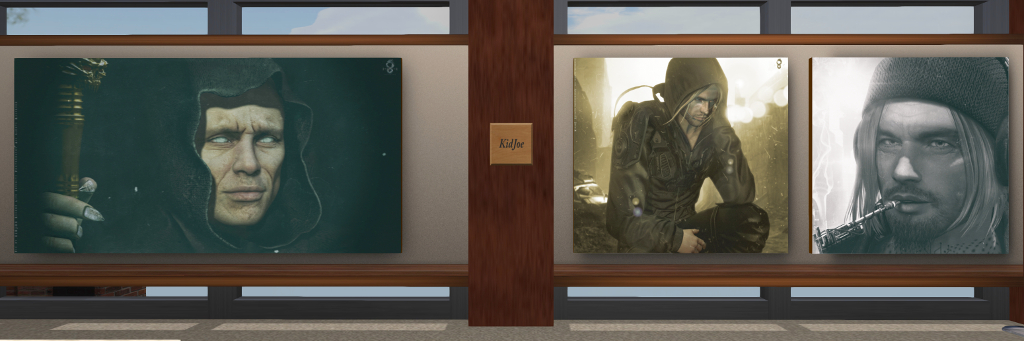
Men in Focus: Men in Motion – KidJoe
While the gallery’s primary focus is on 2D art, as with 2018, this year’s Men in Motion draws on artists working in both 2D and 3D art:
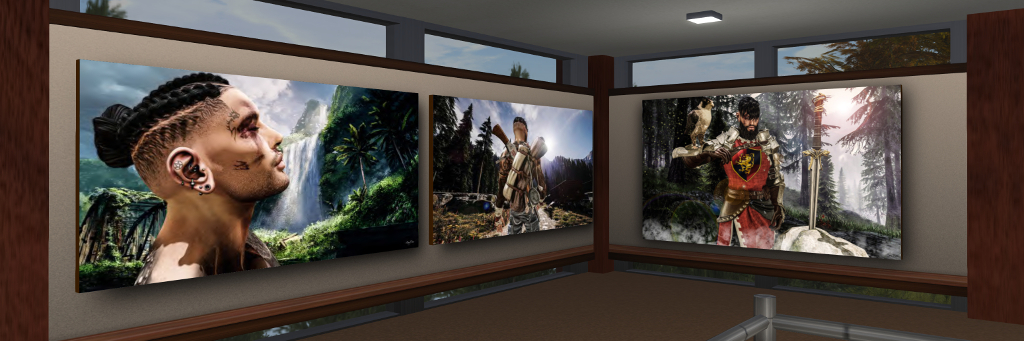
2D artists: Migan Forder, KidJoe Resident, Aco Watanabe and Ashraf Rathmullah, along with Men In Motion members Fafnir Kiranov, Antonio Avtovio, Sebastian Bourne and Alex Avion, who have their art displayed on the upper two levels of the gallery.
3D artists: Mistero Hifeng, Toysoldier Thor, Haveit Neox and Silas Merlin.
Men in Focus: Men in Motion – Migan Forder
I confess that the four invited artists are all men whose work I have not knowingly encountered before, so my visit to this exhibition was educational; and I have to say, their work is both stunning and powerful. All have the ability to tell a story with their images, and quite marvellously so.
I was immediately captivated by KidJoe’s pieces along the back wall of the gallery’s ground floor, notably In the Dark, which is both rich in its expression and narrative and – very personally, brought to mind the Priors of Stargate SG-1, despite the robes being the wrong colour. However, perhaps the most evocative image among KidJoe’s works offered here is The Terror was called jack, which is just startling in its depth and life.
Men in Focus: Men in Motion – Ashraf Rathmullah Toysoldier Thor (centre)
Aco Wantanabe and Migan Forder, both invite us to join them on their adventures through Second Life – and I was again particularly drawn to three of Migan’s pieces – Just Breath, Last Man Standing and Destiny – due to the incredible richness of narrative all three enfold. Aco’s work, meanwhile, wonderful mixes Japanese themes and fantasy in studies of a young mane travelling through Second Life
Above them, Ashraf Rathmullah presents an enticing mix of what might be regarded as more “traditional” – but nonetheless attention grabbing – avatar studies mixed with narrative pieces to off a richly mixed display of art that both stands on its own and leads nicely into the Men in Motion displays on the floors above.
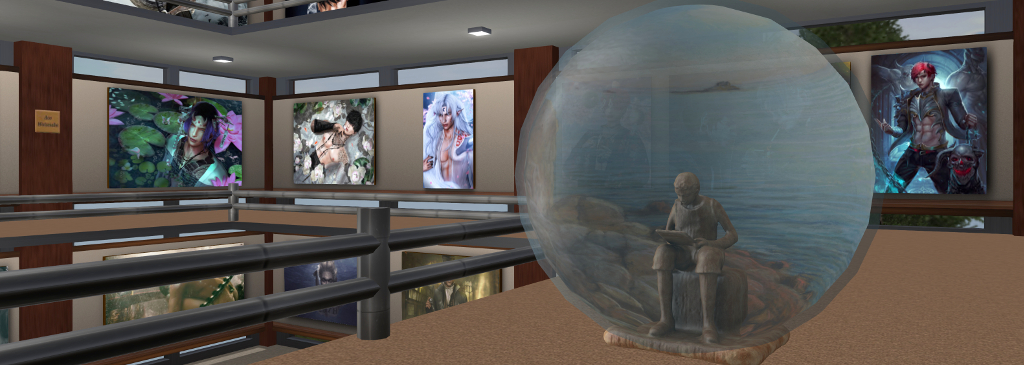
The 3D artists’ work is neatly spaced between the different floors of the gallery, allowing it to be enjoyed alongside 2D art. Some of the pieces will likely be familiar to those who particularly enjoy Mistero’s and Silas’s work (we actually have The artist in a bubble on display at home). While Toysoldier offers some quirky characters guaranteed to raise a smile, while Haveit’s is always captivating to witness.
Men in Focus: Men in Motion – Havit Neox (right) with MiM member Fafnir Kiranov
About the Movember Foundation
The Movember Foundation is a multinational charity raising awareness of, and money for, men’s health and welfare, with a focus on cancer, mental health and suicide prevention. Its titular and widely known campaign is Movember, which encourages men to grow moustaches during the month of November. The foundation partners annually with the Distinguished Gentleman’s Ride to also raise money for men’s health.
Founded in 2003, in Melbourne, Australia by Adam Garone, Travis Garone, Luke Slattery, and Justin Coghlan, the organisation attained registered charity status in 2006, and as of 2014, has raised over US $580m in charitable donations used to fund more than 800 programmes focusing on prostate cancer, testicular cancer, poor mental health, men’s health awareness and healthy lifestyles. It is active in 21 countries and has a global workforce of 130 people. In addition, Movember coincides with International Men’s Day (November 19th), which among its aims, shares the goal of promoting the health and well-being of men and boys.
A storm comes – and brings with it an assortment of nasties to plague Miskatonic
Currently open at Miskatonic County is Tales of Miskatonic County: The Perfect Storm. Described as “A Horror Survival Experience”, created by Rayden Evenstarr, Phoenix Sachin, Logan Porterfield and Tobiath Tendaze, it makes for an interesting if (for me at least) a slight confusing diversion.
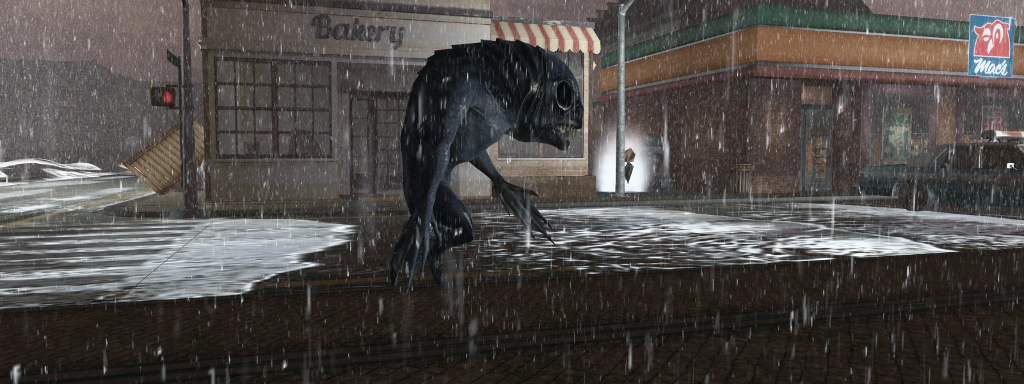
Using the Second Life experience system The Perfect Storm pitches you against zombies, lurkers, cultist gunmen, ghosts, creature of the deep and more in a battle to survive and to complete assorted quests. The latter range from killing some of the aforementioned monsters and creatures through to rounding up kittens or finding puppies – which makes for an interesting mix!
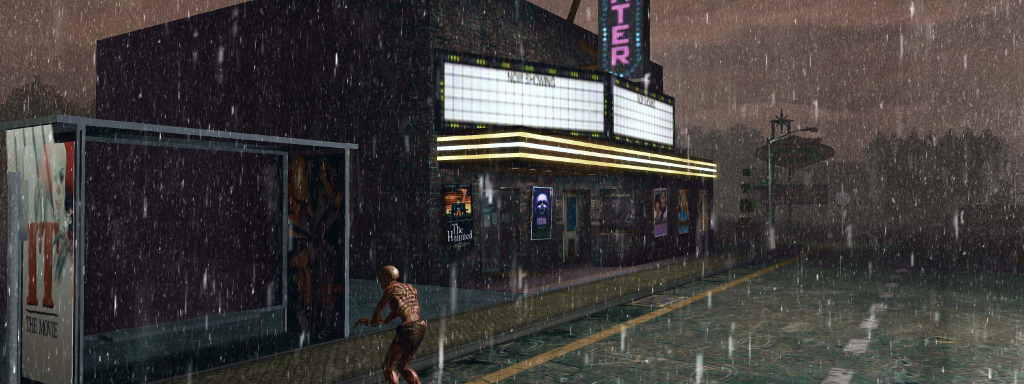
As you emerge from the theatre in Downtown Miskatonic, you find a town in chaos. Torrents of blinding rain obscure amorphous shapes lurking in the shadows. Telephone poles have been sent crashing to the ground in showers of sparks while trees fall upon cars and houses alike. Danger lurks in every alleyway, and you feel as though a thousand eyes are upon you.
Miskatonic is no ordinary town, and this is no ordinary Halloween. The day is October 31st, 1991. The day a ferocious storm system suddenly formed off the New England coastline. A storm system so large that meteorologists deemed it “The Perfect Storm.” The storm turned westward, moving against the jet stream, striking the coastline with a deadly storm surge and hurricane-force winds. Many old-timers of the region dubbed the storm “unnatural.”
– Introduction to ales of Miskatonic County: The Perfect Storm
The streets are lashed with rain – and home to things that creep and lurk
The adventure begins at the Miskatonic Theatre, where players pick-up the game HUD (and must accept the region’s experience in order to play – a one-time only requirement unless the experience is subsequently blocked), together with a magic ring and a pistol.
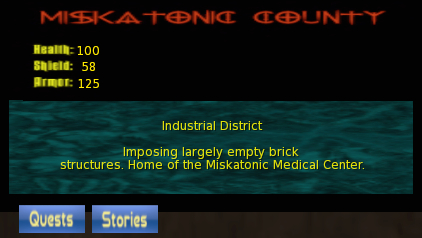
The HUD will auto-attach to the player’s screen under scripted control, and will auto-detach on departing the game. It acts as a relay to record your health, shield and armour, and as an information giver – prompts are displayed in the lower section of the HUD, and there are two buttons: Stories and Quests, of which more anon. The gun and ring are inventory objects and must be worn. The former is required to kill the nasties (you must be in Mouselook), and the latter helps “buff” your game stats.
The HUD provides health information (top), general information on your location (centre) and buttons to view your quests (if any are in progress) and any story fragments you’ve found
Outside of the theatre, the storm is in full force. The northern end of the town is subject to flooding from the storm’s surge, and rain is falling in heavy sheets across the rest of the landscape, with copious amounts of storm damage to be found in the streets.
You’ll need to be in Mouselook whenever you are outdoors, as this is where the nasties roam. You can switch back to third-person view when inside buildings to ease exploring them and interacting with things in them. Shooting the the nasties is a case of aiming the screen cursor at them and blasting away with left-clicks. Hits earn points and will eventually kill the nasty, earning you bonus experience points. However, be warned that they can strike back with claws, teeth, knives, hatchets and guns of their own, eroding your health, shield and armour.
Health can be restored by finding crafting stations and then rummaging for ingredients, then using the crafting station to make consumables and eat / drink them. These items are added to inventory for rezzing and can also be traded with other players, allowing those playing together to help one another. Consumables, once made, can be worn to consume or carried. Some will restore lost health / shields, some may only “buff” for a period of time.
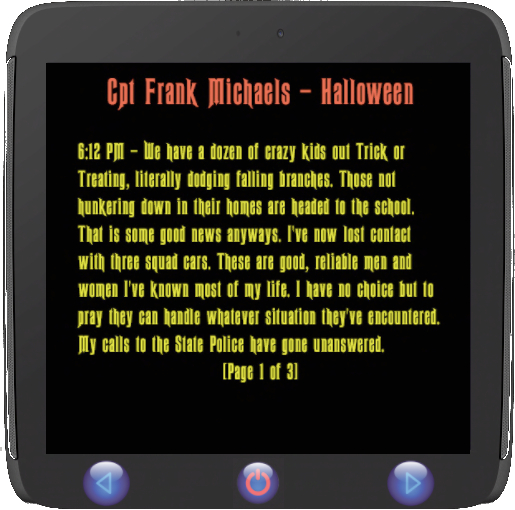
Quests and stories (shown) are displayed in a separate HUD panel by clicking on the Quest or Stories button on the main HUD
Quests are undertaken by finding non-player characters (NPCs) scattered within various locations. Clicking on them will open the Quest panel on your screen and display details of a quest for you to complete. click the “off” button on the panel to close it, and you can set out to complete the required task.
You can have up to four quests running simultaneously, and some will be auto-complete (achieve the goal and the quest ends), others will require you return to the Quest giver. A tally is kept of your progress, and I found this a little irritating, as each time I achieved a target in a quest, the panel would open, blocking part of my view and requiring I hop out of Mouselook to close it (ALT-click didn’t seem to work).
As well as quests, there are story fragments to be found scattered around – these take the form of books with hovertext floating above them. Clicking on a book will add the story fragment to your HUD – click the Stories button to open a panel listing the available stories, and click on the one you want to read by clicking on its title.
Should you find your health drops below 0, you will be incapacitated and transported to the Miskatonic Medical Centre. This restores your health and reveals one of the secrets of the experience: it exists on multiple levels stacked up one above the other through the vertical extent of the region. They are connected by teleports in the form road tunnels. Moving to each of them can earn experience points.
A creature of the deep roams Miskatonic
If I’m totally honest, I don’t entirely “get” the overall goal – other than survival (which may be the sole point) – but then, I’ve not progressed full through the entire experience. In this, the instructions and introduction are somewhat vague – and “emissary” is reportedly coming, but what / who that might be slipped by me. There is also reference to artefacts being stolen – but whether recovering them forms a part of any of the quests, I could say.
Perhaps the way to find out is to play for yourself?
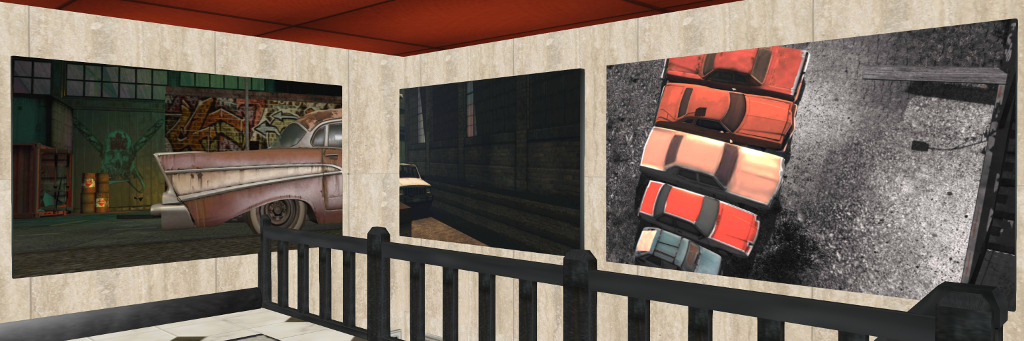
Now open at Melusina Parkin’s gallery space, located above her Melu Deco store, is her latest exhibition, Cars. It is a small, cosy exhibition of a dozen pieces focused – as the name suggests – on cars. Or more specifically, cars in Second Life.
In keeping with Melu’s approach to her art, these are not simple studies of motor vehicles; Melu has an eye for detail and angle, and this is much in evidence in these pieces.
Melusina Parkin – Cars
So, rather than presenting us with what might be regarded as “traditional” shots of cars – side views, three-quarter front or back views, etc., Melu presents us with images in which the framing and background is as important as the vehicle itself, or where the car is presented in unusual circumstances. Nor are these bright shiny models: Melu offers shots of vehicles that have seen better days.
The result is a collection of images where the vehicles depicted within them are more than just cars, they are characters, and the pictures containing them are studies of their nature. It’s an elegant series, each beautifully presented and with a story within it.
Melusina Parkin – Cars
As well as Cars, visitors to the exhibition space can also view a copy of Melusina’s Second Life Exhibits, a gorgeous collection of her exhibitions between 2011 and 2019. Just click on the book and follow the web link.
Last Dove, November 2019 – click any image for full size
Created with love in the spirit of West Texas honouring those that came before, those with us, and our future.
So reads the About Land dedication for Last Dove, a Homestead region designed by Erythro and Shannon Cardalines. And while there are many western-themed role-play regions, Last Dove is something special, as Shannon noted to me as we discussed it after Caitlyn and I had made our initial visit.
It was designed for a set for Erythro to make machinima he wants to show at film festivals in real life. We based the sim on the novel and screenplay of Lonesome Dove. The characters you see here are all bots that Ery scripted to work as his actors.
– Shannon Cardalines describing Last Dove.
Last Dove, November 2019
For those unfamiliar with Lonesome Dove, it was the title book (although technically the third instalment of the story) of a series bearing the same name, written by Larry McMurtry. It started as a film script collaboration between McMurtry and Peter Bogdanovich, but after languishing in development hell for over a decade, McMurtry purchased the rights to the script and turned it into a novel, first published in 1985 and winning the 1986 Pulitzer Prize for Fiction.
The story did eventually reach the screen – albeit the television screen – in 1989 in a CBS 4-part mini-series starring Robert Duvall, Tommy Lee Jones, Danny Glover, Diane Lane and Anjelica Houston among a long list of notable actors. It is a particularly memorable story not so much because of its western setting, but because it is a tale that intertwines themes of old age, death, unrequited love, and friendship – something reflected in the dedication for the region.
Last Dove – riding into town – November 2019
As well as being the title of the novel and series, Lonesome Dove is also the name of the Texas town where the story begins. It is this town – the set of which still stands – that serves as the inspiration for Last Dove; and it is no exaggeration to say that the region marvellously captures the spirit of the location, with several of the notable buildings being reproduced along the dusty main street. The echo of The Stockman’s Hotel, for example can clearly be seen in Last Dove’s Dry Bean Saloon.
In addition to recreating the town, Ery has also scripted a number of characters from the book / series. These may vary between visits – there is a control board for the bots hidden away in one of the building. However, when visiting, you’re more than likely to come across the two principle characters, Captain Woodrow F. Call (played by Tommy Lee Jones in the CBS mini-series) and Captain Augustus “Gus” McCrae (played by Robert Duvall) – with the latter looking particularly reminiscent of has actor alter-ego!
Last Dove – after a day in the saddle, even a girl needs a drink! – November 2019
Given Lonesome Dove is set against the backdrop of a cattle drive to Montana, other touches reflecting on the film include the bunkhouse and a small herd of Texas longhorn cattle, complete with a cowboy bivouac, suggesting the drive out on the trail. In addition, the great plains of Texas are represented by the region surround, which directly abuts the region on three sides, offers scrub grassland that rolls gently off to the horizon and the hazy slopes of distant hills. This gives Last Dove a tremendous sense of depth, with the west side of the region separated from the surround by a span of water that perfectly echoes the Rio Grande, which features in both the story and the town (the set for Lonesome Dove is located near Del Rio, West Texas).
While inspired by Lonesome Dove, I have to admit that initially, the setting put me in mind of Clint Eastwood’s High Plains Drifter. There was something about the plains rolling away to those haze-softened hills and the town on a shoreline that put me in mind of Eastwood’s ghostly Stranger (Death) on his pale horse, riding out of the shimmering haze to mete out vengeance. So much so that, in looking across the plains of Last Dove, I wouldn’t have been surprised had a horseman slowly materialised riding towards the town! In this respect, I did feel a bit of a twit when Shannon explained the actual inspiration – I’d been looking at the Captain Call character with the name ringing bell, but unable to place where I’d come across it.
Last Dover, November 2019
It’s important to state (again) that Last Dove isn’t intended as a role-play region per se. However, it is ideal for photography and for getting into the spirit of the old west, as I hope a couple of my pictures here suggest! Rezzing is also permitted for props – but please ensure you clean things up afterwards.
This is genuinely a superb setting, richly evocative of the story on which it is based. Its offer plenty of opportunity for horse-riding, easy exploration and – as noted – for photography. Absolutely not a setting to be missed. Those wishing to see more of the Lonesome Dove set as it looks in more recent times can do so via the Lonesome Dove Remember link, below.
Last Dove – meeting “Gus” McCrae (centre) and Woodrow Call outside the bunkhouse – November 2019