Isolation’s Passengers in Second Life

Isolation’s Passengers – click any image for full size

Archetype11 Nova, aka Schmexysbuddy Resident, has been responsible for some of the most evocative / thought-provoking region builds in Second Life. I’ve covered a number of them in these pages – notably his Hotel California builds; his work embraces landscape design and artistic statement, often mixing ideas and sentiment, ideals and imaginings in an eclectic whole that captivates the eye and challenges us to look deeper, think a little harder and take a closer look at what is being offered.

With Isolation’s Passengers, Archetype11 offers what might be his most provocative  – and possibly his most personal – region design yet. It occupies a private full region that has the additional Full region LI bonus, although it does not currently make use of the extra land capacity. This additional space  – previous builds by Archetype11 / Schmexysbuddy have tended to be on Homestead regions – appears to offer plenty of opportunity for expansion or (perhaps) for multiple environments within the same location.

Isolation’s Passengers

The foundational aspect for this design is that of the SARS-COV-2 pandemic. This is not an uncommon theme within art and region design at present, but with Isolation’s Passengers, Archetype11 offers a different perspective on the pandemic, one which – as noted – touches on the personal for him, as he noted to me whilst I was visiting the region:

It’s intent is the onslaught of 2nd and 3rd order effects of isolation that aren’t readily visible…the invisible passengers of this pandemic. It was inspired by the death of a friend and brother of mine.

– Archetype11 Nova, describing Isolation’s Passengers

The story of that death can be found here, and should be read as a part of a visit to this region, as it helps to frame some of the motifs to be found within it.

Isolation’s Passengers

For those unfamiliar with the concepts of the 2nd and 3rd order effects of isolation, in the 1980s and as a part of studies into the long-term impact of isolation can have on the psyche among groups such as submariners, small teams on long-duration expeditions in the Antarctic and crews aboard the International Space Station. In particular, they noted three distinct reactions to being so isolated, linked to different points in  the isolation period.

The first order comes early on, encompassing the initial weeks / months of isolation.  It is marked by heightened anxiety, possibly mixed with periods of confusion and panic (think of the early stages of the the pandemic: anxiety over lock-downs, panic buying of toilet rolls, etc.). The second order (sometime referred to as the “sourdough order”) is marked by a sense of routine, possibly edged with a sense of newness / novelty (again, in terms of the pandemic: the novelty of working from home, the formation of a new routine based on self-motivation, etc). And then there is the third order. This is more negative: the dropping of routine as everything blurs into a never-ending whole where days are difficult to separate, and encompasses resentment towards our situation and towards those who are around us (not so much because of who they are but rather because they represent the fact we cannot interact with anyone else), and is a time that can be marked by emotional outbursts, aggressiveness, rowdy or anti-social behaviour.

Isolation’s Passengers

The 3rd order can often include a further emotional response that might appear as contrary to the others listed for it: that of anticipation – the sense that things will soon be over, and life can “get back to normal”, which in turn can lead to further frustration as “the end” doesn’t seem to get any closer, despite the passage of time.

Within Isolation’s Passenger’s we see many motifs representing elements of the second and third order effects of isolation – take the line of large masks with waterfalls falling from one eye: their repetition suggestive of routine; painted bodies suggestive of excitement that the freedom of expression isolation and working from home appears to initially present. Then there is the large clock sitting to one side of the region, representing the dragging passage of time and the resentment it can cause – the reminder of how long its been, and how long, potentially, we may still have to go before things “get back to normal”.

Isolation’s Passengers

But there is more here as well: the personal element of love and loss of a friend beautifully offered through these suggestions of life and death, love and loss through the use of angelic figurines (some partially dismembered), the shrouded busts with their crowns of thorns, the floating bodies under their own shrouds, the great church, the huddled skeletons, the shiny Morgan sports car with its “Just Married” sign and the promise of a bright future,  sitting amidst the wreck of several junker cars suggestive of age and decrepitude – and loss.

The layering of images and ideas within this build is compelling in their sheer diversity. Take the line of masks noted above; within them might also be seen the cracking of our daily façades – the faces we present to the the rest of the world that are becoming increasingly redundant in this age of isolation; also to be found within them is the sense of tears offered by the falling water. Between two of them sits  the carcass of an ageing ship, an orchestra playing even as pumps fail to keep the water at bay. This is rich in multiple motifs: there’s the idea of trying to carry on as normal in the rising tide of change; the echo of the Titanic and the idea we’re facing the sinking of all that can be normal in an increasingly  confusing, isolating world; the hint that despite the current disorder, perhaps normality can return; and then there’s the personal element again: music played in remembrance of a loved one.

Isolation’s Passengers

Poignant, beautifully presented, and watched over by the floating spores of a virus that hang in the sky – a reminder that as per that title of the build – we are all just passengers in the unfolding situation in the world today. Even the region’s core name – Solveig – seems to reflect the intertwined themes presented in the build – Sol and Veig being old Norse words meaning “house” or “hall” (the place where we most commonly have to isolate) and “strength” or “battle” (reflective of the strength we draw on from within in handling the battle we face in moving beyond the 3rd order of isolation).

SLurl Details

Announcing the Second Life Endowment for the Arts

via Linden Lab

In August 2019, and after an eight-year run (it’s first public exhibitions coming in 2011 after initially being announced in late 2010), the Linden Endowment for the Arts (LEA) closed, the organising committee having decided to step away from managing it (see: Linden Endowment for the Arts to officially close, LEA: more on the closure, and a move to save it and Linden Endowment for the Arts: update).

Following the announcement, there were numerous discussions on how the work of the LEA might be continued. In particular, artists Tansee Resident and Riannah Avora launched an in-world group specifically with the aim of gathering ideas and viewpoints on how the work of the LEA – and Linden Lab’s involvement in the body – might be continued.

At the time, a lot of discussions were held and a considerable number of ideas put forward (I was happy to play a small background role in advising both Tansee and Riannah in a number of areas, including potential discussions with Linden Lab). Ultimately, both went on to found groups operating on similar principals to LEA, with Tansee co-founding the Hannigton Endowment for the Arts (HEA) along with Hannington Xeltentat, and Riannah co-founding United Artists of SL.

However, the idea of a Lab-supported facility to help promote arts in Second Life never entirely went away, and Tansee continued to pursue ideas, refining a proposal originally created from the ideas gathered after the LEA had closed down. Then, in June 2020, a conversation with Lab CEO Ebbe Altberg at the SL17B event opened a door of opportunity. This in turn lead to a series of meetings with senior staff at the Lab, including Patch Linden, Vice President of Product Operations, and Brett Linden, the Lab’s senior Marketing Manager. After several such meetings, which included reviews of, and updates to, the proposal, Linden Lab indicated a willingness to support a new body similar to that of the LEA, but operating on a more modest and flexible footing.

Announced today, and starting an January 2021, the Second Life Endowment for the Arts (SLEA) will operate across seven regions supplied by Linden Lab, and managed by Tansee and Hannington supported by a Board of Advisers (the full list of whom is yet to be announced), and a team of volunteers to help in the day-to-day operations, once the new regions are open.

The seven SLEA regions

The seven regions, which are currently being set-up, will comprise the following:

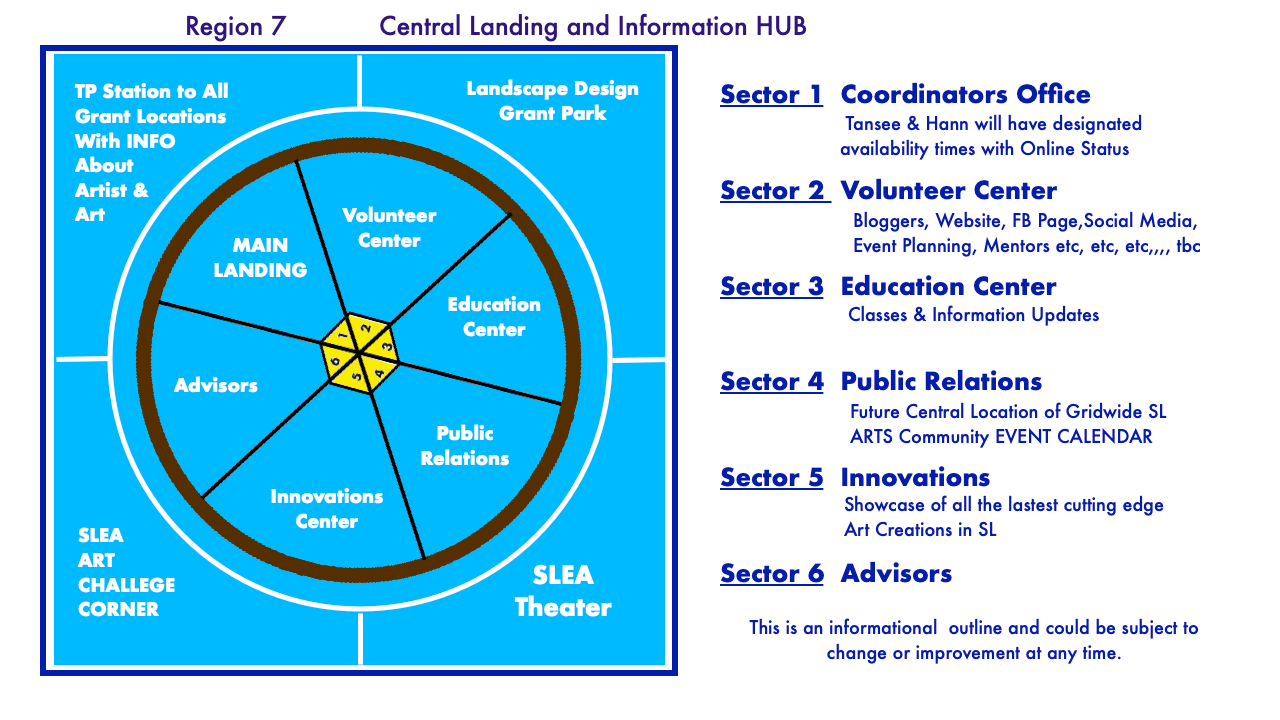
  • A  central hub (SLEA7). This will likely include:
    • A landing point.
    • Facilities for SLEA coordinators, advisers and volunteers.
    • An education centre.
    • A events centre to support arts activities and events across Second Life.
    • A teleport hub serving the SLEA grant regions and information on the artists currently exhibiting.
    • The SLEA Theatre for mounting art-related and special events.
    • An art Challenge corner.
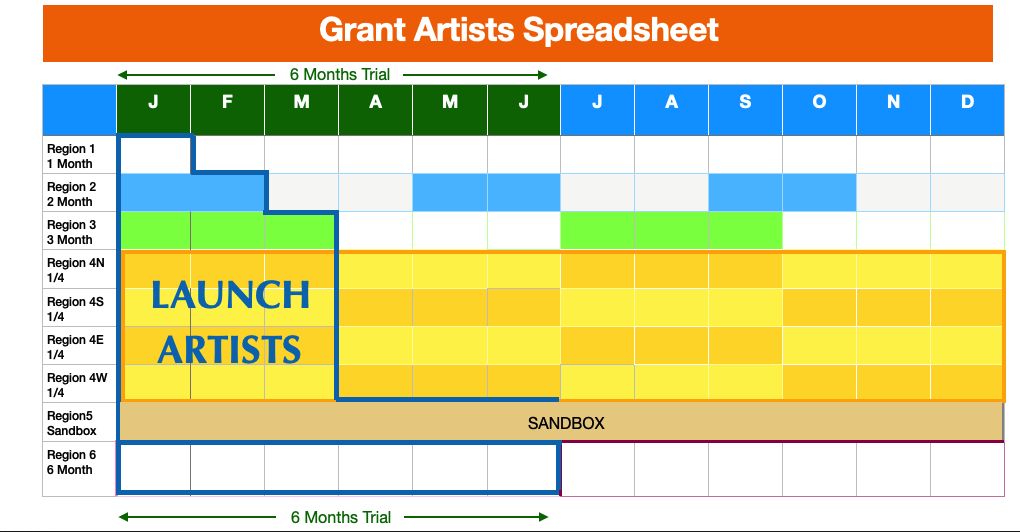
  • Four Full regions (SLEA1-3 and SLEA6) for region-wide art installations ranging from 1 to 6 months duration.
  • A single region (SLEA4) providing four quarter-region installation spaces.
  • A sandbox region. This will include an artist hangout and club for events and parties along with a new underwater building area.
The planned SLEA 7 hub region

As  noted above, SLEA will formally début in January 2021. Between now and then, the plan is to release information over a period of time, starting in October. These activities will include:

  • Providing information on:
    • How those interested to volunteer to help run SLEA, and on specific volunteer roles that are available.
    • How artists will be able to apply for grants, and requirements / guidelines for exhibiting through SLEA.
  • Updates on region design status.
  • Detailed information on the SLEA website, social media channels, etc.
  • The opening of the first round of applications for artists.

The reason for not having the website / social media presence in place alongside of this announcement was explained by SLEA co-ordinator Tansee Resident as follows:

We intentionally do not have a Website or a FB page or any of the essential networking tools. The reason for this is we truly want to include the artists in building this community from the ground up. In order to build a solid foundation it is imperative that we establish a Volunteer base and find people who are willing to share their area of expertise.

Tansee Resident, SLEA Co-ordinator

Proposed time line for SLEA development

So, in the interim period, those interested in SLEA as artists and / or as potential volunteers are asked to join the SLEA in-world group, which will be the primary channel of communications for the next few weeks. Also, to help promote SLEA, there will be a special Designing Worlds show featuring Brett and Patch Linden, together with Tansee and Hannington, which will be show at 14:00 SLT on Monday, September 14th via the Designing Worlds website and channels.

You can also read the official SLEA announcement from the Lab.

I’ll also continue to provide updates through these pages.

The landscapes of Second Life

L’autre Oeil: Anouk LeFarve

Now open at L’autre Oeil (“The Other Eye) Gallery, owned and curated by Blaize Nightfire, is the gallery’s September 2020 exhibition entitled Landscapes. This is an ensemble exhibition featuring the work of Sandi Benelli, Charly Keating, Anouk Lefavre, Michael Lysios, Loegan Magic and Charlie Namiboo, who between them are some of Second life’s foremost landscape photographers / artists.

The gallery opened in June 2020, and was founded with a specific focus of promoting the work of artists to others in the Second Life arts community – although that doesn’t prevent admirers of the arts from visiting and appreciating the art on offer.

L’autre Oeil is a gallery for artists who love other artists. To be seen with the other eye, observers who appreciate a different perspective on the world around us.

– Blaize Nightfire, describing L’autre Oeil’s mission


For this exhibition –  my first visit to the gallery (and certainly not my last) – each artist is displaying three pieces of their work, some of which might easily be seen as story-telling triptych of images. Take Charlie Namiboo’s set, for example, the two outer images of plainslands neatly framing the black and white images of a river in what might be a tale of three parts, the two colour images supporting the centre image.

L’autre Oeil: Charlie Namiboo

Although the title of the exhibition is Landscapes, some of the artists have cast their net a little wider. Loegan Magic, for example, offers a richly evocative rooftop scene that is exquisitely composed, predominantly in black a white, but with a wall painting of John Lennon offered in colour, staring from the the lower part of the image in a haunting capture that carries echoes of Imagine in  Lennon’s eyes, and also a hint of F. Scott Fitzgerald’s Dr. T.J Ekleburg from the Great Gatsby. Similarly, Michael Lysios presents an oriental street scene, whilst Sandi Beneli uses SL landscapes and coastal scenes as a means to frame broader narratives on life and living – from flying a kite to the promise of a car trip. All of these images present additional depth to what is a captivating exhibition.

L’autre Oeil: Blaize Nightfire

Tucked away in the exhibition are three images by Blaize himself, who demonstrates he is no slouch with the camera, offering three images of his own that are as evocative as any of the others in these exhibition.

An attractive ensemble exhibition, well worth dropping by to see.

SLurl Details

The dunes of La Vie in Second Life

La Vie, September 2020 – click any image for full size

After receiving a poke fro Shawn Shakespeare, I was surprised to note that it has been over two years since our last visit to La Vie, the Homestead region held by Krys Vita and previously dressed by her and Arol Lightfoot. As such, following on Shawn’s suggestion, we hopped over to take a look at the region in its latest iteration.

This design is the work of Krys and her SL partner CarterNolan, and is beautifully minimalist in  presentation, whilst offering an attractive and photogenic setting.

La Vie, September 2020

The easiest way to describe it is simply to say that given the current worldwide climate of uncertainty around SARS-COV-2 and so on, La Vie represents the kind of idyllic location many of us probably would like to run away to and spend time appreciating without the the pressures of the world intruding,

Sitting as a series of sand flats that poke their heads above an azure sea, the region has the feel of a place perhaps at high tide – at least on its western side, where wind breakers usually put out for sunbathers sit partially submerged in rippling waves, a pelican watching over them and possibly wondering why the silly humans didn’t move them before the water rose…

La Vie, September 2020

Raised board walks run across the sands and also connect them, their presence perhaps suggesting that at certain times in the year a lot more of the setting might be waterlogged – although for now there is enough sand and low dunes to make wandering well beyond the board walks easily manageable – not that the channels cutting through the landscape are particularly deep. At least not until you get to the east side of the region that is.

It is on the east side that the region places host to signs of civilisation: a tidy mesh of piers and moorings for boats and sail craft, most of the wharves stout and broad enough to carry wooden buildings on their backs. These are mostly commercial in nature and include workshops and sea-related places of business, although a couple of units offer the opportunity to work off the extra kilos that might be added to one’s weight following frequent visits to the Salty Dog Café.

La Vie, September 2020

There’s a strong sense of this all being a local, family-run centre given the frequent use of the “Saltwater” name.  Perhaps the house at the centre of the piers and wharves being the base of operations for whoever runs things. It’s also something of a tour de force of building with AustinLiam’s designs as well, an approach that lends further authenticity to the feeling this really is a place put together by a single group of people working to create a unified presence, rather than a place that has grown over times with many different hands and views. I’ll also admit that seeing AustinLiam’s Captain’s Retreat in the region gave me a case of itchy fingers, as it is a design I’ve long wanted to fiddle around with and make into a cosy home.

With more marshy land off to the south sitting under the spread of a huge oak tree and a pair of monkeypod trees, and open sands to the north that carry the suggestion of strong winds sometimes visiting the land, this is a setting watched over by an old lighthouse to one side and an equally old forest-style look out tower on the other, both offering vantage points from which to suss out the best sunbathing spots on the sands below.

La Vie, September 2020

Completed by multiple places to sit and enjoy the setting – including a swing for watching the local sea turtles – and finished with a gentle sound scape, La Vie in this iteration really does offer a welcome sense of escape and freedom.

SLurl Details

  • La Vie (La Vie, rated Adult)

Pandemonium and Perspectives in Second Life

Attention Gallery – Jon Wyck

The September exhibition at Attention Gallery, owned, managed and curated by Isle Biedermann and Mirabelle Sweetwater (Biedermann), opened on Saturday, September 5th. It offers a double-header of an exhibition, displaying the art of Jon Wyck and Deckhard Neox  in what are two somewhat contrasting exhibitions in terms of their respective themes, which can perhaps best be described as “light” and “dark”.

With Perspectives of light and Life, Jon Wyck presents ten images that offer a mix of landscapes and avatar studies, each neatly reflective of its title. Each is intriguing in its representation of light, be it Moonlight over a shadowed tower, sunlight filters through drapes that adds warmth to a sculpture, the metronomic sweep of a lighthouse lamp caught in mid-rotation, the curtain of light created by the skyscrapers of a city backdrop, or use of colour throughout an image as a whole.

Attention Gallery – Jon Wyck

At the same time, and as the title of the selection indicates, each of the images in this selection offers a comment on life, from the desire for an island retreat to the thrill of living on the edge trying to control a powerful machine, going by way of reflections on art, mysticism and and beauty of nature around us.

With October and Halloween once again approaching, Deckhard Neox offers a trip into the darker side of life with his ten pieces, as he explains in his introductory notes:

PANDEMONIUM is my small gift to horror genre in film and literature, genre that I loved and feared since my early childhood. Emotions, either beautiful, uplifting, inspiring or in this case terrifying make us human and thus curious, enchanted and alive, forever searching for mysteries of life … and death.

– Deckhard Neox

Attention Gallery: Deckhard Neox

The result is a series of images that celebrate all that we tend to bring to mind when we consider in the silver screen’s (and television’s) delight in thrilling  / scaring us: werewolves, vampires, knife-wielding and masked maniacs, balloon-carrying clowns, the threat of shadows moving in the darkness and more.

These are – in a literal sense as much as thematically – dark images (so much so, I admit to finding myself wishing they were perhaps presented in a larger format just to bring more of their details to the fore). Each evokes a sense of atmosphere whilst also playing due homage to the film it is intended to evoke, sometimes clearly – as with The Well (The Ring) Halloween (Halloween), They All Float (It – film and mini series), etc. Others are more subtle – such as Ave Satani (The Omen – which also carries a hint of a certain “hell hound” from Holmesian mythology that has oft been played for horror).

Attention Gallery: Deckhard Gallery

Two small but engaging displays that will be available through until the end of the month, I believe.

SLurl Details

Getting Extreme at Nitroglobus in Second Life

Nitroglobus: Extreme by Poupée Anna-Nana (IMaestra) and Nathaniel Jehangir

Tuesday, September 1st saw the opening of the September 2020 exhibition at Nitroglobus Roof Gallery, curated by Dido Haas. Extreme is a joint exhibition by Poupée Anna-Nana (IMaestra) and Nathaniel Jehangir, who are apparently making their first joint foray into exhibiting their photography through the medium of an in-world gallery.

Both artists focus on avatar photography, although Nathaniel also produces landscape images as well. For Extreme, the pair between them present 14 images supported by sculptures by Igor Ballyhoo and the late Nitro Fireguard, bot of which  have been selected by Dido for the way they reflect the central theme of the exhibit.

Each of us has deep-rooted extreme feelings, often based in traumatic experience, that can be hard to control. We often aren’t even aware of these feelings. Sometimes these feelings make us move around in circles, influencing our relationships with others and our own self-awareness. It’s only through self-awareness that we are able to see and free ourselves from these feelings, that we can step out of the ‘circle’. We present these extreme feelings here in our images, each of us in our own way. We are two distinct artists, two different views and ways of interpreting the same themes.

– statement by the artists

Presented as a mix of monochrome colour images, the pictures are offered without further explanation other than their titles, the artists noting that they would prefer those witnessing the pieces to interpret them for themselves.

Nitroglobus: Extreme by Poupée Anna-Nana (IMaestra) and Nathaniel Jehangir

At first, it can perhaps be hard seeing the extremes of experience within some of these pieces. This is not to say they are without emotion or narrative; rather the reverse, in fact, both narrative and emotion are clearly visible in all of the pieces – but within some of them, it may initially appear  both narrative and emotion is more rooted in perennial questions related to our digital lives  – identity (What’s Left and Mask for example), and whether or not we can find love and companionship (Love Me, Be Mine), for example. Others, such as The Frame, The Whisper, the Kill may initially suggest stories of introversion  more than anything else; even those that touch the fringes of what society might regard as “extreme” (notably  Don’t Mess With Me) may not immediately speak of trauma.

But flip your viewpoint with a second look, and look upon these pieces not as the result of past trauma, but rather the propose of trauma about to be visited upon the subject or those they are about to encounter, and a new narrative is revealed. This is perhaps most evident in Don’t Miss With Me, with its threat of open violence directed towards the observer, and the hint of trauma that may come from it. Then, within Monsters, the scratches over breasts and the banding  about wrist suggest the observer is being cast into the role of the traumatiser, while The Kill similarly switches to reveal a man who is about to visit trauma on an unseen third party.

Thus, throughout this exhibition, we’re presented with a nuanced series of images, and kudos to the artists for not trying to overlay our reactions to their work by offering their own expositions.

Nitroglobus: Extreme by Poupée Anna-Nana (IMaestra) and Nathaniel Jehangir

SLurl Details