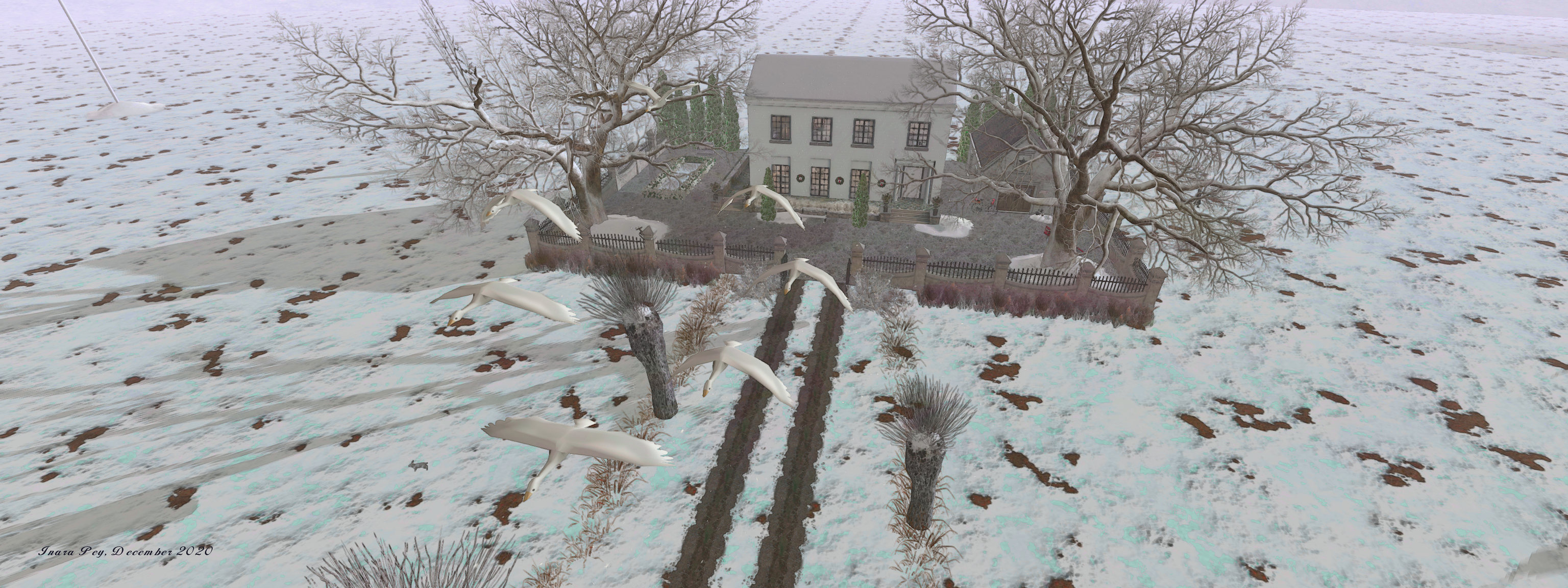
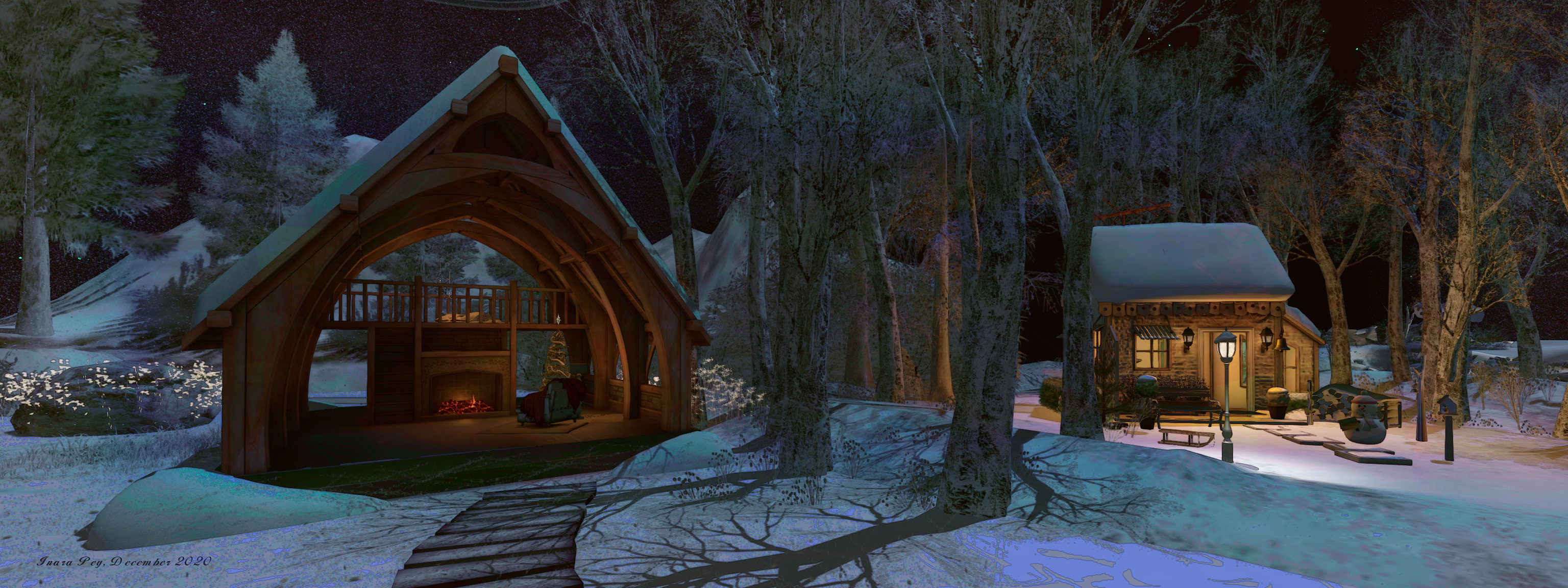
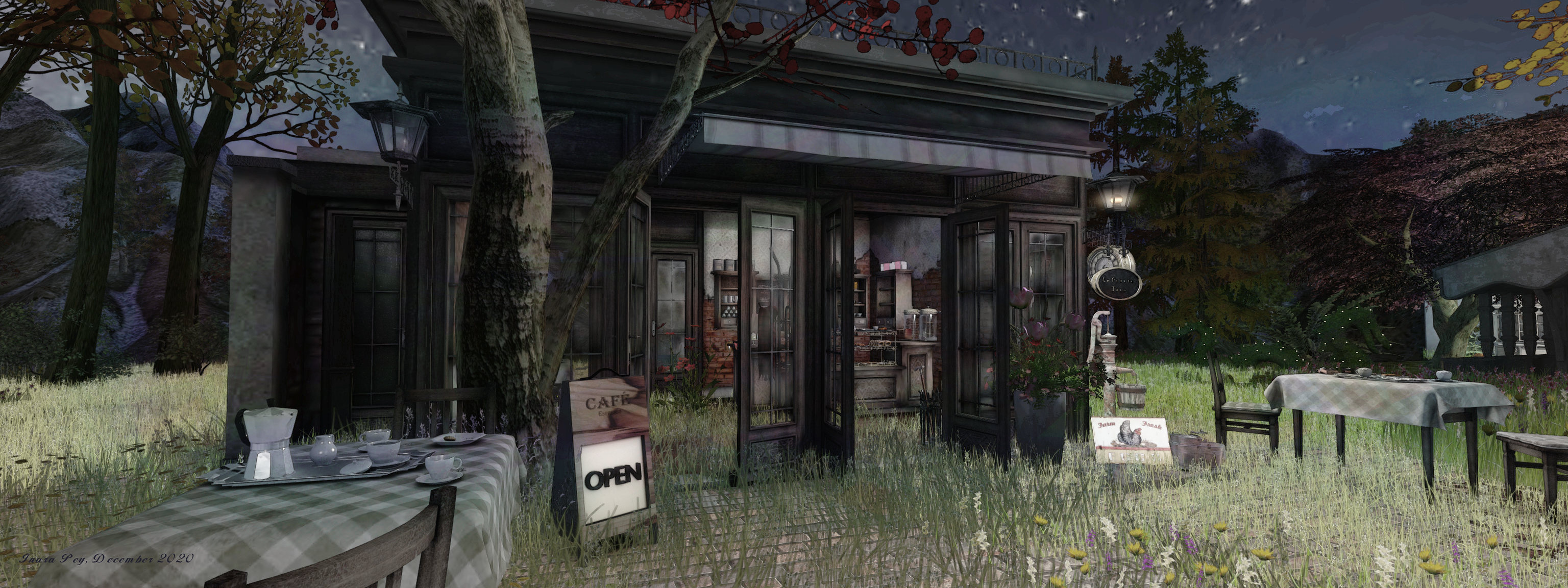
Sitting within a homestead region deep in snow, lays Snoweeta, a charming winter build that is engaging in its simplicity of presentation. Designed by Kaja Ashland, it offers people a little hint of Sweden, specifically taking as its inspiration the southern most county (or län) of Skåne; a place that is a relatively new county within Sweden, having been formed in 1997 – although it is named for the much older historical province of Skåne, from which it takes its coat of arms.
Whether or not Kaja has based the setting on an actual location within Skåne is open to her to tell. However, while it appears to sit on the road linking the small Baltic townships of Ystad and Simrishamn, it is perhaps not where this snowbound setting might actually be that is important, but rather the stories waiting to be found beneath the pale evening sky.
Snoweeta, December 2020
Central to these tales is the farm house sitting at the end of the long drive leading away from the road, the lane forming the region’s landing point. Lit from within, the house offers a sense of warmth and welcome, with the dining table set for dinner – but is it a family dinner, or are visitors anticipated for a gathering of friends? And who uses the garage alongside the main house, converted as it is into a cosy snug, warmed by a log stove? Is it a little work space for readying plants for the garden when spring arrives, or a teenager’s place to get away from Mum and Dad for a while?
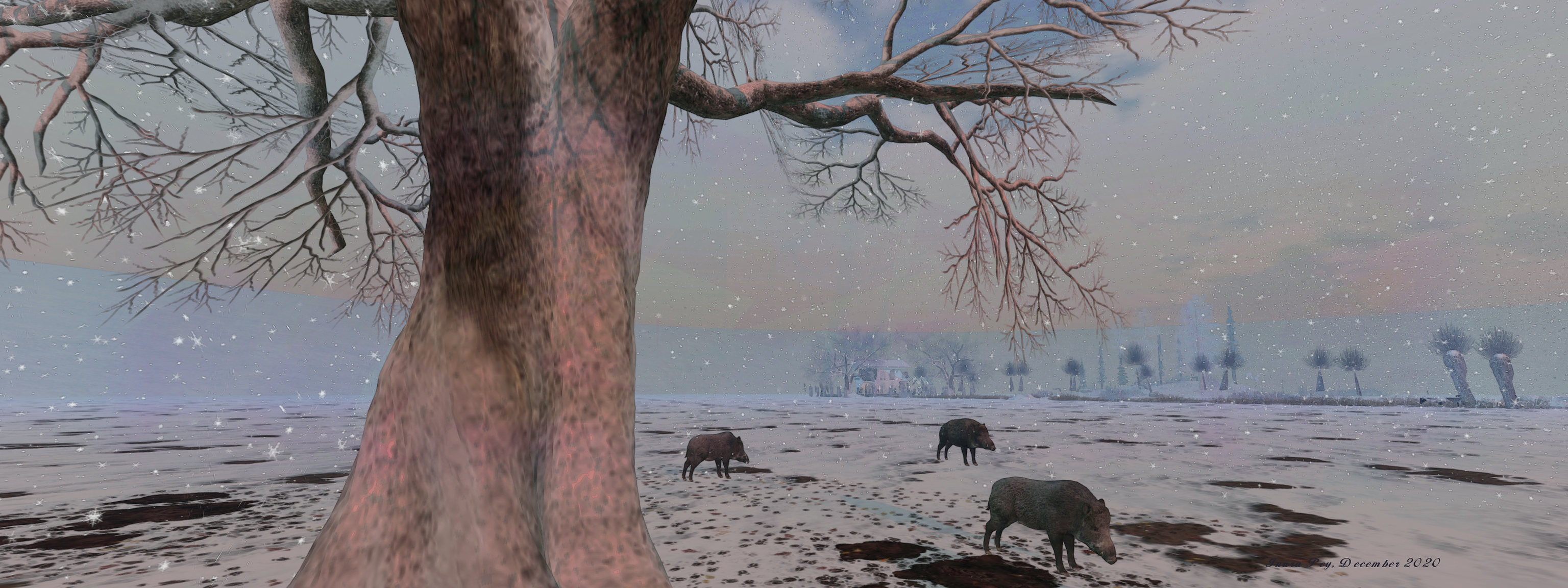
Beyond the house are more vignettes around which stories might be woven: just how did the tractor, a vehicle designed for operating over rough ground and muddy fields come to be bogged down whilst returning to the farm? And who is responsible for the boars gathered under the false shelter of the bare tree caught in its own little snowstorm? Are they a part of the farm or wild residents of the area?
Snoweeta, December 2020
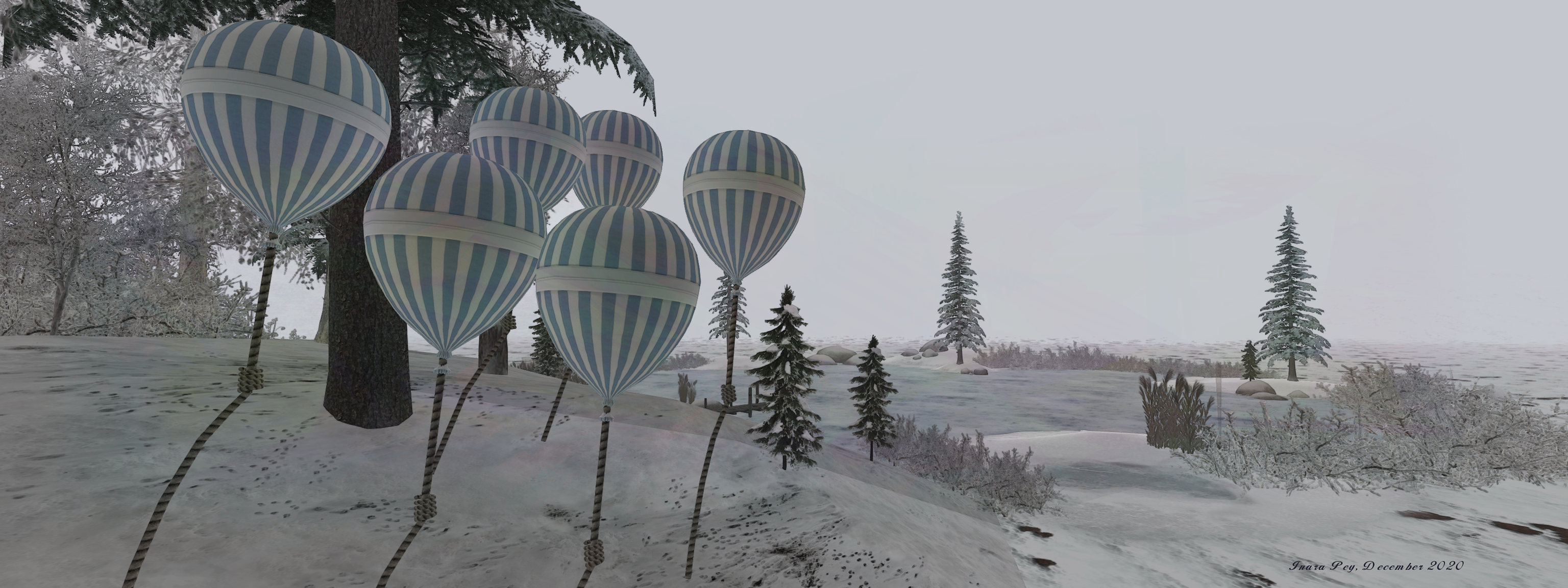
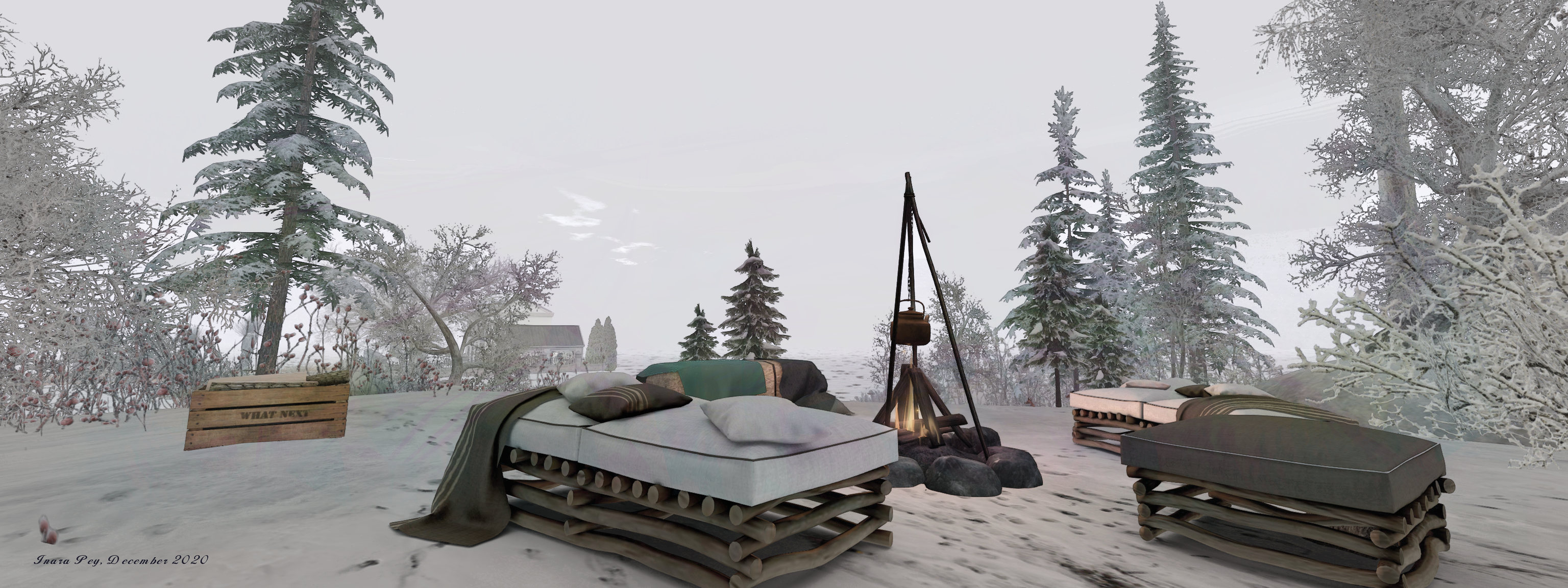
Those who prefer not to contemplate such question can instead snuggle up on the benches in the farm’s garden or inside the house or the cosy garage. Or, if preferred, a walk can be taken over the snowy field to where a low hill offers a retreat for trees within the farmlands, its top crowned by a little camp site. Here, a boiling kettle suspended over the flames of a fire, invites people to stop awhile and sup, while down the far slope of the hill is a frozen pond, prompting questions of skating and outdoor fun – although I wouldn’t recommend trying; the pond is beyond the edge of the region.
How far this place might be from either Ystad or Simrishamn is unclear, but the presence of a police car parked on the road’s shoulder (again, beyond the region’s edge) leaves one wondering what has happened to attract the attention of law enforcement – and whether the occupants of the patrol car are sitting in its relative warmth awaiting the arrival of Henning Mankell’s dour-faced Inspector Kurt Wallander, who might yet be driving his Volvo down the road from Ystad, where he both lives and works.
Snoweeta, December 2020
Simple and attractive in its design, Snoweeta offers an attractively different winter-themed visit.
Milena Carbone (Mylena1992) has opened a new exhibition at Noir’Wen City. Entitled Lux Æterna, it encompasses themes in consideration of religion, humanity and personal belief; elements that are not new to Milena’s work, but are here presented somewhat differently, being projected largely through the work of others, notably Second Life artist Norton Lykin.
Through the exhibition Lux Æterna, I want to express this paradox which is at the heart of my deviant faith in an imperfect God. Our perception of light covers a ridiculously narrow spectrum, and yet this handicap allows us to contemplate incredible beauty. The human species represents a miserable, ignorant, fateful, devastating vermin, trapped in a thin layer of gas on a tiny planet, and yet we have been given the privilege to see, to feel what is. If there is an intention in the universe, this intention is totally indifferent to our fate, and has given us this gift with infinite generosity.
– Milena Carbone
Lux Æterna, “eternal light”, in terms of its religious use, is perhaps most familiar for being a part of the Catholic Requiem Mass, although – and as Milena notes, it most likely dates to Gregorian times. It is a call to God to let his eternal light shine upon the departed as they rest with his saints.
Milena Corbone: Lux Æterna – image by Norton Lykin
Here, the the idea of eternal light is used both physically and metaphorically. As Milena notes, the light humans can see is limited to an incredibly narrow spectrum; one that, long before we discovered the non-visible (to our own eyes) wavelengths on either side of it, nevertheless allowed humanity to contemplate so much, achieve so much through creativity on both an individual and collective basis, and to perceive the richness and beauty of not only our own planet, but the incredible cosmos around us. Yet, at the same time – and even with our going understanding of the non-visible spectrum this promises to reveal even more to us – humankind so often opted (and still opts) to walk the path of ignorance, even whilst espousing enlightenment.
Metaphorically, this narrow spectrum light through which we perceive everything could be said to reflect our narrowness of understanding of any supreme being that might exist. For so long, we constrained “god” in terms of our own viewpoint – one that, far from putting the almighty at the centre of things, has actually placed mankind so that everything – even the idea of a supreme being – literally and figuratively revolved around us, in what can only be viewed as a arrogant outlook on the cosmos.
And herein lies the first paradox: for just as the cosmos is vast – and made more so as we finally drew back the curtain on those parts of the spectrum we cannot visibly see -and with wonders yet to be understood, so to must any supernatural consciousness behind it be vast. Thus, could it even be aware of humanity, as we sit huddled under the protection of our backwater planet’s thin envelope of atmosphere? And so we enter into Milena’s realm of pondering the nature of God; whom she sees as not no so much capricious for allowing all the woes that can befall us, as some might argue – but simply indifferent and / or imperfect, simply because they have far too much to do in just keeping the rest of the cosmos going to pay us that much attention.
These ideas are bound together through Milena’s exhibition in a number of ways. As she notes herself, Norton’s art, in its abstracted beauty, informs us about the two greatest elements within the cosmos: emptiness and light. Both are enduring and unalterable; we can see the light of the stars and nebulae, of novae and supernovae, and of galaxies beyond our own, visual cues to the vastness of the universe in which we sit, whilst the distances separating them appear largely devoid of anything we can perceive, forming an huge and everlasting void around us. To this I would add that through the choice of colours found in the majority of the pieces – the reds, purples, oranges, blues and yellows – we are reminded of the spectrum of light that extends beyond either end of the visible, and thus of the unseen grandeur this sits within the cosmos, and which may yet be found within the the emptiness that sits between the lights of the stars and the galaxies.
And this is only scratching the surface of what is an incredibly simple installation in terms of design and presentation which folds within itself so much food for thought by way of metaphor and suggestion.within the design, for example, is a subtle blending of eastern philosophy and Christian religion: the installation stands as three arms, intentionally representative of the Christian trinity, whiles the empty space at its centre representing the eastern ideal of centring, chakras, inner peace and the natural flow of energy. Elsewhere the the rising stairs might be seen as metaphors for ascendency, an ideal common to both eastern philosophy and “western” religions, if interpreted somewhat differently by both.
Milena Corbone: Lux Æterna – images by Norton Lykin
Through all of this, Lux Æterna also serves to touch on two subjects that can never be far from thinking when contemplating life, the universe and everything (notably religious themes and similar): those of death and immortality. These are concepts that can be said to be uniquely human, as Milena underlines through her use of extracts from Jorge Lui Borges’s The Immortals. Unique because – as Borge himself notes, we are the only creature on Earth with an awareness of death and by extension, contemplate immortality. So animals might be said to be “immortal”, simply because they do not share this awareness or live in that ever-present terrible shadow, and as such, they might be said to be “closer to god” than we can ever aspire (and thus the hare-headed figure standing God-like over the scene).
And yet still, there is that eternal light of the cosmos surrounding us and reminding us of the richness and of everything; a light we cannot help – and indeed always should – contemplate in humility and reverence, simply because of the beauty it enfolds, and the encouragement it gives for us all to expand our thinking beyond the petty.
Old Town Winterland, December 2020 – click any image for full size
For those wishing to partake of an extensive Second Life exploration, Old Town by .:Bekks:. (Bekks Heartsong) could be an attractive proposition.
Covering two regions, the Full region of Adagio Breeze, which has the additional 10K land capacity bonus, and the Homestead Isla Amorosa, it is an expansive setting, covering multiple levels, from ground level through several sky platforms – and also back under the sea.
Old Town Winterland, December 2020
We started our visit – on the recommendation of Shawn Shakespeare – in the region’s Winterland setting, a place that spans both regions and which, as the name suggests, offers a winter setting, heavy in snow, with more falling from the night sky.
This is a level not only heavy in snow, but also in places to visit and things to do – ice skating on a rink or across a lake, take your pick – or if you prefer, along a sky track that runs around the region, dipping down to greet those wishing to try it alongside the Arctic Express,that sits close to the boundary between the two regions.
Old Town Winterland, December 2020
With the lake covering most of the Homestead region, it is the Full region that offers the majority of the snowy attractions – cabins and cottages where visitors can get toasty in front of roaring fires; carousels, coaches, balloons, sleighs and frozen ponds and little camp sites, all interlinked by winding trails and paths visible through the snow that encourage feet to wander and cameras to roam.
Those not taken by all the walking can take a horse from one of the rezzers and ride through the snow, or simply sit and watch others as they explore – or find themselves under observation by the wildlife also to be found out on the snow and amongst the frosted trees.
Old Town Winterland, December 2020
Also to be found within the setting are a number of teleport globes. These provide access to many of the features to be found within Old Town, some of which are on the Winterland level, others of which sit on other platforms or, as noted, at the ground level or under the waves. These offer more to see, and the chance to get away from winter and visit other places and realms.
For those particularly given to horse riding, there is an Old West destination, for example, while those who missed Halloween can find spooks and ghosts within the Hauntings setting. There’s also a little town waiting to be explored, a bohemian camp (and more) at ground level, and even more to be discovered, including karaoke for those who might enjoy it, and spaces for other music and dancing.
Old Town Winterland, December 2020Obviously, given the extent of the offerings within the regions, exploration can take time – and so it’s probably best to break down a visit into several trips, rather than overwhelming yourself. However, as the region’s settings are split between different levels, rendering issues aren’t as bad as might be thought for a location that offers so much to see and do, and this further adds to the attractiveness of a visit.
All-in-all well worth taking a look and let your feet wander as they will.
Currently available at Mareea Farrasco’s IMAGO Gallery for visitors to appreciate is an exhibition of avatar studies by Liz Winterstorm (TinLiz) that is – in four words – beautifully and emotionally expressive.
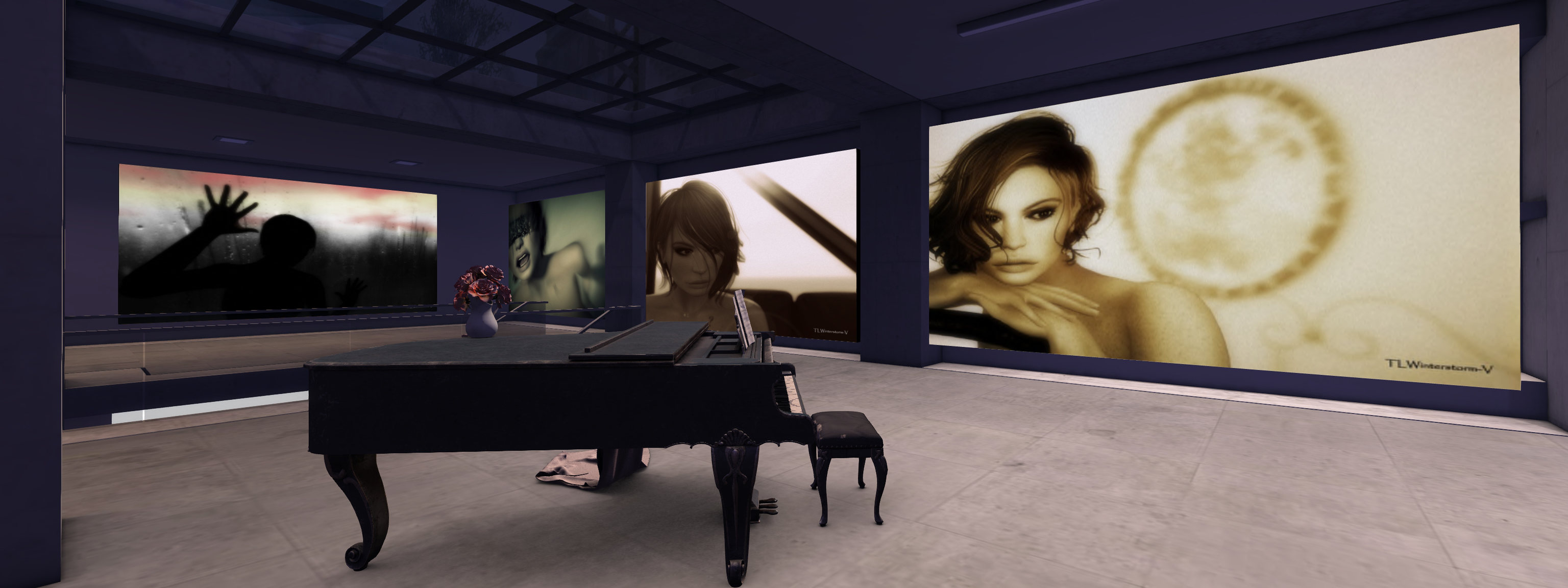
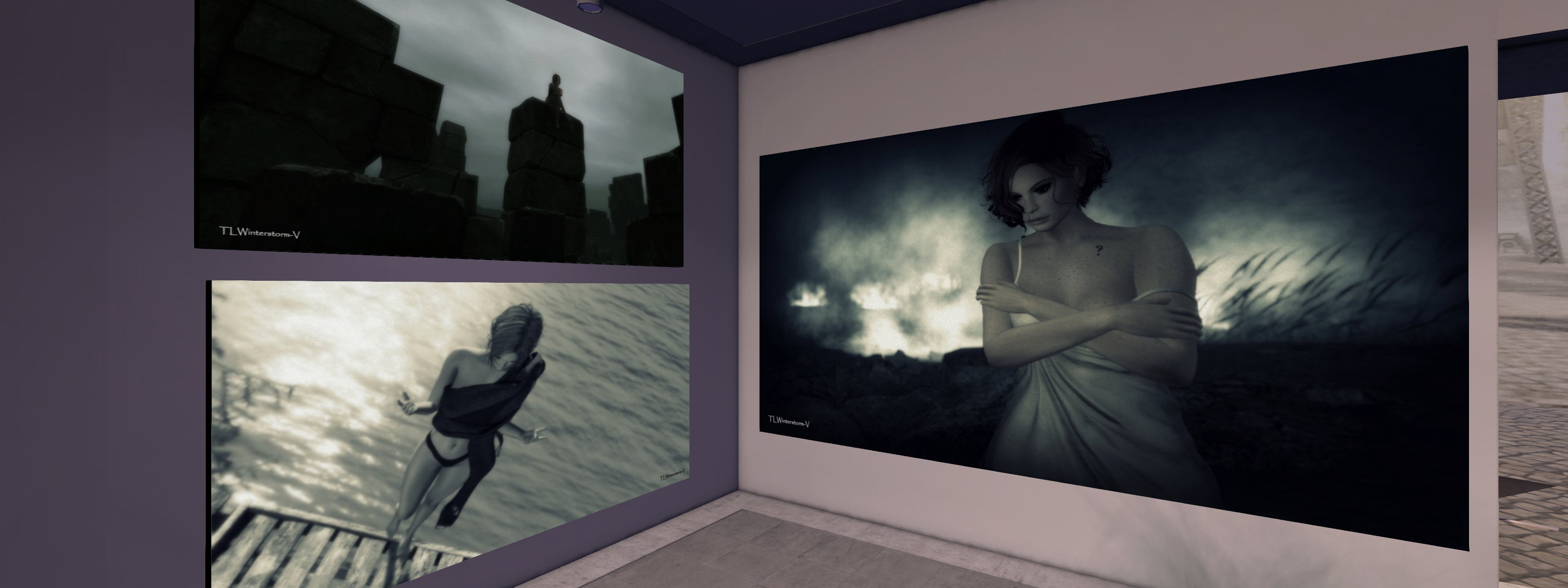
Presenting 28 avatar studies, all of which are either black-and-white or soft monochrome, every one of the presented works is powerfully evocative in its narrative and emotional content, each one perfectly framed and presented, making the entire selection an extraordinary must-see exhibition.
Taken without external post-processing enhancement – Liz notes she simply does not have the patience to learn PhotoShop, these are images show that Liz has an innate grasp of lighting, and the use of light and shadow through her selection of Windlight environments in order to express her pieces.
IMAGO Gallery: Liz Winterstorm
While the selection is untitled (other than Liz Winterstorm at IAMGO), there appears to be a twist of thematic threads running through the images. The first might be seen as purely reflective of emotional states arising from a relationship – particularly those images that involve two figures. There are emotional responses anyone has likely experienced through the ups and downs and turmoil that are a part of many (all?) relationships.
The second thread, equally as evocative, might be seen as a considered reflection of the way many of us have felt at one point or another through the past year: loneliness, emptiness, of wanting things to be over, separation, of being unable to escape (the world’s woes?), anger.
IMAGO Gallery: Liz Winterstorm
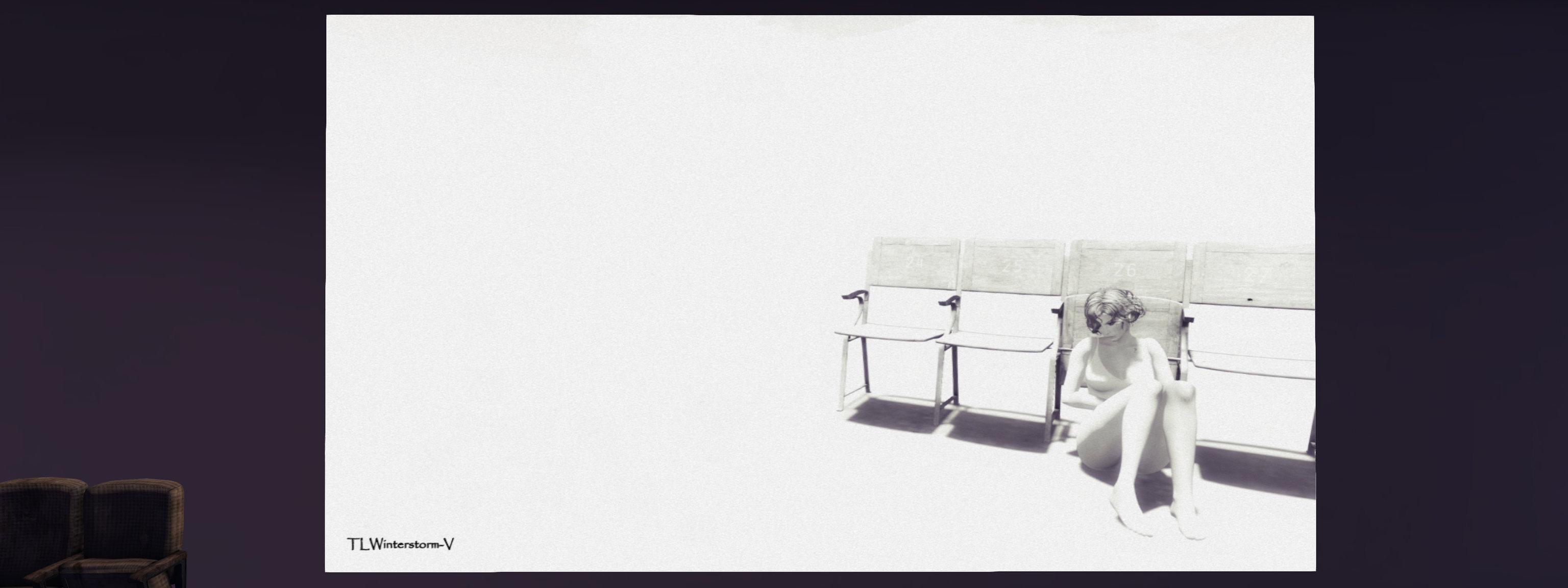
It is this layering of ideas – or at least, suggestions of ideas – that gives this exhibition its depth. But it is not the only thing; as noted Liz has a magnificent approach to using the natural environment through Windlight settings and framing to create pieces that are genuinely visually impressive. Just take a look at Shunned as an example, the use of a pure white lighting and background, coupled with the pose and row of seats gives the piece a quite remarkable depth and emotional focus that can be felt within whichever narrative thread you choose to follow.
As a second example of this narrative and visual richness, take Apocalyptica; it’s title alone is powerful and the imagery fully reflective of either theme. But there is perhaps more here; within the picture is what seems to be a direct reference to the Finnish band itself and the lyrics from their single Life Burns. And this abundance of narrative and imagery flows across all 28 pieces in the exhibition.
IMAGO Gallery: Liz Winterstorm
Very definitely not an exhibition to be missed by those who appreciate Second Life art and photography.
Grauland, December 2020 – click any image for full size
To take a break from scenes of snow and winter, we decided to head over to Grauland and see what region holder JimGarand had put together for December – and as always, we weren’t disappointed with what we found.
Over the years, Jim has never ceased to attract us – and many other visitors – with a series of unique region designs that never fail to offer something new and different, whilst also offering touches that persist between designs to present a sense of continuation from one design to the next.
Grauland, December 2020
With this iteration of the region, that continuance can be found through the maze of rooms and half-rooms last seen in the region’s summer looks, and the ranks of concrete blocks that have appeared in a number of the region’s designs.
The maze of rooms is the first element of the design to be encountered from the landing point, which sits on a pier head that thrusts out into the waters on the west side of the region, a crossed archway forming the walk from the pier head and the maze.
Grauland, December 2020
Beyond the rooms a series of broken walls form a zig-zag walk for those who fancy it – or visitors can go around this to the north, where they’ll encounter a pattern of “portal blocks” – hollow concrete blocks with circular holes in their six sides, inviting people to walk through them, or head southwards where, a little further inland, stands the rows of concrete blocks, standing close to where steps have been cut into the bare rock of an upland table of rock.
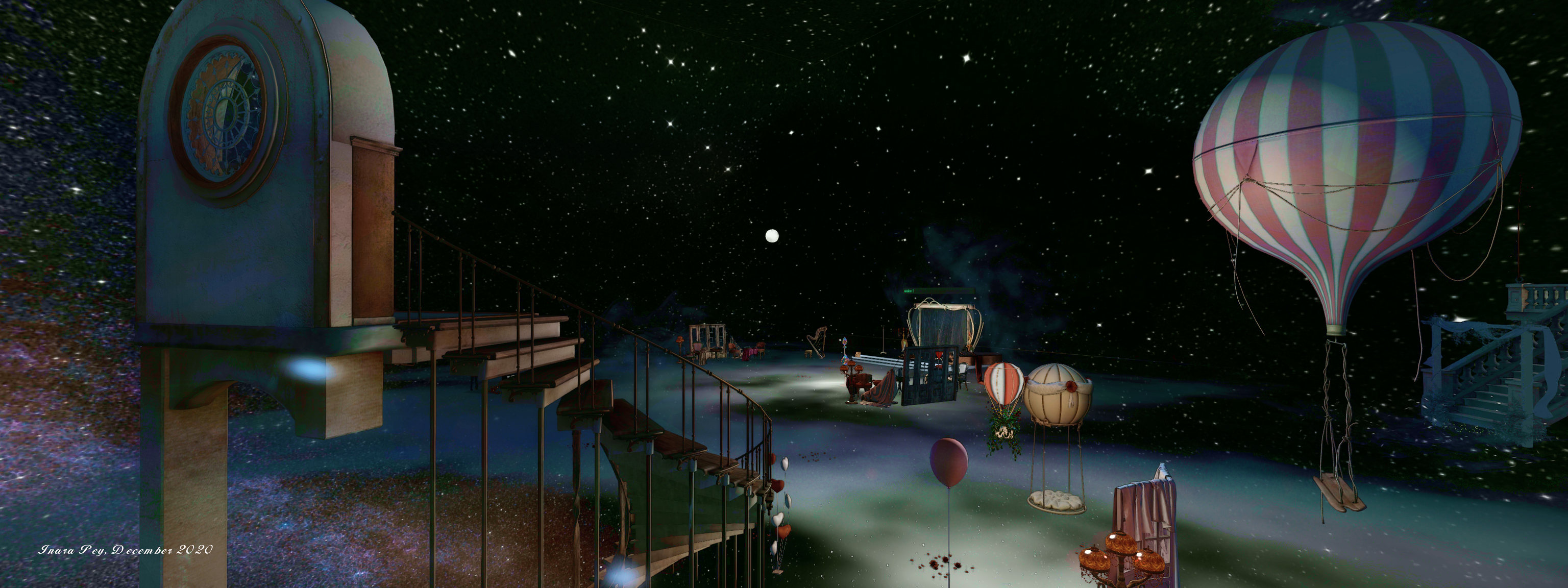
These steps lead up to a most unusual tower that rises from a rough table of rock. apparently made of concrete it raises a single square finger into the air which splits at its top into four arms, each forming an individual room leading off of the central stairwell. As a home, it offers a most unique residence – allowing for its outwardly industrial look. However, here the structure is used as something of an artistic statement – art also being a common theme running through Grauland designs. Each room presents an individual décor from rings of multiple televisions through if not Santa’s grotto, then certain his hi-rise retreat, to a balloon-lovers paradise and a lounge where talking about the elephant in the room is unavoidable.
Grauland, December 2020
The tower is not the only structure on the island. Diagonally opposite it to the north-east and also sitting atop a large plateau, is another concrete building. Octagonal in shape, it appears to have a steeply-sloping, sectionalised roof. It is only on reaching it and taking the tunnel and stairs up into it, can it be seen that the building is actually open to the sky above – although what purpose it might be put to – gallery, event centre or even landing pad for some form of space vehicle – is entirely up to the imagination.
Directly south of of this, and also facing the tower is a large studio house with sunken gardens and swimming pool. The courtyard around the pool offers both places to sit and sculptures to be appreciated. A small club house is to one side of the courtyard, a hot tub alongside it, while a A single passage runs directly east to the water’s edge, flanked by further sci-fi elements in the form of strange pods that offer little studio rooms where visitors can relax.
Grauland, December 2020
Finished in concrete and stone blocks. and with its outside metal stairways, the studio house continues the industrial theme of the setting, but offers comfortable furnishings within, its southern aspect overlooking a small wild flower garden sitting of a shelf of rock between house and sea.
With boats at the landing point, a little an aged and damaged garden shed sitting to the north-west offering a further unusual hideaway, and seating offered throughout, Grauland invites explorers to wander inland and around its rough coastline (rocky outcrops and cliffs allowing, while its low-laying inland mix of blocks, walls (straight and sinuous) offers an artistic statement in its own right.
Grauland, December 2020
Thus, this iteration of Grauland continues the region’s reputation for being an engaging, curious and photogenic visit for all who appreciate exploring Second Life.
Jacob, December 2020 – click any image for full size
At the start of December, Shawn Shakespeare reminded me that it’s been a good few years since I’ve written about the End of Time estate, and suggested taking another look at Jacob, one of the regions within the estate, and which has traditionally stood a little aside from the rest of the regions there in terms of looks and presentation.
Currently, the region sits as a winter setting, designed by Holly Texan (Dacotah Longfall) that is both simple and effective – particularly if you enjoy long, bracing walks through a snowy landscape, hearing the crunch of fresh snow beneath your feet and feeling the crispness of cold air in your sinuses. It’s a setting that is ideal for photographers and rich in subtle details.
Jacob, December 2020
The landing point is tucked into the north-west corner of the region, within sight of the some of the other regions in the estate, the water channel between them and Jacob apparently frozen. A welcome sign informs arrivals that clothing is optional – although skipping through the snow sans boots and clothes is not my idea of a fun afternoon, so was decidedly with clothes during my visit 🙂 .
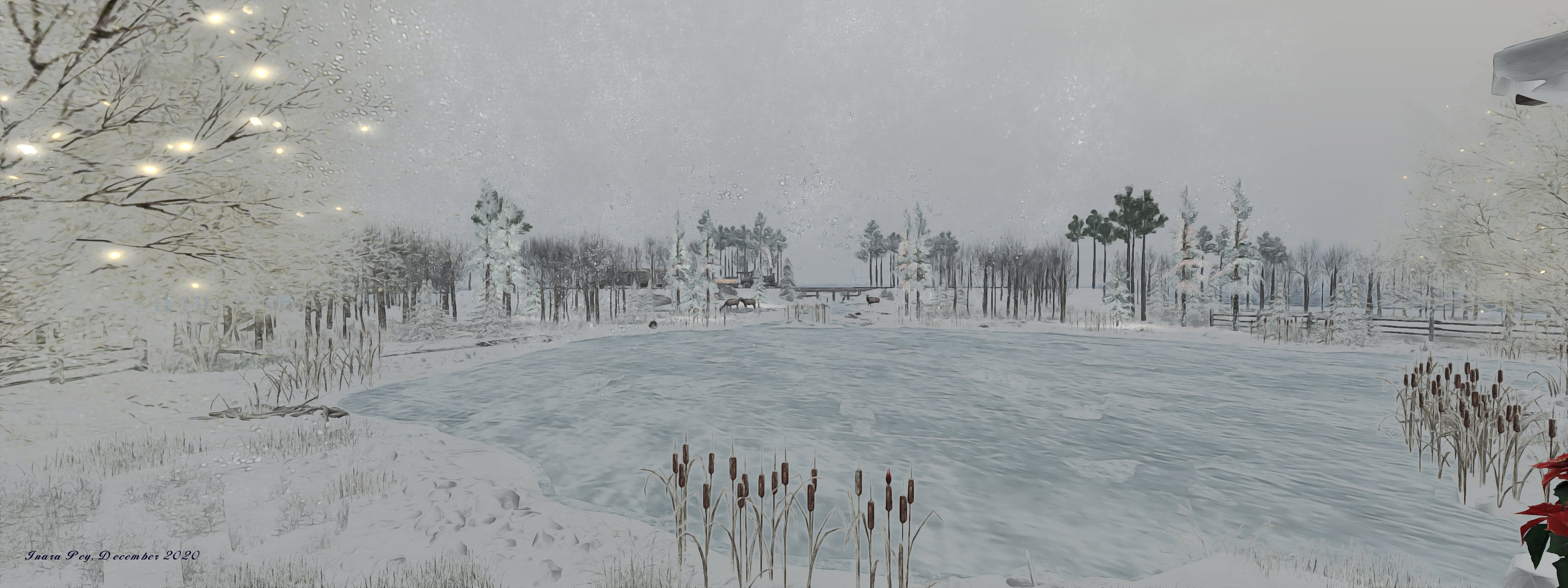
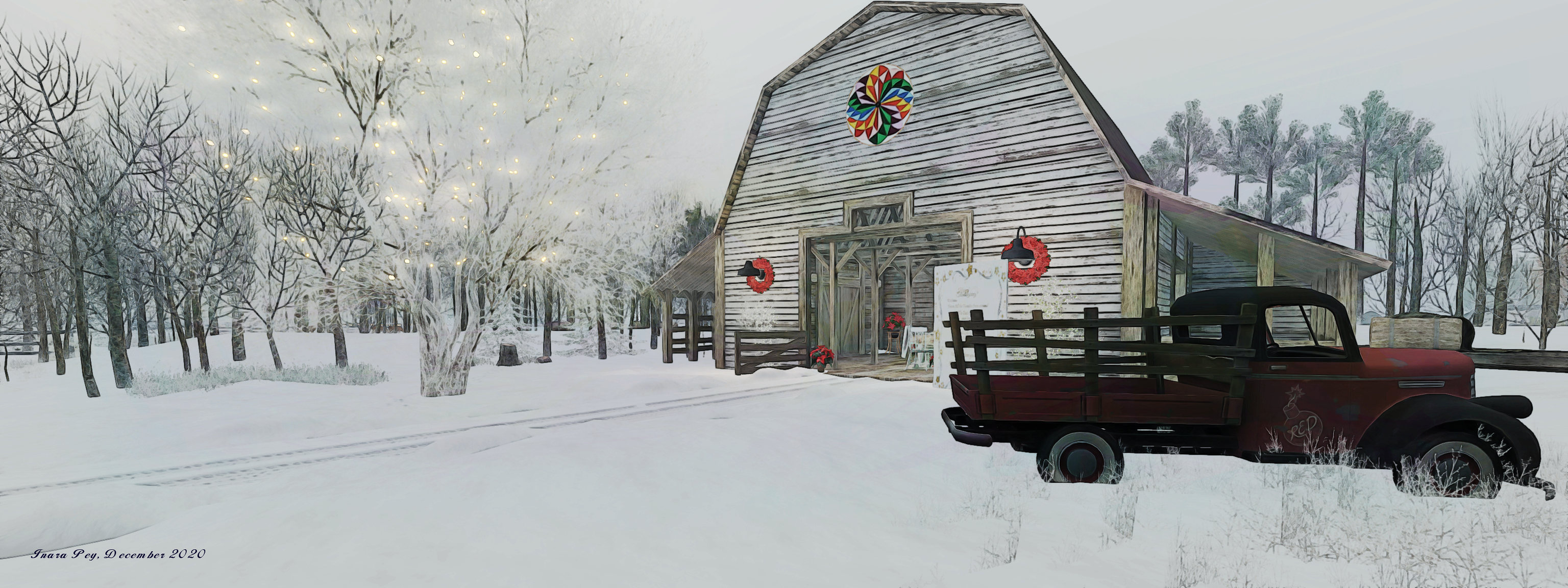
The snow leading away from the sign is rutted with tyre tracks that run between fencing that marks out individual fields on either side, before the southern side of the road opens out to an ice-covered lake. Passing over a covered bridge, the tracks point straight and true to a farmhouse on the east side of the region. A second set of tracks points northwards, perpendicular to those running across the front of the farmhouse, and lead the way to a large barn where best wishes for the US Thanksgiving holiday and the Christmas holiday season are offered to all who visit the region.
Jacob, December 2020
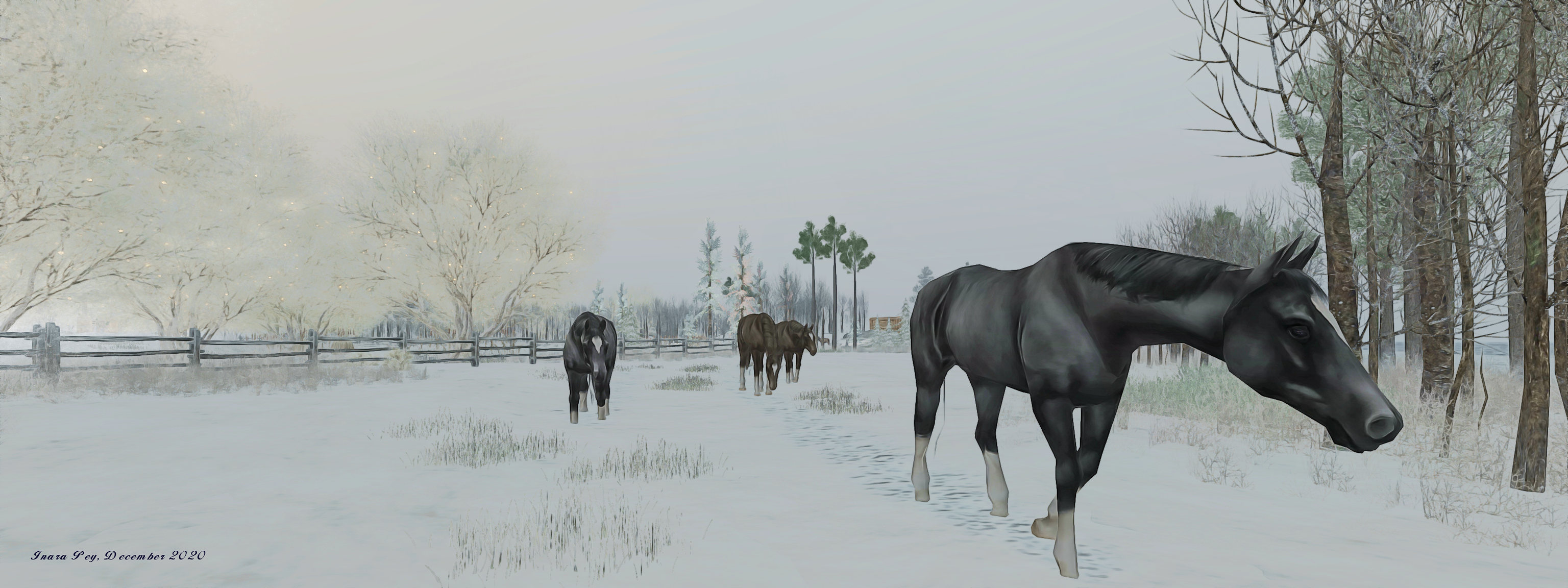
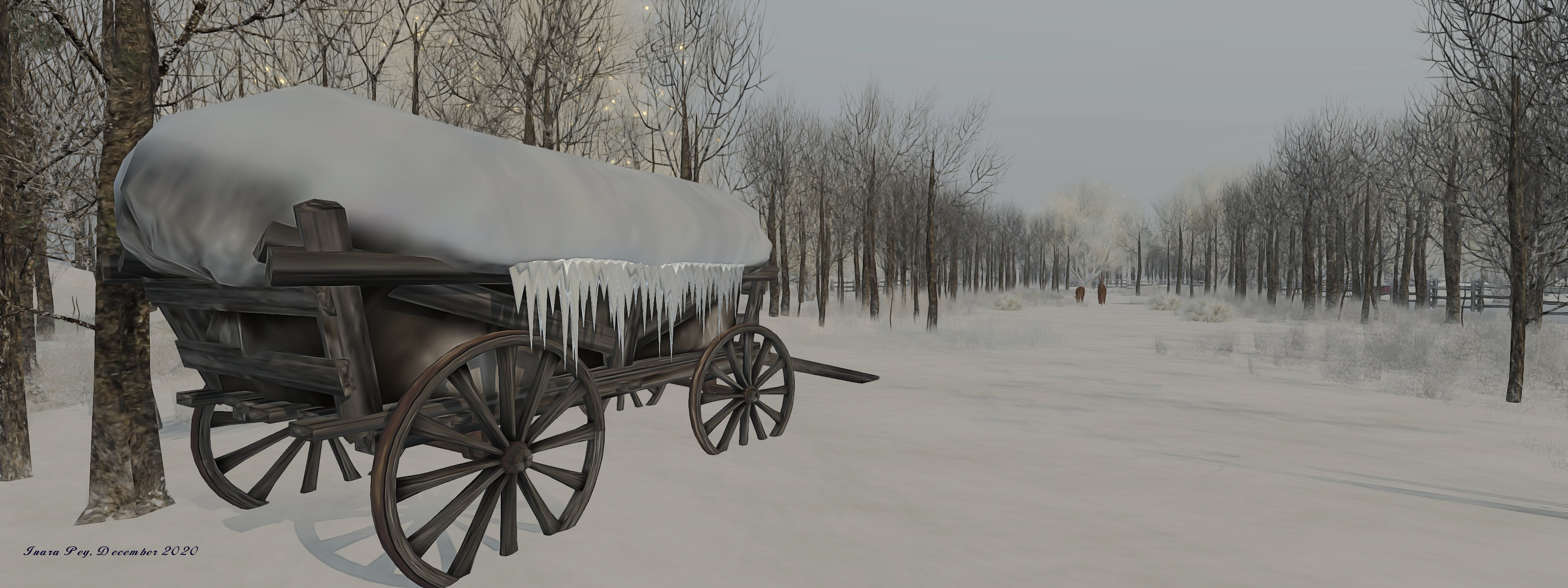
A flat landscape, the region is home to the fields mentioned above, where horses and deer wander and attempt to graze on the grass sitting under the carpet of snow. Copses of trees are scattered across the land, whilst to the south-west, an old steam locomotive is huffing its way along tracks that curve across that corner of the region.
The touches of detail can be found in the way that the deer and horses have left their own footprints in the snow – so often in winter regions, animals appear to be able to move across a landscape heavy with snow without ever seeming to break the virgin surface (although admittedly, there are elk that also appear able to do so!). Similarly, the grounds of the house show signs of human handiwork not just in the presence of snowmen, but in the footprints criss-crossing the snow, suggesting the industrious hands that have made them.
Jacob, December 2020
As a Calvin and Hobbs fan (and who among us, having read Bill Watterson’s tales of a young boy and his stuffed tiger isn’t?), I couldn’t find the snowmen in the grounds of the farmhouse mindful of Calvin’s antics: one apparently up to his neck in “quicksand” (although he doesn’t seem unhappy about that), and the other having lost his head, which lies with a broken nose on the snowy ground. Whether or not both are intended to evoke Calvin’s approach to snowman making, I’ve no idea, but I like to think of them in that way, adding as it does a sense of fun to the setting.
For those who need them, rezzing rights can be obtained by joining the End of Time group – but if you do rez props, etc., for photography or anything else, please remember to pick things up behind you.
Jacob, December 2020
Easy on the eye and on the viewer, Jacob remains a light, engaging visit.