A slice of old Nordic life in Second Life

VARGSÅNGEN, February 2021

VARGSÅNGEN (Wolf Song in Swedish) is a homestead region designed and held by Camila Runo that has been coming in for a lot of attention of late, having been featured in a number of blogs and in a Destination Guide short video. And it entirely right that it has, because the region is home to an engaging build that is fully evocative of the Viking era.

A regular meeting place for the SL Norse and Viking Society (group joiner at the landing point), the region’s About Land panel describes it thus:

A land in the far North, a long time ago when there were gods and giants, Valkyries, dwarfs and trolls. A land where the winters were long, dark and cold and the summers not so warm either but exploding with flowerage for a short period of time. Everyday life was a challenge, sometimes ending way too early.
VARGSÅNGEN, February 2021

And I have to say, having just waded through all six seasons of Vikings, with its re-imagining of the legends of Ragnar Lothbrok, Lagertha, Björn Ironside, Ivar the Boneless, Hrafna-Flóki Vilgerðarson, Horik I, et al, on landing within VARGSÅNGEN, I felt as if I had just arrived in Kattegat, not far from the town of the same name held as the setting for so much of that series.

The region presents a small settlement straddling two islands occupying what might be the mouth of a fjord – it faces an opening to the sea on one side whilst a river flows through the surrounding mountains from the other. It would appear to be of some strategic import, as a huge craved figure towers over the islands, sword held aloft. shield at the ready. Whom it might be – god or man – is yours to decide.

VARGSÅNGEN, February 2021

This statue stands on the southern tip of an island dominated by a huge domed hill of rock and grass, doubtless formed by its resistance to the passage of ice down through the fjord, and which is now home to a (quite literally) high alter where blood sacrifices appear to be a part of the order of ceremonies, watched over as they are by standing stones.

The path up to this summit comes via the lowlands on the north side of the island, using a combination of stone slabs that have in places been set as steps into the steep slopes, and short climbs over grass that feels both slippery and wet to the eye in perfect accompaniment to the overcast sky.

VARGSÅNGEN, February 2021

These low northern reaches of the island also contain reminders of the harshness of life back in the times of the Vikings: bears are to be found among the trees together with wild boar, whilst a stag attempts to defend its already dead mate from the wolves that brought it down and which are hungry to finish feeding on the carcass.

The second island is smaller and lower in nature, separated from its neighbour by a small neck of water easily spanned by a couple of hewn tree trunks. This is the location for the setting’s landing point and settlement. The latter is made up of half-a-down structures presided over by a stone-and wood watchtower where keen eyes keep watch on the fjord’s mouths, and strong legs are ready to descend and run to the great horn in order to sound warning should anything undesirable opt to slip into the channel.

VARGSÅNGEN, February 2021

Within the settlement is a wealth of detail that really needs to be seen to be appreciated, and it is clear that a huge amount of care has been taken to present life in those times as we currently understand it to have been. Humans and livestock share living spaces (making it easier to protect the latter); food is taken wherever it may be found, be it grown from the land, slaughtered after rearing, or taken from the sea in the form of fish or whale meat.

The ties to the sea are also much in evidence: a longship is drawn up at the settlement’s wharf, shields still in place and cargo (the haul from a raid, perhaps?) is being off-loaded. Just across a low ridge from the wharves lies an second ship under construction, the shipwright’s house close by. Could this be Flóki developing his improved hull that would make possible voyages so far out to sea, he’d be able to make his expedition to Iceland?

VARGSÅNGEN, February 2021

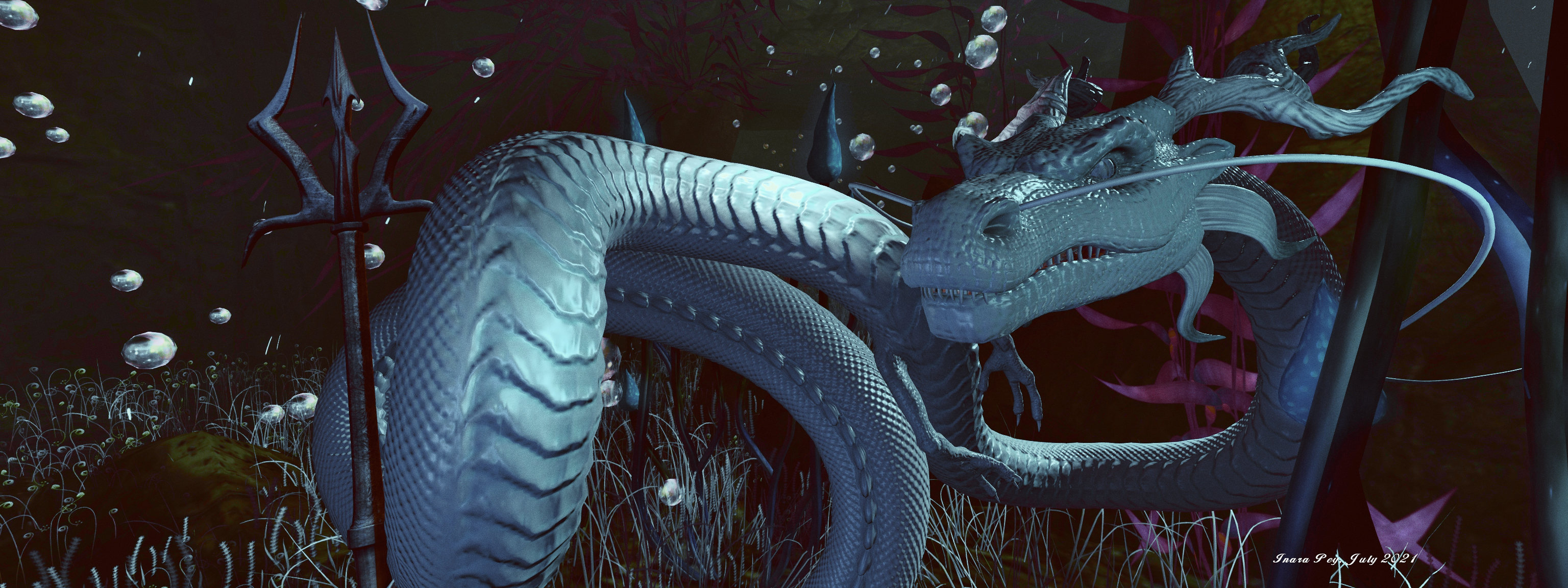
Norse mythology is touched on throughout, from the little carvings of Odin (some of which stand as teleporters along with the smaller boats that can be found), through the the menacing form of Jörmungandr, one of Loki’s three children. It circles within the fjord rather than encircling the world – so perhaps Odin has only recently tossed into the waters of Midgard?

And what of the name of the region itself – VARGSÅNGEN? Whilst meaning wolf song, as noted above, might it also be perhaps taken from the writings of Astrid Lindgren?  Specifically, the lullaby from Ronja Rövardotter (Ronia the Robber’s Daughter)? It’s a haunting song that both in tone and lyrics fits the region perfectly.

VARGSÅNGEN, February 2021

The latter is pure supposition on my part, but to me it adds twist of mythical romance to the region. However, even if the lullaby has nothing to do with the region’s name, VARGSÅNGEN is a rewarding visit in and of itself, and offers a doorway through which enquiring minds can discover more about medieval Nordic life.

SLurl Details


The digital mastery of Kraven Klees in Second Life

The Janus Gallery: Kraven Klees

Currently open at the Janus I Gallery at Chuck Clip’s Sinful Retreat is a truly magnificent exhibition of the art of Kraven Klees which is an truly must-see event.

Working in the digital medium, Kraven specialises in the creation of pieces encompassing a range of techniques –  art, photography, mixed media – whilst also embracing a spectrum of approaches and styles including fractals, abstraction and photo layering, to create pieces that explore the boundaries of what we might consider art to be, and what it means to us personally.

The Janus Gallery: Kraven Klees

As a result, his pieces are both highly esoteric and instantly captivating. There is both a richness of presentation and melding – conscious or otherwise, given the artist notes he deliberately embraces an aleatoric approach to his work such that the final appears of each is a mix of predetermination on his part and circumstance encountered in the creative process – that gives them immediate visual appeal while can be immediately experienced and enjoyed, whilst also calling the eye and mind to look again, and more deeply.

This approach to mixing concious decision with the passage of chance taken by the artist means that while many of these pieces many be linked by a core theme – portraiture, living study, the very richness of colour palette – each and every piece is genuinely unique content, form, colour, style, and expression. This adds enormously to multi-faceted appeal of the exhibition as a whole whilst giving each piece a sense of individual beauty and depth that sets it apart from its neighbours.

The Janus Gallery: Kraven Klees

But there is more here as well; even within those that may appear to be “straightforward” portraits, there are elements that can trigger our emotions and alter our perception. Neural Network, for example, initially appears to offer commentary on the nature of intelligence and our growing reliance on  technology. But a closer examination offers other potentials for interpretation – the potential for, and form of, artificial life; questions on the nature of life  – are we simply little more than the filaments of the brain and the neurons that fires across them? and more.

Alongside of it, Bamboo Man sits as an intriguing study on the human form: flesh, sinews, bone; but at the same time, the entire image in form and colour opens the door to discomfiting thoughts of evisceration and / or hints of Geiger-esque horrors. There is also a certain psychedelic aspect to many of the pieces that comes to us through both the stylised  use of expressive colours and fragmented, fractalised form that heightens our response to them. Like the effects of a drug, they seem to expand our consciousness, reflecting the artist’s desire to increase the dynamic between audience and art / artist.

The Janus Gallery: Kraven Klees

All of this makes The Art of Kraven Klees an exhibition a rich exploration of art, ideas, emotions and outlook. Whether you are drawn into the deeper layering of individual pieces or chose to admire them for their natural beauty and styling, this is a collection that will attract and beguile. As such, this is very much an exhibition that should not be missed, and it will remain available through until the end of the month.

SLurl Details

Sampling some Poison Rouge in Second Life

Poison Rouge, February 2021

Busta (BadboyHi) has a well-deserved reputation for designing eye-catching regions – so when I heard he is behind the new design for the Poison Rouge store in-world, I had to jump over and take a look.

Occupying half of a full region, the setting has something of a Dutch urban feel to it around the landing point – tall, slim town houses built along cobbled streets that line the banks of canals spanned by little bridges – with more to discover beyond.

Poison Rouge, February 2021

The landing point itself is located within a large square. Facing this on three sides, and separated from it by the above mentioned canals, are the town houses that form the home of the Poison Rouge fashion and accessory brand, operated by Shena Neox, who is also the parcel holder.

It’s a visually appealing setting, the square with water features and places to sit, whilst in the streets surrounding it and the store buildings are other little attractions: a little outdoor coffee bar, boats (with sitting poses)  on the canal waters, little overgrown garden plots, while bicycle racks add to the feeling we’re in The Netherlands. To the north of the square lies open water, a row of moorings home to sail boats and fishing trawlers. Further moorings can be found to the west of the square and store, watched over by a lighthouse.

Poison Rouge, February 2021

However, this is very much a location of two halves – whilst the west side is devoted to the urban environment with shops and canals and streets, the east side presents an entirely different setting – although still one in keeping with lowlands that might be found in The Netherlands.

It is reached by way of a railway station that effectively splits the setting in two as it runs south-to-north, from tunnel to terminus. A familiar DRD Arcade Express sits at the station, and with no footbridge over the track, visitors can either pass through the train’s carriages to reach the far side of the station, or follow the footpaths around the northern end of the terminus.

Poison Rouge, February 2021

Beyond the station is a remarkable garden area that is also part cemetery. Of great age, overgrown and rich in features and detail, this is a place to capture the eye and imagination – and time really should be taken in exploring it, as there is a lot to see.

The north side of the cemetery includes the ruins of the church, with further ruins beyond, sitting between open waters and a wetland cove that naturally intrudes into the landscape, gulls circling overhead.

Poison Rouge, February 2021

An aged path runs south through the old churchyard to reach a second square. neatly paved if starting to be overgrown. It is dominated by a large square water feature and grand statue, bordered on three sides by more structures.

The first of these is an elevated walkway that offers a good vantage point from which to observe the square. It looks westward to where a pavilion is slowly breaking into ruin. This appears to form a stage area for music events. Behind it lies another garden space, forming a quite waterside walk, in turn bordered by a rushing stream pouring over rocks from narrow southern falls. The south side of the square is house to tearooms fronted by a raised terrace.

Poison Rouge, February 2021

Throughout all of this is a wealth of detail awaiting discovery: inscriptions on water features, the flight of butterflies, the multiple places to sit through the the looks wildlife – all of which also heighten the photogenic nature of the setting.

Definitely not a place to miss.

Poison Rouge, February 2021

SLurl Details

A HAUS for the arts in Second Life

HAUS Museum of Art, February 2021

An entry in the Destination Guide drew me to the HAUS Museum of Art, an impressive undertaking in celebration of physical and virtual arts led by Cyraphir. And when I say “impressive”, I mean just that.

Having opened in January 2021, this is an expanse facility. Utilising the Omega XL prefab by GullyRivers. with a 100 x 64 metre footprint, the museum presents around 6,400 sq metres of display area across two floors. That’s a lot of space in which to display art, and I’m happy to say that it is space that is well utilised.

HAUS Museum of Art – Itō Jakuchū

From the entrance lobby, the gallery is broadly divided into six areas, five covering individual facets of art: classical (covering the period 1500-1900), couture, modern art, music, and gaming art, with the sixth devoted to literature and the spoken word.

The largest section, located on the main floor, is that of classical art. It is devoted to “some of the most well-known artists in art history”. Displays within it include pieces by Hieronymus Bosch, da Vinci, Michelangelo (including two superb reproductions of both David and Pietà rendered by Cyraphir), Tiziano Vecelli (Titian), Caravaggio, Rembrandt, Itō Jakuchū, Jean-Honoré Fragonard, Katsushika Hokusai, Ivan Konstantinovich Aivazovsky, William-Adolphe Bouguereau, Sir Frederic William Burton, Théodore Chassériau, Gustave Doré, John William Waterhouse, Van Gogh, Utagawa Hiroshige, Gustav Klimit, Pablo Picasso and Salvador Dali.

HAUS Museum of Art – Michelangelo

There is no discernible  ordering as to how individual artists have been placed within the section, which means that Dali rubs shoulders with da Vinci and Picasso, whilst Klimt faces Bosch. Such juxtapositions might jar with the ordered mind used to dealing with so broad a spectrum of art being presented chronologically, but it actually makes for interesting contrasts / comparisons. Take for example the three approaches towards the representation of objects and the human form seen with da Vinci (realism), Picasso (cubism) and Dali (surrealism).

Other artists such as Van Gogh and Michelangelo have there own display space in which their work can be duly appreciated, whilst others might be more closely associated in terms of time frame (Bouguereau and Burton, Itō Jakuchū and Katsushika Hokusai, for example – with the latter two located with Utagawa Hiroshige, noting their mutual country of birth). In all it is a rich and varied selection, and one in which I was pleased to see the likes of Itō Jakuchū, and some of what might be the lesser-known, but still captivating, pieces by the likes of Van Gogh.

HAUS Museum of Art – Vincent van Gogh

However, I must admit to a tinge of disappointment: outside of a single piece by by Sophie Anderson, female painters are conspicuously absent. Where are the likes of les trois grandes dames of the French impressionist  movement: Marie BracquemondBerthe Morisot and Mary Cassatt, or the works of Élisabeth Le Brun, Angelika Kauffmann, Clara Peeters and Marie-Denise Villers, to name but a handful? I hope they will yet be seen in a future exhibit.

On the opposite side of the ground floor area is a hall that, at the time of my visit, featured avatar studies by Kouralee, together with three spaces devoted to a celebration of both physical and digital couture, one of which – the Sketchbook – was still under construction. Between these is a further exhibition of avatar-centric art by Jasmin Kyong.

HAUS Museum of Art -Jasmin Kyong

The upper floor of the galley is home to a mix of displays encompassing anime art, video games, music and literature.

The first of these comes in images taken from Nagabe’s Totsukuni no Shoujo, published in the web-based Online Magazine Comic Blade. Alongside of and opposite this exhibit are celebrations of art, music and literature, the first being the museum’s reading room.  Located next to the Nagabe display, it plays host to live reading events, while across the hall is a section devoted to the late Leonard Cohen.

HAUS Museum of Art – James Jean

The latter reminds us of the breadth and depth of Cohen’s of talent and insight into the human condition as a singer-songwriter, poet, novelist and occasional drawer of cartoons. With a brief biography (with a link to his wikipedia page), a discography and quotes from his songs and books, it’s an effective celebration of Cohen’s life.

Reached via a lounge devoted to live music events, the remainder of the upper level of the gallery hosts a display to Taiwanese-American contemporary visual artist James Jean, whose paintings and drawings have drawn world-wide acclaim. Across a further hallway from it is a homage to video game art that features a look at Valve’s puzzle-platform game, Portal, which contains an interactive element and is somewhat eclectic in its appearance here.

HAUS Museum of art – virtual couture

Overall, HAUS offers and engaging selection of exhibitions, some (or all?) of which I believe I’m correct in saying will change on a quarterly basis. As a gallery, it works well; as a museum, I’d perhaps perhaps like to see more in the way of interactive links to things like wikipedia pages to allow visitors to find out more about a subject and / or artist (and in the case of Sl artists, perhaps the opportunity to obtain their biography). Details on upcoming events can be found in the Info hall behind the entrance lobby, as can an application to be considered as an exhibiting artist.

All-in-all and impressive and engaging project well worth visiting.

SLurl Details


The charming whimsy of a Lightning Bolt in Second Life

Lightning Bolt, February 2021

Lightning Bolt is the name selected by Valarie Muffin Meow (Zalindah) for her latest region creation. It’s an interesting name that appears to be less connected with the region’s presentation than with the fact that it is likely only to be around for a limited period of time, as the About Land description notes:

Made for a special wolf. A temporary nature escape to explore & spend time with love ones. Full of animal friends to hug.

I assume the wolf in question is Dice Starlight, Zalindah’s SL partner – but the region is going to appeal to anyone who appreciates the more unusual, and / or places with a focus on animals and / or with a lean towards the oriental and / or who enjoy whimsy and a twist of fantasy.

Lightning Bolt, February 2021

Those who visited the now-closed Kintsugi – which I wrote about back in May 2020 –  will know that Zalindah very much the eye for creating environments that are captivating and which can, as with the now departed Kintsugi, tickle the grey matter.

With Lightning Bolt, this eye for design and attention to detail is very much on display through the setting, although rather than tickling the grey matter, this is a location intended to simply delight the eye and lift the spirit, and it does so quite marvellously.

Lightning Bolt, February 2021

Forming a curving island that captures within its open arms a north-facing bay, the landscape rises from the landing point on the western headland to the hills enclosing the bay, before dropping gently down to lowlands on the eastern side.

From bamboo groves to walks between tall fir trees and over razor-backed ridges and through grass and wetlands and with a mix of building – some with a Japanese lean – scattered throughout, the setting offers a lot to take in without even getting to what makes it even more appealing to eye, heart and camera.

Lightning Bolt, February 2021

This comes in the form of a series of animal-focused vignettes, each of which exists within its own space and can be taken as being independent of the rest whilst also being fully a part of the overall setting. From lions to deer to cats to dogs, with pandas, otters, pine marten  foxes, rabbits, bears, red panda lynx and orca, all in the mix. Lightning Bolt is even a place where we can even say, “here be dragons!”, as witnessed at the landing point and up on the hills above the bay. And,of course, there are the wolves.

Not only do these animals come in a multiple of species, they also come in a wide variety of forms, large and small and even entirely plushy and  / or cuddly. The best way to see them all is to follow the path from the landing point as it winds up through the bamboo and fit trees and thence around the hills.

Lightning Bolt, February 2021

Doing so with introduce you to the lynx, lion and the first of the dragons, before moving you on to some of the smaller critters – and be sure to take a careful look at the stone tiers of the garden on the slopes below to catch the otters.

From the top of the hills the path curves onwards past the strangest collection of sheep you’re likely to see, to dragons that look to have a hint of gryphon blood in them. The route then drops down to the eastern side of the island, where more awaits.  A nice touch is that as you explore, you’ll more-than-like encounter collision triggers that will use local chat to display a description of the vignette you are about to enter.

Lightning Bolt, February 2021

Within the buildings spread across the region are further scenes to appreciate. These range from the cosy / romantic and little places simply to sit and pass the time, some of them including their own little critters to appreciate.

There are also numerous outdoor spots to visit, from the wolves in their ruins through a little bamboo pond of koi, to my favourite the piano (surprise!) on its own little island where you can play to an appreciative red panda, enjoy a cup of tea and watch the orca in the bay.

Lightning Bolt, February 2021

Throughout its design, Lightning Bolt offers a tremendous amount to see and enjoy. No specific region environment has been set, so I do recommend experimenting with your EEP setting as the region’s depth can be greatly added to with a well selected Fixed Sky setting.

Given its proposed short-term availability of the setting, I strongly recommend that if you haven’t already done so – hop along and pay visit.

Lightning Bolt, February 2021

SLurl Details

Moki Yuitza’s CELLS in Second Life

The Sim Quarterly: Moki Yuitza – CELLS

CELLS is a new region-wide animated installation created by Moki Yuitza that is now open at Electric Monday’s The Sim Quarterly. As is common with exhibits in this Homestead Region – and as indicated by the region’s name – the installation will remain open for a period of three months, allowing people plenty of time to visit and re-visit.

Moki’s work embraces many subjects – the art of creativity, the relationships between sound and colour, perception, the inner workings of the mind, the interpretation of dreams, explorations of abstraction, geometry  and more. Several of these aspects are combined within CELLS to present a unique environment that is both frustrating and fascinating at the same time.

Before visiting the installation, you should make sure your viewer is correctly set-up:

  • Enable Advanced Lighting Model (ALM) – Preferences → Graphics → ensure Advanced Lighting Model is checked. Note there is no need to have Shadows enabled as well.
  • Set your Draw Distance to greater than the width of a region – I would suggest 300m.
  • Ensure your viewer is set to Use Shared Environment – menus → World → Environment → make sure Use Shared Environment is checked.
  • Consider using the region’s audio stream  as it adds a certain aural depth to the installation.
The Sim Quarterly: Moki Yuitza – CELLS

Teleporting will initially deliver you to a sky platform over the main installation where a note card on the installation will be offered. Be aware that the avatar mover at the landing point can be a little aggressive – it planted me in a wall with sufficient force to leave me stuck and in need of a teleport offer from Caitlyn to get free.

Once safely on the platform, touch the blue glowing sphere in the opposite corner to the landing point to be transferred to ground level and the installation itself, which Moki describes as an attempt to look inside the brain of an artificial intelligence to determine how it works, and what we might see as a result.

It’s a highly abstract idea – we all probably have our own views on the matter – and Moki’s presentation is thus justifiably abstract and entirely unique. Blending light, colour, motion and – if you opt to have the audio stream active – sound, the installation is perhaps best described as a kind of lattice of cube-like (or the most part) spaces that climbs upwards through several levels.

The Sim Quarterly: Moki Yuitza – CELLS

Within the cubic spaces of this lattice are groupings of spheres – some coloured and solid, some themselves a simple lattice, some large, some small. Some sit within defined cubes, others float freely. Every so often, and frequently in close succession, these groupings on sphere will rotate around a central axis (with those inside a defined cube turning with the frame of the cub itself) to create new alignments with their neighbours.

Given the context of the installation, this motion perhaps suggests the passage of thought and / or the firing of individual synapses and the AI brain processes information. And visitors can become part of this: at the centre is a double helix-like strand of ramps that climb up through the installation. I doubt their form is accidental, but I’ll leave it to visitors to determine how they interpret them. Along the way they pass through the levels of the installation, allowing visitors to step off the ramps and wander through the spheres as they rotate.

The Sim Quarterly: Moki Yuitza – CELLS

It is here that frustration creeps in as frankly, travelling on foot through CELLS diminishes both its beauty and its complexity. This an installation that should the soared through and witnessed from within and without. As such, I urge you to consider taking flight when visiting (and if you’re comfortable flying in Mouselook, so much the better), or if (like me) you are graced with a 3D mouse – make use of it.

Simply put, beings able to free translate movement from vertical to horizontal and to be able to rise and fall through this installation without constraint utterly alters one’s perspective and heightens appreciation of, and engagement with, CELLS.

The Sim Quarterly: Moki Yuitza – CELLS

A colourful, engaging, potentially mesmerizing and visually impressive, installation, CELLS is definitely worth taking time to visit and explore (again,particularly aerially). For those who like hunting gifts, look out for the conical white prims that are scattered through the installation and rotate   around their own axes. Touch the right one and accept the folder it offers, and you might just gain a reward for your efforts.

SLurl Details

  • CELLS (The Sim Quarterly, rated Moderate)