Cica’s Waiting in Second Life

Cica Ghost: Waiting

It seems like only a few days since I was writing about Cica’s Sandcastles, so I was surprised to receive an invitation to return to her installation region and witness Waiting, which opened on September 19th.

This is a very different environment to Cica’s most recent installations – Sandcastles, Lollipop, Summer Day – in that the theme here is darker, both in tone and potential meaning. However, before going into specifics, while Cica’s environment settings are always central to her work, it is particularly important that Waiting is viewed under its intended environment settings, or an important detail will be lost.

On the one hand, this is a setting where the orientation seems clear: across a desolate, parched landscape with desiccated trees hills rise hump-like or broad and flat, and on which what might be the remnants of a town stand: tall, aging buildings that stand without glass in windows or roofs on top. This all seems straightforward enough. But then there is the sky.

Cica Ghost: Waiting

Stretching from horizon to horizon, the sky is a frozen expanse of flat, parched ground hanging over the setting. And while it may be difficult to initially discern, not only are the trees towards the centre of the land stretching up towards this desolate sky – they also appear to be reaching down from it, branches interwoven like bony fingers. It is a disquieting sight, once noticed, but its and the desolate land below (or is that above, if you flip your perspective to match the “sky”?) are just the start.

As well as the empty buildings and dried-out trees, this is a setting that is home to tall figures. Stone-like grey, emaciated and with faces largely caught in shadows frowns, they are almost golem-like, looking as if they have been formed out of the clay of the Earth beneath the feet of the majority as they sit atop of the central hill (although individuals might be found elsewhere). Why they are huddled together is unclear, but they sit under the tangle of branches “growing” down from the sky – but whether the latter are trying to grasp them or simply form a canopy over them?

Thus, this is a setting with many potential interpretations. These might be aided by consideration of the quote Cica includes with the installation: time waits for no-one. It’s a truism we’re all familiar with, but how might it be applied here? Could it be a reference to the idea that while we have been caught within the worry of the pandemic, life and the world have continued to move forward without us, or might the installation reflect the idea that life is something that happens whilst we sit around waiting for something to happen, or might it mean something more personal, is a matter for how the installation speaks to you as a visitor.

Cica Ghost: Waiting

However, when visiting, do be sure to look around carefully and mouse-over things: there are some interesting characters awaiting discovery – check the trees for a couple of them; and there are the expected sit points and dances that mark Cica’s settings, but which many also not always been easy to spot (but as a clue: when all you have is a hammer…).

SLurl Details

  • Waiting (Luna Sea, rated Moderate)

Duna’s Simply Nature in Second Life

Janus Gallery II: Duna Gant – Simply Nature

Currently open at the Janus Gallery II at Sinful Retreat, Chuck Clip’s superb arts centre, is Simply Nature by Duna Gant. As the artist notes, this is something of a continuation of an earlier exhibition from around two years ago, entitled Poetic Lines, in that it furthers the minimalist theme started in that exhibition, turning the direction fully onto to nature. Thus, the twelve pieces offered at Janus Gallery II capture the elegant beauty of nature, as reflected in so many ways by creations within Second Life, in a marvellously minimalist style that have woven into them a central thematic thread of the interplay of light and water within nature’s realm.

This interplay is perhaps most directly expressed within the sculpture by Duna that spans the entrance to the gallery, itself called Light and Water. As well as offering an anchor for the surrounding images, this sculpture also personifies Duna’s central inspiration for her Second Life photography.

Given this, it should come as no surprise that several of the pieces offers images of the water and the sky, each of which is lightly rendered, both in terms of palette and touch; naturally drawing the eye to the further details within each piece, or which express the natural beauty waiting to be found within the sky itself or upon the ripples of water.

I have looked for those elements that, isolated from everything superfluous that surrounds them, represent by themselves a concept, a poetic line, that invites the viewer to open a door that leads them to interpret the image for themselves beyond what it represents.

– Duna Gant

Janus Gallery II: Duna Gant – Simply Nature

These are images that are almost haunting in their vacant expanse; they naturally draw the eye into them and invite the mind to frame a narrative around them. From Always with its slowly rising (or setting) Moon, through to Loneliness – to offer a minimal sense of progress around the images from lower floor to upper – there is a palpable sense of life, place and wonder, of emotion and thought, that leads the visitor onward from one image to the next, the story forming and re-forming almost prism-like as each new image is encountered. This sense of story is in some respects enhanced by the gallery itself: the dark walls and hidden entrance leaving the visitor with no distraction from the subtle, soft richness of the images.

Through her use of muted tones, minimal colour and both framing and blurring, Duna presents 12 pieces that speak to the beauty of nature, the way in which it can use the simplest of forms over and again, never repeating but also never really changing, to offer something uniquely beautiful, be it the spread of a tree against the sky or the sea, the roundness of a hill or sand dune, or the sense of escape and freedom evoked by the rolls and curls of clouds – a sense further and quite fabulously embodied by the flock of birds to be found in Get Away.

Janus Gallery II: Duna Gant – Simply Nature

An outstanding exhibition, Simply Nature speaks from and to the heart.

SLurl Details

A trip to The Rock in Second Life

The Rock, September 2021 – click any image for full size

There are likely very few of us who have not heard of Alcatraz, the sitting within San Francisco Bay, just 2 km from the nearest shore. As well as being the home of the legendary prison of the same name that operated from 1934 through until early 1963, the island also served as the location of a lighthouse marking the island and the rocks around it and a military fort and barracks that also served as a military prison (notably holding Confederate prisoners of war during the US Civil War). It was in this latter capacity that the island received what is still perhaps its most famous landmark: the great prison block that straddles the island’s spine to this day, construction of which started in 1909.

From the start, the strong currents and cold waters of the Bay were seen as the most effective means of keeping those confined to the island on the island, thus leading in part, to the prison’s reputation when it became a federal prison. Intended to house the those prisoners who repeatedly caused problems in other federal prisons, it quickly gained a reputation for unforgiving firmness – the warders being trained purely in matter of security and control, but on in support and rehabilitation – that eventually lead to the expression that is one of the first things modern day visitors to the island – a US National Historic Landmark since 1986 – read on their arrival:

IF YOU BREAK THE RULES, YOU GO TO PRISON. IF YOU BREAK THE PRISON RULES, YOU GO TO ALCATRAZ
The Rock, September 2021

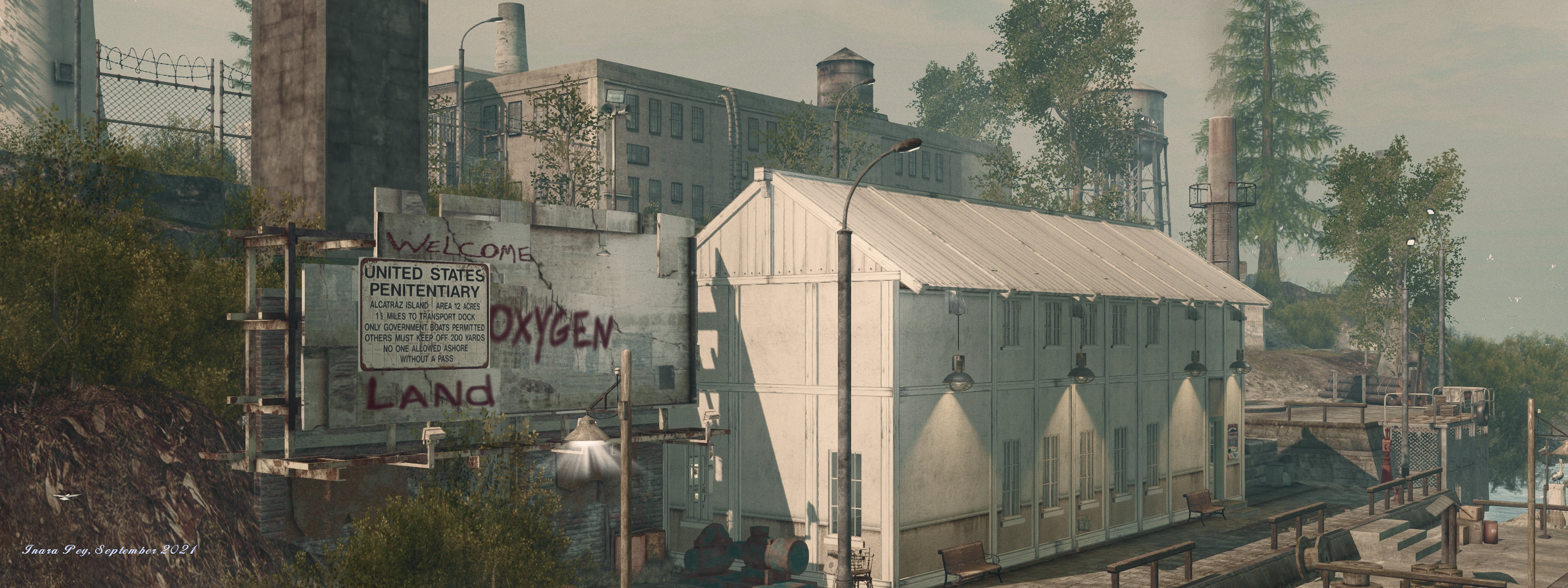
These are also the words Justice Vought uses as a tag for his latest region design, The Rock, which recently opened its gates to visitors in-world, and to which he invited me to pay a visit. And as with all things Justice does with his region designs, it offers mix of reality, art and mystery, whilst being highly photogenic as well as catching much of the spirit of the original.

Like the physical world’s Alcatraz, this La Isla de los Alcatraces (“Island of the gannets”, to use the original name coined by Juan Manuel de Ayala but which is oft given as “The Island of the Pelicans”), this one is reached via a ferry boat ride from the edge of the region as it abuts Justice’s main setting of :Oxygen: – just click on the red block over the water at the wharf landing point, then take a seat on the ferry when it appears.

The Rock, September 2021

Chugging away from the wharf, the ferry curves out and across the waters of the region to arrive at The Rock, coming alongside at Building 64, which originally served as a residential building for the military officers and their families living on the island, following its construction in 1905.

Recreating the entire 22 acres of the island  – or  just the 12-ish acres given over the prison – is not really feasible within a single region of 65,536 square metres total area, But what Justice has produced more than captures the core essence of the island: Building 64, the main prison block (sans mess / dining hall), the parade / exercise area, the lighthouse, the power generation building and its chimney and the water tower that forms one of the three major vertical structures on the island visible from the shore (alongside the aforementioned chimney and lighthouse).

The Rock, September 2021

Both Building 64 and the prison block have interior spaces, the former celebrating the legend of the prison and its cinematic history, the latter containing some of the tiny cells in which inmates were confined for the larger portion of their day, and the stark signage used to remind them that beyond food, clothing, shelter and access to medical attention, they had zero right to anything. The are cells made famous by latter-day day and night tours of the island, with visitors getting a brief opportunity to experience what it was like to be within the cells with the doors shut. Within the Rock, we can experience something of the same – and a little more.

Part of the fable of the prison is that, officially, no-one ever escaped alive – but up to three men may have actually done so (Frank Morris and brothers John and Clarence Anglin), although their actual fates remain a mystery. However, like them, Justice offers visitors the means to make their own escape; only in this case, the escape route appears to make use of historical remains only discovered in 2019 by means of ground-penetrating radar – a “bombproof” shelter, tunnels and ventilation shafts under the former parade ground / exercise yard. Find the way into these, and route to a boat on the shore (rather than a raft, as with Morris and the Anglins) might be found, giving a way for people to get back to the “mainland” of :Oxygen:. I’ll leave you to find the way into the escape route, however!

The Rock, September 2021

Finished with a sound scape reflective of the physical island, the cry of gulls, the crash of surf on rocks and the plaintive call of a foghorn and caught under a lowering sky, The Rock offers a nicely atmospheric visit, one very different in tone – but no less appreciable – to that of :Oxygen: itself as it sits within its latest iteration.

However, a tour of :Oxygen: is a treat for another day and another article. For now, my thanks to Justice for the invitation and the opportunity to make the visit.

The Rock, September 2021

SLurl Details

Persona: emotions and self in Second Life

Kondor Art Centre Main Gallery: Hermes Kondor – Persona

Now open at the Kondor Art Centre Main Gallery is Persona, an intriguing selection of Second Life / Avatar-based images by the art centre’s owner and curator, Hermes Kondor. Intriguing, as that selection of images on display have apparently been selected by Janjii devling – although whether from Hermes’ existing collection of works or from a series of images specifically produced by Hermes with the intent to be used in this exhibition, I have no idea.

The 20+ images are a further tour de force of Hermes’ work as an artist. Each is a rich, digital collage study with an avatar focus. Either presenting a layering of colour or one if monochrome tones, each is a genuinely multi-faceted piece, a glimpse into a life offered through its layered, almost sharded finish, some of which offer a sense of the abstract, others touch upon the surreal, but each one carrying its own narrative. Collectively, these are all exceptionally tactile pieces – they draw out the desire to touch them as much as they call on us to study them and decipher their story.

According to the liner notes accompanying the exhibition, the narrative in each of these images is an intent to explore the idea of persona, the idea that we project facets of our personality depending on circumstance and audience. While this is very true as a theme within the images here, I found it to be somewhat too narrow a view, because while there is a projection of persona in these images, there is a far greater depth of emotion and a capturing of emotional expression.

Kondor Art Centre Main Gallery: Hermes Kondor – Persona

To be fair, this is touched upon within the liner notes, but it is this emotional expressionism that really comes to the fore in viewing the images. In some it is offered directly through the eyes of the subject in the image, or their expression(s), in others it is more subtle – such as the suggestion of music in Persona 091 for example. Of course, emotions and projection  / persona are inter-related, the one tends to give rise to the other; nevertheless so, allowing the mind to explore the former rather than attempting to define the latter – again for me – offered a richer experience.

These are also pieces that, whilst clearly the product of considered experimentation with software, the use of colour or tones, the structured nature of the layering within them, are obviously the result of a cartesian process, both on the part of the software itself (for obvious reasons), and the artist himself. This separates them from what we might regard as “traditional” abstract expressionism in works of art, which tends to be marked by a certain spontaneity, but it also offers a doorway into the medium of digital abstractionism  / abstract expressionism that has a unique richness of its own. Further, and in keeping with the works of Rothko, Newman and Still, these are pieces that carry a strength of symbolism that offers s further narrative avenue awaiting exploration.

Kondor Art Centre Main Gallery: Hermes Kondor – Persona

Evocative, rewarding, challenging and engaging, Personas offers multiple threads of exploration and interpretation. However, when visiting, I would perhaps suggest avoiding reading the posted curator and guest notes that sit on the gallery’s walls along with the images; not because they are in any way “wrong” or anything, but rather because doing so might constrain thinking around, and appreciation of, the images in their own right.

SLURL DETAILS

Lana’s seasons in Second Life

LANA, September 2021 – click any image for full size

Valarie (Zalindah) is a region designer whose work I have covered on multiple occasions in this blog; working on her own or with with Jayden Mercury, she has created a series of memorable region designs over the last few years, all of which I have enjoyed visiting So I was delighted to visit her most recent design for 2021, which opened in August within a Homestead region.

A solo design by Valerie, LANA presents a rich, and in places quirky, setting. The name she has chosen for the setting is rich in its potential meanings – loyalty, wool, an alternate form of the names Alana or Helen, the name of a village in the Tyrol region, and so on. Here, Valerie offers her own definition for the word for the name of her design:

To be ‘calm as still waters’ or ‘afloat’, holding on and inhaling what the world has to offer despite experiencing loss. Allowing nature to take over, seasons to tease you and animals to be our friends. 

– LANA, About Land description

LANA, September 2021

It’s an interesting introduction to the region, suggesting as it does this is a place of recuperation from loss, together with the idea of renewal and recovery, of giving space. Almost all of this is present within the region, which offers itself for rest, exploration and enjoyment; but whether drawn to it out of a sense of loss or not is really down to personal circumstance, although there is  more than enough within the setting to allow memories free passage as we explore.

This is also place, as the description notes, that teases visitors with the four seasons, from a tropical summer in the south-east, through warmer summer greens around the middle of the setting that rise to a large northern hilltop rich in the sense of spring. These are balanced to the west by an autumnal setting that surrounds a small pair of roads and their buildings and, north of this, an avenue of trees that carry the darker green of later summer days as they skirt the base of the springtime hill to reach a small winter’s headland.

LANA, September 2021

It is on the western side of the region, sitting in the bay between autumn and winter, that the landing point sits. This has the first quirk in the region, a short spur of rail line that extends into the water to end in a photo backdrop and on which a single railcar sits. The latter blocks the walk to shore and must be waded around, although this is not an inconvenience, as it reveals the first hint of the oriental touches to the setting in the form of lanterns floating in the water.

Further oriental touches can be found across the setting – such as in the winter headland, for example, where torii gates lead the way to to the upper part of a pagoda sits on a rocky outcrop or up on the springtime hilltop, ripe in Sakura blossom that surround a koi house and its little garden. Not that the far east is the only influence here. The route from tropical beach to hilltop spring, for example is marked by ruins that might be considered medieval in looks – but could also be from central or southern Asia (as well as having a slight elven lean to that as they reach up to the Japanese-style bridge that spans the hilltop’s bubbling stream.

LANA, September 2021

The animals mentioned within the About Land description take multiple forms, from the familiar to the fantastical. Most seem to be standing guard or observing what is going on close by. For example, a floating market in the central lake that carries echoes of Indonesia is being watched over by tigers, while, the route between beach and hilltop appears guarded at various points by a black panther (bringing forth thoughts of Bagheera, Mowgli and India) within the ruins, an albino lion along the path leading to the Koi house and between them, on the bridge, a flying (if wingless) dragon.

To the west, in the little urban setting with is overgrown streets and tumble-down buildings, deer away discovery, watched over by the statue of a Chinese dragon sat before a torii gate, whilst overhead, a chinthe-like dragon hovers with lazy wing flaps. Even the path from the landing point is watched over by a red panda – albeit it one of the stuffed toy variety (and a little oversized!). More animals await discovery, but I’ll leave them for you to find.

LANA, September 2021

Throughout all of this are places to sit and relax, some in the open, others at the townside cafes or in the Koi house, and one neatly tucked away under a hill that might be missed by the hasty. Needless to say, there are also numerous opportunities for photography.

Finished with a gentle sound-scape, LANA adds-up to an engaging visit rich in detail without feeling crowded, with room to explore without feeling you’re constantly bumping into others.

LANA, September 2021

SLurl Details

  • LANA (rated Moderate)

Mihailsk’s Red Sky at Nitroglobus in Second Life

Nitroglobus Roof Gallery: Mikailsk – Red Sky

It was back to Dido Haas’ Nitroglobus Roof Gallery for the second time in less than a week, this time to visit Dido’s Space in the gallery (follow the bare footprints on the floor from the landing point to find it), where Greek photographer-artist Mihailsk makes his second appearance in a 3-month period, this time to offer a selection of new pieces under the title Red Sky.

Mihailsk is relatively new to the SL art scene in terms of exhibiting his work – his first such exhibition was actually the July appearance at Nitroglobus mentioned above, which took place in the main gallery space (see: Mihailsk’s Baptism of Fire in Second Life). The smaller Red Sky offers both an expansion on what made that exhibition so attractive whilst also contrasting very strongly with it.

In writing about Baptism of Fire I noted that Mihailsk – Miha to those close to him – produces work that is avatar-focused, but not necessarily avatar-centric. That is, whilst an image may include an avatar and framed in such a way to draw the eye to that avatar, it is the overall composition – pose, expression, surroundings – be they indoors or out – use of lighting and colour, etc., that are as equally as important in telling the story within the image, rather than sitting merely as a backdrop. With Red Sky, this is equally if more more true, with each of the pieces featuring – as the title of the exhibition suggests – a red sky of a deep crimson hue which serves to  additionally frame the emotional depth of each image.

Nitroglobus Roof Gallery: Mikailsk – Red Sky

Colour is oft used to define or evoke emotions and emotional responses; we talk in terms of someone “seeing red” when exceptionally angry, or of having a “black mood” or being caught in “the blues”; we believe muted tones and colours help evoke feelings of calmness or help people to relax, and so on. Red is especially evocative, as it generates so many responses / emotions / feelings. As noted here, it is often used to represent the stronger emotions of anger and rage, but at the same time it can also express the more tender – love, compassion, care; it can also express danger, the need to be careful or to keep away and, conversely it can emphasise attractiveness and wanting to attract through its use in the clothes we wear.

In his eight pieces, Miha offers six expressions / emotions with which were are all familiar: love, joy, longing, power, pain and danger, together with two pieces – Balance and Visualisation – that speak to broader themes. Within each image, the red sky / backdrop serves to reflect and enhance the sense of emotion already present through the use of other colours, pose, framing, and overall composition.

It is here that the contrast with Baptism of Fire is most evident: were the images there used darker or muted tones / monochrome shading that coalesced within each piece to express their emotion; here it is the strong contrast between the sky and other colours present – green, yellow, the tones of nature, etc., that frames the emotion. But at the same time, the use of colour / tone / shading in this way offers the same strength of narrative context through both exhibitions.

Nitroglobus Roof Gallery: Mikailsk – Red Sky

Writing in his liner notes for Red Sky, Miha states, “We are a part of the environment around us, not the main theme.” This is again evident through his work seen within this collection: the poses are natural in form, capturing simple gestures, etc., any one of us might naturally make in any situation; thus they are devoid of any sense of intentional construction, but appear as moments of life caught in a blink of a shutter, avatar and setting forming a natural balance. And here too, the crimson skies also play a role, for crimson is oft referenced as the colour of blood, the oil in our machine, so to speak, that keeps us running; thus we are reminded both through the emotional content of these pieces and the use of colour that life is not just about participating in it, it’s about experiencing it to the fullest extent we can.

SLURL DETAILS