Lost Unicorn Gallery: Serina – Fantasies and Illusions
Currently open at the Lost Unicorn Gallery, curated by Natalie Starlight, is a superb exhibition of fantasy avatar studies by : SERINA :: ( SerinaK ) entitled Fantasies and Illusions.
Hailing from Japan, Serina is the owner of the Alter Ego mesh clothing brand, and I’m not sure how long she has been involved in SL photography – she joined Flicker in 2018; but I believe this is the first time I’ve see her work in a solo exhibition. And I use the term “superb” above quite deliberately: the pieces exhibited at Lost Unicorn are genuinely captivating.
As avatar / fantasy studies, the pieces presented in the exhibition are rich in colour, detail, motif and visual story, where everything has clearly been carefully considered in compositing and frame that makes them instantly attractive. Most are rendered in colour, although some monochrome pieces are hidden within the collection, their muted tones deliberately chosen to bring forth their story for the eye to see without the need to view any title.
Lost Unicorn Gallery: Serina – Fantasies and Illusions
Whilst focused on fantasy figures and framing, several of the images touch upon the surreal – perhaps most notably with Blind Justice, but elsewhere as well, in subtle touches. This reflects Serina’s broader interest in art that encompasses fantasy, surrealism and fine art. But there is more to be found within these pieces.
Although each an every piece can be appreciated as it is seen, its initial narrative ready to be captured by the eye, this is but an illusion; each carries a deeper story. In some, this might appear to be a personal statement, in others more a comment on society at large. I’m not going to point to individual images here as is often my wont, because these deeper narratives are best discovered by seeking the name of each piece through a right-click → Edit after each has been viewed free from preconceptions brought forth by knowing an particular picture’s title in advance.
Occupying the main lower hall at the gallery, Fantasies and Illusions makes for a grand exhibition – one that flows into the rest of the gallery space as a whole, where the fantasy theme continues with images by a number of artists. Thus the gallery offers a broader, worthwhile visit that I also recommend.
Lost Unicorn Gallery: Serina – Fantasies and Illusions
As noted above, this is the first time I’ve seen an exhibition focused on Serina’s work, and on viewing, I hope it is not the last that I have the opportunity to do so.
Firith Galad, November 2021 – click any image for full size
It has been a while since I’ve dropped in to a region designed by Camila Runo – the last was her take on the bayou lands of Louisiana back in May 2021 (see: A trip to the Bayou in Second Life), although my first encounter with her work came back in 2020 with the original Jambo! (A voyage to Africa in Second Life). Quite what caused the break in my visits I’ve no idea; but seeing Firith Galad a Forgotten Elven Realm listed in the Editor’s Picks of the Destination Guide immediately had me scurrying to pay a visit.
As anyone with an abiding love of Tolkien’s mythology (like me!) will know, Firith Galad is Sindarin (Grey Elven) in origin, and can be literally translated as “Fading Light” (Firith also being the last quarter of the Sindarin / elven year, and so give the time at which this build is available, that name also fits quite nicely). indeed, in respect of “fading”, a further layer of meaning might be found within the region’s name, as quick look at the About Land description reveals:
Surrounded by high mountains and cataracts lies Firith Galad, an ancient elven realm fallen into oblivion. The light is fading, winter is near …
Firith Galad, November 2021
Again, as those familiar with Tolkien’s mythology, the War of the Ring brought to an end the time of Elves, and the start of the Fourth Age, and the ascendancy of Man. At this time, many of the elves of Middle Earth departed into the West, and those left behind recognised they were doomed to fade with the passage of time. While no actual time-frame (before / after the War) is given, the title of the setting nicely fits with this idea of an elven enclave tucked away, perhaps high in Ered Luin (the Blue Mountains) of Lindon, the last remnant of their beloved Beleriand, and a place where they could escape the passing of time in the world around then, content to remain in isolation.
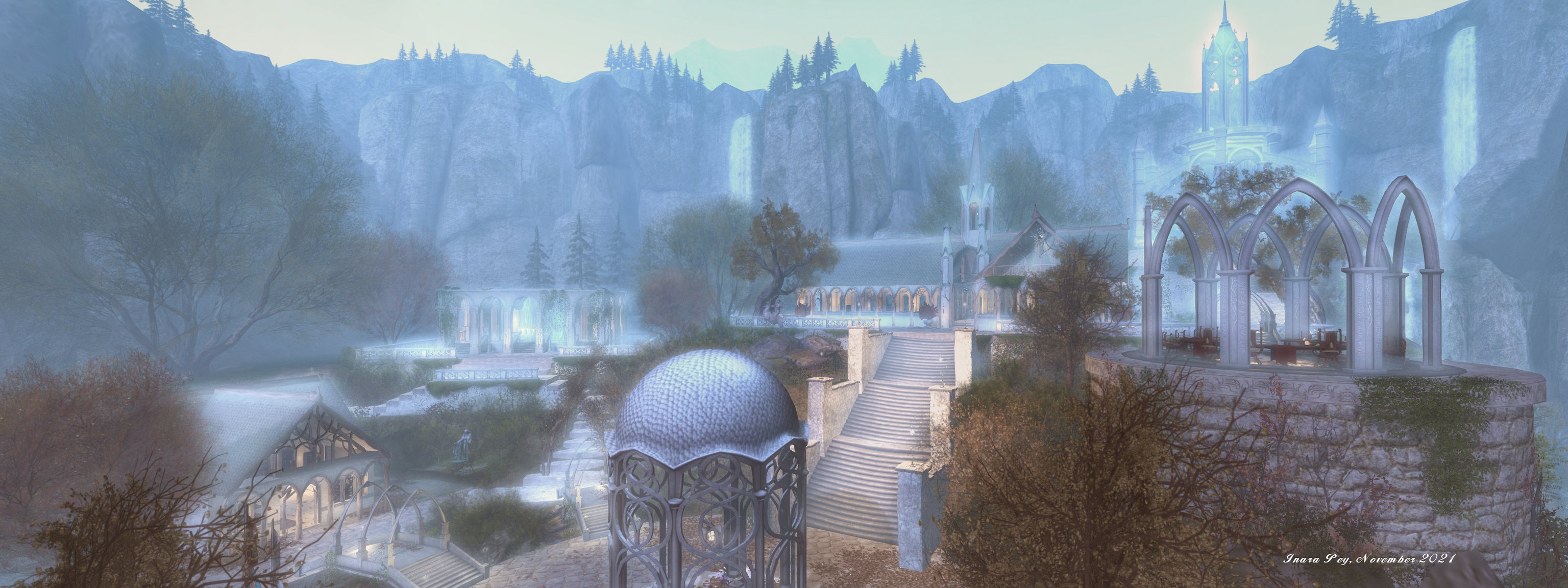
This is an ethereal setting caught in a ghostly light that, with the surrounding walls of rock, serves to separate the realm from the rest of the world, isolating it in a unique fashion whilst bathing it in a cool light mindful of winter, and in which the enclave is gently revealed as one approaches it. Set within a deep mountain valley, the setting is reached far path that clings to one side of the valley walls. It emerges from a tunnel – a hidden passage leading from the world beyond and into the valley. This tunnel is guarded by two gates bearing symbols of the gold and silver Trees of Valinor, Telperion and Laurelin, the first indication that in offering this build, Camila has perhaps cast her net of inspiration wider than Tolkien’s Lord of the Rings, (and certainly Peter Jackson’s interpretation of Tolkien’s world).
Firith Galad, November 2021
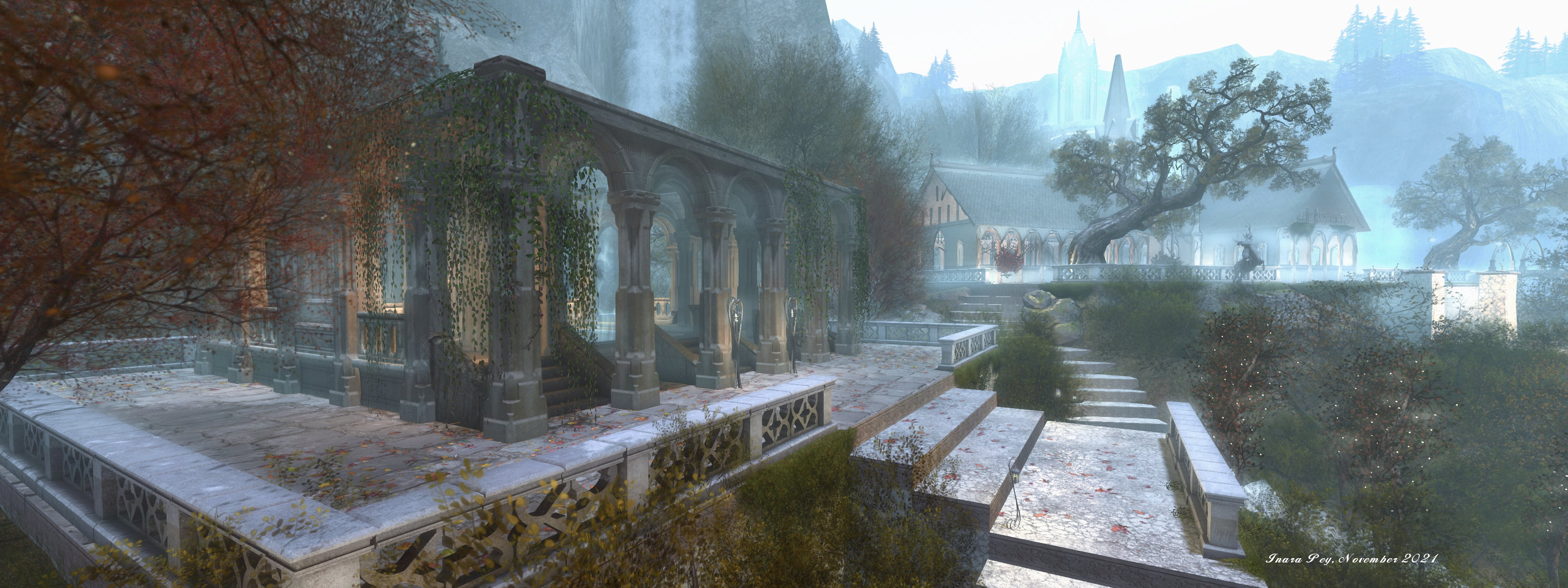
The path clings to the valley side as it runs from tunnel opening to a single stone bridge that gracefully spans the deep chasm of the valley to reach the enclave as it in turn hugs the far side of the valley’s steep walls. Here, beyond the banners bearing what might be an image of Telperion,, the enclave offers a tiered build, making use of shoulder and island of rock extending outward from the high peaks, with the core buildings reached via stair or bridge (or both), all sounds drowned by the thunder of the great falls that tumble to the valley floor far below.
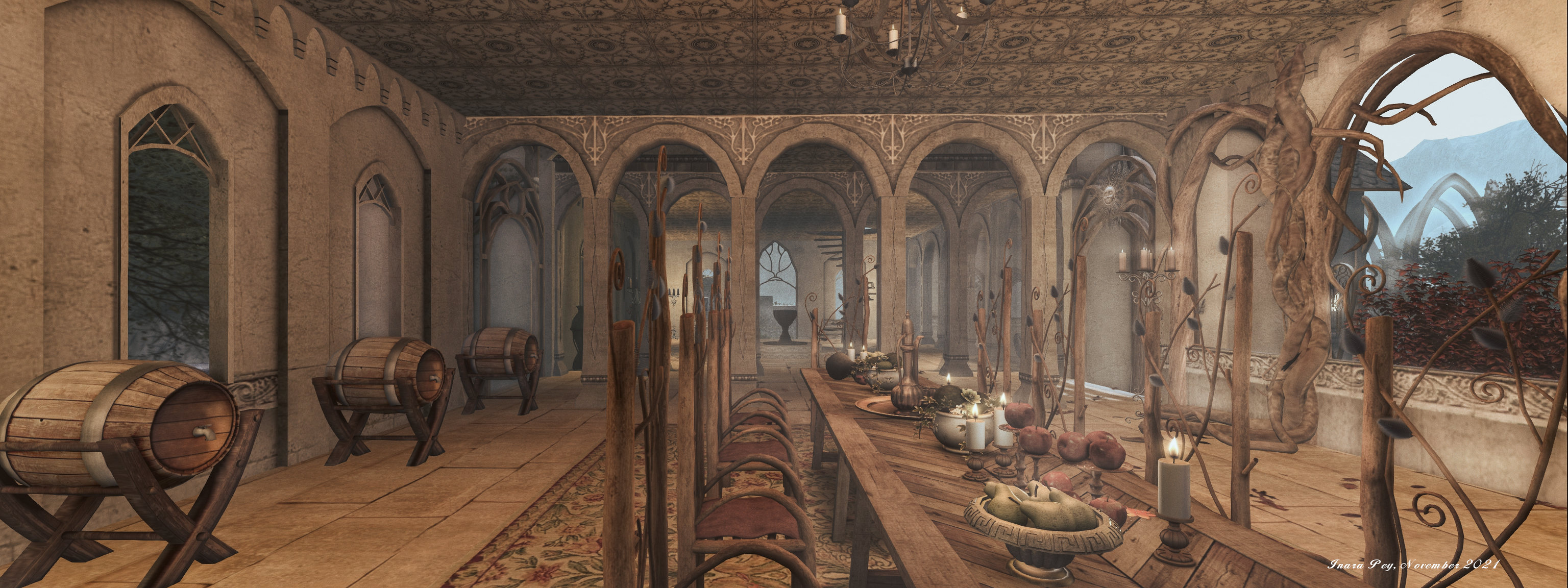
Dominating the realm is a great house, placed at the top of a broad stairway and occupying a large stone-flagged square. Climbing the stairs towards it, visitors are greeted by the sound of harp music, the house itself a place of meeting, feasting, music, and seeing – a basin of water mindful of the one that once belonged to Galadriel sits within it, light glittering above its slowly shimmering water as it appears to wait its time to reveal the future to those who look into it.
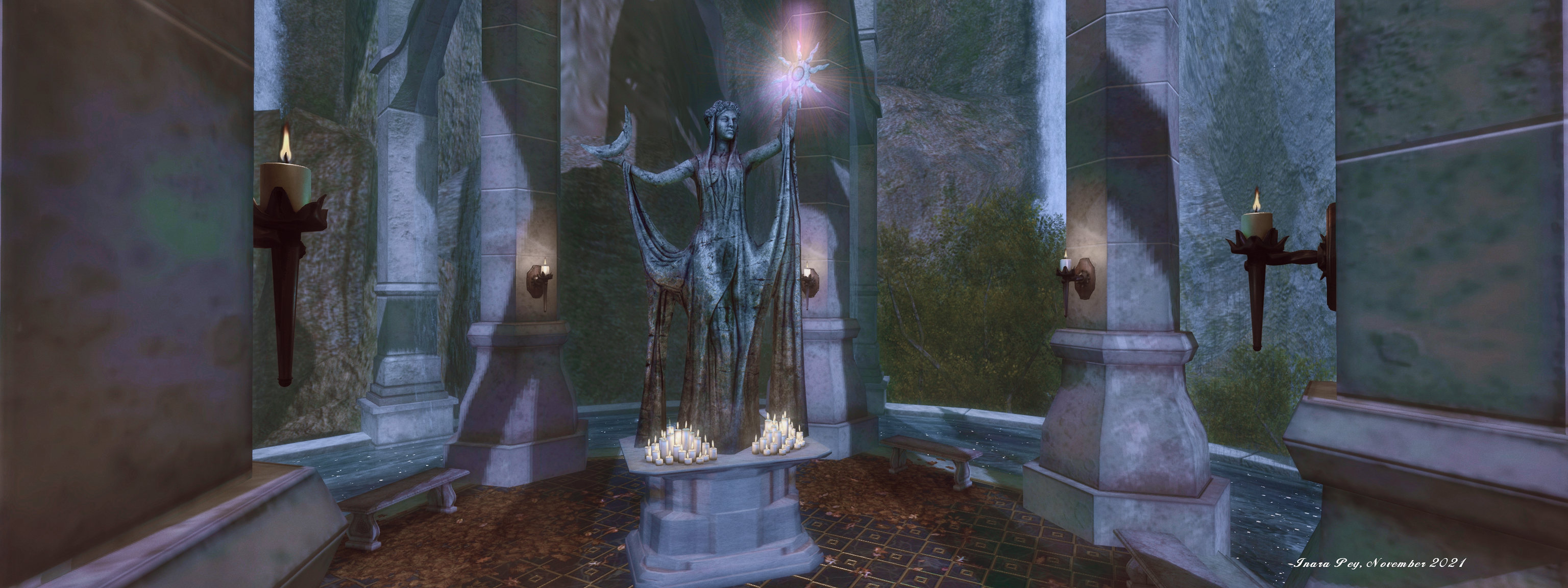
More steps rise upwards from one side of the house, climbing to where a great stone edifice rises, curtains of water falling from some of its buttresses in time to the falls behind it. A single span of stone reaches across the pool that collects this water to reach the centre of the structure. This is home to a tall carven figure, undoubtedly Varda Elentári, known to the Sindarin as Elbereth Gilthoniel, as she holds aloft the vessels holding the light silver and gold light of the corrupted Two Trees of Valinor in vessels fashioned by Manwe and Aulë, that they might become the Sun and Moon of Middle Earth.
Firith Galad, November 2021
Elsewhere within the setting, one might find a meeting place, its horseshoe table doubtless the place of many councils and meetings of fellowships, while across a bridge from the arrival point and its gazebo stands a smaller hall, given over a place of learning / research / study, albeit one with furnishing that are perhaps of distinctly “Mannish” origins in difference to the furniture to be found elsewhere. Then, between this library and the main house there can be found a stone pavilion in which water drops from the high roof to enter a rectangular pool at the pavilion’s centre, what appears to the face of Ulmo, Lord of Waters, and second to Manwe and Elbereth in leadership of the Valar.
With a richness of trees and greenery as befitting the Sindar, who also settled in the forests of Middle Earth during the Second Age, Firith Galad is one of the well-executed settings drawn from Tolkien’s mythology. The attention to detail in referencing The Silmarillion far more than The Lord of the Rings, gives this setting a uniqueness that is hard to deny, and which is a delight to visit and spend time within for any Tolkienite. And even if your interest doesn’t run so deep, Firith Galad is nevertheless captivating in its presentation and sheer photogenic nature.
Firith Galad, November 2021
My utter respect to Camila for her work with this 80-days build.
Nitroglobus Roof Gallery: Milena Carbone – No Exit
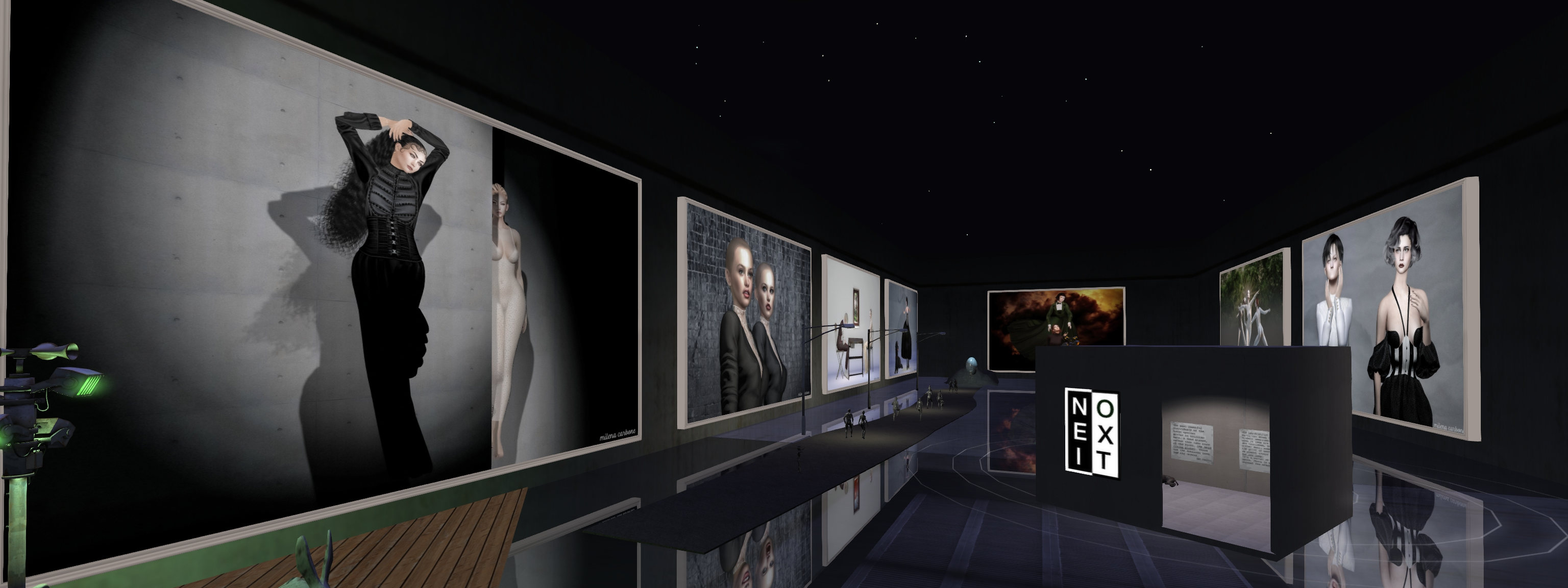
No Exit is the title of the latest 2D art exhibition hosted by Dido Haas at her Nitroglobus Roof Gallery. It features the images and words of Milena Carbone, and is very much something of an “accidental” exhibition which still nevertheless offers food for thought – something Milena is prone to do with her art.
I’ll let Dido explain why No Exit might be considered an “accidental” exhibit:
[Milena] initially intended to work on a totally different project. However, this was cancelled due to her RL work as well as to her lack of motivation. So the images shown at the walls of the gallery this month were not created for an exhibition. Instead they were taken from the stream of images which Milena regularly produces for herself.
I made the selection and pointed out to Milena that there were always two characters in each image, .which made Milena think of the French philosopher Jean-Paul Sartre’s play “No exit” (“Huis clos” in French). And voila the title for this exhibition was born.
– Dido Haas, explaining the origins of No Exit
The connection between Satre and images is important to understand, because – as if so often the case with Milena’s work, there is a philosophical theme running through No Exit that invites consideration and, by nature of the framing of the play’s own central theme.
The title of the play actual comes from the French legal term “in camera”, denoting a private discussion behind closed doors; within it, three deceased people find themselves trapped in a room with no exit, doomed to face eternity with only one another’s company. Thus they are faced with Satre’s truth that “hell is other people” (L’enfer, c’est les autres), itself a reflection of his fascination with existentialism (perhaps most notably through L’Être et le néant), and of the internal struggle that arises when forced to view oneself from both the point of view (that is solely from how they see you in a particular moment) and the perspective (i.e. how they perceive you and your actions within the broader context of their own cultural and societal influences and personal biases / experiences) of another consciousness.
Nitroglobus Roof Gallery: Milena Carbone – No Exit
However, before delving into these deeper themes, I would emphasise that these are images that can be seen and appreciated entirely in their own right and free from any more layer thinking. In fact, I would say they should be seen in this manner before being contextualised within the broader scope of theme and Satre’s world of ontological thinking; there is a beautiful minimalism to every piece that renders it fully as moment of narrative, encouraging us to freely construct a story around it, or to simply appreciate its form, tone, framing and expression.
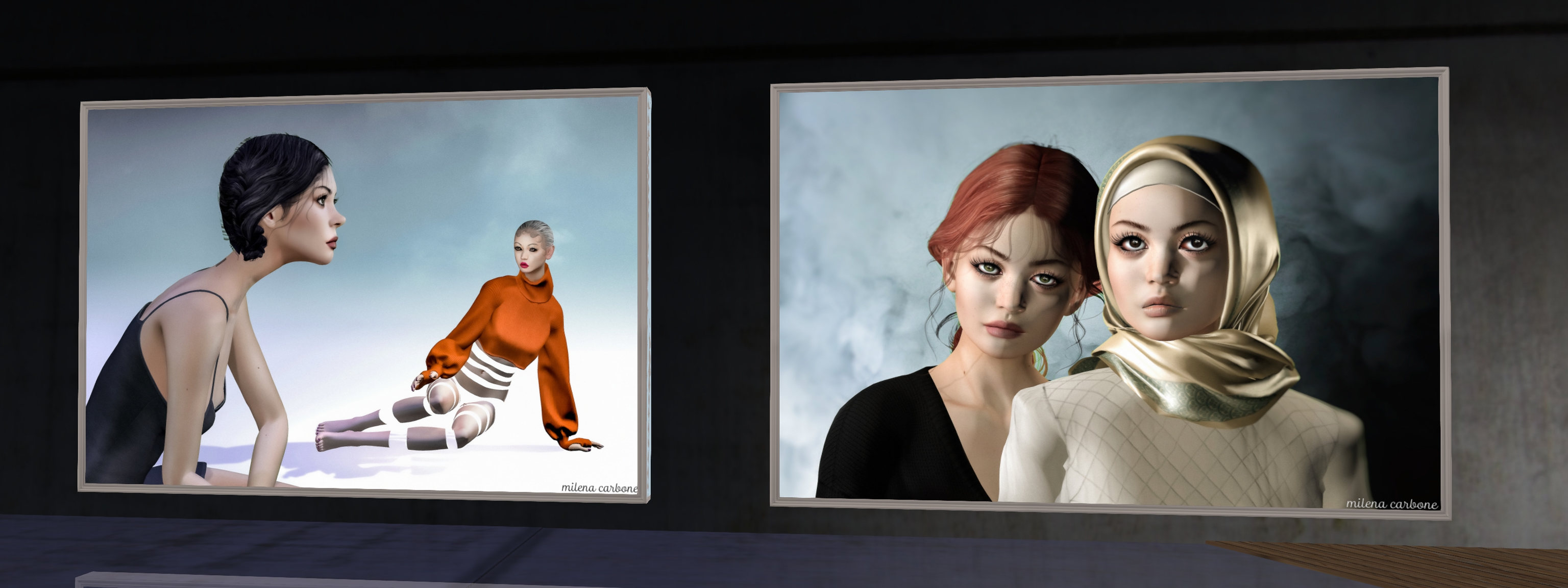
When Milena’s theme and Satre’s ideas are taken into consideration, these are images that taken on an entirely new depth. Take, for example, XXI Century. On the surface, a simple image of two women with different cultural heritages posing for a photograph – be they friends or relatives, it makes no difference. But, add the title of the piece into the equation, together with the fact one of the women is wearing an al-amira, and a more complex narrative emerges, that invokes thoughts of the manner in which during the first 21 years of the 21st century has continued to see the impact of “otherism” – the ostracising of those whose dress, system of belief and place of origin mark them as “different” and thus not to be trusted or allowed. It’s a negative attitude that has gripped many to the point of being without any exit; yet, were they to step outside of the strictures of peer / societal pressure, then the reality that we are all of one, single unique race would become that much harder to ignore.
Elsewhere, the questioning of self, and other others see is more direct (e.g. within Difference, Asymmetry, and The Invitation (the latter’s use of Black and white being particularly effective in bringing for the idea of differencing outlooks / perspectives that challenge our own). Whilst 7 Billion Bullets most clearly questions our entire attitude towards the preciousness of an individual life.
Nitroglobus Roof Gallery: Milena Carbone – No Exit
This image also leans itself to the central cube that sits between the two arms of the exhibition hall. Apparently open from the outside, in stepping in, it becomes a closed room with no exit – a physical representation of the room from Huis clos. Here we are forced to confront the fact that we are all essentially locked in rooms of self – everything we see or experience generates our world-view, making us all, in essence selfish; the imprint of those around us, through their thoughts and actions, rightly or wrongly, shaping our own views and outlooks, thus trapping us in our own hell of thought and convictions.
The words here carry both a startling reality of creating our own hell and – conversely – of allowing ourselves to become trapped in thinking that encourages us to retain that hell. The former is most succinctly stated through the commentary that global ammunition production means that each year, sufficient bullets are produced to wipe out all of humanity. Whether or not one is rooted in “the right to bear arms”, this is a grotesque factoid.; how much better might it be if the money poured into arms and ammunition were to be devoted to green sources of energy, improved food production, medicine and education?
Conversely, the fact that we are trapped within this one world is not an argument against attempting to expand elsewhere. For one thing, we are a naturally expansive race – and right now, we have nowhere else to go – a point of increasing concern given Earth’s finite resources. More to the point, space has more than anything else, given us the means to truly understand the fragility of this world and to actually start to take constructive (if limited) action to curtail damaging activities. For 60+ years, we have simply failed to more properly respond to what as been revealed, trapped as we have become in a materialistic, selfish need to have with no apparent exit – and pointing the finger of blame to a billionaire or two isn’t going to change (much less reverse) that; we – you, me, Milena, et al, are equally as guilty.
Milena is, I understand, absent from Second Life due to those physical world commitments mentioned above, and is liable to remain so for a while. As such, whether or not you are drawn to the philosophical / ontological expressions found with No Exit, or if you would simply like to again experience the attractiveness of her art for its own sake, this is an exhibition well worth witnessing.
Nitroglobus Roof Gallery: Milena Carbone – No Exit
With Halloween now behind us, many in Second Life will be looking towards US Thanksgiving as it sits waiting at the end November 2021. However, being from Europe, Janna Reed (Janna Blackwood) has understandably decided to skip over that particular event and jump straight into an end-of-year winter setting within her Homestead region.
Daydream Believer is an easy-going and understated setting where winter has draped a blanket of snow over the landscape as it sits cupped in the protective hands of surrounding peaks. With broad lowlands that are marked by scattered trees, a small cottage, and cut through by a frozen inlet, the island is marked by two tall hills towards its centre, each neatly sliced into a flat top. Each is also topped by a single structure – an old wooden lighthouse on one, and an almost fairy tale-like tower where Christmas presents are piled within the lower halls and a cosy bed awaits on the upper.
Daydream Believer, November 2021 – click any image for full size
The two hilltops are connected via a bridge that offers its own sense of fantasy, being held aloft by balloons. Whilst it crosses the gap from one hilltop to the other, and sits just outside the door to the tower, the bridge doesn’t provide direct access to the lighthouse on its far side. This sits elevated above bridge and path on a heel of almost completely vertical rock. However, the path from the bridge does provide access to a high cavern and a possible escape from the snow – although it is not without its own surprise.
Running from west to east, the inlet that cuts deeply into the island in a small band of land that prevents it from entirely cutting the land in two. This humpbacked band forms the backdrop for the region’s landing point as it sits on the frozen water. Close by is the first clue to this being something of an interactive environment: a skating stand for couples awaits those who wish to use it. Those visiting on their own can also join the fun via a skate giver located close by, between frozen inlet and a small staking rink. Group membership is required for the skates, but also gives rez rights; however, if you have your own, you can of course wear them.
Daydream Believer, November 2021
A short walk south and west from the landing point and rink, the land rises slightly in the lee of the central hills. Here, two snow forts face one another across the snowy ground, each complete with a snowball-firing canon, allowing for fun and games to be had. Both could do with sitting a little better on the ground, but can be used by sitting on them and then following the the instructions in local chat. As well is these forts and the skating, the region also offers opportunities for riding either via horse (there is a rezzer at the cottage) or polar bear, a number of which can be found around the region.
Given this is a winter setting, Daydream Believer would not be complete without some form of winter sports, and those exploring the region can find a couple of options available to them. The first is a snowboard rezzer waiting at the far end of the ski lifts that connects two low-lying hills tucked into the north-east corner of the region, whilst the second – a sledge rezzer – sits on the snowy plain separating the ski lift’s hills from their much higher brethren. Finally, for those who fancy an airborne look at the region, a bubble rezzer can be found close to the one for snowboards.
Daydream Believer, November 2021
Also awaiting discovery are numerous places to sit, both indoors (the cottage and hilltop tower are open to the public) and out, most with singles and couples options. Those seeking respite from the slowly falling snow are best heading for the cottage or the open-sided pavilion, each of which has a roaring fire that allows toes suffering from walking the snows to be comfortably toasted back to warmth. Even so, the snow might not be entirely left behind as flurries are close enough to the cottage they cab slightly slide inside as their mesh element turns. Said snow can also interfere with sitting in places, so be sure to cam carefully.
With deer, foxes, and penguins waiting to be found, the region offers plenty of wildlife to see, broadening opportunities for photography. As noted, those joining the local group also get rezzing rights for props etc., – but (as always) a gentle reminder to make sure you pick bits up when done!
Daydream Believer, November 2021
Gentle, relaxing and with a taste of winter that is not Christmas-heavy, Daydream Believer makes for an easy-going visit. With thanks to Shawn Shakespeare for the LM.
The 2021 Movember art exhibition at the Men in Focus Gallery curated by JMB Balogh, open on November 1st, once again sponsored by the Men in Motion dance troupe. As with previous years, the exhibition is primarily in support of the Movember Foundation, the leading charity changing the face of men’s health, with the secondary aim of promoting and featuring photography by male Second Life artists.
For 2021, the gallery is displaying the talents of four invited 2D artists – Ethan Lane, Looker Lumet, OSO (akash25g Resident), and Akim Alonzo, whose images are displayed together with works by members of the Men in Motion Dance Troupe and 3D sculptures and pieces by Mistero Hifeng, Silas Merlin, Harry Cover (Impossibleisnotfrench) and Jⓞhan Lionheart (AndreJohan).
Men in Focus Movember 2021: Ethan Lane
The owner and designer of Tulum Reserve, a publicly-accessible region, Ethan Lane specialises in avatar studies, producing single frame stories with his images designed to give flight to the imagination of those viewing them. As an explorer and photographer, he is constantly seeking new themes to incorporate into his images and new or different styles by which he can bring them to life, whilst unabashedly admitting much of his own dreaming (and what he calls his geekiness) is bound within all of his pieces.
Looker Lumet is a Belgian photographer-hobbyist who discovered Second Life photography in 2007. That discovery led him into the world of digital editing and photo-manipulation, and he notes that more than a decade on, he is still honing his post-processing skills and continuing to learn about the tools at his disposal. Through the skills he has acquired, he attempts to present his images as realistically as possible, noting that many of the technical and other improvements that have been made to the platform naturally encourage photographer to move in this direction.
Men in Focus Movember 2021: Looker Lumet
“Art is always a way to express oneself when words fail and that’s the beauty of it,” OSO (akash25g Resident) says of his work and photography and art as a whole. Hailing from India, OSO has the misfortune of having witnessed many unpleasant things in life, a fact that has given him the desire to travel in a world that is free from hate and greed, and where love and care can be freely expressed – an attitude that sharply informs his photography, as can those things in life that have impacted him. His work is intense in narrative, beauty, metaphor and mood as can be particularly witnessed through his Flickr stream.
Hailing from Italy, Akim Alonzo is both a creative photographer and digital artist and the curator of the Itakos Project Gallery, which ran from 2017, when initially leveraged facilities provided by the former Linden Endowment for the Artist (LEA) grant system to display art by those artists in Second Life who might not be confident enough to apply for a grant in their own, through until 2021. Akim made the decision to close the gallery in order to focus his efforts on a new project, details of which are to be announced in the near future. as Akim has a new project in mind. In the meantime, the Itakos Project website remains as an archive of the exhibitions hosted by the project.
Men in Focus Movember 2021: Akim Alonzo
The upper floor of the gallery displays work by three members of the Men in Motion dance troupe – photographer and dance choreographer Antonio Atovio, Men In Motion founder Sebastain Bourne, who marks his work with as little post-processing as possible to give it a natural edge; and Quient, who came to SL as an explorer who used the platform to help educate his daughter, taking her on visits to in-world galleries and museums, before himself becoming enraptured with dance in SL and the opportunities for photography.
Located throughout the gallery’s floor are pieces by the 3D artists exhibiting at the gallery, none of whom need any introduction, their work being familiar across Second Life. All four never fail to engage their audience be it through pieces that combine the near-classical with the modern (Jⓞhan Lionheart (AndreJohan)), or those that engage the emotions (Mistero Hifeng) or offer the potential for narrative (Silas Merlin) or are simply and quite wonderfully quirky (Harry Cover),
Men in Focus Movember 2021: Troupe photographers
About the Movember Foundation
The Movember Foundation is a multinational charity raising awareness of, and money for, men’s health and welfare, with a focus on cancer, mental health and suicide prevention. Its titular and widely known campaign is Movember, which encourages men to grow moustaches during the month of November. The foundation partners annually with the Distinguished Gentleman’s Ride to also raise money for men’s health.
Founded in 2003, in Melbourne, Australia by Adam Garone, Travis Garone, Luke Slattery, and Justin Coghlan, the organisation attained registered charity status in 2006, and has raised approximately US $700m in charitable donations. These funds have been used to fund more than 800 programmes focusing on prostate cancer, testicular cancer, poor mental health, men’s health awareness and healthy lifestyles. It is active in 21 countries and has a global workforce of 130 people. In addition, Movember coincides with International Men’s Day (November 19th), which among its aims, shares the goal of promoting the health and well-being of men and boys.
In October, I visited ancient Alexandria, a two-region build by Kleopatra T. Philopator (Kleopatra Alpha) and Elio Donat, and which offers an historical / role-play environment set in the reign of Cleopatra VII Philopator (69 BC – 10 August 30 BC) – see Cleopatra’s Alexandria in Second Life. However, adjoining the two regions representing Alexandria is a third, offering settings from ancient Greece within the same period (centred on around 43-42 BCE). At the time I covered Alexandria, I had intended to include the settings from ancient Greece; however, in talking to their creator (and holder of the region where they sit), Ellen of Sparta (ellenharriet) it became apparent they should be covered separately – hence this article.
As their joint name suggest, Sparta and Delos offer setting representative of the famous Greek city-state and of the the island said to be one of the most important mythological, historical, and archaeological sites in Greece. In addition, the region also offers the opportunity to visit ancient Crete. All three locations stand separately on their own sky platforms, but are interlinked via a teleport system. In addition, both Sparta and Delos can be reached from the “Library” landing point above Alexandria.
Sparta is today probably best known for its connection with the mythology of Helen of Troy and the Trojan War, and its military might, most notably enshrined in the reign of Leonidas I and the Battle of Thermopylae (480 BCE) during the second Persian invasion of Greece, led by Xerxes I. However, the city-state’s entire history is rooted in legend and mythology, which states it was founded by Lacedaemon, son of the god Zeus (by way of the nymph Taygete), and later became the seat of descendants of Heracles.
Sparta, November 2021
Regarded as less sophisticated than the likes of Athens, Sparta rose to become the dominant land-based power in Ancient Greece, largely due to the system of education imposed by the laws of semi-mythical legislator Lycurgus (c.820 BCE). And whilst seen as “less sophisticated”, it wasn’t in any way backward. For example, Sparta was very much ahead of the rest of ancient Greece in terms of gender equality – women, (at least those classed as citizens of the city) enjoyed a status, power, and respect that was unknown in the rest of the classical world, being seen from birth as near-equals to male offspring and offered the same freedoms, up to and including education and competing in sports. As such, many women played significant roles in the city-state’s history, such as Queen Gorgo, heiress to the throne and the wife of Leonidas I.
As represented by Ellen, Sparta in Second Life sits at a time well past its heyday as an independent city-state (that having been lost in 192 BCE, when Alexander the Great forced it to join the League of Corinth), but when it was nevertheless enjoying a curious renaissance. Whilst subject to the rule of Rome, it was seen as a Free City, allowing at least some of the institutions of Lycurgus to be restored – a fact that lent it to becoming a “tourist attraction” for wealthy Roman citizens wishing to learn about it culture and ways. Hence why, within Ellen’s setting, we find a Romanesque colosseum rising up on one side of the city.
The core of Ellen’s build is laid out along Afetais Avenue, regarded as the major thoroughfare of Sparta. Here can be found a number of buildings that help represent something of Sparta’s long history and its roots in mythology. First among these, just beyond the training arena for those wishing to participate in combat RP and the tournaments that regularly take place at the colosseum, is a temple dedicated to he mythical Helen of Sparta, daughter of Zeus and wife of King Menelaus of Sparta (and perhaps better known as Helen of Troy), as well as temples to the Muses and Heracles, the legendary hero of ancient Greece. He was said to have conquered Sparta two centuries after the Trojan war, causing the rules lines of the Agiad and Eurypontid kings claiming to be his descendants. Red plinths outside of these temples and the other buildings lining the avenue will provide brief note cards on the buildings and the roles of those they honour in the history of Sparta.
Sparta, November 2021
At its northern end, Afetais Avenue opens out into a broad square sitting before a representation of the main courtyard from the massive Mycenaean palace discovered at Aghios Vassilios Hill close to Sparta, a structure thought to have once covered some 35 acres. Here the palace courtyard looks towards the Sparta Acropolis, home to a reproduction of the Sanctuary of Athena Chalkioikos, and the city’s civic amphitheatre.
Delos, meanwhile, transports us to the historic island of the same name. Located near the centre of the Cyclades archipelago, it is home to some of the most extensive archaeological excavations in the Mediterranean. These show the island has been inhabited since around the 3rd millennium BCE, with Thucydides claiming the original inhabitants were driven from the island by King Minos of Crete (he of the Minotaur infamy). By the time of Homer, the island was reputedly the birthplace of the twin gods Apollo and Artemis (although Ortygia is also given as the birthplace of the latter), a legend that led to the island undergoing several “purifications” by Athens in an attempt to render it fit for the proper worship of the gods.
By around 42 BCE, the importance of Delos had waned. Under Roman rule, the island has rises to the heights of being the premier trading centre of Greece after the Romans has soundly stomped on Corinth, but the Mithridatic Wars brought an end to this, such that by the 1st Century BCE, Delos as a centre of trade and culture. Even so, it did remain a centre of population through until the 1st Century CE (after which things get spotty), so Delos as seen here is perhaps representative of the island as it sat during Roman rule, and when its sanctuaries and temples were sill very much maintained.
Delos, the Temple of Apollo, November 2021
Dominating the island is a temple celebrating Apollo, sitting on a hill overlooking the rest of the island, a tall statue of Hebe situated on one shoulder of the hill. Also to be found here is a sanctuary to Dionysus – Delos was the centre of a cult that revered both him and Leto, mother of Athena and Apollo, and an Erechtheion dedicated to Athena. The later stands to one side and slightly below the temple of Apollo in a manner that is mindful of the way the Erechtheion in Athens sits to one side of the Parthenon. Also to be found within the setting is a further grand temple and the palace of Queen Ellen, together with a small wharf, open fields, a marketplace a landowner’s villas, and assorted points of interest, all of which offer a more relaxed environment for potential role-play when compared to the possibly more combat-centric Sparta.
Sitting within its own sky platform, Crete is the work of Ellen with the help of Delia Kleopatra (Naburita), and appears to take us to the Minoan era. It centres on a great palace, seemingly inspires by the Knossos, and within which can be found a tripartite shrine of the kind discovered during excavations at Knossos, and reproductions of frescoes of the kind that may have once decorated the walls of buildings at Knossos.
And role-play (and combat) environments, these settings (notably Delos and Sparta) are home to a wide range of events, which are detailed at the landing points. Dress code for visitors is not strictly enforced, but those wishing to blend into the settings can join the local group and obtain free outfits from the vendors at the Delos and Sparta landing points. When exploring Sparta and Crete in particular, do not that there are private residences to one side of each setting, some of which are available for rent by interested parties – contact Ellen of Sparta (ellenharriet) for information.
Delos, November 2021
Taken on their own, collective and or / with Alexandria, Sparta, Delos, Crete make for an engaging and historically rich visit.