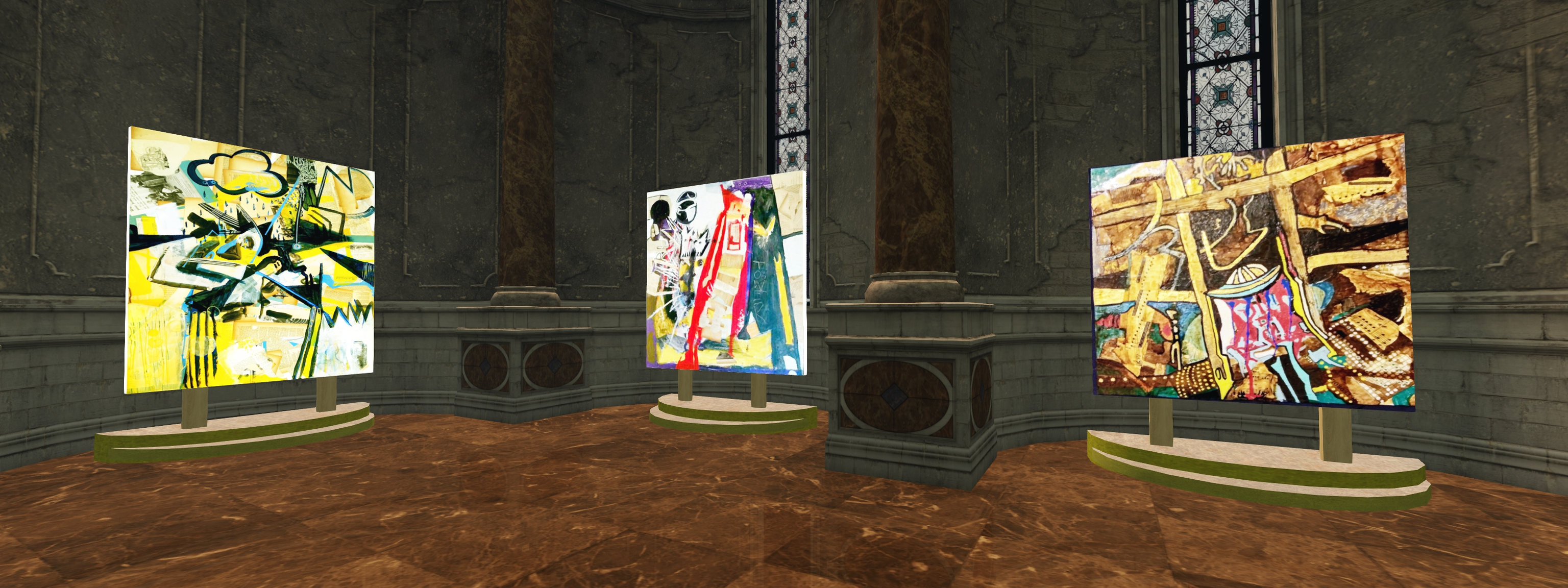
Bamboo Barnes opened her latest exhibition, entitled Drawer, at the Hannington Arts Foundation, owned and operated by Hannington Xeltentat. It also marks my own overdue resumption if covering art exhibitions at HAF.
A self-taught digital artist from Japan, Bamboo has used Second Life as a means of both refining her talent and displaying her work, growing from producing avatar studies to creating intricate pieces that both engage and challenge the eye and mind. Her work, generally vibrant in colour, and also evocative, provocative, and emotive, is among the most striking and unique in Second Life – and has also made the transition into the physical world.
Drawer features 20 images that appear to be self-portraits that – as is Bamboo’s style – lean towards the abstract, whilst using various techniques – collage, overlay, and so on – such that individual pieces can also touch upon the likes of impressionism and surrealism. Each image is perfectly capable of holding the attention in and of itself, but when taken together, how might they relate to the exhibition’s title and the poem Bamboo presents within its introductory notes:
Drawer that don’t close properly. Drawer that you no longer use. A faded picture stuck in the back, ton messed wrinkled one. You’ve forgotten what was like but the smell comes back. For the days you have loved close your eyes, close the drawer.
– Bamboo Barnes
Hannington Art Foundation: Bamboo Barnes – Drawer
To me, these lines suggest two potential interpretations. The first is on the theme of introspection; something Bamboo has dwelt upon through exhibitions such as Receding Reality and Mindstorm. However, here it is perhaps more layered, referencing that spark of joy when finding something created long ago than had been put away and forgotten, and which in turn brings forth memories and feelings that had themselves been locked away unheeded in the filing cabinet of the mind. Are, then, these images each a visual aide-mémoire, bringing forth those long hidden thoughts and emotions that led to its creation?
O might this been a broader commentary that we cannot remain caught up with dwelling on (or in) the past? That life moves on perpetually, carrying us along with it – and for the artist this means accepting what has been created can not no longer be changed, no matter how more advanced we have become or how out outlooks have changed; and for the artists, this means accepting what has been, and it is towards canvases new that one should now turn? And in this, is there not a salient reminder to us all, that while looking back can yield understanding or discovery, so too should the drawers of memory be pushed closed, keeping safe that which has been, while the eyes look towards what is yet to be?
Hannington Art Foundation: Bamboo Barnes – Drawer
As always, Bamboo offers us much to appreciate through her art, and much to ponder both in terms of how each piece came to be and what it represents, and the challenge she present through the five lines of blank verse.
USS Sleipnir and Planet Freya, November 2021 – click any image for full size
Personal log Stardate: 2551.11.10.
After an enforced break at Jasper Point on Idun, and the loss of Resilient Station and its host asteroid a major source of speculation and rumour, it was a relief to receive Commander Constantine’s invitation to take an intra-system jump ship to from the Point to the resource-rich Freya, and the orbit of the coalition’s newest jewel, the USS Sheipnir. Not only had the rumour mill started to get to me, I was keen to see what would be our new home and an opportunity to broaden our exploration of the galaxy, even though the Commander had made it clear elements of the ship were still under construction.
OK, so I’m not actually a part of the Blushock role-play group, but their adventures have been something I’ve been documenting (in part) in these pages, so when the group founder and leader, Fazzy Constantine (Faisel Constantine), invited me to visit the latest chapter in the group’s expanding story and universe, it seems only fitting I should offer some form of in-character notes!
USS Sleipnir and Planet Freya, November 2021
Offering a rich and ever-evolving role-play environment built out from Mass Effect™ Legendary Edition, the Blushock team has a rich history of activity in Second Life dating back over a decade – which in itself pretty impressive. However, rather than re-tread this history here, I invite those interested to find our more by visiting the group’s informative website, to discover more about the group and the Vanaheim system (where most of their adventures have thus far taken place.
When I last visited, the team had just set up a new base of operations – Resilient Station – within a carbonaceous asteroid orbiting Vanaheim in a 19 terrestrial year orbit that periodically carried it close to the lush world of Idun, and the team’s planetary base of Jasper Point (see: Docking at Resilient Station in Second Life). Functioning as a base of operations, an R&R and trading facility and containing research capabilites, the asteroid – Baldur – was mysteriously lost following an experiment involving the artificial creation of black holes.
As a result, Blushock embarked on the development of a new base-of-operations, this time opting to build a massive starship capable of both sub-light and supra-light velocities. In this, the ship uses alien technology able to “fold” space (and time) recovered from pre-existing caverns found deep within Baldur prior to its loss, and which Chief Engineer Noah Constantine (NoahLion) was able to reverse engineer to work with existing Blushock tech.
USS Sleipnir, November 2021 – command deck
The result is the USS Sleipnir, a “Dreadnought” class of vessel that is a truly impressive starship. Named for the mythical eight-legged horse ridden by the Norse god Odin (thus further maintaining the Norse mythology theme that runs through the Blushock RP). The name is fitting both for the fact that the mythical horse could carry Odin great distances, and for Sleipnir’s ability to “mediate between earth [in this case planets] and sky [in this case, space].
A multi-level vessel that clearly utilises a form of artificial gravity, USS Sleipnir is designed to perform a variety of roles: her drive systems means she is capable of visiting multiple worlds within any given star system and uses her space-folding abilities to move between different systems – and even different points in time. As a home, she is fully equipped with the essentials of comfortable living, from living quarters to extensive recreational facilities modelled after those found at Resilient Station – a communal swimming pool, a gymnasium, public social spaces and more.
She is also capable of launching, retrieving and maintaining a range of smaller craft – essential of planetary surface operations and also (potentially) for self-defence – as would be the case with the gunship Mjolnir, named for Thor’s hammer, occupying a dedicated docking hanger under the ship’s stern portions.
USS Sleipnir and Planet Freya, November 2021
Not all of the facilities of the ship are open to casual visitors – although guest quarters are available to those wishing to make an extended visit; joining the Blushock community as an active member can result in access being given to those parts of the ship that are otherwise not readily accessible. However, a part of the ship that can be accessed by all is the most impressive: the massive multi-deck atrium that rises from over the engineering spaces along the ship’s keel to her very top and which sits roughly two-thirds of the way back from her bow and directly between crew and guest quarters and the ship’s primary operating spaces.
This huge space is genuinely stunning – and I really urge visitors to approach it on foot rather then camming out and spying on it. Dominated by two huge hemispheres extending outwards from the main hull, it offers unparalleled views of space – or, when in orbit, of a nearby planet. Extending out into each of these great domes are holographic display platforms, one of which at the time of my visit offered a view of our Milky Way galaxy.
USS Sleipnir – briefing room with the gunship Mjolnir visible through the windows
Between them, and centrally placed beneath the huge, transparent roof of this gigantic atrium is a stellar illumination sphere that casts a natural level of daylight that both gives light and helps to nourish the plants and trees growing throughout the lower garden levels and on the tiers of rock – yes, rock – down which fresh water falls to be recycled and purified for re-use in the recreation area’s pool, located on Sleipnir’s uppermost deck.
The public and social heart of the sip, the atrium is home to birds as well as people, and features places to sit, play games, eat and / or meet friends and crewmates, with companionways and elevators connecting decks and providing access to crew and guest accommodation in the forward part of the ship, or – for those with access – the various offices, labs and other spaces towards the rear of the ship.
USS Sleipnir – personnel quarters
Framed against Planet Freya, named for Odin’s wife and thus a fitting location for the ship’s construction, USS Sleipnir and Planet Freya presents an ideal visit for anyone who enjoys science-fiction. Further setting (representative of Planet Freya, I believe) are to come; while for those looking for a suitable sci-fi environment for photography (RP allowing), the ship makes a great backdrop. And for those who enjoy RP far removed from the likes of Trek or Star Wars, the Blushock team is an ideal group to join and share adventures. The ship’s stargate (not part of the RP) also makes for an ideal means to visit other sci-fi realms in SL.
Saturday, November 6th saw Chuck Clip’s Janus Gallery I at his Sinful Retreat arts hub unveil a new exhibition of physical world art by none other than Filthy Fluno, one of the pioneers of presenting art through Second Life.
Known the the physical world as Jeffrey Lipsky, and residing in Massachusetts, Filthy is a master of art that is so vibrant, it appears to be breathing for itself. His pieces often a marvellous concoction of abstraction, graffiti, and mosaic-like composition that can be rich in presentation, whilst carrying its own narrative, and his style can frequently touch upon the likes of Wassily Kandinsky and Henri Matisse, with a flavouring of Picasso, while also remaining true and unique to itself.
As a virtual world pioneer, he joined Second Life in 2006, recognising the platform as a means to connect with an international audience. Not long after joining he founded (and managed) the Artropolis virtual art community alongside of Maxim Deharo, a group which quickly gained prominence and a hub for arts in SL, and his involvement within the platform was reported in pieces on his work by the likes of the New York Times Magazine and The Improper Bostonian lifestyle magazine, whilst his work and adventures as Filthy Fluno have been exhibited at numerous galleries in the United States and in France and Portugal.
Janus Gallery I: Filthy Fluno
In Filthy Fluno Returns we can witness much of the rich of his work, ranging from the abstracted mentioned above, through to the surreal, with one or two coming close to being impressionistic in their style. Most demonstrate his dynamic approach to art, both in terms of his use of colour and in their overall composition. These are works that are not going to be to everyone’s palette, but for those who like modern art with a twist of metaphor and / or narrative, they are pieces that will not so much gently hold the attention but grab it warmly by the throat and give it a vigorous shaking as the capture the eye and mind.
All of the pieces in the gallery are offered for sale – and not just as virtual pieces. Any purchase entitles the purchaser to obtain a limited edition 9 x 12 inch print on paper with hand embellishments. Simply contact Filthy via e-mail with details of your purchase and suitable mailing address, and he’ll contact you (note that shipping charges included for mailing anywhere in the US or Canada, elsewhere additional shipping charges may apply).
Alongside of the 2D art are a pair of 3D pieces; Nightflyer and BAM, both of which harken back to the days when all people had to create with were humble primitive shapes, with BAM offering a sculpture of Filthy himself.
Janus Gallery I: Filthy Fluno
A genuine blast from the past featuring an artist whose work is as relevant and eye-catching today as it was back in 2006, Filthy Fluno Returns is a terrific exhibition of art and – for those of us who have been active in SL for long enough – a real blast from the past that is evocative on so many levels.
Eccapaiari Mountains , November 2021 – click any image for full-size
We’re getting to the time of year when Second Life tends to be awash with winter / Christmas / end-of-year themed regions, all rich with snow and winter wonderland settings to tromp through and enjoy.
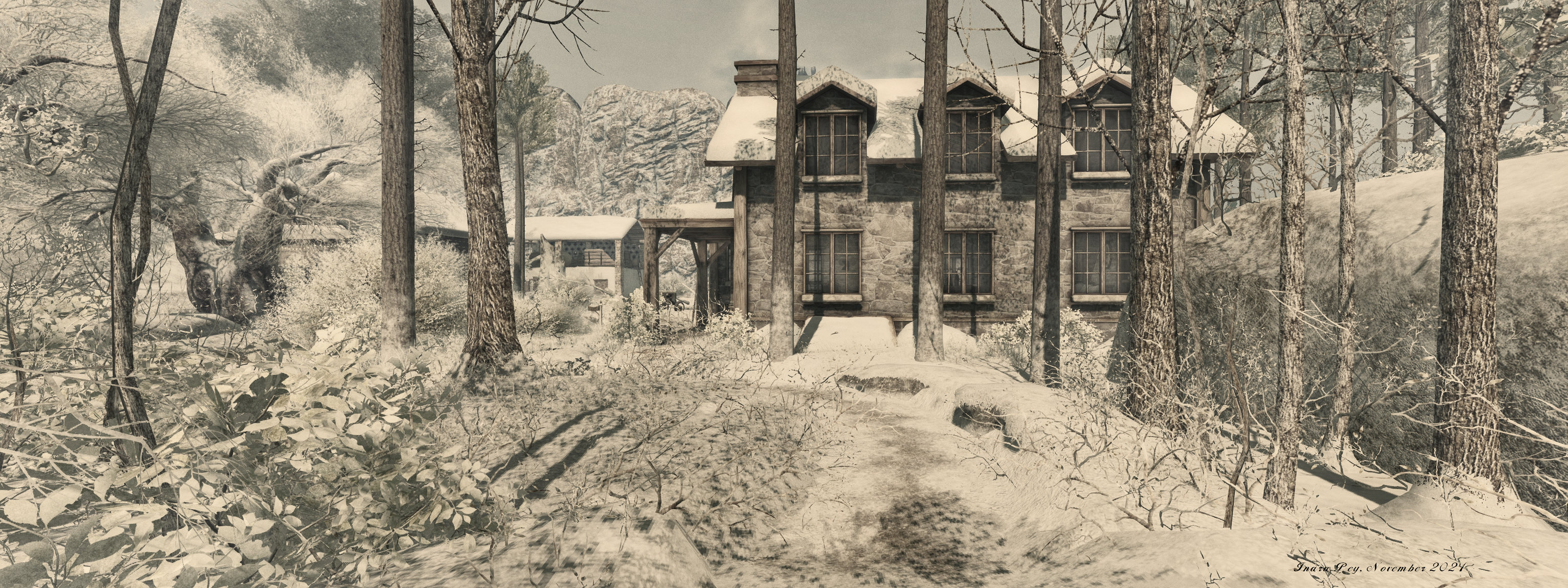
One such place that recently opened as a winter’s setting is that of Eccapaiari Mountains, a charming quarter-region design by Terrygold, located on the ground level of the Solo Arte parcel, where it replaces her earlier Osta Nimosa setting (see: Resting in Osta Nimosa in Second life). As with that setting, this snowy design is easy on the eye, but offers plenty to see whilst forming an ideal backdrop for photography.
Eccapaiari Mountains , November 2021
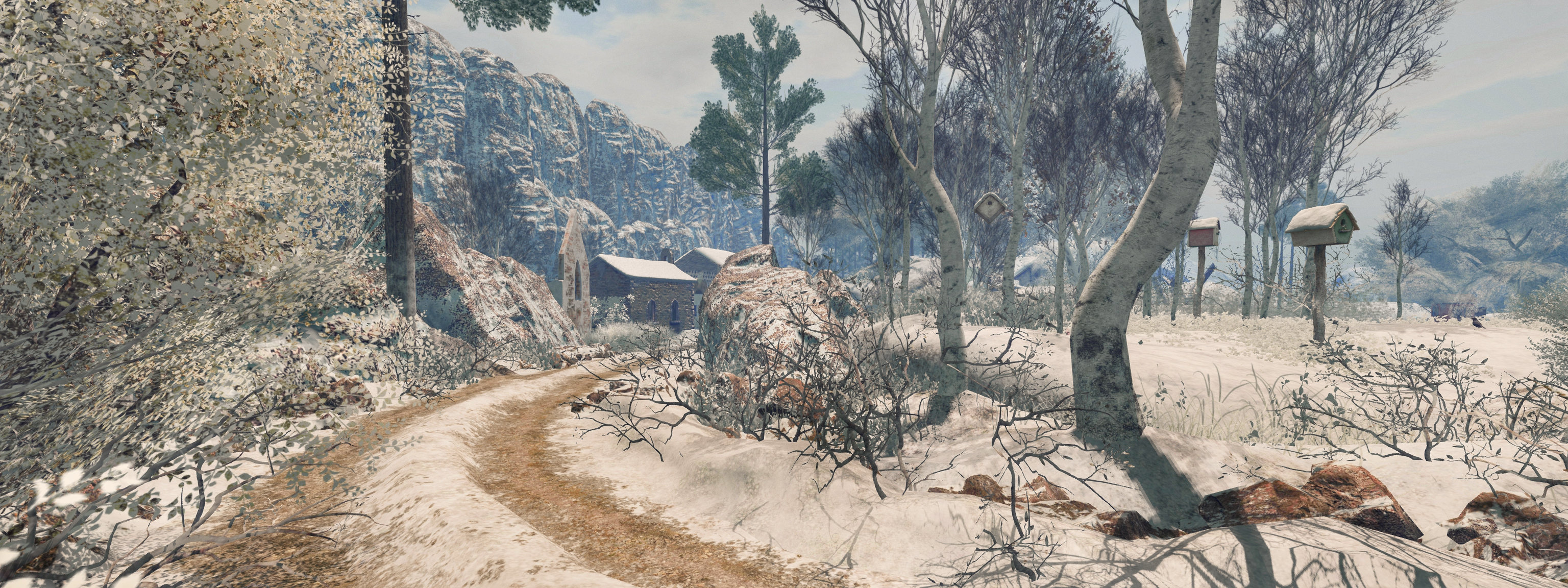
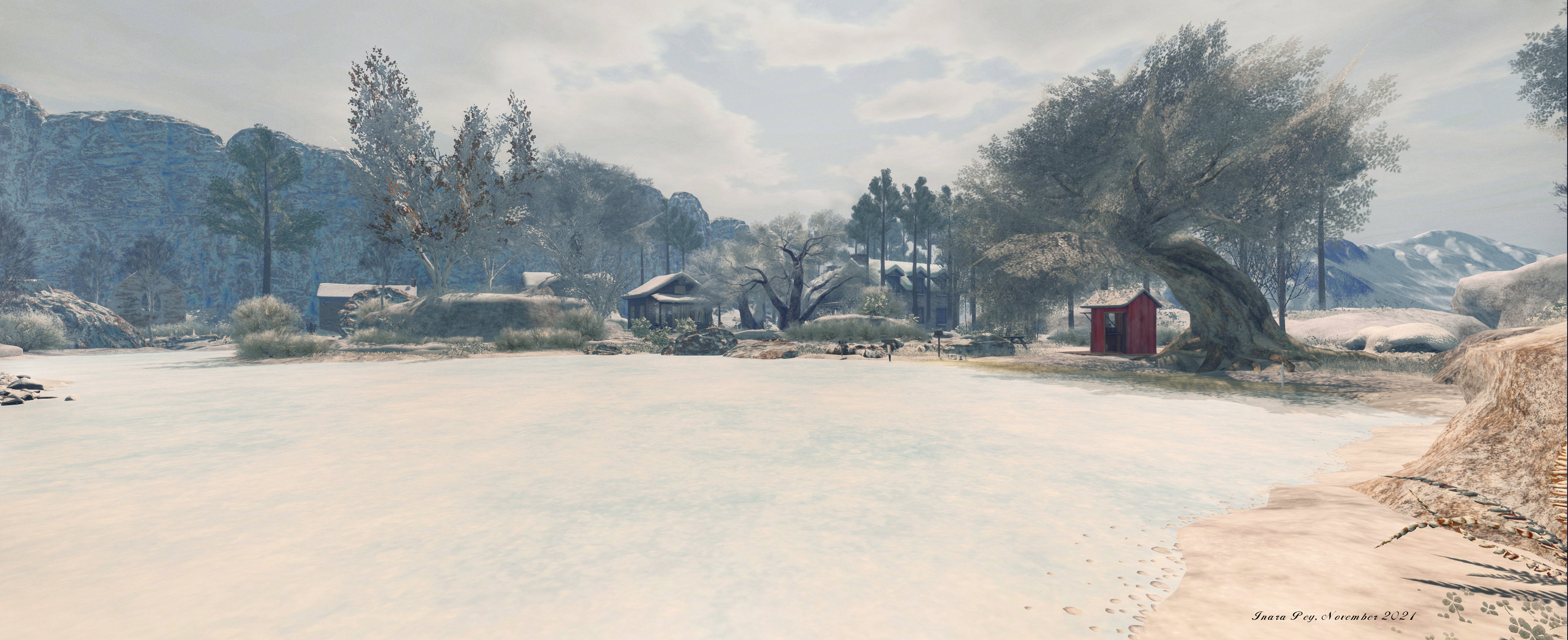
From the landing point, a cart track winds its way around the edge of the parcel, high cliffs to one side, rough lowland to the other spotted by trees, shrubs and bird houses, all of them – cliffs, rocks, bare ground, flora and bird houses – brushed over with snow, which also frosts the shrubs and plants bordering the track. As the this track curves to follow the base of the cliffs, so the land to its right opens out to reveal a broad lake, its water frozen into stillness.
As the land opens, so too do buildings come into view: a small chapel and outhouses for a farm, the track splitting before reaching them, one arm following the edge of the lake, the other curling back on itself to pass by the outhouses and reach the low-slung farmhouse, its roof heavy in an insulating blanket of snow. A small summer house sits across the trail from the farmhouse, its interior heated by a wood-burning stove, with both farmhouse and summerhouse thus offering cosy retreats from the snow for those who seek them.
Eccapaiari Mountains , November 2021
The lake offers the opportunity for skating – there is a skate giver sign on the edge of the ice as the track loops around a rocky outcrop to bring its two arms back together into a single path. Here, sitting outdoors, visitors can enjoy a hot glass of mulled wine or, if skates aren’t to their linking, rez a sled from a second sign and scoot their way around the ice.
Beyond the little hut serving the hot drinks, steps climb up to a small viewing point looking out over the off-region elements of the setting. Those who are so minded might find the dance system as well, sitting in the lee of the tree that also helps shade the little hut, while across the ice a love seat sits within a little wooden shelter where couples might cosy up together.
Eccapaiari Mountains , November 2021
Rounded out by an outdoor fire pit with chairs awaiting those who wish to use them, and the a large sled that also offers single sits and couples cuddles, Eccapaiari Mountains is hardly going to tax anyone’s viewer and is nicely finished with a suitable soundscape. For photographers, the local EEP setting are fine, although for the images here, I opted to use one of my personal settings, which I hope gives a sense
IMAGOLand: Sophie de Saint Phalle – The Art of Water and Colour
Recently opened at Mareea Farrasco’s IMAGOLand Gallery (level 1B), is an exhibition of art by Austrian artist Sophie de Saint Phalle (Perpetua1010). Entitled The Art of Water and Colours, it offers a selection of Sophie’s work which may also serve as an introduction to her broader portfolio of work than can be found at her own gallery spaces, of which more in a moment.
The Art of Water and Colour, as the name suggests, showcases a selection of Sophie’s watercolour pieces that might be split broadly into two categories: landscapes and life studies, although all of them are simply captivating that speak to a talent steeped in, and with an innate understanding of, art and artistic expression.
IMAGOLand: Sophie de Saint Phalle – The Art of Water and Colour
Such is the beauty and skill found within these pieces, none of them really need any form of exposition here; each speaks plainly and clearly as to it’s subject and nature – and to Sophie’s skill as artist and teacher. Each is presented in a style that befits its subject, from the more abstract seen within Bodensee and the pair of “Namibia” scenes, through to the ink-and wash studies of the human form to the sheer beauty and power of Tanz (Dance), these are very much are pieces that speak for themselves.
As noted, these pieces can form an excellent introduction to Sophie’s work, and for those who haven’t witnessed it previously, I would strongly recommend a visit to The Art of Water and Colours be combined with time at Sophie’s own gallery, the SUBCUTAN Art Gallery and Multimedia centre.
SUBCUTAN Art Gallery: Sophie de Saint Phalle – Red Expressions
Here, across four galleries spaces one can more fully appreciate Sophie’s sheer versatility. From further studies of the human form through digital art that is as captivating to – at the time of my visit – the most glorious selection of political caricatures that are both fun and; this a richly diverse tour de force of art.
Set within a series of futuristic buildings by Colpo Wexler, which I know from experience – and as SUBCUTAN proves – are ideal as gallery spaces, SUBCUTAN also encompasses a small club and an information centre, which is rounded out by a fascinating media display that steps the visitor through her creative process in producing Lazy Afternoon, copies of which can be purchased on the upper floor of the main gallery.
SUBCUTAN Art Gallery: Sophie de Saint Phalle – Political Caricatures
For those with a love of art from the physical world, Sophie’s work is not to be missed; whether you explore it through her exhibition at IMAGOLand or via her gallery – or both, for as long as The Art of Water and Colour is open – I cannot commend it strongly enough.
Omerta, November 2021 – click any image for full size
Poking my nose into the Destination Guide recently caused me to spot an entry for Omerta City (actually now featured in the DG Highlights at the time of writing), a Full region design by Lux Voxel that leverages the additional private island Land Impact bonus.
An urban environment, this is a place packed with detail – although I’ll say up-front that this comes at a price; unless you’re running on a fairly robust system, you might find it heavy going if you tend to run the viewer with the likes of shadows enabled and / or a high Draw Distance, so be prepared to make some adjustments to your viewer!
Omerta, November 2021
Omertà is a Southern Italian code of silence and code of honour and conduct that is often associated with the Mafia, and I’d venture to suggest the selection of the name for this setting is no accident given it is sponsored through Lux’s own brand Mesh Mafia. Not that it is particularly mindful of Southern Italy or Sicily, being far more leaning towards being somewhere in the United States. However, it does have the feel for a corner of a city where one could well imagine organised crime keeping an eye – and hand – on things; and enforcing their particular brands of honour codes.
This is a location of multiple faces, with waterfront areas, low-lying and aging business areas overlooked by places of business topped by apartments occupying superior, elevated positions. Within all of this are a range of settings that make exploring the city something of an adventure. Many of the shops are outfitted with interiors that invite visitors into them; clubs and pubs present similar places to spend time within, at least one also containing the kind of racket one might associate with criminal activities as NPC exotic dancers seek to entertain those stepping through the doors.
Omerta, November 2021
Caught under a night-time sky by default, Omerta also has a sense of mystery to it: tucked away here and there are shops specialising in voodoo and magic, for example, whilst the bones of an old and long-deserted and ruined fun fair rises from and overgrown lot. There’s also a sense of life throughout: a corner that may have once been a shop topped by living spaces has been converted into a place for children to use their skateboards, as such corners so often get turned into places for childhood recreation where no formal parks or other spaces exist.
Elsewhere can be found roadworks and the suggestions that parts of the city may be about to undergo redevelopment. There’s also a feeling that the age of the city has lead to something of an unfortunate accident: the subway station sits with its platforms barred to public access, they and the tracks they serve being flooded.
Omerta, November 2021
As noted, Omerta can be heavy-going at times: there is both a lot of mesh and an impressive number of textures which can take time to load and render, particularly if you are prone to keep shadows running at all times (I actually had some issues with texture loading with shadows disabled); as such, it can be a frustrating visit at times (possibly not helped by the region surround / dome).
However, it is more than worthwhile persevering, as the city is also filled with photographic opportunities throughout – and not just under the default EEP settings; as the banner image here hopefully shows, Omerta lends itself to other EEP settings as well.