Time at Valium Creek in Second Life

Valium Creek, January 2020 – click any image for full size

We recently received an invitation from Vallys Lavender to visit Valium Creek, her latest region offering a mix of public spaces and rental homes, and which follows on from [Valium] (read more here). It has been designed for Vallys by Jacky Macpherson (of NorderNey fame), with assistance from Vallys and Terry Fotherington.

The public areas of the region are located to the north and east side, with the residential properties to the west and south, the latter separated from the public areas by a set of railway tracks. The landing point is to the west of the public area, close to the centre of the region, in what appears to be the remnants of a once large stone building, now reduced to flagstones spread across the grass and the stonework from the walls reused to form drystone walls.

Valium Creek, January 2020

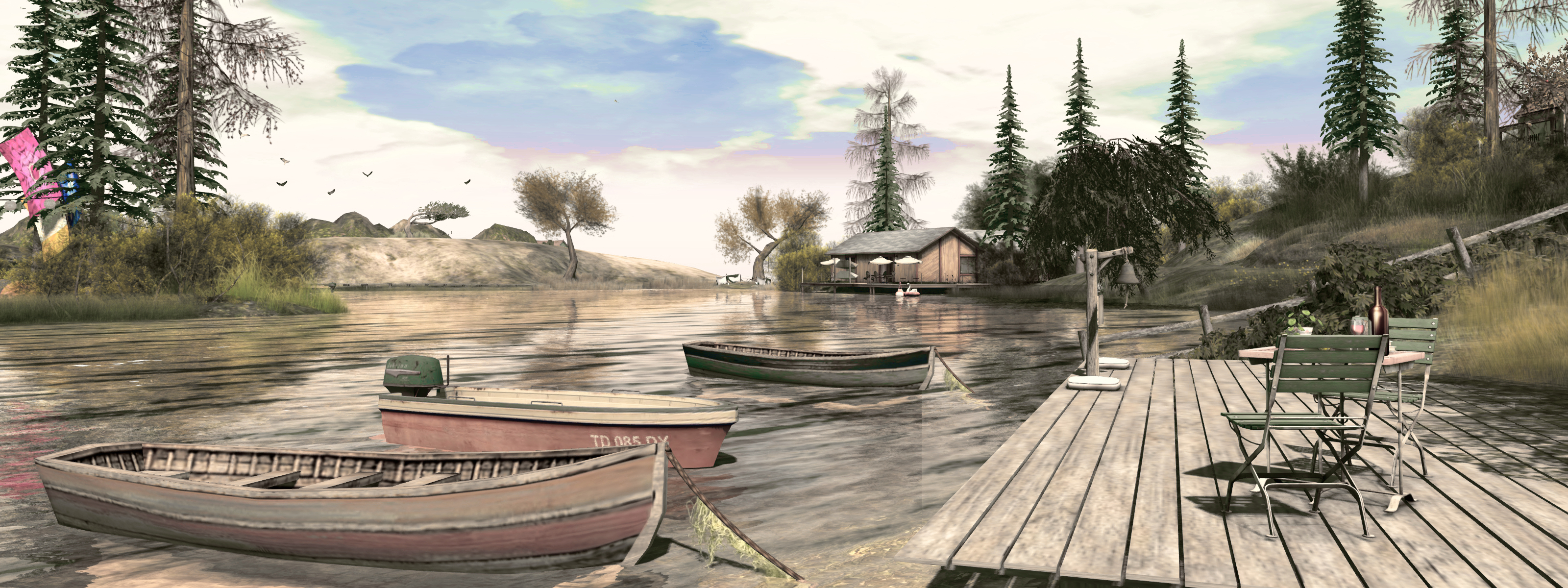
Up a short set of steps is an open-air movie theatre complete with barbecue, and beyond that, more flagstones amidst the grass that offer access to to a shingle beach, a wooden chapel, a public seating area and the local bar. The shingle also runs around an old fishing hut and deck, both of which have both seen far better days.

It’s an eclectic mix of a setting, suggestive of a place of great age then has since been built over but even then, has seen better days. It’s a design that works exceptionally well, offering a memory of the original [Valium] – enhanced by one or two items hat featured in that build, for those who remember it (such as the old rowing boat) – whilst presenting a wholly new environment that is rich in detail.

Valium Creek, January 2020

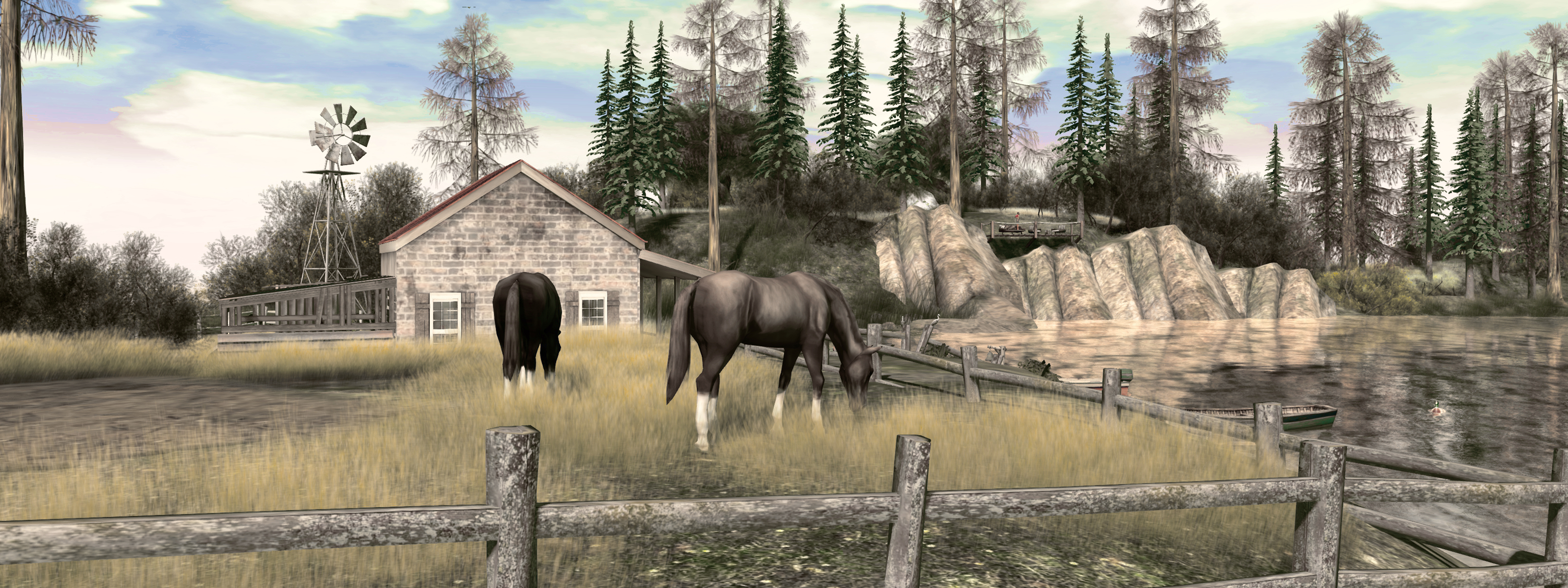
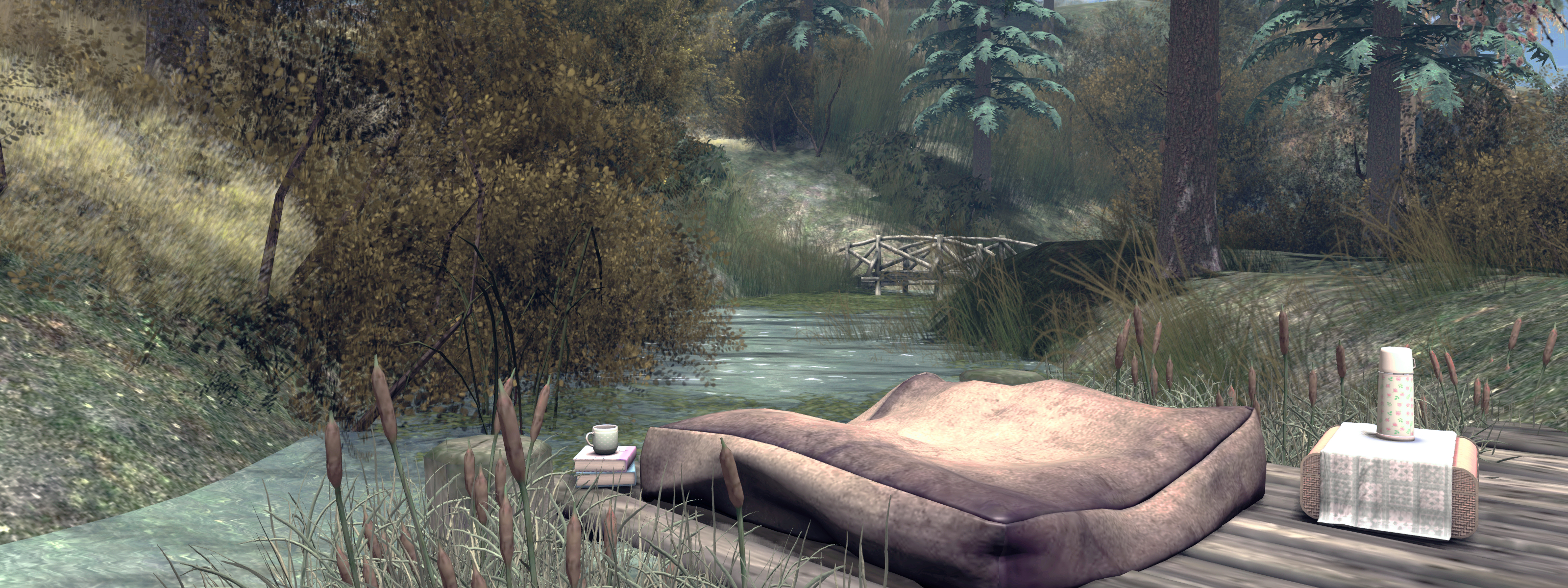
The west side of the region comprises open woodland, rich in fir trees and cut by slow-moving rivers, the banks of which are occupied by ranch-style houses, while away from the rivers are cabins also available for rent. Most of the homes are reasonably separated from its neighbours to offer privacy. The entire layout is suggestive of a untamed setting – lived-in, yes, but still untamed: deer graze at the waterside, birds can be heard in the trees, and while there are no beavers or otter to be seen, there is a sense that if you look around quickly enough, you might just catch sight of them.

Valium Creek donates each month to The Nature Conservancy, an international organization dedicated to preserving our natural surroundings.  A portion of the Valium group join fees are donated. During 2019, Valium Creek donated the equivalent of L$80,000 and our 2020 increase to $35.00 per month will give an additional L$105,000. 

– Vallys Lavender, on continuing the charitable work
she started with [Valium]

Valium Creek, January 2020

Unlike [Valium], this new design doesn’t sit alone. To the north, and reached via a bridge, is Valium Creek Park, also held by Vallys. In some ways this continues elements found in Valium Creek – the fir trees, the railway lines – even the bridge connecting the two regions. However, Valium Creek Park is also very different.

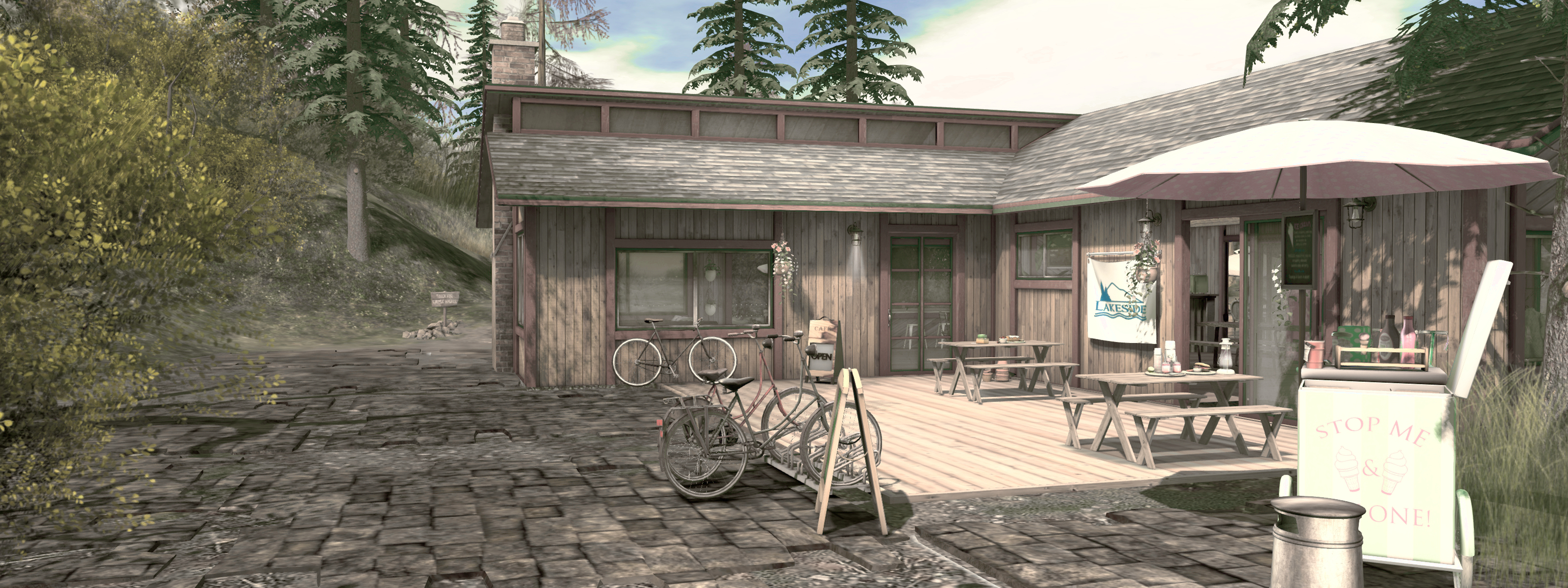
Entirely open to the public, half the region forms an art park operated by Vallys and which will shortly be opening its first exhibition, featuring the work of Mistero Hifeng. It also encompasses a series of event spaces – a chapel set for weddings, a café, and a bar. At its western extreme, the park is dominated by a house and pond that between them mark the point of access to the rest of the region, offered through a stone arch.

Valium Creek, January 2020

The arch offers the way to two bars occupying the north side of the region. The first is Bardeco, operated by Terry Fotherington and Bridget Genna, and which has featured in the Kekeland design (see here and here for more). East of this sits Bar Relax, the work of Bridget, together with NightAttack Guardian and Lillynot Jinx.

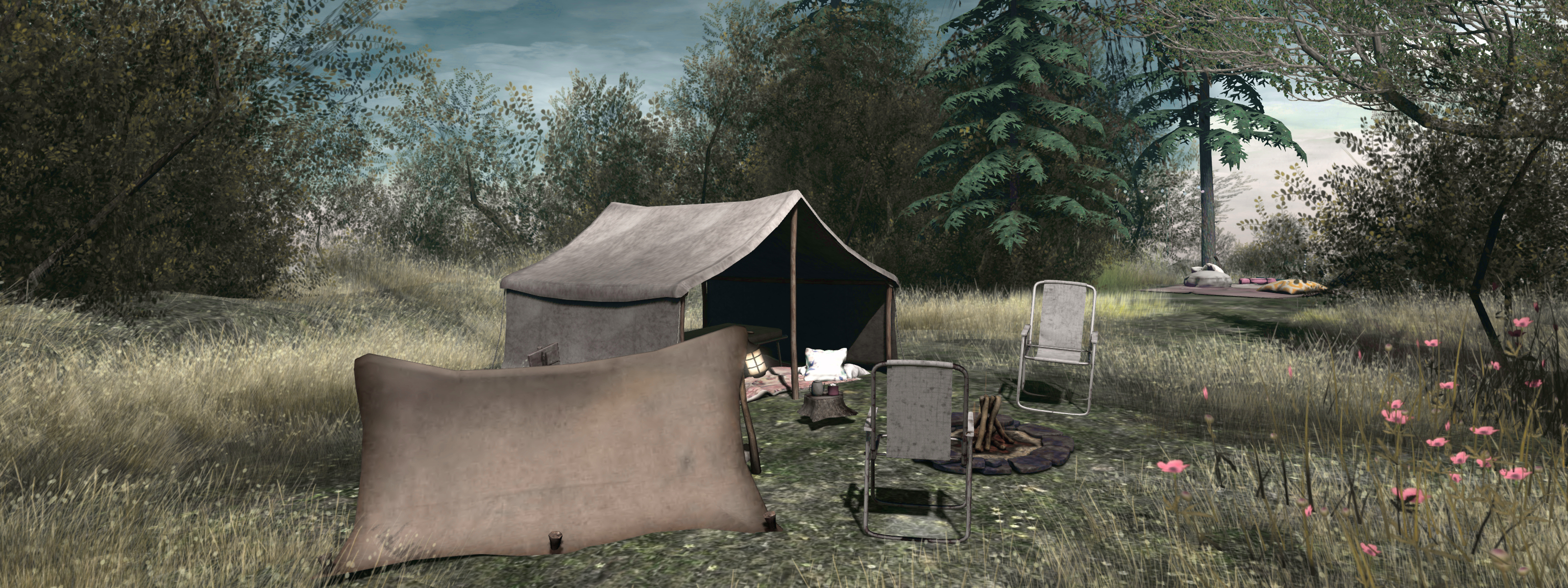
The setting for the latter is perhaps more homely than for the former; and whilst I cannot be sure, it felt as if the land around Bardeco was perhaps still in development, denuded of trees or other flora as it was during our visit. Both of the bars share a commonality, and not just in terms of those involved in building them: they each have a local camp site, for example, while one has a small circular inlet that almost resembles a fishing hole, mirrored by the other having an actual pond.

Valium Creek, January 2020

For those seeking a new home in Second Life, Valium Creek is every bit as a attractive as [Valium] was, while the park with its arts area and three bars may offer a further attraction for those who appreciate attending events. As noted, the region on which the park sits had, at the time of our visits, something of an “unfinished” feel to it – so you might well find some additional elements when visiting. However, and make no mistake, Valium Creek is marvellously photogenic and makes for an excellent visit.

SLurl Details

Aradia’s Winter in Second Life

Aradia’s Winter, January 2020 – click any image for full size

Update, January 12th: Aradia has now been re-dressed for spring.

Aradia is a Homestead region designed by LadyOnia that offers a mix of public spaces and rentals for those seeking a home. We first visited in November 2019, not long after the the region had opened, and when it was dressed for autumn. I jumped back with the start of the new year to take a look at it under winter’s blanket.

The landing point sits to the west of the region, above a broad spread of beach – although given the snow and the winds, it might take a very brave soul to take a dip in the waters or attempt any sunbathing on the sands! The rest of this predominantly low-lying region spreads out eastwards, cut by channels of water that serve to break it up such that exploration is a case of findings ways across the water (and even then, once or twice a little wading might be required!).

Aradia’s Winter, January 2020

I say “predominantly low-lying”, because the north-eastern corner of the region is raised slightly above the rest to form a circular table of land on which the rental properties are located. This looks across the region to where the land unmistakable bulks up in a rocky hill to the south-west.

The rentals are clearly separated from the “public” parts of the region, with just a single point of access by foot to their round plateau. Five cottages and a lighthouse form a ring around the outer extent of their rocky table, the centre of which forms an open space marked by ancient stonework built around a water feature.

Aradia’s Winter, January 2020

Rental information on the properties is available at the information board located on the steps that form the access point for the rentals, spaning the channel separating them from the rest of the region. However, I understand from LadyOnia that she is currently using two of the properties, leaving just four with rental options. Wildlife is very much a feature of the region: herons and egrets keep an eye on the waterways, doubtless watching for unwary fish, although they may face some competition for fishy meals from the otters floating on the water or playing nearby.

Away from the waters, peacocks strut around the territories they’ve claimed for themselves, while rabbits and deer take a more relaxed view of things, content to hop through the snow or graze on the grasses poking up through its blanket. Weasels are also to be found as they scurry through the snow, while sheep and goats can be found at various points, with the sheep laying claim to the ring of standing stones to the north-west.

Aradia’s Winter, January 2020

For those fancying a bit of a climb, the south-eastern hill can be reached via log bridges and a rocky arch, the climb made easier by the stone steps winding up its flanks. The hill’s lower shoulder is broad enough to be home to a large frozen pond, a little café raised to one side of it. The latter offers a place to sit and rest and perhaps enjoy a hot cocoa before carrying on up to the peak, while a sign at the edge of the pond will deliver skates for anyone wanting to make use of the ice as a rink.

The central and eastern lowlands offer open spaces and various features of their own – some of which may be changing a the next few weeks as they are decidedly Christmas oriented, and LadyOnia noted to me that she’s looking to introduce a spring setting to the region in the not-too-distant future. Much of these lower areas are marked by trees with trunks bent so they stand as if crouched against an unrelenting wind. Places to sit and cuddle can be found under some of them, with more places of to to be found scattered around, from simple benches to a giant stone-carved hand to winter’s crescent Moon swing.

Aradia’s Winter, January 2020

One of the pleasing aspects of this region – for me, at least – is that the volume of snow didn’t impact my system’s performance as much as it has elsewhere. However, it does combine well with the region’s windlight to add a natural softening to the landscape as one looks across the region, just as now does in the natural world.

SLurl Details

Catena et Cavea in Second Life

Catena et Cavea, January 2020 – click any image for full size

Catena et Cavea (literally “chain and coop”, but better translated as “chain and cage”), is a Full region utilising the additional 10K land capacity to present a setting of multiple elements, some of which may not suit all tastes given their adult leanings. Held by Ororeia, who designed it with Kyra Nachtigal, the region is described by them both as:

Our home, and at the same time a big playground for everyone. It’s adult, so please no under-age avatars … Feel free to explore everywhere, but please be respectful if we are at home. If a door opens on touch, you are welcome to enter.

Catena et Cavea, January 2020

In this instance, “adult” refers to BDSM activities (as some may well guess from the English version of the region’s name). However, the greater portion of this aspect to the region is located underground, and so while there are more visible elements scattered around, they do not interfere with more general exploration / photography. In fact, I’d say viewer / system performance might be a greater cause of issues than anything BDSM related: this is a region with so much packed into it I had to disable shadows, drop draw distance, etc., in order to be able to move comfortably, my viewer was working so hard.

The best way to describe Catena et Cavea’s layout is to note it can be split into some readily-identifiable areas. The south-east corner, for example, comprises a coastal fun fair with some of the rides in a warehouse. Bounded to the east be a ribbon of sand and on the west by a small, rectangular harbour, it almost forms a little headland raised above the sea.

Catena et Cavea, January 2020

A paved road / path runs up towards the beach from the harbour, separating a second warehouse from the rest of the fun fair. The road forms the landing point for the region (where an information board is available for those wishing to learn more about it – just click for a note card), while the second warehouse has been been converted into  a beach house.

North of here sits a terraced vineyard stepping its way up to a shoulder of the island’s rugged centre. Topped by a cemetery and a summer house and garden space. North of this, the land slopes gently back down towards the coast and a circle of standing stones watched over by further ruins inland. A slender finger of rock also extends outwards from the high parts of the region, pointing out to the north-east and distinguished by a rocky arch under which the beach passes, while the flat top of the rock has been pierced by the tip of a giant sword that stands over the arch as if guarding it.

Catena et Cavea, January 2020

The sword is one of several artistic statements scattered throughout the region. These include the sculpture of a giant hand sitting close to the sword, and which converted into a seat, and smaller statues marking the footpaths running around the west side of the island.

This side of the region takes the form of an almost region-long plateau running south-to-north, home to a large house that may be a private residence when Ororeia and Kyra are present, so again some caution in exploring might be advised when approaching it. The house shares the space with a summer house at the southern end of the plateau and a large circular arboretum, which together with the gardens and paths, appear to be open to the public.

Catena et Cavea, January 2020

More houses sit below the plateau to the south. These do not appear to be rentals, but rather available to those wishing to have a little indoor privacy. However, I’m not entirely sure on this, so they are perhaps approached with caution out of respect to how they are being used, if occupied. They are connected to the plateau by a set of steel stairways that ascend the cliffs, passing the entrance to a bar cut back into the upper reach of the cliffs as they do so. This is very much more BDSM-oriented than the visible spaces on the region, and forms the entrance to underground play areas for those interested.

The north side of the uplands running eastwards from the large house, offer a small bar / play area backed by fenced fields for cattle and sheep. Behind this, the region climbs to a peak and a large pavilion area, the path to which lies on the south side of the island, switch backing its way up from the little residential area or via the shoulder with the cemetery. It’s a path that has a secret of its own – the BDSM tunnels are not the only underground element to the region, as the introductory note card indicates. I’m not going to give the secrets away; suffice it to say not all cliff face rock is necessarily just cliff face rock, and you might need to follow the clues in the introductory note card to find your way to the teleport that accesses the caves.

Catena et Cavea, January 2020

As noted, there is a huge amount going on in the region, rendering wise, and this can really hit performance; with shadows enable I was lucky to get much above 6-8 fps), and even with shadows disabled, there were a number of places in the region were my system was still struggling on single digits. If similarly hit, people might find the region an issue, however, given the photogenic edge to the setting, making allowances for the region’s load might be worthwhile.

SLurl Details

Mimmo’s garden setting in Second Life

Mimmo, December 2019 – click any image for full size

A group design led by Elise Sirnah with LeviCord and Shadeng Krokus, Mimmo is a Homestead region “designed for those interested in photography”. It’s a location we’ve visited a couple of times, although this is the first time I’ve written about it here.

The design of the region has changed between those initial visits and its appearance as seen here. Whether this is a sign it is renewed at regular intervals or not is hard to say: there are now a couple of rental properties within the region that may limit future terraforming efforts (at least in part) if they are retained.

Mimmo, December 2019

At the time this most recent visit, the region presented a summertime setting with a temperature / tropical feel and a very defined north-south lay to the land. To the north, the land is raised into high hills and a curtain wall of cliffs, beneath which the landing point sits on a broad shelf of rock that is also home to a photographic gallery and information about the region.

This shelf offers a view out over the rest of the region as it drops away to the south, cut in two by a stream flowing south and east from falls that drop to a pool below the north-side cliffs. The stream forms a neat divide between the inland grasslands and the south coast beach.

Mimmo, December 2019

Both parts of the landscape include numerous points of interest, with the inland area laid out in a way that suggests it is all part of the same property, marked by a Tuscan villa / farmhouse to the east, the ground flowing to the west past a fenced meadow that is home to grazing sheep and goats, to arrive at a small summer house matching the general style of the villa as it looks out over the sea to the the south-west and one of the two rental properties, sitting on a small island.

Reached via two bridges – one of which is little more than felled tree trunks – the beach offers space for music, sitting, music and an open-sided bar to be enjoyed by all.

Mimmo, December 2019

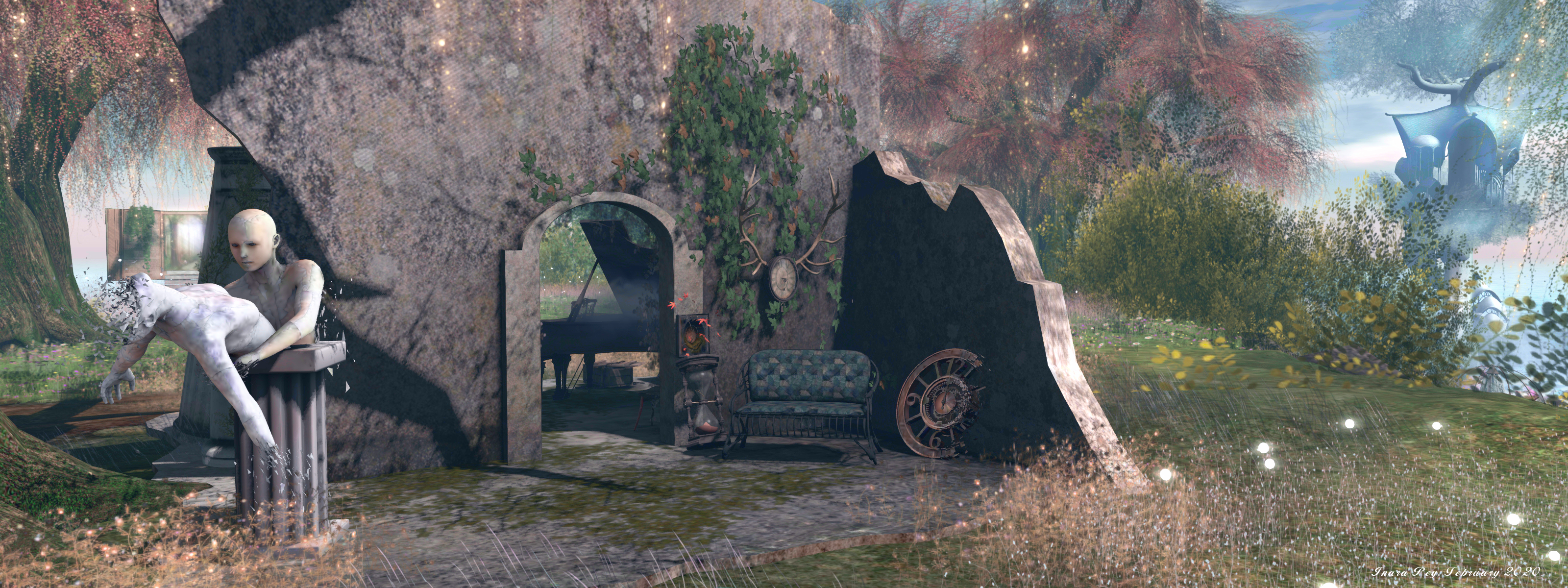
The above barely scratches the surface of the region’s offerings. Within the circle of ancient stone walls sit an ageing piano, which although old, might still be enjoyed by those seeking a set for photography, the rose-entwined harp alongside it offering a suitable backdrop.  Another ruin that sits alongside the fast-flowing stream, offers another set for photography, partially lit by a portable movie lamp.

In keeping with the region’s photographic theme, a camp cabin towards the north-east and just below the land point rock shelf is set for photo-processing, with the suggestion of reporters being somewhere in the region: a video camera and an interviewer’s microphone are sitting on the worktables alongside the photo developing kit. Beyond it, and tucked into the north-east corner of the region under the lee of the hills, is the second of the two rental properties, iron gates marking the edge of the parcel.

Mimmo, December 2019

Those seeking a cosy corner in the region might want to direct themselves to the east side behind the villa, where creative use has been made of two sections from the f8f Storyteller’s Burrow to create two sheltered sitting spots linked by a small cobblestone patio, sitting above a narrow ribbon of sandy shale beach.

There is still more to be found within the region, but the above should be enough to whet appetites. Finished with a matching sound scape, the region has a natural flow to its design and layout, and while there are some odd rough edges to the build, Mimmo in no way fails to deliver on the promise of offering a photogenic location.

Mimmo, December 2019

SLurl Details

  • Mimmo (Pomerania Park, rated Adult)

A late summer at La Clef des Champs in Second Life

La Clef des Champs, December 2019 – click any image for full size

Update, April 2025: Chef des Champs has closed. SLurls have therefore been removed from this article.

It has been some time since I’ve paid a visit to La Clef des Champs (literally, “the key fields”), the region setting by Rose Siabonne. When last I visited, in June 2018, Rose had relocated the setting from a Homestead to a Full region (see: A return to La Clef des Champs).

Part of my reason for not re-visiting is that some time after that last visit, the region appeared to close, and Rose later offered the homestead setting of Hors du Temps (see: An Out of Time experience in Second Life). However, in the latter half of 2019, La Clef des Champs made a return to Second Life (the region details show it as returning in August 2019), and with it, Rose has once again created a photogenic, somewhat Adult-oriented  region – one that was, as the time of my end-of-year visit, still caught in the warmth and colour of summer.

La Clef des Champs, December 2019

As with past iterations of the region, this is a place where Adult activities are allowed, provided they are kept indoors and do not spill over into the gardens and open spaces of the region. As such, some of the buildings scattered across the landscape particularly given over to adult pursuits (notably the two white, modern houses). However, those who prefer not to witness such things shouldn’t be put off from visiting: there is more than enough to see and do without entering the various houses, and some of the buildings – such as the pavilion on the uplands to the south-east.

This pavilion, as with a number of other points across the region offer echoes of previous Les Clefs des Champs for those familiar with previous builds (in this case the piano), without ever being derivative of past builds.

La Clef des Champs, December 2019, December 2019

Water plays a role in the overall design, with the setting split into a primary large island with three smaller isles spaced around it. The largest of these, to the north-west, has a cottage atop it, and while there is no indication the parcel is private, the décor and furnishings with suggest it may well be – so perhaps a little caution should be used when exploring to avoid undue trespass.

Elsewhere, a river cuts through the region, almost splitting it in two has it runs from a set of inland falls and to the east coast. In addition, beaches serve the two white houses, while to the south a bay offers rowing boats and a little café. These help to break up the landscape with places to sit and relax.

La Clef des Champs, December 2019

There are some rough edges to the design, but nothing that spoils the overall effect of the design, while the centre lowlands offer a pastoral setting, complete with farmhouse (unfurnished) with geese, chickens and goats. Between this farmhouse and the (furnished) Tuscan house set a little back from the river, horses roam the grass.

As ever, La Clef des Champs retains an eye-catching design that offers rich opportunities for photography and appreciation of the outdoors.

La Clef des Champs, December 2019

A corner of England with a twist of Tolkien in Second Life

Greenhouse, December 2019 – click and image for full size

Currently in development, and with a planned “official” opening on December 28th, 2019, is a new development occupying the Blake’s Channel regions of Greenhouse (for so long the home of The Greenhouse, one of the oldest and most striking public spaces within the Blake Sea regions and their surrounds), and the neighbouring Mare Nostrum.

The development is the work of friend and artist, Drwyndwn (pronounced DROO-in-doon) Tyne, aka Drw (“Droo”), undertaken in cooperation with the Greenhouse’s creator, Aislin Keynes – who retains a house within Greenhouse – and with neighbour Transparent Banshee, who owns Foliage to the west, home of his Sky Hye Gallery (see: A Sky Hye art gallery in Second Life) and the Foliage air field.

Green house, December 2019

Greenhouse is built along the lines of an English coastal village; and while slightly idealised in places, it is certainly reflective of places that might be found around the coastline of southern England. There’s a small parish church with an accompanying vicarage, a pub very much in keeping with many a small English pub, a memorial to those the village and its surroundings have lost to the two world wars, and a pleasing mix of architectural styles to the houses and shops.

The homes in the village are available for rent, and form a part of the estates operated by Patrick Leavitt (there’s a rental office within the village). These form a mix of houses, cottages, flats and a narrowboat – with the two largest properties also offering region-sized sky platforms for use by their tenants. All of the landlocked homes come with a slip for mooring at the Greenhouse Marina on the east side of the region.

Greenhouse, December 2019

The north end of the village is marked by a large manor house that also sits alongside the Balboa Canal. I’m not sure if this will be a public building or offered for rent (work was still in progress during our visit), but the lands around the village and the marina are all largely public spaces, as are the streets, shops, church and pub in the village – although obviously the rentals are private.

Facing the village from across the marina is Sawson Park, dedicated to the memory of Chad Sawson, the previous owner of the land, who passed away in 2019. This includes a pavilion, formal garden and open meadows backed by a bubbling brook, on the far side of which is the private home of Aislin Keynes, and more meadow lands that extend into Mare Nostrum – of which more in a moment.

Greenhouse, December 2019

Drw has taken a lot of care to create an environment that is entirely natural in look and feel; the village, marina, park and open spaces are all perfectly integrated to offer a contiguous landscape facing Blake’s Channel, and which is carefully screened from the private islands to the north whilst also blending nicely with the Balboa canal and Banshee’s land to the west.

In particular, the position of the Foliage airstrip means that the village potentially offers an ideal home for those who enjoy both sailing and flying – they can make use of a slip at the marina for their boat(s) and hop across to Foliage to rez a ‘plane or helicopter for flying. In this respect, and region boundaries allowing, I wonder if an arched bridge between Greenhouse and Foliage might not be worth considering?

Greenhouse, December 2019

But what of the Tolkien reference in the title of this piece? Well, that brings us to Mare Nostrum. To reach it, take the path through the village from the landing point I’ve given, going first west towards the church, then turning north towards the manor house. You’ll come to a crossroads, the east running path of which is pointed to by a sign indicating the way to Mare Nostrum. This will take you up by path, bridge and stair up into the halls backing both Greenhouse and Mare Nostrum and the woods of En’ Duin Forest (not sure of the derivation here, other that duin is both Sindarin and Quenyan (duinë) for “river” – so (forest) of the river?). Here you’ll come across a twisted trunk of a tree forming an arch over the path, and a sign: Warning. You are about to enter someone else’s dream.

The warning might sound foreboding, but don’t take it to heart. Follow the path on and upwards, and I guarantee that the sight you’ll see will be comparable to the wonder Bilbo Baggins felt on first seeing Imladris, the home of Elrond Half-Elven.

En’ Duin Forest, December 2019

Perched on high cliffs that fall away sharply to the lands and waters below and over which water tumbles in slender curtains, is one of the most Tolkien-esque settings I’ve come across in Second Life. Like Elrond’s Last Homely House East of the Sea, it is both welcoming and yet clearly screened from both land and water to present a hidden realm. Within its buildings, works of men and elves are blended to offer a unique setting, and Tolkien’s writings are given due homage through art on the walls, while the natural gardens and greenswards between the trees give one room to breathe and feel renewed.

Below these high houses is a natural bay, bordered on its western side by a long stone pier. Looking down on it, it is not hard to imagine one of Círdan’s great ships slipping into the bay to moor here, thus linking En’ Duin to Beleriand as well as to Imladris. A graceful bridge connects this pier with a path that runs around an old smithy, now converted for ale and wines (a vineyard lies close by) and which feels almost Hobbitish despite its size, and thence up the hills to join with that leading up to the hillside houses.

En’ Druin Forest, December 2019

Taken as a whole, Drw’s work at Greenhouse and Mare Nostrum is simply gorgeous – and available to everyone to enjoy (just please respect the privacy of those renting in the village!). There is a huge amount to be seen and aprreciated within both regions, as I hope I’ve indicated here, and the En’ Druin Forest offers plenty of scope for fantasy photography. Kudos to both Drw and Patrick for the development of the regions, and for wanting to make them as publicly accessible as possible.

SLurl Details