I received an invitation from Blip Mumfuzz to visit her latest exhibition, Exaggerations which opened on April 8th at Andante Gallery, operated by Jules Catlyn and Iris Okiddo (IrisSweet), and which will remain available through until May 8th.
Blip is an artist whose work I’ve come to admire for its richness of colour and depth, and this is very much celebrated within Exaggerations, a series of images taken around Second Life in which one or more colours have been exaggerated and / or a colour filter has been overlaid.
The result is a series of images that are both stunning and subtle. In some, landscapes have become alien worlds and plants turned into strange new life forms. Others she shrubs turned into pieces of modern abstract art and / or play with abstract expressionism; still others are more subtle in touch: gentle highlight that allow a scene to remain “natural” whilst drawing the eye to certain features: the blush of lipstick or the topping of a pizza or the heat of a barbecue, and so on.
Andante Gallery: Blip Mumfuzz – Exaggerations
Nor are the images confined to the gallery building and its little courtyard. Blip has placed a quartet of large format pieces outside of the gallery, within its grounds so that they might be viewed through the gallery’s windows. These give the exhibition a unique additional perspective, making it appear as if we’re are viewing the exhibition from within itself.
Expressive and full of colour and life, Exaggerations is another eye-catching and engaging exhibition from Blip.
La Masion d’Aneli: Nessuno Myoo – As Mammoths In the Middle Of Butterflies
Having opened on April 6th, 2022, Kicca Igaly and Nessuno Myoo present two intriguing installations at La Maison d’Aneli (curated by Aneli Abeyante) that stand a both individual pieces and as installations that might – in the mind of the visitor – also be intertwined in terms of theme and potential interpretation.
Before getting to the exhibits – both of which can be reached from the teleport disc at the gallery’s ground-level landing point – please note that to appreciate these installations fully, yo should ensure Advanced Lighting Model (ALM) is enabled and render quality is set to High (if your system can handle it) – both set through Preferences → Graphics, and that the viewer is also set to use the Shared Environment.
La Masion d’Aneli: Kicca Igaly – Pulsions
Within Pulsions, Kicca explores the idea that the human condition – the lives we lead and how we interact – is propelled by the decisions we make individually and collectively; pulsion itself being the act of driving forward (as opposed to being drawn forward involuntarily as a result of influences over which we have no direct control).
Within the setting, we are presented by scenes of everyday life: mothers with their children sharing a conversation; children at play, a mother and daughter passing a (presumably) homeless man asleep on a park bench; a tall man watching the children at play, and so on. Over the shoulders of each character float two little figures – their better angels (or positive pulsions) and darker demons (or negative pulsions) that drive their behaviour – whether or not a group conversation descends into gossip and rumour-spreading; whether a discussion remains calm and reasoned or descends into a heated, angry exchange; whether a game played remains friendly and fun or embroiled in bitterness on losing, and so on. By using the term pulsion, Kicca reminds us that the negative choices we make may not always be driven by a need to hurt or upset and so are not necessarily “evil” or “cruel” – although the tall figure watching the two youngsters also perhaps reminds us there can be intentional evil driving the decisions some make…
La Masion d’Aneli: Kicca Igaly – Pulsions
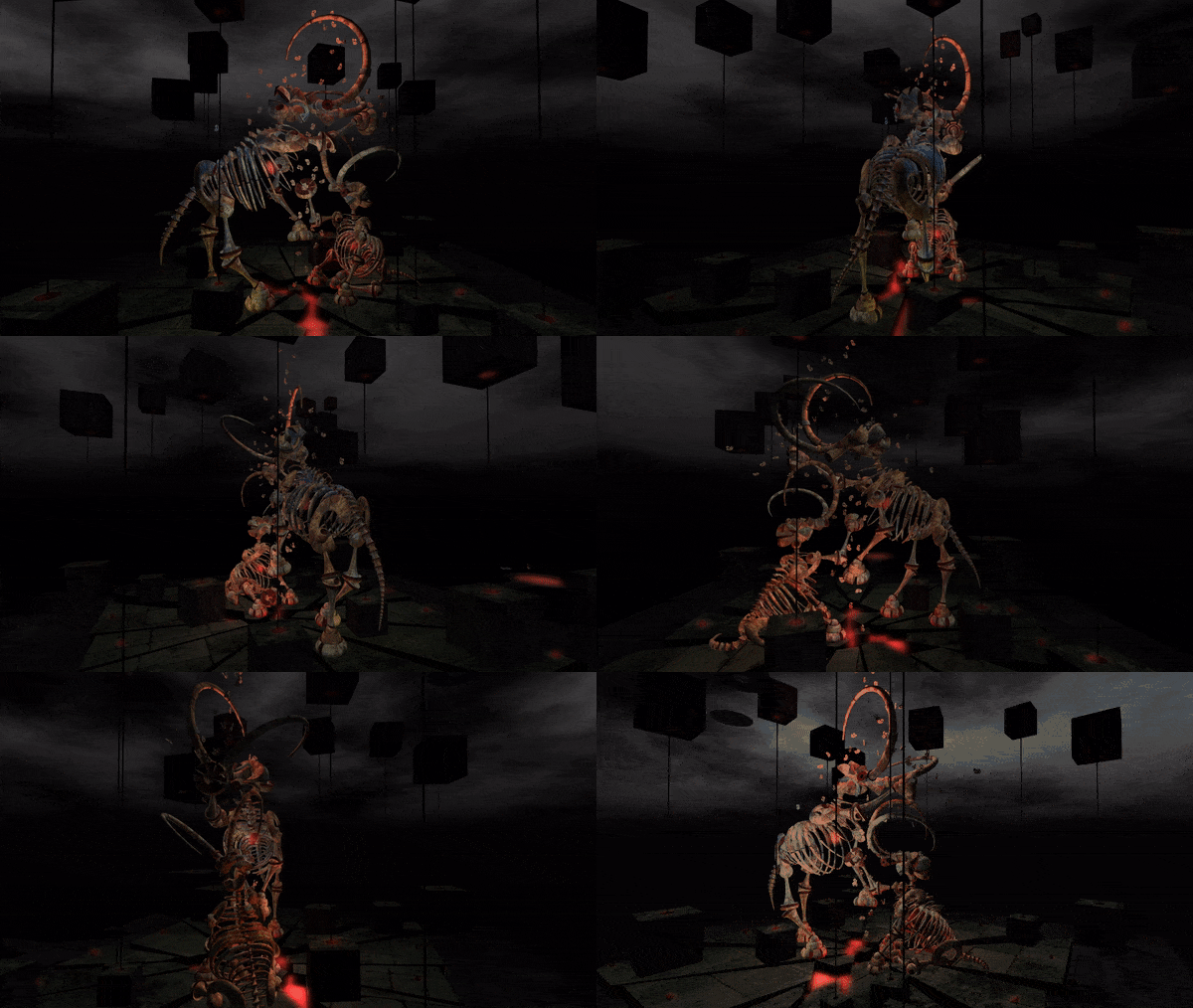
Within As Mammoths In The Middle Of Butterflies, Nessuno presents a single, stunning sculpture of the skeletal forms of two mammoths of unequal size apparently locked in combat, the smaller forced down onto its rear hunches and attempted to ward off a blow from the foreleg of the larger as it rears up on its hind legs in order to deliver the blow with greater force. Around both rises a cloud of butterflies, their peace and innocence shattered by the warring beasts.
Quite what we make of this is left entirely open to interpretation, the artist only stating At the sunset of existence, immersed in the wonder of its own nature. Thus, how we respond to the piece is entirely subjective. For my part, the use of mammoths (now long extinct) and the term “sunset of existence” suggests the piece can – and as with Kicca’s Pulsions – be taken on a statement about the human condition.
As Mammoths In The Middle Of Butterflies
That we are, for example, so polarised in views on subjects such as global warming and so focused on arguing about it, we cannot pause to address the fact that we really are disrupting the global ecosystem and hastening our own demise. Other might see it as a commentary on the the danger of the old truism “might is right”, that some countries have grown so arrogant in their own superiority and might, they care little about the manner in which the decisions they make can have shattering and disruptive impacts on others.
But rather than add further subjective thoughts of my own here, I’ll leave it to the sculpture to express itself to you. All I’ll say in closing is that once again, Kicca and Nessuno present two installations that engage both the eye and the mind.
Ruben’s Art Gallery: Mareea Farrasco – Visiting Salt Lakes of Florence
Following my review of Landscapes – My Personal View, by Alexa Wulfe (Alexa Bouras) – see Alexa’s personal view of Second Life – I was contacted by Ruben (yvan Slade), who offered my an invitation to visit the gallery he operates and curates, and which is currently host to two very different exhibitions.
Ruben’s Art Gallery is located on its own sky platform. The gallery sits within a model, clean concrete structure with two levels and a walled courtyard outside. Both levels of the gallery offer the same amount of exhibition space and are linked via teleport disks, allowing them to exist as independent display spaces with easy access from one to the other. At the time of my visit the gallery was playing host to exhibitions by Mareea Farrasco and Zia Sophia (Zia Branner).
Ruben’s Art Gallery: Mareea Farrasco – Visiting Salt Lakes of Florence
Visiting Salt Lakes of Florence is a series of twelve images captured by Mareea of Gnaaah Xeltentat’s Florence region, which at the time Mareena capture it lay as a setting inspired by the Salin d’Aigues-Mortes (salts of Aigues-Mortes), Camargue, in the south of France, as interpreted by the talented Iska (sablina), assisted by Tippah.
As I noted in The pink salt lakes Of Florence in Second Life, the region is remarkable in the manner in which it captures the spirit and look of its namesake – and Mareea has fully captured the beauty of the region in these images that have been gently post-processed in order to give them the look and feel of watercolour paintings. Most of the images present the landscape of the region, although several offer a more personal look through the inclusion of Mareea’s avatar (and those of friends / others).
Ruben’s Art Gallery: Zia Sophia
On the upper floor, Zia also presents a total of 12 images, although these are drawn from the physical world, being copies of Zia’s fascinating paintings. Four of them are Zia’s coastal and sea views that have been features in some of her recent SL exhibitions and the remaining eight copies of her natural abstract paintings that are, as ever, rich an form and colour.
Both artists are very different in their choice of art – both are united in their eye for colour, tone, and mood, allowing these two exhibitions to stand individually whilst also richly complimenting one another. And for those who enjoy Zia’s work, a gift can be obtained via the artist’s easel within her exhibit.
Ruben’s Art Gallery: Zia Sophia
I’m not sure how long art displays run for at Ruben’s, but at Mareea’s opened in mid-March, I would recommend visiting sooner rather than later, just in case a case of artist is on the horizon.
Artcare Gallery: Gem Preiz – Storm of Steel; On Marble Cliffs
Ernst Jünger (29th March 1895 – 17th February 1998), is a complex figure from Germany’s history in the 20th Century. Born to an affluent family, he rejected his background, serving briefly the French Foreign Legion before serving in the German army throughout the First World War, seeing action in several battles and hard-fought skirmishes on the Western front, being wounded seven times – including to both the head and to the chest (the latter piercing a lung). During the Second World War, he again served in the German Army, where he was both an inspiration for, and had some involvement with, the German anti-Nazi movement (in fact, in 1943 he penned a proposal for peace with the allies which included the removal of Hitler from power and he was involved at the fringes of the 1944 Stauffenberg bomb plot to kill Hitler.
He is perhaps most well known for penning two works: In Stahlgewittern (literally “In Steel Weather” but given the English title Storm of Steel), published in 1920 which brought together his personal experiences of the Great War as recorded in the diaries he kept from 1914-1918; and Auf den Marmorklippen (“On Marble Cliffs”), published in 1939 and most readily seen as a parable against national socialism, written at a time when Jünger had rejected overtures from the Nazi Party on numerous occasions on account of his personal rejection of the German democratic movement and spoken out against liberalism as a whole.
Artcare Gallery: Gem Preiz – Storm of Steel; On Marble Cliffs
Whilst Auf den Marmorklippen and In Stahlgewittern might be interpreted in several ways, the latter has come to be seen as an anti-war treatise and the former a warning against the rise of authoritarianism in any hue. In this, and given the way we appear to be re-treating elements of history experienced a century ago, both books perhaps have particular relevance today.
For Gem Preiz they offer metaphors for the stark choice humanity is facing: to allow ourselves to be ruined through the prettiness of nationalistic politics or to strive harder ad reach our fullest potential. He does this through a new exhibition of his fractal art in which he combines the titles of Jünger’s works, and which can be see at Carelyna’s ArtCare Gallery, itself in a new location.
Artcare Gallery: Gem Preiz – Storm of Steel; On Marble Cliffs
Storm of Steel; On Marble Cliffs offer three rooms of Gem’s art. Within a central hall that forms the landing point, are six images mounted on marble walls that show the potential: gleaming cities that stand (or float) as havens of humanity. Bracketing this on either side are two further halls. In one, this theme to a gleaming future expressed through architectural marvels is continued – although at its centre is a reminder of the dangers inherent in our make-up that may still try to tear down all that we have – and might – achieve: black arms and hands that rise from the floor or drop from the ceiling, reaching out, fingers bent as if to grasp and tear and break whatever they find.
Within the other hall, we see the outcome in allowing the pettiness to prevail is revealed in the form of broken and smashed buildings, sitting with atmospheres heavy with smoke (or pollution) and in places lit by what appears to be fire or burning fires.
Artcare Gallery: Gem Preiz – Storm of Steel; On Marble Cliffs
It might be easy to reconcile Storm of Steel; On Marble Cliffs just as a commentary on the situation in Ukraine; but as he notes – and I hope I’ve indicated here – he net is cast far wider. As such, the exhibition should be seen and appreciated free from preconceptions of our current political climate, just as Jünger’s works were both rooted in their political times but have meaning that reaches well beyond those times.
Do take note of the music suggestions included in the exhibition’s note card, available at the landing point, use the links to play the pieces via You Tube, if so minded.
NovaOwl is a new gallery space operated by ULi Jansma, Ceakay Ballyhoo & Owl Dragonash within the Mainland community of Novatron on the southern side of Corsica. It opened at the start of April 2022 with an exhibition of art by Skip Staheli, that runs through until late June 2022.
As a part of a broader community, the gallery presents a waterfront location, complete with local boat moorings, an outdoor events area with café bar, opportunities to participate in a fishing contest to music every Monday at noon SLT, while a teleport centre alongside the landing point offers connections to other point of interest on the southern side of the continent.
NovaOwl Gallery: Skip Shaheli, April 2022
The gallery building offers a main events space with a galleries lounge over, with the gallery hall running to one side, from front to rear. For Skip’s exhibition, this has been split into three, each of which with a specific focus for the presented art, which Skip describes thus:
The first room [is] a dark room, inspired by my dark thoughts, my worries and sadness, doubts and sometimes anger; about life and things going on in the world. Raw emotions.
The second room [reached] through a gateway, will bring you to a more mystical ambiance [one] still with a eerie feeling to it. Feel the calm, inhale the scent of fantasy, tiptoe to the little pond. Breathe in and see the fireflies dancing.
The third room will bring you to the light [and] a carefree happy spring feeling. [A place] where you can sit down and enjoy the flowers and tea with cake while your feet can rest and relax in the soft early spring grass. Maybe [you might] think a little about this journey in my head and I hope it can tickle you some, and at least give you a little well-deserved smile.
– Skip Staheli
NovaOwl Gallery: Skip Shaheli, April 2022
The result is three rooms with three distinct, but equally captivating artistic thrusts- although visitors should be aware that the layout of the exhibition space means that the first room to be encountered is actually Skip’s second room, with the first immediately to the right on entering and the third immediately to the left.This tends to interrupt the flow of ideas compared to Skip’s notes, as the mystical setting is the first to be encountered – but it does not alter the fact that across all three halls, Skip presents selections of his art that are richly captivating, each one carrying with it a particular narrative – or narrative themes in the case of some.
In this, I would dispute Skip’s reference to the first hall being about “dark” thoughts per se; both Run! and Tears for Australia speak to a man with a depth of love for nature and for animals that reaches well beyond anger to empathy and desire to help and care – although one can well accept an underlying anger at those who are careless enough to bring about wildfires quite outside of any natural causes of the same.
NovaOwl Gallery: Skip Shaheli, April 2022
The love of animals and nature is reflected in one of the images in the second room, sitting among those that turn more to fantasy for their narrative, and which in turn flow through to the remain hall, where beauty and nature take centre seat. Thus, while the three halls each have their own core ideas, all are joined through the richness of art and thematic flow that passes through all of the pieces presented.
That’s the invitation Cica Ghost presents to visitors to her April 2022 installation, Make a Wish, which she opened to the public on Sunday, April 3rd.
It’s a setting – for me at least – conjured up thoughts on nonsense rhymes and children’s tales. I’m not entirely sure why, but it did; I think it might because the installation is rich in a sense of fun and silliness, together with some fantastical amphibious fish that deserve their place in children’s rhymes.
Cica Ghost: Make a Wish, April 2022
The fish bask on the stony land or upon smooth, holding themselves up on fore flippers and fat tails, dorsal fins raised like sails, eyes roving around as they observe everything on this island of humpy hills and rather amusing stick-like houses that vie with the trees to lay claim to being the tallest objects within the setting.
Ladders climb the sides of some of the houses to allow visitors to work their way up onto their roofs, where poses might be played with. Elsewhere sturdy ropes slung between tall poles may offer tightrope walkers a chance to exercise their skills or, for the more sedate, benches present places to sit, either alongside houses or under the gaze of either the local storks or the giant pink blobfish sitting at the edge of one of the setting’s pools.
Cica Ghost: Make a Wish, April 2022
Caught under s grey sky and softly lit, Make A Wish is a simple, enjoyable installation, where even the ladybirds can take a break from their busy lives and give one another a flower over which to make a wish!




 Inara Pey: Living in a Modemworld