In April 2014, I had the chance to try-out Maya Paris’ Sauce, an interactive piece inviting people to discover the secret sauce of relationships … via spark plugs, fish and chips and the aid of good old-fashioned red telephone boxes.
At the time, I noted that Sauce was in some ways the sequel to her equally interactive and wacky Celebrity Blow Your Own Tits off, which was originally hosted at LEA10, and I reviewed here.
However, if you missed the latter the first time around, now is the time to Come On Down to LEA25, where Celebrity Blow Your Own Tits Off is having an encore.
Tits is best thought of as a game show with a satirical edge to it, poking fun at our obsession with looks, beauty and perfection. There’s no actual host, just you (and a friend – it works best with at least two of you), and a series of interactive levels to work your way through, and wacky prizes to gain. Just follow the arrows and click, poke, prod and wear as you go!
It’s crude! it’s rude! It’s a lot of fun. What’s more, work your way through Tits, and you’ll get Sauce on top! A two-for-one deal, all done in, as the late Kenny Everett would say, the best possible taste! Enjoy!
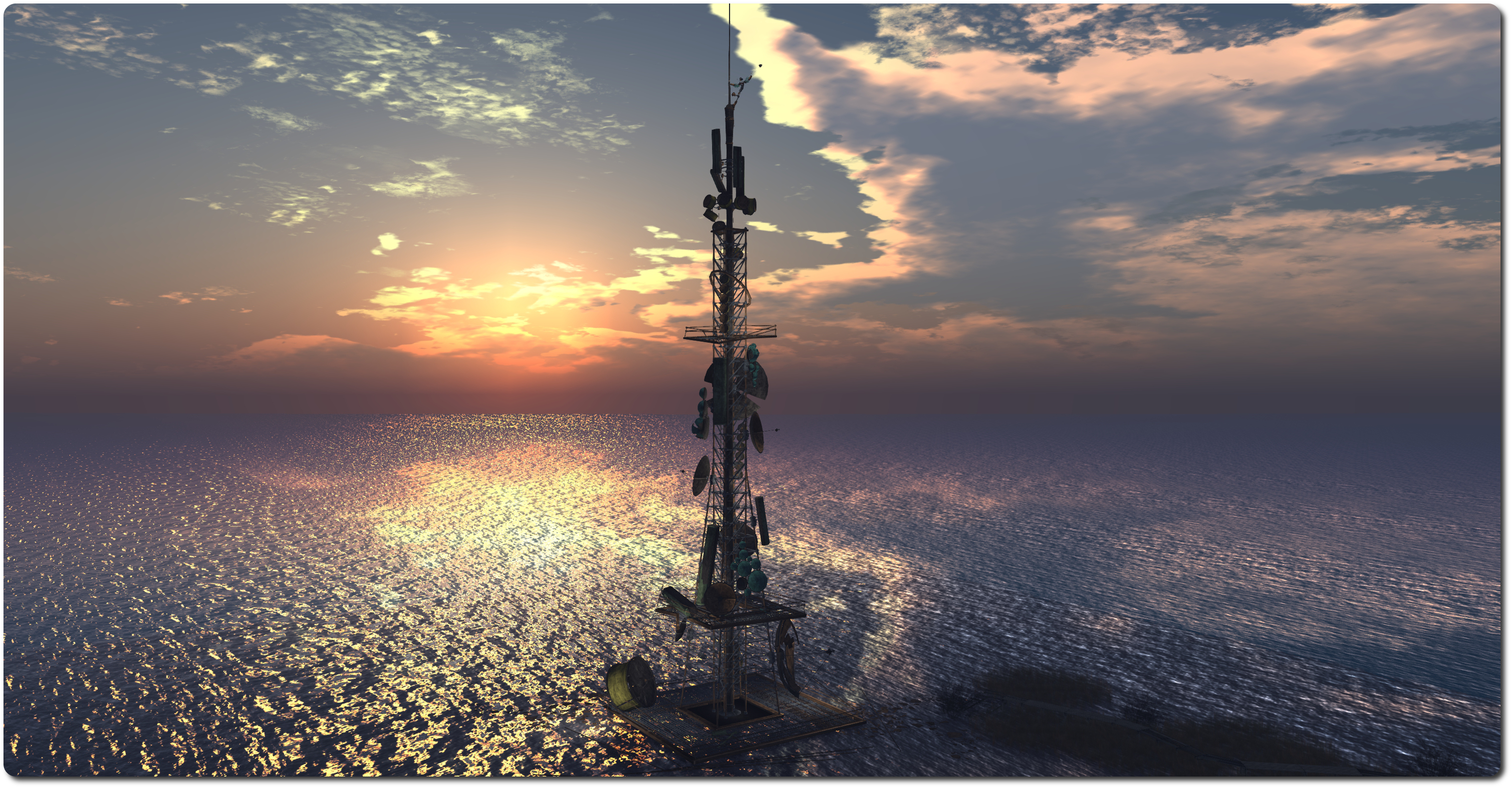
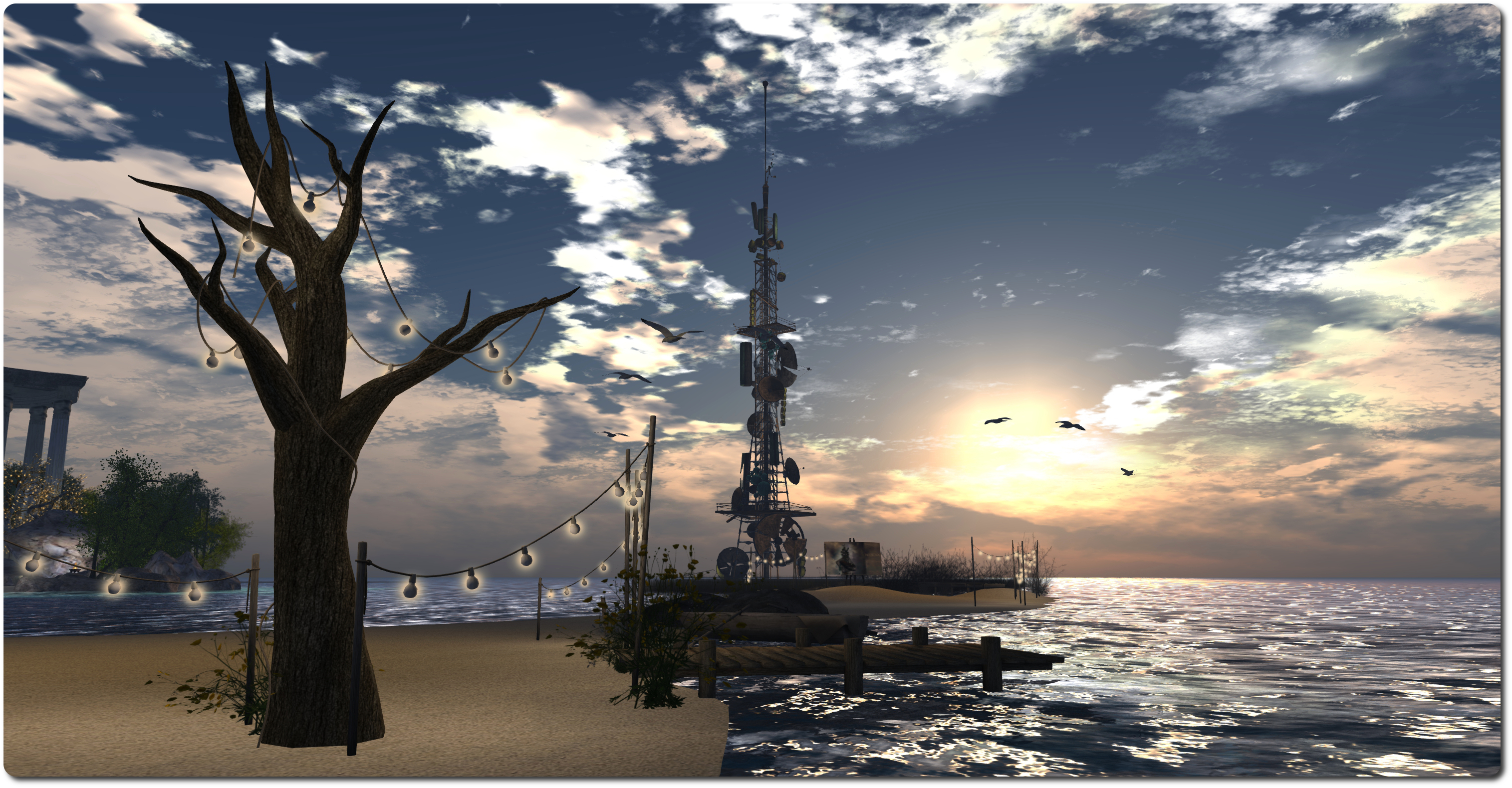
Out on the headland, there stands a great tower, so close to the water’s edge that when the tide is in, the only way to reach it is by a wooden walk winding through the coastal reeds.
They say that once it was a nexus, a hub for of our electronic comings and goings. Through the great dishes and between the long narrow repeaters, all our business rushed back and forth at the speed of light. Directed, amplified, boosted, beamed, messages too numerous to ever truly comprehend passed through that great tower.
But that was then, and this is now. The messages no longer come and go; the invisible beams of information no longer form an unseen web of lines spreading outward from its slender form, up down, left right, some passing one another so close, if they could ever have been seen, you’d swear they were touching. There is No Signal any more.
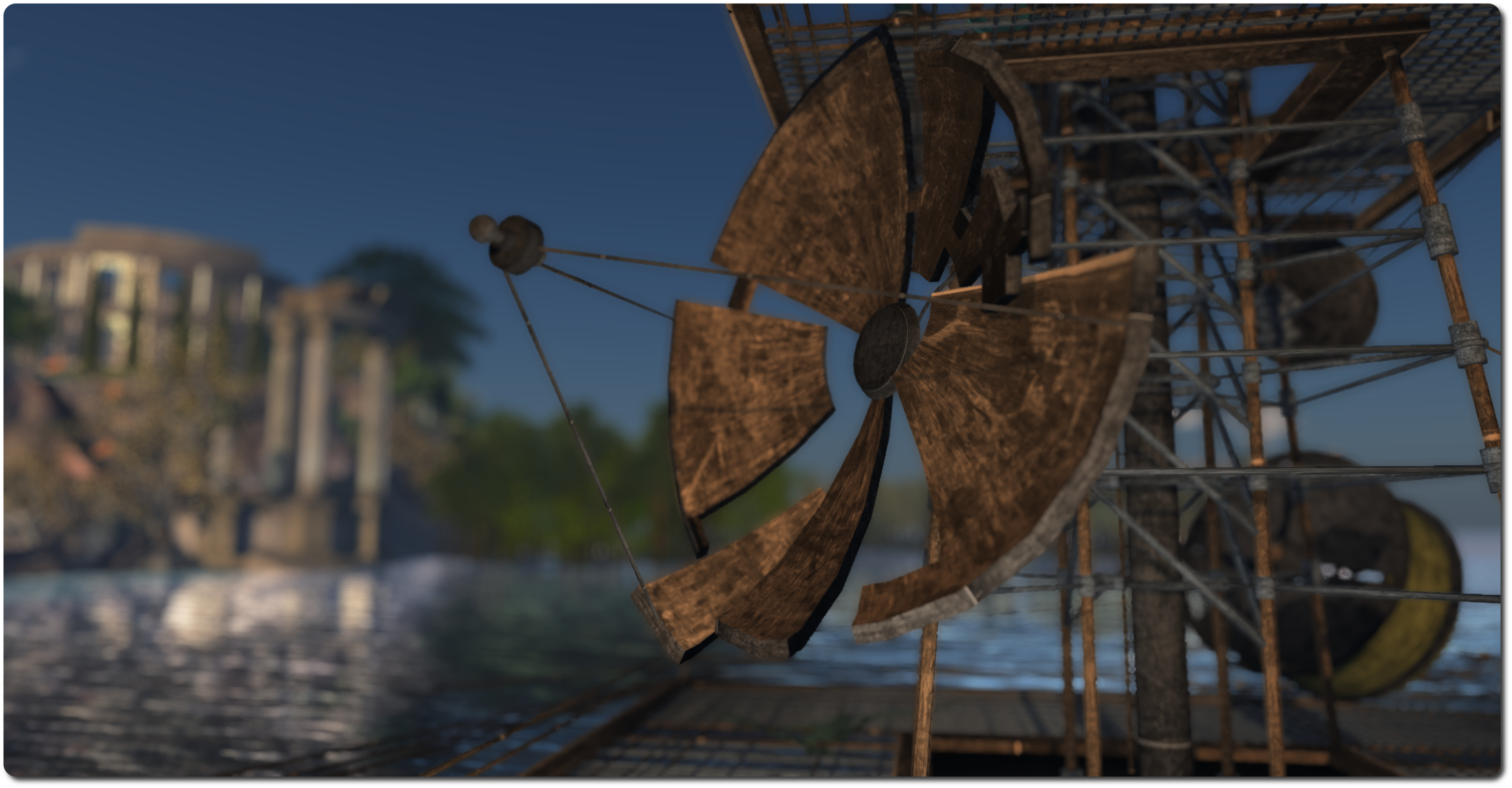
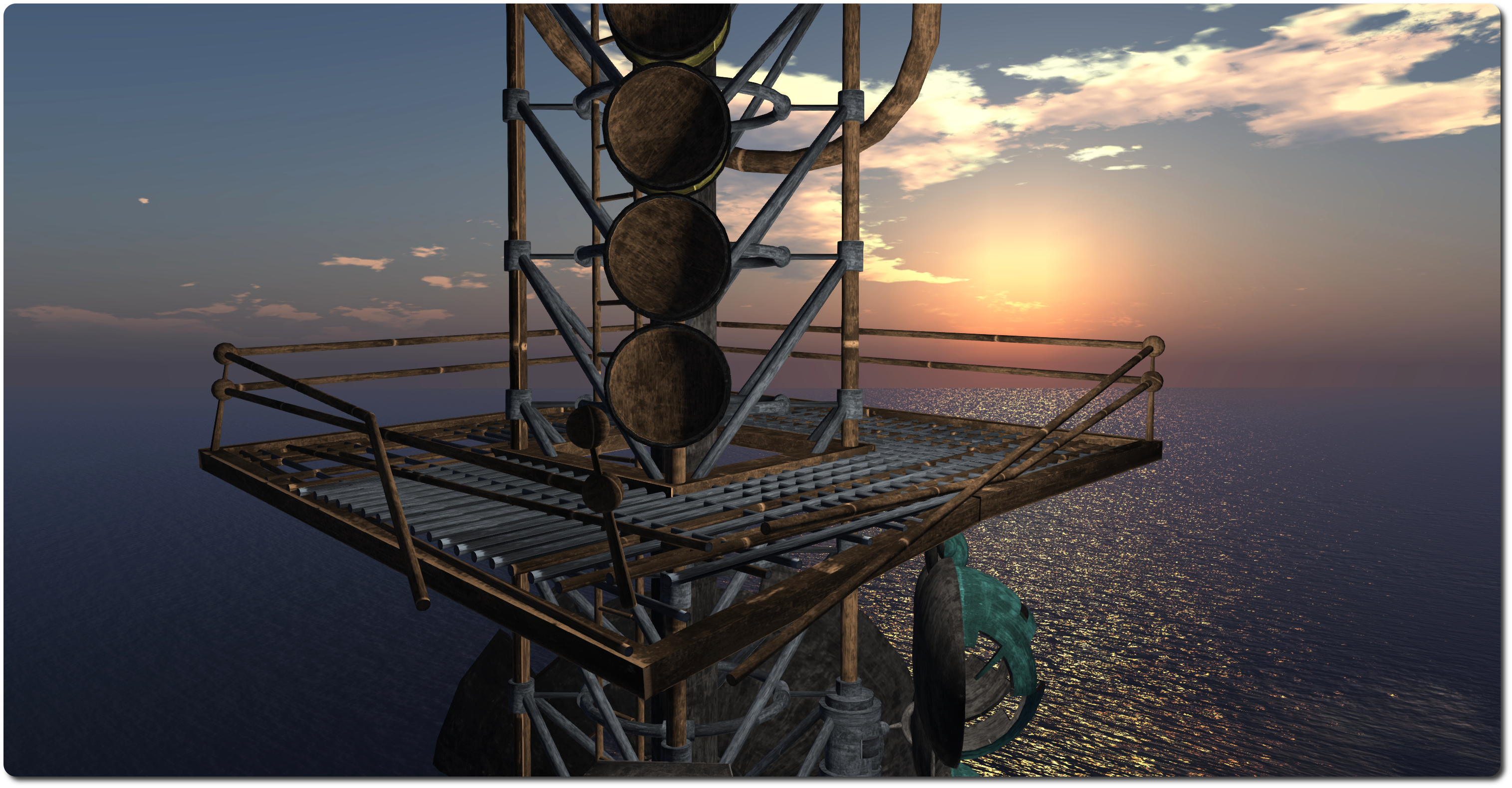
Now the tower stands alone on the headland, its great dishes broken, the clusters of microwave emitters hang forlornly by the heavy cables that once fed them power. Rust now coats the tower’s metal, and its platforms sit in disrepair, lopsided against the backdrop of the sea.
A ladder, as rusted as the rest of the tower, still runs up the side of the structure for those who dare to climb, the creak and groan of metal on metal an ever-present reminder of the decay that sits here.
They say there is a mystery here, waiting to be solved, that if you follow the clues, the enigma of the tower will be revealed. Perhaps the key to the riddle lies within the strange figure, one hand gripping the topmost spire of the tower tightly, their body outstretched, free hand reaching to catch … their hat? … As it is caught upon the wind.
Or perhaps the secret lay elsewhere in the tower’s slender finger. The only way to find out is to walk the headland yourself and visit the place where No Signal can now be found …
No Signal is the latest piece by Nessuno Myoo, currently on display at MIC Imagin@rium, curated by Mexi Lane, and open through until June 14th, 2014. be sure to grab a note card from the welcome board after you arrive. And while visiting, why not take the time to explore the new prim and mesh amphitheatre on the main island, the work of Rumegusc Altamura?
Opening on Wednesday May 21st at 13:30 SLT is a new 3D art sculpture by London Junkers entitled A Dream, the Wings to Fly, located at the torno Kohime Foundation’s 3D Art Gallery and jointly sponsored by the torno Kohime Foundation and Tanalois Art.
It’s a beautifully intricate piece, celebrating the history of aviation and flight. The central element of the sculpture is a jet turbine engine, the blades of which form the two main levels of the piece, connected by a stairway. On the upper section sits an exquisite build which richly encapsulates the dream and reality of flight.
This starts with a sculpture of a bird in flight, the gentle arc of its wings reflected and exaggerated in the arc of the wings of the structure it flies before, and which themselves echo the long history of the dream of flight, when men sought to mimic the shape of a bird’s wing that they might also fly.
At the base of this structure sits the simplest flying machine anyone can make: a paper aeroplane, while above it, continuing the jet aviation theme rises the central spindle of the turbine, passing through another set of turbine blades to support two Spitfire-like aircraft.
But look again, because there is more to be seen here than might at first be apparent. See how the turbine blades are exaggerated in form, twisted into cloudy wisps. Look again at the central turbine spindle rising into the sky, note its shape and the four fin-like supports at its base; here sits not a spindle, but a rocket, pointing to the stars.
And there, at the centre of it all, lies a small, glass Earth, richly symbolic in its placement. It is both the only home we have, a place which aviation and spaceflight have helped us to explore and map and understand as never before. The place our yearning to continue our voyages of discovery longs to one day slip.
Oh! I have slipped the surly bonds of Earth And danced the skies on laughter-silvered wings; Sunward I’ve climbed, and joined the tumbling mirth of sun-split clouds, — and done a hundred things You have not dreamed of — wheeled and soared and swung High in the sunlit silence. Hov’ring there, I’ve chased the shouting wind along, and flung My eager craft through footless halls of air….
Up, up the long, delirious, burning blue I’ve topped the wind-swept heights with easy grace. Where never lark, or even eagle flew — And, while with silent, lifting mind I’ve trod The high untrespassed sanctity of space, – Put out my hand, and touched the face of God.
Lizzie Gudkov, London’s SL partner tells me that London hopes the piece will encourage people who visit it to try their hand at flying in SL; that’s not an inappropriate aim. It matches both the aviation theme of the piece and reminds us that Second Life, with all its rich and varied opportunities, allows imagination to truly take to wing, allowing us all to slip the surly bonds of Earth.
A simply beautiful piece, highly recommended to anyone who is either a lover of aviation or whose dreams encompass the freedoms we’re offered through SL.
Melusina Parkin’s Themes is now open at the The Nite’s Place Red Line Exposition Area. Curated by Simonh Sandial, Themes features 42 photographs selected by Melusina in and exhibition space which allows them to be displayed in 6 groups of seven photographs apiece on the themes of “solitudes”, “landscapes”, “industry”, “details”, “urban” and “minimal”.
The selected images are striking in nature, each one displayed large enough to draw the eye into it, making the observer almost a part of the scene itself. What is particularly noticeable about many of the images is the fact that they appear so very life-like; so much so that on first look, it’s actually hard to tell whether they were taken in-world or in real-life. It is only on closer examination, or when the eye is drawn to certain clues, that the fact the photo was taken within SL becomes apparent.
Take the two images above (put side-by-side for comparison purposes): the one on the left (“Loneliness 1”) gives every impression of having been taken in RL, while in the second (“Loneliness 3”), it is only when one sees the while glow surrounding the nearer of the two sets of lamps that its SL origins are revealed.
This RL / SL “crossover” is intentional on Melusina’s art, as she informed Ziki Questi, who reviewed this exhibition earlier in May. “The aims of my photographer’s work are always the same: showing how fantasy and skills of SL residents made a world that reflects the main features of the natural or human environment’s common imagery,” Ziki quotes Melusina as saying of the pieces on display here.
Not only this, but the selected images beautifully – even hauntingly – reflect their intended themes. In this, several of the pictures in the “solitudes” section were particularly evocative for me, while “industry 1” (see on the left in the topmost image in this article) give rise to images of the romantic age of steam and the stirrings of time long past, together with the feeling of a story waiting to be told.
As noted at the top of this piece, this is a striking exhibition, and for those with a love of SL photography, definitely not one to be missed.
Igor Ballyhoo’s Cyber Orthodoxopened on Sunday May 11th, the first installation in the 4th round of the Linden Endowment for the Arts Full Sim Art series.
Born of the artist’s fascination with the amount of time and energy humans spend trying to convince the world at large that their way is the “right” way, hence the “orthodox” of the title, and his overall response to such attempts: that perhaps we cannot know, and that as such, it is better to keep an open mind to all possibilities, rather than in trying to constrain thinking.
The term “orthodox” implies religion; and there’s certainly there is much in the installation which does poke at religious dogma. However, it would not be fair to classify cyber Orthodox as “anti-religion”. While the symbolism in places is clear, there is much else commented upon here than may at first be apparent to the eye.
The setting for the installation is somewhat industrial; great steel scaffolds stand on two sides of the flooded region, supporting two mammoth curved walls made up of overlapping metal plates. At the base of these are piled the kind of concrete forms sometimes seen in parts of sea defences, designed to break-up the force of incoming waves.
To the north side of the region stand four large concrete piers, towers rising from their northern ends. Sculptures stand both at the ends of these piers and atop their towers, while steel frames supported thick glass form bridges between them, alternately connecting tower with tower, pier with pier, and thus to a further walkway at the foot of the high wall which forms a route around the installation.
The sculptures on the piers range from a piece called The Processing of Splitting Things, through Icarus, the all-seeing eye (with it’s religious and cult related meanings), the cross, a stylised mosquito, to the remnants of a great model of Titan. What do they mean? And what of the ornate cube, suspended between four great concrete piles between two of the piers, within which sits a strand of the double helix?
Out on the water are four more pieces. There’s another gigantic scaffold, the upper parts of which resemble the masts of the ship. This shares the space with a cross of transparent cubes, within which sits a chariot, as if surrounded by clouds, a pair of stylised winged horses, flames rising from them, the entire piece, at first suggestive of Apollo riding his chariot across the sky. Not far from this is an apple floating in the centre of an Esher-like staircase, and a group of slowly rotating minarets floating among clouds. Meaning here is layered.
To take one of these pieces, the apple within the Esher staircase, for example. At first look, it might be taken as a comment upon how the strictures of religious belief (represented by the apple and its association with humanity’s fall from grace). The adherence to the orthodox dogma of a religion can ultimately be circular in nature, appearing to go somewhere whilst ultimately going nowhere.
However, closer examination of the apple reveals it to be etched with a grid work of lines, suggestive of some form of digital mapping, perhaps indicative of the creation of the perfect apple. So is the apple perhaps a metaphor for our hunt for perfection (as modern society perhaps tries to impress upon us through advertising, etc.) in looks and form? The comment again being on the circular nature of such pursuits?
Thus, the various pieces within the installation appear open to more than one interpretation, something which itself underlines the central theme of the piece, that insistence upon orthodoxy is a negative presumption on our part which, in the face of all that surrounds us, tends to limit our understanding more than it gives us growth?
In this, three of the pieces might be seen as particularly poignant: Icarus, the sailing-ship like scaffold and that of chariot lifted aloft by winged horses. These seem to be encouraging us all to keep an open mind, to spread our wings and set our thinking free as we voyage the sea of infinite possibilities, considering all and rejecting none.
Which brings me back to The Process of Splitting Things and the cube housing the DNA strand. Both might be seen as reflections on the reality of life and how it has over the eons, through the simple act of division – the process of splitting things – gone from the most basic of single-celled organisms to the very richness and diversity of life as we know it today, as exemplified by the DNA strand.
Here, perhaps, stands another message which can be addressed to those seeking to impose the confines of their own orthodoxy on us all, a message perhaps best summarised in a quote from Rad Bradbury: Life was its own answer. Life was the propagation of more life and the living of as good a life as possible.
Cyber Orthodox will be open through until the end of May 2014.
They are the souls of avatars lost to us, like echos from other dimensions, it is said, though no one knows for sure.
What we do know is A weakness in the structure of metaverse has opened and they now wander.
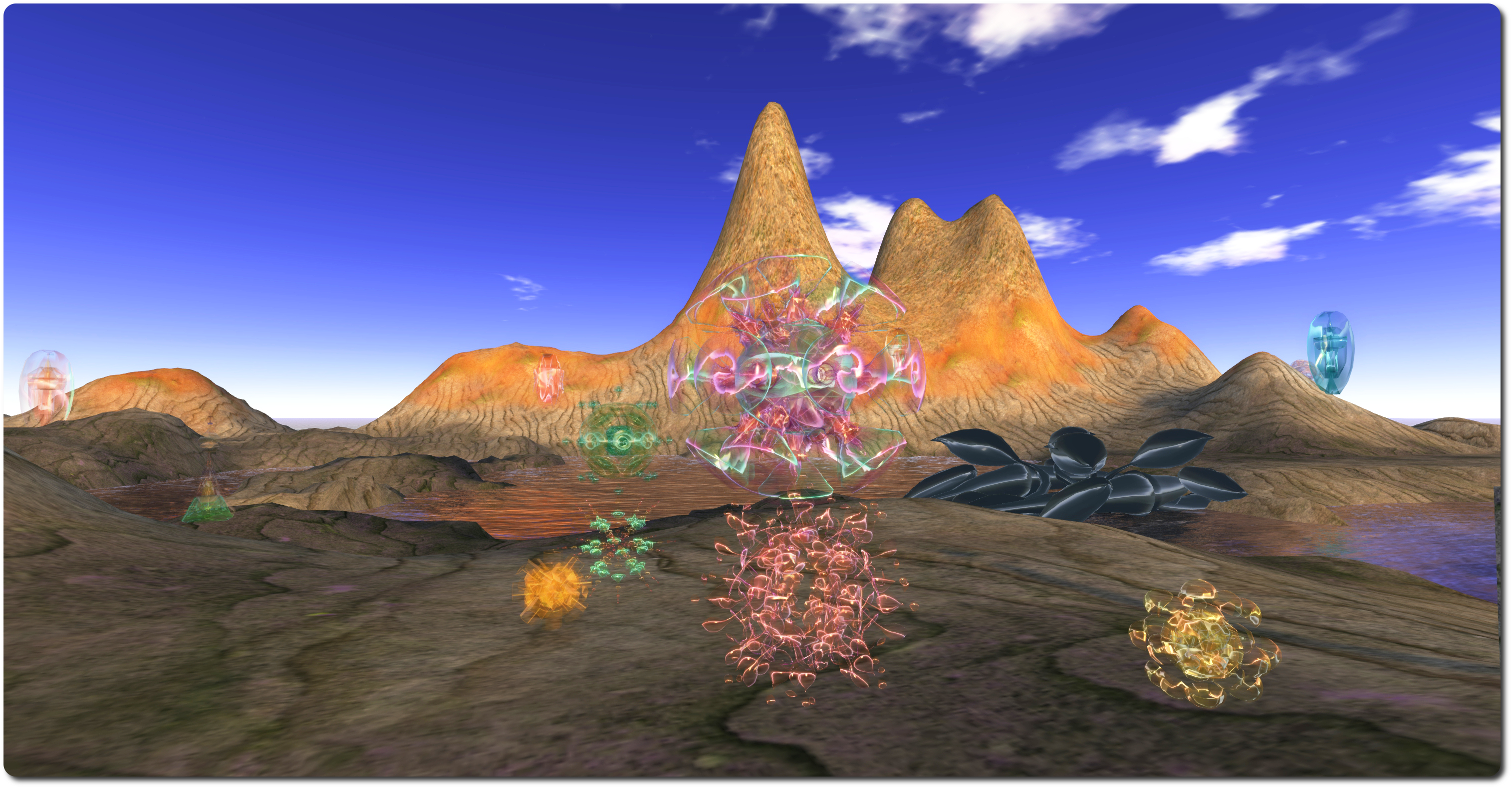
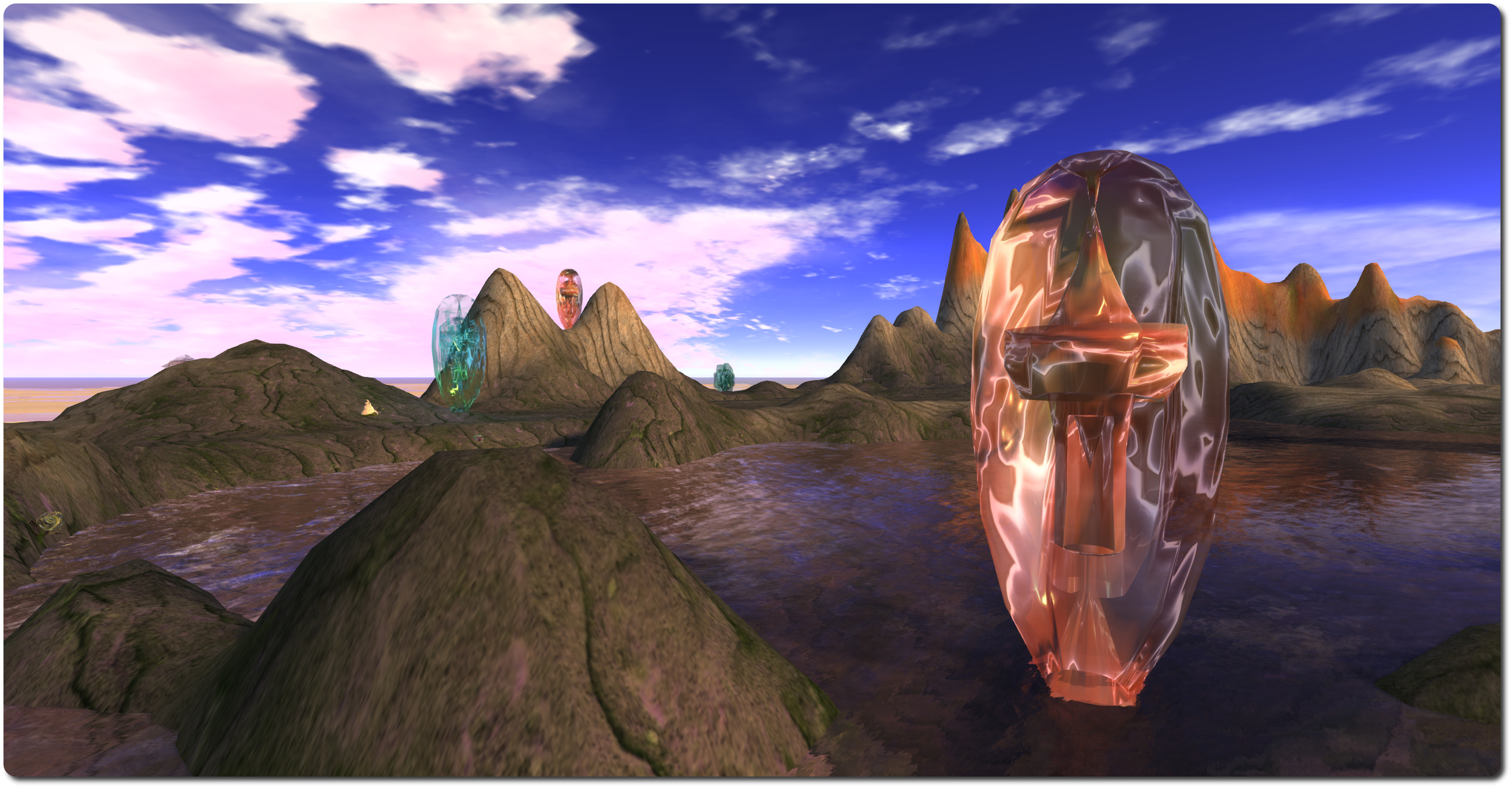
So opens the description of Glyph Graves’ Ghosts of the Internet, a fascinating installation which continues the artist’s reflections in virtual space. Fascinating, because it exists both in Second Life at LEA21 and in the Inworldz region of Translation – and those in one can see the “ghosts” of those in the other moving around, and can even converse with them.
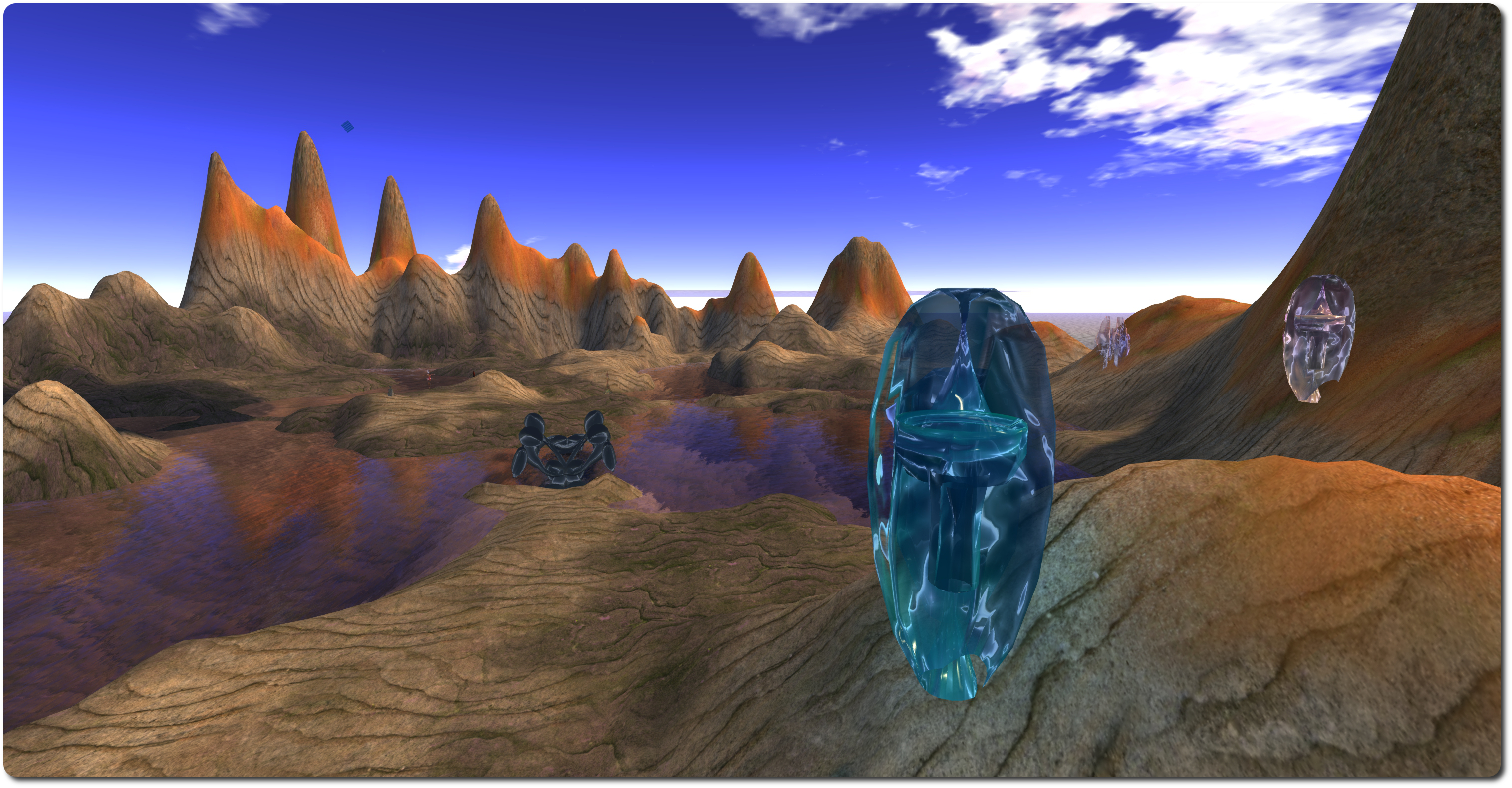
The landing point at each installation provides instructions on how to get started, together with recommended graphics settings (using Firestorm as the example). There’s also a teleport to deliver you to ground level, which is more-or-less identical in both regions (Sasun Steinbeck provided a tool to help copy items between the two environments), comprising barren rock, partially flooded and surrounded by tall hills.
Within either landscape sit a series of semi-transparent otherworldly forms, with shifting colours within, which might be taken as alien crystal growths or exotic sculptures. Some of these are the “bridge” between Second Life and Inworldz, allowing communications between the two to take place. Others, spread around the borders of the landscape are the Pylons of Binding – move beyond them, and contact with “the other side” is no longer possible. Snails also roam each of these realms, and at least one is large enough to slide run over you if you’re not careful, although they are shy: touch one, and it will retreat into its shell for a few seconds.
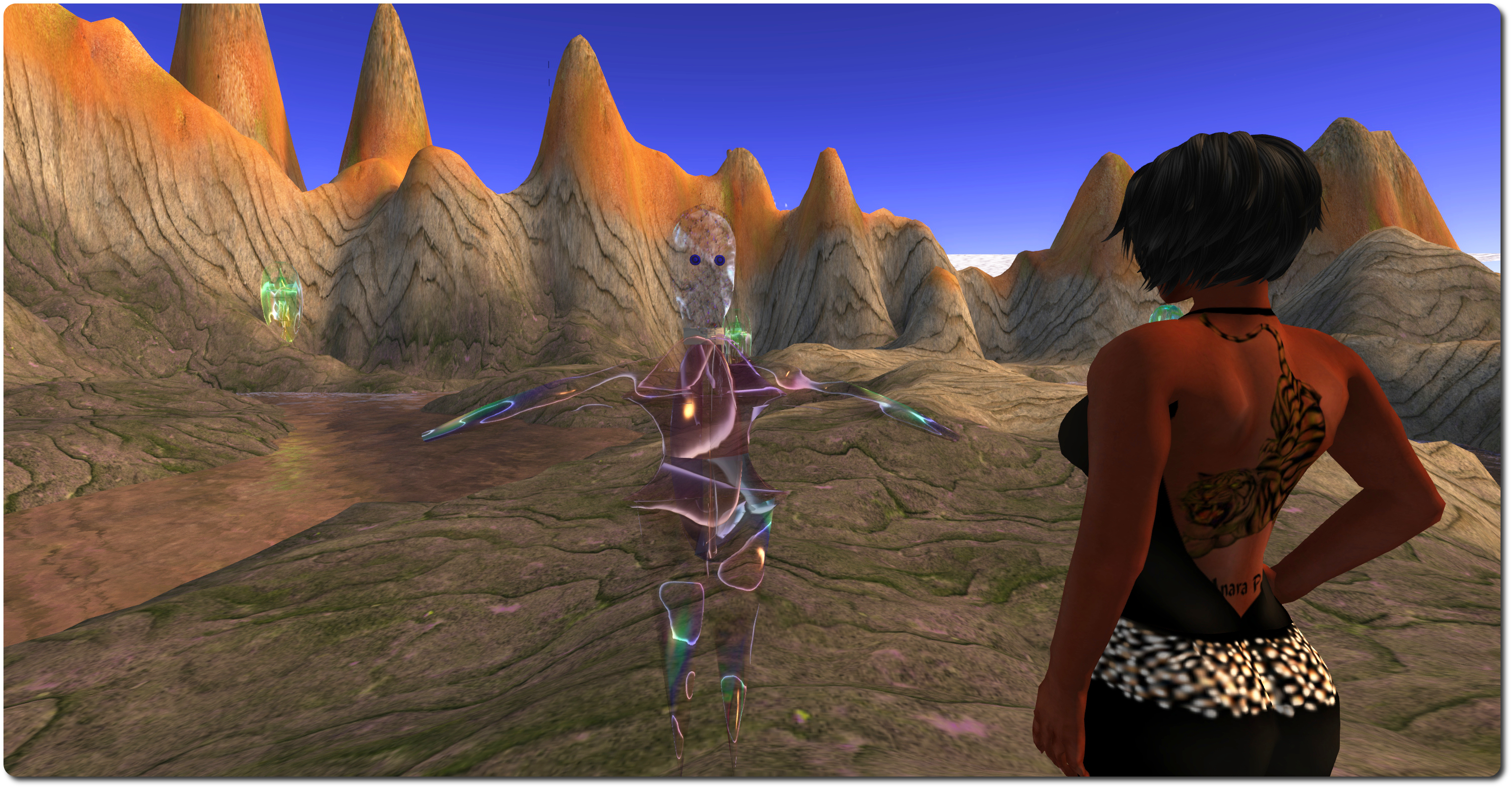
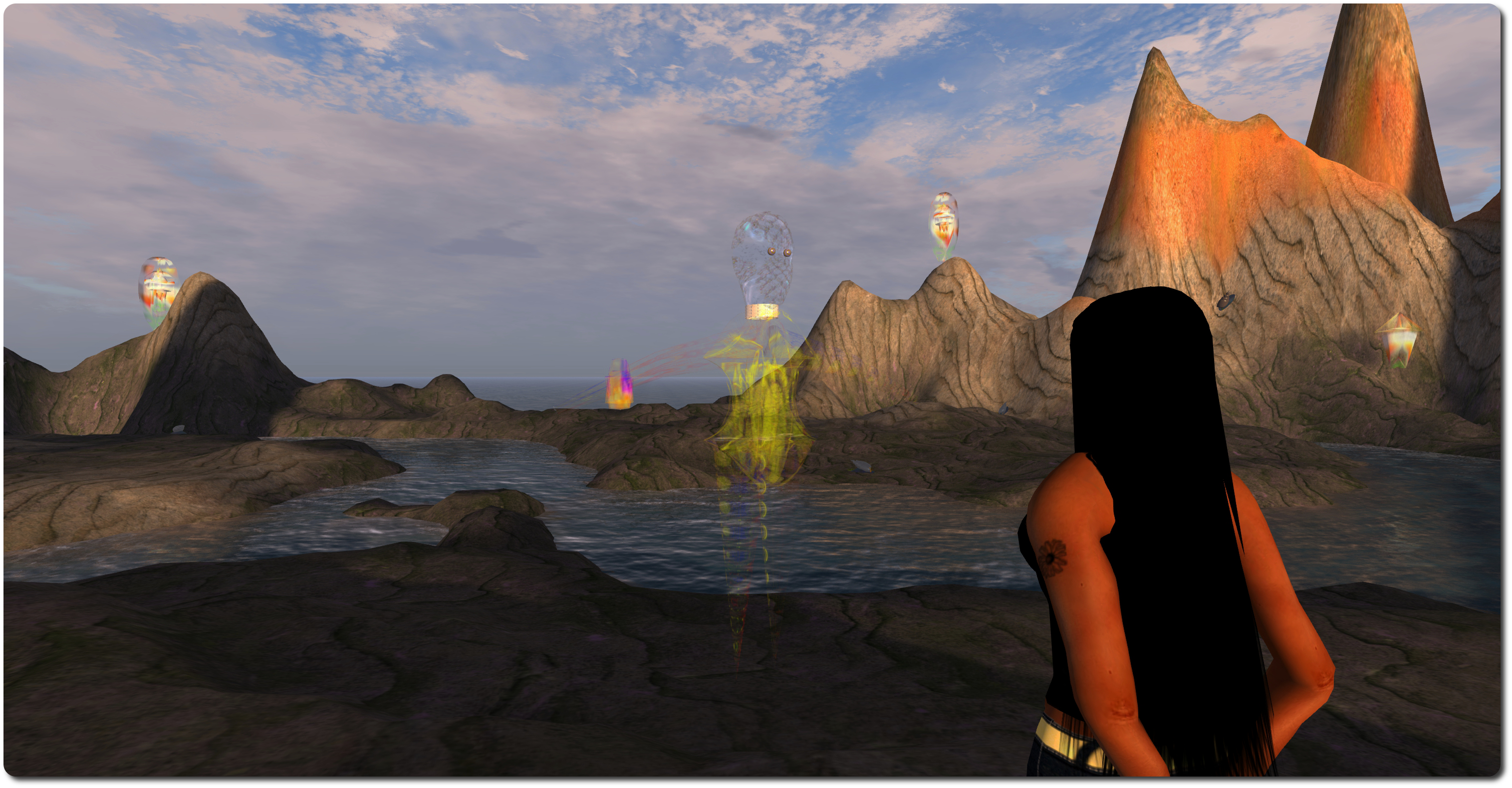
But it is the ghosts which are really the focus here. These appear whenever someone on either side is within the boundaries set by the Pylons of Binding (although if there is no-one in the region on the other grid, no ghosts will be visible). In other words, the ghosts that appear represent avatars visiting the installation on the other grid.
Communications between world is initiated by touching a ghost (which will then become somewhat multi-hued) and then typing into open chat (you may have to wait for the “ghost” to respond to your initial touch first). Only one conversation with a ghost can be established at any given time, so if you touch a ghost already in a conversation, it will not respond to you. It is also not recommended that you touch several ghosts at once to initiate multiple conversations, as “bad things will happen” as a result (and it might get very confusing).
Be aware that whatever you say to the other person is also repeated in open chat at their end of the link, not in IM, and so will be heard by anyone else who is near them. Chat from any other avatars around you, however, is not transmitted. To terminate a conversation, or if you do not which to speak to someone on the other side who touches your “ghost” there, simply touch the appropriate ghost to terminate the connection.
If you have accounts on both Inworldz and Second Life, Ghosts of the Internet brings a whole new level of meaning to the expression “talking to oneself”; nevertheless, it is an easy means of experiencing the installation should there otherwise be on-one else on the other side with whom you can converse. Alternatively, if your focus is solely on Second Life, you can enjoy something of the experience by having a friend hop over to Coppelia, and converse with them from the Ghosts of the Internet installation on LEA21.
As well as being a fascinating technical / artistic piece, Ghosts of the Internet carries with it echoes of the past. Remember the heady days of 2008, when a group of brave explorers set-out to move between dimensions, travelling from Second Life to OpenSim, and the promise therein? It is also – possibly – a hint of a potential future, given Ebbe Altberg’s comments on SL and the metaverse.
Both of these give the installation an added philosophical edge in terms of what might have been and what might yet be. I also found that when talking two myself between the two worlds, prompted thoughts of how the metaverse might be used as an expression or reflection of the multiverse, and our own multiple existences therein …