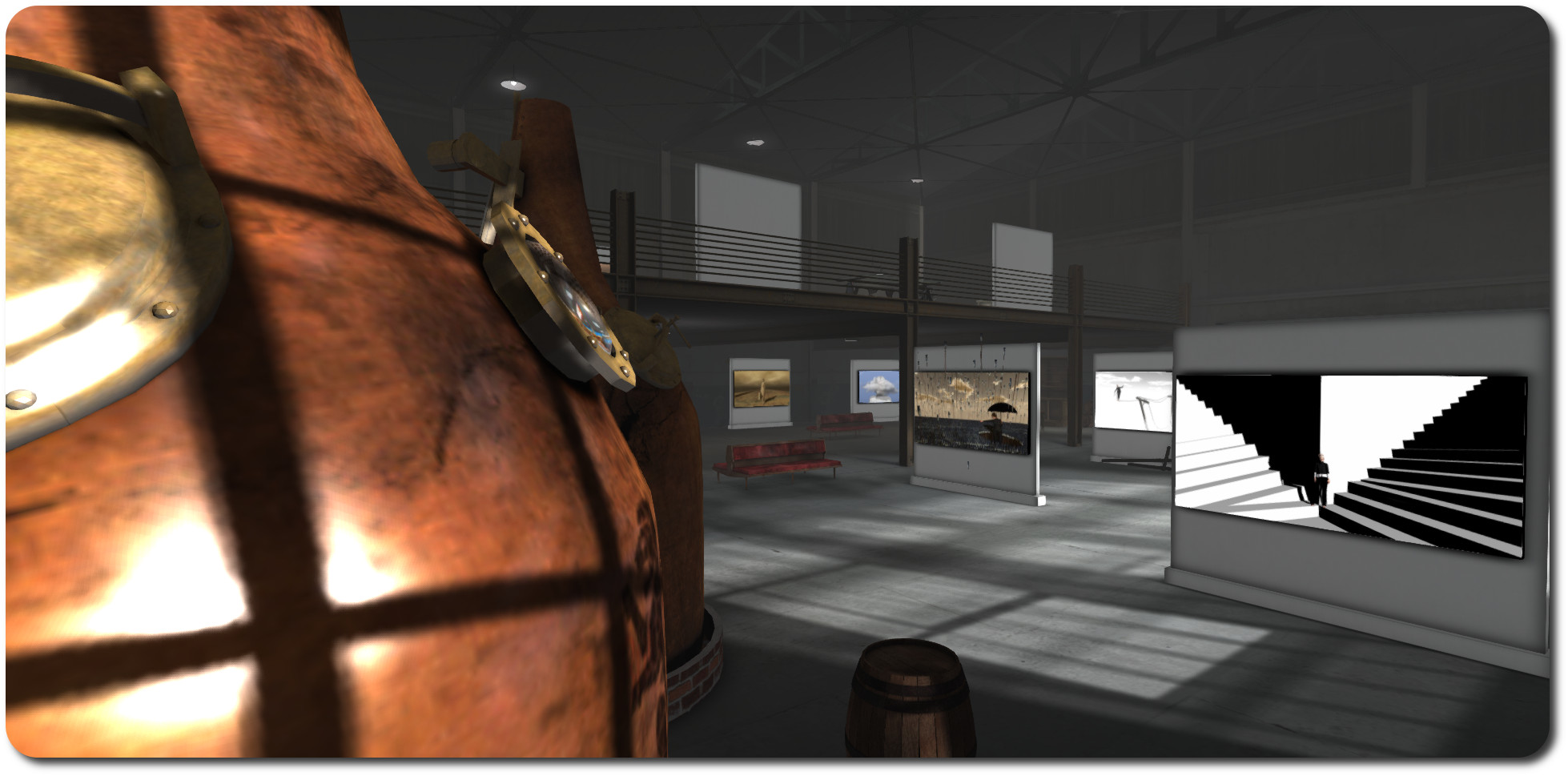
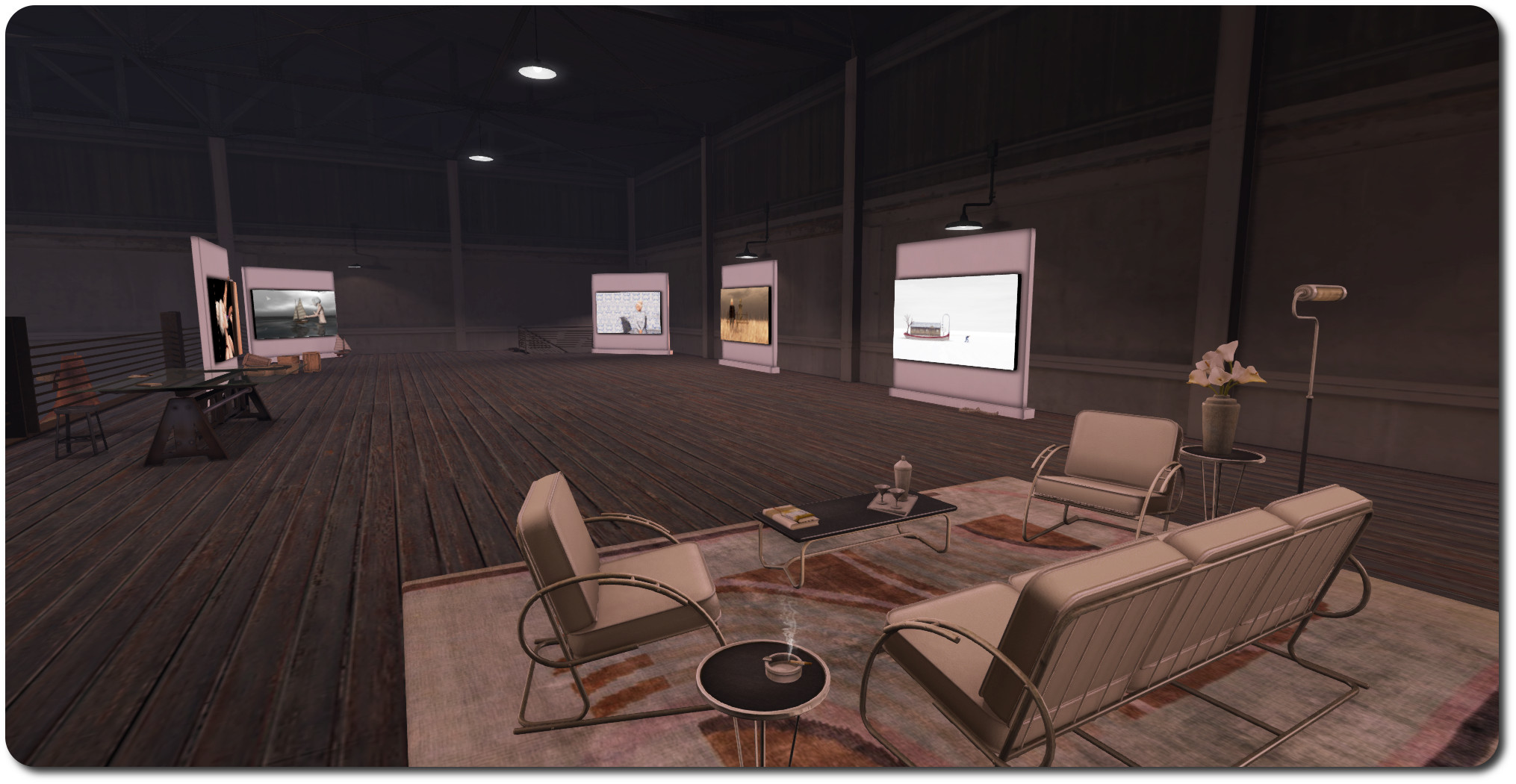
Dathúil, meaning “colourful”, “lovely” or “beautiful” in Irish (also dhathúil), is the name of a new art gallery in Second Life, which opened at the start of March 2015. Run by Max Butoh, the gallery is located on his region of Floris, which is also home to the 1920s themed The Sable Club and the more adult-oriented The Chamber Society (the main venue for which is located well above the ground level of the region).
The gallery is imaginatively presented within the cavernous hall of an old distillery, complete with three great copper whiskey stills towards the back of the hall, and unused whiskey barrels stacked around the room or used as part of the furnishings. Together, these add a suitable additional ambience to the gallery.
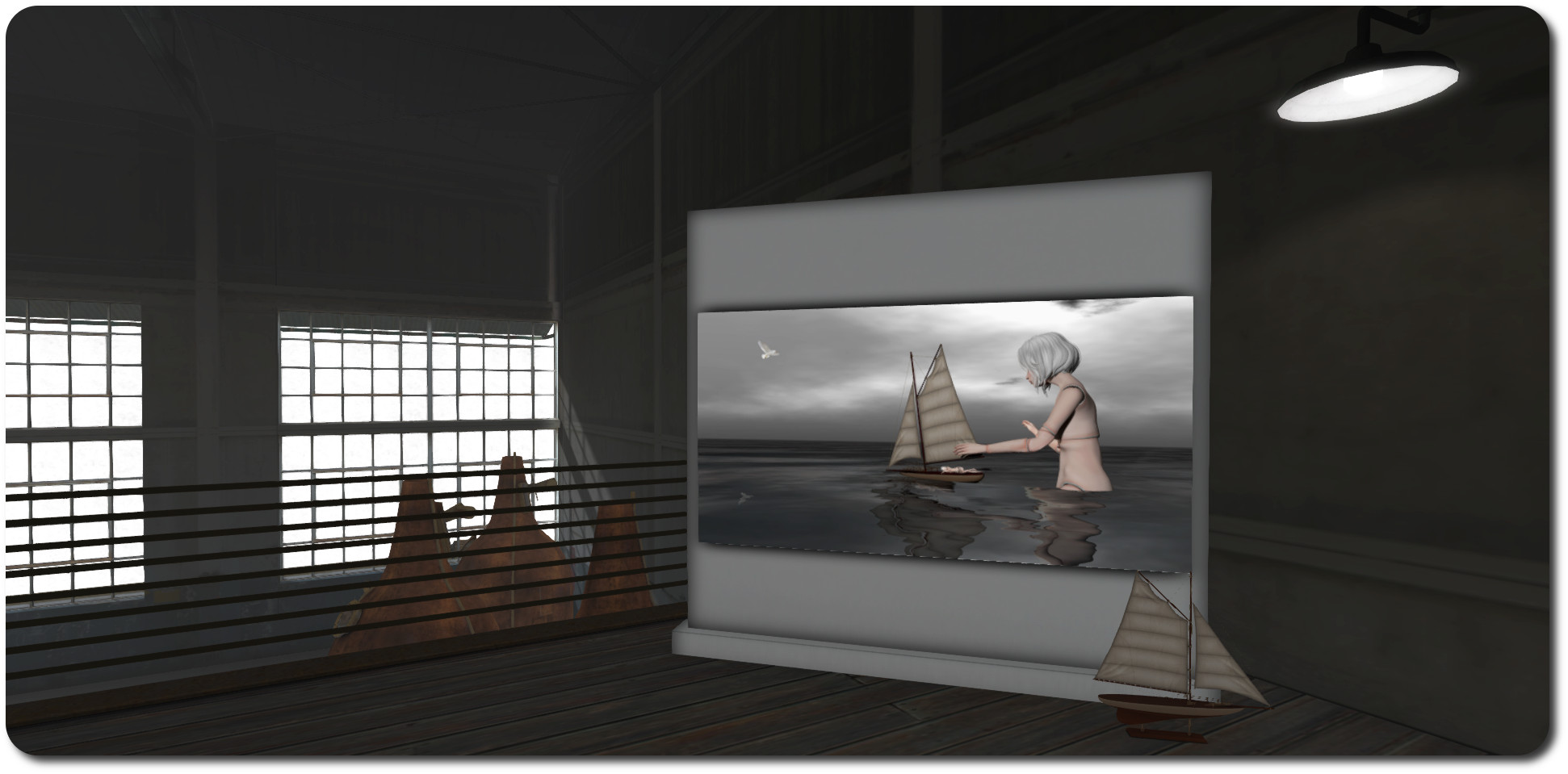
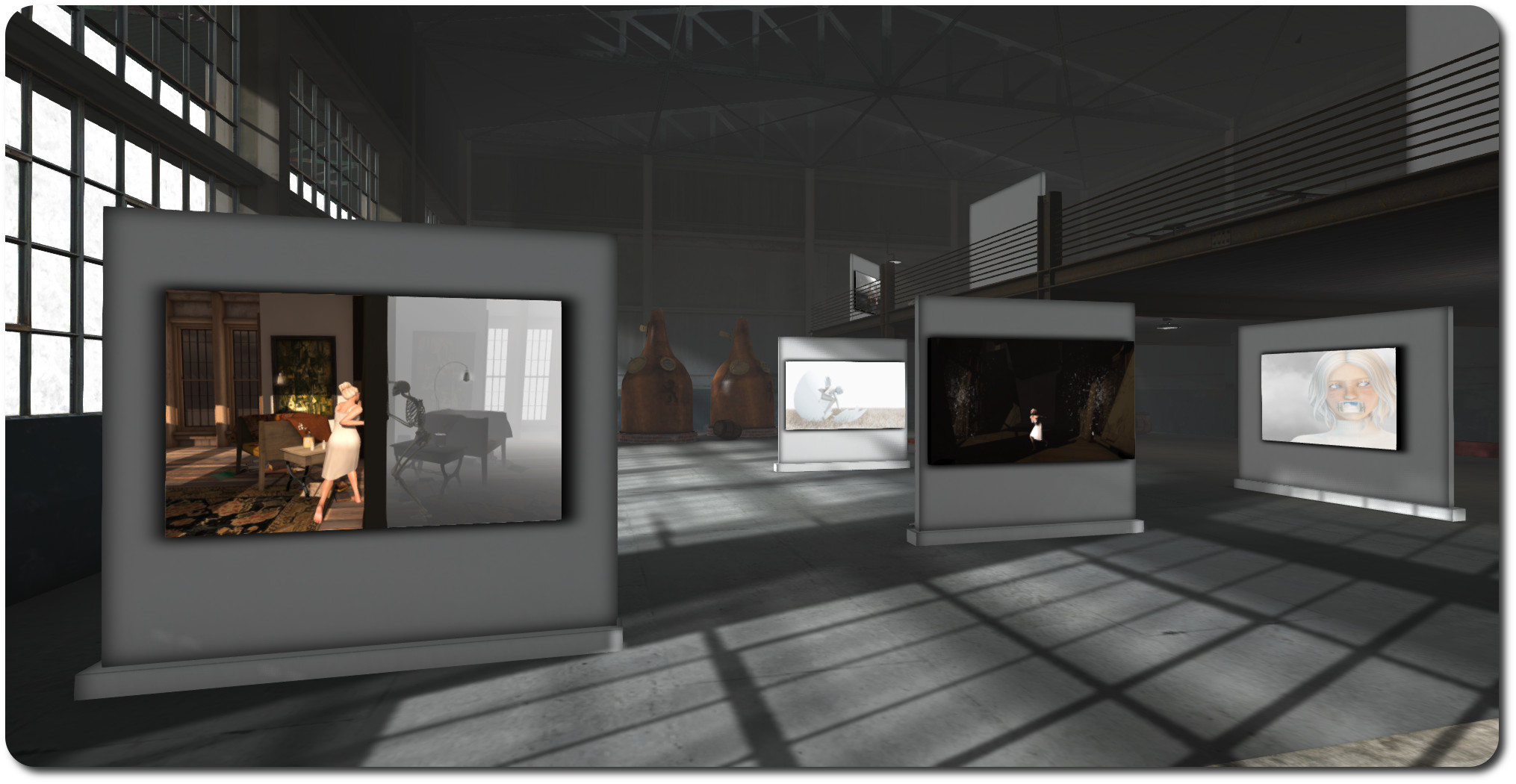
Dathúil will feature the work of invited artists, with exhibitions currently looking set to be on a monthly basis. Featured for the gallery’s debut month is none other than Whiskey Monday, (appropriately enough in some respects given the gallery’s theme and her name), who offers visitors Recently, a collection of her more recent pieces.
Those familiar with Whiskey’s work will know that her photography is generally an evocative, provocative, intimate and fascinating mix of observation, questions of identity and of self, and semi-autobiographical thoughts and illustrations. Her art grew as a natural exploration of her self-expression through mediums such as writing and social media, and as a result of her being inspired by Botgirl Questi, who has also pushed the envelope in the use of social media tools and digital media as a means of self-expression and exploration of identity and self.
What is on offer within Dathúil is a further illustration of Whiskey’s work through a marvellous series of images, all beautifully composed in such a way the the observer is immediately drawn into each and every piece, most likely experiencing a sense of self-identity with the subject matter underlying many of them. Several of the pieces on display include the props used in their creation, adding a subtle degree of additional depth to each them.
All of the pieces on display are available for sale, and Whiskey’s work can also be obtained in the physical world, via Fine Art America, where the individual items on offer can be purchased in a variety of formats, complete with world-wide shipping, and which really are all quite superb.
With Recently forming its debut exhibition and set to run through until the end of March 2015, and with work by Yannick Whoa due to be displayed through the month of April, Dathúil is already establishing itself as an art venue of choice. With an entire themed region built around to it also explore, why not pay a visit yourself (donations toward keeping the gallery and venue open always welcome!), and explore a corner of the 1920s as well as enjoying the art on display?
Now open at LEA 6, in what is the final installation under the UWA’s Full sim Art series as we’re currently familiar with it, is Rebeca Bashly’s When Life Gives You Apples … Run
As Jayjay Zifanwee notes while introducing the piece in the UWA blog, it is fitting that Rebeca should be the final artist to participate in the Full sim Art series in its current format; in 2011, she was the very first artist to participate in the series – indeed, in any LEA exhibition – when her remarkable interpretation of Dante’s Inferno opened in October of that year (my review of which you can read here).
When Life Gives You Apples … Run Offers a provocative look at the subject of the abuse of women, either by others or by themselves. “Looking at various myths, legends and fairy tales, apple seems to be pretty unfortunate for a woman. When an apple appears in a story, you know that something will go bad,2 Rebeca says of the piece. “From Eve, thru Greek mythology to Snow White there was always a catch with an apple. It is beautiful, delicious, tempting, seductive. A Perfect disguise for all bad that can come. I use it as a symbol for the monstrosities that woman too often don’t recognise as such in its early stages.”
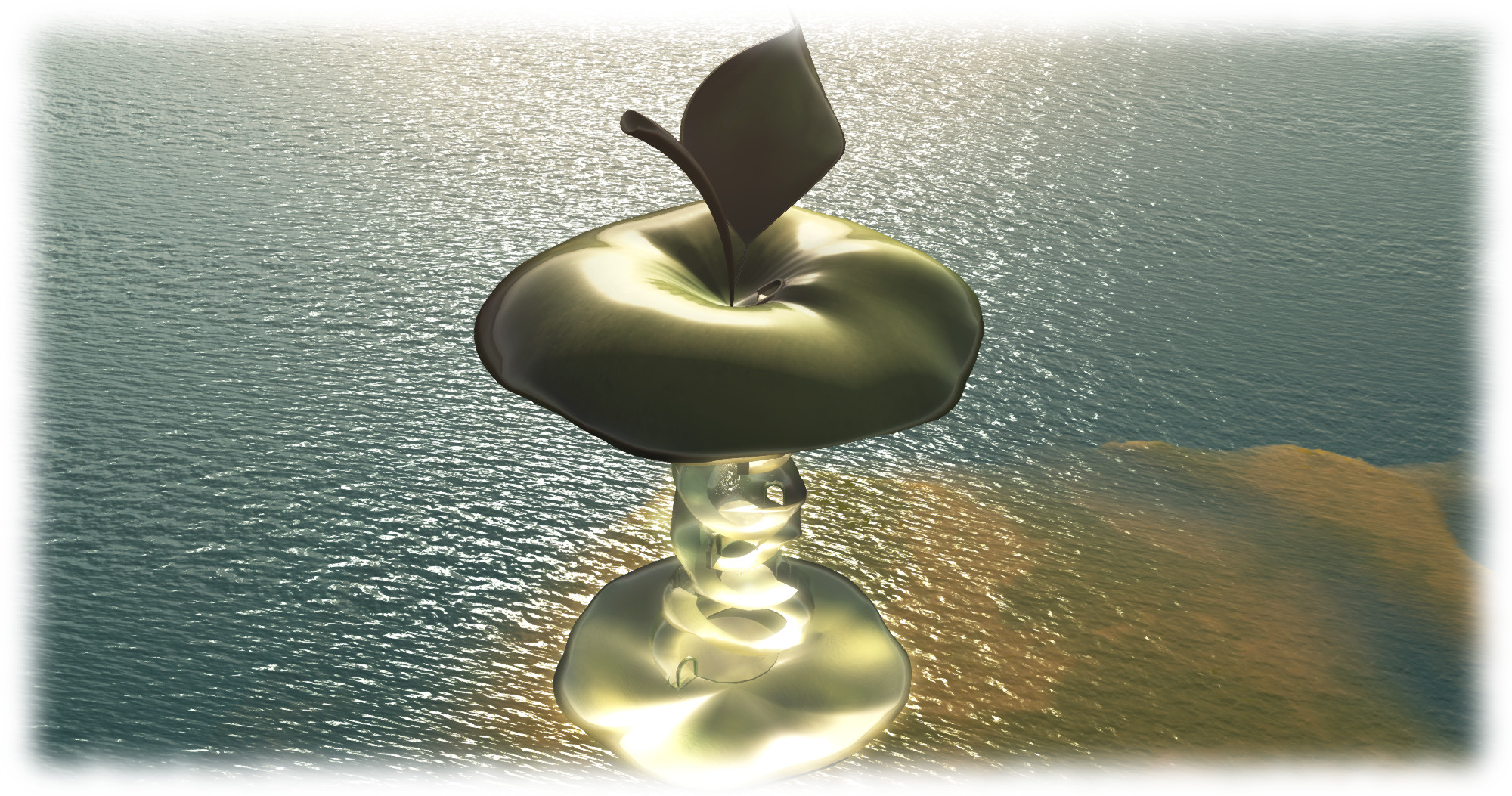
And indeed, the central part of the installation is – an apple. A quiet incredible apple in fact – or at least the core of one, as it has clearly been eaten. Constructed of mesh and over 70 metres tall, the apple sits on the ground, stalk pointing to the sky, the uneaten flesh at its lower end serving as the arrival point, where a smaller apple sits, offering visitors an introductory note card.
Winding up through the the core of the apple is a tunnel visitors are asked to follow. This leads the way up to a couple of teleport platforms at different levels within the apple’s core, a sculpture in occupying the space between them; and it is by taking these teleports that the visitor is led to the parts of the installation dealing more directly with the theme of abuse (or perhaps “subjugation” might be an equally valid term) either inflicted from within or without.
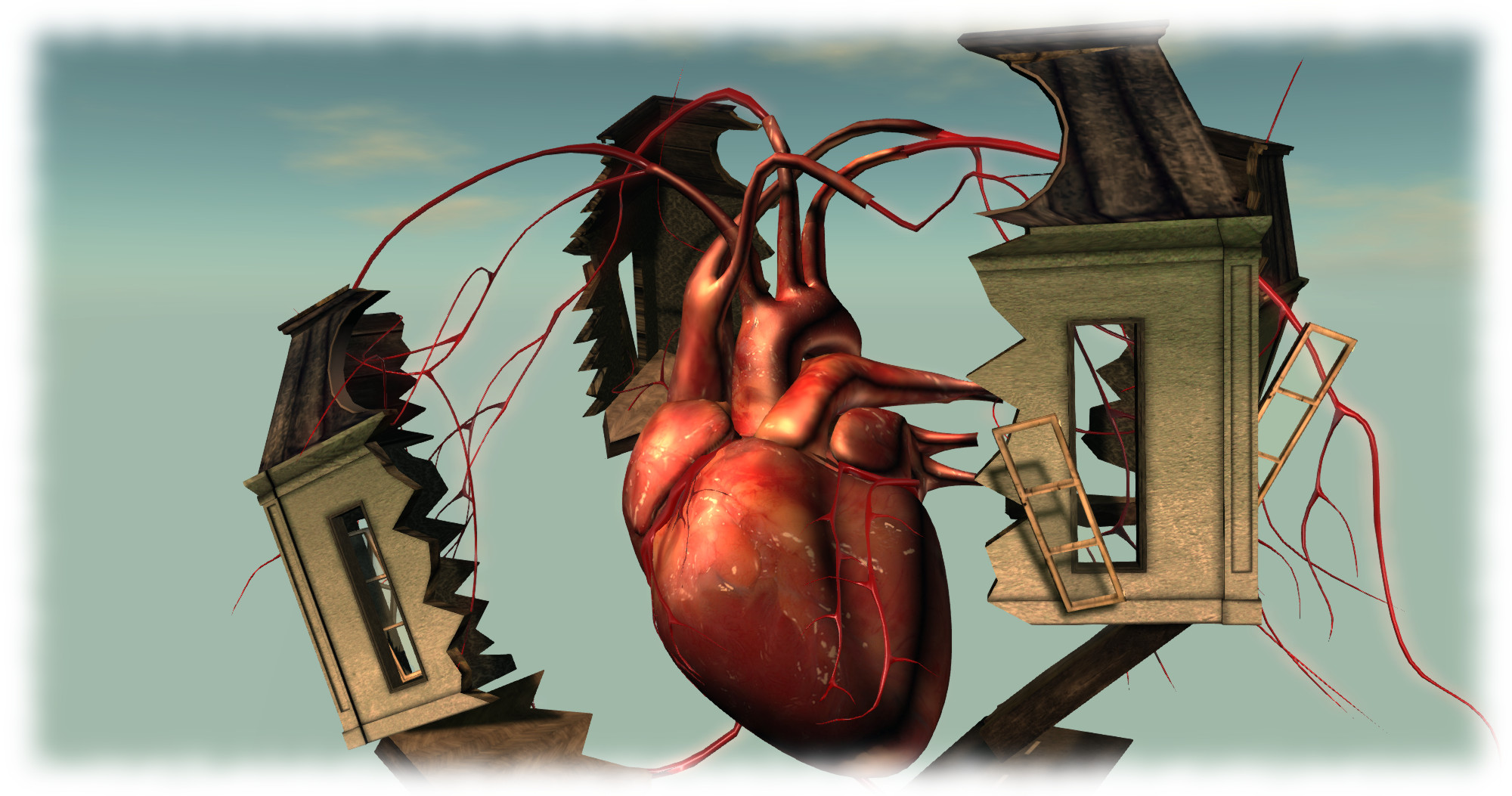
In the first, Home Sweet Home, we see a house being torn apart by a giant heart, both suspended above an open road – itself an image of freedom. The accompanying story suggestive of a person caught in a relationship marked by the abuse of lairs, deceptions, stories, words, finally breaking the circle and finding freedom in herself and in the world at large.
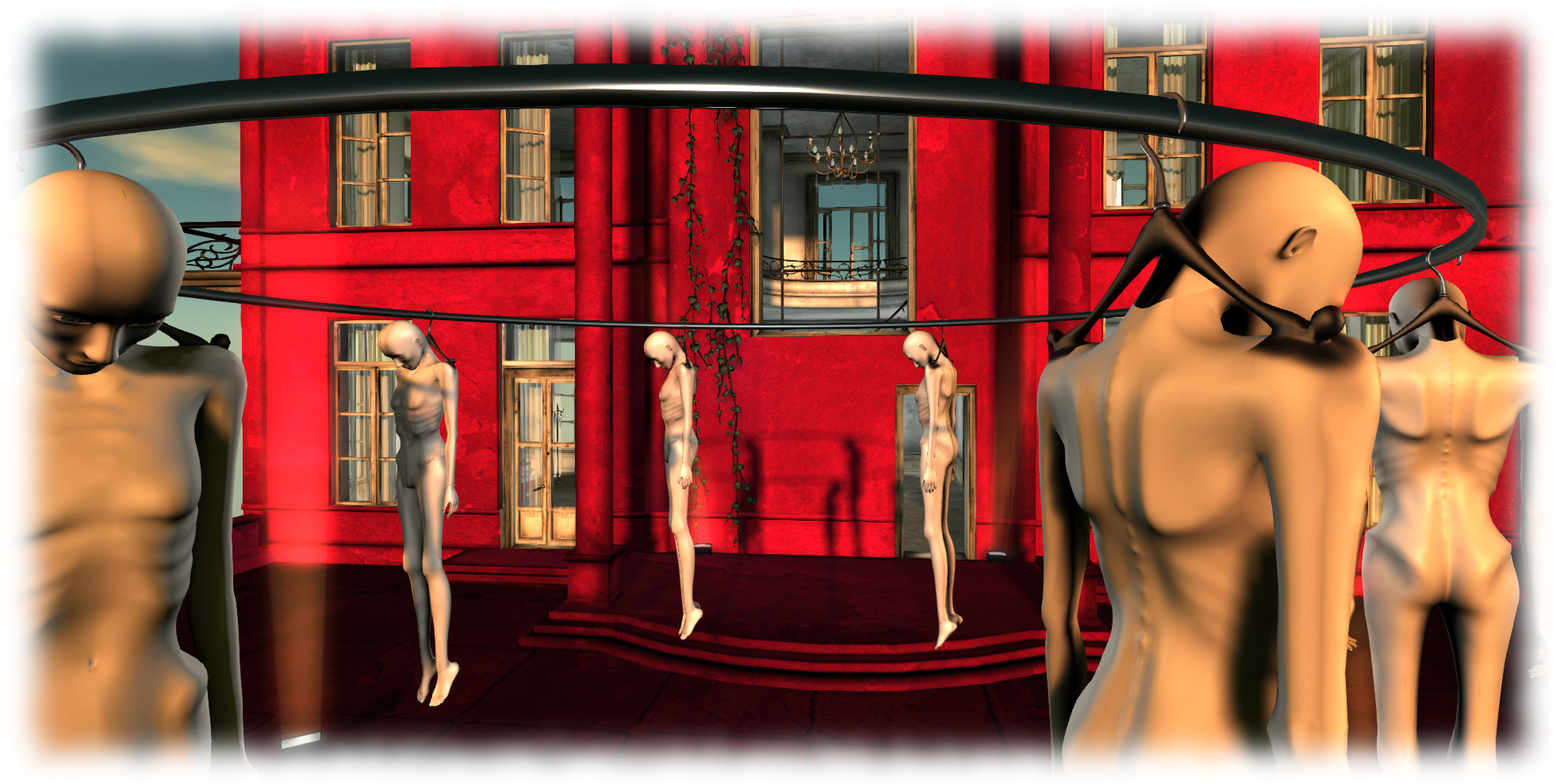
In the second, the subject matter focuses on self-abuse in the form of anorexia nervosa and Bulimia nervosa, and the destructive effects they can have on those stricken with them. This is also accompanied by a story, that of the Doll’s House.
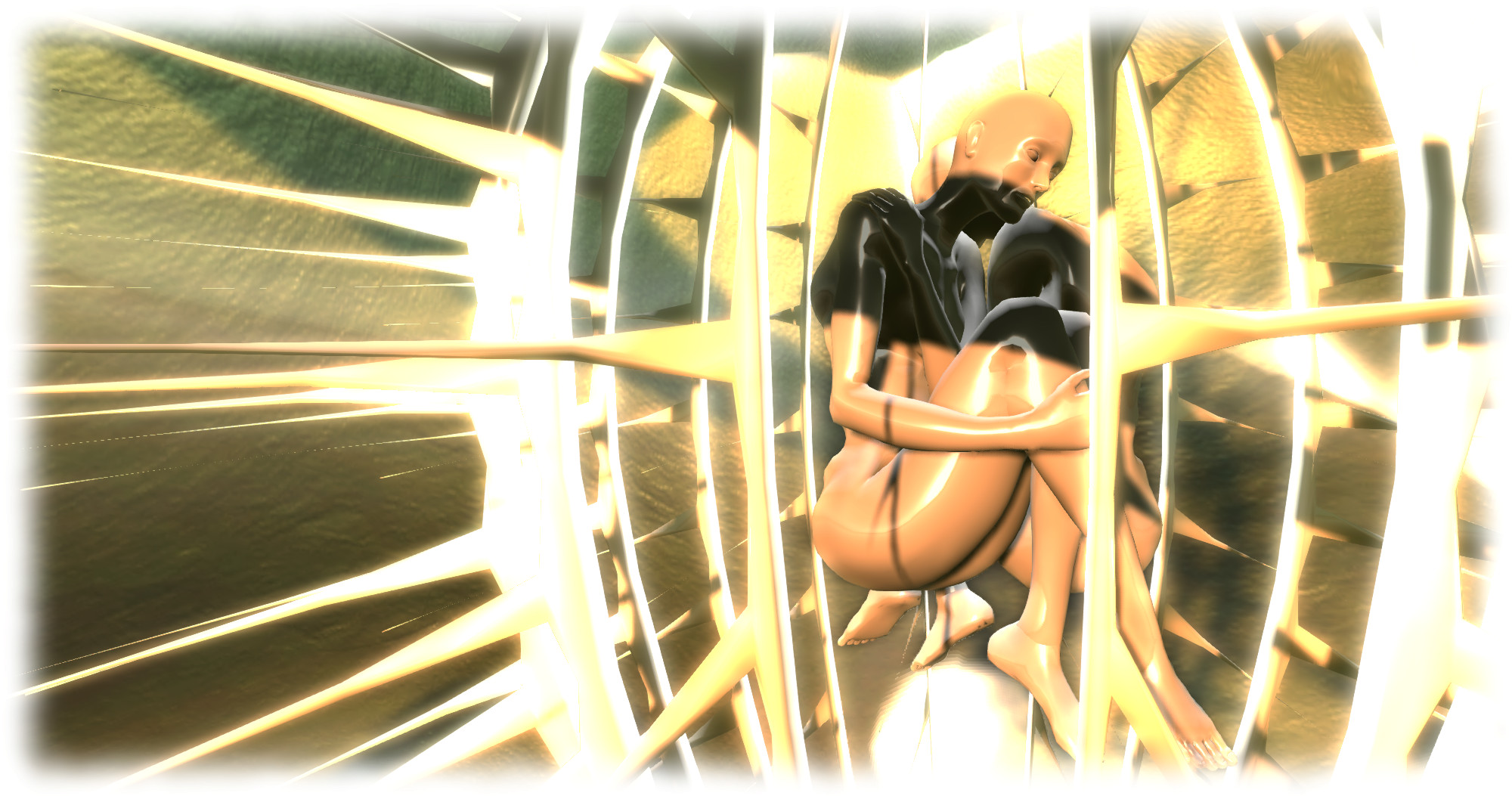
There is strong symbolism throughout this installation, be it with the story platforms, or the sculpture of the caged women. Even the tunnel winding up through the apple core has a meaning of its own, for example; an echo of the way in which maggots can bore through an apple, ruining its wholesome appearance via decay from the inside, just as relationships or lives which might appear whole from from outside are slowly decaying from within, as with the vignettes presented by this build.
As noted towards the top of this article, When Life Gives You Apples … Run is a provocative piece; but one of Rebeca’s strengths is that she’s never fought shy of making people think. As such, this is a worthy piece on which to close the current UWA Full Sim Art series.
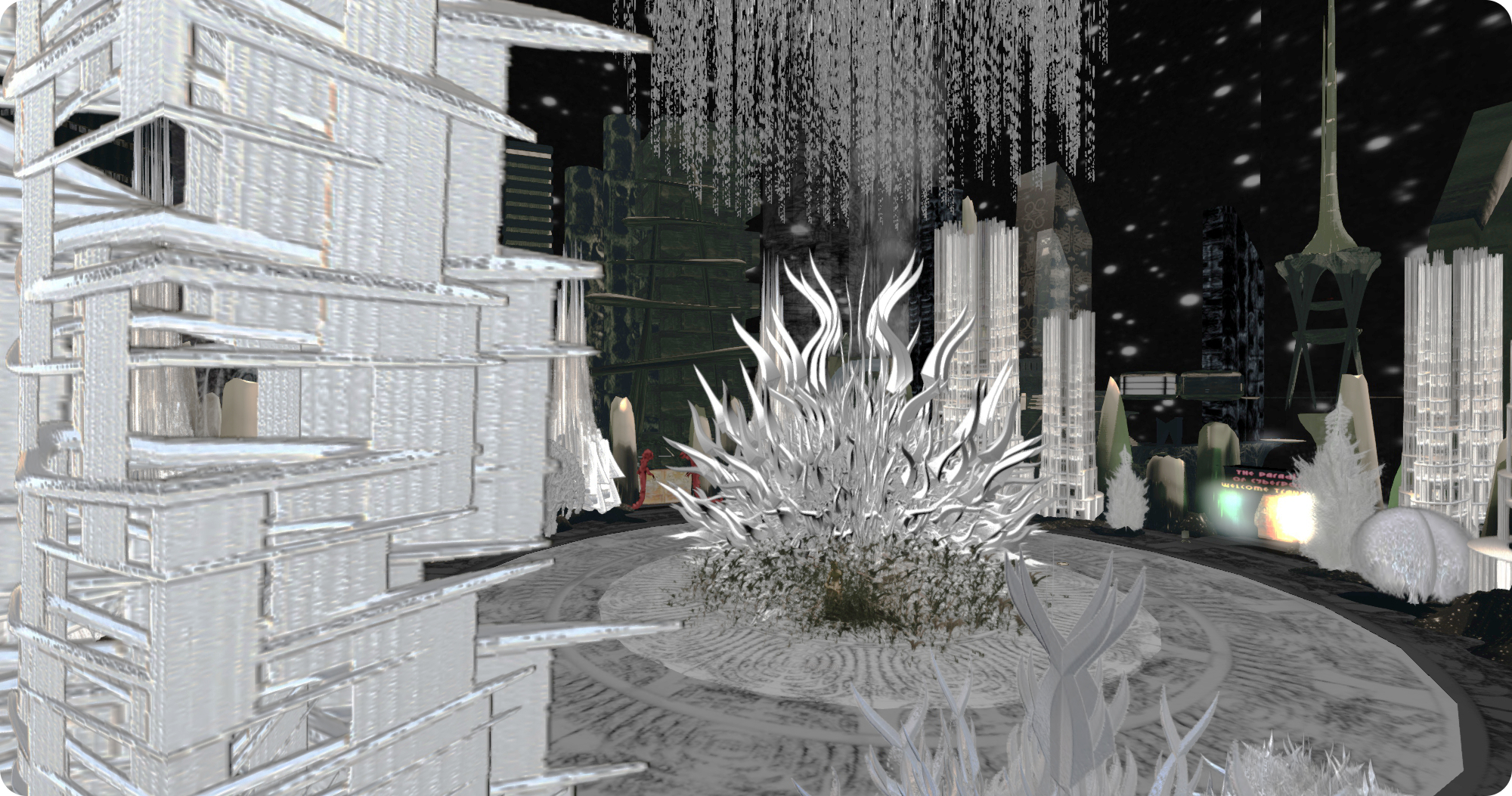
Currently open to explore, although the official opening doesn’t take place until Sunday, March 15th, is The Paradise of CyberPolis, by Asmita Duranjaya and Sable (snakeappletree) at LEA 12. It is billed as a “a grey-scaled story and game-based art installation”, and comes with a narrative storyline visitors are asked to follow whilst exploring the installation, solving clues, with the explanatory notes reading:
Crash-landing on an urban planetary system …
A researcher is slowly awaking from unconsciousness, starting to explore the environment of an ancient, abandoned cyber-city and to solve its mysteries. Seven letters need be found to experience the last surprising solution.
The starting point is the researcher’s crashed aircraft, complete with unconscious space-suited researcher. A HUD is also offered, and you’ll need this in order to unlock (literally) the mysteries and make your way to the surprising solution.
The HUD actually takes the form of a journal (available in English or German), written by the researcher, describing their initial examinations of this world and the discoveries made. Your task is to follow the clues in the book, re-trace the researcher’s footsteps and learn all that they have learned, and in the process find the seven letters mentioned in the introduction. Four of these will be required to unlock the gates of the cyber-city proper (your initial investigations taking place outside of the city’s core), while all seven are needed to unlock the final secret.
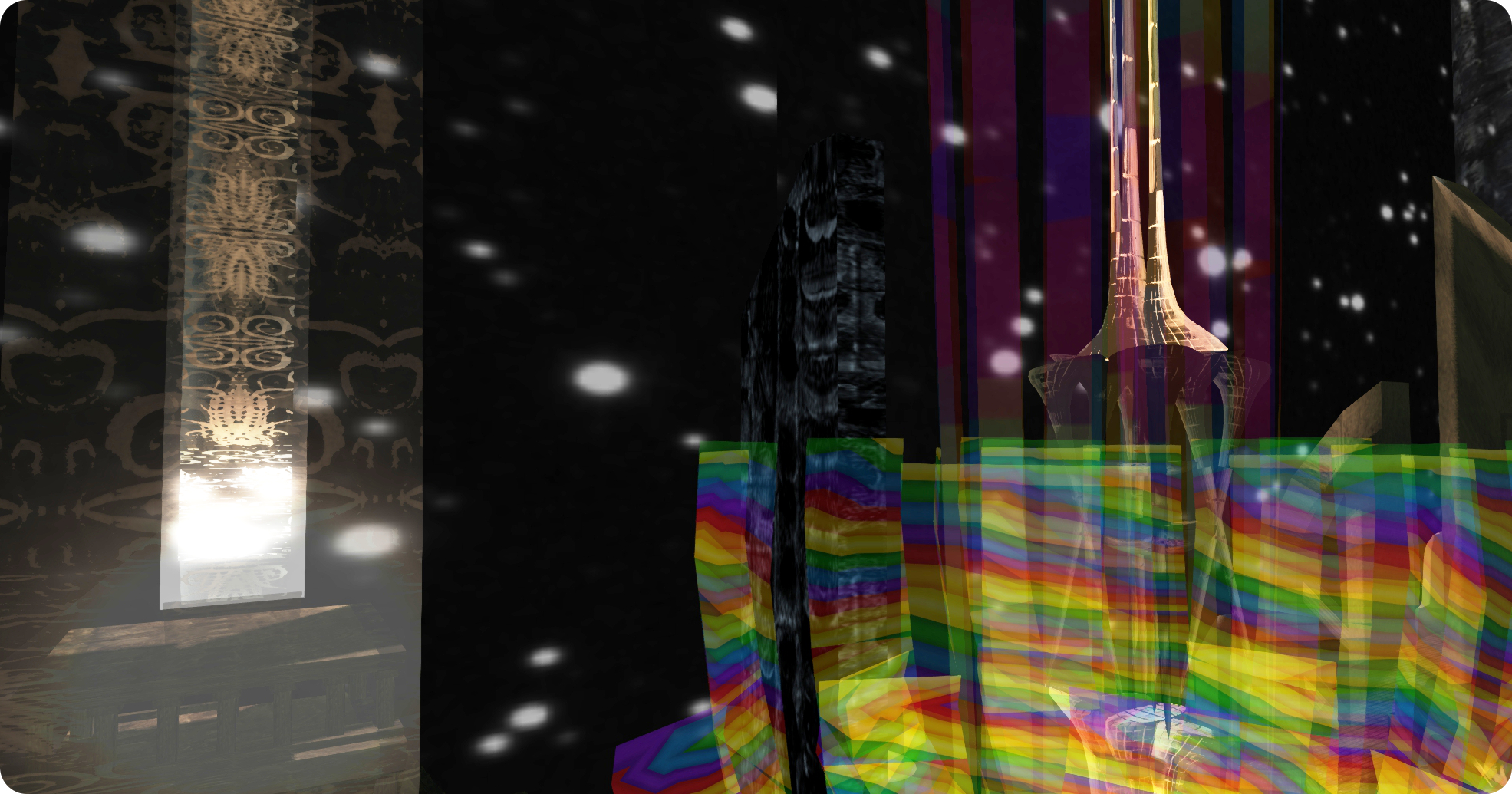
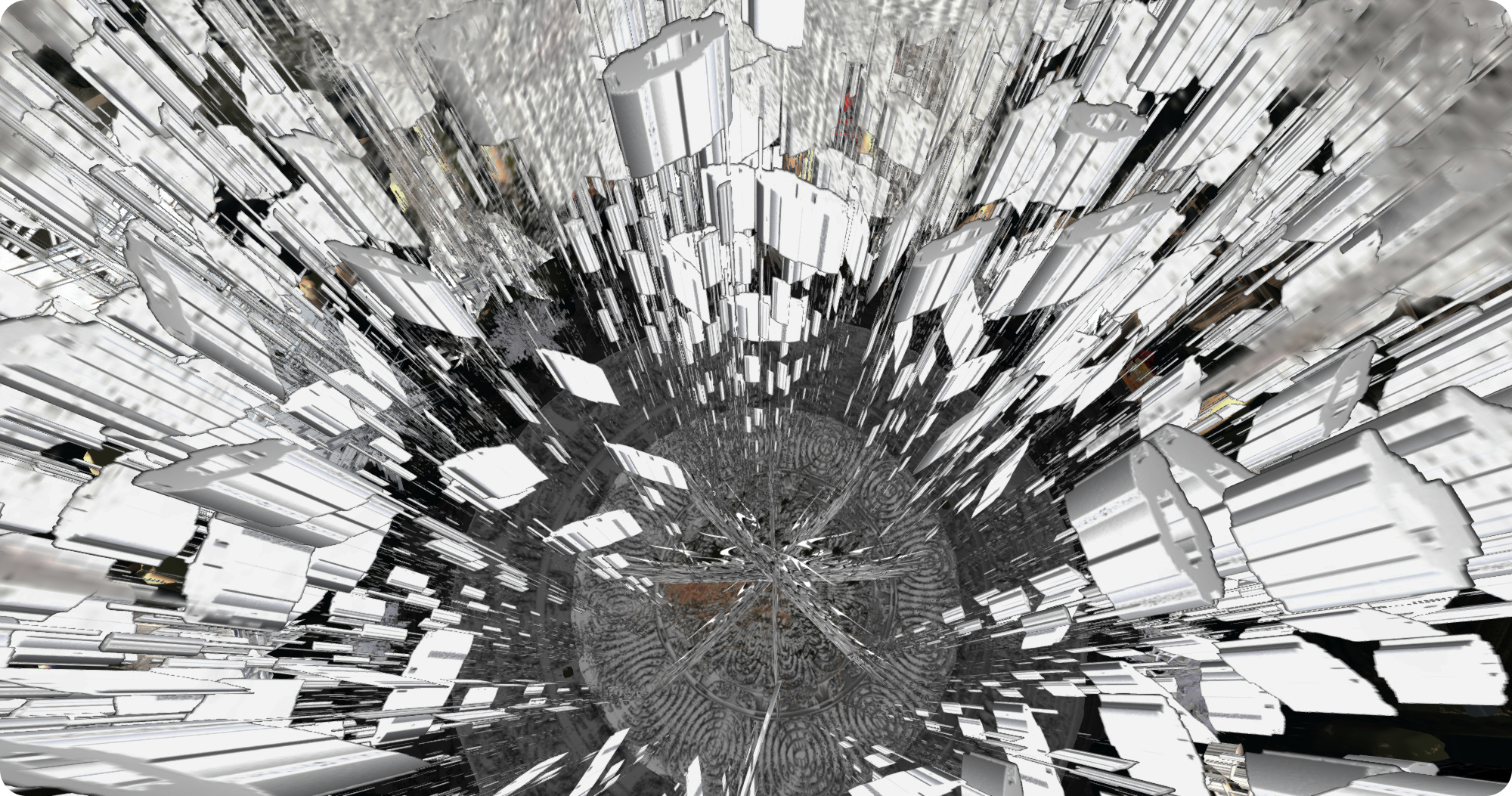
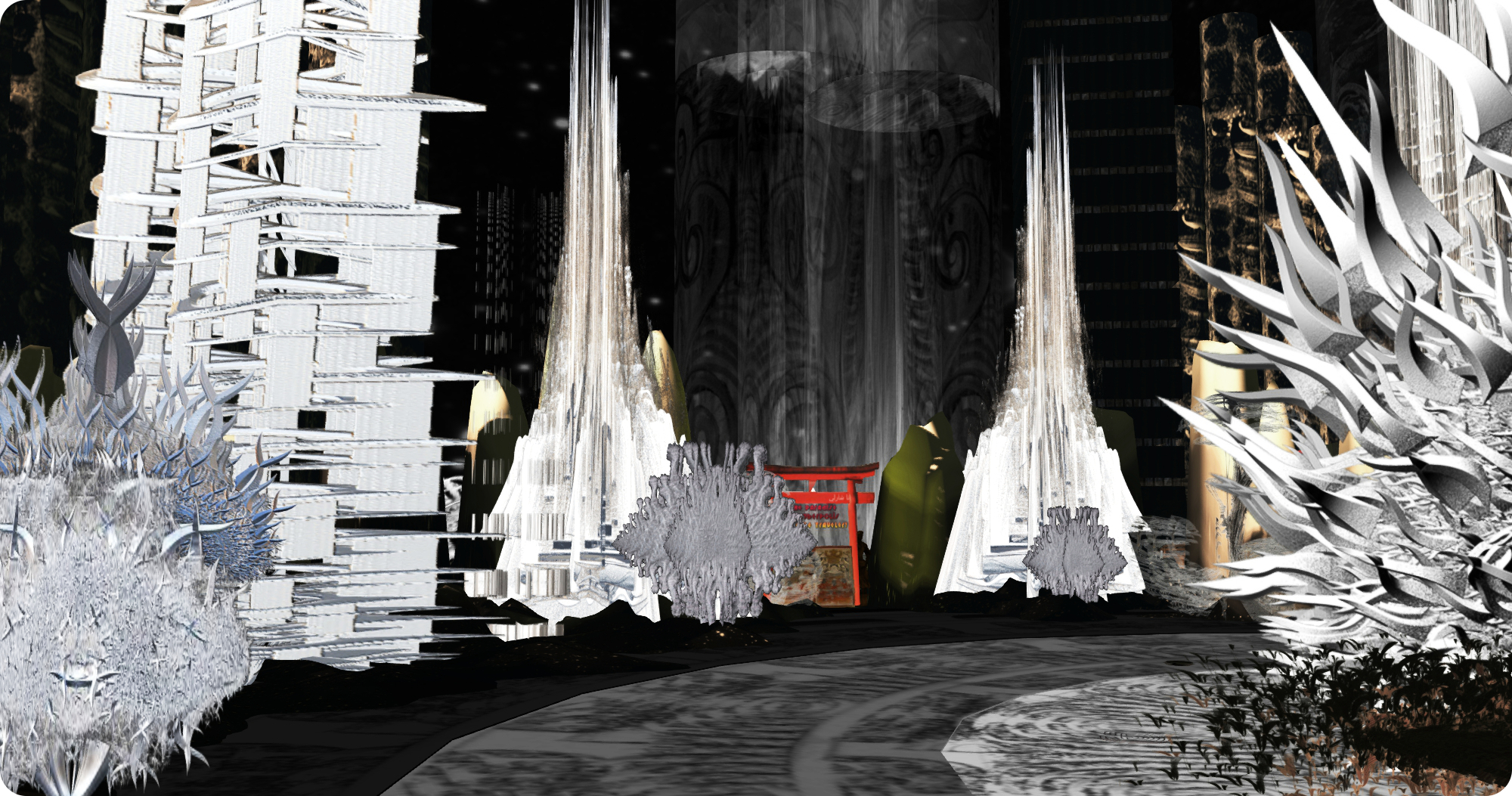
Along the way you’ll encounter a curious environment with mixed influences from the worlds anime, cyberpunk and dystopian sci-fi, in a story with something of a spiritual slant. Most of the landscape is a muted greys and whites, but there are splashes of colour scattered throughout, which form visual cues to places you might want to investigate more closely.
As a game, the idea almost works; you read the book, you riddle the clues, you uncover the required letters. But there is a problem. Of the seven letters to be discovered, only three actually require you investigate the city due to them requiring direct interaction with in-world objects to properly identify the letters in question; the other four can be discovered just by reading the book. Thus, it is possible for some of the visual context of the story to be lost as one simply reads ahead, identifies the letters and goes directly to things like opening the gates of the inner city; and sad to say, I’m not sure that much would be lost from the experience in doing so.
The build itself, while interesting to explore, bears a strong resonance to the NeoCyberCity both artists recently built at Asmita’s own Space4Art / Port Lyndus region (indeed, the two builds appear to share many common elements). As such, it’s actually quite hard to determine why there was a need to utilise an LEA region to produce this particular piece, rather than incorporate it into a pre-existing and similarly themed environment already operating.
FreeWee Ling is perhaps best known for her tireless work on behalf of the University of Western Australia (UWA), and co-organiser and curator of the UWA’s art-related projects, activities and galleries within Second Life. She recently – and rightly – gained recognition from the Australian Department of Education for this work when she was awarded her an Endeavour Fellowship at the end of 2014. This has allowed her to travel from her home in the eastern United States to spend four months at the UWA in Perth, Australia, where she is based with the UWA’s Department of Physics.
In conjunction with her time at the UWA in the physical world, FreeWee has been granted the use of a LEA Artist in Residence region, where she has established FreeWee’s Laboratory v.8.0: Music, Myth, Magic, Light, Shadows, Physics, a unique combination of workshop, study space, laboratory and gallery focused on helping her demonstrate the potential of virtual worlds to students at the UWA.
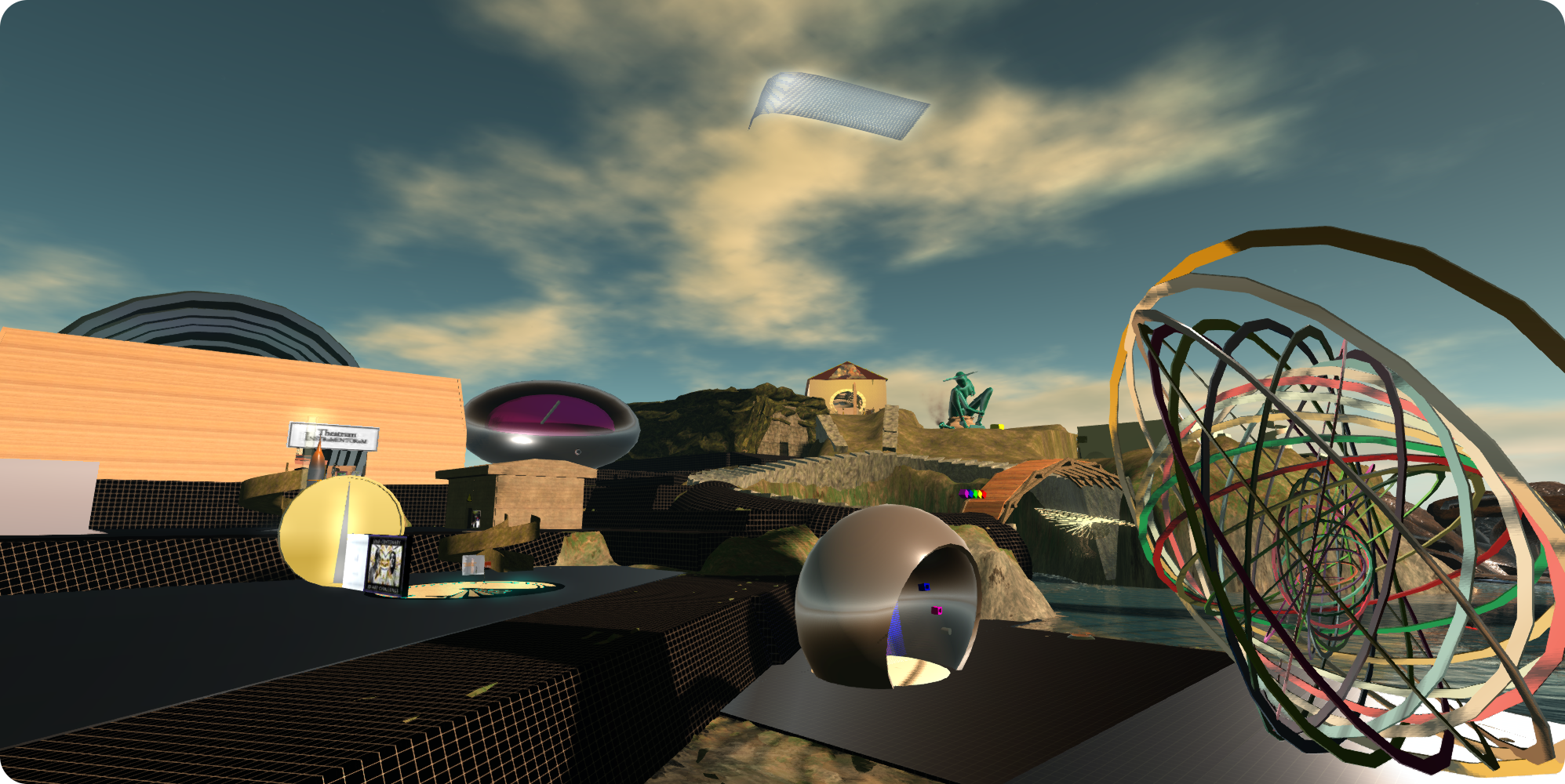
When you arrive in the region, it may look somewhat chaotic and perhaps even feel half-finished. Don’t let this put you off; this is a workshop / lab, and what is on offer more than makes up for chaotic the appearance. Keep in mind as well, that elements within the installation may change over time in order to meet FreeWee’s evolving needs as a part of her work at the UWA.
As FreeWee is working with the Department of Physics at the UWA, many of the items within the region explore the nature of physics in Second Life, be it through movement, light or colour. Just up the ramp from the landing point, for example, is her award winning nanoprim physics lab from 2010, together with a rocket that will take you up to her Solar Observatory, which I’ll have more to say about anon.
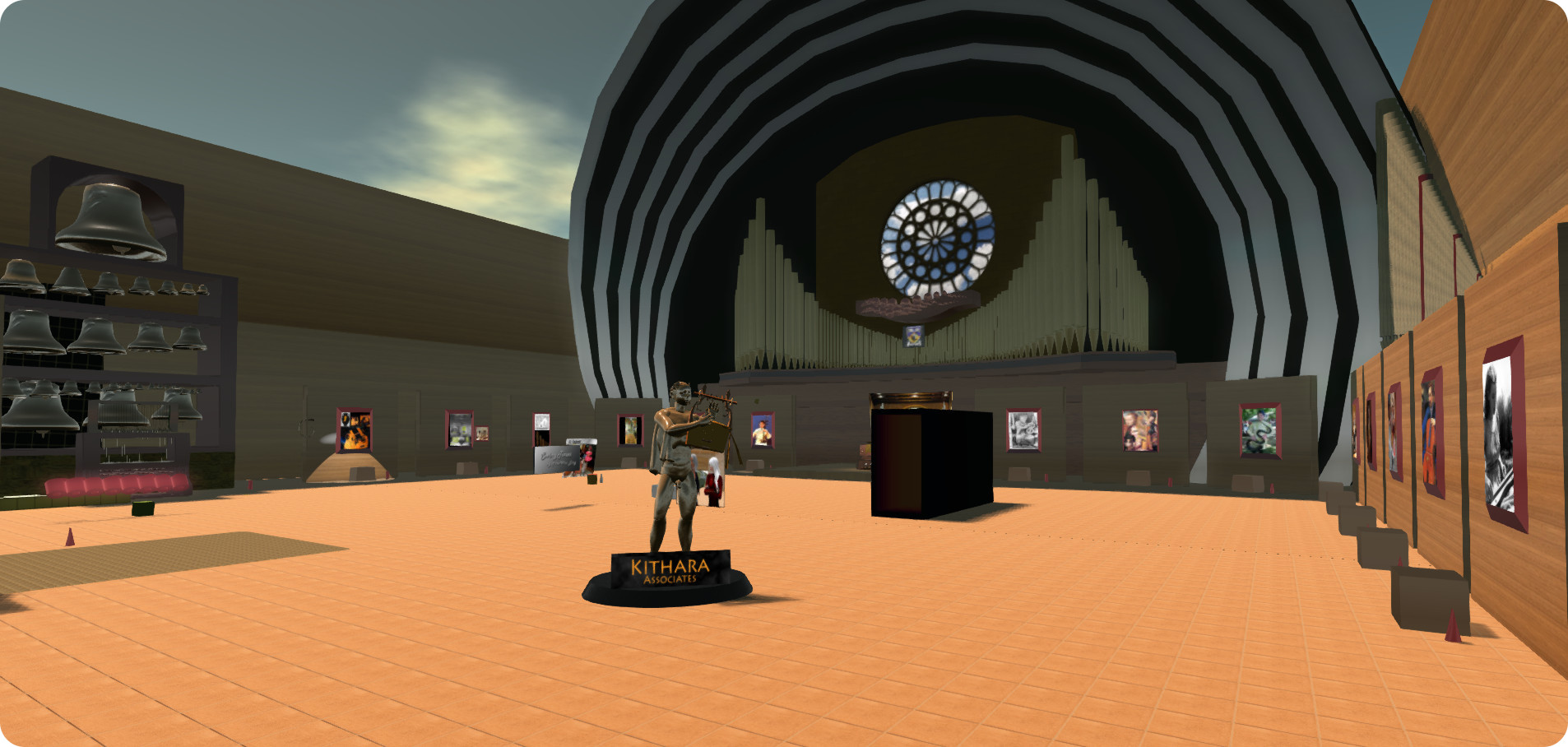
FreeWee is a musicologist by education, with a specialist interest in the history, use and physics of music. Together with fellow musicologist Oriscus Zauberflote, she formed the Kithara Associates, which is focused on the creation of musical instruments in SL that are reasonably authentic in appearance, in order to enhance the immersive experience of the platform for the purpose of learning and research, and this work is also present within the installation, in the form of the Theatrum Instrumentorum.
This is, in essence, a museum of musical instruments featuring photographs and information boards of the instruments in the physical world, and samples of instruments built in-world, some of which extend to the creation of hybrid / fictional instruments depicted in works of art. Several of the pieces are playable, and I particularly enjoyed using the carillon to play a melody I’d had to learn many, many moons ago when starting to learn to play the piano. Also on offer within the Theatrum is a teleport up to Swingtones, a demonstration of the effectiveness of sound in helping to create an ambient, immersive environment.
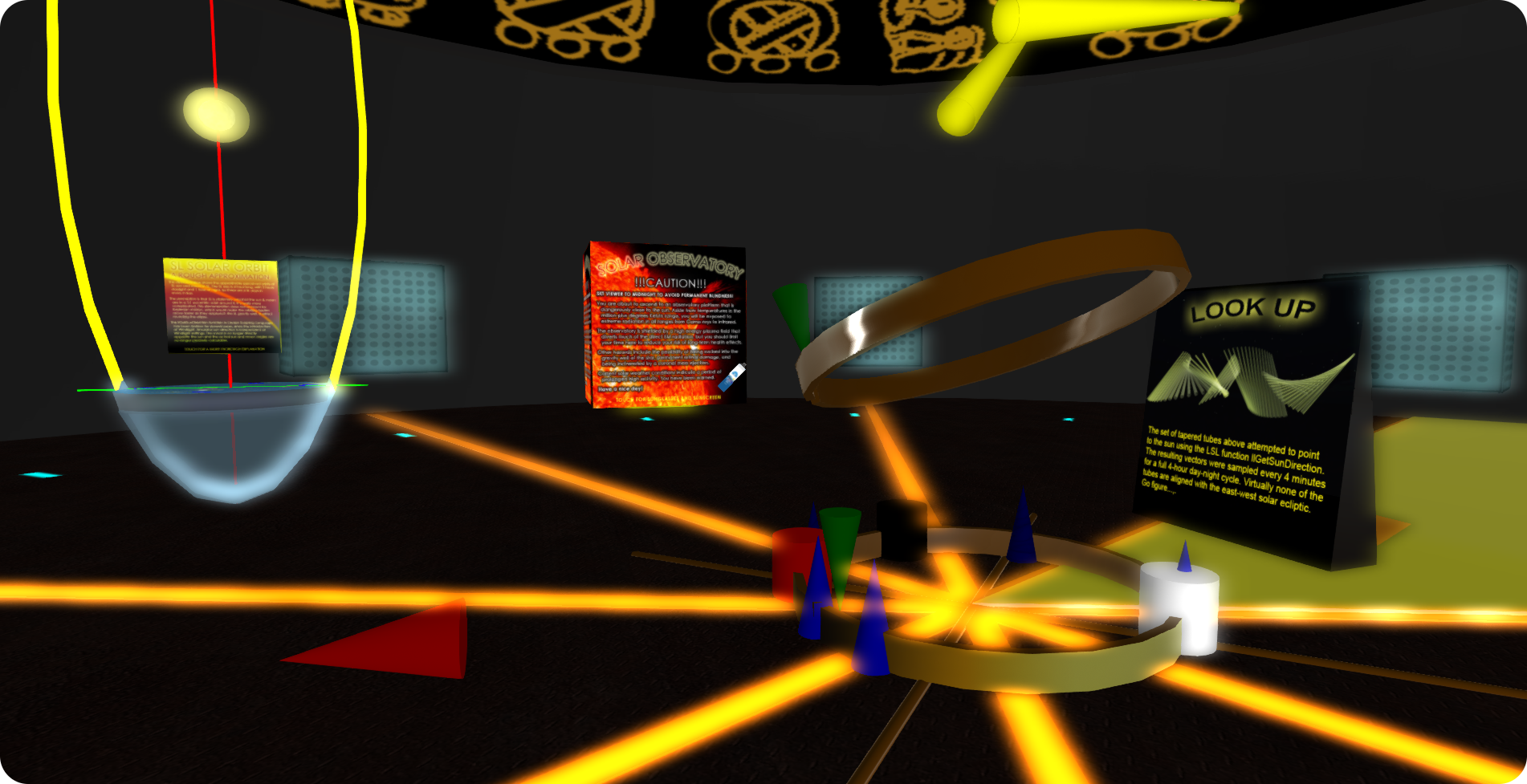
The Solar Observatory mentioned earlier, and which can be reached by rocket, is spread over two levels. The lower level presents visitors with both an introduction to elements of solar and stellar astronomy and also provides insight into the peculiarities of the SL “solar system” and day / night cycle, with interactive demonstrations throughout, as well as well-written information cards and links to external sources.
The upper level, reached by elevator, offers the chance to study the Sun first hand, complete with coronal mass ejections (CMEs), sun spots and the flow of the solar wind. The elevator is guarded with a firm caution about the risks of blindness and exposure to gamma radiation should you opt to take the elevator, but both both sun screen (SPF 1000) and sunglasses are thoughtfully provided to mitigate the effects of both 🙂 . At the top of the elevator is a platform allowing you to view the Sun Sunshine-like, or if you’re feeling particularly daring, you can rez a chameleon flyer and fly yourself around the Sun. However, if you opt to do the latter, do try to keep in mind the story of Icarus, and what happened when he flew a tad too close to the Sun …
Elsewhere in the region you can find a novel “get away from it all” rezzer system, interactive art pieces, a gallery of FreeWee’s own art and, in what is another superb demonstration of SL’s capabilities in the Projection Room (a large white building on the east side of the region.
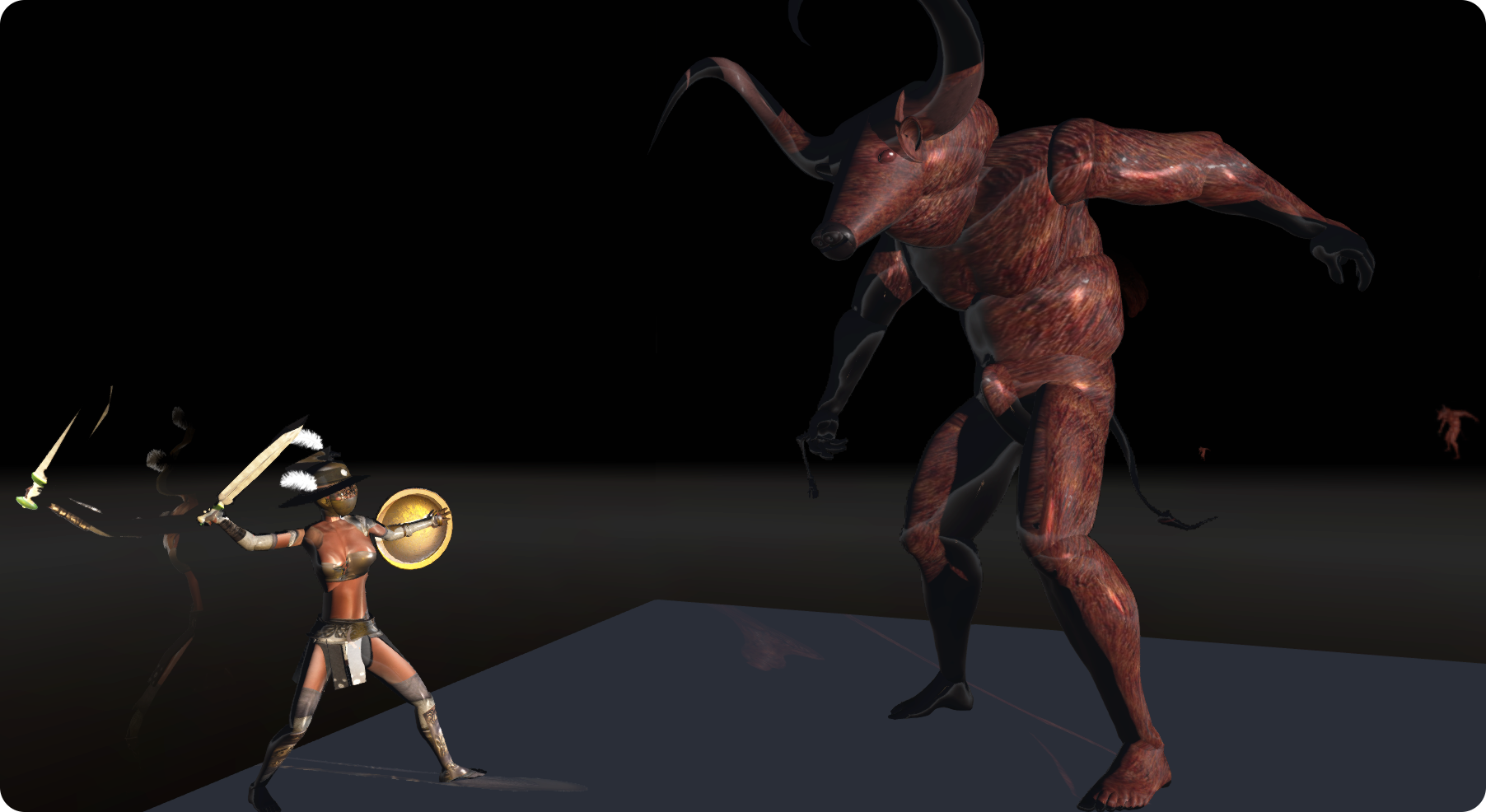
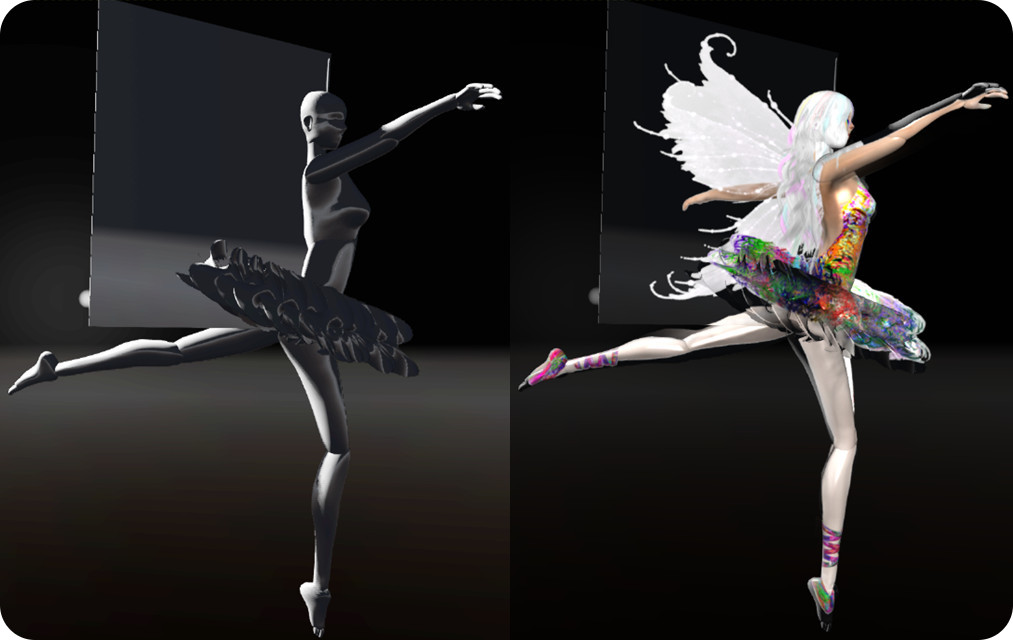
The power of projected lights – the image on the left shows an untextured figure; on the right, the same figure, lit entirely by projected lights. FreeWee’s Laboratory v.8.0: Music, Myth, Magic, Light, Shadows, Physics, LEA27
This focuses on the use of projected lights in Second Life. As such, you will need to have the Advanced Lighting Model graphics option enabled on your viewer (you do not need to enable shadows, so any performance hit you may experience shouldn’t bee too great), and keep in mind that none of the figures in the room are actually textured. What you see as you move around and active the lighting sources is purely the result of using projected light sources and textures.
All told, the Laboratory makes for a fascinating installation, one in which it is easy to become absorbed in the individual elements on offer, allow of which are provided with informative note cards which not only provide insight into what they are and how they work, but often explore the creative processes involved in creating them, and provide a glimpse into FreeWee’s mind and thought processes, further enhancing the time one takes in exploring the installation.
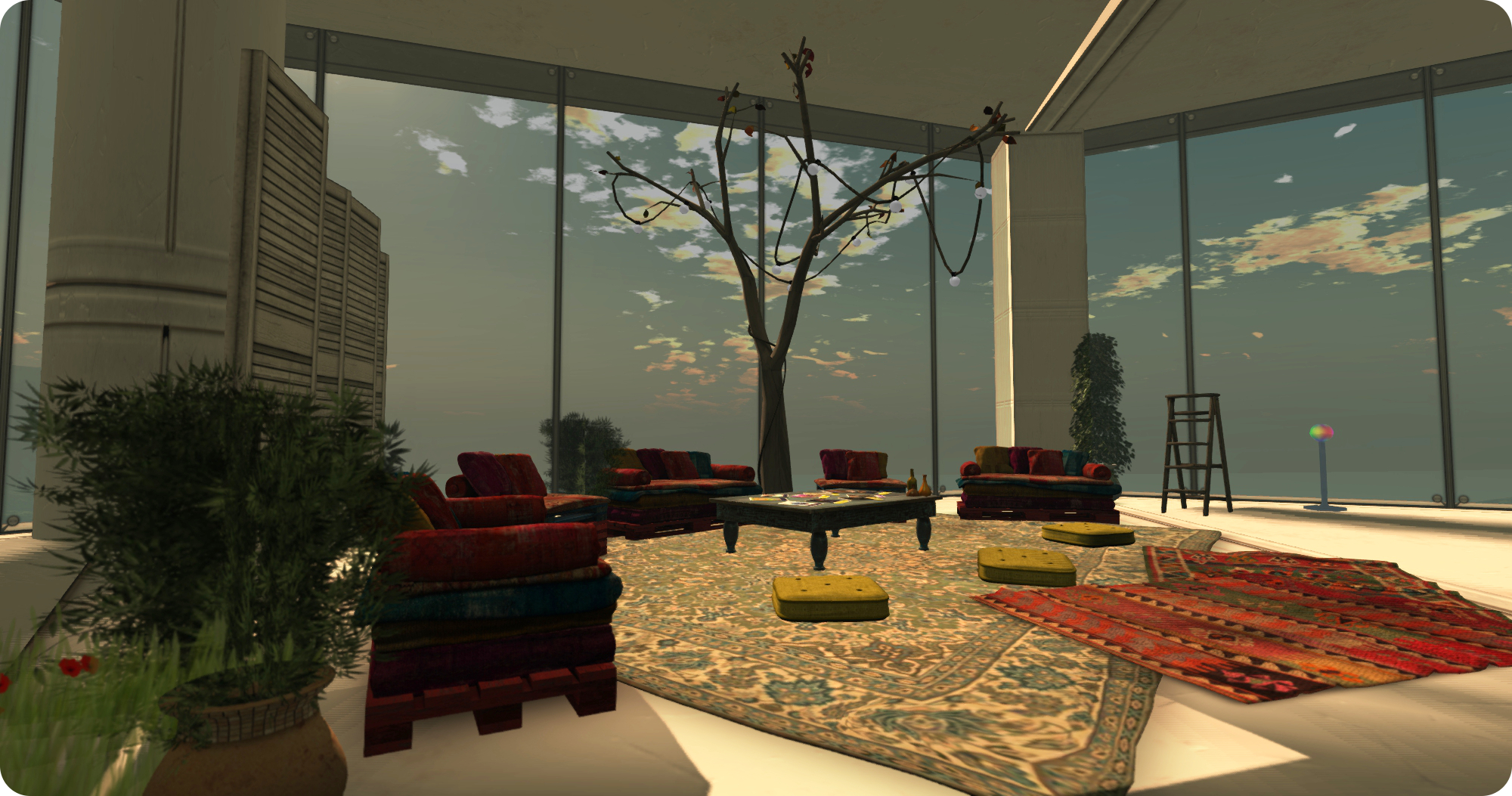
The Living Room is a new art, performance and social venue which will officially open its doors on Tuesday, March 3rd, 2015, at 12:00 noon SLT.
“Daallee and I have wanted a little comfy place for a while,” Owl Dragonash, one of the two people behind The Living Room says of the venue. “A place to give back to the artists and musicians we love an appreciate.”
Spread across the upper two floors of a tall circular tower, The Living Room offers commanding views out over the region in which it sits. The lower floor offers room for people to sit and chat or, if there is a musician playing, to enjoy the music from the comfort of sofas and armchairs. A small art display area is also on this floor, although the main gallery space is the floor above.
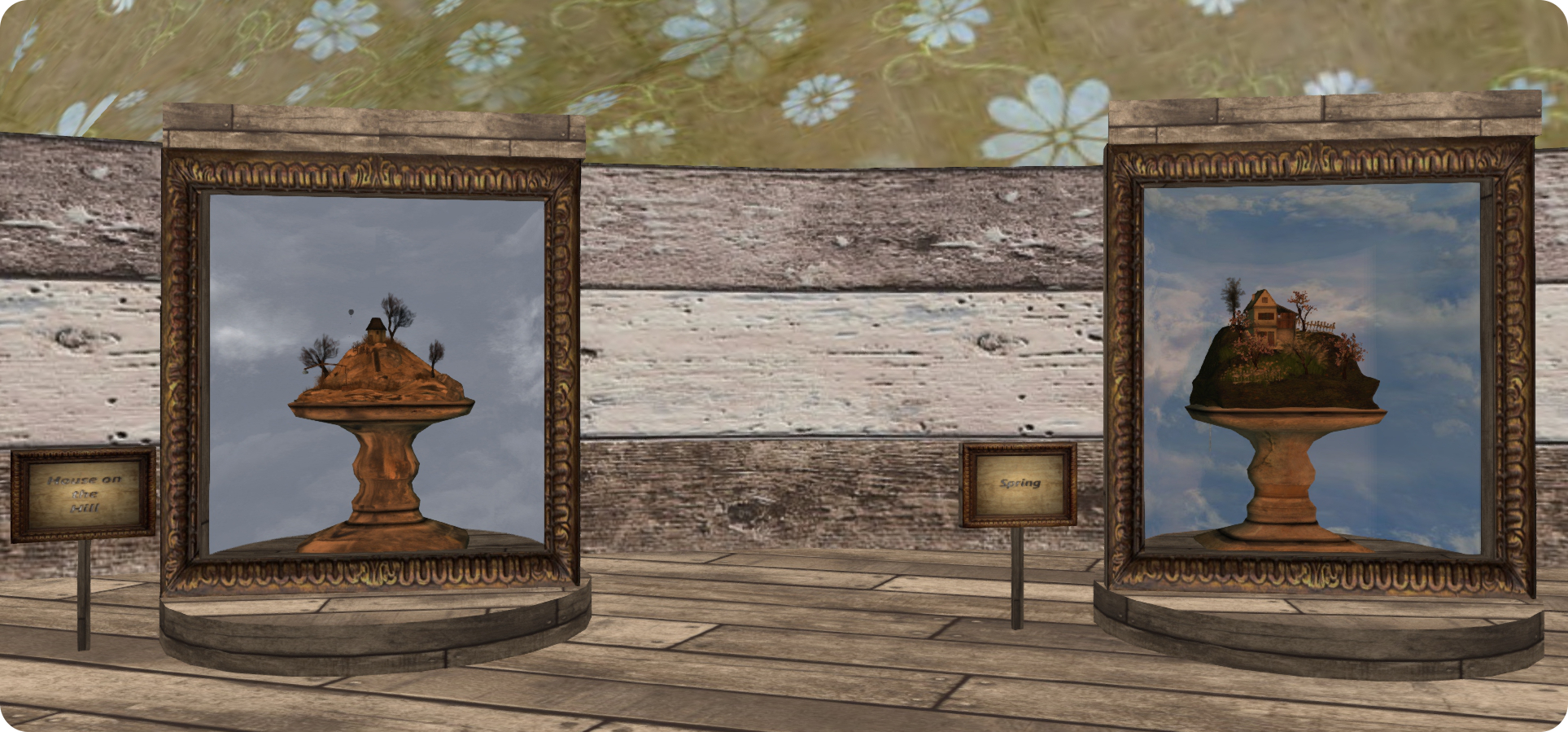
For their début exhibition, Owl and Daallee are excited and pleased to have a small exhibition of pieces by Cica Ghost. And small really is the operative word here, as Cica has provides a set of of seven exquisite little dioramas entitled Small Worlds, and they are an absolute delight.
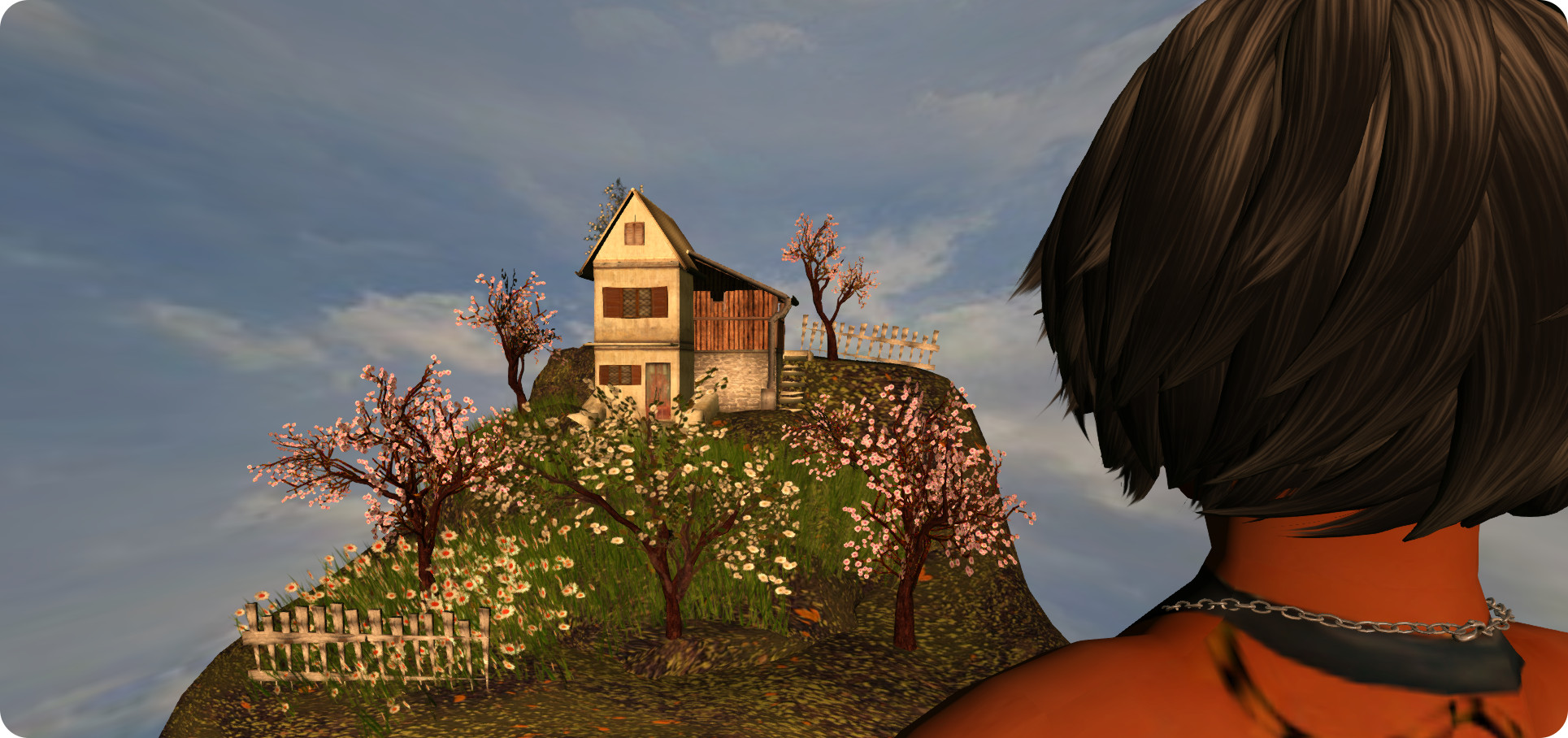
Each diorama is displayed within its own case, sitting atop a small stone plinth. Four of them represent the seasons of the year, while the remaining three present more general scenes, one of which art lovers may recognise as a miniature reproduction of Cica’s wonderful 2014 exhibition, Little Village, which I wrote about almost exactly a year ago.
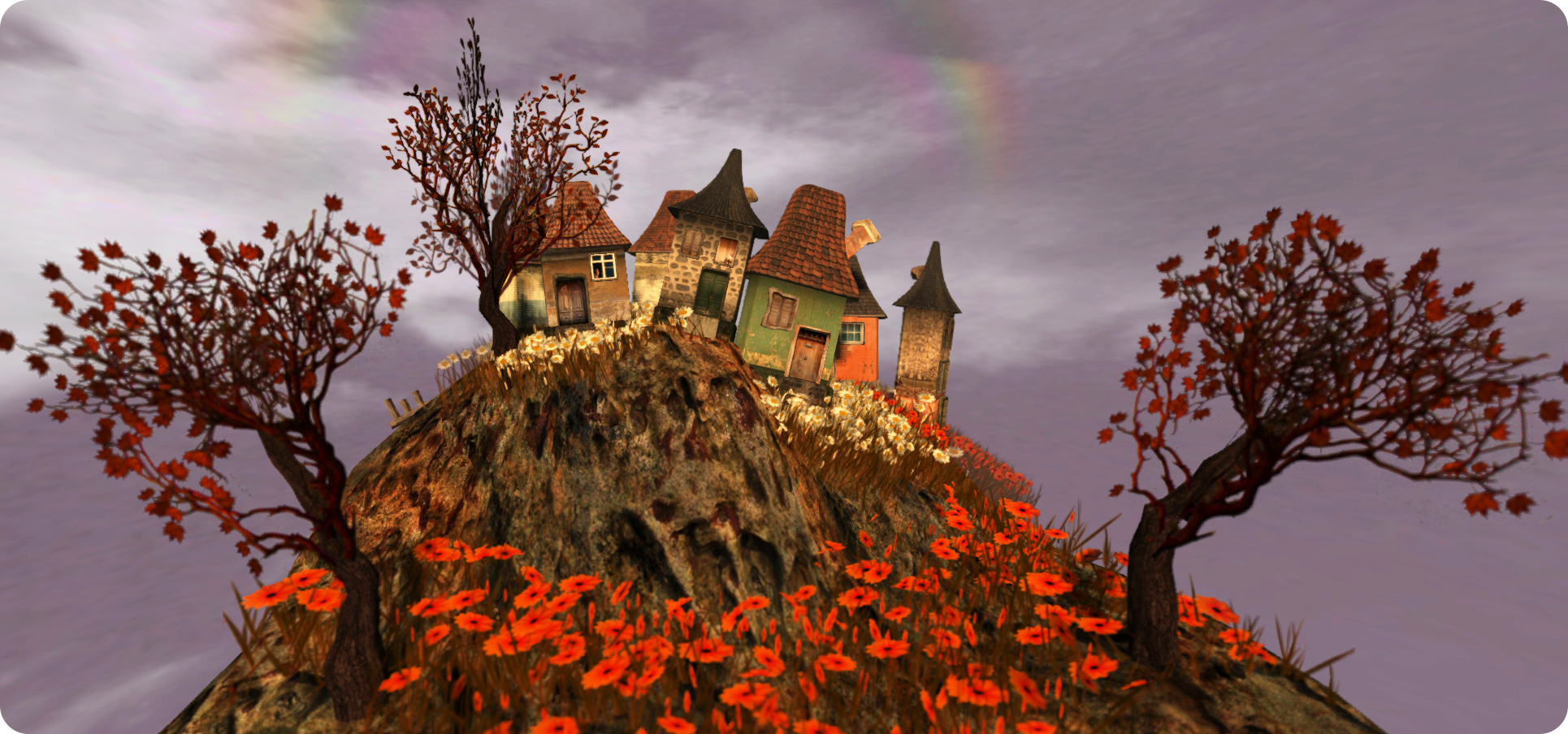
And when I say “exquisite”, I do mean just that, these tiny models are beautifully crafted and rich in detail, so much so that they should be seen for themselves, rather then viewed through photographs.Take Little Village for example (see above). Not only has Cica reproduced her lovely and quirky little hilltop houses, when you look closely at them, you’ll see little cats sitting in the windows of some, a familiar Cica touch on several of her installations in the past.
Each of the models is available for sale at L$400 each for those who particularly drawn to having one at their SL home, and copies can be purchased via the little sign alongside each one, which also provides the LI for each piece as well, so you know precisely what you’re getting (the LIs range from 39 through to 135, depending on the complexity of each model).
Cica’s models for Small Worlds really are tiny and beautifully detailed – The Living Room
To celebrate the opening of The Living Room, the first live music event will feature The Vinnie Show, and Owl and Daallee have already lined-up further entertainment and events, including:
Thursday March 26th: 11:00 – Small Worlds closing party, featuring Winston Auckland
Sunday March 29th: 17:00 – Rynanne’s Closet fashion show with music by Augusto Napoli.
An in-world group has also been created for those interested in keeping abreast of news on events occurring at the venue, and which can be joined via a subscription board on the lower floor. Owl and Daallee have also created a Flickr group where people can post their images of art and music events at The Living Room.
“We imagine The Living Room to be a welcoming hang out used to share Artists and Musicians creative talents with us our community and The SL community,” Owl and Daallee say of their new venue. “And don’t forget, The Living Room lives on Lagrange Point Spaceport sim, owned By Hippie Bowman, which has a full galaxy to explore, take the space taxi it is fun!”
So why not hop on over to The Living Room and enjoy some good music, wonderful art and friendly company – and take a tour of Lagrange Point while you’re there.
Blogger, activist, supporter of live entertainment, raconteur, content creator – there are many ways in which Toysoldier Thor can be defined. However, the one by which he is perhaps best known is that of artist – and deservedly so.
A resident of Second Life since 2008, Toy works in both 2D and 3D mediums, many of which bridge the physical and virtual “divide” in the most interesting of ways. While his art has been widely exhibited across the grid – and even interpreted through dance – perhaps the best way to become acquainted with his work is by visiting his in-world gallery.
It would be easy to attempt witticism by referring to the gallery as his “toybox”, but it would also be unfair; what is on offer across five floors of viewing rooms is a veritable treasure trove of unique art. All of the pieces on display are available for purchase (and any aficionado of art is going to be hard-pressed not to walk away with one or two purchases); but more to the point, each comes with its one descriptive note card, obtained by touching the work in question.
These cards are well worth reading. Far from being a purely descriptive piece on the art itself, they delve into the history of the work – the inspiration behind it, the techniques used to produce it, the sources from which Toy drew in developing it, and so on. In this way, the cards not only reveal more about the piece, they allow us to share in the entire creative process, and provide links to influences and so on, thus providing a unique insight into not only Toy’s craft, but also to Toy himself.
The uppermost floor of the gallery includes a number of Toy’s mesh sculptures, including the remarkable Shattered. A remarkable and emotive piece Toy has produced as both 2D art in the physical world and a 3D mesh model in Second Life, Shattered and the artist have been engaged on a remarkable journey, further narrowing the perceived divide between the virtual and the physical; the piece first becoming a 3D printed model, and which now looks set to become cast in bronze in the physical world as well (and which you can still pre-order).
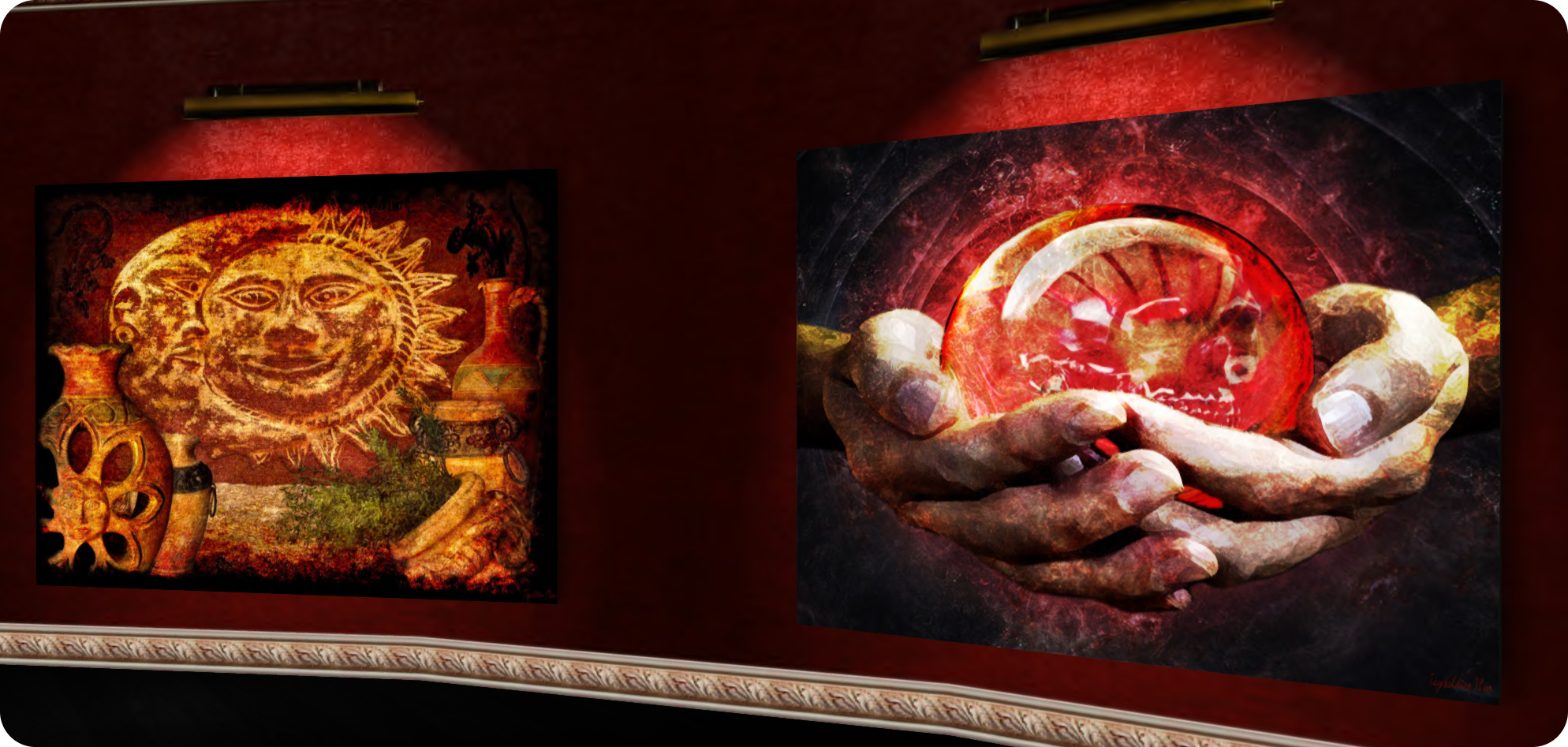
It’s actually this element of physical / virtual cross-over that I find really compelling in Toy’s art. By this, I don’t mean how he might use Photoshop or other digital wizardry in order to edit and enhance photos originating from in-world, but how he actually combines virtual and physical world images to create some quite spectacular works of art. As examples of this, I would point visitors to both Assassin’s Prayer and to Death Seer (seen in the above picture, on the right), which are, in a gallery of quite extraordinary art, utterly stunning.
Those familiar with toy’s work will need no prompting when it comes to a visit to his gallery. If, however, you’ve not taken the time to pay a visit, then it is well worth adding to your itinerary. Anyone who enjoys and appreciates art in either the virtual or the physical world is unlikely to be disappointed; quite the reverse, in fact.