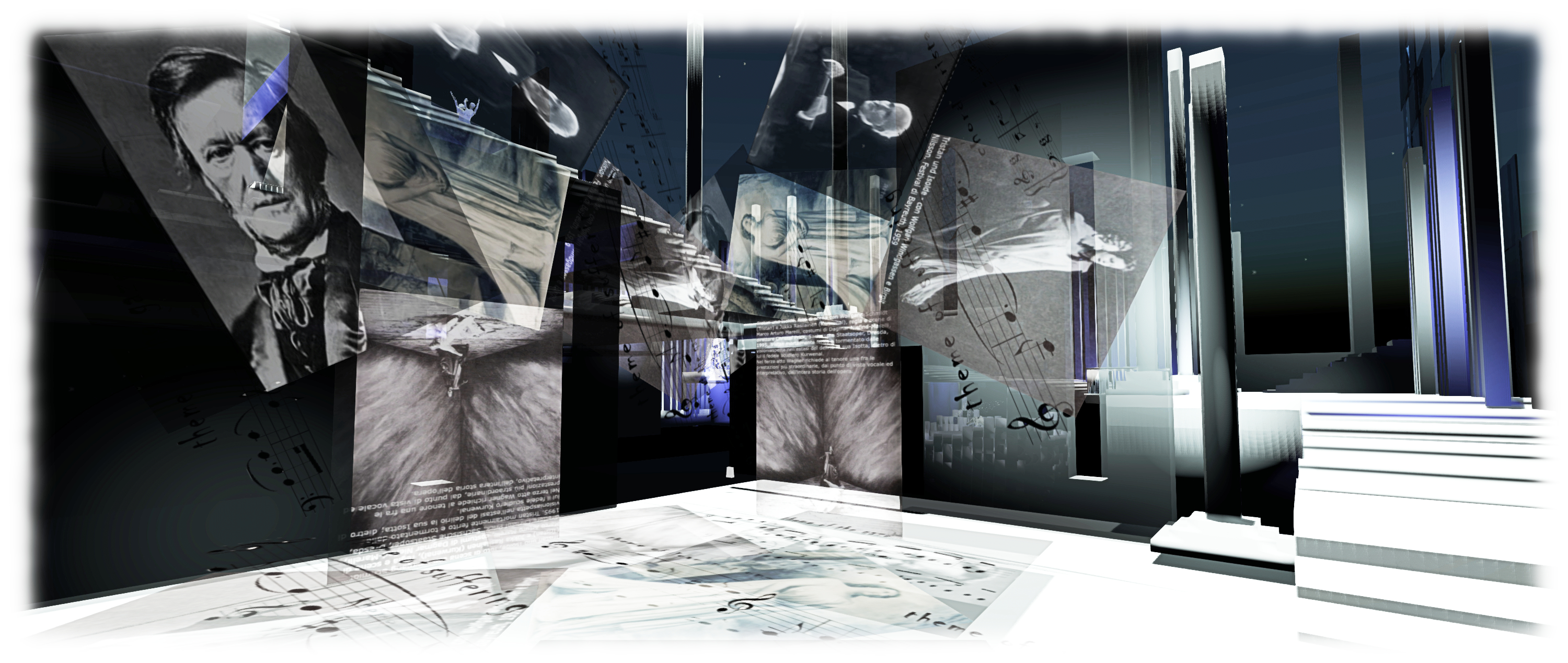
Bryn Oh’s Lobby Cam

Lobby Cam - click any image for full size
Lobby Cam – click any image for full size

Bryn Oh’s latest installation on her home region of Immersiva opened on Sunday, March 29th. Entitled Lobby Cam, it is, in keeping with her previous works there, a full region installation; albeit one which, on the surface at least, seems a lot less complex than pieces such as Imogen and The Pigeons or the more recent The Singularity of Kumiko. But as we know with Bryn, all is not always as it may first appear to be.

Bryn has always embraced the so-called digital divide, and by doing so remove it somewhat from people’s view. Her virtual work has often incorporated elements of her physical world artistry, while her work in the physical world has frequently encapsulated her virtual art. Lobby Cam takes this a stage further, as it places a number of Bryn’s paintings front-and-centre within the installation, which itself appears to have its origins painting possibly inspired by a trip to  Sasakatoon and the surrounding region of Saskatchewan in Bryn’s native Canada.

Lobby Cam
Lobby Cam

The artwork is on display in a lobby-like gallery to one side of the region – although this is not the lobby to which the title of the piece refers. Here visitors can obtain a HUD (free of charge) which presents the wearer with a journal forming the hub of an unfolding story.  From here, the visitor can progress through the gallery space, reaching a wall on which is mounted a copy of the painting on which a good part of the installation is based. As this is approached, the wall breaks apart, allowing access to the rest of the region.

Most of this is given over to fields of wheat which stretch off to the horizon, and from the midst of which a huge wooden grain elevator rises bluntly into the sky. This is not just any grain elevator, however; it is No. 888, originally built in Keatley, Saskatchewan in the late 1920s as a part of the Saskatchewan Wheat Pool, but which was moved in the 1980s to North Battleford, some 137 kilometres (86.5 miles) north-west of Saskatoon, where it was restored as a museum.

Lobby Cam
Lobby Cam

Such grain elevators where once widespread across the prairies, and early photographs of Saskatoon itself show just such an elevator located alongside the railway tracks on the edge of the town, forming something of a focal point. Within Lobby Cam, the elevator sits as a focal point within a broad spread of wheat, like some tall ship riding the sea, the rippling wheat, which moves to the SL wind, the waves beneath its prow.

Given its size, the elevator is a natural destination, and there are several floors within it to be explored, including the upper floor which links back to the HUD-based story, which I’ll get to in a moment.  Further across the fields, towards the south-east corner, sits the battered bulk of an old Toronto streetcar, doors and windows broken, a part of it boarded-up as vines wind their way through it. Elsewhere amidst the wheat visitors will also find the rusting hulk of a old pick-up truck, sitting like a raft in the middle of a yellow ocean.

All of these pieces are perhaps emblematic; a commentary on the passage of time and the changing of ways. They also help to attract one’s attention to elements of the unfolding story. As mentioned above, the HUD obtained at the start reveals a journal. Initially, only the first few pages can be read but, explore the region and you’ll come across more, which are automatically added to the journal as you do so, allowing more of it to be read. I’ll not say too much more on this, other than you should take a little time in your explorations, as there are pages and more to be found.

Lobby Cam
Lobby Cam

Throughout the build, there are many references to some of Bryn’s other works, some obvious, some perhaps less so. Such motifs are not uncommon to her work, and they add both depth and familiarity to her pieces.

In the default windlight (I’ve taken the liberty of using a different windlight in the images here), the entire installation has something of a “rough” look to it colours in places – such as on parts of the grain elevator – can look a tad odd to the eye, which the old Toronto streetcar might at first look like a badly-made model. However,  this is entirely intentional.

As already noted, the entire installation is essentially the recreation of a painting; thus, the colours and rough uneven surfaces and (in places) blocky finish to various elements in the installation are all redolent of the colours and textures found in the original painting.

Bryn’s work can often be taxing for some computers, and Lobby Cam is no exception, although Bryn has once again put considerable effort into minimising any loss of performance that might be experienced. She also offers some notes on how to lessen the potential impact and improve your experience – including trying SL Go (Bryn has no affiliation with the service, but recognises it as a means by which those on lower-end systems can perhaps better enjoy the installation). These notes can be read directly in-world at the HUD dispenser, or obtained via note card by clicking the information board above the HUD dispenser, or via Bryn’s blog, which includes the introductory trailer video I recommend you watch, if you haven’t already.

Lobby Cam offers-up another intriguing piece from Bryn, which as noted at the top of this article may initially appear less complex than some of her other work, but which is actually beautifully layered.

Lobby Cam
Lobby Cam

Related Links

Metamorphosis: looking through the eyes of Escher

Metamorphosis - Beq Janus
Metamorphosis – Beq Janus

Beq Janus is an artist clearly inspired by the work of Maurits Cornelis (M. C.) Escher. For RFL of SL 2013, she produced models of  Waterfall and Tower of Babel. In 2014, she offered Metamorphosis, inspired by Escher’s pieces of the same name, and which included additional influences and themes drawn from Escher’s life, as a symbol of the promise as we journey towards a cure for cancer.

Now Metamorphosis is now back, located over the Quarry Hill region of New Babbage, and it is a veritable masterpiece of art, rich in symbolism as well as capturing so many elements and nuances of Escher’s work – and also, if one looks around, Beq’s previous Ecsher-inspired builds.

Metamorphosis - Beq Janus
Metamorphosis – Beq Janus

The most prominent influence from Escher in the piece, as Beq notes, is that of the artist’s 1939 wood print Metamorphosis II. However, elements of both Metamorphosis I and Metamorphosis II can also be found. Also evident, again reflecting Escher’s work and the influences in his life, are elements of the little Italian town of Atrani – most notably the church and surrounding houses.

“Recreating a two dimensional work in three dimensions has its challenges, and more so when the work is deliberately faking the third dimension,” Beq notes of the challenges in bringing Escher’s work into the digital realm. But there are also opportunities, as she also notes, “it also gives you freedom to play with the unseen areas. I have tried to make the sim explorable, with tunnels and caves that lead you through the rocks, past stalactites and back round into the central square. I am sure that there are places I have not intended to make still waiting to be found.”

Metamorphosis - Beq Janus
Metamorphosis – Beq Janus

As such, this is a fascinating build to explore, one filled with many paths one might follow through it, originally intended as a reflection of the RFL of SL 2014 theme of journeys; both the global journey towards finding the ways and means to eradicate cancer from our lives, and the individual journey those of us afflicted by cancer, or who support those struck by cancer, take in dealing with the disease. In fact, one might also say the installation resonates with this year’s RFL theme as well; offering us a walk through art inspired by the past as we look to the future and a world without cancer.

This is also a build which makes fascinating use of light and shadow, encouraging the visitor to experiment with windlights, sun position and the camera.

Metamorphosis - Beq Janus
Metamorphosis – Beq Janus

If you didn’t get to see Metamorphosis last year (which I sadly didn’t), I cannot recommend a visit to Quarry Hill highly enough.

Related Links

A City, inside and out

City Inside Out, LEA 20

Officially opening at 13:00 SLT  on Thursday, March 26th at the LEA, is Haveit Neox’s newest full region installation, City Inside Out.  It’s a breath-taking and, at first look, bewildering build, huge in size, confusing in complexity and powerful in narrative.

The simplest way to describe the theme of the installation is to take the description from About Land:

Walking into any interior reveals only exteriors. The sense of personal space is absent. How is a city experienced when there are no comforts for the soul, no home?

City Inside Out, LEA 20

The description of the build, found close to the landing point adds a little more detail:

To someone without a home living on the streets, the bustling city becomes one united exterior. “City Inside Out”, explores a world that lacks interiors. Some pedestrians throw coins into the beggars’ hats, others bark insults to their faces. Joggers, dog walkers, groups of boisterous friends, clean people in new clothes, romantic couples, cell phone conversations, shiny traffic, wash their daily tides of health and prosperity past the homeless.

And thus the world around us starts to take shape: this is a city we’re asked to see through the eyes of the homeless, the dispossessed; those who have nowhere to be, nowhere to go. For these people, the city is a very different place to the one we know. It’s a place where everything is strange, alien, and threatening. A place bad enough in daylight, but as Haveit further explains, becomes much, much worse at night…

City Inside Out, LEA 20

Late each night, the people living on the streets are confronted by another kind of crowd, dangerous as the sharp knife and gun. They are defenceless, even within their own bodies. Sensations abound, prickly as lice and poisonous insect infested clothing, blurry as sight without glasses, with ringing ears of imaginary voices, and resignation to untreated illness. The survival test is administered without consideration for those who will see the next day.

Armed with this narrative, it is possible to make your way down and through the installation, crossing bridges, descending ladders and – in places – flying – and see various elements and aspects as they are meant to be seen: as a frightened, forgotten nameless … lurker … in a city were “ordinary” life passes one either side of you and renders you invisible. A place where, when you are noticed, it can feel terrifying or threatening.

City Inside Out, LEA 20

Witness, for example,  the portrayal of the man taking his dog(s) for a walk; is it really a pack of hounds he’s struggling to control, is is that home the mind of the lost, homeless individual conceives it, when in fact to the rest of us, it is simply one man and his dog? And, nearby, look how the figure dropping small change down towards you literally towers over you, massive hand outstretched, face a mask…

Then there are the horrors of the night and of living and sleeping rough, portrayed in nightmare images of bottles and guns and more with insectoid legs climbing towards you, or seemingly skittering around or even looming over you; parasitical, ready to suck the life from you.

City Inside Out, LEA 20

If all this sounds dark, it’s not; there is a magnificence about this build that is enthralling – and such is its size, I doubt a single visit will suffice to appreciate it all. Time is needed to explore the various levels, the heights and depths and to appreciate all the imagery and metaphor that is layered throughout this amazing city. And do be prepared to play with your camera position and rotation; this is a city where gravity knows no constant in places.

From high in the air to below the water, City Inside Out is an incredible build from an incredible architect of cities of the mind. Not to be missed.

Related Links

Sparkys: colour my world

Sparkys - Romy Nayar
Sparkys – Romy Nayar

Now open at MetaLES is Romy Nayar’s brilliant Sparkys, quite possibly the most engaging art installations to be seen in Second Life so far this year – and one quite possibly set to remain so in people’s minds. It’s an immersive, interactive piece which offers charm and fun to visitors – although it’s worthwhile taking your time to explore, or you might miss out on the major interactive element.

Visitors arrive in a land formed of greyscales. Colour seems to by almost entirely absent; tall slits, hinting at something overhead, rise from the surrounding grey/white water lapping at one’s ankles; a single set of step leading upwards to… nowhere, it would seem. However, climb the steps and an elevator will descend, offering you passage upwards to a multi-level town, precariously balanced atop the high stilts.

Sparkys - Romy Nayar
Sparkys – Romy Nayar

Houses, shops, stations, restaurants, parks: all sit at differing heights, all connected by various means: railway train, balloons, rickety-looking walkways, fragile seeming bridges, elevators – all of which make the act of exploring the town a joy in itself. For the daring, there’s even the opportunity to grab hold of the legs of a young man who has invented his own little gyrocopter, and ride with him as he flits back and forth between one house and another, the latter (I’m guessing) that of his log suffering mother, who keeps her attention square on sweeping the front path, rather than offering him encouragement in his madcap adventures.

As you wander this grey world, you’ll likely start to notice that some of the local residents are experimenting with paintbrushes, attempting to add a little colour here and there. This is because one enterprising young man has discovered the titular Sparky’s, bee-like creature that produce paint, which he is collecting, and (again, I’m guessing), his mother is making available to the townsfolk. The problem is, of course, that colour is a new concept here, so the locals aren’t entirely sure what should go where…

Sparkys - Romy Nayar
Sparkys – Romy Nayar

This is where visitors can help. Find your way to the little old lady operating a small market stall, and you can obtain a paint HUD. Join the group listed in the note card accompanying the HUD (just copy / paste the group link into local chat and click on it) and you’ll be able to help paint the world yourself, simply by selecting options in the HUD menu and then going to mouselook and   left-clicking / dragging the cursor.

Get your position and draw distance right, and a lot of fun can be had. don’t worry about spoiling the environment – all the paint is prim-based and will “dissolve” after a while, although if a lot of people are slapping paint around, you might find prim limits are hit and have to wait a while for things to clear.

Sparkys - Romy Nayar
Sparkys – Romy Nayar

All told, Sparkys, as mentioned, is one of the most delightful, engaging and fun installations currently in Second Life, and will be open to explore through March and April. Do take your time when exploring, and be sure to cam around a lot – every platform has a little story to tell (complete with local sounds), which further adds to the delight and fun.

Sparkys - Romy Nayar
Sparkys – Romy Nayar

Related Links

Moving islands: the movie

Moving Islands [Rafts], a round 5 AIR entrant, 2013/14, curated by Eupalinos Ugajin
Moving Islands [Rafts], a round 5 AIR entrant,conceived and curated by Eupalinos Ugajin, 2013/14
From late 2013 through early 2014, LEA 20 played host to Moving Islands [Rafts], a collaborative art installation, conceived and organised by Eupalinos Ugajin, and which involved more than than 24 artists from across SL.

The task set for each participating artist was to create a piece that freely interprets the central theme of moving islands or rafts.  Derek Michelson provided assistance with scripting and Takio Ra with sounds. The result was a collection of remarkable pieces which were eclectic, quirky, fun, different, provocative, interactive, and more, and which grew and changed through the run of the installation, as Eupa invited different artists to add works, swapped things around, and so on.

Moving Islands [Rafts], a round 5 AIR entrant in 2013/14, curated by Eupalinos Ugajin; seen here: Maya Paris' contribution
Moving Islands [Rafts], a round 5 AIR entrant, conceived and curated by Eupalinos Ugajin, 2013/14
Indeed such was the depth of the installation,  which also enfolded a further collaboration between Eupa and Ole Etzel entitled In The Belly of The Whale, I don’t think my coverage of Moving Islands [Rafts] really did justice to it.

This being the case, I was delighted when Eupa tapped me in-world to let me know there’s now an official video of the project available. I’ve taken the liberty of embedding it here – but do be sure to watch it in all it glory of Eupa’s channel as well. At just under 22.5 minutes in length, it is not short, but like the installation itself, it is an absolute delight to watch, complete with quirky sound track and sound effects which perfectly match to tone and feel of the actual installation.

Ruins: “The Ruined City”

Ruins, Wondering Dew; Inara Pey, March 2015, on Flickr
Ruins (Flickr) – click any image for full size

Ruins is Cica Ghost’s newest build. It presents a wonderfully evocative scene, with the broken shells of buildings rising like the battlements of an ancient castle from a mottled scrub land. It’s an enthralling, enigmatic build which, for me, bought to mind an old Anglo Saxon poem, The Ruined City, which I offer here in modern verse, accompanied by images of Cica’s work.

The Ruined City

Wondrously wrought and fair its wall of stone,
Shattered by Fate! The castles rent asunder,
The work of giants moldered away!
Its roofs are breaking and falling; its towers crumble
In ruin.

Plundered those walls with grated doors —
Their mortar white with frost. Its battered ramparts
are shorn away and ruined, all undermined
By eating age.

Ruins, Wondering Dew; Inara Pey, March 2015, on Flickr
Ruins (Flickr)

The mighty men that built it,
Departed hence, undone by death, are held
Fast in the earth’s embrace. Tight is the clutch
Of the grave, while overhead of living men
A hundred generations pass away.

Long this red wall, now mossy gray, withstood,
While kingdom followed kingdom in the land,
Unshaken beneath the storms of heaven — yet now
Its towering gate hath fallen. . . .

Ruins, Wondering Dew; Inara Pey, March 2015, on Flickr
Ruins (Flickr)

Radiant the mead-halls in that city bright,
Yea, many were its baths. High rose its wealth
Of hornèd pinnacles, while loud within
Was heard the joyous revelry of men —
Till mighty Fate came with her sudden change!

Wide-wasting was the battle where they fell.
Plague-laden days upon the city came;
Death snatched away that mighty host of men….

Ruins, Wondering Dew; Inara Pey, March 2015, on Flickr
Ruins (Flickr)

There in the olden time full many a thane,
Shining with gold, all gloriously adorned,
Haughty in heart, rejoiced when hot with wine;
Upon him gleamed his armour, and he gazed
On gold and silver and all precious gems;
On riches and on wealth and treasured jewels,
A radiant city in a kingdom wide.

There stood the courts of stone. Hot within,
The stream flowed with its mighty surge. The wall
Surrounded all with its bright bosom; there
The baths stood, hot within its heart. . . .

Ruins, Wondering Dew; Inara Pey, March 2015, on Flickr
Ruins (Flickr)

Related Links