Erik Mondrian: master of fine arts in and beyond Second Life

A still from Empty, the 9th video in Erik Mondrian’s [MFA] Thesis video series, filmed in Second Life
Erik Mondrian is a writer, artist, and scholar who makes work about place, belonging, love, longing, and madness. He holds an MA in Mass Communication & Media Studies from San Diego State University, focusing on virtual worlds as new media, and is close to graduating with Interschool Master of Fine Arts (MFA) in Voice Arts & Creative Writing and supplemental concentration in Integrated Media from California Institute of the Arts.

He is also a Second Life resident, and someone I’ve come to know, albeit indirectly through social media, and I’ve  been enriched by our acquaintance.

For his thesis work at CalArt, Erik has produced a series of eleven videos to illustrate his writing, and filmed within Second Life. Each of the first ten videos offers and examination of an aspect of life or identity, or of emotions or feelings, personal reflections or desires; each narrated by Erik, words and images combining into a series of stunningly moving and deeply eloquent visual poems (even those presented as prose) which are quite breathtaking in their breadth and meaning.

Making: the first video in Erik’s Thesis series

As companions to Erik’s words, these are films which are fabulously unique and perfect in reflecting and amplifying his words; each marvellously frames his thoughts and the emotions of each piece without ever intruding or distracting. Through them, Erik displays that not only is he a master of words, but he is also deeply visually creative; the composition, framing and presentation of each video is utterly captivating.

Since my MFA at CalArts is three-pronged, I wanted (with the support & encouragement of my mentor on the Creative Writing side, Jon Wagner) to do a thesis project that blended all three of my areas of study in some way [written word, voice and media] … The project also came about in part because of my years spent in virtual worlds of all kinds [and] the experiences I’ve had there and the people I’ve met …  I’ve been “on-line” for close to 25 years, and almost as long in virtual spaces from IRC and MUDs through to worlds like The Palace, Active Worlds, and of course, almost fourteen years in SL.

– Erik in discussing his thesis video series

What I personally find engaging in these films is the rich, allusive timbre evident in Erik’s writing. Together with his sheer lyricism, he produces wordscapes that are beautifully attractive. Through a crafted choice of words, he encourages, suggests, points – but never blatantly leads or cajoles. He sets out path of thought, complete with potential branches or turns, where allusion and suggestion lies as much within each word as within every passage. He invites us listen and allow our imagination to take whichever route it may choose through prose and verse. Thus, while there may well be a destination Erik has set for our journey, how we reach it is entirely left in our hands – or rather our thoughts and our mind’s eye.

Escape: the second video in Erik’s Thesis series (and her favourite)

These are also unmistakably deeply personal pieces. By his own admission, Erik is reserved, quiet, introverted. Yet he has the gift of observation and the power of expression, These combine to resonate within each of us and find fertile ground within our thoughts. Thus, while personal to him, the ideas, feelings, emotions, questions, desires, ideas and images he creates are equally personal to those who listen and watch. And this is something that he is himself aware of, as he appears to note through the eleventh video in the series, which stands as both a conclusion and an artist’s statement.

Place without belonging. Longing without love. A special kind of madness that comes from hiding in plain sight, seen but not yet recognised, heard but not yet understood. I move through time and space, observing all, saying far too little. What do you make of this? The lives you live, the memories, the moments—where do they go? Who do you find there? I’ve tried to make that journey here, tried to reconcile my circuitous wandering, outwardly aimless, with a destination that remains forever a step ahead, an optical illusion that pulls away even as it draws me forward.

– From video 11: Artist Statement

It is through this final piece that Erik is most revealing about himself and by extension, each of us. As such, and while billed as an “artist’s statement”, it is integral to the whole series and should be watched and absorbed as a part of the whole.

I could wax further on the subject, but really, the best way to appreciate these films is to see and savour them. So instead, I’ll close with a quote from my fellow Second Life writer and traveller, Ricco Saenz

These videos are brilliant, powerful and thought-provoking. They create an intriguing atmosphere – and udoubtedly deserve to be called art.

– Ricco Saenz, January 11th, 2019

You can see all of the videos back-to-back in their intended order via Erik’s Thesis playlist. And be sure to read the accompanying notes for SLurl to the SL locations featured in each.

Related links

The Inevitability of Fate in Second Life

The Inevitability of Fate

I was led to The Inevitability of Fate, a region-wide installation by Rose Borchovski (the innovative Dutch multimedia artist, Saskia Boddeke in the physical world) by fellow grid explorer (and accomplished writer and machinima maker) Erik Mondrian – and I’m genuinely indebted to him for doing so, for a number of reasons.

The first is, and to be perfectly honest, I actually had no idea any of Rose’s installations were still present in Second Life; over the last few years she appears to have focused more on physical world installations that have a virtual cross-over features the work of artists such as Bryn Oh (see Art and Obedience in Berlin and Second Life and The virtual reality of the Russian avant-garde for more). Secondly, while this installation did get a mention in this blog when writing about Rose’s work on 2013, I never actually properly reviewed it, so I can now put that to rights.

Thirdly, and most significantly, this is an installation that is poignant in its message, and while it reflects on events that took place in the middle of the 20th Century, the underpinning message it carries has as much relevance in the world in today’s political climate.

The Inevitability of Fate

The landing point provides, via blank verse, a synopsis of the installation. This comes with an information note card outlining preferred viewer settings. Of these, the most important is to make sure your local sounds (not the audio stream) are active – a major part of this piece is aural, starting right on the landing point itself, which should be listened to before taking the teleport down to the ground level, as it very much sets the scene both directly through the spoken words and by the background sounds – particularly the clackety-clack of a train, which is not as innocent as might first seem.

On the ground, we are introduced first to Lot, then to her mother, Beth. All seems normal, Lot at play in the first vignette, and beyond it, Lot happily celebrating her ninth birthday with her mother. As a small aside, when moving through the vignettes (your route is denoted by white-on-black arrows), keep an eye out for the yellow tear drops, which offer poses, and the small blue eyes, which offer teleports.

These first vignettes are joyous – as childhood should be. But all too quickly, things change as we move beyond the birthday celebration.

The war came and all did change. A harsh hand ruled the world of Beth and Lot. They were forced to leave. They were separated from each other. They were made the enemy.

The Inevitability of Fate

With the war comes an increasing series of unsettling changes: we – with Beth and Lot – must wear yellow ribbons (a recognition of Jews within Germany and other occupied  / Axis nations being forced to wear the yellow Star of David). Then we are informed of a list of restrictions placed on our lives, both in terms of movement and activities. Finally comes removal of identity we become a number and “the Ememy”, forceably relocated to a ghetto.

This leads, inevitably to separation, as Lot is taken away from Beth. Here the story jumps forward to a post-war era, where, and although she survived, Beth’s agony does not end.

After the war Beth returned. The child Lot had disappeared; no one knows where she went. Beth keeps searching for Lot. On good days, Beth is able to imagine that Lot is flying like a bird, with her face towards the sky, searching for the stars. On bad days, Beth can only be angry about her loss. Beth’s wounds will never heal. Lot had no chance to become who she meant to be.

The Inevitability of Fate

While the horrors of the concentration camps and the Holocaust are not represented directly, they are given subtle recollection: the aforementioned clacking of train cars on rails (trains being the means by which those from the Ghettos were ferried to the camps) and the high “fence” surrounding the installation revealing itself, when viewed closely, to be the names of those known to have lost their lives as a result of their internment. Meanwhile the chequerboard surface of the landscape and some of the elements within it might be seen as an indirect reference to the stripped uniforms worn by those interred in camps and prisons.

Although historical in presentation, the relevance of The Inevitability of Fate to the modern political landscape is clear, from the re-emergence of discrimination and bigotry against people on the basis of appearance, colour race, gender or sexual orientation, through to the use of their religion or circumstance to blank label them as “the enemy” and / or a scapegoat for perceived woes – or simply as a means of political expediency / deflection, right up to and including the separation of children from parents, which has led to many of the latter being left entirely unaware of the fate of the former.

All of this may make The Inevitability of Fate an uncomfortable visit, but that doesn’t make it any less worth seeing.

SLurl Details

Ice in Second Life

InterstellART: Ice

Ice is the name of an exhibition by Fluer Heartsdale Chun (Fluer Heartsdale), now on display at the Artist in Residence gallery at InterstellART. This is a fascinating exhibition of real-life photography focused – as the title suggests – the subject of ice.

My journey into art began many years ago as a child while watching my grandmother paint. I experimented with many different mediums before falling in love with photography. Photography allows me to capture the world as I see it and show it to others.

– Fluer Heartsdale Chun discussing her art.

InterstellART: Ice

While perhaps in keeping with the time of year (at least in the northern hemisphere!), ice is also unique subject for photography, it is a unique substance, able to present itself in many different ways and forms, Fluer’s images demonstrate this, as well as revealing her eye and talent as a photographer.

When looking around my eye is drawn to the hidden and often overlooked common objects that surround us. With the aid macro lens I am able to capture and bring to light that which is often overlooked.

– Fluer Heartsdale Chun discussing her art.

InterstellART: Ice

Often seen as a colourless, sometimes clear, sometimes cloudly creation and generally thought of as smooth and evenly surfaced, ice can in fact be alive with both colour and form. Individual crystals are multi-faceted; they are both delicate and yet tremendously strong when unified. When we look at a surface of ice, it can be like looking into a frosted pane of glass or seeing the roll of waves on a pond or observing a limb of the Moon. All this and more is perfectly captured in the images Fleur presents within this exhibition.

With my macro lens I am able to take close-up photos which show that there is much more to ice than is visible to the naked eye. In the future I will collecting water from different sources to freeze and photograph, so that I may document any difference in how they freeze and photograph.

– Fluer Heartsdale Chun discussing her art.

InterstellART: Ice

This is a truly unique set of photographs, and one I thoroughly recommend seeing for yourself. When visiting, I would also suggest setting your viewer to midnight to fully appreciate the photos.

SLurl Details

Fracture Facture in Second Life

Club LA and Gallery: Joss Floss

Now open on the mezzanine level of Club LA and Gallery, curated by Fuyuko ‘冬子’ Amano (Wintergeist), is an intriguing exhibition by Joss Floss.

Fracture Facture (or possibly just Fracture) is an unusual curio of a piece that defies attempts to quantify it – which I tend to think is intentional. It is also very cleverly presented, mixing 2D and 3D elements that I suspect in places are both slightly tongue-in-cheek whilst simultaneously intended to challenge perceptions.

Club LA and Gallery: Joss Floss

What amounts to eight individual pieces are arranged around the walls and on the floor, each presenting a very specific vignette, starting with (in terms of being nearest to the stairs up to the level), the titular piece Fracture. No liner notes are provided to the exhibition or to the individual pieces, so interpretation is purely in the eyes of the beholder.

For my part (and given the way my mind works), I felt several of the pieces perhaps carry a subtext on the subject of identity, which rage from how we perceive our worth in life, to the manner in which some may objectify others, unable to see them as individuals, through to a need to reinforce ego, with (perhaps) a metaphor for our lives always in a state of flux (or perhaps “repair”). Another of the pieces struck me (whether intentional or not) as gently mocking the more highbrow approach to art, as it put me in mind of the over-inflated view taken of a certain English artist’s “autobiographical” work. However, I do emphasise that there is absolutely no objective reason why this should be so, in terms of the piece by Joss.

Club LA and Gallery: Joss Floss

But this is the real charm of the items in little exhibition. Like the artist, they defy being put in a box, but instead ask to each be seen and judged on the basis of how it presents itself to us, without a broader constraint of exhibition theme, or stated ideal on the artist’s part.

SLurl Details

Windlight Gallery re-opening exhibition in Second Life

Windlight Gallery: anyia and Maaddi Benazzi

Kultivate magazine and the Windlight Art Gallery are celebrating the re-opening of the latter – now housed in a new gallery building – with their first art exhibition for 2019.

Officially opened on Sunday, January 6th, 2019 at 13:00 SLT (a time I was unfortunately unable to make in-world, despite being one of the artists – my apologies to all), the exhibition features work by 18 artists: Camellia (captainofmysoul), Marcel Mosswood, Maaddi Benazzi (maaddi), Caly (CalystiaMoonshadow), Dream Kolda (DreamMakerXDreamBreaker), Kayly Iali, artandsoul Constantine, Cybelle Moon (Hana Hoobinoo), anyia, Jamee Sandalwood Hiess (Jamee Sandalwood), Tequila Mockingbird (Tequila Krovac), Pieni, Kody Meyers (KodyMeyers), Fuyuko ‘冬子’ Amano (Wintergeist), John Brianna (johannes1977), Karma Daxeline (Karma Weymann), Seraphim Placebo and, as noted, yours truly.

Windlight Gallery: Jamee Sandalwood Hiess and Cybele Moon

Such a gathering brings together a rich mix of art and images, encompassing both the physical and the virtual. John Brianna, Kayly Iali, Marcel Mosswood and Pieni, for example, offer a mix of their own paintings and drawings, Cybele Moon presents more of her captivating fantasy images, and artandsoul Constantine offers a selection of physical world photographs.

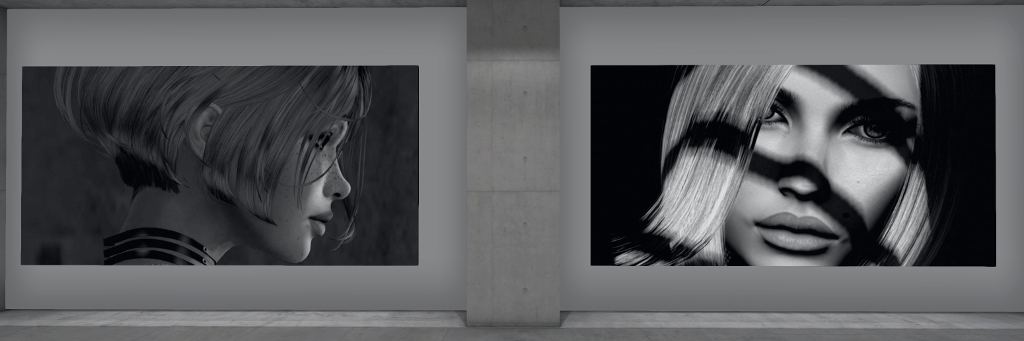
As might be expected, the SL images largely split themselves between avatar studies and landscapes, although Kody Meyers present some quite stunning interpretations of Mistero Kifeng’s sculptures. I also have to admit to being drawn to both the marvellous monochrome winter images by Jamee Sandalwood Hiess and aniya’s self-portraits.

Windlight Gallery: Kody Meyers, Fuyuko ‘冬子’ Amano and your’s truly

The new Windlight gallery building is a design from the Fanatik range and which is popular among gallery owners. It offers plenty of space, with high ceilings and good lighting, while an upper level offers additional display space, its mezzanine design avoiding any feeling that the space is crowded.

SLurl Details

Black and White at the Lyric Art Gallery in Second Life

Lyric Art Gallery – Black and White: Ebcy Clift (l) and Boone Blanco

Opening on Saturday, January 5th, 2019 at the Lyric Art Gallery is Visual Feast: Black and White, an exhibition featuring over 30 artists (and for which I’m kicking myself, as I was invited to participate… and then forgot!). Each of those artists participating was asked to submit and image on the theme of winter landscapes, although some of the art displayed takes a slightly different turn on presentation, with several pieces, while monochrome, focused on avatars.

Exhibitions like this are often an interesting way of getting to see work by artists / photographers with whom you might not be familiar or otherwise get to see – or to re-acquaint oneself with the work of artists not seen in a while. Such is the case for myself, in coming across First Touch by  Leonorah Beverly, and artist whose work I only recently encountered for the first time, instantly finding her landscape work instantly captivating. With First Touch, whilst not a landscape, demonstrates her skill in presenting an evocative story within an image.

Lyric Art Gallery: Emma D’Souza (l); Beccha (c) and Leonorah Beverly

Within those pictures that keep more-or-less to the theme of winter landscapes, these is a fascinating mix; from “straight-forward” pieces with fields of snow or trains chugging between snow banks, or houses sheltering under thick blankets of snow, through to more subtle views of winter: snowflakes drifting through an open window (Black and White by Beccha); or wonderfully atmospheric, with a bridge caught under a sullen sky; the clouds portents of cold weather (Bridge Over Troubled Water by Mishe Mactavish).

The avatar studies are equally  broad ranging, with several encompassing the winter theme as the setting, others focused purely on the avatar(s) imaged. While it is not surprising avatars get to feature in some of the images – we can be much a part of a winter setting as fir trees, snowmen and frozen ponds -, I admit to being surprised at the number of images that more-or-less eschew the winter theme (or present it only minimally) in favour of presenting a portrait, either completely or to a greater degree. Which is not to say any of them are any the less captivating – I found Pure by Andre Mascot (Snouman) particularly striking, for example.

Lyric Art Gallery: Gwen Enchanted (L); Gustaf (pv544); Fenn MacMoragh (r)

All told a very eclectic, engaging exhibition that offer more of a mix than might be expected from the invitation / greeter description. For those able to attend, the official opening will take place at 11:00 SLT, on Saturday, January 5th, 2019, with music by DJ Fae.

SLurl Details