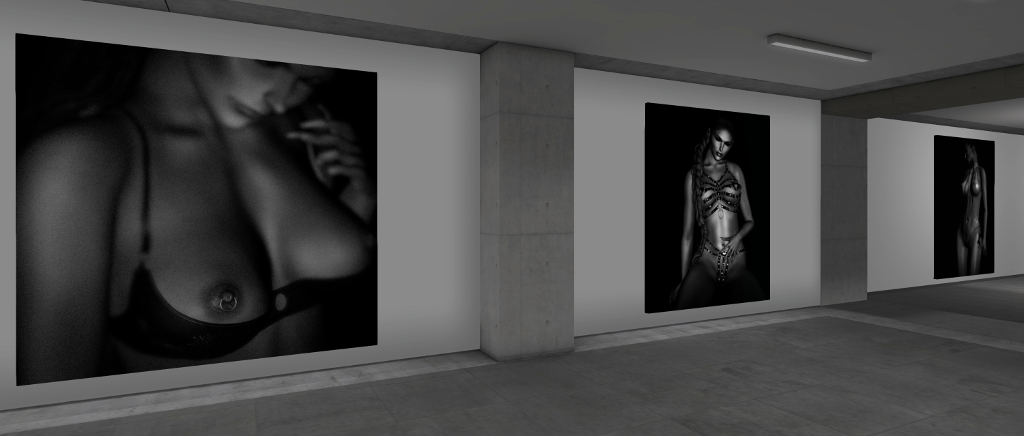
Now open at DiXmiX Gallery is an exhibition by The Huntress (TheHuntressSnare) simply entitled The Huntress. It presents 15 monochrome images, all of them nude studies of The Huntress, and which stand as a celebration of the female body.
By using monochrome, rather than colour, the images The Huntress presents a series of images that have a certain depth that might otherwise be lost. The dark background used in each tends to focus the eye and the mind much more keenly. This results in two things: it brings added life to the studies whilst also making no bones about the sheer sensuality contained within them. Within many of them, this is not only a woman comfortable with her body, she is prepared to delight in it and decorate it for her own pleasure.
The more sensual nature of the pieces displayed obviously also casts the observer into the role of voyeur. While obviously posed, there is a natural fluidity to several of the images that suggest the subject is perhaps unaware of the camera: the position of a hand over a breast as if stroking, or hovering over the midriff – as if a few more minutes would see the subject caught in flagrante delicto.
Obviously, such voyeuristic leanings, coupled with the level of nudity on display might put some off; on the other hand there is no denying the artistry involved in these images: the posing, the lighting, the angle and cropping. Each is in itself a study in the art of photography. They are also, possibly somewhat autobiographical, reflecting the artist’s own freedom from, and acceptance of, self.
Update, March 22nd: as per Cougar’s comment below, the château at Petit Lac Des Cygne is currently closed to public access.
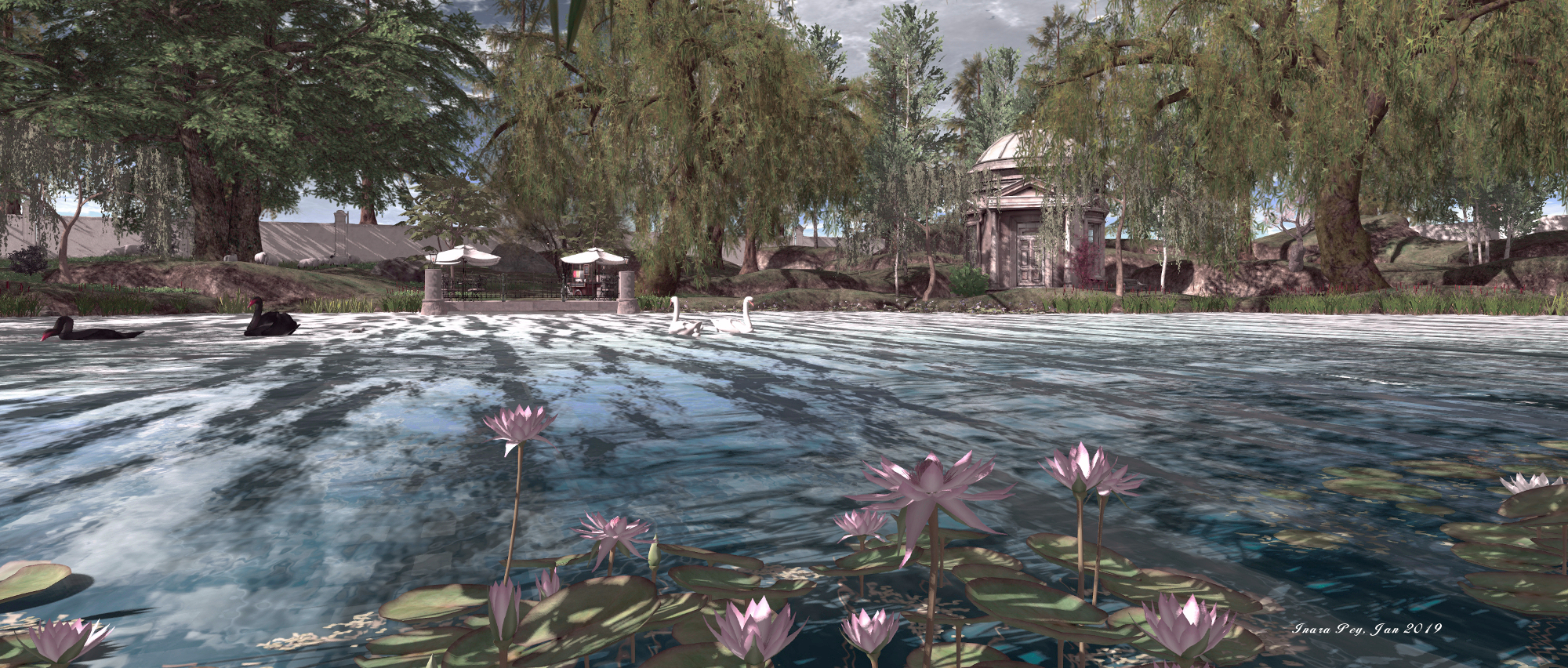
Petit Lac Des Cygne (“The Little Lake of Swans”) is a private estate that recently opened to the public for several days of each week (it is closed to public access on Mondays and Tuesdays). This is a stunning Full region utilising the 30K LI allowance designed by Cougar (Cougar Sangria). Were I to sum it up in two words, they would be: quite magnificent.
The setting in modelled after the Nouvelle-Aquitaine region of south-west France, and is stated to lie some 100 kilometres from the Atlantic Ocean and 50 kilometres from the Spanish border with France – both as the crow flies. Originally located on a Homestead region, the setting had only recently located to this Full region, and has been expanded upon by Cougar in the process to provide a rich setting, in which resides the lake of the title, a château, and plenty more to explore.
The introductory note cards, provided automatically at the landing point, might read a little forthright, but the requests made within them are not unreasonable, and do state matters clearly. The region is open to rezzing props for photography; those who do so are asked to ensure they pick up their items after the fact, with repeat offences not being tolerated. A backstory for the setting has been written in two parts, and is available here (part 1) and here (part 2) on Cougar’s blog; I recommend reading both as they add further immersion to a visit.
Surrounded by the peaks of tall mountains free of the grip of snow, and whose slopes roll down to meet the region’s edge, this is a setting that very much has the feel of being located on the French side of the Pyrenees in, as Cougar points out in her backstory, the département Pyrenees Altantiques (which is also the adopted name for the region’s simulator).
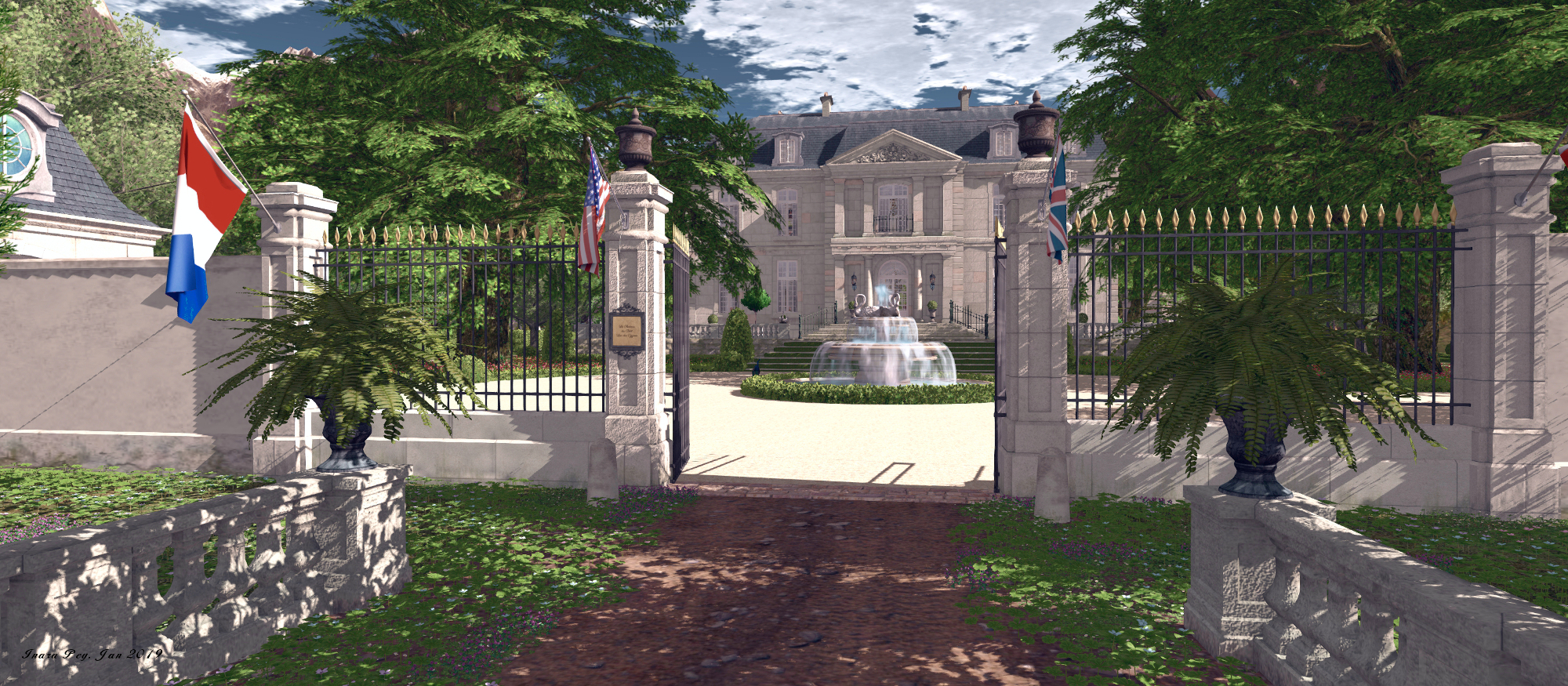
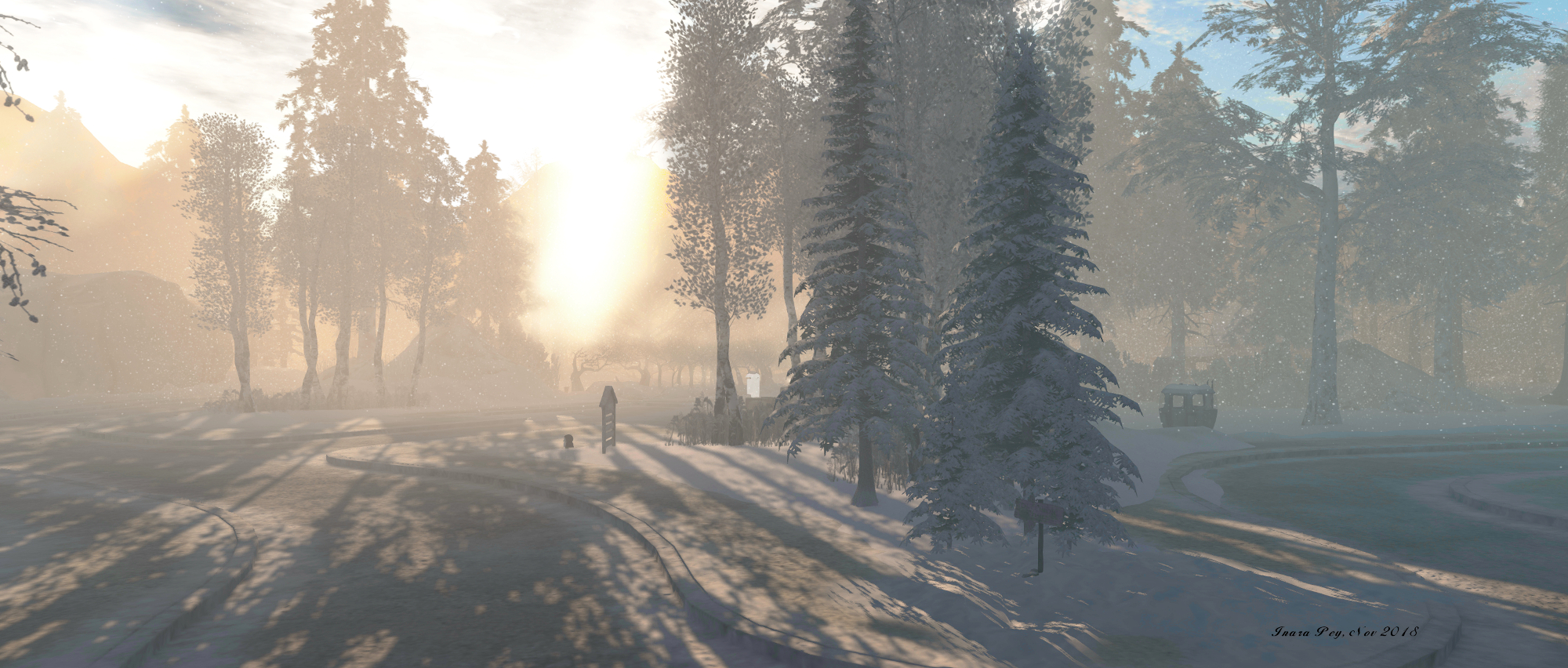
A track winds its way from the landing point, lazily meandering between tall grass and trees. It present a route around a local farmhouse (actually the Le Petit Café Cygne – about which you can read more here), complete with outdoor produce stalls, to the walls and gates of the château. Of modest size, this is nevertheless a fine house, with large courtyard to the front and formal gardens to the rear.
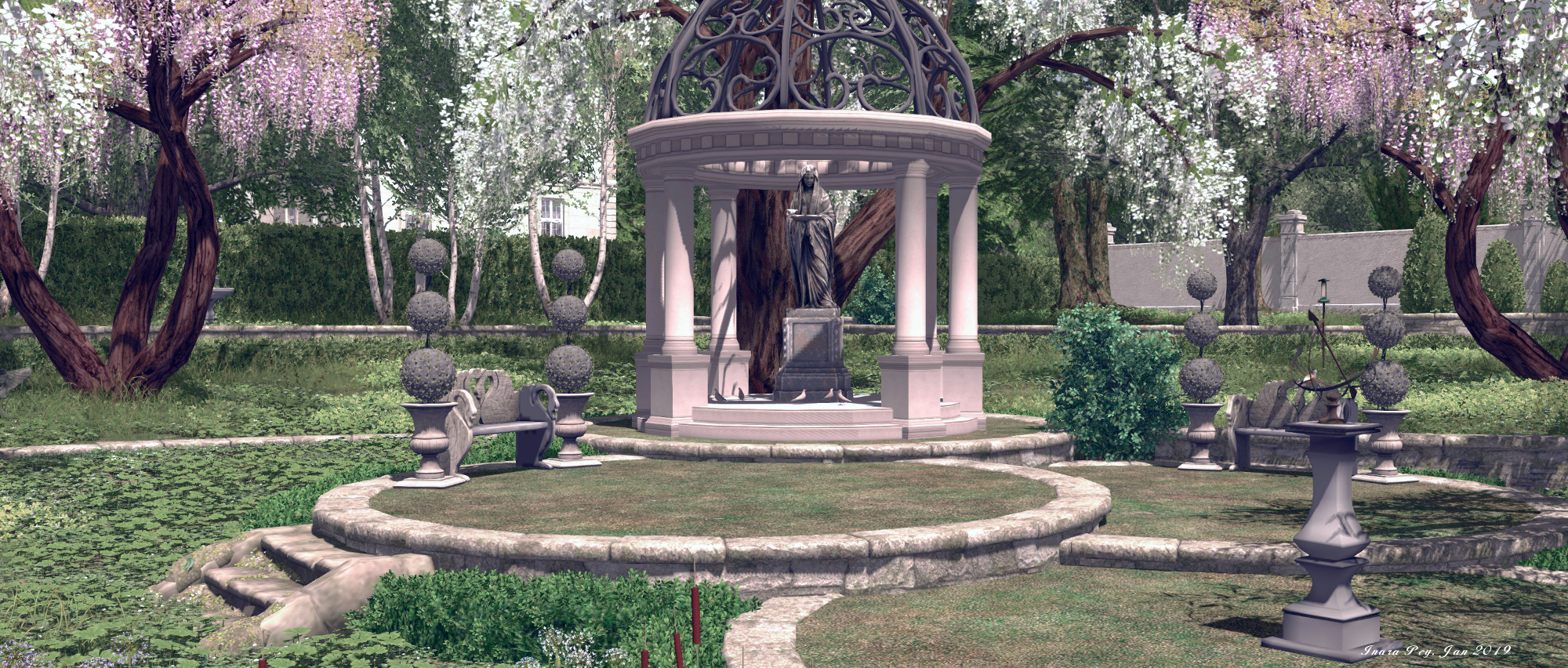
The path to the lake is to be found within the château grounds, and despite its name, it is of a reasonable size. Here, swans gently pass the time on the water, sheep graze along the lake banks, and a little outdoor café offers refreshments as it extends out over the water. All of this is watched over by a pavilion and a folly, standing as silent sentinels either side of the water. The latter is the studio for an artist, the former the setting for a small formal area amidst the wilder grasses, complete with astrolabe, statue and seating.
The château is elegantly furnished, wonderfully representative of a house that has been restored with care and love, again in keeping with the region’s backstory. The formal gardens are carefully laid out, a modern swimming pool set back and below the main house so as not to spoil the period feel, while chess can be found on one of the side lawns. Close by, a summer-house perhaps offers space for formal balls or receptions, the doors thrown wide in summer, allowing music and laughter to drift over the gardens.
Cougar describes the region as a labour of love for her; one that has taken several moths to achieve. This is very evident in the care and attention to detail that has been taken throughout the design. There is a natural look and feel to Petit Lac Des Cygne that is simply sublime; perfectly topped by an ambient sound scape (do make sure local sounds are enabled); it is beautifully presented, whether your interest is in exploring, photography and / or simple admiration. Places to sit can be found throughout, and make for welcome spots by which to pass the time.
While there is a lot going on within the region that might affect viewer performance, Petit Lac Des Cygne is a destination that rewards patience, and which really should not be missed.
A still from Empty, the 9th video in Erik Mondrian’s [MFA] Thesis video series, filmed in Second LifeErik Mondrian is a writer, artist, and scholar who makes work about place, belonging, love, longing, and madness. He holds an MA in Mass Communication & Media Studies from San Diego State University, focusing on virtual worlds as new media, and is close to graduating with Interschool Master of Fine Arts (MFA) in Voice Arts & Creative Writing and supplemental concentration in Integrated Media from California Institute of the Arts.
He is also a Second Life resident, and someone I’ve come to know, albeit indirectly through social media, and I’ve been enriched by our acquaintance.
For his thesis work at CalArt, Erik has produced a series of eleven videos to illustrate his writing, and filmed within Second Life. Each of the first ten videos offers and examination of an aspect of life or identity, or of emotions or feelings, personal reflections or desires; each narrated by Erik, words and images combining into a series of stunningly moving and deeply eloquent visual poems (even those presented as prose) which are quite breathtaking in their breadth and meaning.
Making: the first video in Erik’s Thesis series
As companions to Erik’s words, these are films which are fabulously unique and perfect in reflecting and amplifying his words; each marvellously frames his thoughts and the emotions of each piece without ever intruding or distracting. Through them, Erik displays that not only is he a master of words, but he is also deeply visually creative; the composition, framing and presentation of each video is utterly captivating.
Since my MFA at CalArts is three-pronged, I wanted (with the support & encouragement of my mentor on the Creative Writing side, Jon Wagner) to do a thesis project that blended all three of my areas of study in some way [written word, voice and media] … The project also came about in part because of my years spent in virtual worlds of all kinds [and] the experiences I’ve had there and the people I’ve met … I’ve been “on-line” for close to 25 years, and almost as long in virtual spaces from IRC and MUDs through to worlds like The Palace, Active Worlds, and of course, almost fourteen years in SL.
– Erik in discussing his thesis video series
What I personally find engaging in these films is the rich, allusive timbre evident in Erik’s writing. Together with his sheer lyricism, he produces wordscapes that are beautifully attractive. Through a crafted choice of words, he encourages, suggests, points – but never blatantly leads or cajoles. He sets out path of thought, complete with potential branches or turns, where allusion and suggestion lies as much within each word as within every passage. He invites us listen and allow our imagination to take whichever route it may choose through prose and verse. Thus, while there may well be a destination Erik has set for our journey, how we reach it is entirely left in our hands – or rather our thoughts and our mind’s eye.
Escape: the second video in Erik’s Thesis series (and her favourite)
These are also unmistakably deeply personal pieces. By his own admission, Erik is reserved, quiet, introverted. Yet he has the gift of observation and the power of expression, These combine to resonate within each of us and find fertile ground within our thoughts. Thus, while personal to him, the ideas, feelings, emotions, questions, desires, ideas and images he creates are equally personal to those who listen and watch. And this is something that he is himself aware of, as he appears to note through the eleventh video in the series, which stands as both a conclusion and an artist’s statement.
Place without belonging. Longing without love. A special kind of madness that comes from hiding in plain sight, seen but not yet recognised, heard but not yet understood. I move through time and space, observing all, saying far too little. What do you make of this? The lives you live, the memories, the moments—where do they go? Who do you find there? I’ve tried to make that journey here, tried to reconcile my circuitous wandering, outwardly aimless, with a destination that remains forever a step ahead, an optical illusion that pulls away even as it draws me forward.
– From video 11: Artist Statement
It is through this final piece that Erik is most revealing about himself and by extension, each of us. As such, and while billed as an “artist’s statement”, it is integral to the whole series and should be watched and absorbed as a part of the whole.
I could wax further on the subject, but really, the best way to appreciate these films is to see and savour them. So instead, I’ll close with a quote from my fellow Second Life writer and traveller, Ricco Saenz
These videos are brilliant, powerful and thought-provoking. They create an intriguing atmosphere – and udoubtedly deserve to be called art.
You can see all of the videos back-to-back in their intended order via Erik’s Thesis playlist. And be sure to read the accompanying notes for SLurl to the SL locations featured in each.
I was led to The Inevitability of Fate, a region-wide installation by Rose Borchovski (the innovative Dutch multimedia artist, Saskia Boddeke in the physical world) by fellow grid explorer (and accomplished writer and machinima maker) Erik Mondrian – and I’m genuinely indebted to him for doing so, for a number of reasons.
The first is, and to be perfectly honest, I actually had no idea any of Rose’s installations were still present in Second Life; over the last few years she appears to have focused more on physical world installations that have a virtual cross-over features the work of artists such as Bryn Oh (see Art and Obedience in Berlin and Second Life and The virtual reality of the Russian avant-garde for more). Secondly, while this installation did get a mention in this blog when writing about Rose’s work on 2013, I never actually properly reviewed it, so I can now put that to rights.
Thirdly, and most significantly, this is an installation that is poignant in its message, and while it reflects on events that took place in the middle of the 20th Century, the underpinning message it carries has as much relevance in the world in today’s political climate.
The landing point provides, via blank verse, a synopsis of the installation. This comes with an information note card outlining preferred viewer settings. Of these, the most important is to make sure your local sounds (not the audio stream) are active – a major part of this piece is aural, starting right on the landing point itself, which should be listened to before taking the teleport down to the ground level, as it very much sets the scene both directly through the spoken words and by the background sounds – particularly the clackety-clack of a train, which is not as innocent as might first seem.
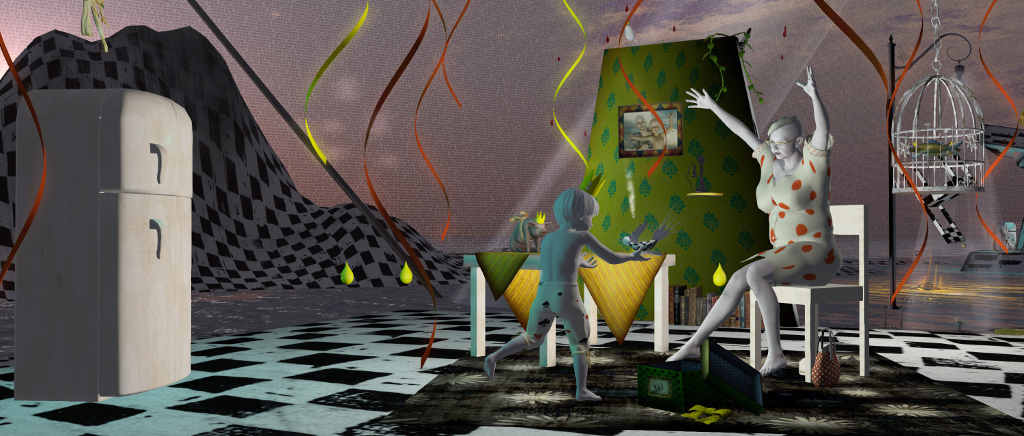
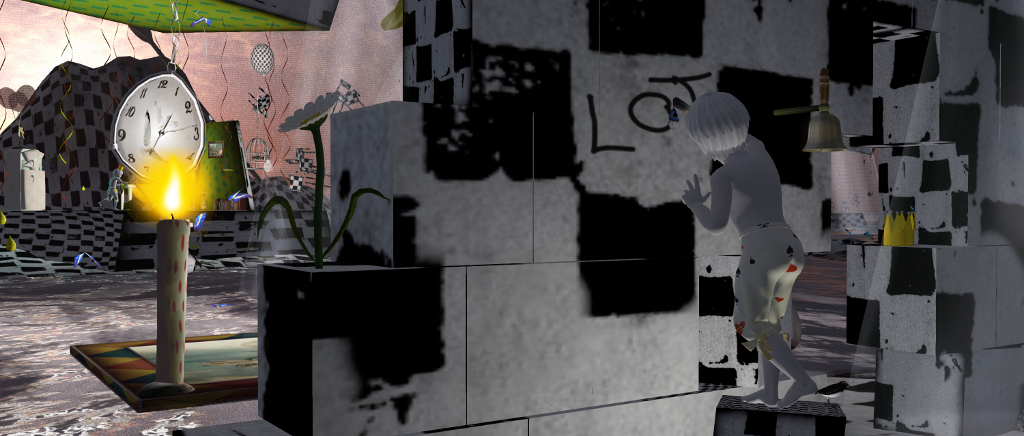
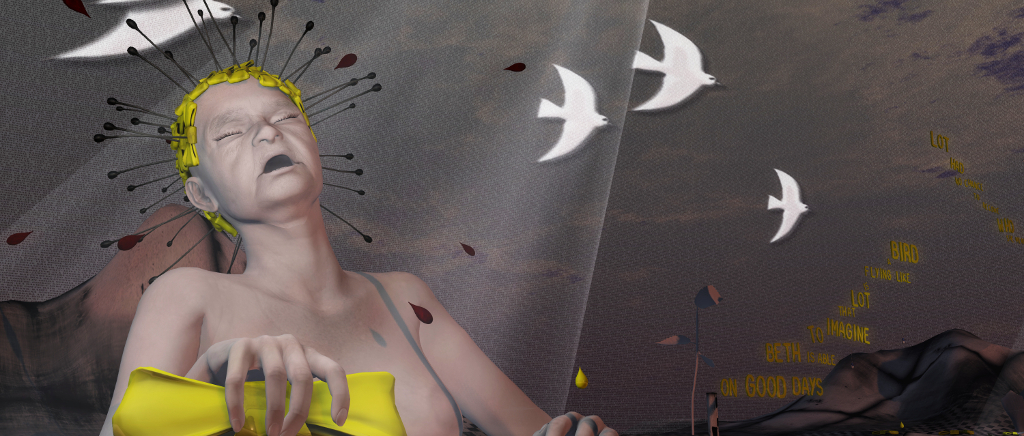
On the ground, we are introduced first to Lot, then to her mother, Beth. All seems normal, Lot at play in the first vignette, and beyond it, Lot happily celebrating her ninth birthday with her mother. As a small aside, when moving through the vignettes (your route is denoted by white-on-black arrows), keep an eye out for the yellow tear drops, which offer poses, and the small blue eyes, which offer teleports.
These first vignettes are joyous – as childhood should be. But all too quickly, things change as we move beyond the birthday celebration.
The war came and all did change. A harsh hand ruled the world of Beth and Lot. They were forced to leave. They were separated from each other. They were made the enemy.
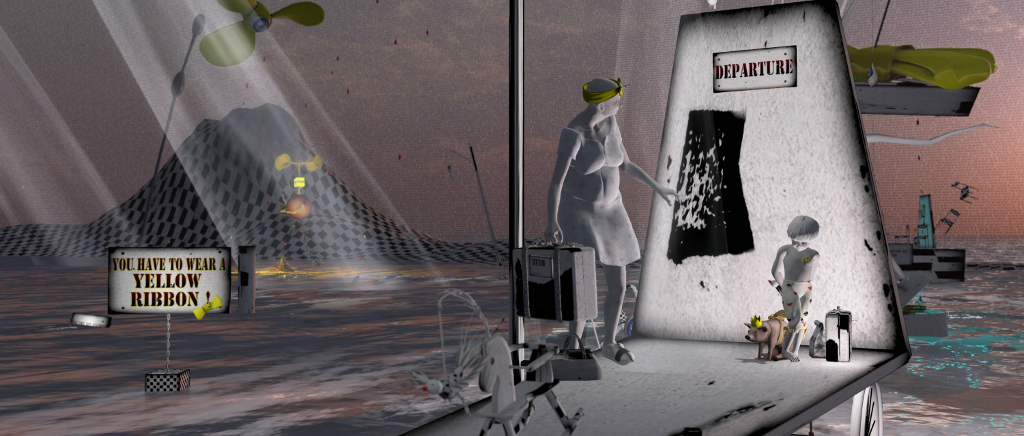
With the war comes an increasing series of unsettling changes: we – with Beth and Lot – must wear yellow ribbons (a recognition of Jews within Germany and other occupied / Axis nations being forced to wear the yellow Star of David). Then we are informed of a list of restrictions placed on our lives, both in terms of movement and activities. Finally comes removal of identity we become a number and “the Ememy”, forceably relocated to a ghetto.
This leads, inevitably to separation, as Lot is taken away from Beth. Here the story jumps forward to a post-war era, where, and although she survived, Beth’s agony does not end.
After the war Beth returned. The child Lot had disappeared; no one knows where she went. Beth keeps searching for Lot. On good days, Beth is able to imagine that Lot is flying like a bird, with her face towards the sky, searching for the stars. On bad days, Beth can only be angry about her loss. Beth’s wounds will never heal. Lot had no chance to become who she meant to be.
While the horrors of the concentration camps and the Holocaust are not represented directly, they are given subtle recollection: the aforementioned clacking of train cars on rails (trains being the means by which those from the Ghettos were ferried to the camps) and the high “fence” surrounding the installation revealing itself, when viewed closely, to be the names of those known to have lost their lives as a result of their internment. Meanwhile the chequerboard surface of the landscape and some of the elements within it might be seen as an indirect reference to the stripped uniforms worn by those interred in camps and prisons.
Although historical in presentation, the relevance of The Inevitability of Fate to the modern political landscape is clear, from the re-emergence of discrimination and bigotry against people on the basis of appearance, colour race, gender or sexual orientation, through to the use of their religion or circumstance to blank label them as “the enemy” and / or a scapegoat for perceived woes – or simply as a means of political expediency / deflection, right up to and including the separation of children from parents, which has led to many of the latter being left entirely unaware of the fate of the former.
All of this may make The Inevitability of Fate an uncomfortable visit, but that doesn’t make it any less worth seeing.
The majority of the following notes are taken from the Content Creation User Group (CCUG) meeting, held on Thursday, January 10th, 2019 at 13:00 SLT. These meetings are chaired by Vir Linden, and agenda notes, meeting SLurl, etc, are usually available on the Content Creation User Group wiki page.
SL Viewer
There are still no updates to the current crop of official viewers in the pipelines, leaving things as follows:
Current Release version 6.0.1.522263, dated December 5, promoted December 13. Formerly the Spotykach Maintenance RC viewer.
Release channel cohorts:
Estate Access Management (EAM) RC viewer, version 6.1.0.522564, December 19.
BugSplat RC viewer, version 6.1.0.522614, December 18. This viewer is functionally identical to the current release viewer, but uses BugSplat for crash reporting, rather than the Lab’s own Breakpad based crash reporting tools.
Love Me Render RC viewer, version 6.0.2.522531, December 18.
Project viewers:
Environmental Enhancement Project (EEP) viewer, version 6.0.2.522550, December 18.
Bakes on Mesh project viewer, version 6.0.1.522127, December 7.
Linux Spur viewer, version 5.0.9.329906, dated November 17, 2017 and promoted to release status 29 November – offered pending a Linux version of the Alex Ivy viewer code.
Obsolete platform viewer, version 3.7.28.300847, May 8, 2015 – provided for users on Windows XP and OS X versions below 10.7.
Hover Height / Vertical Positioning Issue
Ever since server release 18#18.10.25.521081 was deployed at the end of October / beginning of November 2018, there have been reports of a hover height / positioning issue for full mesh avatars of less than “normal” height. This can leave such avatars floating 0.2 to 0.3 metres off the ground if non-height related changes are made after hover height has been set (BUG-225893).
Current Status
Anchor Linden has found the root cause for the issue, buried in the Bake Service. He has a fix for the problem, and it will be going out as soon as possible after it has been through testing and QA.
Animesh
Animesh and Pathfinding
As noted in my Simulator User Group update, there is increasing interest in Pathfinding now that Animesh is available, and there is a forum discussion going on around the ways and means to move Animesh which encompasses tests with Pathfinding.
Again, the Lab currently aren’t working on Pathfinding, but they are aware of the discussions and following them. In particular, there is interest in hearing back from people who have used Pathfinding sufficiently who could perhaps help define a set of best practices for using the capability / who have used it sufficiently with Animesh to be able to point to deficiencies in the system or could suggest means of improving it.
Animesh Sex?!
Early on in Animesh development a feature request was put forward suggesting a switch be added to the viewer so that if Animesh creators are on a parcel with parcel privacy enabled, they will obey the setting and not be seen from outside of the parcel so long as the root prim remains within the boundary (see BUG-202592). The idea would be to prevent “adult / sex” Animesh from being accidentally seen.
The bug was closed without action, and a suggestion has been made to add a scripted capability to do the same things. This seems to be something of an edge case / overkill, given animated objects of a sexual nature can be seen within a region with privacy enabled, even if the using avatars cannot.
Animesh Marketplace Sub-Categories
There are currently no plans to add sub-categories to the Animated Objects category of the Marketplace.
If it is felt there is a name to add further sub-categories, suggestions should be made via the CCUG meetings and also the Web User Group meetings.
Environment Enhancement Project
Project Summary
A set of environmental enhancements allowing the environment (sky, sun, moon, clouds, water settings) to be set region or parcel level, with support for up to 7 days per cycle and sky environments set by altitude. It uses a new set of inventory assets (Sky, Water, Day), and which include the ability to use custom Sun, Moon and cloud textures. These can be stored in inventory and traded through the Marketplace / exchanged with others, and can additionally be used in experiences.
The project also includes a new set of render shaders to support atmospheric effects such as rainbows, crepuscular rays (“God rays”), better horizon haze and fogging (but will not include rain / snow).
Graham is continuing the final work on the shaders for things like crepuscular ray support, and Rider is working on a clean-up of the new EEP UI elements.
An updated project viewer that includes all of this work is anticipated as being available in week #3 (commencing Monday, January 14th, 2019).
Rider will also be updating the EEP LSL documentation in the wiki.
Sample settings objects are expected to appear in the viewer library “soon”. These will comprise all of the current default windlight settings found in the official viewer, plus a selection of windlights found in Firestorm.
ARCTan
ARCTan is the code-name for the project to re-evaluate object and avatar rendering costs to make them more reflective of the actual impact of rendering both, which it is hoped will also help correct some inherent negative incentives for creating optimised content (e.g. with regards to generating LOD models with mesh). This project has been on a slow burn through 2018, but is due to resume in 2019 – although when is still to be determined.
Other Items
iOS Client: Mention was made of the preliminary work being carried out to develop an iOS client. For details, please refer to the following blog posts:
Wiki updates: these is apparently some issue with the SL wiki which is causing problems with updates to the “official” pages managed by Linden Lab.
Mac Retina fixes: there are apparently issues of UI blurring with Mac Retina screens. There are fixes in-hand, but the time frame for deployment is not clear, although a new build of the viewer with Retina support was due to go to the Lab’s QA team on Thursday, January 10th.
Next CCUG Meeting: due to the Lab’s internal All Hands meeting (delayed from the start of the month), the next CCUG meeting will be on Thursday, 24th January, 2019.
On January 9th, 2019, and thanks to a pointer from Whirly Fizzle, I blogged Lab working on a Second Life iOS client?noting that a Bit Bucket code repository had recently been set-up by Brad Linden for just such a purpose.
In writing the piece, which includes some of the Lab’s recent commentary of the subject of mobile / streaming solutions for Second Life, I indicated that I had contacted Linden Lab with a series of questions concerning the repository and what it might signify, and that I’d provide an update on receiving any reply.
Being so early into the work, the Lab declined to comment on all of the questions I asked, but here is what they did say via-email in responding to my enquiry:
As you point out, we discussed at our Town Hall events last year that we’re actively looking at ways to extend the reach of Second Life to new audiences including mobile platforms. For example, we’re in the early stages of work on an iOS companion app for Second Life.
Right now we’re focused on getting a prototype out to our Residents, at which point we’ll be looking for feedback and suggestions. In the early stages, we will not be tying the app to a streaming service. However, we don’t have anything to formally announce yet about the specific features, capabilities, and availability.
– Brett Linden, Second life Marketing Manager, via e-mail
Granted, it’s not a lot of information, but there are a couple of potentially interesting elements to the statement that might help contextualise things / be indicative of some of the thinking still in place at the Lab. For example, the use of the term mobile platforms and noting that that the iOS work is offered as an example of this work.
This would perhaps suggests (and in answer to some of the questions asked following my original piece) that an Android client is still part of the Lab’s thinking. Certainly, it is something I’d anticipate, given both the popularity of the Android platform and the popularity of Lumiya and Mobile Grid Client*.
I also found the comment In the early stages, we will not be tying the app to a streaming service interesting, suggesting as it does that a future streaming solution is still very much part of the Lab’s broader thinking.
Again, this would make sense given the ongoing move of SL to the cloud. As well as providing the means to deliver SL as a whole to users, the cloud move further deepens the Lab’s relationship with AWS. This might in turn allow them to more positively and cost-effectively (to both the Lab and to users) supply a streaming service to mobile devices and web browsers at some point in the future. Perhaps this might even be part of a broader examination of their product offerings once Second Life is firmly established within a cloud-based infrastructure.
So, food for thought; in the meantime. I’ll continue to update on the iOS work as / if / when news emerges.
* I’m intentionally avoiding LittleSight here, as it is questionable as to whether the app is still being maintained and the repeated complaints that users have been unable to log-in since the last update (October 2016).