The Stolen Child in Second Life

The Itakos Project, The Stolen Child – CybeleMoon

CybeleMoon (Hana Hoobinoo) is renowned for her fabulous mixed-media art. It carries within it a richness of tone, a mixing and balance of light and shade, a depth of symbolism and – most poignantly – a wonderful framing of narrative that makes any exhibition of her work in Second Life utterly unmissable.

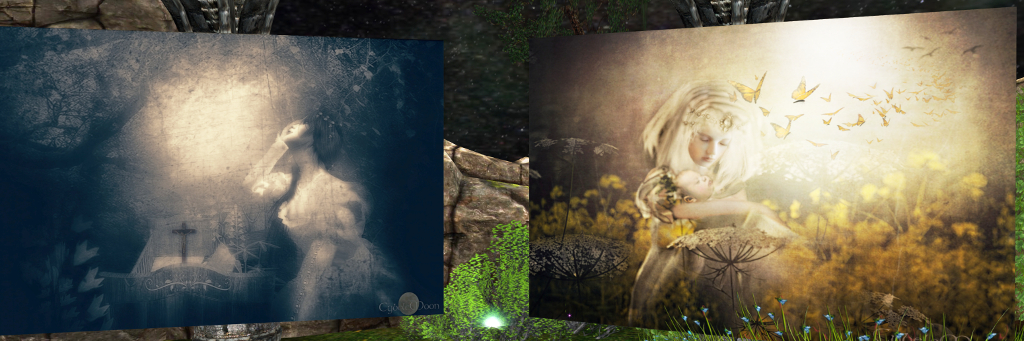
All of this richness, depth and framing is on display in full force at The Itakos Project, curated by Akin Alonzo, where Cybele presents The Stolen Child, a series of 15 images presented within a glade-like setting caught in the enfolding arms of ancient ruins, which has been specially built for the exhibit by Akim. Reached via the teleport door in the main foyer of the gallery, this setting is not merely a backdrop for Cybele’s art, it is part of the overall theme of the exhibition, designed through its form and lighting to increase the feeling of immersion in in the story the exhibition presents.
The Itakos Project, The Stolen Child – CybeleMoon

This story is not offered as a linear tale; rather, there is a central strand of theme running through both setting and images. This strand leads us through Cybele’s images, linking them indirectly and without necessary order (although one is suggested, somewhat by the circular placement of the pieces) as they form windows, if you will, into the underlying proposition of the exhibition; a proposition a proposition Cybele explains thus:

Fairies are not benevolent creatures at all, attracted by the strength and vitality of mankind, they kidnap children and especially newborns, or seduce (for the purpose of kidnapping) beautiful girls and boys.

She continues by noting the myth of the fairy lies routed in a times past need to rationalise the death of a child, be it at birth or with a short span of months or years thereafter: that the fairies had stolen the child away from a otherwise sad destiny. Within this weaving of fable, there was also menace: children with autism, depression, or other mental health issues were at times considered to have lost their souls as a result of eating fairy food.
The Itakos Project, The Stolen Child – CybeleMoon

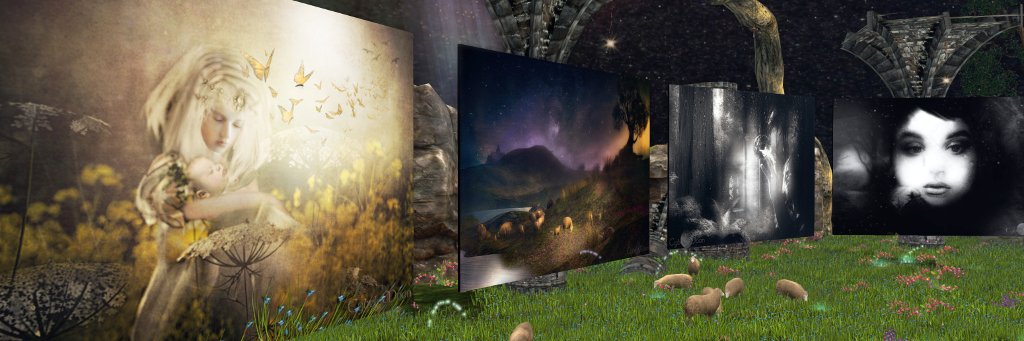
Thus through Cybele’s art were are presented with a series of poignant scene sit within the framework of the dome of a night’s sky – the time when fairies might be abroad more than during the hours of daylight – and within a symbolic ring of ancient walls and arches. The latter carries with it a echo of the fairy ring of mushrooms that act as doorways to the fairy realms, or the idea of the faery castle hidden from mortal eyes by the form of a hill, and into which abducted children might be taken should they not take care.

That central strand running through the images – and the exhibition as a whole – takes the form of The Stolen Child, written in 1886 by by William Butler Yeats, who was also captivated by the entire mythology of faeries in Irish mythology. Through the words of his poem, we witness the bewitching song of the faerie folk, calling to children, tempting them away…

Come away, O human child!
To the waters and the wild
With a faery, hand in hand,
For the world’s more full of weeping than you can understand.
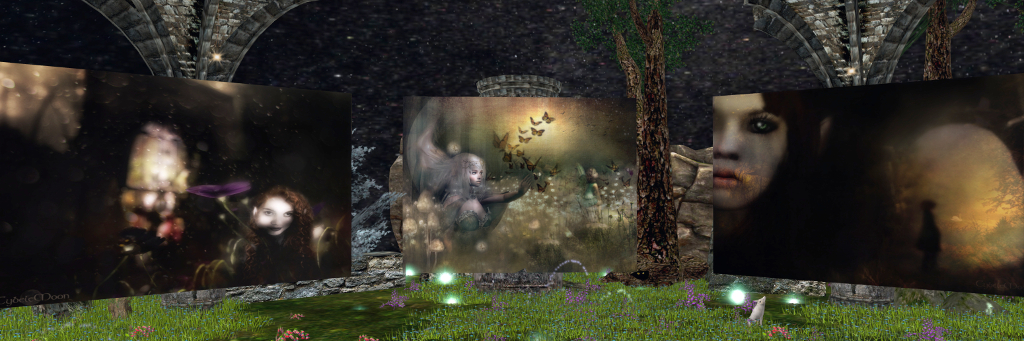
The Itakos Project, The Stolen Child – CybeleMoon

Cybele takes lines and words contained within the poem as titles for each of her pieces. Thus, each image forms that window I mentioned above, a glimpse into a scene, one that is often double-edged. On the one hand, it may seem innocent and rich in joy or tranquillity: young folk running through a meadow; a view across rolling hills at twilight while sheep graze; the innocence of blowing into a dandelion. On the other, the titles of the pieces hint at the darker element of fae intent: the stealing away of children, of leaving mothers bereft, to deny the young that chance to see sheep grazing at twilight or know the comforts of home and hearth, their young lives having been swept away with the promise of dances by moonlight in places forbidden by their ever-anxious parents.

To further accompany the exhibition, Cybele also provides a short story, together with additional images, that can be found on her (always enchanting) website. Also presented with the story and images is an audio recording of the marvellous Loreena McKennitt, who put the words of The Stolen Child to music. I’ll leave you with a video of the song from one of Ms. McKennitt’s live performances, and the note that this is a truly engaging and evocative exhibition; rich in narrative and atmosphere, and absolutely not to be missed.

SLurl Details

  • The Itakos Project (ATL, rated Moderate) – remember to take the teleport door in the gallery’s foyer to reach the exhibition!

2019 SL User Groups 35/2: Content Creation summary

(fae forest), July 2019 – blog post

The following notes are taken from the Content Creation User Group (CCUG) meeting, held on Thursday, August 29th 2019 at 13:00 SLT. These meetings are chaired by Vir Linden, and agenda notes, meeting SLurl, etc, are usually available on the Content Creation User Group wiki page.

Bakes on Mesh

Project Summary

Extending the current avatar baking service to allow wearable textures (skins, tattoos, clothing) to be applied directly to mesh bodies and heads. This involves viewer and server-side changes, including updating the Bake Service to support 1024×1024 textures, but does not include normal or specular map support, as these are not part of the existing Bake Service, nor are they recognised as system wearables. Adding materials support may be considered in the future.

Resources

Current Status

  • BoM is now live. See:
  • There are some local edit issues  – some already noted in the viewer release notes – that can produce odd results when using the appearance editor which correct themselves on exiting the appearance editor and when baked via the Baking Service.
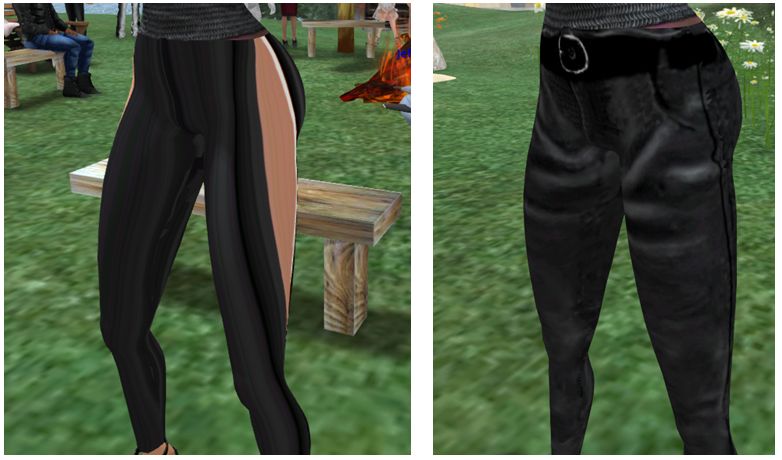
Cathy Foil has noted this glitch than can occur with Baked_Lower wearables on BOM: when editing locally in the appearance editor, the leg does not appear to be masked correctly by the wearable (which is also incomplete at the waist). Once baked, however, the wearable appears correctly applied and in full (r). Credit: Cathy Foil.
  • Some of these local edit issues may not be specific to Bakes on Mesh, but may be more noticeable as a result of BoM, and the Lab is looking to resolve them.

Animesh Follow-On – Project Muscadine

Project Summary

Currently: offer the means to change an Animesh size parameters via LSL.

Current Status

  • The simulator support on Aditi (the beta grid) – DRTSIM-421 (region Bakes on Mesh) has been updated, but there are no feature changes within it.
  • The project viewer has been merged with Bakes on Mesh (as the release viewer) and is passing through the Lab’s QA, and so should be appearing soon.

ARCTan

Project Summary

An attempt to re-evaluate object and avatar rendering costs to make them more reflective of the actual impact of rendering both. The overall aim is to try to correct some inherent negative incentives for creating optimised content (e.g. with regards to generating LOD models with mesh), and to update the calculations to reflect current resource constraints, rather than basing them on outdated constraints (e.g. graphics systems, network capabilities, etc).

Current Status

  • Work has now resumed.
  • First part of this is to continue data-gathering and look at re-aligning some figures based on the changes made for Animesh.
  • Thus far, the project primarily comprises enhanced logging to assist the Lab in data collection, allowing information on the overall cost of a specific avatar or in-world object to be gathered.
  • Once enough data has been gathered across a broader enough spectrum of content to give the Lab confidence they have a good understanding of things, then work can start on adjusting the cost calculations for rendering, etc.
  • It’s important to note that any user-viewable changes as a result of ARCTan are still some way off, and the Lab will be staging things to let users know what is happening when, and what it is likely to impact.
  • There was a lot of general conversation towards the end of the meeting on what people hope ARCTan will do (e.g. forcing creators to make proper use of avatar LODs, etc.).

Environment Enhancement Project

Project Summary

A set of environmental enhancements (e.g. the sky, sun, moon, clouds, and water settings) to be set region or parcel level, with support for up to 7 days per cycle and sky environments set by altitude. It uses a new set of inventory assets (Sky, Water, Day), and includes the ability to use custom Sun, Moon and cloud textures. The assets can be stored in inventory and traded through the Marketplace / exchanged with others, and can additionally be used in experiences.

Due to performance issues, the initial implementation of EEP will now likely not include certain atmospherics such as crepuscular rays (“God rays”).

Resources

Current Status

  • Work continues on rendering bug fixes.
  • The number of remaining issues is “trending downwards”.

Misc. Items

  • The upcoming Voice RC (or project) viewer mentioned at the last TPVD meeting still has a couple of issues preventing it from surfacing in the Alternative Viewers page.
  • The Umeshu Maintenance viewer (currently version 6.3.1.530411, merged with Bakes on Mesh) could be promoted to de facto release status as early as week #36 (commencing Monday, September 2nd), in a break from the Lab’s preferred 2-week gap between release promotions.
  • Date of next meeting: Thursday, September 12th, 2019.

Lab Gab episode 1 – a summary

Strawberry and Xiola Linden with “Gabby”the cat (name TBC) on the Lab Gab set

The first episode of Lab Gab streamed on Wednesday, August 28th, hosted by Xiola and Strawberry Linden, and drew a comfortable audience. I intentionally stayed out of the chat but saw a few familiar names there.

Running to 35 minutes, the programme was not deeply revelatory with regards to Second Life news – that will likely be for future segments of the show. However, it did offer a comfortable, if slightly frustrating start – I say frustrating because the broadcast gremlins raised their little heads to try to keep Strawberry from being heard over the stream.

The first few minutes  – up to around the 9 minute mark – of the show covered Xiola and Berry’s roles at the Lab, and folded in notes on the Lab’s various social media presences and also the Destination Guide for finding places to visit.

Bakes on Mesh (BoM) then got a plug, being the latest update from Linden Lab. Berry attempted to clear-up confusion as to what it is (simply put: a means to apply system avatar wearables to suitably prepared mesh bodies and heads in a manner somewhat akin to how they used to be used with the system avatar, albeit with the option of supporting high resolution textures than available for the system avatar).

The official blog post on the release is available here, and I attempted to cobble together a basic primer on the subject (although I suspect that in part might also veer a little too close to the technical).

In talking Bakes on Mesh, Berry underlined at that BoM will require mesh body and head creators to provide updates to their offerings that are correctly flagged to use Bakes on Mesh natively. She also noted to the experimental Omega Bakes on Mesh applier system that I also referenced in my primer article. This is available from the Omega in-world store. However, I was interested to note that it did not work for Berry  – and I actually found it less than satisfactory when testing. Overall, the results seem variable, with some having absolutely no issues with it, and others (like Berry and I) encountering problems – hence, again, why it is called “experimental”. For those who wish to try it out, step-by-step instructions, courtesy of Theresa Tennyson (who is not associated with Omega, so please don’t crowd her with questions if you do have issues!) are available here.

Additionally, Berry pointed to an alternative HUD (L$125) which apparently works just fine, although I’ve yet to try it myself.

One of the key points with Bakes on Mesh is that it should enable body / head creators to make their products less complex, simply because they do not need to include so many onion skin layers, hence why the release advantage with BoM really lies in updates to existing bodies and heads, as the various creators will hopefully make available in the coming weeks (Slink has already updated). Thus, even for those who don’t use applier systems for clothing that mush, Bakes on Mesh is important, as adoption of updated bodies / head can have the potential to help reduce general rendering load for everyone.

Around the 14:40 mark, Xiola indirectly replied to some speculation on my part (raised when writing about Lab Gab ahead of the show), when I wondered:

I also admit to being curious as to whether the show might at some point down the road – depending on its longevity – also occasionally “hop over the fence” into Sansar or even perhaps take some “behind the scenes” (desires for things like privacy allowing among staff) looks at the Lab itself. “Lab Gab” seems to be too broad a title to remain purely about Second Life (although there is a lot to explore on that subject alone), even allowing for it being intentioned as a “catchy” name for the show.

By way of “reply” (I’m not sure Xiola’s comment was driven as a result of my speculation or not) Xiola noted:

I know the name of our new show here is “Lab Gab” – we just really likes how that sounded … but currently, short-term, our plans are to definitely focus on Second Life, although obviously we work for Linden Lab and Linden Lab also has Sansar … but the focus of this show is, initially and short-term, Second Life and the Second Life Community.

After some general chit-chat around giveaways, the show turns to a mini Q&A session from around the 19:15 mark, some of which are summarised below:

  • Linden Lab is currently working on an communications / companion app for iOS
  • When are last names coming back?
    • Still being worked on, have a lot of variables involved in terms of back-end systems and complexity.
    • Again, those interested can catch the last formal update I have (including comments from Oz Linden) in the First and last names section of my coverage of Oz’s appearance at SL16B with April Linden in June 2019. This also addresses a number of questions on the topic.
  • Linden Homes:
    • There is now a weekly roll-out programme (Mondays, Wednesday, Fridays) when homes are made available through the Linden Homes web page.
    • New types and styles of Linden Homes are still in the works, but no release dates.
    • Best way to stay up-to-date is to keep an eye on the official blogs and on the Linden Homes update thread on the forums.
  • Will Lab Gab include interviews with Lab staff? – Yes.
  • Upcoming major updates:
    • Bakes on Mesh is now out, per above.
    • The Environment Enhancement project (EEP) is progressing towards release – but no definite time frame other than Soon™ as bugs are being stomped on.
    • Not directly mentioned in the show is the new Animesh enhancements work (Project Muscadine) and also back on the horizon is the restarting ARCTan (two name but two of the more user-facing projects – there is also a lot of under-the-hood work going on).
    • Details on projects like this can be found in my (generally) weekly Content Creation User Group meeting summaries and also my other SL tech summaries.

An interesting start to the series, nicely relaxed, and a segment where the voice issues didn’t spoil things too much. Some nice teasers were dropped on future shows and direction which suggest Lab Gab will be a good option for tuning into every couple of weeks. In the meantime, you can catch the entire first show below.

Frogmore: Swedish childhood memories in Second Life

Frogmore, August 2019 – click any image for full-size

Update, November 2019: Frogmore has relocated to a full region. The SLurls in this piece have therefore been updated to point to that location. A review of the new region location is available here: Frogmore: more Swedish memories in Second Life.

Frogmore – or to give it its full name, Frogmore Gamla Stan (“Frogmore Old Town”), is a homestead region designed by Terry Fotherington (of {PAPPADO} – read more here and Kekeland  – read more here – fame) on behalf of region holder Bengta. The region’s design serves a very specific purpose, as Bengta explains:

Frogmore Gamla Stan is a memory of life as a child in Öregrund, Sweden. The air is filled with the scent of the sea, old fishing boats, and smoked herring. A simple life filled with love and laughter.

Frogmore, August 2019

A quick check on Öregrund reveals it to be a small town (population 1,500-ish in 2010), on the Baltic coast of Sweden’s Uppsala County. It’s apparently a place that was largely ignored by Sweden’s 19th century industrialisation; other than bar iron passing through the town’s harbour en route to places like England, the town itself largely remained centred on fishing, although in the late 19th century it did became popular as a spa resort.

It is that history as a fishing town, as Bengta notes, that Frogmore draws a part of its inspiration, together with the rugged beauty of the Scandinavian coast, to form a wonderful little fishing hamlet clinging to a rugged coastal region / group of islands. Given that it is only inspired by childhood memories as visualised through the eyes of another, direct parallels between Frogmore’s look and Öregrund perhaps shouldn’t be made.

Frogmore, August 2019

Instead, it is better to simply wander along the single, cinder-topped road, passing between brightly-painted wooden places of business and cabins (none of which are furnished within, to allow the focus to be on the landscaping and overall setting, to where steps climb upwards and more inland. The waterfront cabins and buildings are literally that: right on, and sometimes over, the water, with steps and moorings for rowing boats, nets drying as they hang from walls, and sofas and benches set on raised porches.

More houses and places of business can be found on the stepped shoulders of rock rising on the landward side of the road, and with a little care and scrambling, you can make your way to where a primitive log bridge spans a narrow watery gorge separating the two largest islands. This is worth taking, as it leads the way past a superb little rocky stream that tumbles down from one pool to another which, presumably has an opening somewhere under the cold-looking waters to allow the flow to continue on its way. Created using one of Alex Bader’s new Animated River Building Packs (see here and here), it really shows what can be achieved with what is  – to me – the best mesh river system available in SL.

Frogmore, August 2019

Exploring the region can be both fun and a little frustrating. Fun, as there are little cinder trails to be found here and there, offering the way between rocks to cabins or down to little beaches and coves. Frustrating, because although there are a couple of paddle boat rezzers to be found on the different islands, the lie of the land means you can’t actually use them to get from the little town to the other islands or vice-versa, leaving flying the only alternative.

The other peculiarity I had with a visit was that on our first (exploratory) time in Frogmore, the region was backed by off-sim mountains. On my return for photos, these steadfastly refused to render (and I tried 3 different viewers and various tricks to try to force them to render). Hence why some of the shoots accompanying this article may be different to those of Frogmore you may have seen elsewhere. Chatting to a couple of other people on the region, I learned they were having similar issues between visits – sometimes the mountains would render, sometimes not.

Frogmore, August 2019

But, mountains or no mountains, there is no doubting Frogmore’s beauty or its uniqueness among public regions, not just because of its appearance, but because of its founding inspiration and the “third-party”, so to speak, interpretation of that inspiration by the designer.

SLurl Details

Lab Gab launches on August 28th via YouTube

Image courtesy of Linden Lab

Lab Gab is the title of a new live stream event being hosted by Xiola and Strawberry Linden, that commences on Wednesday, August 28th at 15:00 SLT. Initially announced in a blog post on August 23rd, Lab Gab is intended to be:

A variety show of sorts – we want to explore Second Life, answer your questions, talk to Residents from all over the world, and stream it through the internet and into your homes, phones, and wherever you get your quality entertainment.

With Xiola going on to note:

In our first show, we’ll be introducing ourselves, talking a little bit about what Lab Gab is, and interacting with you through YouTube live. In the future, we will invite special guests to come visit us on the set and talk about events and issues that impact the communities in Second Life.

For those interested, Lab Gab will initially be streamed via the official Second Life You Tube channel – although other platforms will be added in the future – with shows planned to go out every couple of weeks or so.

I confess, I’m not a great fan of live streamed events (outside of things like meetings, where there tends to be a more formalised approach to things), simply because at times things can get dragged out or take a sudden right turn away from something that might have otherwise been interesting. However, there is no denying the seat-of-the-pants sense of adventure those actively leading / participating in such events can feel, and the very unpredictable nature of where things might lead can add to the appeal for a watching audience.

At the same time, I also admit to being curious as to whether the show might at some point down the road – depending on its longevity – also occasionally “hop over the fence” into Sansar or even perhaps take some “behind the scenes” (desires for things like privacy allowing among staff) looks at the Lab itself. “Lab Gab” seems to be too broad a title to remain purely about Second Life (although there is a lot to explore on that subject alone), even allowing for it being intentioned as a “catchy” name for the show.

Certainly, dipping the occasional toe in Sansar’s waters might help dispel some of the many misconceptions that circulate among SL users concerning that platform, while taking a peek inside the Lab could also help both dispel certain myths and offer greater insight into what goes into keeping Second Life chugging along. Just a couple of ideas I’m throwing out there, LL, if you’ve not already considered them 😉 ).

In the meantime, if you are curious to see how Lab Gab sets itself up as a magazine show look at Second Life, be sure to watch tonight’s instalment via the You Tube link above, and keep an eye on the Lab’s social media and blog for updates about future shows.


2019 SL User Groups week #35/1: Simulator User Group

][Octopussy][ goes Cuba; Inara Pey, July 2019, on Flickr][Octopussy][ goes Cuba, July 2019 – blog post

Server Deployments

As always, please refer to the server deployment thread for recent news and updates.

  • There was no deployment to the SLS (Main) channel on Tuesday, August 27th,  leaving it on server maintenance package 19#19.08.06.529800, containing internal fixes.
  • On Wednesday, August 28th, the core RC channels should be updated as follows:
    • BlueSteel should be updated with server maintenance package 19#19.08.23.530348, comprising the simulator deployment improvements recorded in the Lab’s official blog post:  Simulator release channel improvements, and my own blog post Lab notes updates to SL simulator deployments.
      • Among other things, this update will see the RC channel name be removed from Help > About in the viewer (it will simply be recorded as “Second Life Server”), and the channel name will no longer be returned for LSL enquiries.
      • Note this is the RC channel name that will be changing – both the simhost name and the simulator version will still be visible, contrary to comments in the forums. Also, simulator version number will remain available to LSL; it is again, just the channel (sim_channel) that  will always return “Second Life Server”
    • Magnum ad LeTigre should receive server maintenance package 19#19.08.23.530380, very helpfully referred to as “Maintenance fixes” and “Maint Train woo woo chuga chuga chuga chuga”
    • There will be a further small-scale RC deployment that will (if I understand things correctly) comprising the script usage improvements  –  the smaller deployment being cautionary after things went sideways when an attempt was made to deploy these updates to an RC channel in week #34.

SL Viewer

The Bakes on Mesh viewer was promoted to de facto release status on Monday, August 26th, with the release of version 6.3.0.530115. You can find out more here:

As a result of this promotion, the Umeshu Maintenance RC viewer updated to version 6.3.1.530411 on Tuesday, August, 27th, bringing it to parity with Bakes on Mesh. This will likely be the next viewer to be promoted to release status in around 2 weeks time.

The rest of the viewer pipelines see no change at the start of the week and remain as follows:

  • Release channel cohorts:
  • Project viewers:
    • Project Muscadine viewer (Animesh enhancements), version 6.4.0.530100, August 19th
    • 360 Snapshot project viewer, version 6.2.4.529111, July 16th.
    • Legacy Profiles viewer, version 6.2.3.527749, June 5. Covers the re-integration of Viewer Profiles.
  • Linux Spur viewer, version 5.0.9.329906, promoted to release status 29th November 2017 – offered pending a Linux version of the Alex Ivy viewer code.
  • Obsolete platform viewer, version 3.7.28.300847, May 8th, 2015 – provided for users on Windows XP and OS X versions below 10.7.

In Brief

  • The planned changes to RC deployments (see the blog post links above) has caused some drama, partially due to people misunderstanding that the RC channel names will be less obvious, as noted above – but not the simulator / simhost names.
    • However, it is true that the downgrading of ready access to RC channel names will make it harder for users to recognise which channel they are on – which could made testing capabilities and features harder, given that people are not so familiar with simulator versions and simhost names.
    • The flip side to this is that in some respects, the Lab doesn’t want people to know which channel they are on to stop preconceptions about issues, etc., they may encounter (e.g. “I was on Magnum, which has X release on it, and I have this issue – so it MUST be X that is at fault!”) – and according to Oz Linden, they would like to see more testing of new features on Aditi ahead of any main grid RC deployment.
    • To help people understand what is being released, the simulator version release notes are promised to be “more informative” in future and where relevant. That said, “Maint Train woo woo chuga chuga chuga chuga” isn’t exactly setting the bar that high in terms of informative release notes.
  • There is a reported issue with experiences whereby any scripts compiled to an experience prior to simulator version 19.08.06.529800 will not recompile on 19.08.06.529800 or later. The issue is further described thus, following any attempt to recompile:
    • Checking Properties for the recompiled scripts will show no compiled experience. Plus shift-copying or using the edit menu to copy or dropping an experience script in a host, will all result in the experience being completely lost from the script compile. However, llResetScript() doesn’t trigger the loss.
  • A bug report has been raised on group chat lag (BUG-227477). The Lab is aware of this and has left the report open for further input from those experiencing issues. Constructive and informative feedback is clearly being sought, along the lines of the comments thus far left.