Where a journey can begin in Second Life

Where Our Journey Begins, September 2020 – click any image for full-size

Open for the Autumn period (or spring, for those living in southern latitudes) is Where Our Journey Begins (I’m assuming the “begings” apparent in the name at the time of our visit is a typo), a Homestead region  designed by Vivian Ewing and Dream Shadowcry.

Offered as a place to relax and take photographs (which can be shared through the region’s Flickr group), it’s a setting that appears to be caught in a forever sunset, quite the romantic time of day (although admittedly, I opted to run my own daylight settings while visiting), and which is visually impressive both in its layout and for one or two ideas it might give to those who like to fiddle with their own homes.

Where Our Journey Begins, September 2020

Where Our Journey Begins sits with a north-south orientation as a horseshoe shaped island, the open end of which looks westward towards the lowering Sun. Cupped within the arms of this horseshoe is a deep inlet, no doubt cut by the waters falling from the high curtain of rock that forms a major part of the island’s eastern aspect, the falls within it sitting as a series of high steps down which the waters tumble to reach the curved bay.

The open end of this bay is spanned by a broad stone bridge that connects the north and south aspects of the island and provides visitors with a landing point. Whatever traffic this bridge once witnessed has now largely passed: its stone surface is now the home of long grass and even young trees have gained a foothold at either end of it’s span. As well as being the landing point, this bridge offers a place to sit and the first opportunities to take photographs within the region as it is subject to the periodic sweeping gaze of the off-shore (but still within the boundary of the region) lighthouse.

Where Our Journey Begins, September 2020

The northern and southern arms of the island offer places to visit and appreciate. To the north, the bridge leads visitors to where a flat-topped table of rock thrusts out from the much higher curtain of waterfalls. A path curls up the side of this table, the easiest way to reach the top. As it does so, it passes the flat toes of the cliffs, a place of long grass shaded by autumn-shaded willows and green fir trees and is the home of a old carousel and its ticket booth and pipe organ.

The top of the table presents a summer house set within its own grounds (but open to the public) and with plenty of detail within and without – I admit to particularly liking the manner in which a glass-walled pavilion has been converted into a cosy outdoor bathroom warmed by its own wood-burning stove.

Where Our Journey Begins, September 2020

Stone steps guarded by old concrete gate posts point the way down from the terrace behind the summer house to a broad lip of rock that offers a secluded hideaway and place to sit. A second path just to the right of the one that rises up the the plateau, slopes gently down to where a small meadow sits under the arms of two huge oak trees and sheltered by a rich growth of the bushes, the home to a wooden gazebo warmed by a stone-built fireplace.

The southern end of the island presents a further table of grass-topped rock, this one lower than the one to the north. It is home to what may have once been farm outbuildings – a windmill and a couple of barns. However, while one of the barns still provides shelter for sheep, this area now looks to be more of a garden space; the second barn has been converted into another little summer house / music room, three of its walls now fitted with windows, the space between it and the other barn fenced as a little wild garden.

Where Our Journey Begins, September 2020

From this southern spur, it is possible to walk down to the island’s shoreline and the shingle beaches that border three sides of it. Two of these beaches offer further places to sit – an open deck to the south, and a little beach house with canvas sides and roof and extended deck to the west. Looking towards the lighthouse, this beach house is fronted by an old pier, matched by one at the foot of the lighthouse, both of them suggest a route between island and lighthouse, although sadly, there is no rowing bone to traverse it. However, you can cam-sit yourself onto the boat tied-up at the lighthouse pier – a method that also lets you avoid the disapproval of the seagulls who have laid claim to both of the old piers!

I’m not sure how long Where Our Journey Begins will remain open to the public. As noted, it’s About Land details indicate it is available for public visits for the “Fall season”, so I presume that as it has apparently only opened recently, it’ll remain available to the public until at least mid-to-late October – but don’t quote me on that!

Where Our Journey Begins, September 2020

Overall, the region makes for a photogenic and engaging visit, although some adjustment to viewer settings might be required to get the best FPS when wandering (I had to switch to a lower draw distance to keep my FPS at least in the teens). It’s a setting that is well put together and offers a lot to discover and appreciate.

SLurl Details

Bamboo Barnes at Ribong Gallery in Second Life

Bamboo Barnes at Ribong Artspace Gallery, September 2020

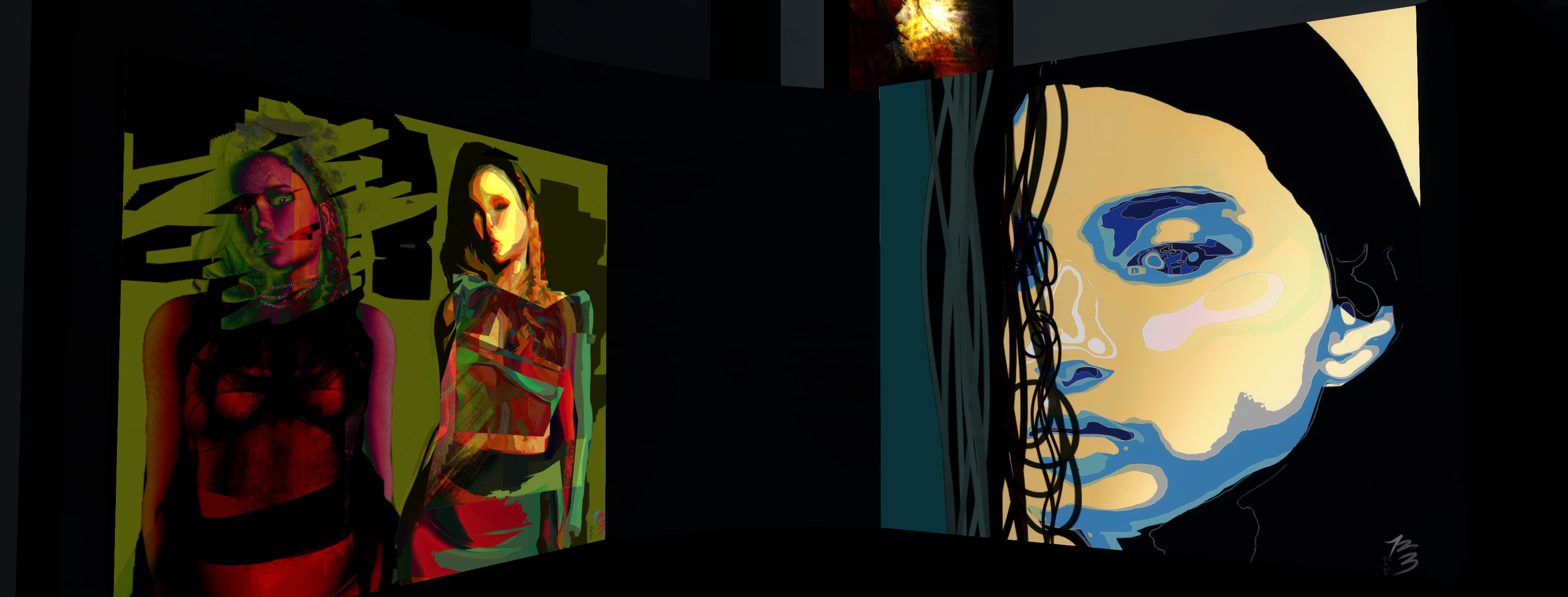
Bamboo Barnes is one of the most vibrant, evocative, provocative, and emotive artists displaying her work in Second Life. Hailing from Japan, Bamboo works with digital tools to produce pieces that are strongly assertive, both in terms their narrative depth and their ability to dominate the space they occupy, rich pieces that speak to the eye and mind.

All of this can be witnessed first-hand at her current exhibition, Receding Reality, which opened at Ribong Gallery’s Artspace 2243, and which opened on September 12th, 2020.

Bamboo Barnes at Ribong Artspace Gallery, September 2020

What is born out of me transforms like water: here is an uncertain ego and an inexhaustible feeling for those who have left.

– Bamboo Barnes

This is an extensive exhibition of work that presents pieces in a range of styles that have, per Bamboo’s description, something of a introspective nature about them. The styles themselves offer hints of Dali, Picasso, Warhol, encompassing abstract, pop-art, neo-impressionism, expressionism and neo-expressionism.

Bamboo Barnes at Ribong Artspace Gallery, September 2020

The elements of introspection comes from the faces apparent within many of the painting on offer; faces that oft carry thoughtful expressions or distant looks, suggestive of caught in memory, or are incomplete  or distorted, as if being pulled from half-remembered memories. Those that feature figures rather than facial features equally suggest distant thoughts.

As I’ve noted in the past when writing about Bamboo’s art, the emotions she experiences whilst producing a piece are a central aspect in how it eventually emerges. These emotions may be the result of her own feelings or perhaps those evoked by the music she is listening to, and her own response to the emerging piece. This tends to give her art an added depth, those emotions remaining with it and transferring to the observer the longer one regards it. There is also something almost visceral in her work through her use of colour; this in turn gives her work an attraction that pulls at the attention.

Bamboo Barnes at Ribong Artspace Gallery, September 2020

SLurl Details

Linden Lab launches the Official Second Life Merchandise store

via Linden Lab / RedBubble

Some might say it’s a long time overdue, but on Friday, September 25th, Linden Lab announced the launch of the official Second Life Merchandise Store offering a range of physical world merchandise related to Second Life and Linden Lab.

The on-line store is hosted by RedBubble, and currently comprises a range of SL and Lab branded clothing items and accessories utilising both the “new” and “old” logos, with the promise that more items t come soon, including seasonal and limited time items.

The Second Life store on RedBubble

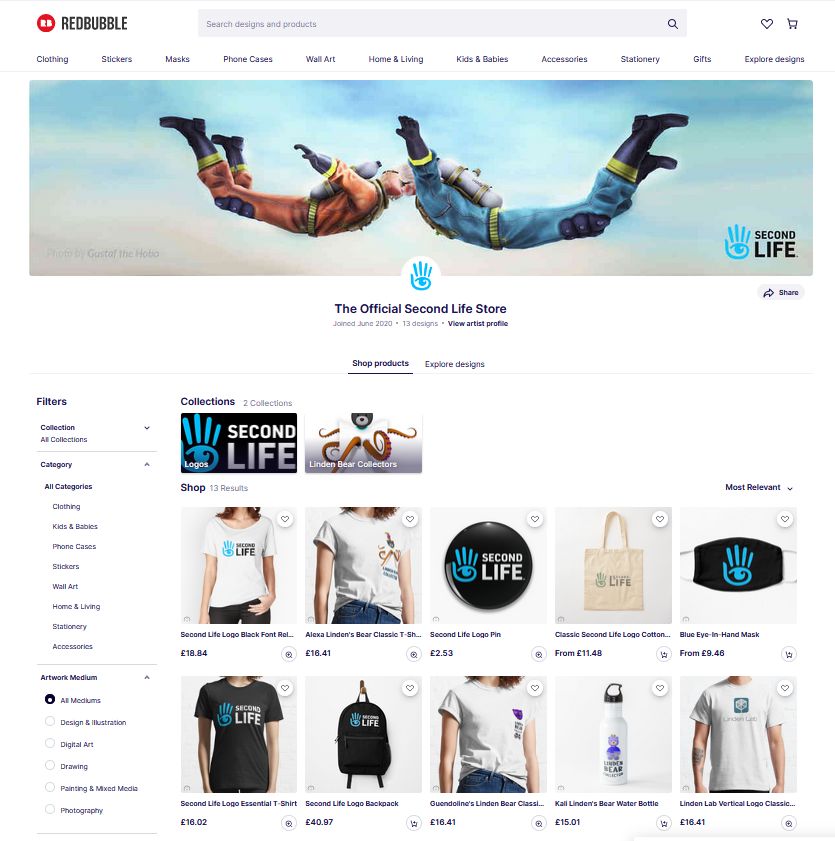
As with most virtual market stores, the RedBubble Second Life Merchandise Store feature a list of categories down the left side of the page (note: these are a part of the site design, and not all of them may apply specifically to Second Life / Linden Lab). The main part of the site is then devoted to displaying the displaying the essentials on available merchandise, with filter options, and the ability to use at the designs offered with applicable products, rather than the product itself. Obviously, clicking on an individual item will open a page devoted to it, where things like size, etc., can be selected.

A nice aspect of the site is that it appears to automatically recognise your country of origin and presents prices in your local currency. Payments can be made via Credit / Debit card or using PayPal, whilst shipping options are available for “regular” or “faster” delivery. Joining RedBubble allows for faster checkout: your own personal page, a complete order history and tracking option, and the ability to follow favourite merchants on the site (such as Second Life / Linden Lab) and receive notification of new items as they are added to the store.

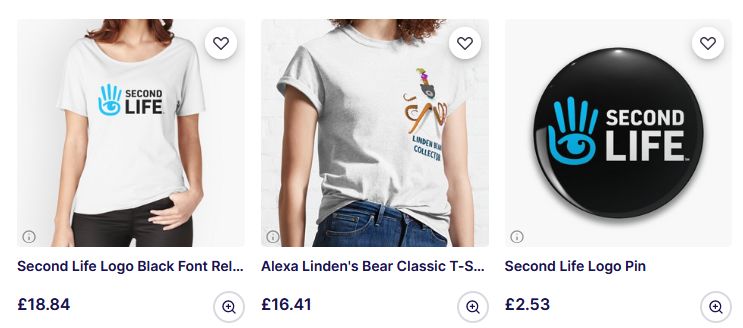
RedBubble automatically recognises your country of origin (unless using something like a VPN, perhaps), immediately presenting the price of items in your local currency, as seen here, in my view of some of the SL merchandise

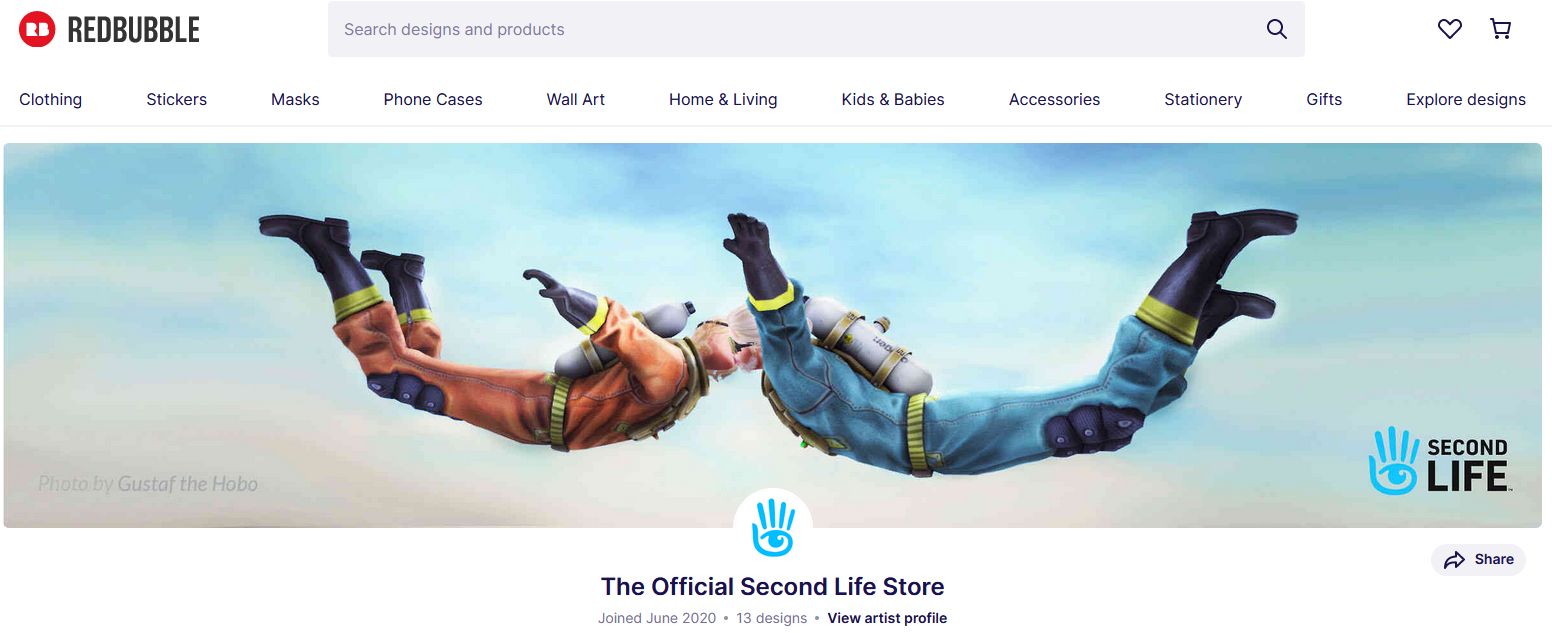
I’m not entirely sure why the site features a couple of skydivers snogging as its banner image – perhaps this will change according to some site criteria, but it did strike me as something not really immediately representative of either Second Life or Linden Lab – not that either is particularly easier to pigeon-hole in a single image for those unfamiliar with either.

That very minor niggle aside, the store would appear to be a good move – hopefully we’ll see merchandise such as mugs (Lab Gab mugs have oft been requested), coasters, key fobs and other handy items, as well and more clothing items appearing in due course. Actual Linden Bears would be fun as well, if perhaps harder to produce in  a cost-effective manner.

In the meantime,those interested / curious can hop over the the official store and have a mooch.

A Thousand Windows in Second Life

A Thousand Windows, September 2020 – click any image for full size

Lotus Mastroianni and Fred Hamilton (frecoi) are back with another region design that will likely be around for a month(ish) for people to enjoy. Their most recent builds have tended to have an urban design rooted in the physical world, starting with their take on a Brazilian favela back in May of 2020 (see:  Visiting A Favela in Second Life), and this latest design continues this theme, appearing to be inspired by a part of a place that lies very close to my heart.

With A Thousand Windows, Fred and Lotus seems to take as their inspiration the tight-knit tenement blocks located in the Mong Kok district of Hong Kong’s Kowloon peninsula. Mong Kok is a place I’ve visited on numerous occasions in my life (notably as a result of once living in Hong Kong many, many, years ago). I say this because, while there is no outright pointer to Mong Kok within the build, parts of it appear to pay clear homage to the district.

A Thousand Windows, September 2020

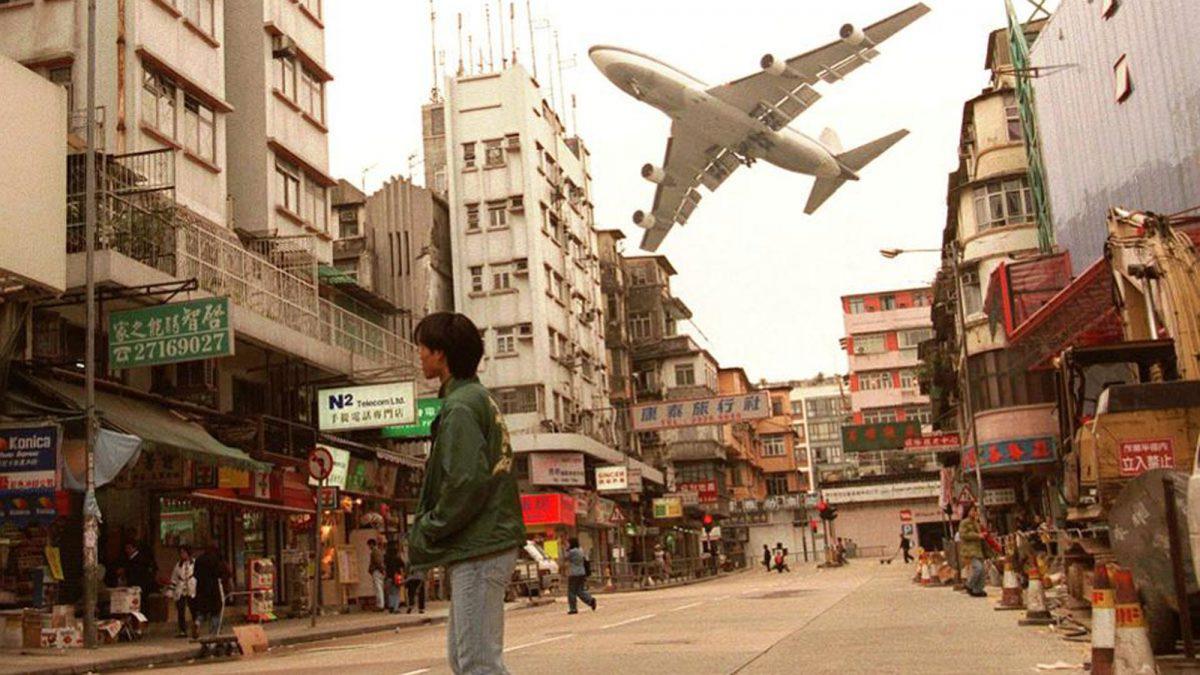
Take the 737 airliner passing overhead, for example; to me, it sits as a reminder that the district once lay beneath one of the approaches airliners had to make in order to touch-down at Hong Kong’s former airport at Kai Tak, a short distance away.  An approach that had aircraft practically scraping the roofs of the tenements, as made famous in many a photograph.

Elsewhere, in fairness, the region could have been inspired by any number of densely-packed housing units in the orient, but for me, Mong Kok is the place it brings to mind, even if Kai Tak did cease operations more than 20 years ago, having been replaced by a much larger, purpose-built facility built (much like Kai Tak) on reclaimed land, but out at Chek Lap Kok island, sitting off the north coast of Lantau. However, the focus of the build isn’t airlines or airports, but rather the densely-packed nature of the old tenements and the lives that go on within them.

A Thousand Windows, September 2020
There is a huge world out there, but what happens behind all those windows? what lives and worlds are hiding there? How many eyes peer into the fleeting reflections of so many lights?

– About Land, A Thousand Windows

This is actually a question I can remember asking myself, both as a youngster living in Kong Kong, and as an adult tourist who has made many return visits. With their shoebox sized (by western standards) living spaces, stacked one atop the next in grey, slab-like concrete towers cut through with narrow roads and alleys set back from the broader through routes of places like Yua Ma Tei occupying the main thrust of the Kowloon peninsula, parts of Mong Kok always struck me with a sense of mystery as to what was going on behind the blinds-shouded windows and narrow verandahs strung with laundry that so often formed the face of the squat tor blocks as they looks at the world.

All this is marvellously captured with Lotus and Fred’s design, which has been ideally set within a twilight environment to emphasise the volume of windows representative of people packed into so tight a space.

A Thousand Windows, September 2020

Set within four façades representative of five floors of apartment blocks, the region presents a number of tower blocks of similar height with narrow streets and alleys running between them. Neon signs hang from the sides of buildings and laundry hangs from verandahs – again a common sight I remember from Mong Kok. Most of the buildings within the setting are shells, although one or two contain interiors, making exploration worthwhile.

As well as the narrow streets sitting within their concrete canyons, the region offers elevated walkways from which the view can be appreciated, as well as offering the way to some outdoor spaces. And if you look hard enough, you might find an elevator leading up to the rooftops of one gathering of blocks, a couple of seats located just a across the roof from the elevator top from which to admire the view of the 737 passing overhead – and the visitors passing below.

A Thousand Windows, September 2020

Opportunities for photography, either by day or night, can be found throughout – as can be seen in the Flickr stream Lotus and Fred use for their builds. I admit to finding the sound scape accompanying the build a little odd – particularly the loud buzzing of flies (although that could perhaps be hornets of wasps, both of which could be a summertime nuisance in Hong Kong when I was little) but this can easily be ignored, leaving one to remain fully immersed in the setting.

All told, another enticing, attractive build. And just in case you haven’t seen photos of airliners over the actual Mong Kok district, I’ll leave you with the following.

A 747 passing over the broader streets of Mong Kok as it descends into the former Kai Tak Airport, Hong Kong – catch the 737 sitting above A Thousand Windows

SLurl Details

The Artists at Campbell Coast in Second Life

Artists’ Village, Campbell Coast

The Artists’ Village at Campbell Coast, created by BJoyful and Doc Rast (rasterscan) and curated by Owl Dragonash, opened A Street Fair, an extensive ensemble exhibition of 2D and 3D art on Tuesday, September 22nd.

A Scottish themed Mainland residential setting that’s open to the public, Campbell Coast offers access to both Linden roads and protected land and to sailable water, with the Artists’ village occupying one corner overlooking the coastal waters. The exhibition features a mix of residential artists and guest artists, with art displays both within the town houses of the village, along the cobbled streets and on the outdoor walls of some of the the buildings.

Artists’ Village, Campbell Coast: Etamae

Participating artists within the studio spaces comprise:  Dhyezl, Moondance, Reycharles, Gidgy Adagio, Whimsical Aristocrat, Michiel Bechir, Owl Dragonash, John and Tempest Huntsman, Suzen Juel, Dimi Ludwig, Jed Luckless, Lexus Melodie, Inara Pey, Larree Quixote, GoSpeed Rasere and Skip Staheli.

Further special exhibits are presented by Etamae, Jaz, Shakti Adored, Thomaz Blackbur, Lena Kiopak, Radagast Malaprop, and Ciottolna Xue.

Artists’ Village, Campbell Coast: Skip Staheli

As might be expected from this list, the art on display is wide-ranging and covers both 2D and 3D art, the former primarily focused on landscapes and avatar studies – although Jed luckless presents a rather unique display of posters from his past exhibitions and those from Phish Bowl events, , whilst GoSpeed offers links to her novels. Ciottolna Xue’s sculptures, meanwhile bring additional life to the local streets, together with some by Reycharles as they sit outside his studio.

Given the sheer volume of art on offer, trying to define all of it would lead to a TL;DR piece – suffice it to say that what is presented is engaging and well worth the visit. And given the sheer volume of art, for those looking for something new for their SL home, as well as those who appreciate art, will find this a worthwhile destination.

Artists’ Village, Campbell Coast: Yours Truly

SLurl Details

Calling artists: an exhibition to say farewell to the UWA in Second Life

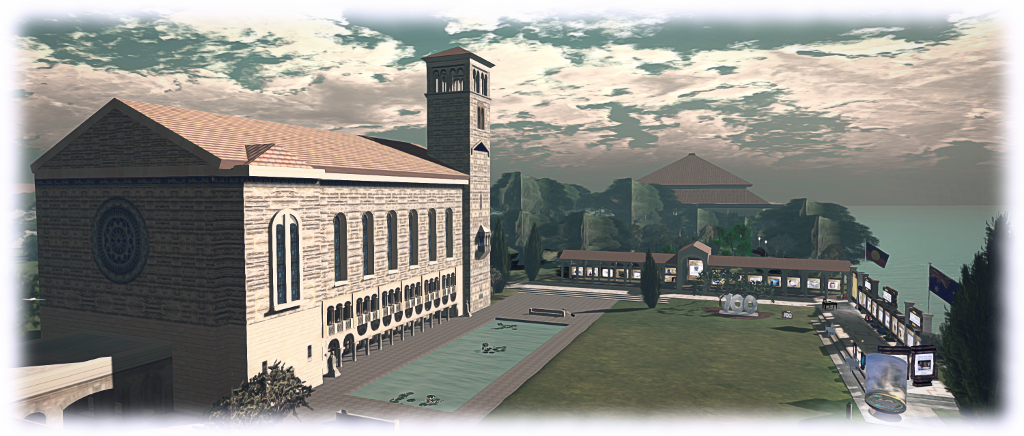
The University of Western Australia has been a long-term patron of the arts in Second Life

From 2009 through through 2018, the University of Western Australia (UWA) was a name synonymous with patronage of the arts in Second Life.

The university first became involved in Second Life largely through the encouragement of faculty member Jayjay Zifanwe, and under his guidance and the curation of FreeWee Ling, UWA oversaw a series of art challenges that offered impressive cash rewards for 2D, 3D and machinima artists.

These Art and Grand Challenges yielded some of the most exceptional displays of art and creativity seen within – and beyond – Second Life, and became a hallmark for artistic excellence.  Over the years, I attempted to cover down the years through this blog; however, from the end of 2015, UWA started a gradual winding-down of their operations in Second Life.

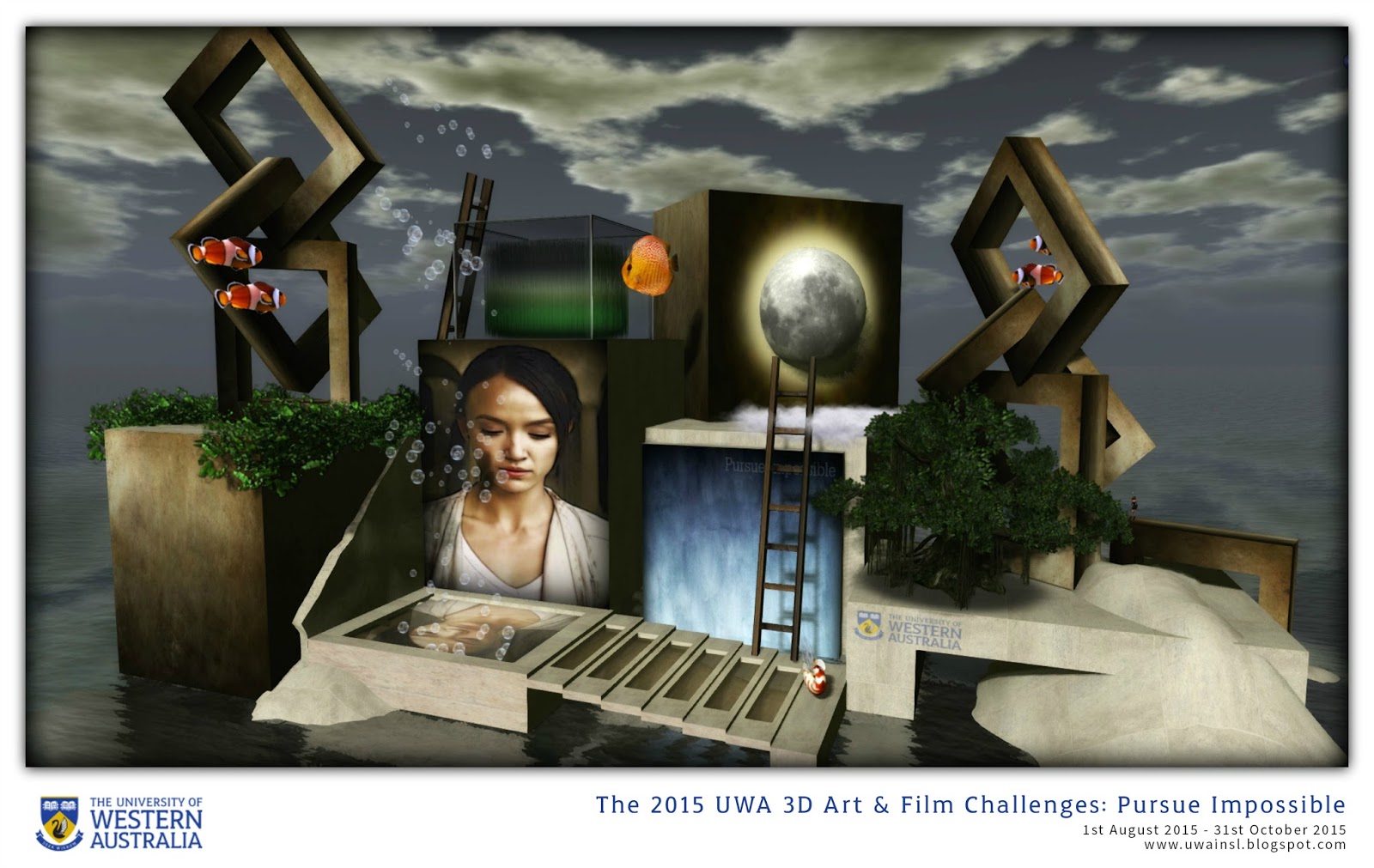
This started with the ending of their direct sponsorship of their art challenges with the Pursue Impossible challenge (see Pursue Impossible: celebrating art and machinima in Second Life), after which, events continued to be run, albeit without a cash prize incentive. Then in 2016, it was announced that four of the five regions operated by the university would be closing – although this was extended through to mid-2017 n (see UWA to scale back in Second Life and All UWA regions to remain in Second Life through mid-2017), allowing one more prize-based challenge  – sponsored through the generosity of LaPiscean Liberty – to take place (see UWA’s Transformations in Second Life

Pursue Impossible (2015) marked the end of the UWA supporting Second Life artistic expression with large-scale cash prizes. Image courtesy of UWA

Sadly, all good things must eventually come to an end, and the time is coming to say farewell to the last remaining UWA region – and in order to do so, a final art exhibition is to take place in the UWA’s exhibition space over the region.

Open to all 2D and 3D artists, the exhibition has been entitled Gratitude. It is being organised with the approval of the UWA by Chuck Clip, who describes the event thus:

This is a grand finale, a sad farewell to show our gratitude to UWA and all that they did for us as artists, curators, and residents of SL. Their work brought life and beauty to all of us and made the art world in Second Life a thing to behold. Why The Theme “Gratitude”? For over a decade, the University of Western Australia has been synonymous in the minds of many residents of Second Life with the arts and the support thereof. Their work was unparalleled on the grid, and made waves in the art world that, even as they prepare to close their sim, resonate through the art world today.
There are so many people whose lives they touched in one way or another. So many artists found inspiration in their 3D Art Challenge themes, and support in the encouragement of the community they created. Let us all come together this one last time to say thank you to the men and women of this great institution, to celebrate their achievements, their impact on our own achievements, and to mourn their departure.

– Chuck Clip, via note card

Those wishing to participate in this special event should note the following:

  • The event is open to all Second Life 2D and 3D artists, but is limited to one entry per artist.
  • Artists will be given a maximum of 150 LI with which to realise their work.
  • Entries should be able to be interpreted by the casual viewer as being representative of the theme of Gratitude. Where the link to the theme is difficult to ascertain, this should be referenced in a note card accompanying the work.
  • All entries must be submitted no later than 23:59 SLT on Sunday, November 1st, 2020 via the official UWA Art Show Submissions boxes (see below).
  • All entries must be accompanied by a note card containing: the artist’s name and a brief biography; the name of the submitted art (this should match the actual name of the piece as an object); a description of the piece; any landmark to more of the artist’s work, if applicable.
  • The exhibition will open at 12:00 noon SLT on Wednesday, November 11th, 2020, and will be marked by a special opening event with live entertainment, and will close on December 30th, 2020.
  • The region is currently set to close on December 31st, 2020, and art will be cleared prior to this occurring.

How to Enter

  • Place the artwork and covering note card in the UWA Art Show Submissions boxes located in the following regions:
    • University of Western Australia.
    • Sinful Retreat landing point.
    • To submit entries, left-click on the entry and HOLD the mouse button down, then press CTRL and drag the entry to the Art Show Submissions box. When the cursor is over the box (red outlines should appear around the receiver box), release your left mouse button and the item is received.
    • Repeat the above for the note card as well.
  • If you have problems with the box give artwork to Chuck Clip along with  a note card containing your name, together with the art.

General Rules

  1. Any style of 2D and 3D artwork can be submitted, provided it is in keeping with the exhibition theme and meets the General maturity rating for the UWA region and in accordance with Linden Lab’s Terms of Service and Community Standards. Items can be static or animated.
  2. In addition:
    • All entries cannot exceed a maximum of 20×20 metres.
    • If scripts are used, they should be kept too a run time of 0.2ms (0.5ms  maximum). Anything above this must include an on/off on touch with time out of up to 10 minutes.
  3. By submitting an entry, you are giving permission to the University of Western Australia and Chuck Clip to place the objects anywhere on the UWA region, and to have information and images of the entries placed on UWA websites and on websites promoting the UWA region or events held on the UWA region or to be filmed for machinima purposes.
  4. All work must be original. Renderings of works by others, in part or in whole, whether or not they are under copyright, should be acknowledged and permissions secured when appropriate.