Logos representative only and should not be seen as an endorsement / preference / recommendation
Updates for the week ending Sunday, November 8th
This summary is generally published every Monday, and is a list of SL viewer / client releases (official and TPV) made during the previous week. When reading it, please note:
It is based on my Current Viewer Releases Page, a list of all Second Life viewers and clients that are in popular use (and of which I am aware), and which are recognised as adhering to the TPV Policy. This page includes comprehensive links to download pages, blog notes, release notes, etc., as well as links to any / all reviews of specific viewers / clients made within this blog.
By its nature, this summary presented here will always be in arrears, please refer to the Current Viewer Release Page for more up-to-date information.
Note that for purposes of length, TPV test viewers, preview / beta viewers / nightly builds are generally not recorded in these summaries.
Official LL Viewers
Current release viewer version 6.4.10.549686, formerly the Mesh Uploader RC, promoted on October 14 – No change.
Release channel cohorts:
Cachaça Maintenance RC viewer updated to version 6.4.11.551711 on November 6.
Project viewers:
The Project Jelly project viewer (Jellydoll updates) updated to version 6.4.11.551213 on November 2.
Custom Key Mappings project viewer updated to version 6.4.10.549685 on, November 2.
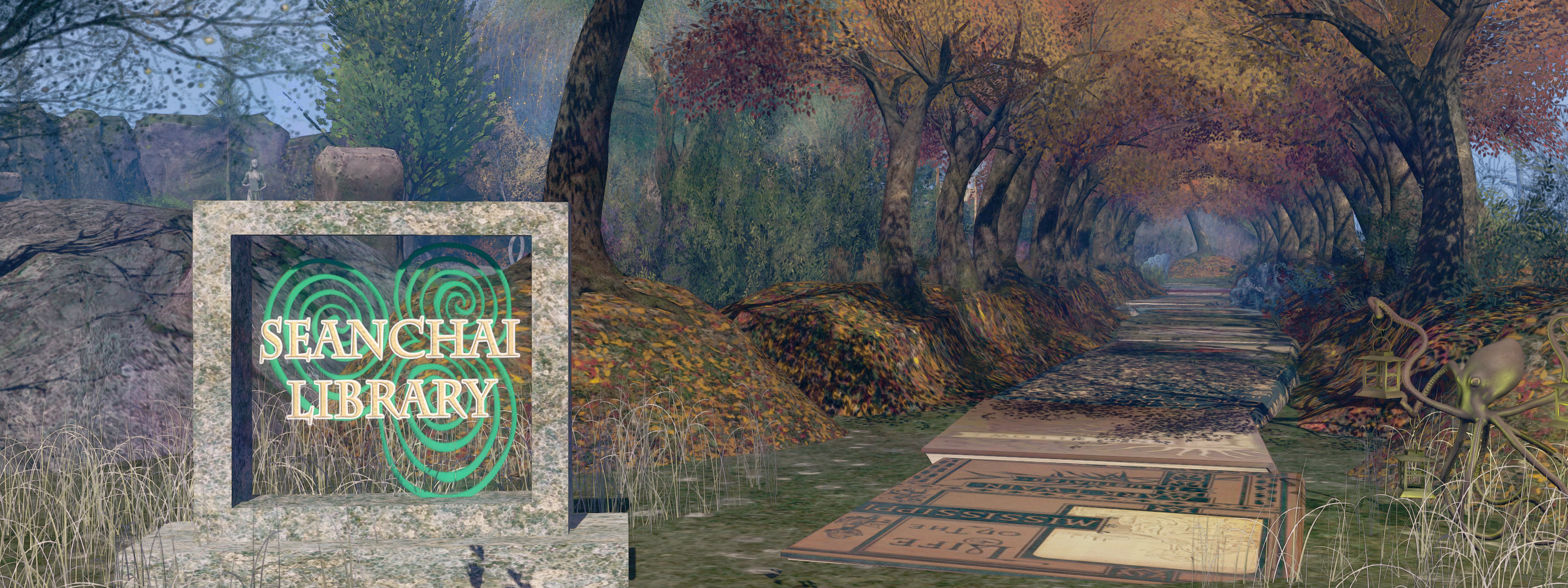
It’s time to highlight another week of storytelling in Voice by the staff and volunteers at the Seanchai Library. As always, all times SLT, and events are held at the Library’s home in Nowhereville, unless otherwise indicated. Note that the schedule below may be subject to change during the week, please refer to the Seanchai Library website for the latest information through the week.
Monday, November 9th, 19:00: The Dark Bright Water
Gyro Muggins reads Patricia Wrightson’s second novel charting the life of Wirrun of the Inlanders.
First encountered in The Ice Is Coming, when Wirrun set out on a quest to overcome the rise of the ancient enemy of Australia, the ice-bearded Ninya, the young janitor now has a reputation as a Hero among the Inlanders (Wrightson’s fantasy view of the Australian Aboriginals). It’s not a title he appreciates; he would much rather just get back to his janitorial work.
But the spirits of the land are restless: Yunggamurra, a river spirit is lost, so uses her siren-like powers of song to draw to herself those who might might take her home. Her singing come to Wirrun’s ears, and those of an elderly aboriginal emissary, and he realises he must journey to the very heartlands of Australia to better understand what he is feeling.
This he does, with the old emissary and his friend Ularra. Once there, he discovers that a storm is indeed rising within the domain of the spirits, and he is uniquely placed to both find Yunggamurra and prevent the coming storm. And so his new adventure begins.
Tuesday, November 10th:
12:00 Noon: Russell Eponym, Live in the Glen
Music, poetry, and stories in a popular weekly session at Ceiluradh Glen.
19:00: Woman’s Weird: Strange Stories by Women, 1890-1940
With Willow Moonfire.
Wednesday, November 11th, 19:00: Nine Princes in Amber
Carl Corey wakes in a medical clinic, with little to no knowledge of who he is or how he got there. Fearing he is being over-medicated and kept against his wishes, he overpowers staff and discovers his stay is being paid for by his sister, one Evelyn Flaumel, whose address is on the hospital’s records.
Fleeing the clinic, he makes his way to his sister’s home. Here, with the aid of a pack of tarot cards and a confession from his sister, he learns that his name is actually Corwin (and she is Flora), and they are two of 14 siblings – nine male and five female.
One of those brothers, Random, arrives, pursued by strange, vicious creatures, that force Corwin to join Random into fighting them to the death – during which Corwin discovers he has super-human strength.
After the fight, Random reveals more truths to Corwin – notably that he and his siblings are of royal descent from a planet called Amber, a parallel world to Earth from which he has been cast into exile.
Random reveals that their father, king Oberon, has vanished, and the throne is therefore open, and persuades Corwin in a quest to claim it. However, to do so, they must travel through the realms of Corwin’s brothers and sisters in order to reach Amber, and the journey reveals to Corwin his family’s ruthless and Machiavellian nature – a nature he shares -, and that the path to the throne is a route of force and betrayal.
Join Corwyn Allen as he reads the first volume in Roger Zelazny’s Chronicles of Amber series.
Thursday, November 12th, 19:00 Bernard Evslin’s Monsters and Mythology
Shandon presents another remarkable tale from ancient Greece in Amycus, Part 2. Also in Kitely – take the teleport from the main Seanchai World grid.kitely.com:8002:SEANCHAI.
November 9th, 2020 sees the opening of the latest exhibition at Nitroglobus Roof Gallery, curated by Dido Haas, and it is a double first for her. The invited artist is Traci (Traci Ultsch), who is an artist in both the physical and virtual worlds, and she is exhibiting her physical world art in Second Life for the first time – marking this exhibition as the first time Dido has displayed work from outside of Second Life at Nitroglobus.
Camouflage is another provocative selection of art that pokes strongly at the grey matter sitting between one’s ears. Thirteen pieces (plus the titular artwork) are offered, and an initial glance at them might lead one to characterise them as “pop art” – but this would be misleading; these are pieces that are, both literally and figuratively, layered.
The literal layering lies within the technique used to create the pieces on display, which Traci describes thus:
My method of working usually revolves around the collecting of objects (Magazine cuttings, dirt, stones, tape) which are then laid out on glass layers, painted on, layer upon layer until the idea starts to fall apart. At which time, it’s photographed or scanned at the moment of collapse and gone. The moment is cleaned away and all that’s left a captured image of something now gone.
The figurative element is rooted in the title of the piece, and Traci’s description for the exhibition, which she gives as:
Camouflage is the use of any combination of materials, colouration, or illumination for concealment, either by making animals or objects hard to see, or by disguising them as something else
The idea for this exhibition came from the (not recent) realization that, for quite some time, my life and work has been driven in some way by the desire to lose myself. In both RL and SL I’ve spent many years trying to find a level of ‘exposure’ I’m comfortable with. A lot of these feelings and experiences have fed into my RL artwork and my ‘Second Life’ where I’m beginning to wonder who is really obscuring who.
– Traci, describing Camouflage
Thus, layered within Camouflage are questions of identity (including self-identification), reflection, exploration of creativity as it relates to her ability to express herself to the world(s) at large. These literally are nuanced, layered pieces, that invite the eye and mind to examine closely from title through imagery, a mental peeling of the layers as we visually bring together the various aspects of each piece.
This idea of layering goes a lot deeper however than purely a reflection of the artist’s own introspection and examination. For anyone who has invested any part of their “self” in their avatar, these are pieces – and questions – with which they will identify: who we are, how our physical world dealings can inform our virtual identity and – equally importantly – how our virtual dealings, outlook and expression can come to inform our physical world life and outlook.
That said, Camouflage offers a broader theme as well. As Traci notes, art is a moment caught in time. Whether a photograph (posed our otherwise), a painting of the countryside or a building, or the Pollock-like splashing of paint on a canvas or whatever other technique is used – all art is, at the moment of capture / completion, an expression of a point in time that can never be truly reproduced again; copied, yes, but not reproduced as a unique statement.
This is particularly true of Traci’s work, which as she notes, reaches the point of near-destruction prior to being scanned, and then destroyed. As such, these pieces are not only expressions of identity and the questions that surround it, they are equally also unique captures of the artist’s sense of self and her governing emotions at a singular point in time, offering us a series of unique insights into her thoughts and feelings.
Sugar Mine, November 2020 – click any image for full size
Sugar Mine is a Homestead region I learned about from Annie Brightstar. For those who are not aware of Annie’s work, she curates information on places to visit – regions, art exhibitions, installations, and events – and provides information on them through her Scoop it! pages and via her Twitter feed, which I tend to drop into from time-to-time as it is an excellent reference for things I may have otherwise missed.
The region is the home to Tomster Starflare and his gardener Gioia Sautereau, with the majority of it open for people to explore – providing visitors only attempt to reach those areas accessible on foot from the landing point or via the the teleports. The latter come in two forms: teleport discs and also experience portals (be sure to accept the experience when offered) that take a number of forms: mirrors, doorways, floating portals, stairways, and so on. The “on foot” aspect of visits should be kept in mind, as there is an adjoining region that’s part of the same group, but not necessarily part of the same setting.
Sugar Mine, November 2020
As a region carrying an Adult rating, there are aspects of the setting that lean towards BDSM – but nothing particularly overt (in fact, it’s so subtle, you might actually miss it). It is also a place that’s a little hard to describe; carrying a strong industrial thread, alongside something of a deco / steampunk vibe in places, together with hints of dystopia and of futurism. All of which makes for an engaging mix.
Many of these elements are evident at the landing point: an industrial wharf watched over by a steampunk lighthouse, whilst a hover truck floats under the arch that marks the main road away from the wharf – although there is a route for those on foot that goes via the nearby beach and stairs up the neighbouring headland.
Sugar Mine, November 2020
Both the footpath and the zig-zagging road lead the way up to a plaza built on top of tall, deco-style and high-rise buildings. On its way to the plaza, the road offers a view out over one of the more dystopian aspects of the region: a semi-collapsed Eiffel Tower (of which more anon). A hover barge floating off the shoulder of the hill facing it offers a futuristic counter-point.
The plaza itself has buildings on three sides, with the fourth largely open, presenting a view across the waters below to a island that matches the plaza in elevation. Water tumbles from a dam-like outflow to drop unimpeded to the waters below, passing the double lines of tram tracks that appear from a tunnel as it does so. This water drop and other elements at the top of the hill continue the industrial theme, whilst the three buildings each offer a deco-esque look. One of these forms a cinema, another a large saloon club, and the third appears to be purely decorative. A steam-power motorcycle and British Moran Plus 4 add a further mix to the setting.
Sugar Mine, November 2020
The club offers a its own rich mix of themes: sci-fi, retro, and more. It is also the place where the fun may well begin, depending upon how you find your way around. In one corner is the image of a flight of stairs. Walk into it, and you’ll be teleported to a building some distance away that might otherwise be an annexe to the bar. This in turn offers two further teleport points – stairs (you’ll need to look for them) back to the main bar, and a doorway to the fallen Eiffel Tower.
The stairway in the main bar is not the only teleport portal to be found there, there is a second that leads to a further room below ground, which also has its own portal. There are more portals to be found elsewhere (notably on the old Eiffel Tower), but I don’t want to give too much away about where they lead. Suffice it to say that some may be one-way, leading you from point to point (including across the water to that other tall island with its own water tumbling from multiple outlets on hight, and marked by the sliced hull of an old Soviet-era submarine).
Sugar Mine, November 2020
However, the portals are not the only means of finding more places to explore – at the landing point, the plaza and elsewhere are teleport discs that offer the means to hop around. most notably, these will also offer the means to reach the region’s caversn – just left-click to select your destination, then right-click and teleport.
For those who wish, dances are available at various points, while the high, flat top of the smaller island offers a semi-natural retreat with a large body of blue water and places to sit. This island also offers a way down to the ground-level buildings that support the high plaza. These have a curious Japanese aspect to their signage , adding a further twist to things, although most are just façades for the most part.
Sugar Mine, November 2020
Genuinely unique in its approach and design, Sugar Mine makes for an engaging visit edged with a sense of being a magical mystery tour.
On Friday November 6th, 2020 Lab Gab, the live streamed chat show hosted by Strawberry Linden on all things Second Life returned to the the subject of the work to transition all Second Life services to Amazon Web Services (AWS) and away from running on the Labs’ proprietary hardware and infrastructure.
The session came some 7 months after the last Lab Gab to focus on this work in April 2020 with Oz Linden and April Linden (see Lab Gab 20 summary: Second Life cloud uplift & more), and this time, Oz Linden sat in the hot seat alongside Mazidox Linden.
The official video of the segment is available via You Tube, and is embedded at the end of this article. The following is a summary of the key topics discussed and responses to questions asked.
Mazidox Linden is a relative newcomer to the Linden Lab team, having joined the company in 2017 – although like many Lab staff, he’s been a Second Life resident for considerably longer, having first signed-up in 2005.
He is the lead QA engineer for everything simulator related, which means his work not only encompasses the simulator and simhost code itself, but also touches on almost all of the back-end services the simulator software communicates with. For the last year he has been specifically focused on QA work related to transitioning the simulator code to AWS services. He took his name from the Mazidox pesticide and combined it with the idea of a bug spray to create is avatar, to visualise the idea of QA work being about finding and removing bugs.
Oz Linden joined the company in 2010 specifically to take on the role of managing the open-source aspects of the Second Life viewer and managing the relationship with third-party viewers, a role that fully engaged him during the first two years of his time at the Lab. His role then started expanding to encompass more and more of the engineering side of Second Life, leading to his currently senior position within the company.
“The Bugspray” Mazidox Linden (l) and Oz Linden joined Strawberry Linden for the Friday, November 6th segment of Lab Gab to discuss the cloud migration work
Cloud Uplift is the term Linden Lab use for transitioning all of Second Life’s server-based operations and services from their own proprietary systems and services housed within a single co-location data centre to commercial cloud services.
The work involves not only the visible aspects of SL – the simulators and web pages, etc., but also all the many back-end services operated as a part of the overall Second Life product, not all of which may be known to users.
The process of moving individual services to the cloud is called “lift and shift” – take each element of software, making the required adjustments so it can run within a cloud computing environment, then relocate it to AWS infrastructure and hardware in a manner that allows it to keep running exactly as it did prior to the transfer, while avoiding disruptions that may impact users.
The current plan is to have all of the transitional work completed before the end of 2020.
However, this doe not mean all the the work related to operating SL in the cloud will have been completed: there will be further work on things like optimising how the various services run on AWS, etc.,
It allows Second Life to run on hardware that is a lot more recent than the servers the Lab operates, and allows the Lab to evolve SL to run on newer and newer hardware as it becomes available a lot faster than is currently the case.
In particular, up until now, the route to upgrading hardware has involved the Lab reviewing, testing and selecting hardware options, then making a large capital expenditure to procure the hardware, implement it, test it, then port their services over to the hardware and test, then implement – all of which could take up to 18 months to achieve.
By leveraging AWS services, all of the initial heavy lifting of reviewing, testing, selecting and implementing new server types is managed entirely by Amazon, leaving the Lab with just the software testing / implementation work.
A further benefit is that when SL was built, the capabilities to manage large-scale distributed systems at scale didn’t exist, so LL had to create their own. Today, such tools and services are a core part of product offerings alike AWS, allowing the Lab to leverage them and move away from having to run (and manage / update) dedicated software.
Two practical benefits of the move are:
Regions running on AWS can run more scripts / script events in the same amount of time than can be achieved on non-AWS regions.
The way in which simulators are now managed mean that LL can more directly obtain logs for a specific region, filter logs by criteria to find information, etc., and the entire process is far less manually intensive.
It has always been LL’s policy when dealing with third-party vendors (which is what AWS is) not to expose SL user data to those vendors, beyond what is absolutely necessary for the Lab to make use of the vendor’s service(s).
This means that while SL user data is stored on AWS machines,it it not stored in a manner Amazon could read, and is further safeguarded by strict contractual requirements that deny a company like Amazon the right to use any of the information, even if they were to be able to read it.
In fact, in most cases, user-sensitive data is effectively “hidden” from Amazon.
LL is, and always has been, very sensitive to the need to protect user data,even from internal prying.
In terms of the simulators, a core part of testing by Mazidox’s team is to ensure that where user data is being handled (e.g. account / payment information, etc.), it cannot even be reached internally by the lab, as certainly not through things like scripted enquiries, malicious intent or prying on the part of third-party vendors.
[54:30-55:18] Taken as a whole, SL on AWS will be more secure, as Amazon provide additional protection against hacking, and these have been combined with significant changes LL have made to their services in the interest of security.
The biggest challenge has been continuing to offer SL as a 24/7 service to users without taking it down, or at least with minimal impact on users.
This generally requires a lot of internal testing beforehand to reach a point of confidence to transition a service, then make the transition and then step back and wait to see if anything goes dramatically wrong, or users perceive a degraded service, etc.
An example of this is extensive study, testing, etc., allowed LL to switch over inventory management from their own systems to being provisioned via AWS relatively early on in the process, and with no announcement it had been done – and users never noticed the difference.
Another major challenge has been to investigate the AWS service offerings and determine how they might best be leveraged by SL services.
As many of the SL services are overlapping one another (e.g. simulators utilise the inventory service, the group services, the IM services, etc.), a further element has been determining a methodical manner in which services can be transitioned without impacts users or interrupting dependencies on them that may exist elsewhere.
The technology underpinning Second Life is a lot more advanced and recent within the AWS environment, and this means LL have a had to change how they go about certain aspects of managing SL. This has in turn required experimentation, perhaps the deployment of new tools and / or the update / replacement of code, etc..
During the transitional period it has been “significantly” more expensive to operate SL, inasmuch as LL is paying to continue to operate its proprietary systems and services within their co-lo facility and pay for running services via AWS.
Even after the need to continue paying for operating the co-lo facility has ended, it is unlikely that the shift to AWS will start to immediately reduce costs.
However, the belief is that moving to AWS will, in the longer term, reduce operating costs.
Whether reduced operating costs lead to reduced costs to users, or whether the savings will be re-invested in making further improvements to the service lay outside of this discussion.
Right now the focus is not on driving down costs or making service significantly better, but is solely the work of getting everything transitioned. Lowering costs, making more efficient use of the underpinning capabilities provided by AWS will come after the migration work has been completed.
What Happens to the Old Hardware / Facility, Post-Uplift?
Several years ago, LL consolidated all of their hardware and infrastructure into a single co-location data centre in Arizona.
Most of the hardware in that facility is now so old it has depreciated in value to a point where it is pretty much worthless.
A specialist company has therefore been contracted to clear-out the Lab’s cage(s) at the co-lo facility and dispose of the hardware.
As a demonstration of LL’s drive to protect user data, all drives on the servers will be removed under inspection and physically destroyed via grinding them up on-site.
Officially opening on Saturday November 7th, is the annual Movember art exhibition at the Men in Focus Gallery, curated by JMB Balogh. Sponsored by the Men in Motion dance troupe, the exhibition is in support of the Movember Foundation, and furthers the gallery’s aim to both promote and feature photography by male artists.
Once again, I was graciously granted the opportunity to preview the exhibition – thank you, Jo! – which sees 2D artists Darkyn Dover, Winter Jefferson, Pavel Stransky and Arnno Planer join several of the Men in Motion dance troupe in displaying their work, together with 3D artists Mistero Hifeng, Luc Lameth and Reycharles.
Men in Focus Movember exhibition: Darkyn Dover
Of the 2D artists, I’ve long been familiar with the work of both Darkyn Dover’s Pavel Stransky, and admire both for their ability to frame images as stories. This is very much displayed with the selections they present in this exhibition, where Darkyn’s work can be found on the ground floor and Pavel on the third, with some more “traditional” posed avatar studies (lying on the beach and looking out to sea) and portraits (notably Pavel’s striking studio-like piece simply entitled Portrait) added to the mix.
For those images offering a narrative, within these two selections, I found myself particularly drawn to: Darkyn’s No Ideas, which offers both a story in its own right whilst offering a strong feeling of familiarity and understanding for those of us who have ever suffered from a bout of extended writer’s block. Meanwhile, Pavel’s Singing in the Rain, which not only brings to mind Gene Kelly’s entire magical dance routine from that film, but also tells a story of Kelly’s entire genius as a dancer and the heyday of the Hollywood musical; it’s a genuinely evocative piece, beautifully framed.
Men in Focus Movember exhibition: Arnno Planer
Sandwiching Pavel’s work are the selections are those by Winter Jefferson (2nd floor) and Arnno Planer (4th floor). Both offer more “traditional” avatar studies, mostly tightly focused on the avatar such that while costumes are used, the narrative that might be offered is a lot narrower in presentation. This is not a critique of either artist in any way at all; every artist in SL has a specific style and approach to their work, and both Arnno and Winter’s work is engaging and very much broaden the mix of art here.
Of the 3D artists, all are making a return to the gallery, and their pieces – as enticing as ever – can be found on each of the guest artists levels, and the two levels devoted to the art of members of the Men in Motion dance troupe.
The Movember exhibit officially opens with a 2-hour event featuring the music of Ame Starostin Cheveyo, starting at 17:00 SLT on Saturday, November 7th.
Men in Focus Movember exhibition: Luc Lameth
About the Movember Foundation
The Movember Foundation is a multinational charity raising awareness of, and money for, men’s health and welfare, with a focus on cancer, mental health and suicide prevention. Its titular and widely known campaign is Movember, which encourages men to grow moustaches during the month of November. The foundation partners annually with the Distinguished Gentleman’s Ride to also raise money for men’s health.
Founded in 2003, in Melbourne, Australia by Adam Garone, Travis Garone, Luke Slattery, and Justin Coghlan, the organisation attained registered charity status in 2006, and has raised approximately US $700m in charitable donations. These funds have been used to fund more than 800 programmes focusing on prostate cancer, testicular cancer, poor mental health, men’s health awareness and healthy lifestyles. It is active in 21 countries and has a global workforce of 130 people. In addition, Movember coincides with International Men’s Day (November 19th), which among its aims, shares the goal of promoting the health and well-being of men and boys.





 Inara Pey: Living in a Modemworld