Theda’s “clean slate” in Second Life

Theda Tammas: Tabula Rasa

Tabula Rasa is a Latin phrase meaning “clean slate”, it is a term often used by some epistemological philosophers to encompass the theory that we are born without built-in mental content, and all the knowledge we attain comes purely through experience or perception. We are a clean slate upon which our natures are formed as a result the nurturing and influence we receive from those around us, and through the environment we live within.

It’s a doctrine that sits in opposition to that of innatism, which holds that the mind is born already in possession of certain knowledge and traits which form the basis of our nature and personality, and thus are unlocked, rather than formed through the process of gaining experience and our developing perceptions. Both doctrines have long histories, tabula rasa can be traced back to the writings of Aristotle, whilst innatism was a doctrine held by the likes of Plato and Descartes.

Theda Tammas: Tabula Rasa

Tabula Rasa is also the title Theda Tammas has selected for her latest installation, which recently opened in Second Life. It Occupies a sky platform on which is set a stark setting – a construction site, if you will – has been established; a place of beams both horizontal and vertical, here and there with sheets and strips of fabric attached. Within it, and under the overcast sky, figures stand, walk and twirl on the spot. Most do so individually although some are in pairs; all have their faces covered as they appear to be exploring their environment.

The symbolism here is clear: the covered faces reference the idea to the blank slate, the we are all initially vessels empty of knowledge; their motions and poses of the individual figures suggesting they are exploring their environment – that through these acts, they are embodying the core concept of tabula rasa – that the knowledge we gain, we we become, is the result of exploration, experience and the growth of our perception.

This is further exemplified by the pairs of figures, their poses encompassing both the idea of experience and the concept of nurturing: in one place a hood figure cares for another by carrying it; in another two hold a loving embrace, suggesting the love and care passed from a parent to a child, further helping the latter gain understanding of love and care through the contact.

Theda Tammas: Tabula Rasa

Nor does the symbolism end there; it extends to the construct that forms the setting: the fact that the setting is that of a construction site underlines the idea that who we care, what we become, is a process of construction through experience and growing perception – just as a building is formed the the bringing together of beams and joists.

Whether or not one agrees with the doctrine of tabula rasa (studies have show innatism can be shown to exist, whereas tabula rasa is much harder to establish), this is a fascinating and rich exploration of the latter. When visiting – and as per the sign at the landing point – make sure you have ALM and shadows enabled (Preferences → Graphics), and use the local environment settings (menu → World → Environment and make sure Use Shared Environment).

SLurl Details

In Vogue (+ elsewhere): Second Life and designer fashion

via Linden Lab

February / March are important months in the world of fashion, being the period when the “Big Four” cities  – New York, London, Milan and Paris – each hold their own flavour of Fashion Week, giving home-grown and international designers and fashion houses opportunities to show off their collections and lines for the end-of-year autumn / winter season (with each city also hosting a further Fashion Week in September / October where they look towards the following year’s spring / summer season).

Over the last couple of years, these mega events have had to re-invent how they operate and reach their audiences thanks to Covid, with Zoom, Instagram, TikTok, AR and more all being experimented with and leveraged in one way or another. And while 2022 has seen many of the barriers to audience-based events relaxed (such that 5-day London Fashion Week, for example, will feature some 250 designers and fashion houses present their work to audiences at events across the city), some designers are retaining a virtual edge to their work, thanks largely to the all of the buzz around “the metaverse” and things like NFTs.

As reported by the likes of Vogue and Glamour UK, both the New York Fashion Week has, and the London Fashion Week will, feature designers with digital “metaverse” offerings – one of whom in particular has seen Second Life as having powerful relevance when it comes to fashion.

Designer Jonathan Simkhai

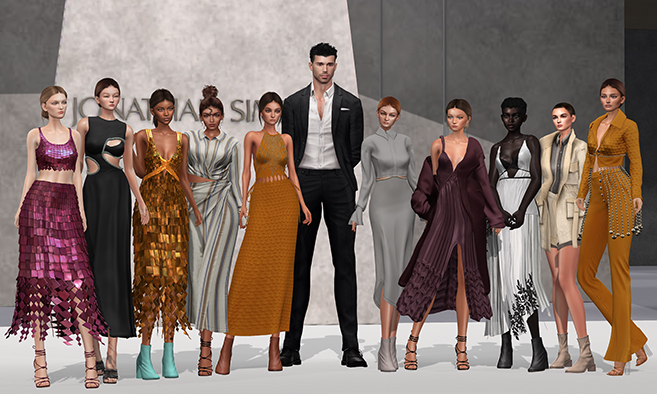
The individual in question is New York fashion designer and 2015 CFDA/Vogue Fashion Fund winner, Jonathan Simkhai. As a part of the New York Fashion Week event, he offered a special preview of some of his designs from his Autumn / Winter 2022 (AW22) collection at a special fashion show that took place in Second Life.

In all 11 pieces from the collection have been visualised for Second Life by none other than Mishi McDuff (aka Blueberryxx), founder and owner of SL’s popular Blueberry brand (and, I will admit, one of my go-to designers on the admittedly rare occasions I feel I need to spruce up my virtual wardrobe). In bringing the designs to SL, Blueberry has also given them a special “metaverse flair” – utilising the unique advantages of the digital world to offer twists to some of the items that cannot be replicated in the physical world – such as a sequined dress that gradually loses its embellishments and morphs into a bodysuit as the model walks the runway.

The items were presented to an invited audience of models, influencers, celebrities, and journalists from the fashion, technology and lifestyle industries. They had the opportunity to see the virtual items ahead of Simkhai presenting their physical world equivalents on the New York catwalk, so the guests could witness the virtual garments and their unique properties up close – and even try them on.

This may sound like something straight out of 2006-2008, when many physical world brands tried to hop into SL in the belief it would magically allow them to grow their market influence, but actually it isn’t. The Simkhai / Blueberry relationship is far more symbiotic and engaging, and for two reasons.

The first is that as well as being presented to invited guests, the Second Life Simkhai collection will be the subject of a series of catwalk shows open to Second Life residents on Thursday February 17th / Friday February 18th, with shows set hourly from 13:00 through 16:00 (inclusive – see the Destination Guide link at the end of this article). Not only will these serve to show the designs to the Second Life community, they will also – according to Vogue’s Maghan McDowell –  allow SL users to purchase them at around L$1,000 per item.

The second reason is that Simhkai  – who has already utilised the likes of Zoom and Instagram to engage with clients, customers and audiences and build “communities” – sees Second Life as a vibrant community into which he can tap in a bi-directional manner: he can bring his designs to a new, digital customer base, and he can offer existing customers a new and exciting way they can represent themselves, as he noted in talking to Maghan McDowell:

This is about introducing the brand to a new customer. And for my customer who might not feel like the metaverse means that much to her yet, this will be a nice introduction and discovery. My design philosophy is leaning into dichotomies or juxtapositions. We are all so obsessed about looking at fashion history, but this is really about looking forward and looking into the future, with Covid giving us a kick in the backside.

– Jonathan Simkhai, Vogue Magazine

In this, Blueberry is a particularly good partnership brand: not only has the brand achieved in excess of 20 million unit sales in the course of a decade, it has encouraged a loyal customer base, become a watchword for digital quality and also embraced platforms beyond SL. All of which adds up to the potential for a genuinely symbiotic relationship; given this, it will be interesting to see what comes of this initial experiment.

And how did Blueberry and Simkhai get their VIPs into SL? Rather ingeniously, as McDowell (again) explained in Vogue:

Before attending Simkhai’s virtual show, guests first submitted images that were turned into avatars, then selected which Simkhai piece they wanted their avatar to wear. Guests were dropped into the space via a link, viewing the collection — and other guests — from unique angles, just as they would in the physical world.

– Maghan McDowell

It’s a novel approach – one potentially not that easy to scale without a lot of work – but for small, specialised events, it is something that could help to get SL seen as a potential platform for a variety of events, presentations, etc.,  where previously it has been ignored. These may not do much to grow the platform’s retained and engaged user base, but that doesn’t mean they cannot help in terms of more focused engagement with the platform by a broad cross-section of possible audiences.

In covering the broader scope of fashion and technology – including the inevitable love affair with NFTs (albeit one with perhaps something more quantifiable for the purchaser that much of the dross / ponzi acts we’ve thus far seen) – the Vogue piece in particular makes for an engaging and informative read. It’s just a bloody shame that it sits behind a pay wall; hence why I include the Glamour piece; it is shorter and less detailed, but it does cover similar ground in talking about the Blueberry / Simkhai experiment and the “metaverse dabbling” (so to speak) of other designers such as Roksanda Ilinčić.

More is promised in terms of digital fashions in the coming year, and it really is good so see Second Life to be sitting pretty much at the centre of things at this point in time. Kudos to Mishi and Jonathan Simkhai in their collaboration; I genuinely hope it continues. And full marks to Jonathan Simkhai for not just going after the (yet to be proven) world of NFTs, but for leading from the front and dicing into the potential of Second Life.

I can’t operate in fear of being criticised, otherwise I would have quit this job six months into it. The bigger the risk, the bigger the reward. So many New York designers went to Paris to show — and we are going to the metaverse.

– Jonathan Simkhai, Vogue Magazine


With thank to Vikki Vortex for access to the Vogue article.

Related Links

2022 SUG meetings week #7: summary

Bordeaux, France, January 2022 – blog post

The following summary notes were taken from the Tuesday, February 15th, 2022 Simulator User Group (SUG) meeting. It forms a summary of the items discussed, and a video of the entire meeting is embedded at the end of the article – my thanks to Pantera for recording it.

Server Deployments

  • There was no deployment to the SLS Main channel on Tuesday, February 15th, 2022, but the simhosts were restarted.
  • Wednesday, February 16th should see the RC channels updated with simulator release 568051, postponed from week #6, and which includes a series of bug fixes (including one for BUG-230771 “llRequestUsername returns invalid data when invalid key is provided”) and adds a feature to LSL: OBJECT_ACCOUNT_LEVEL flag to llGetObjectDetails(): when called on an agent in the region, returns the agent’s premium status.

Available Official Viewers

This list reflects those viewers available via the first four links in the LL Viewer Resources section, below.

  • Release viewer: version version 6.5.2.567427 – Mac Voice hotfix viewer, January 13 – no change.
  • Release channel cohorts (please see my notes on manually installing RC viewer versions if you wish to install any release candidate(s) yourself).
    • Maintenance RC viewer, version 6.5.3.567451, issued on January 20th, combining the Jenever and Koaliang Maintenance viewers.
    • The Tracy Integration RC viewer version 6.4.23.563771 (dated Friday, November 5) issued Tuesday, November 9.
  • Project viewers:
    • Performance Improvements project viewer version 6.6.0.567604, dated January 24.
    • Mesh Optimizer project viewer, version 6.5.2.566858, dated January 5, issued after January 10.
    • Performance Floater project viewer, version 6.4.23.562625, issued September 2.
    • Legacy Profiles viewer, version 6.4.11.550519, dated October 26, 2020.
    • Copy / Paste viewer, version 6.3.5.533365, dated December 9, 2019.

In Brief

  • A request was (again) made to have simulator behaviour change such that vehicles hitting a parcel ban  / ban lines are “bounced” (much like they do on reaching an edge of the grid) rather than avatars being unseated / dumped and the vehicle returned to the owner’s Lost and Found.
    • This has been requested before, but rejected.
    • During the meeting, the idea was referred to as something that “might be possible”, although it would require protocol changes, if tackled.
    • An alternative suggestion put forward (by a user) was to have a vehicle given the lowest access permissions among those avatars seated on it. That way, if any agent attached to an object cannot enter a parcel, the vehicle would treat that parcel as a solid obstruction. This was seen as potentially more “doable” idea, and a formal Jira Feature Request was asked for – see BUG-231802.
  • A request was made for a grid-wide KVP (or KVP-style) database (as is available to Premium members under the Experience Keys system) to be made available that could be used as a permanent data store (see BUG-231801) available to all who need it.
    • Some of the ideas put forward around this at the meeting included updating the script engine so that scripts can dynamically write data to note cards – something as seen as problematic by the LL or have the viewer use local storage for data generated for use by the avatar (e.g. from a HUD) – something that could be an issue if data is stored on one machine is needed when on another device.
    • Cost of storage was noted as a possible issue, with the suggestion that perhaps (and whilst not permanent) KVP-like storage could be made available along the lines of Local Textures: the data is available for use for as long as a person is logged-in, after which the storage used would be cleared.
    • A further alternative suggestion made by LL – again, note the word suggestion – was the provision of a LSL API that could be used to access AWS services like Dynamo – that is, LL supply API and data movement, users wanting to use the capability supply the account and credentials. This was suggested with an idea of soliciting feedback on the idea.
    • A suggestion was also put forward for a new asset type specifically designed for read / write data storage, but capped at (say) 64 KB.
    • Again, this was a discussion – there are currently no plans to implement any of the above.
  • An issue with uniformly applying EEP settings across multiple regions in an estate via scripted means and smoothly applying it to avatars into and through the estate. A specific bug requiring rectification via the use of fast timers has been identified, together with a possible improvement to handling EEP settings via script. A bug report (BUG-231806) and a couple of feature requests (BUG-231807 and BUG-231808) have been filed on the matters – please refer to them and the video for more.
  • There was a lot of text chat around Avatar Expressiveness – however, as most of this was was subjective and the Lab is not yet in a position to provide further information on the capability, I’ll leave it to the video, below.

Admiring Adwehe’s Crescent Moon in Second Life

Nitroglobus Roof Gallery: Adwehe – Crescent Moon

Monday, February 14th, 2022 saw the opening of Crescent Moon, the latest exhibition Dido Haas is hosting at her Nitroglobus Roof Gallery in Second Life. Presenting the work of Adwehe, this is an exhibition that mixes 2D and 3D art together with a custom EEP setting for the gallery which really should be used (menu → World → Environment → make sure Use Shared Environment is set) if the exhibit is to be properly appreciated.

When the EEP is set, visitors will see that a crescent Moon dominates the sky along one arm of the Gallery; but this is no mere play on the title of the exhibition, there is a purpose in including this huge waxing crescent Moon and making it as much a visual element of the exhibition as any of the images and sculptures Adwehe has on display.

Nitroglobus Roof Gallery: Adwehe – Crescent Moon

Perhaps the best way to sum up the theme of Crescent Moon would be to use a word that has become a common subject within the world of Second Life art: “identity”. However, this is also too simplistic a term when applied here; Crescent Moon is a multi-faceted exploration of interlocking themes: an exploration of self, identity, the relationship between human and avatar; questions of “godhood” and creation and artistic discovery.

As Adwehe notes, the Moon has a special attraction for humans down the ages and around the world. It has been a focus of worship, a reminder of our small place within the cosmos, encouraging our ancestors to see it as the seat of one deity or another. It is also something we only see thanks to the sunlight it reflects – reminding us the Sun is very much the source of life on Earth – whilst that reflected light causing us to see the world around us differently to how we perceive it by the direct light of day; a world both illuminated, yet distorted.

Nitroglobus Roof Gallery: Adwehe – Crescent Moon

And like the Sun and Moon were once seen as seats of goods, so we can, in sitting behind our screens, become gods in our own right: we can create and destroy at will, whilst our avatars sit as the projection of “self”, but one perhaps distorted. They are not us but projections or who we are – or more correctly, what we want to present of ourselves – through the medium of photons – the same atoms of light that give us life – but organised into a form that is not truly “us”.

Thus we have the opportunity to explore, to experiment, be it through self-expression, through that ability to create with prim, texture, particle, and mesh – and for the artist to do both, through experiments at colour and art from, physical and digital, camera and canvas, Opportunities that both reflect on our inner natures and also to play back into ideas of creation, godhood and primality.  All of this is richly explored within Crescent Moon. Within the images we have a captivating mix of painting and photography; they speak to the artist’s acknowledged experimentation with her work in preparing for this exhibition.

Nitroglobus Roof Gallery: Adwehe – Crescent Moon

But there is something more within them as well. The colours used in many of them are primal in tone: red, blue, black, green; colours that appear to have been painted on Adwehe’s avatar as much as the canvas. This gives the colour images a primal element, something added to by the fact that the character in them – and most of the more monochrome images – is dancing, something that might be seen as an act of worship – or given the Moon’s association with the female gender, perhaps they might also be seen as a celebration of femininity and woman as the source of life. Through these primal / feminine themes, we have a further intertwining of ideas of identity, exploration of self and place both as modern explorers of coming to terms with a new digital realm, giving birth to new means of expression and creation, whilst also presenting an echo of our ancient ancestors as they faced a new and strange realm of the world we have long-since tamed – or is that conquered?

This expressiveness of art, dance, and exploration of our sense of self and place extends into the sculptures Adwehe also presents. With regards to these sculptures, I particularly like the way they both embody the themes of the exhibition and moods expressed by the images and even gently enfold JadeYu Fhang’s KHAOS, a regular piece Dido has on display at Nitroglobus, perfectly into Crescent Moon.

Nitroglobus Roof Gallery: Adwehe – Crescent Moon

This is an exhibition that mixes so much into it: 2D and 3D art; primal body painting and modern abstractionism; contrasts of humanity and godhood; reflections of our modern mastery of the technology to create worlds of our own, and of our need to find comfort in what could be a strange and something frightening physical world through the worship of what appeared to be two great constants of life: the Sun and the Moon. It is also an exploration of self and mood as we join the artists in her experiments with light, colour, image and object.

SLurl Details

2022 viewer release summaries week #6

Logos representative only and should not be seen as an endorsement / preference / recommendation

Updates from the week ending Sunday, February 13th, 2022

This summary is generally published every Monday, and is a list of SL viewer / client releases (official and TPV) made during the previous week. When reading it, please note:

  • It is based on my Current Viewer Releases Page, a list of all Second Life viewers and clients that are in popular use (and of which I am aware), and which are recognised as adhering to the TPV Policy. This page includes comprehensive links to download pages, blog notes, release notes, etc., as well as links to any / all reviews of specific viewers / clients made within this blog.
  • By its nature, this summary presented here will always be in arrears, please refer to the Current Viewer Release Page for more up-to-date information.
  • Note that for purposes of length, TPV test viewers, preview / beta viewers / nightly builds are generally not recorded in these summaries.

Official LL Viewers

  • Release viewer: Mac Voice hotfix viewer 6.5.2.567427, dated January 13 – no change.
  • Release channel cohorts:
    • No updates.
  • Project viewers:
    • No updates.

LL Viewer Resources

Third-party Viewers

V6-style

  • No updates.

V1-style

  • Cool VL updated to version 1.28.2.59 (Stable), February 12 – release notes.

Mobile / Other Clients

  • No updates.

Additional TPV Resources

Related Links

Aliens, felines, crypto and cartoons in Second Life

Seanchai Library

It’s time to highlight another week of storytelling in Voice by the staff and volunteers at the Seanchai Library. As always, all times SLT, and events are held at the Library’s home in Nowhereville, unless otherwise indicated. Note that the schedule below may be subject to change during the week, please refer to the Seanchai Library website for the latest information through the week.

February 14th, 19:00: When They Came

I was never afraid of monsters—at least, not until They came: the visitors from outer space.

Now They’re in our skies, on our streets, always watching, forever waiting.

At seventeen, I’m just about to graduate from the Juvenile Education System and declare my career of choice. The Midnight Guard—who protect our community from the vicious things that lie outside our walls—calls to me.

It’s hard, dangerous work, with gruelling hours that offer little sleep, but it’s the one thing I know will help make a difference in our ever-changing world.

– Ana Mia, When They Came

Having graduated from the juvenile education system, Ana Mia decides to join her sister as a part of Fort Hope’s Midnight Guard. Fort Hope is a stronghold, protecting its inhabitants from Earth’s alien invaders; and the Midnight Guard forms the eyes, ears and guardians of the stronghold’s Wall.

Without the Guard and without the Wall of the stronghold, the aliens would be free to harvest humanity, using their ships and the Coyotes who form their eyes and ears in opposition to the Midnight Guard.

Gyro Muggins read’s the first volume in Kody Boye’s When They… saga. Volumes two and three to follow.

Tuesday, February 15th

12:00 Noon: Russell Eponym

With music, and poetry in Ceiluradh Glen.

19:00: Klawde: Evil Alien Warlord Cat

Klawde had everything. Sharp claws. Fine fur. And, being the High Commander of the planet Lyttyrboks (think about it if you need to!), an entire world of warlike cats at his command. But then he is stripped of his feline throne and sentenced to the worst possible punishment: exile to a small green-blue planet that is, as they say, “far out in the uncharted backwaters of the unfashionable end of the western spiral arm of the galaxy”, known to its dominant bipedal race as “Earth”.

On that planet, Raj is a young man who had everything: a cool apartment in Brooklyn New York, his three best friends living in the same apartment block and comics and pizza always within easy reach. Then, courtesy of his mother taking a job on the other side of the country, he finds himself exiled to the community of Elba, Oregon.

These two lost souls, one seeking friendship (and, hopefully, pizza and comics) but forced to join a nature camp, the other a cunning, brilliant feline emperor, both exiled and seemingly lost, are destined to meet. And when they do – whether Klawde likes it or not – the emperor cat will find his plans for revenge on those who would oust him from his empire running somewhat secondary to becoming Raj’s new Best Friend as the two of them become bound by a series of new and hilarious adventures.

With Caledonia Skytower.

Wednesday, February 16th: The Great Simoleon Caper

Neal Stephenson  is often credited with foreseeing “the Metaverse”, the immersive, 3D interactive successor to the Internet, as given form in his 1992 novel, Snow Crash. However, what may not be widely known is that he was also one of the first science fiction authors to attempt to plumb the potential depths of crypto-currency.

This is did through a number of his novels and short stories, and in the case of the latter, one of his more well-known “shorts” on the subject is The Simoleon Caper. First published in 1995 by Time magazine, the story is set within the same universe as Snow Crash, but at a period that precedes the events of that novel and within a United States that, whilst similar to that presented in the novel, is also in a slightly earlier form, as is the Metaverse.

The central story involves one individual’s apparently innocent work to help promote a non-governmental electronic “currency” called the Simoleon. His work attracts the attention of a  group of “crypto-anarchists” who operate an entirely virtual nation, the First Distributed Republic (FDR – get the play on the initials?) and believe the government is going to use the individual’s work for their own subversive aims.

Featuring ideas of misinformation, subversion (including the ability for e-currency to circumvents government taxation), The Great Simoleon Caper perhaps has more relevance in today’s world as it balances on the edge crypto-financial, metaversally-hyped digital abyss, both in the story it tells. It also  – as with much of Stephenson’s work – lends itself naturally to the “traffic jam test” of critical reflection.

With Seanchai Library guest Mike Lorrey.

Thursday, February 17th 19:00: Who Framed Roger Rabbit?

Here’s a bit of fun for you: A novel based on a screenplay based on a novel.

In 1981,  Gary K. Wolf published Who Censored Roger Rabbit? In doing so, he introduced the world to hard-boiled PI Edddie Valiant and second banana comic strip character Roger Rabbit, who both live within a strange universe in which real humans, like Valiant, co-exist with comic strip characters like Roger Rabbit – and Snoopy, Dick Tracy, Hagar the Horrible and others.

That story was then used as the basis for the Disney / Amblin Entertainment film Who Framed Roger Rabbit, leased in 1988. Shifting the core of the story from the 1980s to the 1940s and exchanging cartoon strip characters (complete with speech bubbles over their heads) for animated characters, the film was an instant success and remains a much-loved madcap adventure involving Eddie Valiant and the halpless Roger.

Who Framed Roger Rabbit: The Novelisation by Justine Korman Fontes takes the screenplay for the movie and presents it in a novel format for further enjoyment. And, to complete the circle, both it and the film prompted Wolf to write  Who P-P-P-Plugged Roger Rabbit? in 1991; an attempt to recon his original story into that of the film whilst also acting as a continuation of characters and stories found within the film.

With Shandon Loring.