Sweetwater Valley, August 2022 – click any image for full size
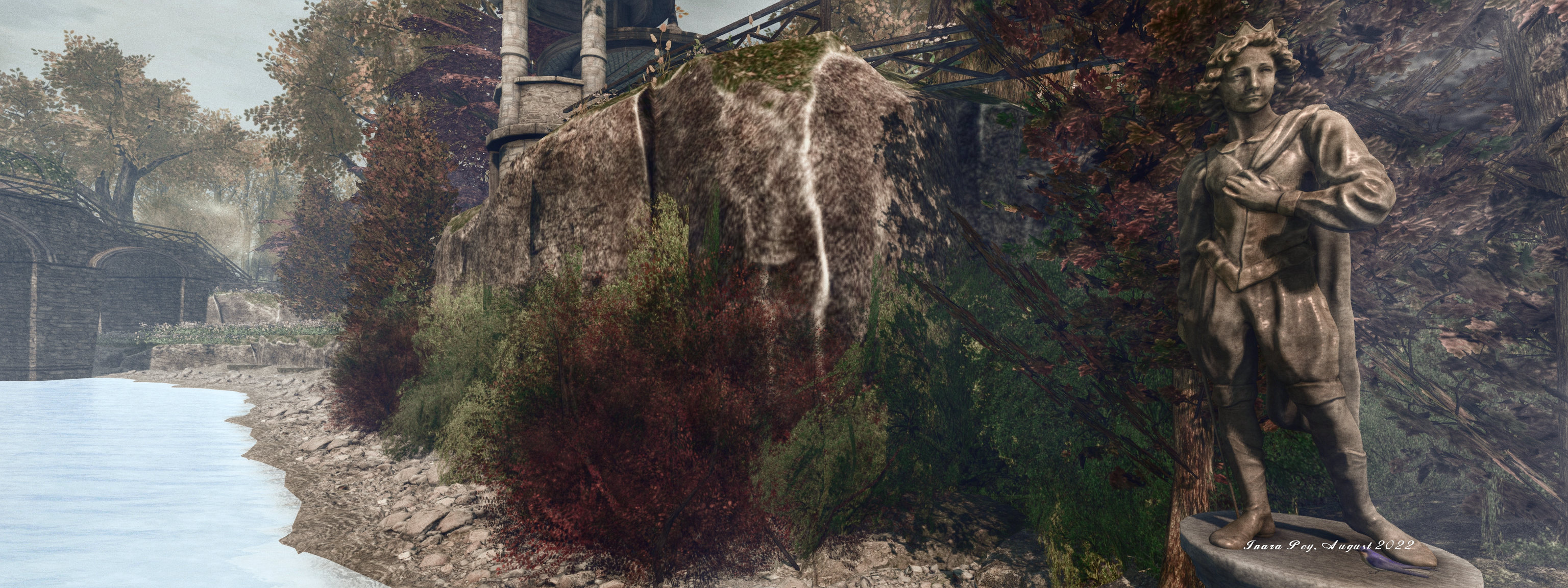
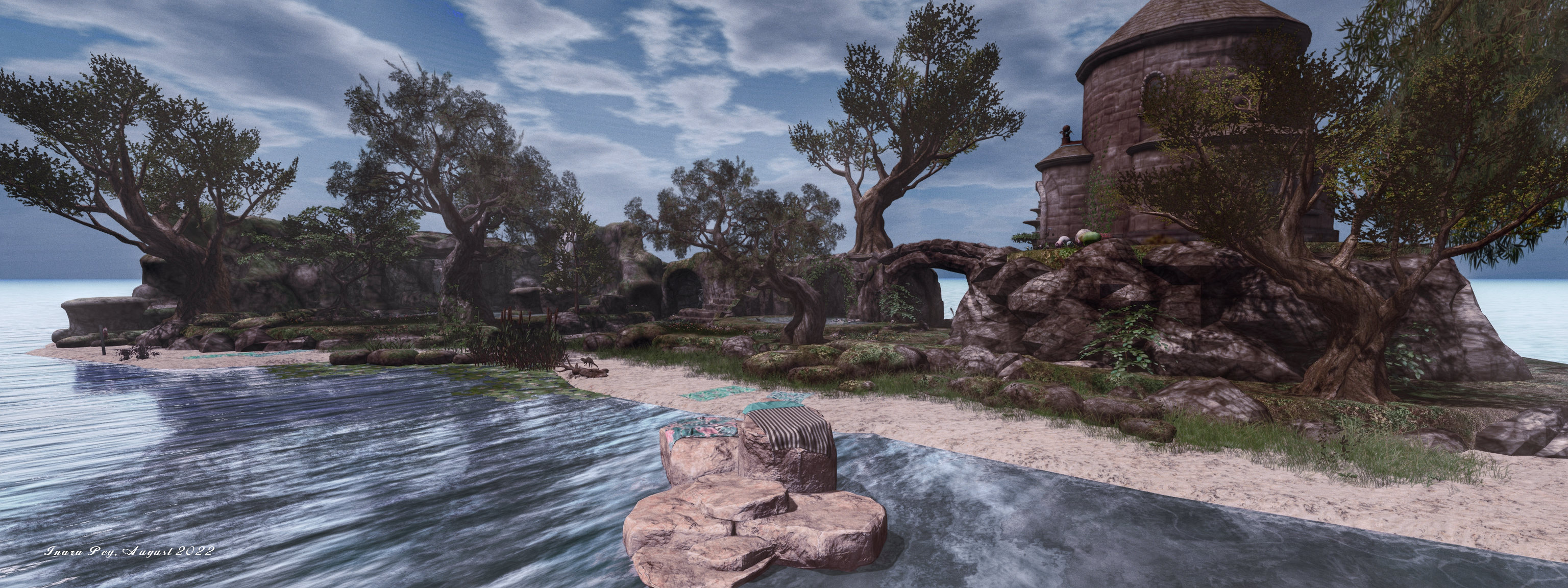
It was off to Heterocera once more after Shawn Shakespeare passed me the Landmark for Sweetwater Valley, an utterly engaging region-sized retreat set out as cliff-top parklands running around the edge of a narrow passage of water which has over time, cut its way into the landscape to leave a lone table of rock rising between cliffs and open sea.
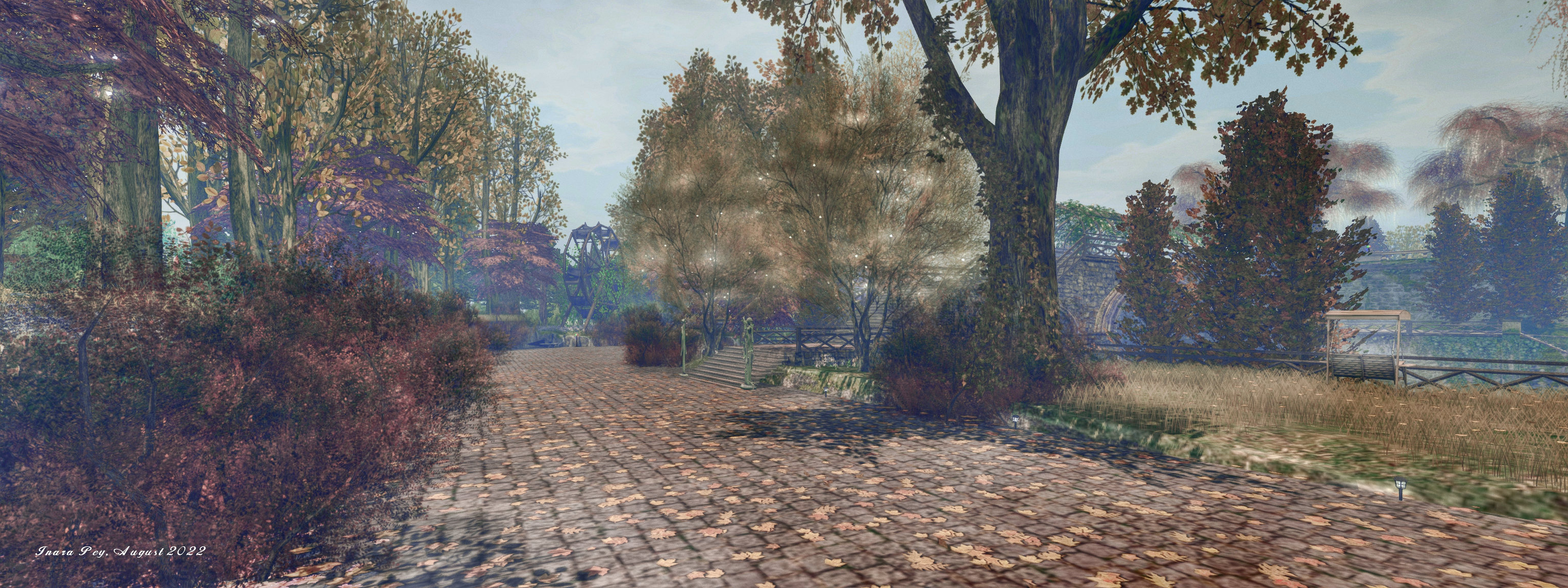
Sitting on the north-east coast of the continent, the setting has been designed by Selena XOXO. The landing point sits on the southern side of a broad bricked path as it arcs around the top of the cliffs, and is set a short distance back from their edge.
Sweetwater Valley, August 2022
To the east, this path runs straight and true, passing an ice-cream concession before dropping down a stairway to sit just above the water’s edge. Here, a small wharf sits and a gondola can be taken for an (automated) ride around the base of the offshore island.
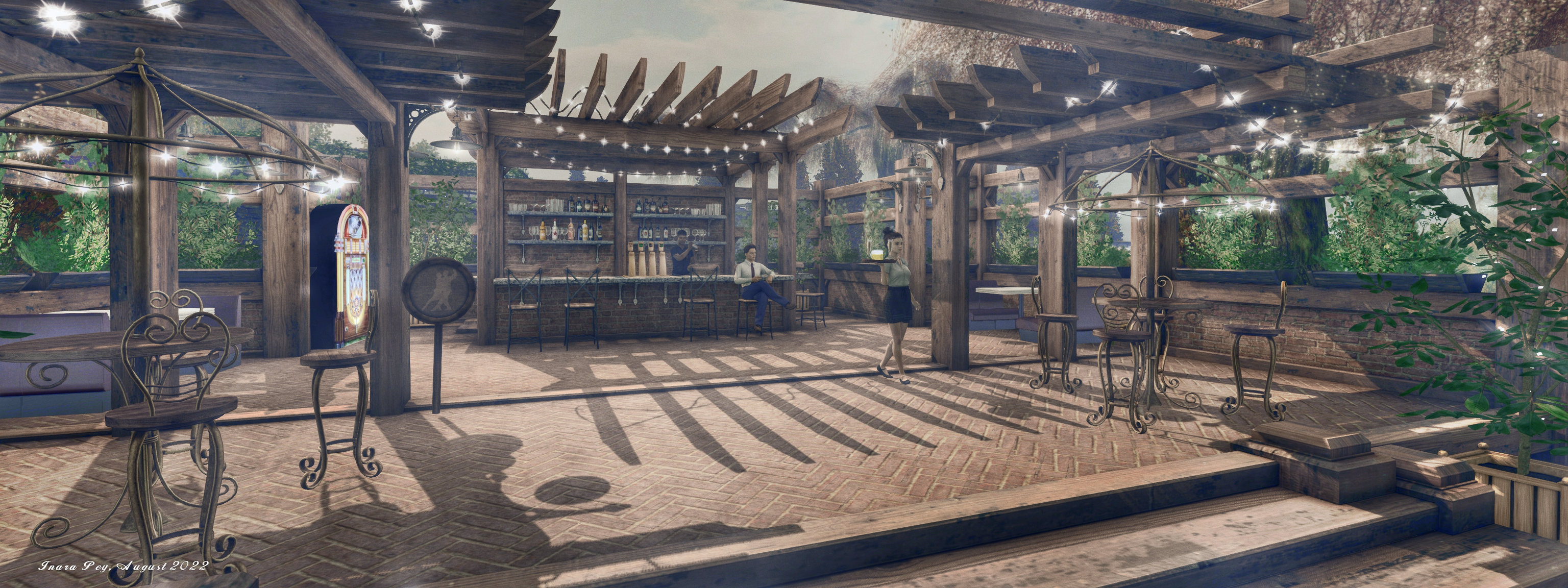
Westward, the path curls gently north, passing the entrance to the park from the local highway and also by an old Ferris wheel, to become something of a headland sitting between open waters and the mouth of the gorge. Here sits a tiered area for relaxing and / or dancing, and where steps descend to where a carpet of flowers sit under the shade of trees and a further hidden place to sit and contemplate or cuddle can be found. A further waterside wharf can also be found here, tucked below the terraces, allowing people to hop off (or onto) the automated gondola as it circles the waterway.
Sweetwater Valley, August 2022
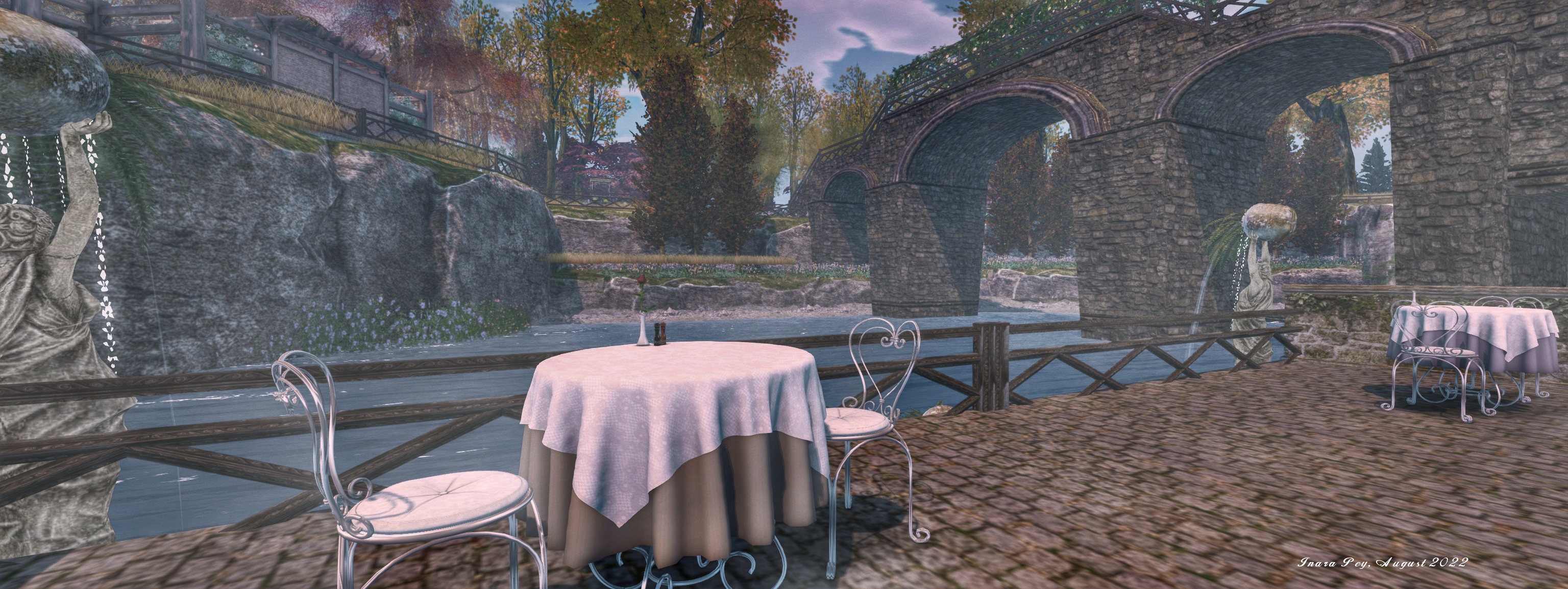
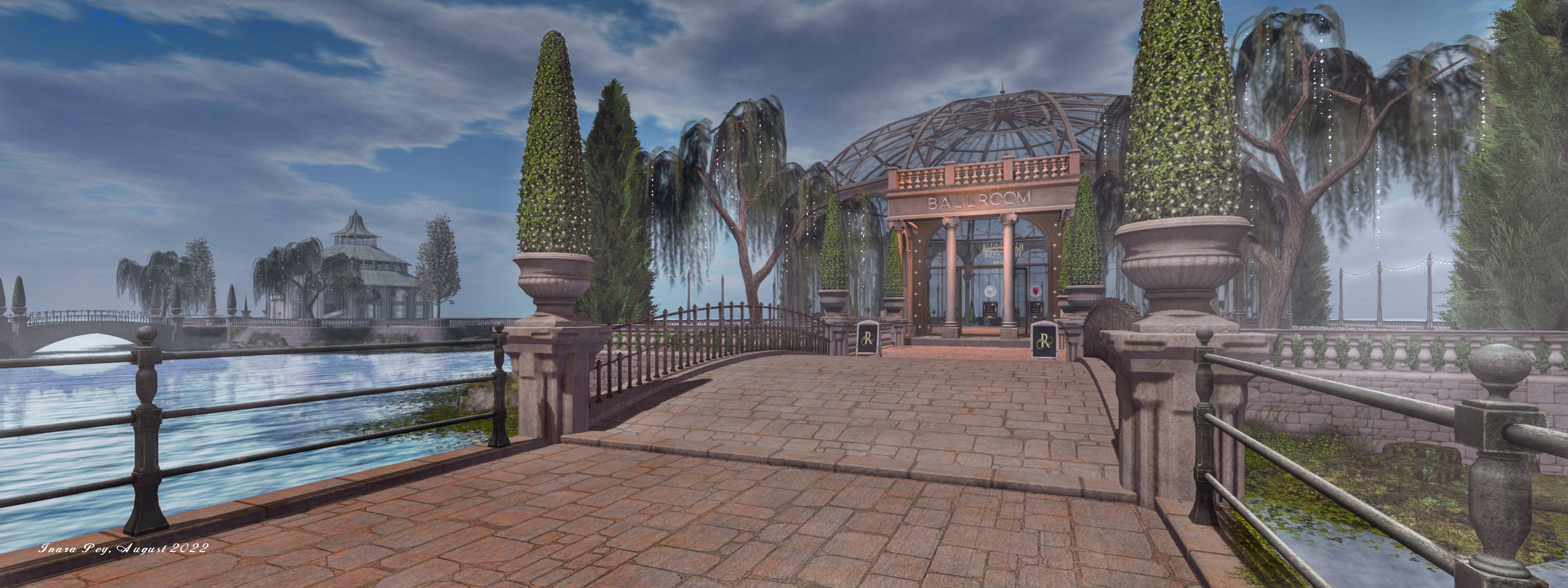
The centre island can be reached via the span of a single high bridge sitting atop three tall arches as they march across the waters of the gorge from the western cliffs. This bridge offers access to a waist-high paved footpath which circles the island, occasionally dipping down towards the waters below or providing access to terraces and places to sit.
Facing the bridge as it reaches the island is a set of stairways leading up to the flat top of the island’s plateau, passing by way of a shortcut linking it to the setting’s landing point. The top of the island is a place given over to dance and music, where Elvis is busy swinging his pelvis and Samuel L. Jackson is shruttin’ his funk in moves John Travolta could only dream of in Pulp Fiction. OK, so maybe they are not actually Elvis and Mr. Jackson, but you get my drift…
Sweetwater Valley, August 2022
Finished with a custom soundscape and environmental settings (although it looks good under a variety of the latter), Sweetwater Valley is rich in detail, with sculptures scattered throughout and little touches than encourage one to stay and explore (including a farther ride on the water, for those who spot it under the island!). Yes, there are a few places where the grass and flowers disconcertingly march away from rocks and edges to float in mid-air, but not enough to in any way put one off.
Above all, this is a pace that lives up to its About Land description, requiring very little more to be said about it other than – go see for yourself!
Beautiful hangout with good music, and an awesome dance area. Take that someone special on a romantic Gondola ride. Lots of cuddle spots.
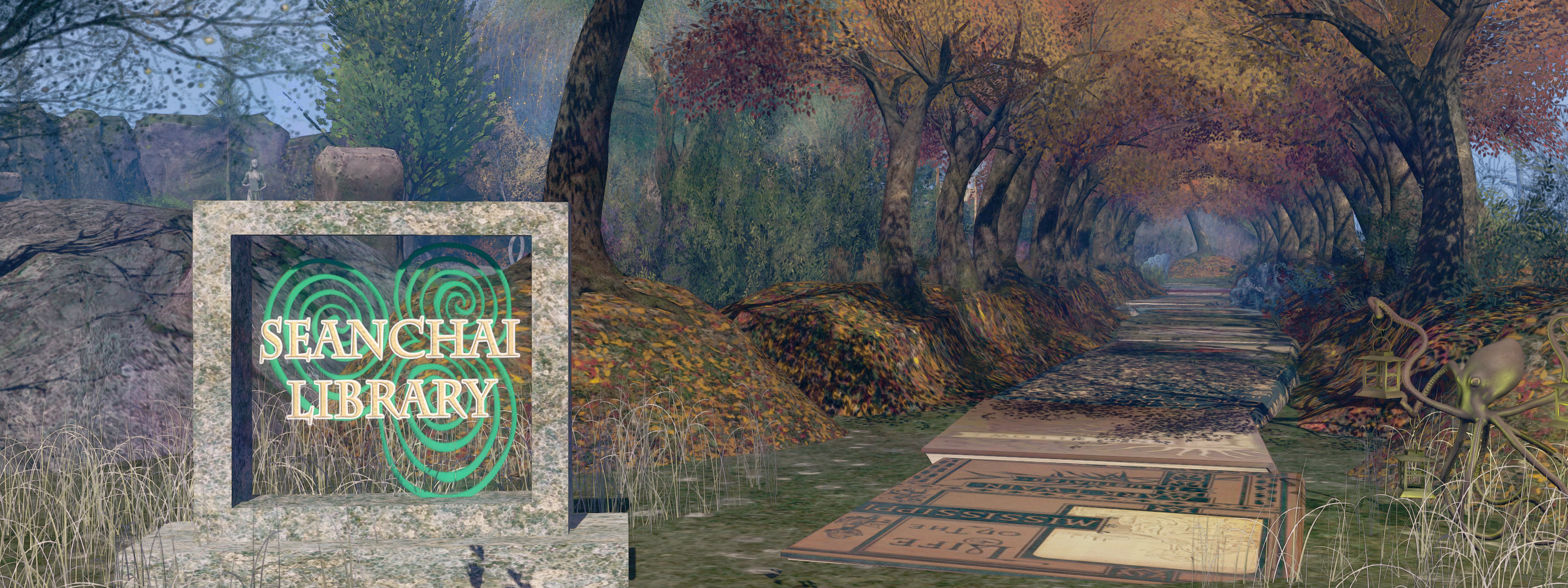
It’s time to highlight another week of storytelling in Voice by the staff and volunteers at the Seanchai Library. As always, all times SLT, and events are held at the Library’s home in Nowhereville, unless otherwise indicated. Note that the schedule below may be subject to change during the week, please refer to the Seanchai Library website for the latest information through the week.
Monday, August 8th, 19:00 Mark Twain Shorts
Samuel Langhorne Clemens (1835 –1910) known by his pen name Mark Twain, was an American writer, humorist, entrepreneur, publisher, and lecturer. He was lauded as the “greatest humorist the United States has produced”, and William Faulkner called him “the father of American literature.”
Caledonia shares selections tonight, including his humorous story “The Celebrated Jumping Frog of Calaveras County” published in 1865, and based on a story that he heard at Angels Hotel in Angels Camp, California, where he had spent some time as a miner.
There lived a girl named Petra Peña, who wanted nothing more than to be a storyteller, like her abuelita.
But Petra’s world is ending. Earth has been destroyed by a comet, and only a few hundred scientists and their children – among them Petra and her family – have been chosen to journey to a new planet. They are the ones who must carry on the human race.
Hundreds of years later, Petra wakes to this new planet – and the discovery that she is the only person who remembers Earth. A sinister Collective has taken over the ship during its journey, bent on erasing the sins of humanity’s past. They have systematically purged the memories of all aboard – or purged them altogether.
Petra alone now carries the stories of our past, and with them, any hope for our future. Can she make them live again?
Caledonia Skytower read Donna Barba Higuera’s 2021 winner of the Newbery Medal and Pura Belpré Award.
Wednesday, August 10th, 19:00: Seanchai Flicks
A special for Star Wars month as the Seanchai cinema space plays host to videos and throw popcorn around!
Logos representative only and should not be seen as an endorsement / preference / recommendation
Updates from the week ending Sunday, August 7th, 2022
This summary is generally published every Monday, and is a list of SL viewer / client releases (official and TPV) made during the previous week. When reading it, please note:
It is based on my Current Viewer Releases Page, a list of all Second Life viewers and clients that are in popular use (and of which I am aware), and which are recognised as adhering to the TPV Policy. This page includes comprehensive links to download pages, blog notes, release notes, etc., as well as links to any / all reviews of specific viewers / clients made within this blog.
By its nature, this summary presented here will always be in arrears, please refer to the Current Viewer Release Page for more up-to-date information.
Note that for purposes of length, TPV test viewers, preview / beta viewers / nightly builds are generally not recorded in these summaries.
Official LL Viewers
Release viewer: version 6.6.2.573358 – formerly the Maintenance 2 RC viewer, dated August 1, promoted August 4 – NEW.
Release channel cohorts::
Maintenance (N)omayo RC viewer, updated to version 6.6.3.573882, August 5.
Rosehaven Seafolk Sanctuary, August 2022 – click any image for full size
In July I received an invitation from Matticus Marinea (Matticus.Blinker), the lead builder for Rosehaven Seafolk Sanctuary to pay a visit to the latter and spend time exploring. It admittedly to me longer than I’d hoped to get there – my apologies to Matticus and region holder Owner of Rosehaven Valley and the rest of their community for this being the case.
Below a timeless European country estate, lies a watery realm of mysticism & tranquillity. Rosehaven Seafolk Sanctuary is an open refuge to all ocean dwelling residents of Second Life. We invite everyone to come and explore our large underwater caverns and seafloor. Discover the many hidden wonders, connect with others at the many scheduled events in a safe community atmosphere.
– via Matticus Marinea / Rosehaven Seafolk Sanctuary About Land
Given the location occupies a Full private region with the additional LI bonus, there is a lot to see, with visits starting either above or below the waves, depending on preferences.
Rosehaven Seafolk Sanctuary, August 2022
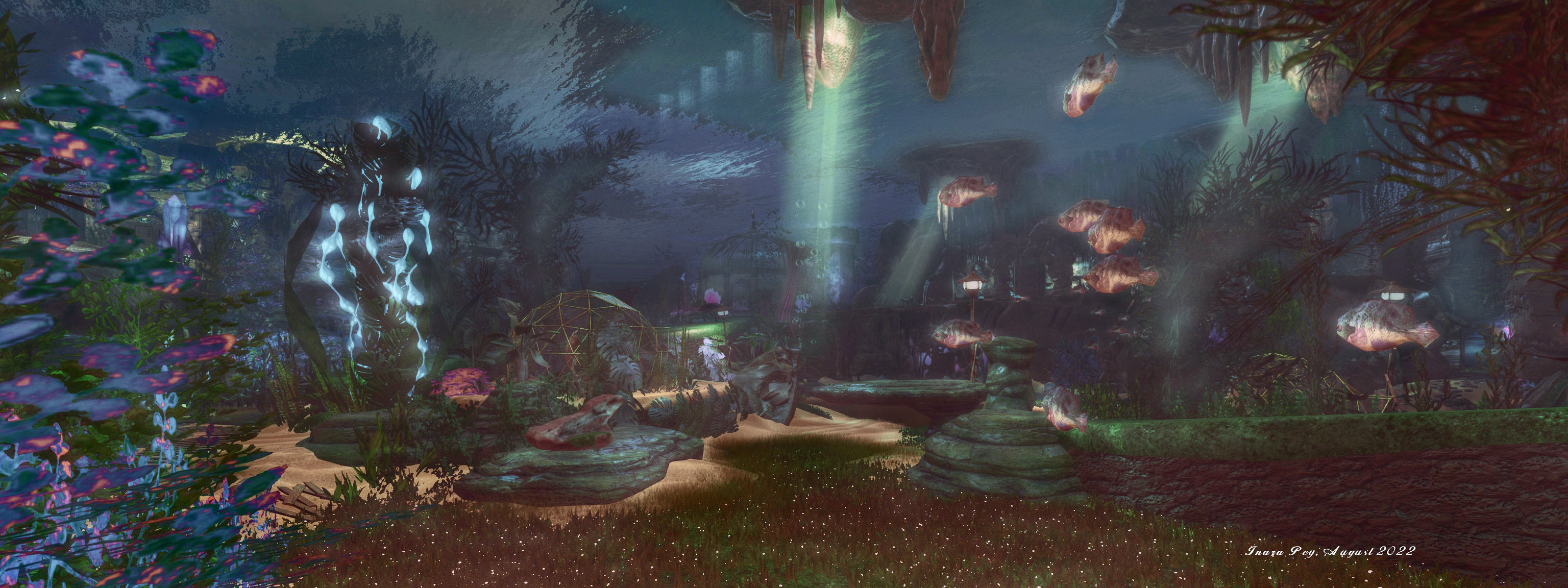
Merfolk will most likely want to start underwater, as this offers the most varied environment; it’s certainly where Imp and I started our explorations. The landing point here offers information on the region, together with two teleport boards – aquatic and land. Both offer quick access to key points under and above water, but I really recommend exploring by walking / swimming.
One thing that quickly becomes apparent when underwater, is the care that has been put into making things as diverse as possible, mixing larger public spaces with smaller, more romantic /intimate spots that are tucked away between doors and inside caves or at the end of tunnels or beyond rocky arches.
Rosehaven Seafolk Sanctuary, August 2022
There is also more of a richness of architectural and floral expression to be found here that might be expected from a merfolk environment: places resembling tree houses, plants that might be as at home in a garden on dry land as one where octopi might tend.
Being a long time merman in Second Life, I have seen a lot of underwater sims come and go. A big problem we have as mer-builders is that there just isn’t enough diversity in items (foliage, rocks, buildings) which are made specifically for underwater spaces. Therefore, when I finally had the opportunity to work on something in this larger scale, I wanted to incorporate non-traditional plant life to create an experience that is distinctively different and yet familiar.
– Matticus Marinea
Rosehaven Seafolk Sanctuary, August 2022
Exploring can be done mer-style – by swimming (we slipped into a couple of mermaid-like looks!) or on foot; the central public spaces are neatly paved, and human walkways and paths are clearly marked, and stairs and steps link areas at different depths, while ladders and stairs offer various routes up to the dry land elements of the setting.
That said, finding your way around still requires a little patience and time; just when you think you’ve seen everything, it’s more than likely turning another corner around a shoulder of rock or climbing another set of steps will reveal something more, be it an underwater lawn complete with a miniature of Stonehenge, an oyster-like bed or a little nightclub awaiting a singer at the microphone – and more.
Rosehaven Seafolk Sanctuary, August 2022
Above ground, the region is laid out as a grand manor estate with outhouses. The manor sits with an elegant formal garden before it, the outhouses range around in a quadrangle. The manor, its garden and the majority of the outhouses are private, unless playing hose to an event. The only exceptions to this are the Tourist information Centre, which forms the above water landing point (complete with information and teleport boards), and the café / bistro facing it.
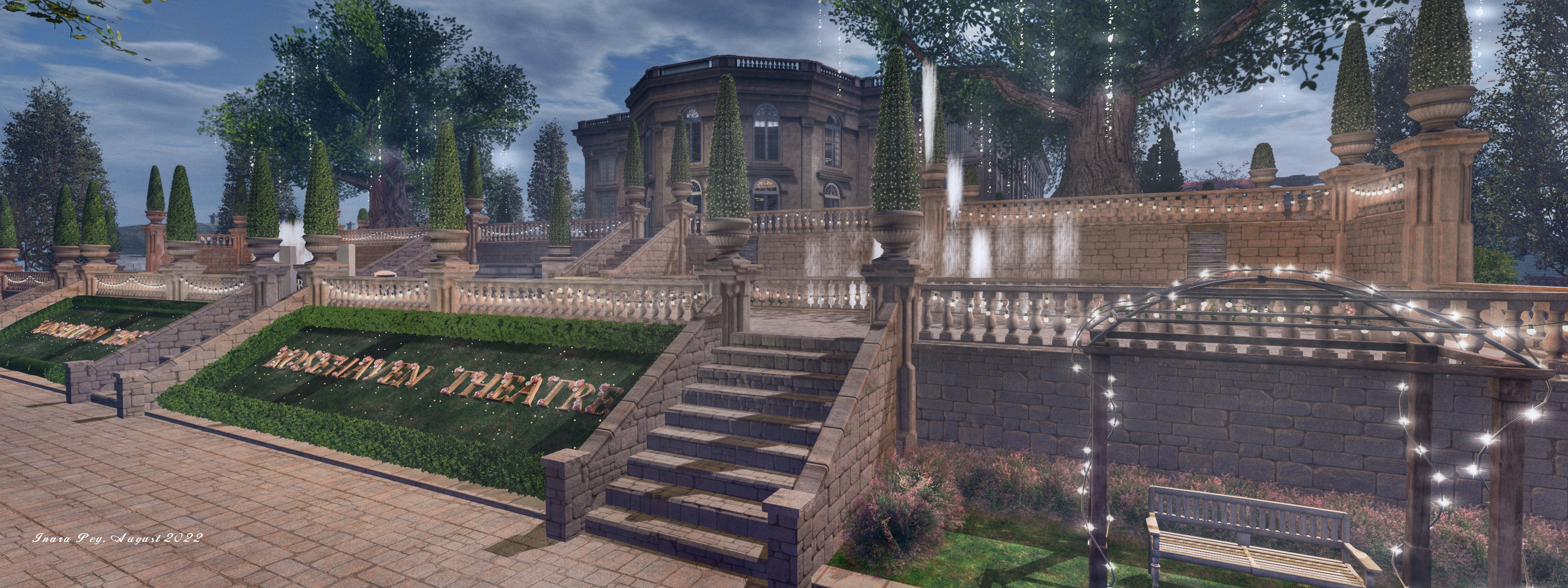
These latter face a waterside walk, the water spanned by a trio of bridge which provide access to the Rosehaven Theatre, home to productions that include Broadway shows, ballet performances, variety shows, musicals, dance recitals and more, presented by the theatre’s troupe and cast. Alongside of sit the double tier of The Cabaret Club, offering an open air performance space on its flat roof and a further venue inside.
Rosehaven Seafolk Sanctuary, August 2022
A further bridge crosses a water channel between the Club and the Aviary – but as it was unclear whether or not the latter is open the public, we kept clear (there is another small island bracketing the theatre and Cabaret Clubs, and this is home to private residences, so please avoid trespass.
Two islands are also to be found tucked into the region. Within the south-east corner sits Sawyer Island. A little haven unto itself, separated from the manor and other structures by water, it is best reached by boat or – for those wanting to come to it underwater – by finding the path, stairs and ladder that provide access to the island via a pool close to its centre. Please be aware that Sawyer Island area is a “clothing optional” space; naturists are always welcome but visitors should not confuse “a lifestyle of practicing non-sexual social nudity in private and in public” with anything sexual.
Rosehaven Seafolk Sanctuary, August 2022
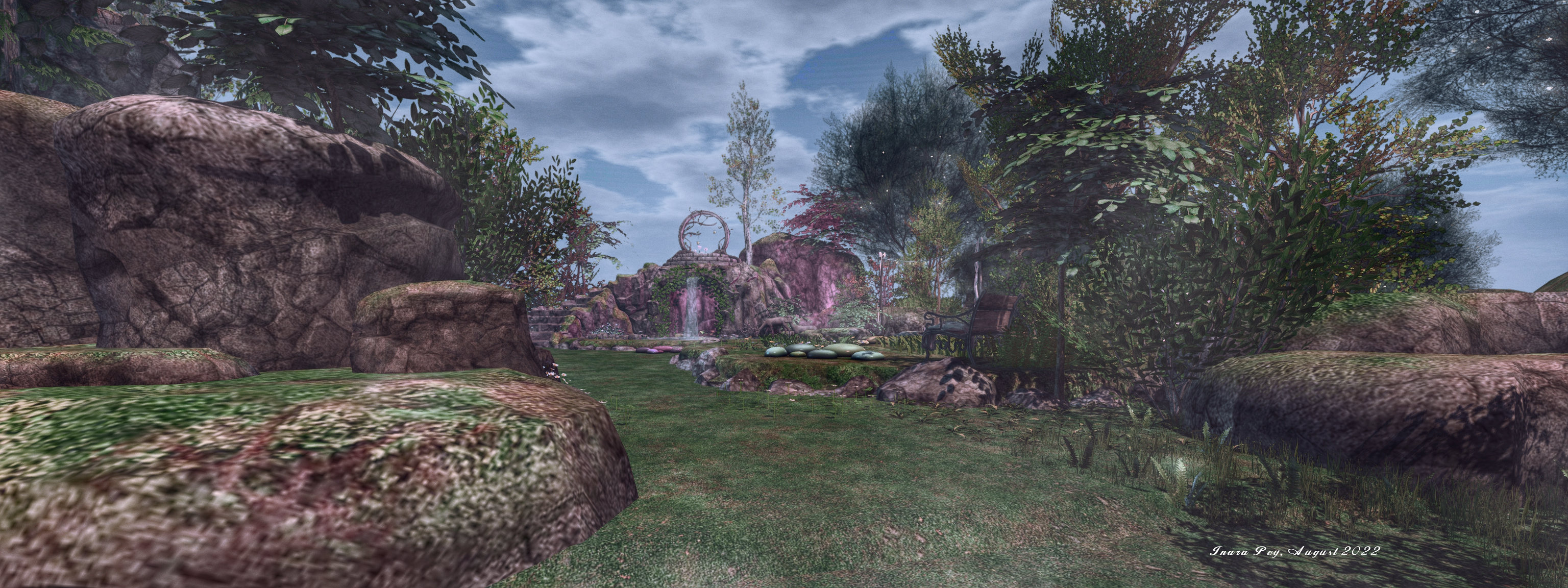
Occupying the north-east corner of the region is Fae Haven. Again best reached by boat or by finding your way up to it from underwater, this presents an idyllic, relaxing retreat awash with magic and enchantment, perfect for those seeking a quiet place to relax with friends or to simply be at one with nature. It sits as a welcome refuge to the Fae Folk of Second Life: elves, fairies, sprites & fauns, with the Enchanted Pond often used as a gathering place for dancing and music.
For me, one of the most impressive aspects in Rosehaven is the use of space. The entire size of the region is use for both the above water and undersea settings without either directly impinging on the other. They can thus be enjoyed and appreciated entirely individually to one another, whilst also being gently bound together by their connected access points to present an integrated environment.
Rosehaven Seafolk Sanctuary, August 2022
Finished with an accompanying local soundscape, Rosehaven Seafolk Sanctuary makes for a richly detailed visit (which can take some systems by surprise, so do be prepared to make some viewer adjustments if necessary) with a lot for find and enjoy both above and below the waves.
My audio recording and chat log of the Content Creation User Group (CCUG) meeting held on Thursday, August 4th 2022 at 13:00 SLT.
The video recording by Pantera Północy of the Third-Party Viewer Developer (TPVD) meeting on Friday, August 8th, 2022 at 13:00 SLT. This video is embedded at the end of this summary, my thanks to her as always for recording the meetings.
These meetings are chaired by Vir Linden, and their dates and times can be obtained from the SL Public Calendar.
This is a summary of the key topics discussed in both meetings, and is not intended to be a full transcript of either.
LL is deprecating a number of Graphics Preferences from the viewer. These include:
A number of obsolete options (e.g. terrain detail slider, avatar cloth option).
The removal of the abilities to turn off the Advanced Lighting Model (ALM) and turn off atmospheric shaders.
The latter two have been previously indicated, and form a part of the PBR / materials work, where the plan is to eventually have two rendering paths: ALM with PBR support and ALM without PBR support.
HOWEVER:
While the options to disable ALM / Atmospheric Shaders are being removed from the official viewer, the actual rendering code for non-ALM rendering (aka forward rendering) is not at this point being removed.
The rendering code will not be removed from the viewer until such time as Linden Lab has a high level of confidence there is no significant impact on users’ SL experience in having to run with ALM enabled all the time, across the vast majority of supported hardware / edge-cases do not emerge where forward rendering is required.
There is still work to be done in order to get ALM running at the (generally faster) frame rates seen with non-deferred rendering, and these are said to be “coming in” to the viewer.
This work includes adding a slider for the number of local lights, so that users on lower specification hardware can dial-down the number of such lights that are rendered, thus helping to boost performance.
However, it was noted that if some doe experience issues due to running their viewer at High / Ultra settings (and their hardware cannot really handle this with ALM enabled), the will be encouraged to lower the quality slider.
Work still to be done on implementing a “data saving” / low bandwidth mode for those on metered Internet connections that will reduce the amount of data (e.g. materials maps) the viewer has to receive. However, the extent of this work and what it touches on in the viewer is still being specified / investigated.
LL is “reasonably confident” that content will look as intended under both non-PBR and PBR rendering, and that it will run as well under ALM as it does currently with ALM turned off.
It is hoped that eventually Second Life will reach a point where the ability to “turn off” PBR rendering could be removed from the viewer – however, it is acknowledged that there is hardware feature required by PBR that isn’t support by all client systems, so this dependency needs to be removed before this can be done.
Work is progressing both on the back-end and with the viewer, although the latter is not ready for any form of public consumption.
The plan remains to produce a test view that will be made available in the near future, and have regions on Aditi (the Beta grid) where it can be tested. Most of the viewer-side work is focused on bug fixing.
Overall, the focus remains on supporting the core glTF 2.0 specification, particularly now this is a recognised international standard (ISO/IEC 12113:2022).
This will provide six supported channels remain Albedo, Normal, Emissive, Ambient Occlusion, Roughness, and Metal.
Subsurface scattering and terrain support will not be part of the initial release.
While interest has been expressed in seeing a glTF mesh uploader in the viewer, this will also not be a part of the initial PBR supporting viewer; the focus is on getting the adopted core specification elements working before attempting to add additional capabilities.
Custom Pivot Points
There have been numerous requests over the years for allowing custom pivot points in mesh at upload (while pivot points can be defined in a .DAE file, they are currently ignored at upload). However, investigation has suggested provision of a solution is more complex than had been thought, prompting a discussion that ran through the majority of the meeting. The following is an attempt to provide a reasonable summary of that discussion.
Arbitrary pivot points can be defined using LSL. However, this is far from perfect.
It places a severe load on the simulator due to the number of object updates (rotation and translation) that must be exchanged between the simulator and viewers as the object is moved.
As rotation is, by default around an object’s or linkset’s centre, LSL solutions often rely on workarounds by creators to achieve a desired result (such as by physically placing a small mesh triangle away from the object and then linking them, so as force the centre point between them to be offset relative to the object). Unfortunately, such techniques can have issues of their own (bounding box sizing, physics upsets, etc).
It relies on somewhat arbitrary interpolation to achieve a smooth rotation / pivot.
Some years ago, a code contribution was made to LL which would enable the pivot points / offsets set within a mesh .DAE be preserved at upload (e.g. by the addition of a simple check box in the uploader which would instruct it to import the file with the offset data).
Unfortunately this solution has its own potential limitation – it effectively bakes the offset point into the object, precluding any further manipulation of the offset were any required – it is thus not viewed by the Lab as optimal unless it can be shown it would in fact work for the vast majority of potential use-cases requiring custom pivot points.
One alternative solution might be to add a new parameter to all volumetric primitives which defines their origin point / centre. This would potentially be more flexible that the above approach, but also carries issues of its own, including:
It still may not work for all use-cases, leading to further alternative approaches being taken, leading to potential conflicts in execution between to different approaches.
What happens in linkset where child prims are specifically targeted for manipulation? if a custom pivot point is set within the root of the object, will it play nicely with the child prims that are themselves being manipulated (e.g. moved), or will things like scaling errors be introduced?
Perhaps the biggest issue identified with providing support for custom pivot points (and which has bearing elsewhere within and for Second Life) is that the platform has no real concept of a node hierarchy – it simply sees all items in the linkset as “children” of the root, whether or not they are linked to it directly or “via” other items in the linkset. (e.g. if you link prims “A” and “B” together, A is a “child” of “B”; if you then link “B” to “C”, SL sees “A” and “B” as equal “children” of C; whether in a node hierarchy, “B” would be seen as a child of “C”, but “A” would remain a child of “B”).
Such a hierarchy would more readily allow for pivot points, as they would be executed according to their parent child relationships, eliminating the need for additional script calculations to ensure the correct rotation / positioning of child primitives.
Unfortunately, implementing a node hierarchy at this point in Second Life’s development is not a trivial undertaking, and more work is required to fully understand the overall benefits implementing it would bring compared to the potential issues / drawbacks – and there does seem to be an appetite among some at the Lab to move in this direction.
Overall, no solid conclusions were drawn at the meeting – other than the fact that more structured discussion is required (including encompassing avatar attachments, which have their own raft of considerations).
In the meantime it has been suggested that an “amend” version of the code contribution that would allow pivot points / offsets defined within a mesh during creation are recognised and maintained by the uploader, rather than being ignored, is implemented within a test viewer, and this could be made available to creators for review / testing.
TPVD Meeting Specific
Changes to the Official Viewer Repositories and Build Process
This is an initiative to improve continuous update integration in the viewer and improve the viewer deployment process.
For TPVs and developers, the most visible aspect of this is moving the viewer repositories from BitBucket to GitHub. This includes the viewer code base and the other public code bases currently in BitBucket (Autobuild, LLCA, etc.).
There are a number of reasons for doing this, including future potential to:
Automate pull requests for code.
Potentially simplifying the Code Contribution licence.
There work is being carried out in two phases: move the repositories to GitHub and then establish the infrastructure to take advantage of GitHub’s capabilities.
LL expects to spend a “couple of months” getting things in place before they are ready to offer a more precise timeline on the repository migration (which will be of core value to viewer developers), and will be looking to discuss this in future TPVD meetings.
Invisible Cities – Fighting Women is the title given to a combined 2D and 3D art installation by Debora Kaz that is currently open to the public through until the end of August 2022 at Nitroglobus Roof Gallery, curated by Dido Haas.
Supported by a custom lighting environment created by Adwehe, this is perhaps one of the most complex installations and layered installations I have seen – something that in itself is saying a lot: Dido has a consummate skill in challenging the artists she invites to exhibit at Nitroglobus, consistently leading to installations that stand head-and-shoulders above those found elsewhere in Second Life in terms of their richness of presentation, meaning, and narrative.
Perhaps the best way to describe the installation is to use Debora’s own words, both from the introductory notes (available via the giver at the landing point) and the open letter Debora has written form women and which is displayed on the north side of the gallery space (and which is included with copies of each of the pieces in the exhibition when they are purchased):
Invisible Cities – Fighting Women wants to show the pain and difficulty of being a woman in a world where women historically were portrayed as objects of desire, exposed to consumption, which induces rivalry, resulting in us women not having a real union to fight the violence that is directed at us.
– Debora Kaz, introducing Invisible Cities – Fighting Women
Whether we like it or not, we live in a world that is largely derived in terms of patriarchy, be it societal, historic, or religious or a mix of all three. It is a global environment where even today, women are faced with a broad range of physical violence (1 in 3 women world-wide will be beaten or raped or face other forms of direct violence at the hands of males at least once in their lives) and more subtle psychological violence.
It is something many women the world over are trying to address and overcome through projects and activities such as One Billion Rising, through protests, activism and even through art – as has often been seen here in Second Life.
However, as Debora moves to point out in Invisible Cities – Fighting Women, we so often undermine these efforts by committing “violence” upon ourselves and one another: we cave to the demands of advertising, objectifying ourselves, turning ourselves into things of desire to attract others; we seek to dominate one another at work or socially, and so forth.
Within this capitalist game of consumption and desire, women compete with each other attack each other in an irrational way; and most of the time, they are not aware of it, because of the superstructure. Structural misogyny occupies the minds of not only men, but it is also present in the formation of every woman who is born objectified. The demand to be desired grows and seeks to be desired all her life – by men, but mostly by women; to be desired by another woman is to have power, to be better than others is wanting to be better than any other woman.
With this in mind, the union that women desire [in order] to combat violence against women [as] imposed [by] the history of patriarchal societies becomes unviable. It is not possible to unite when someone wants to have one power relationship over another.
– Debora Kaz, Invisible Cities – Fighting Women
Through the 16 images and 5 sculptures, Debora presents aspects of all of this in quite vivid and engaging pieces. Within them, we can find reactions to patriarchal dominance (Fuck God) to the need for mutual support (I’m By Your Side), and more. Throughout all of the pieces, colour pays a major role. Pink references both female empowerment and the struggles we face – external and internal – to be understood as individuals, while harder, courser colours are used to represent emotional and the turmoil they can and create and the conflicts – again, internal and between one another – they induce.
Individually, these are striking pieces; each carries a weight of narrative that has impact – this cannot be denied. However, I would be remiss if I didn’t admit to being somewhat confused in understanding the core theme and message of this installation. I’m not sure if this is down to a shortfall on my part or because the artist has accidentally cast her net too wide and introduced to much in the way of narrative and subtext. As such, I encourage you to visit and explore Invisible Cities – Fighting Women for yourself and free from any confusion on my part.


 There lived a girl named Petra Peña, who wanted nothing more than to be a storyteller, like her abuelita.





 Inara Pey: Living in a Modemworld