2023 SL Puppetry project week #23 summary

Puppetry demonstration via Linden Lab – see below.  Demos video with the LL comment “We have some basic things working with a webcam and Second Life but there’s more to do before it’s as animated as we want.”

The following notes have been taken from chat logs and audio recording of the Thursday, June 8th, 2023 Puppetry Project meetings. Notes in these summaries are not intended to be a full transcript of every meeting, but to highlight project progress / major topics of discussion.

Meeting And Project Overview

  • The Puppetry User Group exists to provide an opportunity for discussion about the development of, and feature for, the upcoming Second Life Puppetry project(see below for details), bugs, and feature ideas.
  • These meetings are conducted (as a rule):
    • On Aditi (the Beta grid) at the Castelet Puppetry Theatre, commencing at 13:00 SLT.
    • Those encountering issues in logging-in to Aditi should contact Second Life support for assistance.
    • Generally on alternate Thursdays to the Content Creation meetings.
    • Comprise a mix of text and voice – attendees can use text only, if preferred, but should enable to hear comments / responses given in voice.
  • These meetings are open to anyone with a concern / interest in the Puppetry project, and form one of a series of regular / semi-regular User Group meetings conducted by Linden Lab. Dates and times of all current meetings can be found on the Second Life Public Calendar, and descriptions of meetings are defined on the SL wiki.

General Project Description as Originally Conceived

LL’s renewed interest in puppetry was primarily instigated by Philip joining LL as official advisor, and so it really was about streaming mocap. That is what Philip was interested in and why we started looking at it again. However since Puppetry’s announcement what I’ve been hearing from many SL Residents is: what they really want from “puppetry” is more physicality of the avatar in-world: picking up objects, holding hands, higher fidelity collisions. 
As a result, that is what I’ve been contemplating: how to improve the control and physicality of the avatar. Can that be the new improved direction of the Puppetry project? How to do it?

Leviathan Linden

  • Previously referred to as “avatar expressiveness”, Puppetry is intended to provide a means by which avatars can mimic physical world actions by their owners (e.g. head, hand, arm movements) through tools such as a webcam and using technologies like inverse kinematics (IK) and the  LLSD Event API Plug-in (LEAP) system.
    • Note that facial expressions and finger movements are not currently enabled.
    • Most movement is in the 2D plain (e.g., hand movements from side-to-side but not forward / back), due to limitations with things like depth of field tracking through a webcam, which has yet to be addressed.
  • The back-end support for the capability is only available on Aditi (the Beta grid) and within the following regions: Bunraku, Marionette, and Castelet.
  • Puppetry requires the use of a dedicated viewer, the Project Puppetry viewer, available through the official Second Life Alternate Viewers page.
  • No other special needs beyond the project viewer are required to “see” Puppetry animations. However, to use the capability to animate your own avatar and broadcast the results, requires additional work – refer to the links below.
  • There is a Puppetry Discord channel – those wishing to join it should contact members of LL’s puppetry team, e.g. Aura Linden, Simon Linden, Rider Linden, Leviathan Linden (not a full list of names at this time – my apologies to those involved whom I have missed).

Additional Work Not Originally In-Scope

  • Direct avatar / object / avatar-avatar interactions (“picking up” an apple; high-fives. etc.).
  • Animations streaming: allowing one viewer to run animations and have them sent via the simulator to all receiving viewers without any further processing of the animations by those viewers.
  • Enhanced LSL integration for animation control.
  • Adoption of better animation standards – possibly glTF.
  • Given the project is incorporating a lot of additional ideas, it is likely to evolve into a rolling development, with immediate targets for development / implementation decided as they are agreed upon, to be followed by future enhancements. As such, much of what goes into the meetings at present is general discussion and recommendations for consideration, rather than confirmed lines o development.

Bugs, Feature Requests and Code Submissions

  • For those experimenting with Puppetry, Jiras (bug reports / fixes or feature requests) should be filed with “[Puppetry]” at the start of the Jira title.
  • There is also a public facing Kanban board with public issues.
  • Those wishing to submit code (plug-ins or other) or who wish to offer a specific feature that might be used with Puppetry should:

Resources

Meeting Notes

  • The viewer remains at  version 6.6.12.579958, issued on Thursday, May 11th.
    • This update includes access to Rider Linden’s experimental attachment point tracking & forwarding to the server feature.
    • It also includes various incremental improvements to handling puppetry, such as support for parsing binary LEAP data from the LEAP script.
  • Work has slowed a little due to Linden staff being out-of-office recently (hence why no meeting since May 11th), and personnel on the Puppetry project also working on other simulator projects.
    • This has notably impacted Leviathan Linden’s work on Inverse Kinetics (IK), which has had a knock-on impact slowing Rider Linden’s work on LSL support for driving puppetry.
    • However, progress has resumed on the IK work and while described as currently “not stable”, and problems are still to be solved in situations where a target position is too far away for a joint in the skeleton to reach, or where multiple joints (e.g. 5 or 6) are involved.
    • One issue that is proving difficult to handle is the default avatar mesh joint weighting is incorrect along the forearm and wrist. What is required is two distinct joints at the forearm to do mesh bending correctly: a hinge at the elbow and also a twist constraint along the forearm bone, toward the wrist, rather than (as is currently the case) treating the wrist as a ball joint. This may be the subject of further internal discussion at LL as Leviathan gets more of the IK work nailed down.
  • WRT IK:
    • Leviathan is looking to solve the targeting issues first, then work back to ensure that there are no collisions between a limb and avatar body (e.g. reaching across the avatar’s body to pick something up, and the avatar’s elbow / part of the arm appears to go through the body).
    • Forward And Backward Reaching Inverse Kinematics (FABRIK) – which is the fundamental algorithm for suggesting new joint positions in a range of applications, including 3D modelling – is the route of choice of the Lab; however, adopting to FABRIK is taking some trial and error.

Additional Notes

  • Aura Linden is here but she is working on the Animation importer project which has been split off from the Puppetry project. Currently, the status is animations can be import import animations from some tools/formats, but others aren’t working yet.
    • It was noted at the last meeting, that for animation import, LL is looking towards using / supporting Assimp (github: https://github.com/assimp/assimp), which supports some 30-40 animation formats, converting them to it ownformat for ease of import to multiple platforms. Notably, it supports .FBX and glTF, so it fits with the Lab’s goal of utilising glTF for materials, mesh imports, etc.

Date of Next Meeting

  • Thursday, June 22nd, 2023, 13:00 SLT.

A Summer’s return to Missing Melody in Second Life

Missing Melody, June 2023 – click any image for full size

For those of us in the northern hemisphere, summer is rolling around again with its promise of sunny skies, green fields and lazy walks along riverbanks, idling under the shade offered by the outstretched boughs of a tree, enjoying an afternoon tea or coffee in an easy-going café and more.

More particularly for me, this time of year marks the passing of almost 12 months since the last time I dropped into to Missing Melody, making it high time for a revisit.

Missing Melody, June 2023

Missing Melody is, alongside of the equally eye-catching Longing Melody, presented by Bambi (NorahBrent) as a place of comfort, retreat and relaxation; a place which is never far from thoughts and where a welcome is always waiting. Or to use Bambi’s words, as they are so apt:

What is a Missing Melody? It’s that song in your head that you can’t get out but not sure how it really goes. It’s that temptation you want to have in your life so you can fight to resist. It’s that place in your heart that is always waiting to be filled.

– Bambi (NorahBrent)

Missing Melody, June 2023

For this iteration, Bambi offers a setting which reflects all of my descriptions of summertime above: a rural location rich in the delights of summer, from a stream bubbling and tumbling from a pond high on a hill to follow the curve of the land as it steps down the slope in a series of rocky drops to finally vanish within a culvert, through to the cattle content to stroll the broad grasslands, mingling with horses who also appreciate the rich grazing, even if the local sheep are a little stand-offish!

As a regular supply of fresh water, the pond and stream have attracted much of the local flora over the years, such that the pond is now guarded by the weeping heads of willows and a curtain-like surround of shrubs and bushes which seem determined to protect the secrets of the ducks and geese happy to splash about in the water, and offer the local deer a private place to drink. However, it is a secret that has been penetrated, as the gabled boardwalk reaching out over the pond (but not reaching its opposite number on the far bank) shows.

Missing Melody, June 2023

This gabled boardwalk reaches the pond from a small gathering of garden outhouses sitting alongside a well. Looking a little careworn but still with potted plants being tended, even if the porch swing could do with a little TLC, this little garden space seems to also be a place of play for youngsters going by the tricycle and scooter waiting the return of their owners. How long they’ve been here is hard to say, but the presence of goslings playing in a tub of water, a cat happily sleeping in the sun and a deer and fawn close by, suggests the erstwhile owners of these wheeled means of transport have been gone some time.

Across a bridge spanning the tumbling stream, a path leads down form this little hideaway to reach the Oh Deer Café where refreshments and “sweet yummy moments” await, either indoors or served on the terrace overlooking the sloping growth of wild flowers washing upslope from the stream to counter the neatly-growth flowers in their planters along the edges of the terrace.

Missing Melody, June 2023

The café and the little hidden garden corner aren’t the only places of retreat / refreshment here.  Cross the stream and take a walk over the shoulder of the hill and past the grazing cows and horses, and you’ll spy brick walls and a small out sitting up on the flank of the setting’s uplands. The route to it will take you back past the pond, allowing you to join with another path that links it with the red brickwork. Within the high walls and shaded by trees still wearing their springtime blossom sits a fountained pond dominated by a flower-draped statue. Here, as koi swim in the clear waters, a couple might find a place to sit and sample a glass of burdock and wildflower wine.

For those who prefer to remain close to the babbling chatter of the stream, there is a tree house waiting at the end of a pair of rope ladders. With a bench seat / swing (I’d perhaps not try swinging it too far!), it allows a peaceful watch to be kept over the horses and cows below.

Missing Melody, June 2023

Finished with a pleasing sound scape (albeit one in which the café can sound like the Lunchtime Hordes have descended upon it), it really doesn’t need to be said that Missing Melody is, as ever, highly photogenic and makes for a genuinely easy-going visit … even if I just go a say it anyway 🙂 .

SLurl Details

2023 SL SUG meetings week #23 summary

Sunnmøre, April 2023 – blog post

The following notes were taken from the Tuesday, June 6th Simulator User Group (SUG) meeting. They form a summary of the items discussed and is not intended to be a full transcript. A video of the entire meeting is embedded at the end of the article for those wishing to review the meeting in full – my thanks to Pantera for recording it.

Meeting Overview

  • The Simulator User Group (also referred to by its older name of Server User Group) exists to provide an opportunity for discussion about simulator technology, bugs, and feature ideas.
  • These meetings are conducted (as a rule):
  • They are open to anyone with a concern / interest in the above topics, and form one of a series of regular / semi-regular User Group meetings conducted by Linden Lab.
  • Dates and times of all current meetings can be found on the Second Life Public Calendar, and descriptions of meetings are defined on the SL wiki.

Server Deployments

  • On Tuesday, June 6th, the SLS Main channel servers were restarted without any user-facing changes. Those regions within the channel which still supported LSL XML-RPC functionality had that capability switched off.
  • On Wednesday, June 7th the RC channels should be updated with a simulator release providing support for the new inventory thumbnails viewer capability soon to be forthcoming. See my recent TPVD meeting summaries for more on this capability.
    • This project – or at least the simulator element – is apparently known as “Manicure” internally at the Lab!).

Viewer Updates

No changes to the crop of official viewers for the start of the week, leaving the list as:

In Brief

  • The long-requested Linkset Data (LSD) functions llLinksetDataDeleteFound and llLinksetDataCountFound should be going to LL’s QA team for testing in the upcoming week, and so could be appearing in a maintenance simulator update Soon™. Although it will first go to Aditi for testing.
  • BUG-233832 “llCreateLink LSL function sleep time might be excessive” is due to be addressed in a simulator update due to go to RC in week 24.
  • BUG-202560 “Allow us to pass list data between links to vastly reduce script time” is currently under consideration. Rider Linden’s thinking is that, rather than send the 3 predefined int, string, and key data items, it would be possible to send an arbitrary list.
    • He also noted that at some point he “would love” to add JSON as a first class datatype. Ding so would vastly reduce the time spent parsing and the memory usage, as it would remove the need to keep playing with strings and substrings.
  • The latter pert of the meeting includes a discussion on sensors (and sensing avatars), which touches on BUG-233784 “Add sensor type LOW_SCRIPTED as an option”, and BUG-4329 “Feature Request: New sensor functions that are not bound to a prim’s position & rotation plus inclusion of an Owner filter”. Refer to the video below for details.

† The header images included in these summaries are not intended to represent anything discussed at the meetings; they are simply here to avoid a repeated image of a rooftop of people every week. They are taken from my list of region visits, with a link to the post for those interested.

Through Their Eyes in Second Life

Nitroglobus Roof Gallery, June 2023: Caly Applewhyte – Through Their Eyes

Now open at Nitroglobus Roof Gallery, curated and operated by Dido Haas, is an exhibition by Caly Applewhyte (Calypso Applewhyte). Entitled Through Their Eyes, it opened of June 5th and is the second exhibition I’ve visited of late (the first being Yes Her, which I reviewed for both itself and a possible wider context here) seeking to make a valid statement about women in society, and the unfair bias all too often demonstrated concerning our right simply to be who we want to be in societies – including, increasingly, even within so-called liberalised nations in the west – and not to be subject to uneven demands / expectations.

As Caly offers her own very clear and concise description of the focus of Through Their Eyes, I won’t bore you with my own subjective ramblings; instead, I’ll quote Caly directly.

Women have long been an integral part of society, but their experiences and perspectives are often ignored or undervalued. When we look at the world through women’s eyes, we see a complex and multifaceted reality.
In many societies, women are expected to conform to certain standards of behaviour and appearance, which can be restrictive and limiting. These societal expectations can have an impact on women’s self-esteem, confidence and sense of worth. Women often face a double standard, where they are judged more harshly than men for the same behaviours or actions. Despite these challenges, women have shown incredible resilience and strength, and have made significant contributions to society in a variety of fields.

– Caly Applewhyte, on Through their Eyes

Nitroglobus Roof Gallery, June 2023: Caly Applewhyte – Through Their Eyes
Through women’s eyes we can better understand the challenges they face, the unique perspectives they bring and the importance of promoting gender equality. By recognizing and addressing these challenges, and promoting women’s unique perspectives and contributions, we can work towards a more just and equitable society for all.

– Caly Applewhyte, on Through their Eyes

Thus, the exhibition presents a series of individual studies representing women of many ethnicities and backgrounds, even one a focused head-and-shoulders portrait in which the colour of skin, style of hair, mode of dress (where visible), is not intended to be the primary focus (although they clearly have a role to play in reminding us that women are global citizens who come from many backgrounds and social groups and who aspire to many things – just like the male of our species). What is important in these images are the subject’s eyes.

Nitroglobus Roof Gallery, June 2023: Caly Applewhyte – Through Their Eyes

Whether looking directly at the camera or focused on something unseen from the perspective of the camera’s lens, the eyes of the women Caly has created / drawn together for this series all speak to matters of intelligence, vitality, hope, strength, desire; the emotions and drives that play such a key role in the lives of men, often to high levels of peer praise and adulation, but when shown by women are discounted – or worse, derided or subjected to passive-aggressive responses that (truth be told) perhaps speak to the fragility of the male ego than anything else.

These are eyes that speak of a wish to be free to express, to strive, to achieve; they present each individual in these portraits as an individual. At the same time, they offer a window by which the the world might be seen as women are too often forced to regard it: as a place of struggle simply to be accepted as an individual with needs, wants, drive and desires. In considering the world the eyes in these portraits are looking out upon, some might be encouraged to better understand the constant uphill struggle women face to simply gain a foothold of equitable respect within societies which are still the world over, driven by a patriarchal expectation of position and privilege rather than equality and openness.

Nitroglobus Roof Gallery, June 2023: Caly Applewhyte – Through Their Eyes

SLurl Details

2023 SL viewer release summaries week #22

Logos representative only and should not be seen as an endorsement / preference / recommendation

Updates from the week through to Sunday, June 4th, 2023

This summary is generally published every Monday, and is a list of SL viewer / client releases (official and TPV) made during the previous week. When reading it, please note:

  • It is based on my Current Viewer Releases Page, a list of all Second Life viewers and clients that are in popular use (and of which I am aware), and which are recognised as adhering to the TPV Policy. This page includes comprehensive links to download pages, blog notes, release notes, etc., as well as links to any / all reviews of specific viewers / clients made within this blog.
  • By its nature, this summary presented here will always be in arrears, please refer to the Current Viewer Release Page for more up-to-date information.
  • Note that for purposes of length, TPV test viewers, preview / beta viewers / nightly builds are generally not recorded in these summaries.

Official LL Viewers

  • Release viewer: Maintenance S RC viewer, version 6.6.12.579987, dated May 11, promoted May 16.
  • Release channel cohorts (please see my notes on manually installing RC viewer versions if you wish to install any release candidate(s) yourself).
    • No updates.
  • Project viewers:

LL Viewer Resources

Third-party Viewers

V6-style

  • Kokua updated to version 6.6.12.50745 (no RLV) and 6.6.12.54169 (RLV variants) June 3 – release notes.

V1-style

Mobile / Other Clients

Additional TPV Resources

Related Links

The history of computing in Second Life

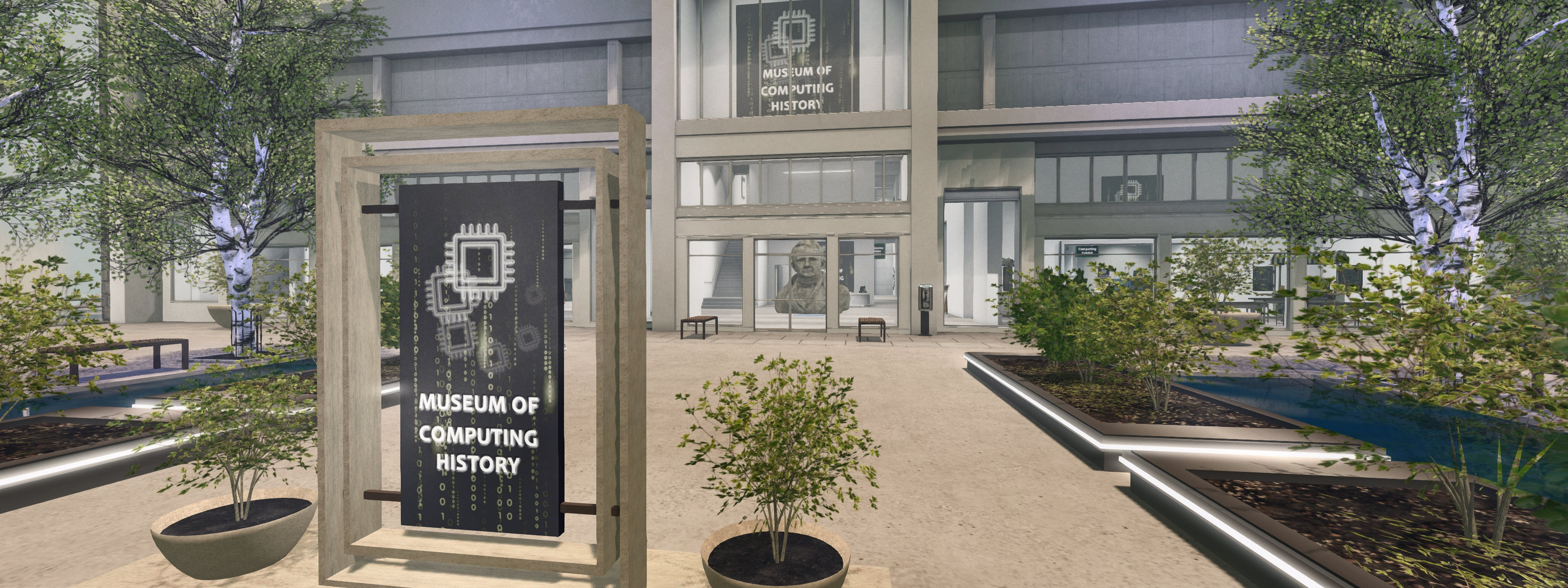
Museum of Computing History, June 2023

As a part of my on-going (and occasional) visits to museums in Second Life, I recently had the opportunity to drop in on the quite excellent Museum of Computing History, managed and curated by Brian Aviator, with the assistance of Timothy McGregor and Kevin Jackman.

Tucked neatly under Brian’s Blackslough Field Regional Airport and overlooking the inland seas and waterways of Sansara, this is one of two museums Brain operates / curates in Second Life, the other being the LGBTQ History Museum and Cultural Centre (also due to appear in these pages later this month, and which is – at the time of writing – featured as an Editor’s Pick in the Destination Guide in recognition of Pride Month).

Museum of Computing History, June 2023

Extending over two floors, and with an ample, well-tended forecourt / terrace public space before it, the museum offers an impressively comprehensive dive in to the history of computing, from the abacus to the blade server and the rise of AI, featuring not just the technology and technological innovations, but many of the the individuals who have contributed to the development of computers, computational engineering and computer science down through the centuries and decades.

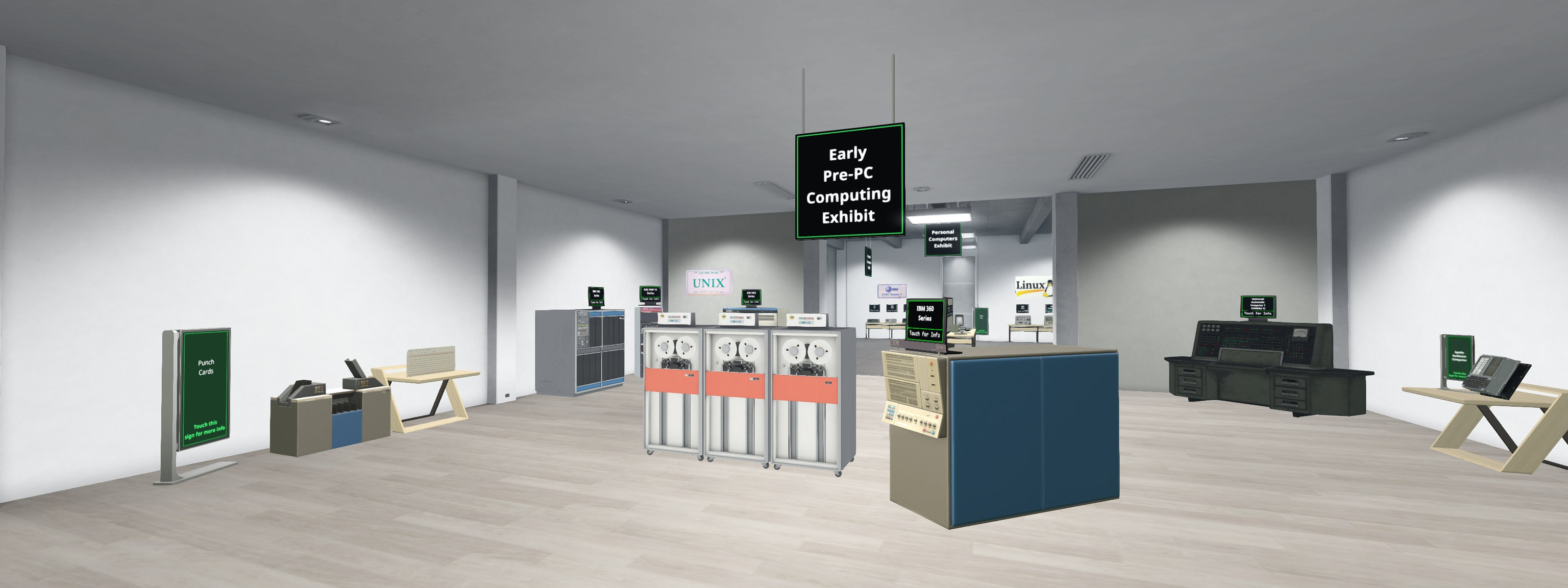
From the entrance foyer, dominated by a bust of Charles Babbage, the lower level of the museum comprises the Admiral Grace Hopper auditorium and four exhibition halls in which may be home to static exhibitions, and others have their displays rotated over time as new exhibits are developed (as is the case on the museum’s upper floor). At the time of my visit, the exhibits in these lower halls comprised:

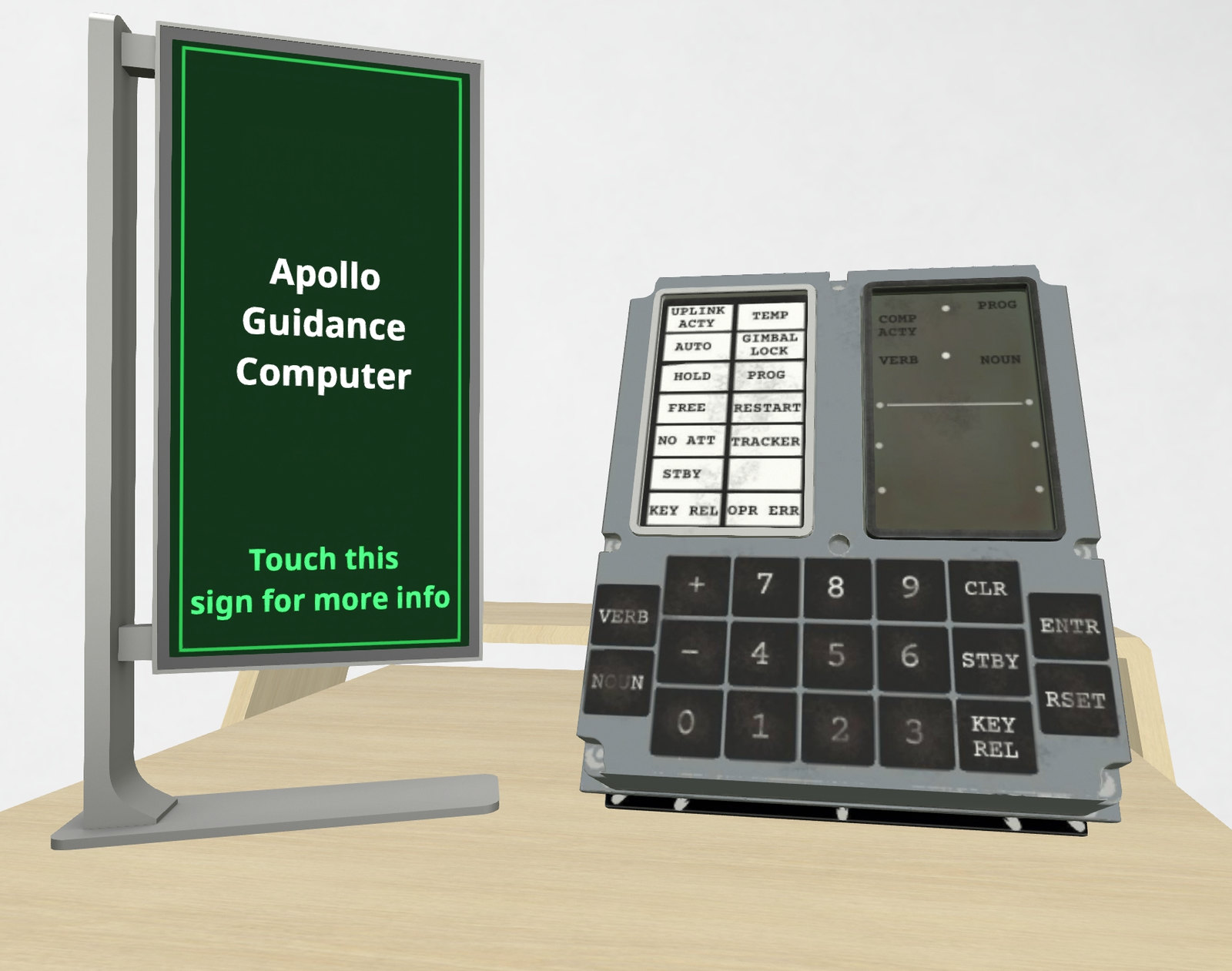
  • Museum of Computing History, June 2023. Made famous during the Apollo 11 landing mission, July 20th, 1969

    Early Pre-PC Computing, which includes one of the earliest computational machines known to Man (the abacus), alongside models of Babbage’s Difference Engine; the electro-mechanical devices which played major roles in the European theatre of World War II – the German Enigma code setting machine and the Polish-British code breaking Bombe; the machines from the early decades of the modern computer era:  punch-card and tape-driven monsters, and even a look at one of the first computers to be used extensively “off-world”: the Apollo Guidance Computer (thanks to Hollywood and numerous dramatizations of the Apollo 11 lunar landing, perhaps now more widely known as the “1202 alarm computer”).

  • The Personal Computers Exhibit, which is liable to raise fond smiles for some, including as it does models of Commodore, Sinclair, Apple, Tandy, IBM and other machines as well as their associated operating systems upon which many enthusiasts cut their computing teeth. I personally found myself smiling at the presence of the BBC Model B and (for reasons that are both convoluted and irrelevant to address here, but include personal travels, Sir Arthur C. Clarke and film director Peter Hyams) the Kaypro II).
  • An Interactive Fiction Exhibit, with its reminder that there was a lot of brain-engaging fun to be had with computers long before the arrival of graphical games and shooting the bejesus out of others. This is also supported by a video presentation called Get Lamp: the Text Adventure Documentary, available through the Admiral Grace Hopper auditorium.
  • A look inside what might now be regarded as an “old school” data centre with huge boxlike machines (rather than huge boxlike racks of machines), and the odd super computer.

These hall all feature models of the various systems, boards, boxes and computers which in turn represent the work of multiple creators from across Second Life – such as (but most certainly not exclusively) Crash Lunar and (appropriately, given the museum’s subject matter) Ozzy Wozniak, both of whom provide a range of free models of computers, handhelds and consoles for those interested. Additional models have also been provided by Brain himself, imported (I believe I’m correct in saying) from 3D models developed by the Universidad de Castilla-La Mancha, Spain – for whom Brian gives acknowledgement. All are presented with display boards which, when touched, will provide a notecard of contextual information (and it should be noted that even the posters on the walls in some of the halls can also be touched for information of their own).

Museum of Computing History, June 2023

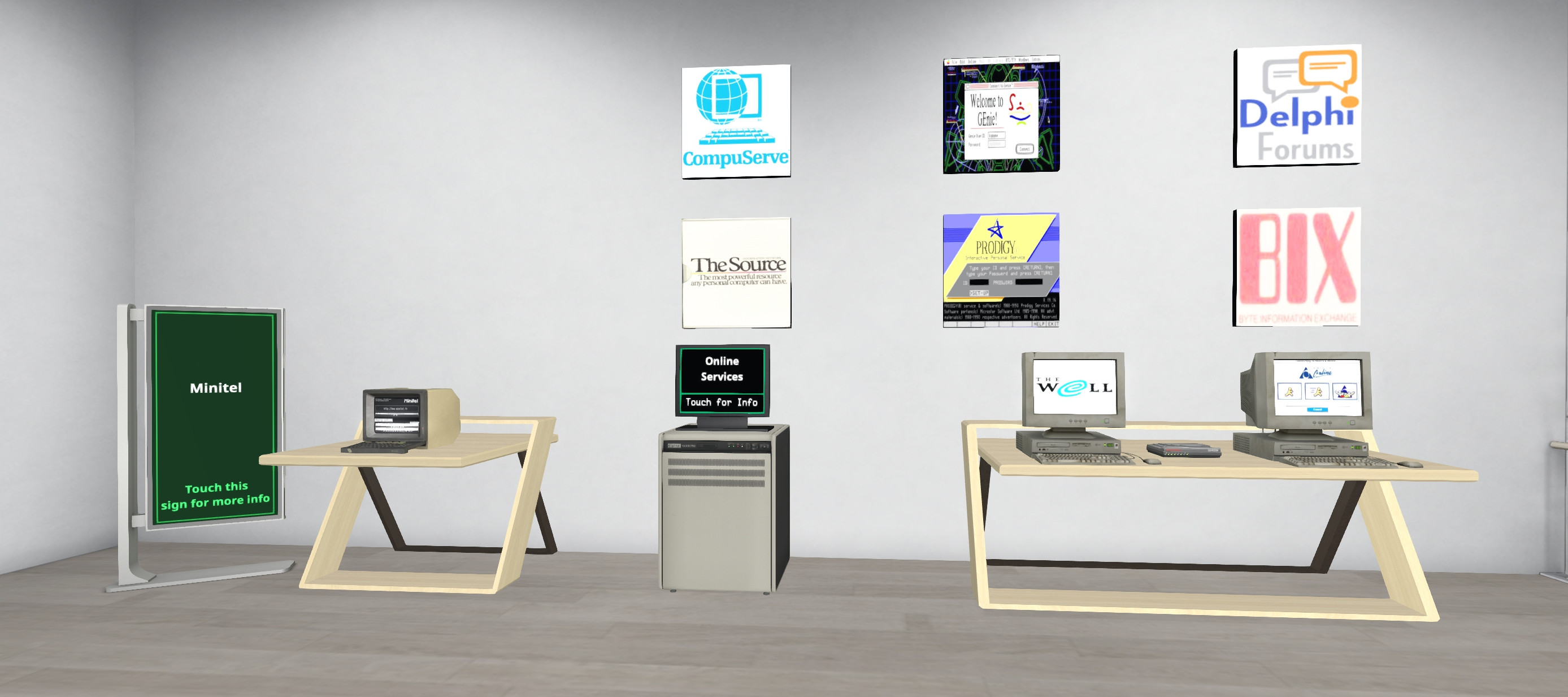
The upper floor if the museum comprises five exhibition halls, all following the same approach as the lower floor, with each focusing on a specific exhibit related to computing. At the time of my visit, these comprised: the relationship between computers and telecommunications and the rise of networking; video games and console systems; the development of artificial intelligence; the noble / ignoble art / act of hacking (which of these terms largely dependant on the who, what, where, when and how of the said hacking) , and biographies of some of the leading personalities and individuals who have played a role in the evolution of computers, mathematics, computer sciences, communications, and related subjects.

Comprising images of the individuals concerned which can be touched for a notecard-based biography, the latter covers people who – at least in name – are likely be  known to many: Augusta Ada King, Countess of Lovelace, Alan Turing, Steve Jobs, William Gates III, Steve Wozniak, Sir Tim Berners-Lee and Linus Torvalds, for example – and one Philip Rosedale; those who might be familiar (if not really known, such as Blaise Pascal; Seymour Cray; Vinton “Vint” Cerf (who has actually been in Second Life) and Robert Kahn; to those who really should have much wider recognition than they do, but whose achievements have perhaps been overshadowed by others – such as the aforementioned Grace Hopper, together with Margaret Hamilton and Dorothy Vaughan, who at times get pushed aside in the male-dominated history of computing, and Douglas Engelbart, whose work at times gets subsumed by the near-mythic achievements of Steve Jobs.

Museum of Computing History, June 2023

The latter’s work (with that of his team at the Stanford Research Institute – now SRI International) is the subject of a second video presentation within the museum, highlighting what would become retrospectively called The Mother of All Demos. The was a live event held in 1968, in which Engelbart interactively demonstrates his team’s oN-Line System (NLS), which is very much the precursor of just about everything we take for granted with computers today: the graphical interface with its cursor (or “bug” as they called it) and mouse; the ability to work collaboratively and share files dynamically; the use of hypertext and hypermedia – even teleconferencing. The video offered at the museum summarises Engelbart’s presentation, but for those interested, the entire demonstration – which lasted over 90 mins – is also available on You Tube.

I admit I did find myself a little conflicted over the use of notecards throughout the museum; not because it is a difficult format to understand, but rather because there are instances where the information is liable to change (such as with the biographies of some of those featured within the upper floor exhibitions, or on the subject of AI), which might lead to some information becoming out-of-date. As such, I wondered if offering a mix of web links as notecards, depending on the subject matter, might not be easier from a maintenance standpoint.

Museum of Computing History, June 2023
But, that is very minor quibble; there is no denying the Museum of Computing History has been extremely well put together, offering as it does something of interest for anyone with an interest in the subject – whether computer nerd or as someone simply interested in historical context and / or the influence of computing and computational machines have had down the centuries / decades. Information is easily accessible, and the range of topics cover and their associated depth means there is a lot of be absorbed without being overwhelming, and more than enough to encourage repeat visits.

 SLurl Details