Premium subscription changes: a little more news from Grumpity

At the April 20th, 2018 town hall event, Linden Lab CEO Ebbe Linden confirmed that as a part of pivoting Second Life’s revenue generation away from a heavy reliance on land, the Lab are looking at introducing a range of Premium account options which will have different levels of benefits associated with them – see here for more (includes an audio extract of his comments).

While details have yet to be finalised, Grumpity Linden spoke to some of the ideas under consideration at the Web User Group meeting. Because her comments are likely to be of interest beyond that meeting, I’ve provided a transcript of her comments, with an audio recording, below.

to précis Grumpity’s comments:

  • The Lab is looking at a range of Premium subscriptions, not just the single tier we know at present.
  • As per Ebbe’s original comments, how many and what they might each comprise is still TBD.
  • The over-arching idea is to make premium options so attractive, it would be “insane” to ignore them.
  • Simple examples of additional benefits being looked at is guaranteed access to in-world events / early access to in-world events, but overall, the Lab is looking at a broad range of benefits and (in the case of Basic accounts) limits.
  • With regards to Basic accounts, the Lab’s view is:
    • There are many things within Second Life which come at a cross to everyone’s in-world experience, but which are offered on an “unlimited” basis to Basic account holders – this may change.
    • Despite rumours circulating on the forums, there are no plans to prevent Basic account holder from rezzing things in-world.
    • The Lab wants to provide a Basic account experience sufficient to give incoming users an understanding  / flavour / taste (call it what you will) of all aspects of Second Life, while encouraging those who engage with the platform motivation to move to a subscription tier.
  • The coming changes are not about curtailing any use of Second Life or limiting what people can do or “nickel and diming” everything that can be done within Second Life.  they are about giving people more reasons to go Premium, make them happy / excited about premium opportunities, and hopefully of driving revenue generation.

Obviously, it would be nice to have more in the way of specifics – and these will come it time. As has been noted, it is still somewhat early days in what is being considered / planned, and I (and others) will obviously be reporting on things as the plans are made more public.

In the meantime, for those interested, here are Grumpity’s comments, and the audio recording of those comments as made at the April 25th, 2018 Web User Group meeting.

What’s coming on the premium tiers? We are looking at all of the existing premium benefits, we’re also looking at what is included with Basic accounts. Our goal is to make a basic experience that allows you an introduction to all areas of Second Life.

So I saw some fascinating speculation on the forums, and I don’t believe we’ve ever considered not allowing Basic members to rez. That would be probably insane on our parts, because this would take away from an integral part of Second Life.

But there are certain things that impact everyone’s experience on one hand, and are completely unlimited to a Basic account on the other.

So we’re looking at different ways of putting in limits that will actually improve everyone’s experience, give basic accounts a sufficient taste of what it is like but also; honestly, our goal is that if you’re committed to Second Life and  you’re invested in Second Life, the Premium benefits are such that it would be insane not to be Premium. And that’s the end goal.

And we’re looking at all sorts of limits, and we’re also looking at higher Premium levels that give you even more things. Like you could get into events even before all the other people, and you’d be guaranteed to get into the hair fair or something.

I can’t give away specifics, because this is so far away, and then when we announce you guys will be, “Oh, this is old news!”  So, we’d like to hold some stuff back. But our goal is to make you happy; it’s not to make your lives miserable and to nickel and dime you at every turn. It is to make Second Life more profitable and successful by making our residents happy [and] also by making new residents’ introduction to Second Life smoother.

Crunching some numbers: the 2018 SL infographic

Courtesy of Linden Lab

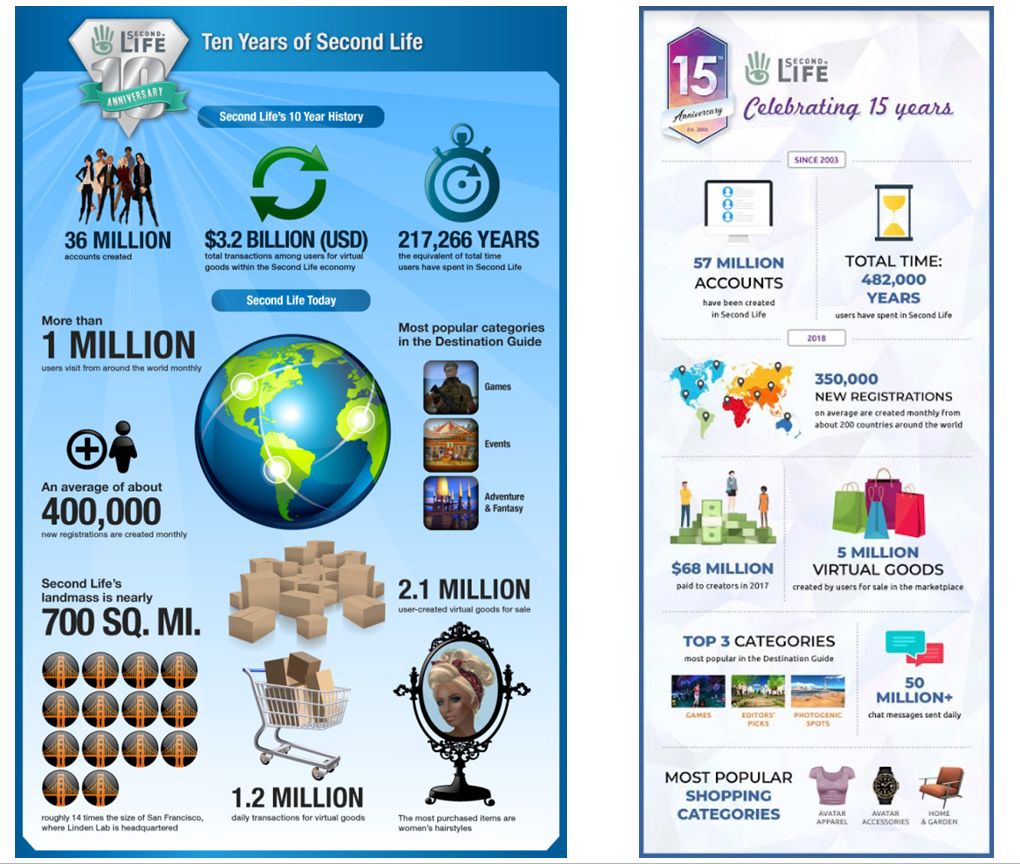
On Monday, April 23rd, Linden Lab issued an infographic on the state of Second Life as the platform approaches its 15th anniversary. The last time the company did this was, I believe, for the  platform’s tenth anniversary in 2013.

Both infographics obviously offer a potted view of Second Life which some might choose to take as spin – but casting the platform in a positive light is what PR is about. More than that, when all is said and done, the figures do go some way to showing the platform is still a vibrant place with a healthy economy and a (broadly speaking) positive engagement on that part of active users.

The “spin” element might be seen in elements such as the number of accounts created in Second Life: a total of 36 million between 2003 and 2013, and a further 21 million in the last five years (for a total of 57 million since 2003, when SL formally opened its doors to the public at large). These figures sound impressive, but when push comes to shove, “accounts created” is a pretty meaningless figure. What really matters is the number of active accounts operating within Second Life; and the fact is that over the years these have been dropping – perhaps not by the amounts some might think – although it is admittedly hard to pin things down to a precise figure.

Similarly, the number of new user registrations (400,000  reported in 2013 and 350,000 reported in 2018) doesn’t add up to a major indicator of SL’s health – but, in fairness nor do they indicate any kind of major decline, despite the 50,000 drop over the intervening period between the two infographics. But really, the issue with Second Life is not the number of sign-ups achieved, but the number of retained active users the platform obtains.

Side-by-side: the 2013 (SL10B) and 2018 (SL15B) infographics. But how useful are they?

Perhaps of more value, to a degree, are figures like the total hours users have spent engaged in the platform. in 2013, this cumulative total for 10 years was stated as an equivalent of 217,000 years; for the 15th anniversary it is put at 482,000 years.  What these show is that while the number of active users engaged in Second Life may have shrunk somewhat (notably since its peak in around 2008), those still engaged in the platform are between them potentially spending more time logged-in to the platform than they were five years ago.

Why this might be is open to speculation; but one group of reasons could be that the time an effort Linden Lab has put into improving the overall Second Life infrastructure, making batter use of technology, improving the performance of much of the platform (simulators, back-end systems, etc.), and the work put into enhancing user-facing capabilities, which have collectively encouraged people to spend more time in-world now than five years ago.

This increase in time spent engaged in the platform has other potential benefits as well – such as in increased economic activity. This is somewhat indicated by the 2018 infographic, which indicates that Second Life creators and land holders cashed out some $67 million in 2017. During sessions such as Lab Chat, and other public meetings, it had been indicated that the amount cashed-out by users in 2015/2016 was around $60 million; so it would seem that overall, the SL economy is experience an upturn, albeit a modest one. The strength of the economy might also be indicated by the rise in the number of virtual goods for sale: 2.1 million in 2013 and a stated 5 million in 2018 – although I point to this increase with the caveat that items for sale doesn’t necessarily translate directly into increases in goods sold.

Given that the 2018 infographic would tend to indicate overall engagement in the platform among engaged Second Life users has increased, the economy has apparently undergone something of a growth as well, it’s perhaps understandable why – as per the recent town hall meeting – there is now a much stronger emphasis within the Lab to pro-actively try to grow the user base going forward – and some interesting approaches are being tried.

So, what of the issues of active user numbers and new user accounts? It is true that Second Life is experiencing shrinkage in the number of active users. However, a degree of perspective is required when discussing it. At its peak in around 2008, SL averaged around 1.1 million active monthly log-ins. Today, it is lower – but by how much? That’s a tough nut to crack.

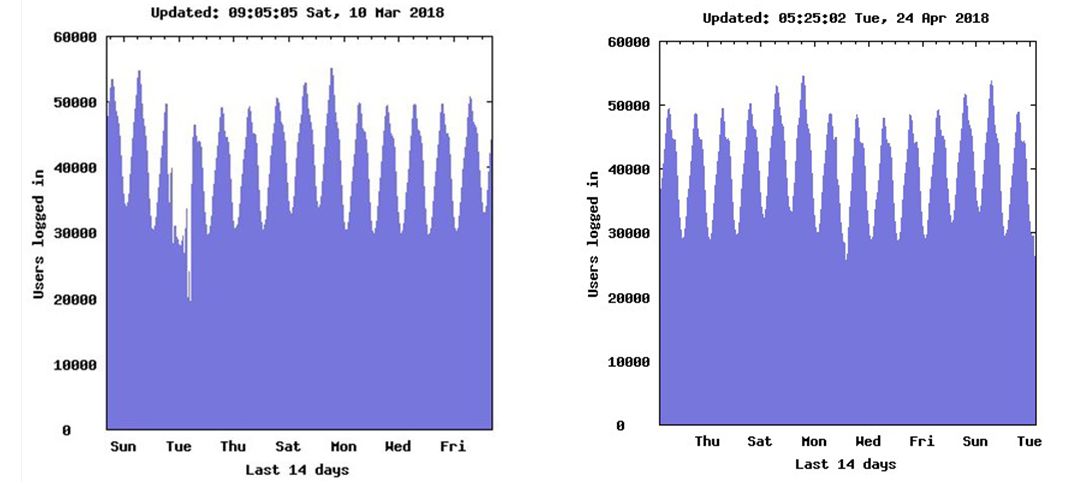
One of the few sources of real data we have comes from the SL Statistical Charts Page put together many years ago the most respected Second Life blogger (whose insight is genuinely missed), Tateru Nino, which is still active today. Among other things, it provides a series of breakdowns of concurrent log-ins – current and over set periods of times. These tend to collectively show that by-and-large average concurrency is between 30,000 and 50,000. Even when taking the bottom end of this range as the daily “average”, it still yields around 900,000 active monthly log-ins. That’s just 200,000 from the platform’s peak.

Second Life average concurrency is around 30,000-50,000 per day, as illustrated by these two 14-day extracts from Tateru Nino’s Statistics Charts, deliberately collected just over a month apart from one another

Of course, it might be argued that some of these concurrent log-ins are alt accounts or possible bots and so “don’t count”. But how large a figure is that likely to be? It’s impossible to know. Some factor it as being more than one-third, which might not be a wholly unreasonable figure; however, a counter-point to this is that just because someone is logged-in on two accounts doesn’t mean they’re not actively contributing to things like the economy through both of those accounts; so while it might be argued such activities reduce the total user count, it may not negatively impact the platform’s economy. Similarly, and where there are no empirical numbers available, it is fair to say that bot usage today is a lot less prevalent than when SL was at its peak; thus while their influence cannot be completely discounted, they are likely to have less of an influence on concurrency today than a decade ago.

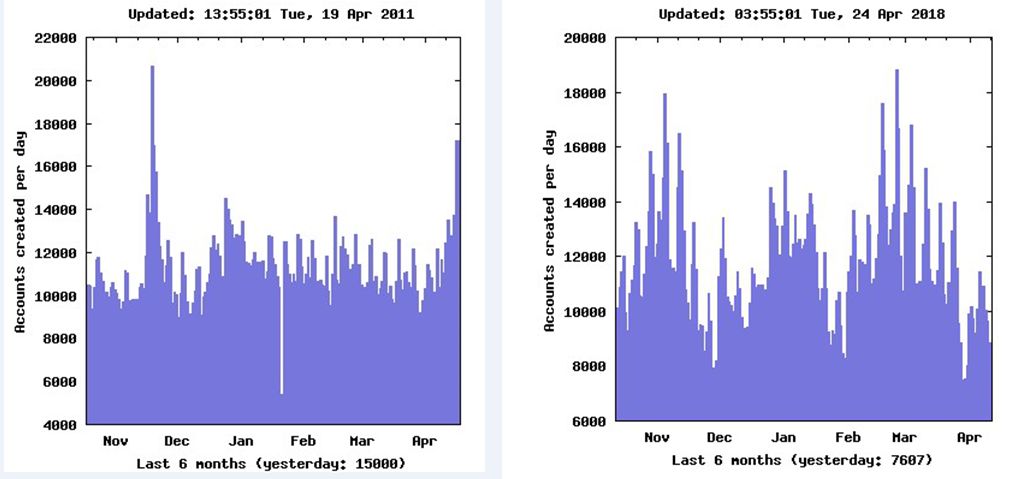
The most interesting aspect of the figures is perhaps those of sign-ups As noted above, the Lab notes a decline in monthly sign-ups of around 50,000 since 2013. Looking at Tateru’s data for 2011 (the nearest 6 month period to 2013 I have archived) and 2018, shows the average daily rare of sign-up hasn’t varied overly much across the years – although arbitrary daily figures can show more of a variation.

Sign-up across 2 6-month periods, in 2011 and up to April 2018. The averages for both are not too far apart

Both the infographic and Tateru’s stats would again point to the Lab’s optimism around growth, indicating as they do that while daily sign-ups have dropped somewhat over the years – Second Life potentially still generates interest, not all of which can be put down to existing users creating thousands of alt / bot account daily. The problem is, as noted earlier, getting more of those sign-ups converted to active, retained users.

Overall, the current infographic reveals that while there is undoubtedly room to grow the numbers of active users, and despite the downplaying of monthly active users by some, Second Life is still a healthy platform for both users and the Lab when it comes to generating revenue – and the weight of virtual goods tends to point to the Lab’s hopes to re-balance their own revenue generation away from such a heavy reliance on land tier as having merit.

More to the point, it does demonstrate that, despite all the fears about the arrival of Sansar, etc., as Second Life approaches a celebration of it’s fifteenth anniversary, it still offers a richness and depth that can keep us all engaged with it.

April 20th 2018 Town Hall with Ebbe Altberg: transcript with audio

Strike the pose: Ebbe and moderator Xiola Linden at the first Town Hall session, Friday, April 20th

On Friday, April 20th, Linden Lab hosted two Town Hall meetings at which questions were put to the Lab’s CEO, Ebbe Altberg. Those wishing to ask questions were asked to submit them via the forum thread A Conversation with Linden Lab CEO Ebbe Altberg, although outside of the core meeting, Ebbe took time to answer questions from the audience present at the event.

Some 200 questions were asked, many of which were technical in nature. As many of the subjects of these questions were no things Ebbe could respond to directly, the decision was made to have the Lab’s subject matter experts address them directly through the forum thread itself after the Town Hall meetings, a process which may take several days to complete. So, if you did ask a technical question that wasn’t raised at either Town Hall event, be sure to check the thread to see if an answer in provided there.

The following is a transcript of the core questions and answers offered at both sessions, with audio extracts provided as reference.

  • These notes don’t follow the chronological flow of the sessions, as I’ve attempted to group subjects by topic for more concise reference.
  • Due to the nature of the event, some questions of a similar nature were asked at both sessions, which elicited very similar answers in each case. Where this is the case, I have generally provided the answer which – in my opinion, admittedly – offers the most information.
  • Similarly, Ebbe’s opening comments at both events followed similar lines, so I have only provided a transcript of the remarks made at the first session.
  • Questions are given in bold.
  • The “back to summary” links will take you back to the blog post summary of the session, and can be used by those who prefer to “subject hop” rather than work their way through the entire transcript.

The Short Form

For those who prefer, the following is a bullet-point list of the core questions asked, gathered into the same topic headings as the transcript notes. Links are given to the relevant part of the full transcript for those who would prefer to read / listen to the complete answers / comments.

Note: due to the nature of WordPress internal text anchors and scrolling, you may have to scroll up a little after jumping to a specific topic, in order to see the question.

Opening Comments – First Session

  • Linden Lab remains committed to Second Life, which is managed by a dedicated team covering Product, Engineering, Support, Marketing, etc. Jump to topic.
  • The Lab remains focused on growth, for Second Life as much as Sansar; Sansar does not signal the end of Second Life, nor are there plans to “transition” SL users to Sansar.
  • A lot of focus is on pivoting LL’s Second Life revenue generation away from a land-based model to one more balanced between land tier and other fees. Jump to topic.
  • Major effect and investment in being put into moving all of Second Life to a cloud based infrastructure, which will hopefully bring benefits. This should be seen as a sign of commitment to SL. Jump to topic.

Revenue: Land, Fees, Subscriptions and Compliance

Note: this section includes answers to questions about upcoming US SEC regulation changes and the incoming EU GDPR, which were primarily responded to in terms of compliance data management.

  • Land costs following the move to the cloud. – Land costs many not dramatically change, and revenue rebalancing has the potential to do more. Cloud benefits potentially more technical in nature, but may offer some fees benefits. Jump to topic.
  • How can Linden Lab sustain itself on a free-to-play basis? – Free-to-play, revenue and subscriptions: Free-to-play accepted norm in the industry and not changing with Second Life. However, as part of a re-balancing of revenue generation, what can be done on a free-to-play basis versus what might be possible through subscription options is being considered. Jump to topic.
  • Can you explain how LindeX and transaction fees are constantly increased with no perceived added benefit to users?
    • Providing an economic model that globally allows people to pay money into it and withdraw money from it requires regulatory compliance a state, federal and global levels, and this costs.
    • Increases in transaction fees, along with subscriptions, etc., may offer a means to reduce the cost of SL land.
    • Jump to topic.
  • What is the Lab’s policy on user data protection? – taken very serious, vis: compliance (above), LL does not participate in any business models that feature the use of user data. Jump to topic.
  • Have you considered charging for additional accounts, say US $10 per account? – Not come up, will pass it on to the team.
  • Are there going to be adjustments to Premium accounts? – Yes, and considerable work is being put into this by the Product team to determine the types of Premium account / subscriptions should be offered and what their individual benefits should be. Jump to topic.
  • Will the changes to Premium accounts also see changes to how arrears are handled, e.g. not lock accounts out? – time is provided for people to catch up on payments. Jump to topic.
  • Will any reduction in land fees apply to Skill Gaming regions? – in time, hopefully, yes. Jump to topic.

Technical / Project Questions

  • Will there be updates to Lab-owned in-world infrastructure – InfoHubs, themed private regions, etc? – already in hand. Jump to topic.
  • What are the plans for Second Life on Mobile? – It’s under discussion, but no firm plans, with a hope there might be a good business case to move in that direction. Jump to topic.
  • Will the return of Last Names allow people to freely choose their last name, or will it be ‘choose from a list’?
    • Also see my audio updates from Oz, Grumpity and Patch Linden on the return of Last Names – comments referencing that post are including in parentheses in the following bullet points).
    • Pre-made list (but suggestions on last name options may be sought from the community to help with refreshing the list with new options).
    • Will also be able to change your first name.
    • Will involve a fee (in US $) and might be a Premium benefit.
    • As a warning to creators: if you script items to identify avatars, don’t use names, use the avatar Agent Key.
    • No time frame as yet on when it will be rolled out.
    • Might be a Premium-only benefit; if available to all, Premium may have a specific advantage (TBD) over Basic.
    • Jump to topic.
  • When will Animesh Bakes on Mesh and Windlight EEP be available? –  No precise dates, but Users actively involved in testing. Hopefully in the next couple of quarters. Jump to topic.
  • Will the Teen Grid ever come back? – Not being discussed. Probably better to work on ensuring proper controls in place to allow people to use the one grid. Jump to topic.
  • What is the Lab’s commitment to the open source project? No change. Can’t really take it back and wouldn’t want to due to TPV synergy. Jump to topic.
  • Will any features from Sansar be back-ported to Second Life, such as the rendering engine or Marvelous Designer support? – rendering engine, no. Marvelous Designer support – possibly a question for the Second Life team. Jump to topic.
  • Will my.secondlife.com [Profile feeds] be improved to help make connections a-la Facebook? – connections and building communities are important, but whether my.secondlife.com is a part of that is unclear, as there are other potential channels. Jump to topic.
  • Would it be possible to spin-up a second instance of a region being rebooted, and transfer avatars to it and maintain traffic, rather than forcing them to teleport elsewhere / log off, and then letting the original just shut down? Jump to topic.
  • When is Second Life going to be optimised to run well on high-end client systems with good Internet connections and graphics? Jump to topic.

New Users and the On-boarding Process

  • Is Linden Lab planning to advertise Second Life to attract new customers and keep the population size healthy and sustainable? – this is a constant effort, and the Lab is investing time, effort and money into the entire end-to-end on-boarding process to not only maintain, but to hopefully grow, SL’s user base. Jump to topic.
  • What are Linden Lab’s plans to bring-in new users and incentivise past users to return? – partially answered above, plus the improvements to the platform, the content users continue to make, etc. Jump to topic.

General Topics

  • What is the Lab’s view on adult content and the future of adult content? – No change. Jump to topic.
  • Will there be more sessions like the Town Hall or like Lab Chat after SL15B? – There are in-world technical meetings, but the hope is to have more general in-world meetings and discussions going forward. Jump to topic.
  • How do you compare the Oasis [from Ready Player One] as an educational place with Second Life? – Second Life is probably the closest to the Oasis in the world today and has a broad range of uses and involvement which is inspiring. Jump to topic.
  • Do you see Second Life lasting for another fifteen years? – Yes; Second Life is still successful on many levels, so why not keep it going?
  • Can you give a positioning statement between Sansar and Second Life? – two products with some similarities, but also significant differences, each managed by a separate teams. Jump to topic.
  • What have you found to be the biggest challenges for Second Life with regards to your planned vision, and how are you overcoming those challenges? Jump to topic.

Second Life: Town Hall series announced

To mark Second Life’s fifteenth anniversary, Linden Lab has announced a series of Town Hall meetings at which Second Life users can hear members of Linden Lab and well-known groups within SL talk about the platform, their work, and answer questions offered by users.

The announced sessions will comprise:

  • Linden Lab CEO Ebbe Altberg.
  • Members of the Firestom team.
  • Residents of Bay City.
  • The Designing Worlds team.

The first of these town hall meetings will feature Ebbe Altberg in a double session on Friday, April 20th, at the following times:

  • 09:30 SLT.
  • 13:00 SLT.

User are invited to offer questions for Ebbe via the forum thread A Conversation with Linden Lab CEO Ebbe Altberg. Questions will be selected from those submitted, and as many as possible will be answered within the time frame set for the meetings.

Users can attend the meetings by teleporting to one of the three following landing points at Town Hall Island:

Not: none of the above SLurl may be open to the public prior to the day of the event. 

Other Town Hall meetings, to be “held in the coming months”, will be announced in due course.

Ebbe and Oz talk Second Life in the cloud

Credit: Linden Lab / Amazon Web Services Inc.

It’s a huge effort. Right now the Second Life grid is a proprietary set-up in a hosting facility that we have customised for the purposes of what we’re doing – which made sense a decade and half ago. But these days, with the services from Google and Amazon and Microsoft with cloud infrastructures, it makes a lot of sense to shift our technologies to be on top of those cloud infrastructures instead of having our own.

Ebbe Altberg, VWPBE, March 15th, 2018.

That the Lab is working on moving Second Life to the cloud is becoming more and more widely known. First mentioned by Landon Linden (aka, Landon McDowell, the Lab’s Chief Product Officer) during his SL14B Meet the Lindens session, it was “officially” announced in August 2017 via a blog post.

Landon Linden, June 2017, talking about the Lab’s hope to move Second Life services to the cloud.

It’s a long-term project, which will extend well into 2019 (at least), building on a relationship with Amazon dating back to 2008, and which today both Blocksworld and Sansar (see: “Project Sansar”: an Amazon ECS case study), from which the Lab hope to gain a range of benefits, including – in time – perhaps the opportunity to offer a broader range of products at more comfortable (for users) price points.

There are some significant technology challenges the Lab faces with the move. However, progress is being made. Some non-user visible services are already running in the cloud, and more recently, the Lab has started preliminary testing with cloud-based simulators – although they are fair from ready for users to access, as Oz Linden outlined at the March 16th TPV Developer meeting:

We have actually run experimental regions on cloud servers, and it worked. There were some functional limitations that we have to do a lot of work to solve before we could begin to do regions that ordinary users can get to … It’s something we’re pursuing as aggressively as we can [but] I’m not even sure we have a sufficiently comprehensive view of the problems … some of them will only become apparent as we actually put things into production.

Oz Linden, TPVD meeting, March 16th, 2018 – full audio below.

Oz Linden, March 16th, 2018, talking about progress to date, and how things are likely to progress.

For the Lab, the benefits of the move to the cloud include things like a reduction in their capital expenditure  – no need to maintain their own dedicated hardware (or continuously update / replace it) within a dedicated operating environment. It also means they can more dynamically scale consumption according to needs – this could be beneficial for a number of the back-end systems within Second Life.

It turns it into less capital expenditure to have to buy all the equipment and doing all the maintenance on that. You kind-of pay for what you use; with Second Life [right now], once we’ve bought a piece of hardware, we have to sit on it whether it’s being utilised or not, whereas you can kind-of dynamically scale your consumption as necessary when you use something like AWS … which we believe will reduce costs for use and then ultimately, we hope to pass that on to customers.

Ebbe Altberg, VWBPE, March 15th 2018.

Once the transition has been completed and the Lab has had time to evaluate things, the move might allow them to offer a more varied land product – something again touched upon in Ebbe Altberg’s 2018 VWBPE address, and allow them to more extensively “re-balance” the revenue model – something that is also an ongoing project at the Lab.

We’re really thinking hard about the economic model of Second Life. We share a belief inside the Lab that land is quite expensive. so we’re constantly looking at ways to lower land prices and find other ways to find revenues. So I think you will see us try to shift from what I would say [are] high real estate taxes to more consumption taxes or fees to create an environment where it’s easy for people to create and own experiences, and we [the Lab] participate more in all the transactions that take place.

Ebbe Altberg, VWBPE, March 15th, 2018.

Given that land tier provides the lion’s share of the Lab’s revenue, this re-balancing is far from easy to say nothing of the potential for user outcry at any fee increases). Ergo, having better means to lower fees such as through reduced operating costs and a broader spread of more “affordable” products could – depending on the time frames involved – go a long way towards helping the Lab achieving that re-balancing goal.

So what might the move to the cloud mean for users? That’s hard to quantify at the moment, simply because the project has so far to go.However, some hints at what might happen have been offered.

For one thing – and on the subject of different land products – it might allow the Lab to offer two broad categories of region / server type; I’ll call them “always on” and “on demand”.

  • “Always on” would be simulators running 24/7 as with SL at present. These would be ideal for handling Mainland, large open spaces like Blake Sea and the larger, contiguous private estates. Such regions might have a similar type of fixed-fee tier cost associated with them as we have today (although not necessarily the same price points).
  • “On demand” would be simulators that are only active (and charged for) when in active use. When devoid of avatars, they are saved to disk and spun down. These types of region could be ideal for special events, or for private business / residential regions which don’t have any surrounding regions, and would only be charged for when avatars are present; once the last avatar leaves, following an appropriate pause, the region is saved, and the instance spun-down.

Such an approach has been alluded to by Ebbe Altberg:

Some experiences might want to have continuous persistence over time, and maybe that’s one type of pricing model, for an “always on” type of scenario. Maybe other will be fine with, “hey, I’m only using this for a few hours in a class a few times a week” or something. and if that can spin-up in a few seconds, and then I just need to basically pay for the time that I’m utilising it. Those could be potential options for us to explore.

Ebbe Altberg, VWBPE, March 15th, 2018.

Land offerings could be broadened in other ways. Again, as Ebbe Altberg indicated at VWBPE 2018, there might be high-performance, high-capacity, “upper tier” servers available for those needing them for specific uses (e.g. events need high concurrency levels or similar), sitting alongside more moderate, lower-cost servers for things like residential use.

More intriguingly, cloud hosting might even allow the Lab to more readily geo-locate simulators / regions with their physical world audience. Such regions wouldn’t necessarily have to be grouped together in-world, they are simply located a lot close to the user base that most frequently uses them, potentially improving performance for that audience.

Today we are located in the US, which means that people from Australia or Asia or Europe have to travel quite a ways, which is hundreds of extra milliseconds of latency. So if you want to have a very dedicated community in Australia or somewhere, we could maybe start to distribute our server infrastructure to be closer to where the actual customers of those regions are, which would make things more performant.

Ebbe Altberg, VWBPE, 15th, March 2018.

There will be more to come on SL and the cloud and the Lab provide further updates as the work progresses, and I’ll hopefully report on them as they are made public. In the meantime, and for those who haven’t waded all the way through the VWBPE 2018 video with Ebbe Altberg (and Brett Linden), or who don’t want to read either my transcript of that event or the bullet-point summary, here’s the audio of Ebbe’s comments on SL and the cloud:

Second Life: Last names to return – Linden Lab

Update, March 22nd: At the Content Creation User Group meeting, Oz Linden indicated the return of last names will be somewhat similar to the “old” system – users select a last name from a list. However, people will be able to change their names as often as they like (although a fee will apply). See more in my summary update.

He also indicated that the Lab might take suggestions from users for last names which can be included in the various sets of names offered.

As promised during the VWBPE 2018 conversation with Linden Lab CEO Ebbe Altberg and Brett Atwood (Brett Linden), Senior Manager for Marketing at Linden Lab, the company has provided a blog post presenting something of a “roadmap” for Second Life.

The post, which also serves as something of a launch of Second Life’s 15th anniversary, starts with a recap of the Mainland price restructuring announced on March 14th, 2018, and goes on to provide an interesting list of items – some of which could prove to be highly popular.

Key among these is the promise that – after years of requests – last names will be returning to Second Life.

No time frame is given – beyond later this year. Note that this is not necessarily the return of the “old” system of last names, but appears to be a means for people to more readily change their last name, the blog post stating:

The return of Last Names – You’ve asked for it (a lot!), so we will provide a way to customize your last name in Second Life! More details will be available later this year.

Another item which may well be of interest to existing users is a new attempt by the Lab to raise the level of new user retention within Second Life, with the post noting:

Themed Learning Islands – Getting connected to people who share your interests will be easier than ever with “Themed Learning Islands.” Soon newcomers may start their adventures in one of several themed areas, so their first experience in SL will be among Residents who share similar interests. This new initiative is in addition to our existing Community Gateway program which empowers independent communities to develop their own newcomer-friendly experiences.

Speaking at a recent Third-Party Developer meeting, Grumpity Linden, a Senior Product Manager at Linden Lab provided an overview of what this will entail:

Another intriguing change will see the Mainland Land Auction system overhauled, including integration with Place Pages and the ability for users to auction their own land.

Merchants are liable to be interested in the news that the Marketplace will see improvement, with the blog post noting:

We’ve got a number of improvements to Marketplace in the works, too! We’re integrating many long-requested features that will help to reduce clutter and improve the functionality of listings as the Marketplace gets a facelift later this year.

Among the more general items listed in the blog post – at least for those who follow this blog  – is a summary of some of the new capabilities and updates which are coming to Second Life:

  • Animesh.
  • Bakes on Mesh.
  • Environmental Enhancement Project (EEP).

All three are primarily covered in my Content Creation User Group updates.

It’s also worthwhile that alongside of the EEP work mentioned in the blog post, there is also a project – no time frame available – to improve the Second Life’s atmospheric shaders – which could help update SL’s general appearance and more easily allow atmospheric effects like Godrays.

The work to move Second Life to the cloud gets a mention in the blog post. Credit: Linden Lab / Amazon Web Services Inc.

The work to move Second Life to the cloud also gets a mention – and I’ll have a blog post on this up and available soon, largely as a result of the VWBPE 2018 event mentioned above, and also comments made by Ebbe Altberg and Oz Linden at a recent Third-Party Developer meeting. In the meantime, the blog post notes the work to enhance and improve SL’s performance both on the server-side and in the viewer.

Elsewhere. it is noted that Premium members will see further benefits as the year unfolds:

  • Additional benefits for merchants with Premium membership, which may have come out of / been hinted at during Web User Group meetings.
  • Linden Homes are going to get a (long overdue) revamp.
  • Premium users  will be able to run Experiences that are enabled anywhere on the grid (unless specifically blocked by a landowner). This is again something many Experience creators have requested since the introduction of Experiences.

Finally – and as some have noted with the arrival of new region groups on the grid in recent weeks – a further new Experience-based game is on the way. Expect to see that, according to the official blog post, closer to the actual SL15B celebrations.

All told, the list of 15 expectations is an interesting mix of news, some of which those actively engaged in Second Life will already be aware, as note. Others – again, perhaps notably the upcoming return of last names – could generate excitement among users. I’m personally keen to see the new themed learning islands, and will hopefully have more information on them as the project launches in the new future. I’ll also continue to cover the technical enhancements to the platform through my weekly project updates.