Following recent announcements about efforts to improve communications and engage with the users, and to provide the opportunity to ask questions of members of the Lab’s senior leadership (see: Linden Lab: updates to policies and new initiatives on community relations (May 2nd, 2024) and Summary of Tilia acquisition Lab Gab + SL Round Table News (April 24, 2024)), on Thursday, May 16th, 2024, Linden Lab announced both the venue details for the the first Community Round Table and those from the Lab’s leadership team who will be attending.
Those attending from Linden Lab will be Oberwolf Linden (Linden Lab Executive chair and co-owner, Brad Oberwager) and Senior VP of Product & Engineering Grumpity Linden.
The time and date of the event (as have previously been given) are: 09:30-11:00 SLT, Monday, May 20th, 2024.
The event will be held at the Linden Estate Service regions, and the following SLurls have been provided for accessing the regions:
Those wishing to submit a question in advance can still do so via this anonymous form.
In addition the the above, the post provides details on how users can engage with the Lab through the Feedback Portal and Support Portal, and by attending the regularly scheduled User Group meetings held in-world on a range of specific subject areas. For details on the latter, please refer to the SL wiki Official User Groups page, and for dates and times, please see the SL Public calendar†.
The official post concludes:
We understand that agreement on every idea or suggestion may not always be possible. However, we can assure you that your ideas and suggestions matter deeply to us, and those perspectives help shape our decisions. Your voice is valued in our ongoing journey together.
We are deeply grateful for the opportunity to collaborate with each and every one of you in shaping a world that is not only enjoyable and prosperous but also vibrant and flourishing. Your presence here means the world to us, and your contributions are invaluable in making Second Life an exceptional place to belong. Thank you sincerely for sharing your time with us and for being an integral part of our journey towards creating something truly special together.
Again, please read the official blog post for all information on the meeting.
†While they are not officially representative of the Lab or these meetings, please note that I attempt to provide summaries of a number of user group session within these pages, and Patera Północy provides video recordings of the meetings she is able to attend via her You Tube channel).
On Friday, April 26th, 2024, Linden Lab issued a pre-recorded Lab Gab session featuring the company’s Executive Chairman, Brad Oberwager (Oberwolf Linden) discussing the recent news concerning the acquisition of Tilia.io, the all-in-one payments platform established by Linden Lab in 2019 and which manages payment processing and cashing out for Second Life, by Singapore-based business-2-business (B2B) payments infrastructure firm Thunes, and which I reported on here on the acquisition.
At the same time, the blog post promoting the Lab Gab session provided further information on the upcoming Community Round Table event, first informally announced on April 19th, 2024.
The following is a brief summary of the Lab Gab session, offered as a quick reference summary for those interested. In addition, a brief summary of the Round Table event news is at the end of this article.
The news of the acquisition has been the subject of considerable commentary on the official forums and elsewhere, and the concerns voice are seen as “understandable”.
Summary of Tilia (as clarification):
A payments company which (for Second Life) allows users to use credit and debit cards and PayPal to buy Linden dollars; tracks the use of those Linden dollars and support the sale of those Linden Dollars, and allows users to cash-out the USD value of those Linden Dollars [after fees] to their bank accounts.
However, Tilia is not the LindeX itself – that is separate technology specific to Second Life.
Running Tilia costs “millions and millions” of dollars to run, so the decision was taken to spin it out as a business in its own right so that it could support other customers / platforms, and thus alleviate some of the costs faced by LL.
However, this has not worked out as well as had been hoped. While Tilia has a modest client list, it still relied heavily on Linden Lab to meet its costs, thus detracting for finances which could be used within Second Life.
The decision was therefore made to seek an organisation which might – “under guidelines” acquire Tilia and make it profitable.
First criteria: any company acquiring Tilia must to commit to continuing to support Second Life, and the relationship between Second Life and Tilia is continued.
Second criteria: what could any company acquiring Tilia bring to Tilia and thus to Second Life?
Additional criteria included: how much were companies willing to pay; what would happen to Tilia staff, how fast could a buyer commit to completing the deal, etc.
Thunes is an international money movement company “missing one piece of a very interesting jigsaw puzzle” – the United States.
In short, Thunes does not have MTLs to operate in the United States, although they had begun the process of applying for them.
Brad Oberwager was introduced to the CEO of Thunes right at the time thought was being given to selling Tilia, and Thunes were starting on the road of applying for MTLs in the US.
As both parties recognised the value in reaching an agreement, they were able to rapidly enter into an exclusive agreement for the sale of Tilia.
Tilia gives Thunes the ability to operate in the United States in a more cost-effective manner than Thunes could otherwise achieve.
Tilia (rebranded as Thunes) will effectively become Thunes’ centre of operations for expanding its business into the US.
[As noted in my article] Thunes allows for a range of payment methods direct to customers in multiple currencies and to bank accounts, to virtual wallets, etc., with payment made in real-time. These are abilities Linden Lab has not been able to build-in to Tilia, as they are both complex and expensive.
As Thunes integrates Tilia into its business model, Second Life will be able to access Thunes’ global network and services.
[From 11:00] While there were other suitors for the deal, Thunes was the company with which Brad Oberwager felt most comfortable.
Thunes also demonstrated they really want to invest into Tilia and grow it as a business.
They weren’t simply looking at Tilia as a means to gain the MTLs.
They didn’t see Tilia as a one-stop solution; rather it is a merging of capabilities neither Thunes nor Tilia have individually.
The 5-Year Partnership and Payment Options to Second Life Users
The Thunes press release on the acquisition references a 5-year partnership with Linden Lab.
This is in reference to the business agreement between Linden Lab and Thunes, which is “so good” for both, the two companies wanted for formalise it beyond just the acquisition of Tilia, thus meeting the first criteria within the Lab’s requirements for any Tilia acquisition.
Any offer made for Tilia which had not provided the ability to meet the first criteria set by Brad Oberwager would not have been accepted.
There will be “a lot of things offered” to Second Life users, but what cannot be committed to as this point in time is when these things might be offered, simply because Linden Lab will not be involved in the day-to-day management and development of Tilia, post-sale. However:
“First on the roadmap” is better pay-outs and more pay-outs.
There will also [likely] be more options for purchasing L$.
Regulatory Approval and When Will SL Users Notice the Transition
The acquisition is being handled as a reverse triangular merger [in essence, Tilia is both the subsidiary and the post-acquisition entity].
The company will be rebranded, but all the technology and data will “remain Tilia”. As such, Second Life users may never know that the transition has happened; all the things that are important in terms of data are staying the same; all of the things in terms of the technology are “only going to get better”.
What will change in Tilia’s owner, and this is where the regulatory approval comes in.
MTLs cannot simply be handed over to a new owner when a company operating them is sold; the new owner has to be approved by the state (/territorial) regulator(s) responsible for issuing the MTLs.
While regulators work at different speeds [and Tilia is licensed in 48 US states and territories), the process of gaining all the required approvals could take “from 5 to 9 months”.
Confidence in a buyer being able to gain all this regulatory approval was another criterion for any sale of Tilia. Thunes give him that level of confidence, because it has gone through similar processes elsewhere in the world.
Proceeds of the sale will [obviously] go to the owners of Linden Lab. They will then determine how much of those funds are invested back into Second Life.
The better Second Life (or aspects thereof) do, then the greater the amount of money put into Second Life. Cited examples:
If SL Mobile sees high adoption and use, if it becomes successful on the Apple / Google app stores, etc., then more money could well be put towards further development / enhancement of the mobile product.
If SL sees increases in retained new users as a result of initiatives, with the daily average usage of the platform increasing, then more money will go into further improvements in that area.
A key point with the acquisition of Linden Lab [by Oberwager and Waterfield in 2020] is the company spending has increased, which has “proven to be a good thing” for the platform.
User Data Security: An important point to note with the acquisition of Tilia is that Second Life user data is not changing hands.
Tilia will have new owners and will be renamed, but the lock-down of Second Life user data resides in two places: Tilia (for financial information) and Second Life (actual user data).
As a financial services company, Thunes is required to keep financial data as secure as it currently is with Tilia, and the data will not be removed from the current Tilia systems and moved elsewhere.
User fees for payment processing, cashing out, etc.: Brad Oberwager has “no intention” to change fees “any which way” as a result of the deal with Thunes.
Pointed out that LL does revise fees, but tends to do so in a manner intended to reflect the value of the services they provide. So, while fees for payment processing, etc., have increased in the past – they have generally been as a result of lowering fees elsewhere (e.g. in reducing land tier).
Also made clear that while there are no plans to increase payment process / cashing out fees as a result of this deal, the LindeX is expensive to run and maintain – and so he is not saying there will “never” be any fee increases; changes will be made on a business benefit basis.
Views Second Life as a “moral imperative” – it is so good for so many in the world for so many reasons, that there is a moral need that goes beyond a financial reason to have Second Life continue.
The only connection between selling Tilia and Second Life is that, under Linden Lab’s ownership was not “financially good” for Linden Lab, but is a potential financial powerhouse for Thunes.
The Thunes deal has gone ahead purely because it is good for Linden Lab, for Second Life and for Tilia and its employees; therefore there is “nothing negative” about the deal.
He remains fully supportive of Second Life, and – per the earlier examples – willing to put the money raised from the sale back into Second Life.
Round Table Update
As per the original April 19th informal announcement, the Round Table event will take place on Monday, May 20th, 2024, commencing at 09:30 SLT, and will be the first in a series of such events, which are defined as:
An opportunity to connect directly with our top executives, share your input, and discuss ideas on enhancing Second Life. This initiative represents another step in our efforts to improve our community interactions, ensuring that your voice is more directly heard and valued.
The location for the event has not (at the time of writing) been stated, but will be announced “closer to the date”.
This first Round Table will feature Linden Lab Executive Chairman Oberwolf Linden and Senior VP of Product & Engineering Grumpity Linden. Plus:
The session will include further discussion of the above Tilia acquisition, and on upcoming Linden Lab / Second Life Policy updates.
There will be an open Q&A portion of the event (which is not for airing individual support issues or personal grievances and subject to the SL Community Standards.
In addition, questions and / or feedback can be provided to the Leadership in advance of the event using this anonymous form.
Future Round Table events will feature other Lab executives participating on a variety of topics, and the scheduling of these events will likely vary to be more accessible to other time zones.
On Friday, April 19th, Linden Lab issued a pre-recorded segment of Lab Gab, intended to provide updates on various technical projects currently in progress – notably the SL Mobile app – and to provide a modest degree of update on policy matters in the wake of allegations levelled publicly and pseudonymously against the company and some of its employees and contractors, during the month of February 2024.
The video itself – which is embedded at the end of this article – is extensively indexed within its You Tube page. The following is a brief summary of the major (in my eyes) points raised in the segment, and offered as a quick reference summary for those interested.
Currently remains in Premium Plus closed alpha testing (Premium Plus members can sign-up for access to this alpha testing phase).
Work is in progress to expand access to Premium subscribers. However, this requires moving the app from the iOS (Test Flight) and Google Android testing infrastructure (where users have to be manually added to the test environments) to an environment where granting access can be handled on a more automated / streamlined basis, and this will take time to complete.
An update highlighting some of the more recent Mobile app features was issued on April 5th, 2024, and the week commence April 15th, 2024, saw an updated version of the app made available to those in the alpha test programme, which includes further bug fixes and updates – including the addition of deformer support, so quadruped / non-biped avatars render correctly in the app.
SL Mobile development is being looked at in terms of what residents may want to do and the features required to achieve that.
Currently the focus is on users staying connected through notifications, being able to converse, etc., and the receipt (and response to) off-line IMs (which is said to have implications for Second Life in general, not just with regards to Mobile, with future updates on what is being done being promised.
Related to this is work on actually being able to do things – visit places, change outfits / looks / accessories, etc., and interact with objects.
In addition to providing features and capabilities for active users, Mobile is being thought of in terms of how to get “lapsed” users to re-engage with the platform. This work particularly requires the building-out of a set of capabilities to help such users re-engage with the platform and friends as smoothly as possible.
(taken from questions submitted in advance, following the announcement of a Mobile update segment of Lab Gab originally scheduled for March 2024, but subsequently postponed.)
Will SL Mobile support HUDS – yes.
Create and build on Mobile? – longer-term it might be possible to provide a feature that allows some form of content creation on Mobile, but it will be limited. For “serious” content creation capabilities, the desktop viewer will still be required.
Will Mobile be free or pay-to-access – currently, there are no plans to charge for Mobile use, but ideas for making current subscription plans ore meaningful for those only accessing SL via the app are being considered.
A glTF “featurette” capability, providing real-time mirrors in Second Life (including avatar reflections).
Currently available for testing on Aditi (the Beta grid), but simulator support due to start limited deployment on Agni (the Main grid) during week#17 (commencing Monday, April 22nd), with viewer support (at the time of writing) available via the glTF Featurettes RC viewer.
In keeping with the new glTF features, leverage both reflection probes and the upcoming 2K texture support.
Signal Linden demonstrates the glTF mirror capability, which is about to become fully available in Second Life
2K Textures – including Fees
Full support for 2048×2048 textures.
To ensure there is no undue impact on performance given 2K textures have 4 time the area of current 1K textures, work has been put into streaming optimisation to ensure only the require MIP map is used with a textures (e.g. if the texture is 2K, but the surface it is being displayed on only requires 512K – then the 512K MIP map will be used, NOT the 2K MIP.
Fees for 2K texture uploads:
Basic / Plus account: L$50 per texture.
Premium account: L$40 per texture.
Premium Plus: L$10 per texture.
Viewer support will be provided separately to the Mirrors / PBR Terrain work, “soon”.
PBR Terrain
Provides support for PBR materials on SL terrain (including specular and normal map support).
Includes the use of 2K textures.
Materials applied to Second Life terrains. Credit: Linden Lab
Not only improves the texel density (resolution) for terrain, but also provides better blending between textures as terrain elevation changes.
General
Those wishing to see glTF mirrors and terrain support can do so by requesting access to Aditi (the beta grid) and visiting one of the following regions: Rumpus Room 2048; Rumpus Room 2049; Rumpus Room 2050 and Rumpus Room 2051.
However, (initially limited) deployment of back-end support for Mirrors and PBR Terrain on Agni (the Main grid) commenced on Wednesday, April 17th, using the Featurettes RC viewer available via the Alternate Viewers page. The supported regions have the same Rumpus Room names as given above, and I will be updating on this as a part of my SUG meeting summaries.
Note: this section is in keeping with the statement by Linden Lab owner and Executive Chair, Brad Oberwager in light of allegations made with a pseudonymous article which appeared on a social journalise website in February 2024 (further commentary on this can be found here).
A reminder of the age requirements for Second Life:
Second Life is generally for adults (18 years or older).
16-17 years are allowed, but only within General rated regions.
Second Life is not intended for anyone under the age of 16, except for students in the 13-15 year age range, who are restricted to regions operated by recognised / sponsoring educational organisations, and provided with access through a special registration process.
LL is keenly aware of the need not to expose minors to inappropriate content. As such, the age verification process for users entering second Life is to be strengthened, and further details on this will be made available soon.
Use of child avatars:
Linden Lab recognises that adults do role-play and present as child avatars in ways that are entirely without any form of sexualisation or in any way ageplay related, and the company has no intention to limit or prevent this kind of engagement.
However:
Child avatars should not be used to access or be near regions which have (or also have) adult-rated content / activities.
Consenting adults engaging in adult-oriented role-play with / using avatars presenting as children (aka “ageplay”) is not allowed – and will never be allowed – in Second Life, and the policy on this is strictly enforced.
In light of the recent allegations, the Lab is in the process of strengthening the child avatar policy, and the updated version will be rolled out soon. The intent of these changes is to ensure an even greater separation between the use of child avatars and adult-rated content in Second Life.
As well as the above, LL is looking to improve policies relating to conduct both within the broader Second Life community of users and within the company as well (e.g. how staff interact with the wider community, and policies relating to potential conflicts of interest / the perception of favouritism, in the case of the latter).
A cross-department project is also underway to help with content moderation, both in-world and on the Marketplace.
A new channel of communication to launch in May 2024.
Being seen as a more “general purpose” user group meeting type of forum where users can put forward their ideas on how to improve Second Life to executive members of Linden Lab’s leadership.
The following notes were taken from the Thursday, April 11th, 2024 Combat User Group meeting (also referred to as the Combat Committee User Group or CCUG, an abbreviation also used by the Content Creation User Group, and which I’ll not be using in these summaries to reduce the risk of confusion between the two). They form a summary of the items discussed, and are not intended to be a full transcript.
Meeting Overview
The Combat User Group exists as a forum to discuss improvements to the Linden Lab Combat System or LLCS to better support combat in Second Life.
The core idea is to provide additional events and capabilities which sit on top of LLCS to provide combat creators with better tools with which to create better combat systems for their specific scenarios.
The meetings are the result of a proposal document on improving the native damage system in SL, written by Rider Linden, and which is the focus for both the meeting and any work arising from them.
These meetings are conducted (as a rule):
By Rider Linden, with the support of Kyle Linden.
On alternating Thursdays (rotating with the Content Creation User Group) at 13:00 SLT. Meeting dates are recorded in the Second Life Public Calendar.
Initially in text, although voice might be included in the future depending on feedback from those attending.
Rider has updated the simulator running on the Aditi combat test regions (Thermopylae and Gallipoli). In particular:
The combat log events so that it will provide up to 1020 bytes of data at a time.
The single JSON object becomes an array, which will hopefully address the issues of overflowing the listen event.
A fix a possible exploit wherein rezzing a prim with damage in a non damage area then shooting it into a damage area would cause damage. To prevent this, the object becomes TEMP and DIE_ON_COLLIDE with no damage. This will be extended to regular damage to prevent situations such as people sniping at opponents from “safe” zones.
The issue of physical objects with damage (via llSetDamage or REZ_DAMAGE) not causing damage to objects with no sitters should now be fixed.
Setting up a well known sender for those so llListen can filter them is coming soon.
Rider is currently working on region settings for what happens when someone “dies” in combat.
Rider proposes setting up two combat-specific region on Aditi (the Beta grid), specifically for testing output from this work / project.
Names are TBC, but will likely be something along the lines of “Waterloo”.
These will hopefully be up and running in about a week.
In terms of initial work, Rider is looking to “knock off” the low-hanging fruit:
First will be llGetHealth.
Second will be damage transfer across regions (e.g. damage transfer is not going to 100% when you cross a region boundary).
The above will be followed by work on the on_damage() event, key to much of the rest of the work.
New documentation accompanying the events and capabilities will be posted the to LSL Wiki.
The thinking is to use both of the above to allow for current and new vehicles (built in respect of the LLCS-2 updates).
This led to a discussion on damage distribution when a vehicle carrying sitters is hit (Rider’s approach being if a vehicle carrying four avatars is hit, then each would receive 25% damage), and how llDamage should be handled (e.g. if called from within a vehicle – one avatar shooting another – damage goes to the avatar; if llDamage called from outside the vehicle, it goes to the vehicle and the vehicle determines how the damage is applied to those sitting on it).
As a result of the discussion, a new function – llDetectedTarget – was seen to be increasingly desirable. This would allow specific avatars riding a vehicle to be targeted (e.g. the driver).
The meeting time may be changing to allow more US attendees. 3:30 SLT is being considered – although this could then exclude those from Europe.
In February 2024, an article was published on the social journalism website Medium¹, making various allegations against Linden Lab and some of its employees and contractors together with various users on the Second Life platform, as well as claims relating to some of the services provided to users of the platform.
At the time of the article’s publication, I contacted the Lab concern its claims and allegations, but other than referencing a broad statement being given to those contacting Support on the matter, and an off-the-record comment, there was no official response for the purposes of quoting. As such, I decided not to comment on the claims or the Lab’s response until such time there was any formal statement on the matter, rather than writing on the basis of pure speculation.
Such a statement was made on Wednesday, March 20th, 2024 (when I happened to be away from Second Life entirely, dealing with an exceptionally hectic personal life, hence the somewhat belated nature of this piece). It came from company owner and Executive chairman, Brad Oberwager, who is, as many know, extremely hands-on with Linden Lab and its products.
For my part, I’ll simply highlight the core part of the statement, coming as it does after numerous in-world and on-line demands that the Lab publicly respond to the piece published via Medium’s website:
I promise you that we are taking this very seriously. Very. Full stop.
I promise we hear you. We know you’re angry and you’re confused. We are working to do our best to resolve your concerns and restore your trust in us. These are complicated issues and we want to do things right. We will make mistakes along the way. I wish I could say we will not, but we will.
As owner of Linden Lab, I have initiated a thorough investigation, both internally and with external partners, to review whether or not there have been any violations of our company and community policies by employees, contractors, or community members. While early preliminary internal investigations suggest that some of the accusations are unfounded, I want to make sure that we get additional investigative support externally to ensure that the process is fair and thorough.
One of our top priorities has been to ensure the safety of our residents, moles, employees, and families. There are real people behind the avatars, and it has been important to confirm that nobody was in actual physical danger.
Additionally, I am taking proactive steps to review and revamp many of our policies, including a comprehensive review of our Community Standards, Content Guidelines, and Ageplay Policy. Any violation detected will be met with swift enforcement actions to protect our community. We’ll be sharing these revised policies in the coming weeks and, critically, we are turning to the community to help us shape the future of how governance operates within Second Life.
While there were almost immediate calls on on social media and in-world for the Lab to make known its response to the allegations made and provide “full transparency” (or even a basic “we are investigating”), they were perhaps premature.
Given the seriousness of some of the allegations made (including the potential for them to be defamatory towards the company and the individuals named), caution of approach in even the most preliminary investigation was bound to be required, together with legal circumspection on what the Lab might or could say. This is further compounded by the fact the Medium piece brings together numerous different claims and allegations, some of which are perhaps easier to verify (e.g. issues within the Marketplace), others of which are not (including obtaining some veracity concerning the author of the piece, particularly given its pseudonymous nature²). Ergo, any investigation, either preliminary or in-depth, would / will take weeks (even months) to complete.
Nor, frankly, should there be any expectation that – given a statement has now been made – that the results of any investigation will be publicly disclosed in full once completed. There may well be legal or other ramifications which preclude this from happening.
That said, I do welcome the statement by Mr. Oberwager; it actually speaks well of the company that as soon as they have been in a position to respond to user sentiment on the matter, they have done so, and through the voice of their owner.
Footnotes
At the time of writing this piece, the article in question has been found in violation of Medium’s rules of publication, and is subject to further investigation, and thus suspended from being viewed.
The Medium piece was published under the account name “dantesedmond1844”.This appears to be a intentional reference to Edmond Dantès, the protagonist in Alexander Dumas’ 1844 novel of revenge / vengeance, The Count of Monte Cristo. Which, given the overall nature of the article, to me would appear to be a very curiously coincidental choice of account name (or possibly a contextual choice).
Note: as this piece is related to an on-going investigation onto an article containing unproven (and potentially questionable) allegations against specific individuals, it is requested than any comments offered in response to this piece forgo naming or otherwise discussing those individuals.
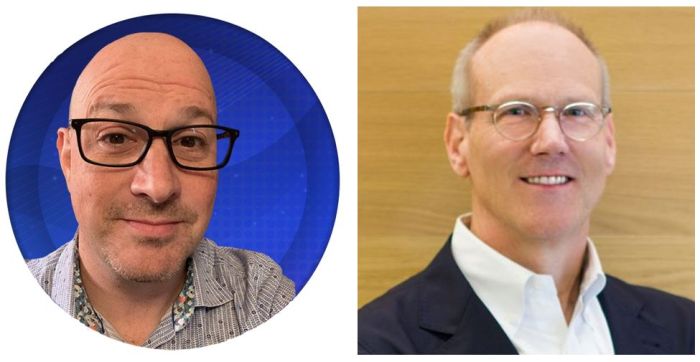
Andrew Kertesz (l) and Steven Feuling (r) – formerly Mojo and Styfy Linden, both of whom departed Linden Lab earlier in 2024.
Update: March 10th, 2024: The management team list is back up on the corporate About page.
In 2021 and 2022, Linden Lab made two fairly high-profile – in terms of the company’s management team – hirings; both of whom recently departed the company within the same time frame.
To take them in order of joining the company, Andrew Kertesz, a 20-year veteran of the gaming industry, arrived at the Lab as the new VP of Engineering in July 2021 to replace Scott Lawrence (Oz Linden). In doing so, he took the name Mojo Linden.
It is not unreasonable to say his impact was immediate and positive. Openly engaging with user through the various user groups – notably the Content Creation User Group (CCUG) and Third Party Viewer Developer (TPVD) meetings, as well as popping up from time-to-time at Simulator User Groups.
Three of his major user-facing contributions to the platform comprised a push to overhaul and improve the viewer’s performance; encouraging the adoption of industry-recognised standards (the Khronos glTF 2.0 specification); and pausing the development of the Lab’s efforts to develop an initially limited (“chat centric”) mobile app, in order to determine if a more comprehensive mobile solution might be developed (what we now know as SL Mobile). He was also keen to eliminate much of the platform’s technical debt – such as moving the simulator code to 64-bit architecture and to try to leverage technical options that hadn’t actually been around when SL first opened its doors.
The other hiring was that of Steven Feuling, who joined the company in May 2022 as Linden Lab’s first ever Chief Marketing Officer (CMO), alongside of Peter Capraro, who became the company’s first Chief Information Security Officer (CISO).
Taking the name Styfy Linden, a major part of Mr. Fueling’s focus was, according to Business Insider, to help Second Life to start to expand its user-base once more. In this he worked closely with Brett Linden, the Lab’s VP of Marketing. He also saw his role not only in marketing and promoting Second Life within market sectors relevant to the platform (e.g. the content creation sector) to b ring new users in, but also in trying to both enhance the events-driven appeal of SL through partnerships with external organisations and through direct engagement with existing users to encourage their ongoing retention.
Styfy certainly wasn’t as much a “public” figure as Mojo in terms of user visibility – he did appear in a Lab Gab session for 2022’s SL20B celebrations (which I summarised here); however, his influence – alongside of that from Brett – would seem to have been key in the formulation of projects such as the Motown Experience and Welcome Hub.
While the Lab may have something of a bumpy reputation as an employer in some quarters, it is true that a lot of the staff there – particularly among the management team and who are directly responsible for the platform’s operation and services – tend to be with the company for years at a stretch. As such, I was particularly surprised to find Mojo Linden was no longer listed as part of the company’s management team, and nor was Styfy.
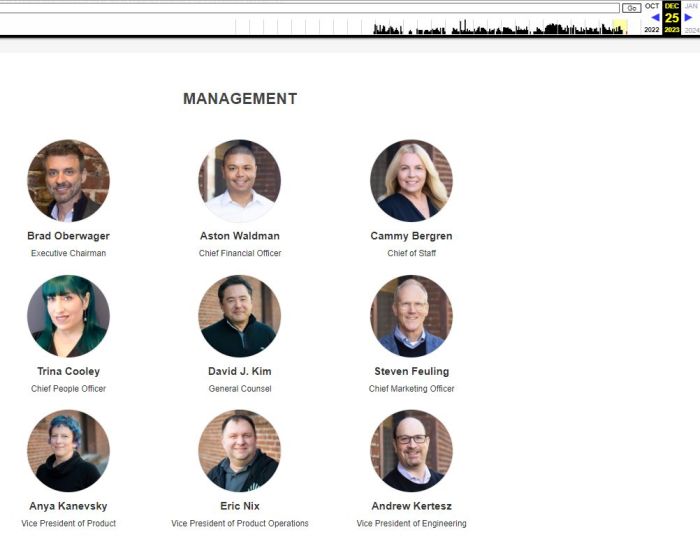
Linden Lab Management Team, as listed on the company’s About page in December 2023 (via the Wayback Machine)
Admittedly, it took a big of digging to find this out; some time between January 15th, 2024 and now, information on the Lab’s board and management team has been removed from the company’s About page (or at least, that’s been the case while I’ve been poking at things over the last couple of days; maybe there’s just been a bit of a SNAFU and said information will reappear).
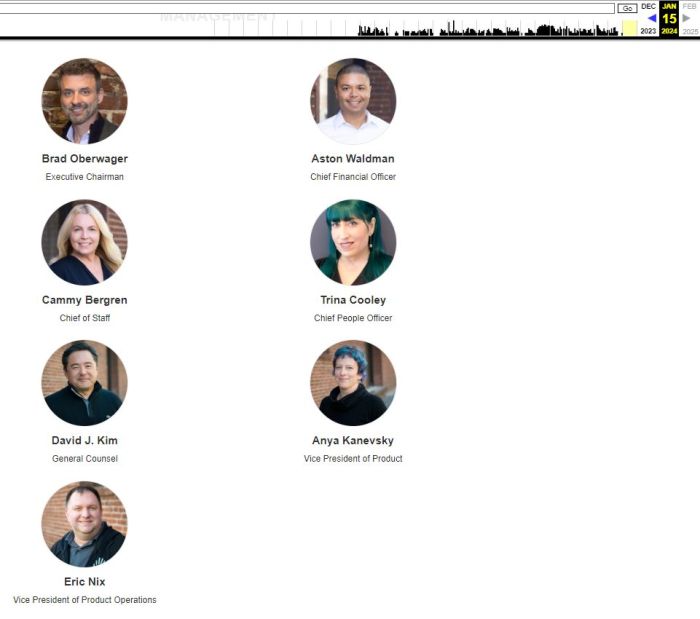
Anyway, using the Wayback Machine, I was able to confirm that both Mr. Kertesz and Mr. Feuling were listed as a part of the management team on December 25th, 2023, but by January 15th, 2024 their names had been removed. On discovering this, I ran a check on their in-world Linden accounts, and both have been deactivated (as is the company’s policy when personnel depart).
If I’m honest, I had wondered as to Mojo’s whereabouts a couple of times of late; his absence from the CCUG meetings had become sufficient enough for me to notice (he was by no means at every meeting, but had a habit of dropping in perhaps once and month – or close to that). However, I just assumed he was focused on other projects, and its not as if his departure has caused the wheels he helped set in motion seize up.
Linden Lab Management Team, as listed on the company’s About page, January 15th, 2024 (via the Wayback Machine)
Obviously, people and roles do not always work out; the CMO role at the Lab was brand new to the company, and it is possible that given LL’s size, it became recognised as a square peg / round hole situation. Similarly, leading figures within organisations can be poached away / become tempted by opportunities they spot elsewhere. As such, the departure of two senior staff from the Lab in what appears to be fairly close order might be coincidence more than a sign of Something Going On, even if finding out did cause an eyebrow to do a Spock.
Certainly, I’m not going to speculate on the ins and outs because I don’t want to feed into any conspiracy theories that might be doing the rounds (in relation to this or anything else). It will be interesting to see – if possible, assuming the management team info doesn’t reappear on the corporate website – if either post (particularly that of VP of Engineering) gains a new face (again, assuming there has not been any internal promotion to the position in the interim).
Instead, I’ll simply wish both gentlemen well in their respective futures, and also thank Mojo (should he ever read this!) for taking the time to engage with users and in responding to nagging enquiries from the likes of myself.





 Inara Pey: Living in a Modemworld